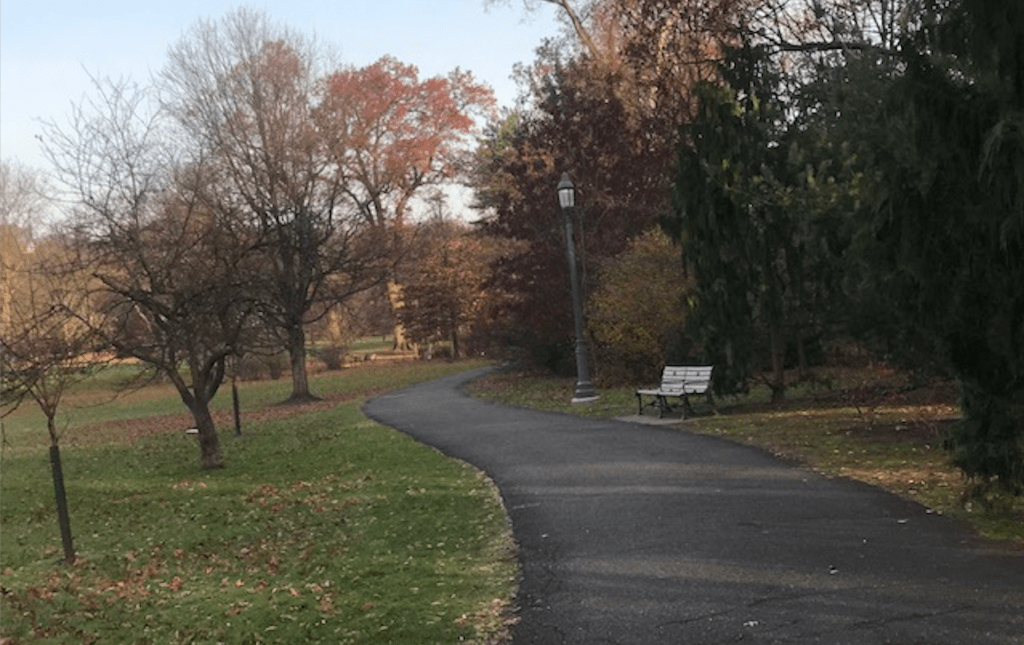
A photo I took this past Friday during a walk in a local park.
As someone who takes a long stroll almost every day, I like to see walking in literature.
Of course, memorable walks in fiction are usually not just for relaxation or exercise. They need to have some drama attached — whether positive drama, such as when romantic couples amble along, or mixed or negative drama like much of the rest of this blog post will show.
So, let’s begin trekking down the path of examples…
The first novel that came to mind was Walter Scott’s The Heart of Mid-Lothian (1818). In it, working-class protagonist Jeanie Deans trudges about 400 miles/644 kilometers from Edinburgh to London to seek a royal pardon sparing her sister Effie from a death sentence. It’s my favorite of Scott’s many great novels.
As I stay with 19th-century literature for a minute, I’ll mention that memorable walks can occasionally occur indoors, too. One of the most vivid parts of Emile Zola’s 1877 novel The Drinking Den (L’Assommoir) is when Gervaise and Coupeau and their wedding party trudge through the Louvre — a joyful, tense, chaotic scene that presages a union that will be happy and then disastrous.
Walking is also involved in escapes (as is running). I thought of Harriet Beecher Stowe’s 1852 classic Uncle Tom’s Cabin, in which Eliza frantically tries to flee slavery on foot with her young son in her arms. Also, Louis L’Amour’s 1987 novel Last of the Breed has Native-American protagonist Joseph Makatozi make a break from Soviet imprisonment and then walk hundreds of miles across Siberia trying to elude his would-be captors.
In Jean M. Auel’s The Plains of Passage (1990), the fourth installment of the Earth’s Children series that began with The Clan of the Cave Bear, prehistoric couple Ayla and Jondalar hike the enormous distance from what is now Ukraine to what is now France.
There’s also lots of wearisome walking during the epic journey of the “good guy” characters in J.R.R. Tolkien’s The Lord of the Rings (1954) — as there is with the father and son in Cormac McCarthy’s post-apocalyptic The Road (2006).
I haven’t read The Long Walk (1979) by Stephen King or The Unlikely Pilgrimage of Harold Fry by Rachel Joyce (2012), but know each novel has much moving of feet.
Animals in fiction can tread huge distances, too, as exemplified by Luath and Bodger the dogs and Tao the cat traveling approximately 300 miles/483 kilometers through the Canadian wilderness to try to return home in Sheila Burnford’s 1961 novel The Incredible Journey.
I’ll conclude with Nicholas Sparks’ A Walk to Remember, which the title of this blog post referenced. If I’m remembering correctly, the title of that moving 1999 novel refers to a wedding-day walk down the aisle of young characters Landon and the terminally ill (?) Jamie. Not a long walk, but a very important one.
Thoughts about, and examples of, this topic? And a relevant video:
My literary-trivia book is described and can be purchased here: Fascinating Facts About Famous Fiction Authors and the Greatest Novels of All Time.
In addition to this weekly blog, I write the 2003-started/award-winning “Montclairvoyant” topical-humor column every Thursday for Montclair Local. The latest piece — about being the parent of a student athlete — is here.
 Dave Astor on Literature
What a delightful exploration of walks in literature! Your examples span a wide range of genres and eras, highlighting how walks in fiction often carry more weight than mere movement. From Jeanie Deans’ formidable journey in ‘The Heart of Mid-Lothian’ to the epic treks in ‘The Lord of the Rings’, each example encapsulates a unique blend of character development and narrative progression. It’s fascinating to see how such a simple act can be woven into pivotal story moments. Thanks for sharing these memorable literary walks!
LikeLiked by 1 person
Thank you very much, Shayan! I particularly enjoyed these lines of yours: “…each example encapsulates a unique blend of character development and narrative progression. It’s fascinating to see how such a simple act can be woven into pivotal story moments.”
LikeLiked by 1 person
I don’t have a great knowledge of walks in literature, but Charles Dickens I know got much inspiration for his work from his long and legendary walks.
LikeLiked by 1 person
Thank you, lyndhurstlaura! Walking can definitely be a spur for ideas and writing inspiration. (Works for me. 🙂 )
LikeLiked by 1 person
I love anything to do with books and would be thrilled if you’d write a guest blog post about your writing for my site! If you think it might be fun or helpful to have my followers meet you, here’s the link for general guidelines: https://wp.me/p6OZAy-1eQ – da-AL
LikeLiked by 2 people
Thank you very much for the kind offer, da-AL! Greatly appreciated. 🙂 But, unfortunately, I’m just too busy with my writing and other things to do this.
LikeLiked by 1 person
Much appreciate your taking the time to reply. Hope you’re busy with good things. The offer is always open
LikeLiked by 1 person
Thanks so much! 🙂
LikeLike
I’ve known writers who swear by walking for inspiration.
LikeLiked by 2 people
Thank you, Ana! I can totally see that. I also know writers who get ideas while walking, and it works for me, too. 🙂
LikeLiked by 1 person
Some say it takes us back to the womb ~ also the principle behind the rocking chair and the rocking cradle.
LikeLiked by 1 person
Walks can indeed be quite soothing — mentally and physically.
LikeLiked by 1 person
👍
LikeLiked by 1 person
🙂
LikeLiked by 1 person
And when a book is written about the race for the 2024 GOP presidential nomination it’ll be about a bunch of people who aren’t running so much as walking. And about one who just lies there.
LikeLiked by 2 people
I wrote that reply, Dave. Bill Tammeus. Not sure why it didn’t post my name.
LikeLiked by 2 people
Thank you, Bill! Well said! Indeed a mostly pathetic bunch of Republican
“contenders.” And, yes, the “one who just lies there” is quite a liar.
LikeLike
Finally getting some time here to come back and say great post. Unusual topic too, so well done there. I’ll bung Kindapped into the mix. Well it has to have involved walking or we wouldn’t have the Stevenson Trail here based on the book. I’ve quite a few times enjoyed the walk to James of the Glen’s–who was hung for the murder of Colin Campbell– birthplace, now the Duror Bothy. . Another book I’ve read involving walking is ‘The Heirs of the Kingdom by Zoe Oldnbourg about one the crusades –a hell of a walk for those who went.
LikeLiked by 2 people
Thank you, Shehanne, for the kind words and the interesting examples of this theme! Yes, when one goes back to pre-1900 and centuries before that, chances are there’s more walking — in literature and in real life. Having a car during the Crusades would have been an issue with no gas stations…
Didn’t know there was a Stevenson Trail — great!
LikeLiked by 1 person
Yes It is I came across it one of the times I was looking for things we hadn’t done in Glencoe. A lot of it is based on Kidnapped, on Breck and Davie’s hiding in that area. https://www.stevensonway.org.uk/
LikeLiked by 1 person
Wow! Looks like a long, beautiful walk. Thanks for the link!
LikeLiked by 1 person
I was just looking for the bits by Glencoe. And like that we had quietly done them already BUT what I liked when I looked beyond that was it was not over subscribed like the West Highland way.
LikeLiked by 1 person
Sounds like the trail is really well created!
LikeLiked by 1 person
I know, The West Highland Way often runs alongside or near to a road except when you hit Bridge of Orchy and then apart from crossing the A82 just before the Devil’s Staircase and then along behind the Nevis Range of mountains. But this seems to me far more ‘remote,’ and away from it all. But it does get much less attention.
LikeLiked by 1 person
Thank you for that interesting information, Shehanne! Makes me want to walk there. 🙂
LikeLiked by 1 person
If you like unspoilt wilderness, miles and miles of it to yourself then yes. It is for the soul quite frankly.
LikeLiked by 1 person
Unspoiled wilderness is such a wonderful rarity! 🙂
LikeLiked by 1 person
I know but there truly is quite a bit of there
LikeLiked by 1 person
Nice to hear!
LikeLiked by 1 person
we’re choosy where we walk !
LikeLiked by 1 person
Ha! 😂 And why not? 🙂 A good thing…
LikeLiked by 1 person
Oh yeah. I can’t stand doing hills in what amounts to queues.
LikeLiked by 1 person
A less “peopled” walk can be very appealing!
LikeLiked by 1 person
What a lovely moment of nostalgic pleasure you gave me, Dave, by mentioning THE INCREDIBLE JOURNEY, about two dogs and a cat that travel through the wilderness to get home. I read that book as a child, and it made a powerful impression on me–I’ve never forgotten it. The writer somehow makes the animals into “real” characters without succumbing to cuteness. Just writing about it now makes me want to read it again!
LikeLiked by 3 people
Thank you, Kim! Glad my post evoked fond memories of “The Incredible Journey” for you. 🙂 I also loved that book — and the movie version was pretty good, too. Yes, the animal trio seemed very real, and not overly cutesy.
LikeLiked by 1 person
Ah, walking in novels, a great topic. There is plenty of walking in Jane Eyre when she runs away from Rochester. The Stand also contains a lot of walking as flu survivors first find Mother Abigail and then go to Boulder. The Road is also all about walking. Henry walks in The Red badge of Courage, one in the wrong direction 😉. Paul carries Kat across the combat zone in an attempt to save his life in All Quiet on the Western Front.
LikeLiked by 2 people
I am David also involves a lot of walking. Davis starts from a concentration camp in Eastern Europe and ends in Denmark.
LikeLiked by 2 people
Thank you, Robbie, for all those great and varied examples of walking in literature! Yes, apocalyptic-type novels usually require the characters to do plenty of walking in order to possibly survive. Also the case in Mary Shelley’s “The Last Man,” Octavia E. Butler’s “Parable of the Sower,” etc. And of course pre-20th-century novels like “The Last Man,” “Jane Eyre,” and “The Red Badge of Courage” often have plenty of walking because of fewer transportation options in the pre-car, pre-plane era.
LikeLiked by 2 people
Yes, that is exactly right. The Road has been on my mind recently. Such a powerful and shocking story.
LikeLiked by 2 people
Cormac McCarthy could be VERY compelling in his novels.
LikeLiked by 1 person
I’ve only just finished “The Stand”. Can’t believe I didn’t think of it! People spread all over the country and lots of car jams meant lots and lots and lots of walking. Not to mention the final showdown when Stu and his gang walk from Boulder to Las Vegas.
LikeLiked by 2 people
The post-apocalyptic “The Stand” had it all — including all that walking.
LikeLiked by 1 person
“There was no possibility of taking a walk that day…” those 19th century ladies LOVED their walking. If I remember right, in “Pride and Prejudice” they do laps inside a room, maybe because the weather was a bit “Jane Eyre” or maybe because they had nothing else to do. I’m so glad we invented video games!
When you mentioned drama filled walks, I thought of Stephen King who was hit by a van while out on a walk. I don’t know too much about the real life details of it, but he wrote the same story into the last volume of “The Dark Tower” series, and I believe the fiction version has a lot in common with the real life version. A pretty harrowing fiction read; I can’t imagine how frightening it must have been for the king of horror.
Thinking of Stephen King, the next thought was obviously going to be “The Long Walk” which I see you’ve mentioned, but have not read. I first read it when I was about fifteen and have read it multiple times since then. Each time I’m just as shocked by where the story goes. I highly recommend it.
P.S. I promise I started drafting this before Anonymous mentioned “Jane Eyre”. I’ve gotta learn to hit that send button a lot quicker!
LikeLiked by 3 people
The Long Walk is one of my favourite King books too
LikeLiked by 2 people
Thank you, Sue and Robbie! I looked for “The Long Walk” during a library visit this past Sunday and it wasn’t there. 😦 Maybe next time…
That was a horrendous accident Stephen King was in in 1999. 😦
And, yes, plenty of walking in “Jane Eyre,” “Pride and Prejudice,” etc. Ha! 🙂 I would have loved to see Jane Austen’s characters play video games. “Pride and Tetris”? “Minecraft Park”? “Grand Theft Auto Abbey”?
LikeLiked by 2 people
Oh, Dave, you are so funny! The Long Walk could be packaged with other Richard Bachman books so check if there is a combo version.
LikeLiked by 3 people
Thank you very much, Robbie!
Excellent advice. Will look for “The Long Walk” in the “B” rather than the “K” shelves next time. 🙂
LikeLiked by 2 people
I always love your puns and word play, Dave 🙂 Just to add to what Robbie said, you may find it in a collection called “The Bachman Books” which used to be four novellas, but is now printed with three due to the fact that one of them was all about shooting up a school. I hope you find it. “The Long Walk” will stay with you for a long time.
Sue
LikeLiked by 2 people
Thank you, Sue, for the kind words and that advice!
LikeLiked by 1 person
Oh, Dave! I can’t believe you failed to mention Jane Eyre’s eventful walk when she left Thornfield Hall and her beloved Mr. Rochester!
LikeLiked by 4 people
Yikes! A big omission on my part, especially considering that “Jane Eyre” is my favorite novel. Thank you, Anonymous!
LikeLiked by 2 people
Haha, I caught that one too 🌟
LikeLiked by 2 people
🙂
LikeLiked by 2 people
Ah yes walking in fiction is a great setting for some drama to come – either positive or negative. A Walk To Remember is a lovely example of memorable walks in pop literature. It makes a great tool for writers to create some tension or help move the story along.
LikeLiked by 3 people
Thank you, Sara! I agree that walks of various kinds can be a great tool in novels.
I also agree that “A Walk to Remember” — though sentimental and very “mass-market” — was a lovely novel (and movie).
LikeLiked by 2 people
Yes it definitely is a nice story. 😊 Sad, but impactful and heart warming.
LikeLiked by 2 people
That describes it exactly!
LikeLiked by 2 people
I cried the first time I watched the movie. Found it incredibly romantic. The second time I found it even sadder, but just as epic.
LikeLiked by 2 people
The story is indeed both romantic and heartbreaking. (And one of those instances where the movie was as good as the book.)
LikeLiked by 2 people
Yes very true! ❤️
LikeLiked by 2 people
🙂
LikeLiked by 1 person
😊😊😊
LikeLiked by 2 people
“But there’s been no contact with an Electoral College coach, because even former pitchers usually don’t become underhanded politicians.” 😂🤣
LikeLiked by 4 people
Thank you very much, Resa! Glad you liked that ending to my latest humor column. 🙂
LikeLiked by 3 people
Funny and not at the same time. Well done!
LikeLiked by 3 people
Much appreciated, Resa! 🙂
LikeLiked by 3 people
Okay… so for some reason what popped into mind was “Fear and Loathing in Las Vegas”. Yes, it’s a road trip, but then they get to Vegas.
I walked inside a/the casino with them.
It’s been a long time since I read the book, and I’ve never seen the movie.
Most memorable is walking around the casino. I never felt so crazy and stoned and dizzy in all my wild years (now a memory).
I barely remember the book, but I’m still spinning from walking in the casino.
At the end of “We the Living” – Ayn Rand – Kira tries to make one last escape to escape from Russia, by walking though a remote part of Russia across open border. It’s in the winter, in the deep & blowing snow.
Her last stop before the border, she is taken in by peasants. The wife gives Kira her white wedding dress to wear as camouflage. It’s an absolutely gruelling walk!
Recommended to anyone who needs to understand what authoritarian governments/dictatorships are like/can lead to. That would be many, so it seems, these days.
LikeLiked by 4 people
I appreciate seeing those two excellent examples you vividly described, Resa!
The first part of your comment brought back memories of covering a political cartoonists’ convention in Las Vegas about 25 years ago. It was at Caesar’s Palace, and I had to take a long, disorienting walk through a casino area to get from the hotel-check-in desk to an elevator that went up to my room. Ugh.
If Trump wins next year, we’ll get quite an uptick in authoritarianism in the U.S. 😦
LikeLiked by 2 people
Omg, Caesar’s Palce IS disorienting.
Haha! It doesn’t matter where you go in the Las Vegas hotels, you will have to walk through the casino. Of course they want to disorient you. Then you’ll have to sit down at a slot machine (no where else to sit) to gain composure.
I gotta say, from my Canadian armchair, EEEK! and ask – Are so many so blind?
I’ve already said to several friends – if trump wins we will see an exodus into Canada like we can’t imagine. It will begin with all the people he plans to put into”camps”.
LikeLiked by 2 people
“Then you’ll have to sit down at a slot machine (nowhere else to sit) to gain composure” — funny and sad line by you. Yes, Resa, it’s all about being steered toward gambling. Fortunately, I resisted. 🙂
A Trump win would indeed evoke a “what were people thinking” response and plenty of desire to move to Canada on the part of many Americans. That might be the time for me to buy Geddy Lee’s memoir…in a Toronto bookstore.
LikeLiked by 2 people
Ah, I see a possible business boom up here!
Are you thinking of reading his memoir?
LikeLiked by 2 people
I read very few nonfiction books these days, but that’s one I might get to eventually. 🙂 How about you?
LikeLiked by 2 people
I could read Geddy’s memoir. I love non fiction. I have to avoid citing one on many of your posts. However, you might recall that I can’t control myself every once in awhile.
I’m tempted to read Liz Cheney’s new book.
LikeLiked by 2 people
Liz Cheney’s book is appealing to me, too, Resa. She remains right-wing, but did have the guts to take an anti-Trump stand for integrity. One of a VERY few Republicans with some ethics.
I’d love to read more nonfiction books, like I used to, but it’s hard to find time to read enough novels to feed this blog. 🙂
LikeLiked by 2 people
I do admire LC’s stand for democracy and her non fear of trump.
Hmmm, well perhaps you could do 1 post every blue moon on when non fiction reads like fiction?
“Red Notice” by Bill Browder is in that category. When I read it it I kept checking…this is non fiction….right?
In the meantime, you’ll just have to keep eating books for breakfast!
LikeLiked by 2 people
Resa, I did once write a post about nonfiction that reads like fiction (I think before I started this blog), but couldn’t find a link during a web search I just did. Oh well…
I love when nonfiction is that compelling.
Breakfast? Usually oatmeal. Unfortunately, the first line of “Moby-Dick” wasn’t “Call me Oatmeal.”
LikeLiked by 2 people
….or call me bookmeal!
LikeLiked by 2 people
Ha ha! 😂
LikeLiked by 2 people
😂
LikeLiked by 2 people
🙂
LikeLiked by 2 people
Your last comment is spot on Resa and it is scary to watch it all unfolding. Especially, when you know as much about the histories of wars as I do 😩
LikeLiked by 3 people
Thanks Robbie! It is scary. War is beyond horrid.
I’m all for the slogan “make art not war”.
However, the chain is only as strong as the weakest link.
Therefore, in terms of world peace, the weakest links being: autocrats, dictators, terrorists (religious and otherwise), war mongers, cartels, ignorance etc. – they all need to go to art school.
Problem is, how to get them to go?
Exactly!
Facetious? Yes, in hoping to make the point that we as individuals must be vigilant in exercising intellect. The arts is one way to do that.
(Hey Dave, look what your walk topic is bringing out!)
LikeLiked by 3 people
Resa, I love when topics lead to tangents. 🙂
Yes! More art, please. Though most autocrat types are not interested. Trump did have “The Art of the Deal” book ghostwritten for him, but…
LikeLiked by 2 people
Exactly!
trump’s book should have been “the Art of the Steal”.
Did I ever mention my humility in the fact that I did costumes for an ABC network movie of the week about trump?
It was early 2000’s and ended with someone pitching him on “The Apprentice”.
I knew nothing about him, at that point. I did a massive amount of research.
I learned enough to know that when he came down the elevator in 2015, he could win.
LikeLiked by 2 people
“The Art of the Steal” — exactly, Resa!
Trump was always a racist/sexist/money-grubbing jerk, but his politics weren’t quite as right-wing back in the day when you had that indirect connection you mentioned. Trump saw the opportunity, and adjusted his ideology like putting on a new set of clothes.
LikeLiked by 2 people
… like a true narcissistic psycho pathological liar.
LikeLiked by 2 people
Well said, Resa! That’s him in a nutshell!
LikeLiked by 1 person
Hi Resa, your comment is most interesting as most creatives of all sorts are liberals and pacifists. Perhaps it is because we find our joy and happiness in the beauty around us and in the pleasure of the written word. Most creatives are not power or money hungry, we are driven by our ‘art’ and not be consumerism and material gratification. This is my favourite quote (in inverted commas because it is very tragic) “I am young, I am twenty years old; yet I know nothing of life but despair, death, fear, and fatuous superficiality cast over an abyss of sorrow. I see how peoples are set against one another, and in silence, unknowingly, foolishly, obediently, innocently slay one another.”
From All Quiet on the Western Front by Erich Maria Remarque
LikeLiked by 4 people
Agree about creatives.
That is one great quote. I checked and it’s 100 years old. It holds true today, as young people from Eastern Europe to the Middle East to parts of Africa, to S. America, Central America, and places in between are engulfed in war, or plagued by warring factions.
What a world!
LikeLiked by 3 people
While I’ve only read one of the books you’ve mentioned, I can think of several works of fiction–names long forgotten–in which an event during a walk plays an important role or turning point in novels of all genres. Characters disappear after going for a walk; others are murdered along the way; some meet the love of their life. Then, there’s the encounter with an alien aircraft or an angel. You’re on to something, Dave 😀
LikeLiked by 3 people
Thank you, Rosaliene, for listing all those compelling dramatic things that can occur on a walk! Reminds me (if I’m remembering correctly) that the protagonist in Erich Maria Remarque’s “Arch of Triumph” met a woman while walking in the beginning of that great novel; their romantic relationship would become a key story line.
LikeLiked by 2 people
Going forward, I’ll be looking out for such scenes in novels 🙂
LikeLiked by 2 people
I know what you mean, Rosaliene! I think I’ll be more conscious of walks in fiction, too. 🙂
LikeLiked by 2 people
Such an interesting topic, and I’ve enjoyed reading the comments!
LikeLiked by 3 people
Thank you very much, Becky! I’ve been greatly enjoying the comments, too. 🙂
LikeLiked by 2 people
Many thanks, Dave, for your very interesting topic and book proposals, which made me immediately think of walking or hiking in the countryside and in this context to Tess of the D’Urberville and her pure countryside, which was modernized by technical progress and the poor farmers, who also had to walk a lot, were turned away and lost their work consequently.
LikeLiked by 4 people
Thank you, Martina! Very glad you (poignantly) mentioned “Tess of the d’Urbervilles.” Yes, novels with rural/farm settings will usually have plenty of walking. A shame so much of farming has become “big business,” with all the negatives that includes.
LikeLiked by 2 people
🌾🐂🤣
LikeLiked by 2 people
🙂
LikeLiked by 1 person
Hi Martina, Tess of the D’Urbervilles is a great mention. I love that book 💗
LikeLiked by 3 people
This is really good to hear, Roberta💖
LikeLiked by 3 people
‘The Long Walk to Freedom’ by Nelson Mandela was a big one for me.
I also enjoyed the video for the great U2 – I was young then too!
By the way, I have started to read your book, Dave😉
LikeLiked by 4 people
Thank you, Chris! I appreciate you mentioning the great Nelson Mandela and his book. So few really admirable leaders during the latter 20th century through today; Mandela was one of them.
I love that U2 video, too! From around the year 2000, I think.
And…thank you very much for reading my book! 🙂
LikeLiked by 1 person
A nice mention, Chris 💕
LikeLiked by 3 people
There is nothing like a good music Dave..
LikeLiked by 4 people
Thank you, Bebe! I had been considering that great song as a “Walk” tune to include with this post. 🙂
LikeLiked by 2 people
Dave…finished the Grisham`s latest….” The Exchange”, this time of political unrest, wars, buildings being destroyed, folks are starving everywhere…in the World..
The book was too nerve racking for me. In between I skipped 50 some pages…can`t inagine Mr. Tom acting to this one again…..
LikeLiked by 2 people
John Grisham can be VERY intense in a number of his novels, Bebe, as you know. Sounds like he packed a lot of fraught subjects into “The Exchange.”
LikeLiked by 2 people
As always your information is very interesting and the song you shared is wonderful🌹
LikeLiked by 4 people
Thank you very much, Luisa! 🙂 One of U2’s best songs, I think. 🙂
LikeLiked by 2 people
🙏❣️🙏❣️🙏
LikeLiked by 2 people
🙂
LikeLiked by 2 people
“Travels With Charlie ” by John Steinbeck, on my reading list. 🐶
From Michele E&P, way back
LikeLiked by 4 people
Thank you, Michele! As I recall, there was indeed some walking among the cross-country driving in that Steinbeck nonfiction book. The dog certainly needed to be walked. 🙂
LikeLiked by 2 people
Susi anon here, ha. A brief mention of Tom Sleigh’s book, Space Walk which is a collection of poems. Sorry, I’ve been watching a lot of old episodes of Outer Limits, and that along with your theme reminded me of the space walk on the moon, and Neil Armstrong’s quote “…one small step for mankind…”. Of course, those are different walks altogether as is the following https://youtu.be/IFd97LojySM?si=RgCvW5z_kj-fCcWY.
LikeLiked by 4 people
Thank you, Susi!
Yes, a certain amount of walking at different gravity levels in space and sci-fi. Reminds me of Ray Bradbury’s “A Sound of Thunder” story about the timeline-changing impact of some clumsy, off-the-path walking.
“Walking My Cat Named Dog” — love it! 🙂
LikeLiked by 2 people
I can highly recommend The Unlikely Pilgramage of Harold Fry as a very enjoyable novel. The work that immediately came to mind when I read your question is Chekhov’s short story “The Lady with the Dog.” The novels that involve walking I can think of off the top of my head are John Fowles’ The French Lieutenant’s Woman, Tim O’Brien’s Going after Cacciato, James Fenimore Cooper ‘s The Last of the Mohicans, and Thomas Hardy’s Tess of the D’Ubervilles.
LikeLiked by 4 people
Thank you, Liz, for the many excellent examples! “The Unlikely Pilgrimage of Harold Fry” has been on my to-read list for a while, and I hope to get to it. And, yes, much walking in “The Last of the Mohicans” and in several of James Fenimore Cooper’s other “Leatherstocking” novels.
LikeLiked by 3 people
You’re welcome, Dave.
LikeLiked by 3 people
🙂
LikeLiked by 3 people
Some really varied facts. A lot of walking!
LikeLiked by 4 people
Thank you, Anonymous! Yes and yes, I guess. 🙂
LikeLiked by 2 people
I know we’re much more familiar with the single movie, but I think there were several books in the “OZ” series. The first book, The Wonderful Wizard of Oz, by L. Frank Baum certainly involves a long walk. I’d also point out that the first attempt at making a movie from that story is also interesting.
LikeLiked by 6 people
Thank you, Dan! Great mention! I’ve read “The Wonderful Wizard of Oz,” and should have remembered to include it in my post. 🙂 I liked “The Wizard of Oz” movie better, but the 1900 book was quite good.
LikeLiked by 4 people
There’s a movie that was made in 1910 (Silent) available on YouTube. I do prefer the movie we’re all familiar with, but it was interesting to watch the silent version
LikeLiked by 3 people
Many years ago, I saw a double feature in a Manhattan “revival” theater of the 1939 and silent movie “Wizard” versions, with the latter film probably the one you’re referring to. I remember the Scarecrow as being VERY limber. 🙂
LikeLiked by 3 people
Yes 🙂
LikeLiked by 3 people
🙂
LikeLiked by 3 people
Hi Dan, ah, yes, the yellow brick road. A great mention. Another book I love and I enjoyed the version of the movie featuring Judy Garland.
LikeLiked by 3 people
I do like watching the movie, Robbie. Someone is always showing it this time of year.
LikeLiked by 3 people
I think I’ve watched “The Wizard of Oz” movie at least 10 times in my life, Dan and Robbie — in theaters, on TV, and via DVD. A near-perfect film: exciting, poignant, funny, great acting, great music, great costumes, great set designs…
LikeLiked by 2 people
What a interesting topic, Dave. The first book that came to mind was Jane Austin’s, Pride and Prejudice. Elizabeth seems to love walking and I wondered whether walking was encouraged during the Regency era. I discovered that walking held great significance and was a common mode of transportation for both men and women during this age. It provided a means of getting from point A to point B, especially for those who did not own carriages or horses. Walking was considered a socially acceptable activity for women, as it allowed them to engage in exercise while maintaining their modesty. And as seen throughout the Pride and Prejudice walking allowed the Bennetts an opportunity for social interaction. And, of course, I couldn’t resist a quote.
“I do not wish to avoid the walk. The distance is nothing when one has a motive.”
Jane Austen, Pride and Prejudice
LikeLiked by 7 people
Thank you, Rebecca! Excellent mention of “Pride and Prejudice” and Elizabeth Bennet! Makes sense that walking was a big thing in the early 19th century for all the reasons you mentioned; there were certainly fewer transportation options than today. (I remember reading in a biography of Jane Austen contemporary Walter Scott that the latter author was a big walker despite a bad leg. Or maybe because of a bad leg; the walking helped strengthen it.)
Love the quote! 🙂
LikeLiked by 3 people
Pride and Prejudice was the first book with lots of walking in it that came to mind when I read this post. There was quite a bit of walking across a snow-covered Siberia in Doctor Zhivago. The young boy in I Am David walked great distances to reach his destination. A great topic.
LikeLiked by 5 people
Thank you, Darlene! Three great mentions! Reminded me that there’s also quite a lot of walking in the snow in various other Russian novels; in several Jack London novels (such as “The Call of the Wild” and “White Fang”); etc.!
LikeLiked by 3 people
Ha, I also thought of I am David, Darlene. I enjoy reading other reader’s thoughts and contributions. That being said, if I buy any more ebooks, my kindle might blow up.
LikeLiked by 3 people
Mine too. 😊
LikeLiked by 4 people
“Kindle Overload” is a thing… 🙂 😦
LikeLiked by 2 people
A lovely mention, Rebecca. Do you know The Land of Far Beyond by Enid Blyton. It was a favourite childhood book of mine and also involved a lot of walking. It is based on John Bunyan’s Pilgrim’s Progress which was a long walk too. And, of course, Dante who walks through the nine circles of hell, purgatory and Heaven in Divine Comedy.
LikeLiked by 4 people
Robbie – excellent mentions. The first time I meet Pilgrim’s Progress was when I read the children’s version at 8 years old. I remember thinking that there was a lot of walking happening. I still want to travel with Dante using Dorothy Sayers translation. I loved following your reading.
LikeLiked by 5 people
I liked Dante’s Inferno best. I obviously have a penchant for darker stories.
LikeLiked by 4 people
Another good blog.
I didn’t get quite as far as the London walk when I read The Heart of M L. This is a bit of a stretch, but, can you remember/does it say how long it took ? I’m thinking of Ben Jonson’s walk the other way. I think it him took 60 days.
LikeLiked by 4 people
Thank you, Michael! Unfortunately, I can’t remember how long it took Jeanie Deans to make that marathon walk; I read “The Heart of Mid-Lothian” about 15 years ago. 🙂 But I’m sure it was many, many weeks.
LikeLiked by 3 people