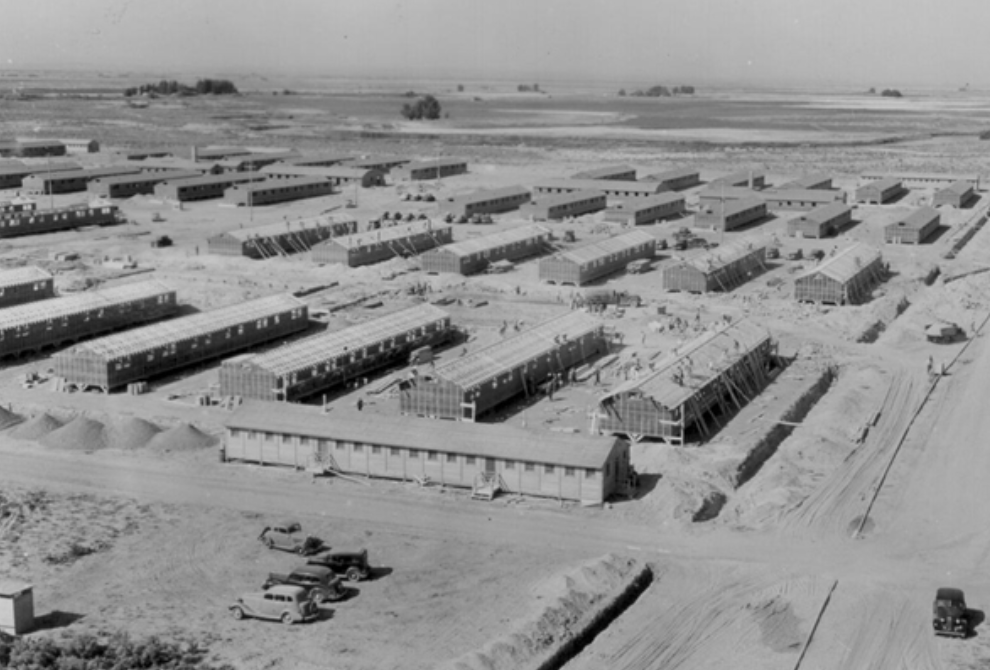
An internment camp in Idaho for Japanese-Americans during World War II.
It’s quite intense when fictional characters who are in love disappear from each other’s lives. So many questions evoked: Why did they get separated? How long will they be apart? Will they ever get back together? If so, how will that come about? If not, why not? All this can make for page-turning, emotionally wrenching novels.
I experienced this again last week when reading Jamie Ford’s heartwarming/heartbreaking 2009 novel Hotel on the Corner of Bitter and Sweet, which focuses on Chinese-American preteen boy Henry Lee and Japanese-American preteen girl Keiko Okabe in the months after they meet in Seattle in 1942. They develop a charming relationship amid anti-Asian prejudice that’s especially virulent against Japanese-Americans at a time when the U.S. and Japan were on opposing sides during World War II.
Then, Keiko and her family are forced to move, along with other innocent Japanese-Americans, to a bleak internment camp in Idaho. She and Henry manage to stay in touch for a while until their relationship is sabotaged (we learn how that happened late in the book) and the two go on to have totally divergent lives with no contact at all. Then Henry, who married someone else, becomes a widower in the mid-1980s. Will he and Keiko find each other again? (During a time when the Internet, and its search-for-people possibilities, was not a general-public thing.)
Through these two characters, author Ford (who is partly of Chinese descent) makes us deeply feel the injustice of what was done to loyal Japanese-American citizens during WWII. And I couldn’t help thinking of the blatant racism that spared most (not all) white German-Americans and white Italian-Americans from also being wrongly put in custody, even though the countries of their ancestry were at war with the U.S., too.
Speaking of white Europeans, we have the English characters Anne Elliot and Captain Frederick Wentworth in Jane Austen’s Persuasion. They’re engaged until things get broken when the young, not-yet-mature Anne is persuaded by interfering family and friends that Wentworth doesn’t have high enough social status. Eight years later, the two meet again. Will things work out this time? My favorite Austen novel.
In Charlotte Bronte’s Jane Eyre classic published three decades later, we have the famous rupturing of the Jane/Edward Rochester relationship. They are subsequently apart for about 10 months (a 10 months in which a LOT happens) until…
A novel written in the 20th century but set in the 19th features an unconsummated “affair” between Newland Archer and the free-spirited Ellen Olenska even as Newland is engaged and then married to the conventional May Welland. This is in Edith Wharton’s memorable The Age of Innocence. After May’s death nearly three decades later, Newland has the chance to see Ellen again. The ending surprised me.
Circling back to World War II, a key relationship in Herman Wouk’s gripping War and Remembrance is between Byron and his Jewish wife Natalie. The two are parted as Byron serves in the U.S. Navy, and further parted when Natalie — through a series of events too complicated to summarize here — ends up in a Nazi concentration camp despite being an American. Will she survive?
Reunions don’t always occur, or, when they do, don’t always result in “happily ever after” endings. While I don’t want to give specific spoilers, not every situation I discussed above concluded as pleasingly as readers might have hoped. But others finished in a more upbeat way.
Examples fitting the theme of this post?
My literary-trivia book is described and can be purchased here: Fascinating Facts About Famous Fiction Authors and the Greatest Novels of All Time.
In addition to this weekly blog, I write the 2003-started/award-winning “Montclairvoyant” topical-humor column every Thursday for Montclair Local. The latest piece — about an unfortunate intra-town lawsuit and a great cat cafe — is here.
 Dave Astor on Literature
I am also in the Persuasion camp. I read War and Remembrance many years ago when I binged on novels with WWII settings and didn’t mind length. I don’t remember a lot about it so should find cliff notes to jar my memory. But considering that I sometimes forget books I read last year that’s not so unexpected. Loved your post!
LikeLiked by 1 person
Thank you, Sascha! 🙂
Nice to hear that “Persuasion” is also a favorite of yours!
“War and Remembrance” is definitely a great book; WWII novels can be depressingly riveting, so I understand how one can binge on them.
And I hear you about forgetting the details of some books, whether read recently or long ago. 🙂
LikeLike
Separations are not easy. Perhaps that is why we want to explore partings within a novel format. Main characters separated for a long duration creates tension and suspense in a storyline. The separation allows for character development and growth, as they navigate challenges and face obstacles on their own. It also adds a sense of anticipation and longing for the characters to reunite. When that coming together does not happen, we experience a deep sense of loss, a bittersweet acceptance that some things are not meant to be. The most moving parting to me was between Frodo and Sam.
“But I have been too deeply hurt, Sam. I tried to save the Shire, and it has been saved, but not for me. It must often be so, Sam, when things are in danger: some one has to give them up, lose them, so that others may keep them….you will read things out of the Red Book, and keep alive the memory of the age that is gone, so that people will remember the Great Danger, and so love their beloved land all the more. And that will keep you as busy and as happy as anyone can be, as long as your part in the Story goes on.”
Perhaps knowing that the story goes on is what gives us the strength to move on – to evolve.
A wonderful post and discussion, Dave!
LikeLiked by 1 person
Thank you, Rebecca! 🙂 Your first paragraph says just about all there is to say about separations. Terrific essay in just a few sentences.
And “The Lord of the Rings” part of your comment was indeed very moving. Tolkien’s classic trilogy definitely had moments of great poignancy amid the riveting adventure, wonderful humor, and more.
LikeLike
Hello Dave,
Another poser that got me thinking, for days.
So, the only novel I could think of was “Gone With the Wind”.
Scarlett, due to war, is not only separated from family, but from Tara. It’s a great tale in terms of break down, separation, rebuilding, reunion.
That also goes for the country, itself.
I know the story has issues with its depictions of slavery, but it is still a valid piece of literature in many ways.
One thing that got me going here, is that my mother-in-law was Japanese Canadian. Although born in Canada, at a young childhood age,
was sent with some of her family to a camp.
Not only was she separated from friends & other family, but from home and life.
There were some reunions after the war, all with varying outcomes, sentiments.
That experience was so powerful that she spoke of it, relived pieces of it on her deathbed, while in a semi-conscious state. That is of course not a book, but it is the art imitating life that some books are made of.
It has effected me.
LikeLiked by 1 person
Thank you, Resa! “Gone With the Wind” definitely fits this topic — and, yes, there are different forms of separation in that novel as well as in real life.
Very, very sorry about what happened to your mother-in-law. Things like that really are outrageous, and deeply traumatic to people — often for life, as you note.
LikeLiked by 1 person
It surely is a crazy world and life. I have been wildly fortunate to have had the luxury of being in the arts. (although skint in my younger days). 🤗
LikeLiked by 1 person
Being in the arts definitely has the potential of making a person feel more satisfied…creative satisfaction.
LikeLiked by 1 person
Agree!
LikeLiked by 1 person
🙂
LikeLiked by 1 person
“Life and Fate”(1959) by Vasily Grossman is a sprawling (896 pages[!]) novel, constructed to be comparable in scope and size to “War and Peace”, that attempts to capture the milieu and events around the Battle of Stalingrad, waged between two totalitarian states, and its aftermath. “Life and Fate”, containing a myriad of storylines and characters,is centered chiefly on the family of Viktor Shrum,a theoretical nuclear physicist.
As it pertains to the week’s theme:
The Shrum family is separated from their apartment in Moscow because they have been evacuated to Kazan. Viktor’s mother is separated from Viktor’s family because Lyudmilla, Viktor’s wife, cannot abide her mother-in-law’s hostility to Tolya, her son by her first marriage.
Tolya is separated from his family by military service, as is Lyudmilla’s sister’s lover, tank commander Novikov, eventually separated from his command by Party hack treachery. Sister Yevghenia, in turn has separated from her husband Krymov, a Political Commisar, who is separated from his position and into prison as a traitor. Viktor is ostracized by his fellows, suspicious of his Jewish ethnicity and some politically incorrect remarks, upon the family’s eventual return to Moscow, and his return to his workplace.
Other characters, other separations: from life itself, as suffered by a Jewish female doctor, Mostovskoy,an old Bolshevik, and the heroes of House 6/1. From humanity: Eichmann, Hitler and Stalin briefly appear.
LikeLiked by 1 person
Thank you, jhNY, for the well-crafted comment! Those are a LOT of interesting separations in what sounds like a pretty impressive novel. Wartime can definitely/tragically yank people apart in all kinds of ways. And the Stalin era and reign of terror — ugh.
LikeLike
Separation, reconciliation, marriage
Katherine Swinford, John of Gaunt, novel, Anya Seton – history
Candide & Cunegonde – even though she’s become ugly.
Forbidden relationship (rank)
Antonia Caenis Vespasian.
The Course of Honour, Lindey Davis.
Separation, reconciliation.
Siblings, not lovers, siblings can love each other
Micah and Mordecai.
Persuasion ? Despite being a set book for English A level, still my favourite Austen too.
LikeLiked by 1 person
Thank you, Esther, for all those examples of the separation theme!
When it comes to 18th-century novels, they don’t get much better than “Candide.” Such a readable book with a LOT of depth. Glad you mentioned it.
And great to see another person whose favorite Austen novel is “Persuasion.” 🙂
LikeLike
Hi again Dave. Something’s been nagging away at me since reading this post, and today I got it. It’s a short story, ‘An Unexpected Reunion’ by 19th-century author Johann Peter Hebel. Here’s a link to an online translation – very moving. Best regards, Laura. https://www.alois-broeder.de/en/Texte/TextUnverhofftesWiedersehen.html
LikeLiked by 1 person
Thank you, Laura! Just read it — yes, really, REALLY poignant and powerful. With that accomplished in very few words.
LikeLiked by 1 person
Yes, the brevity of the piece somehow adds to the poignancy.
LikeLiked by 1 person
I agree!
LikeLiked by 1 person
ETA Hoffmann wrote something similar, titled “The Mines At Falun” in 1819–I’d guess because there must have been a perfectly preserved corpse of a young miner discovered at Falun.
Puts me in mind of Stendhal’s theory of crystallization, based on his observation:
(from wikipedia)
In the summer of 1818 Stendhal took a trip to the salt mines of Hallein near Salzburg with his friend and associate Madame Gherardi. Here they discovered the phenomenon of salt “crystallization” and used it as a metaphor for human relationships.
“In the salt mines, nearing the end of the winter season, the miners will throw a leafless wintry bough into one of the abandoned workings. Two or three months later, through the effects of the waters saturated with salt which soak the bough and then let it dry as they recede, the miners find it covered with a shining deposit of crystals. The tiniest twigs no bigger than a tom-tit’s claw are encrusted with an infinity of little crystals scintillating and dazzling. The original little bough is no longer recognizable; it has become a child’s plaything very pretty to see. When the sun is shining and the air is perfectly dry the miners of Hallein seize the opportunity of offering these diamond-studded boughs to travellers preparing to go down to the mine.”
LikeLiked by 1 person
Fascinating, jhNY!
LikeLike
That’s wonderful, and obviously of great interest at the time, so much so that at least two writers chose to weave stories around it.
LikeLiked by 1 person
Thanks for writing about Hebel– I knew nothing about him, and now, at least,I know: Hebel’s tale was first. I will be on the lookout for “The Treasure Chest”– which, as I have no German, I hope is the title in English of his collection of tales.
LikeLiked by 1 person
Hi Dave, the first book that comes to mind for this theme is Gone with the Wind. Lots of ill fated separations in that book including Rhett’s final separation from Scarlett at the end. Great Expectation also has separations that have big impacts on Pip, the convict, and all other parties in the book. There is a separation in Tess of the d’Urbervilles after Angel rejects Tess. I need to think on this further.
LikeLiked by 1 person
Thank you, Robbie! Three very relevant titles (all classic novels in their way) exemplifying this theme!
The American Civil War that was so central to “Gone With the Wind” was also the “setting” for some other separation novels, including “Cold Mountain” and “March” — the latter Gwendolyn Brooks’ take on the father in “Little Women” being away from his wife and four daughters.
LikeLike
I have read about Marsh. Did you enjoy it?
LikeLiked by 1 person
I did like “March,” Robbie. Very imaginative and harrowing.
LikeLike
That’s good to know, Dave.
LikeLiked by 1 person
🙂
LikeLike
I suppose Interview with a Vampire is also about separation in its different way. Louie is separated from his family and friends through the act of becoming a vampire. He is endlessly seeking what he’s lost.
LikeLiked by 1 person
Great mention, Robbie! I haven’t read that Anne Rice novel, but did read her excellent “The Witching Hour” — which also had some separation stuff.
LikeLike
HI Dave, this is the first Anne Rice book I’ve read. I’ve made a note of the one you’ve mentioned here. Thank you.
LikeLiked by 1 person
“The Witching Hour” is quite long — almost 1,000 pages in the edition I had. Could have stood to lose 200-300 of those pages, but overall a lot of great moments. Not sure I’ll read more Anne Rice, but, if I do, it would be “Interview with a Vampire.” 🙂
LikeLike
Thanks, Dave. One of my brothers-in-law was born in an internment camp for the Japanese. Creation of those camps was one of the lowest points in the conduct of America’s government. I just saw this brother-in-law, Gary, with his wife, my sister Mary, and one of their kids, Doug, this past Saturday at my uncle’s funeral in Illinois. So Gary is outliving the fools who decided where he’d be born.
LikeLiked by 1 person
Thank you, Bill! Totally agree that the “creation of those camps was one of the lowest points in the conduct of America’s government.” Very sorry your brother-in-law and his family had to be a part of all that. 😦
LikeLiked by 1 person
Another great examination, Dave. I just finished a new release, “The Soul Whisperer’s Decision” by Gwen M. Plano. After a terrible accident, a wife is in a coma, near death. The husband, affected by PTSD, has to get away. There are a number of things going on in the book, but the separation from each other and perhaps from reality s prominent.
LikeLiked by 1 person
Thank you, Dan, for the comment and the mention of that Gwen M. Plano book! Sounds like an INTENSE, very compelling novel.
LikeLiked by 1 person
She covers a lot of ground at a quick pace.
LikeLiked by 1 person
A skillful accomplishment!
LikeLiked by 1 person
I just finished a book that fits quite neatly into this category – the Angel Tree, by Lucinda Riley. Although the couple reunites frequently through the book, they have a lot of near-misses and close calls but something always gets in the way of them actually ending up together. It was a pretty good read and I actually really recommend it. I have yet to read Persuasion, I really must get to that ASAP! 🙂
LikeLiked by 1 person
Thank you, M.B., for the comment and the book recommendation! It definitely sounds like that couple in “The Angel Tree” goes through a lot of angst. 🙂 😦
LikeLiked by 1 person
Our WW2 internment of Japanese-Americans involved more people by far, but
“A total of 11,507 people of German ancestry were interned during the war, comprising 36.1% of the total internments under the US Justice Department’s Enemy Alien Control Program.[29]”
https://en.wikipedia.org/wiki/Internment_of_German_Americans
“By December 10, 1941, nearly all the Italians, about 147 men, that FBI Director J. Edgar Hoover planned on arresting before the official declaration were in custody.[7] By June 1942, the FBI had arrested a total of 1,521 Italian aliens.[8] About 250 individuals were interned for up to two years in the WRA military camps in Montana, Oklahoma, Tennessee, and Texas, in some cases co-located with interned Japanese Americans. ”
https://en.wikipedia.org/wiki/Internment_of_Italian_Americans
LikeLiked by 1 person
Thank you, jhNY! I had heard that a relatively small number of German-Americans and Italian-Americans had been interned during WWII, but, yes, many more Japanese-Americans. Still, that paragraph in my blog post needs some clarifying, and I will edit it as soon as I send this reply. I appreciate the info regarding my research lapse. 🙂
LikeLike
Thank you, Dave, for this interesting subject and I remember quite well the programmed first wedding between Jane Eyre and Mr. Rochester and the consequences! Today, considering your topic, I feel like mentioning the hurtful separatation between Asta, the main character of the Sealwoman’s Gift and her beloved husband Olafur.
LikeLiked by 1 person
Thank you, Anonymous (Martina?)! I appreciate that sobering mention of “The Sealwoman’s Gift,” which remains on my to-read list. 🙂
And, yes, that “Jane Eyre” wedding. One of literature’s most memorable, dramatic scenes.
LikeLike
Sorry Dave, sometimes I have some problems with your site, but you have guessed right:)
LikeLiked by 1 person
🙂
I saw that you had “liked” my post soon before the comment, and you had previously mentioned “The Sealwoman’s Gift,” so… 🙂
LikeLiked by 1 person
You guessed well, Dave! 🤣When I write from the reader it works perfectly, but not from my email! Anyway have a good reading week.
LikeLiked by 1 person
Blog platforms can be tricky sometimes. 🙂 😦
Have a good reading week, too, Martina!
LikeLiked by 1 person
Hi Martina, The Sealwoman’s Gift is certainly a fitting mention here. The first wedding between Jane Eyre and Mr Rochester certainly gave a new meaning to the asking of that specific question at a wedding. I’ve held my breath during that moment at weddings ever since I read Jane Eyre.
LikeLiked by 1 person
Cal and Aron’s reunion with their mother Cathy in Steinbeck’s East Of Eden, a rather shocking one, to say the least, for all three of them. Another shocking reunion: Humbert’s reunion with the now married and pregnant Dolores, in Nabokov’s Lolita. On a brighter although somewhat personal note re the author which is both redeeming and repulsive is Dorothy’s happy reunion with Auntie Em in The Wonderful Wizard Of Oz By L. Frank Baum, who believed in women’s suffrage yet also believed in the the genocide of Native Americans and the murder of Sitting Bull. Talk about compartmentalization…
Nice theme Dave, Susi.
LikeLiked by 2 people
Thank you, Susi! Those are some VERY memorable reunions you mentioned. “East of Eden” character Cathy — talk about a villain! She is horrible. Didn’t know that about L. Frank Baum; yes, wildly inconsistent views when it came to tolerance.
LikeLike
Thanks Dave. I have to say as far as fictional characters I’ve loathed, I can’t decide which of these three I loathed more Cathy or Humbert, or Clare Quilty the pornographer who also kidnapped Dolores (Lolita). At least Cathy killed herself which means she felt shame and remorse for the things she did. Susi
LikeLiked by 1 person
Yes, Cathy Ames might have had a tiny bit of conscience. Humbert Humbert? I also found that pedophile loathsome. So many hateful villains…Lord Voldemort of the “Harry Potter” books, slaveholder Simon Legree of “Uncle Tom’s Cabin,” Roger Chillingworth of “The Scarlet Letter,” Annie Wilkes of “Misery,” etc.!
LikeLike
L. Frank Baum wrote the following, 5 days after Wounded Knee, as editor of the “Aberdeen South Dakota Saturday Pioneer” newspaper:
“The Pioneer has before declared that our only safety depends upon the total extermination of the Indians. Having wronged them for centuries, we had better, in order to protect our civilization, follow it up by one more wrong and wipe these untamed and untamable creatures from the face of the earth.
The proud spirit of the original owners of these vast prairies inherited through centuries of fierce and bloody wars for their possession, lingered last in the bosom of Sitting Bull. With his fall the nobility of the Redskin is extinguished, and what few are left are a pack of whining curs who lick the hand that smites them. The Whites, by law of conquest, by justice of civilization, are masters of the American continent, and the best safety of the frontier settlements will be secured by the total annihilation of the few remaining Indians. Why not annihilation? Their glory has fled, their spirit broken, their manhood effaced; better that they die than live the miserable wretches that they are.”
“The Wizard of Oz” remains my favorite Hollywood musical (thanks Yip Harburg and Harold Arlen!), but it’s hard to love it as much as I’d like, knowing Baum’s dreadful words after Wounded Knee.
LikeLiked by 1 person
Yikes! Absolutely disgusting, ultra-racist words. And Baum’s tortured “logic” of white people treating Native-Americans horribly and thus having to wipe the rest of them out because they’re justifiably infuriated at their treatment. Ugh.
LikeLike
Herman Wouk’s War and Remembrance is on my TBR list.
LikeLiked by 1 person
Thank you for the comment, Arlene! “War and Remembrance” is a VERY compelling novel. But lonnnggg — plus there’s “The Winds of War” prequel. Totally worth the time, though.
LikeLike
I have that too, will read them soon.😍
LikeLiked by 1 person
You definitely have some GREAT reading ahead. 🙂
LikeLiked by 1 person
I am presently reading something about early Bosnia. Fascinated by herb cures although it is fiction.🥰
LikeLiked by 1 person
That does sound interesting!
LikeLiked by 1 person
Hi Dave,
An obvious one maybe, but I gotta go with “Romeo and Juliet”. Separated by their families, by plague, by fake death, real death; it’s amazing they spent enough time together to learn each other’s names!
Sue
LikeLiked by 1 person
Thank you, Sue! Great “Romeo and Juliet” mention, and I laughed at the second part of your comment’s second line. Yes, things were NOT easy for those two characters. 😦
LikeLike
Another book that fits this theme is Green Dolphin Street by Elizabeth Goudge. It’s set in the 19th century, when long distance travel was difficult. Two sisters on the Channel Islands are in love with the same man. He ends up in New Zealand and writes asking one of them to travel there so they can be married. Things don’t turn out as expected. Eventually the sisters are reunited decades later. It’s a rather old fashioned book but worth reading.
LikeLiked by 1 person
Thank you, Audrey, for the “Green Dolphin Street” mention and your excellent summary of that 1944 book! Sounds intriguing, and, when I went to Google, I found this info: “The novel won a $125,000 prize offered by Louis B. Mayer for a novel suitable for filming.”
LikeLiked by 1 person
Here’s the movie’s theme song, as rendered by one of the greatest jazz greats, pianist Bill Evans:
LikeLiked by 1 person
LikeLiked by 1 person
Sorry for the double posting– my reply appeared blank until I refreshed the page. Ooops.
LikeLiked by 1 person
VERY nice music!
(And no problem with the double posting. It happens…)
LikeLike
And a film was made in 1947. I haven’t seen it, however.
LikeLiked by 1 person
Pretty impressive cast: Lana Turner, Donna Reed, Van Heflin…
LikeLiked by 1 person
Perfect examples of the theme, Dave.
LikeLiked by 1 person
Thank you very much, Jennifer! 🙂
LikeLiked by 1 person
You have reminded me of Cold Mountain. It was on an A level syllabus. It was a slow journey read but captured the brutality of men by war. Am reading Remarkable Bright Creatures or the Octopus Story as I call it. The octopus separated from the sea and a young boy separated from both mother and father. I’ve no idea yet how the tale will turn.
LikeLiked by 1 person
Thank you, navasolanature! “Cold Mountain” is a very relevant mention, with its male protagonist walking many months to try to reunite with the novel’s female protagonist during the American Civil War.
I’ve heard a lot about “Remarkably Bright Creatures.” I hope it’s living up to the hype! 🙂
LikeLiked by 1 person
Think prefer the Octopus story as I call it to the very slow literary journey of Cold Mountain. Hype? Guess so. For me the octopus sometimes knows too much about our human lives but it is a story of dealing with loss. In my ‘animal centric’ novel I try to show a confusion about human lives and actions. But think the Octopus story works but not complex like The Overstory or as insightful as the fig tree in Eli Shafak’s ‘Island of Missing Trees’. Think will try and review these new nature focus lit works. Mine was dreamt up 2015 to 16 and I was told to put a human story in too. So took to this era when it seems this may now be considered publishable.
LikeLiked by 1 person
Thank you for the follow-up comment, navasolanature! Glad you’re mostly enjoying “Remarkably Bright Creatures”! And, yes, “Cold Mountain” is a bit slow. I liked that novel a lot, but didn’t love it. And, yes again, “The Overstory” is quite complex but very readable. A real “tour de force”!
LikeLiked by 1 person
The Overstory certainly is and have heard it called the War and Peace of nature writing.
LikeLiked by 1 person
I think that “War and Peace” comparison is valid! 🙂
LikeLiked by 1 person
Another interesting topic, Dave. I haven’t yet read any novel about the Japanese-American internment camp. Ford’s novel “Hotel on the Corner of Bitter and Sweet” sounds like an interesting read. No other novels based on the separation theme comes to mind. In real life, separation of loved ones has become far too common in countries torn by violence and war.
LikeLiked by 1 person
Thank you, Rosaliene! I’m aware of at least one other novel — Isabel Allende’s “The Japanese Lover” — that in part focuses on the outrage that were the internment camps for Japanese-Americans. And, yes, you’re so right when noting that “separation of loved ones has become far too common in countries torn by violence and war.” 😦
LikeLiked by 1 person
Thanks for the mention of Allende’s novel.
LikeLiked by 1 person
You’re welcome, Rosaliene! I found “The Japanese Lover” very good but not great. More a fan of Isabel Allende’s “The House of the Spirits,” “Daughter of Fortune,” “Zorro,” etc.
LikeLiked by 1 person
Great Circle by Maggie Shipstead has a depth and breath of elapsed time,reunions, an epic story,one of the best books I’ve read in last few years. What a beautiful story.
Michele, E & P back in the day
LikeLiked by 1 person
Thank you, Michele! That’s a high recommendation and excellent description! Now on my to-read list…
LikeLike
How about The Great Gatsby? Daisy and Jay’s physical separation takes place off-stage, but in every other way, they’re separate.
LikeLiked by 1 person
Thank you, Liz! Excellent mention! Jay Gatsby trying to restart that relationship is certainly a key part of the novel.
LikeLiked by 1 person
You’re welcome, Dave!
LikeLiked by 1 person
🙂
LikeLiked by 1 person
A favorite novel of mine is Louis de Bernières’ CAPTAIN CORELLI’S MANDOLIN, which was turned into a 2001 movie. The book takes place during the Second World War on a Greek island that Italian soldiers have occupied. The novel’s lovers, a young Greek woman and an Italian officer, are separated during the book, first by the Germans and then, after the war, by Greek Communists. I waited desperately for them to be reunited. Are they? No spoilers.
LikeLiked by 1 person
Thank you, Kim! I read “Captain Corelli’s Mandolin” a few years ago, and it is indeed an emotional powerhouse of a novel. The ending? Hmm…I’ll avoid spoilers, too. You summarized the book very well!
LikeLike
Ooooh, I haven’t read “Persuasion.” I love Austin, will have to check it out. Thanks!
LikeLiked by 1 person
Thank you, Marie! “Persuasion” also has the benefit of being a fairly short, quick read. I think I finished it in a day…a good day. 🙂
LikeLiked by 1 person
I always enjoy your posts, because they get me thinking. It’s a theme that’s been around for a while, a staple of stories through the ages. How about Odysseus and his cautious homecoming after all those years away? Or Agamemnon’s less-than-careful one, to a welcome that he didn’t see coming from wife Clytemnestra? There’s what I assume to be the ‘reconciliation’ of Stephen and Lucy at the end of ‘The Mill on the Floss’ – but did he ever truly love her? If you ever read ‘The Nether World’ by George Gissing there’s Sidney and Jane – but enough said on that, no spoilers. I’m sure I’ll come up with more, but that should do for now – and ‘Persuasion’ is my favourite Austen too. 🙂
LikeLiked by 1 person
Thank you, Laura! Yes, separation of romantic partners, spouses, etc., is a theme that’s been around for millennia. (And in Margaret Atwood’s feminist take on “The Odyssey” — “The Penelopiad.”)
Great that “Persuasion” is your favorite Jane Austen work! It’s such an excellent book. If I were to rank Austen’s six novels, I’d go with 1) “Persuasion,” 2) “Pride and Prejudice,” 3) “Sense and Sensibility,” 4) “Mansfield Park,” 5) “Emma,” and 6) “Northanger Abbey.”
LikeLiked by 1 person
Yes, I need to read ‘The Penelopiad.’ So many books, so little time. I forgot to mention that I loved ‘The Age of Innocence’ too, most of Edith Wharton, in fact, although Lily Bart in ‘The House of Mirth’ is at the top of my Wharton list. I’d put ‘Sense and Sensibility’ before ‘Pride and Prejudice’ in my list, and ‘Mansfield Park’ at the bottom – I could never warm to Fanny Price. The examples keep on coming – the triangle of Esther, William and Fred in George Moore’s ‘Esther Waters,’ and I think someone else has already mentioned ‘Captain Corelli’s Mandolin’ on this thread. I’d better stop, but they’ll keep coming I’m sure for some days. Thanks again for another great post. 🙂
LikeLiked by 1 person
I appreciate the follow-up comment and other examples, Laura! “The House of Mirth” IS a great novel; I agree that it’s at least slightly better than “The Age of Innocence.” Wharton’s “Ethan Frome” is really compelling, too, and “The Custom of the Country” is pretty scathing. Plus, I LOVE Wharton’s ghost stories.
I realize Fanny Price is a rather bland character, but Emma Woodhouse really annoyed me and I found “Northanger Abbey” to be uneven — some great moments, some boring moments. But I “get” your Austen list. 🙂
LikeLiked by 1 person
I shall have to do some re-reading of Edith Wharton, it’s been too long. I too was annoyed by Emma Woodhouse – shades of a late relative-in-law who was controlling in the extreme!
LikeLiked by 1 person
Yes! Emma Woodhouse reminds a reader of real-life busybodies — female and male. Sorry about the behavior of your late relative-in-law.
LikeLiked by 1 person
No problem, such in-laws behave like that by tradition. As a final thought, I was tempted away from literature into the world of film on this theme. John Ford’s excellent ‘The Searchers’ has Ethan and Martin return home after a lengthy but fruitless search for Ethan’s niece Debbie to find a wedding in progress for Martin’s sweetheart Lorrie to marry another man. Cue Ethan’s priceless comment to Martin and Lorrie, ‘I guess you two will have a lot to talk about.’ 🙂
LikeLiked by 1 person
Ha! 😂 I guess “tradition” is not always positive. I’ve had a few “interesting” in-laws and relatives myself. 🙂 😦
I know of “The Searchers” but have never seen it. Sounds memorable — including that understated comment. 😂
LikeLiked by 1 person
It’s a great film, ‘Literary’ in its way.
LikeLiked by 1 person
I guess it’s deservedly a classic!
LikeLiked by 1 person
And then there is the heartbreaking poem Evangeline, A Tale of Acadie by Henry Wadsworth Longfellow. It was my first introduction to the theme of separation in writing and I have never forgotten it.
LikeLiked by 1 person
Thanks for that mention, Darlene! Sounds like “Evangeline” had a big impact on you. I should read that Longfellow poem…
LikeLiked by 1 person
I recall our teacher reading it to us in school. I went home and cried my eyes out. I should read it again.
LikeLiked by 1 person
That is a VERY memorable school experience!
LikeLiked by 1 person
Snow Falling on Cedars by David Guterson comes to mind. Also Doctor Zhivago by Boris Pasternak. Your examples are excellent. Persuasion is my favourite Jane Austen novel too.
LikeLiked by 1 person
Thank you, Darlene! I definitely should have mentioned “Doctor Zhivago”! A compelling novel with a very interesting writing style. And nice to hear that “Persuasion” is also your favorite Jane Austen book. 🙂 (The better-known “Pride and Prejudice” is second for me.) I think Anne Elliot of “Persuasion” is Austen’s most admirable protagonist in her six novels.
LikeLiked by 1 person
Many feel that Anne Elliot is a character most like Jane Austen herself.
LikeLiked by 1 person
Interesting, Darlene! That could explain a lot!
LikeLiked by 1 person
Thank you to Robbie Cheadle for recommending “Hotel on the Corner of Bitter and Sweet”!
LikeLiked by 2 people
Hi Dave, I hope you enjoyed this book. I read it before I read another book about the bombing of Pearl Harbour, a very horrific and dreadful event. It did give me some understanding as to why feelings ran so high against the Japanese at that point in time. Life is never measured or fair, unfortunately.
LikeLiked by 1 person
Thank you, Robbie! I did enjoy the book a lot. A very convincing depiction of “first love” (on the positive side) and the internment of innocent Japanese-Americans (on the horribly negative side).
LikeLike
I also enjoyed it very much. So sad when innocents get caught up in the turmoil of war, but it is often unavoidable given how war plays out.
LikeLiked by 1 person
I totally agree with both your points, Robbie. Innocents are always devastatingly affected by war. 😦
LikeLike