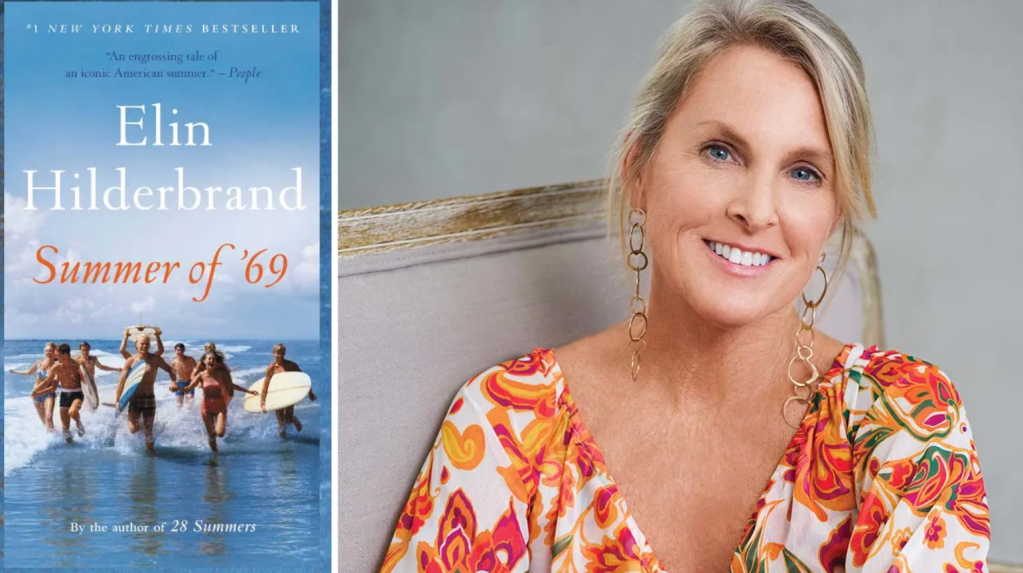
Photos courtesy of Sony; Nina Subin
I’ve written before about the unexpected in literature, but I’m going to take a partly different angle this time. It involves readers’ expectations of certain authors and novels, and how those readers can be surprised.
For instance, as I prepared to read Elin Hilderbrand for the first time last week, I expected her to be an (excellent) escapist writer. Heck, her fiction is often set on the idyllic (?) island vacation destination of Nantucket, Massachusetts, and a blurb on the back of the Summer of ’69 novel I chose said “Hilderbrand’s books are…perfect beach reads.”
Well, Summer of ’69 was certainly entertaining (and excellent), but hardly 100% escapist as it focused on a multi-generational family. There were various plot strands referencing racism, sexism, class divisions, adultery, suicide, the Vietnam War, etc. I’m glad all that was there — it made the novel more compelling — but those things weren’t on my Hilderbrand bingo card. Obviously, I hadn’t done enough pre-reading homework!
Another example of a novel that surprised me was from the summer of ’61 — 1861, that is, though I don’t know if Silas Marner was published in the summer. I opened the pages of George Eliot’s classic a decade or so ago with the expectation that it would be a dry work that many students famously disliked when it was assigned to them in high school. But it turned out to be a poignant, heartbreaking, heartwarming novel about a man who goes through some life-changing tragedies and triumphs. I loved it.
Going back another two centuries-plus, I thought Don Quixote would be entertaining but perhaps, because of its 1605-1615 publication period, not super-readable for modern eyes. But Miguel de Cervantes’ novel WAS super-readable in the 21st century.
Yes, some long-ago books are much more enjoyable than one might expect. Among those that come to mind are Voltaire’s Candide, Henry Fielding’s Joseph Andrews, and Fanny Burney’s Evelina — all written in the 18th century.
Getting more recent again, a John Steinbeck reader who starts with The Grapes of Wrath might not be ready for just how humorous that author can be when he puts his mind to it. I had no idea how much I would laugh when I polished off Tortilla Flat, Cannery Row, and Sweet Thursday (even as those novels also contained plenty of social commentary). Then, Steinbeck’s epic East of Eden wiped the smile off my face.
Not much humor, either, in Uncle Tom’s Cabin, but that novel surprised me. I thought it would be an earnest anti-slavery work that was sort of an obligation to read. But the story line is quite skillful and compelling, and Harriet Beecher Stowe’s title character is a more nuanced, more admirable person than what some critics have stereotyped him as.
Another 19th-century novel — by Stowe’s Hartford, Connecticut, neighbor Mark Twain — surprised me in being almost completely serious. That was Twain’s Personal Recollections of Joan of Arc, which also had the unusual distinction for the usually humorous or seriocomic author of featuring a female title character.
J.K. Rowling turned heads, too, when writing the deadly serious, non-wizard novel The Casual Vacancy after her blockbuster Harry Potter series that had plenty of humor amid the intense drama. Surprising, yes, but not a surprise for me and other readers who saw all kinds of reviews of, and articles about, The Casual Vacancy before reading that change-of-pace novel.
Yes, doing some homework about a novel or an author can prevent surprises, but then we might lose the fun of being startled. 🙂
Novels and authors you’ve read that were different than you expected?
My comedic new 2024 book — the part-factual/part-fictional/not-a-children’s-work Misty the Cat…Unleashed — is described and can be purchased on Amazon in paperback or on Kindle. It’s feline-narrated! (And Misty says Amazon reviews are welcome. 🙂 )
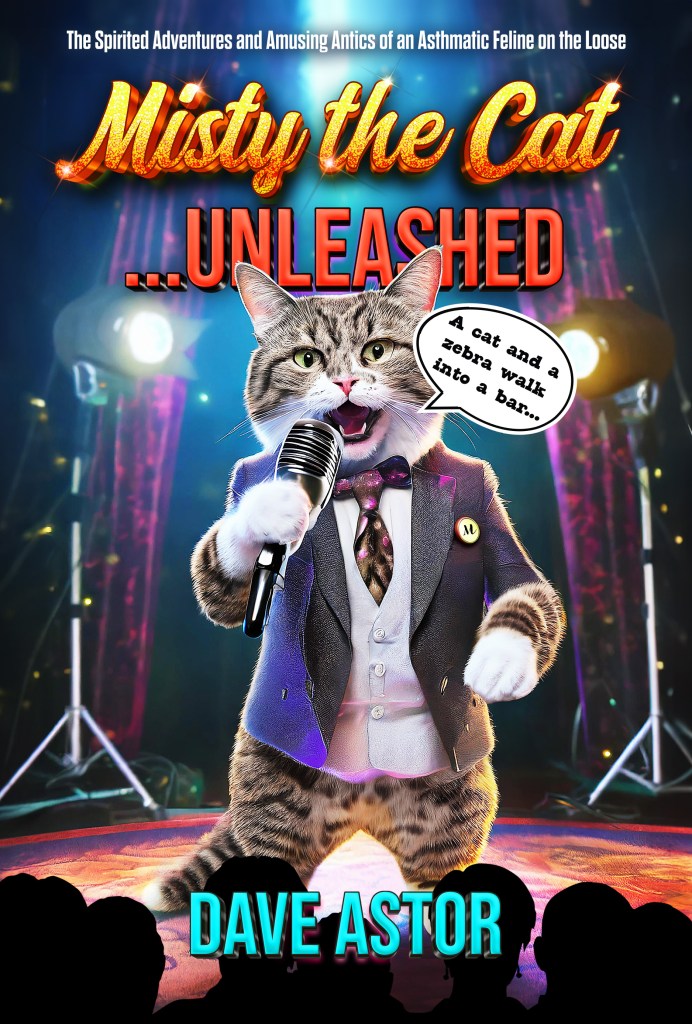
The 90-second promo video for my book features a talking cat: 🙂
 Dave Astor on Literature
Well, maybe , dear Roberta,you could tell me one you didn’t like soo much and it could be that I don’t know it yet and it makes me curious! Have a good day.
LikeLiked by 2 people
Shogun was a huge surprise to me.
A friend raved incessantly, and insisted I read it. I almost didn’t bother when I saw how thick it was.
Actually, A Ghost And His Gold by Roberta Eaton Cheadle was a surprise.
I’m not the biggest fan of paranormal, but there was so little (modern day) and the tie in with the Boer War historic fictional drama part was intriguing.
Best, I knew almost nothing about the Boer War. Now I have been educated, in a most entertaining way. Excellent book!
LikeLiked by 1 person
Thank you, Resa, for those two great surprise examples!
Yes, the size of Shogun is daunting, but I loved that novel. Wonderful when a 1,000-page book feels too short. 🙂
And Robbie is SUCH a talented — and varied — writer/creator. It feels like there’s no genre or art at which she’s not excellent. Getting an education (in an entertaining way) is a major added bonus.
LikeLiked by 1 person
Thanks Dave!
I do love history. Robbie’s book teaches without being one sided, as opposed to a historian near the time who might take a biased view.
LikeLiked by 1 person
Sounds pitch-perfect!
LikeLiked by 1 person
Yes!
LikeLiked by 1 person
Hi Dave, interesting, I read one Elin Hildebrand book called The Castaways and it didn’t have the sort of depth you’ve described. Most of the books I finish are good and in line with my expectations. I’m reading a book of short stories by Anton Chekhov which I’m enjoying very much.
LikeLiked by 1 person
Thank you, Robbie! I’ll be trying at least a couple other Elin Hilderbrand novels, and it will be interesting to see whether they’re more like “Summer of ’69” or “The Castaways.” I wonder if “Summer of ’69” being set in the past, during a very consequential year, had something to do with its depth.
Anton Chekhov’s short stories are GREAT. In a kind of subtle way.
LikeLike
I enjoyed the one about the Peasants the most to date. Fascinating how they lived and their thoughts about emancipation.
LikeLiked by 1 person
Chekhov definitely addressed various important themes — emotional and societal.
LikeLike
Now here’s something… I’ve had several special Vintage Penguin books which I’ve had many years ago. They are called the Penguin Seven Wonders of the World.
I began with Anna Karenina by Tolstoy and then Madame Bovary by Flaubert, and I enjoyed both of them. Rather later, I read Hell by Dante, which had a long and very useful ‘notes’ which was from Dorothy L. Sayers (she was excellent). I turned to Don Quixote by Cervantes, and I managed to read about a third, but I gave it up – too dense.
So, I still have three books, and I haven’t even touched these. Maybe I might try Faust by Goethe, or even earlier – The Aeneid by Virgil or The Odyssey by Homer… maybe.
LikeLiked by 1 person
Thank you, Chris! Interesting! I hadn’t heard of the Penguin Seven Wonders of the World until seeing your comment. 🙂
One can quibble with Penguin’s seven choices and which other great works were left out, but certainly some stone-cold classics in there.
For some reason I didn’t find Don Quixote uncomfortably dense; maybe I was in a dense-ignoring mood when I read it years ago. 🙂
Dorothy L. Sayers was a real Renaissance woman in her way. Author, scholar, etc.!
LikeLiked by 1 person
Hi Dave – look at this… I just pulled out my old Don Quixote book. It seems very good – I wonder why I didn’t finish it? So now I need to read it again, probably from the start. There is even a bookmark left there. It’s rather pretty and it seems it came from Barcelona, Spain.🤔
LikeLiked by 1 person
Wow! That’s wonderful, Chris! Love that the bookmark is still there, and that the edition seems to be from Miguel de Cervantes’ country! Would be interested to hear your thoughts if you do try Don Quixote again. 🙂
LikeLiked by 1 person
Eventually… I think!😉
LikeLiked by 1 person
🙂
(I slightly edited my previous reply from “if you do reread Don Quixote” to “if you do try Don Quixote again.”)
LikeLiked by 1 person
Dave, this is the second day I’ve come across Elin Hilderbrand books on WP and must admit my initial thoughts were the same as yours. Seeing the depth and range of her themes this has me intrigued!
I’ve read a few Steinback and never think of his humour. Maybe I should revisit his books.
An engaging and fun literary post, Dave. I’m currently reading a ‘100 Best Books’ and Don Quixote made it and feel it is perhaps one I should read in my life! Happy Reading and sharing all about books! 😀 Annika
LikeLiked by 1 person
Thank you, Annika! Yes, Elin Hilderbrand was kind of a revelation. 🙂 I plan to read more of her work.
The majority of Steinbeck’s novels are definitely deadly serious.
I love lists like “100 Best Books”! 🙂 Hope you enjoy “Don Quixote” if you get to it. I wonder if it can be considered the first “modern” novel.
LikeLiked by 1 person
Hi Dave,
Like most people, I’ve read “Pride and Prejudice” about a thousand times and love it even more with each re-read. Then recently I read “Northanger Abbey” which I think might be even better than “P&P”. So imagine my surprise when I found myself half way through “Mansfield Park” and dreading picking it up because it’s just so tedious. But I’m not a quitter, so I’ll force myself to finish, and then I can say I’ve read all six of Austen’s complete novels and then I might go back and re-read “Northanger Abbey” just because it was such fun.
I was also surprised when I recently read “The Tenant of Wildfell Hall”. I’ve read and loved “Jane Eyre” multiple times and I’ve read “Wuthering Heights” once, which was enough for me. I expected Anne Bronte to sit somewhere in the middle of Charlotte and Emily. I also thought maybe it actually wasn’t very good which is why Anne is the least talked about. But I was blown away by how much I enjoyed it and by how very modern it felt. I wish poor Helen Graham had better options available to her but all of those characters felt so relatable that I just loved spending time with them. Probably even more than “Jane Eyre”, and I completely understand if that means I have to spend time on the naughty chair.
Sue
LikeLiked by 1 person
Thank you, Sue! GREAT observation that a literary surprise can be when we like or dislike a novel more than we expected.
I’m also a big fan of Anne Bronte’s “The Tenant of Wildfell Hall.” Well written, ahead of its time, and even more feminist than Charlotte and Emily’s novels.
As for Jane Austen, I thought “Northanger Abbey” was uneven — with some parts quite enjoyable. I also had mixed feelings about “Mansfield Park” — a pretty good novel with a rather boring protagonist (Fanny Price) by Austen standards. My three very favorite Austen novels are “Persuasion,” “Pride and Prejudice,” and “Sense and Sensibility.” Mixed feelings about “Emma.”
LikeLike
I’m so glad to hear you call Fanny boring! It’s not a word I thought I’d use about an Austen novel, but I’m glad it’s not just me who thinks it fits. At lunch time about an hour ago I posted on another site about my love of “The Tenant of Wildfell Hall” and so that’s fresh in my brain and Fanny is turning down a marriage and I’ve got the two stories in my head together and I’m thinking maybe Austen will force Fanny into an unhappy marriage and a miserable life, which isn’t nice, but would make for an interesting story and then I realise I’m channelling some Bronte and Austen would never do that. No, Fanny is going to make the boring predictable choice, and have a boring predictable life. Oh well, only 150 pages to go and then I may actually go read “Villette” which people on my Bronte post are raving about.
LikeLiked by 1 person
Fanny Price is indeed boring, Sue. But she’s a nice person; that’s an important something.
Intriguing thought about mashing up Austen and Bronte! I look forward to reading “The Tenant of Mansfield Park,” “Emma Eyre,” and “Wuthering Abbey.” 🙂
I found the semi-autobiographical “Villette” uneven. Some excellent parts, some parts that dragged. I preferred “Jane Eyre” — and “Wuthering Heights” and “The Tenant of Wildfell Hall” — by a large margin.
LikeLike
Any of those mash ups would be better than “Pride and Prejudice and Zombies”. It’s a good point that you make about Fanny being nice. She’s a bit weak and lacking in spirit for my liking. Especially compared to a character like Elizabeth Bennet. Or even Jane Bennet. But the world is seriously lacking in nice people at the moment so I probably shouldn’t complain when I come across one, even if they’re fictional.
LikeLiked by 1 person
Oh this is so boring! He’s proposed, she said no, and now we’re on chapter three or four of talking about it! I’m sorry, Ms Austen. I know other books of yours have been brilliant, but can you just get on with it in this one?!
LikeLiked by 1 person
True about Fanny Price, Sue. Nice is good, but a little more charisma and spirit would also be welcome. Certainly unlike several other Austen “heroines,” as you allude to. Maybe Fanny’s boringness was completely deliberate on the author’s part?
From my memory, “Mansfield Park” does end eventually… 🙂
LikeLike
Interesting topic, Dave. I’m not coming up with anything that hasn’t been mentioned, but the fact that authors step away from the predictable pattern is refreshing.
LikeLiked by 4 people
Thank you, Dan! I also like it when authors surprise their readers. The attempt might not always be successful, but it’s worth a try. And the results can be GREAT.
LikeLiked by 2 people
A very wise choice to have people like Nina Subin as guests on your blog. The reviews are excellent for books that you can look for to read, without fear of making the mistake of having chosen it. A great option for the reader eager to search for books they haven’t read. Good week for you.
LikeLiked by 2 people
Thank you for the kind words, macalder02!
Glad you liked my brief descriptions of the mentioned books.
When I found the picture of Elin Hilderbrand and her book while searching for an image to put on top of this blog post, Nina Subin was the credited photographer. 🙂
LikeLiked by 2 people
You know, I used Google Translate and as you well know, the translation is not that reliable. Sometimes it translates into automatic. As you see fit and deviate from the original. That’s why I was confused. Ultimately, your review was great to be able to choose my next readings. A hug.
LikeLiked by 2 people
Thank you for your follow-up comment! Yes, Google Translate is definitely imperfect. 😦 Hope you enjoy your near-future reading!
LikeLiked by 2 people
Don’t have the slightest doubt that this is how it will be
LikeLiked by 2 people
🙂
LikeLiked by 2 people
Dave, I’ve been surprised by all the great storytellers you’ve introduced me to on your blog 🙂
LikeLiked by 3 people
Thank you, Rosaliene, for the kind and cleverly said comment! I’m grateful for the novels and authors commenters have recommended. 🙂
LikeLiked by 2 people
If I wanted to reread one of your here mentioned books, I would decide for “Silas Marner”, because it touched me deeply how Eppie was able to completely change Silas’ way of being! Many thanks, once more, Dave, for your interesting post.:)
LikeLiked by 2 people
Thank you, Martina! I agree — the adopted daughter/adopted father relationship between Eppie and Silas was moving and wonderful. I’d love to reread “Silas Marner,” too.
LikeLiked by 1 person
Hi Martina, it’s lovely to see you. I always look for your comments. A great choice of book to re-read. I rarely re-read books, but I have read Charlotte and Emily Bronte’s books more than once, as well as some of Charles Dickens’ works. Enjoy the rest of the week.
LikeLiked by 2 people
I am also very pleased to see you, Roberta! I have to confess you that I also reread my beloved Jane Eyre:) I should, of course, also reread Charles Dickens’ books.
All the best to you too.
LikeLiked by 1 person
There are only certain Dickens’ books I would read twice. Some are enough the first time around – smile! Enjoy the rest of the wee.
LikeLiked by 2 people
And yet re-reading is almost at odds with our starting theme. (This recalls the android in a sci-fi show who erased his memory in order to enjoy the same favorite books again.)
LikeLiked by 1 person
True, Evan! More comfort than surprise with a reread.
LikeLike
Yes, that is true. I must admit that I knew so much about Charles Dickens’ books before I read them, there could never have been any surprises in any of them. And I’d seen some of the movies before I read them.
LikeLiked by 1 person
Interesting, Robbie. Your comment reminded me that as much as I’ve enjoyed a number of Dickens’ novels — “The Pickwick Papers,” “David Copperfield,” “Great Expectations,” “Dombey and Son,” etc. — I’ve never reread any books by that author.
LikeLike
Hi Dave, that is interesting. They are rather heavy so I do understand.
LikeLiked by 1 person
Dear Roberta, I have sent you an answer to your comment from my iphone, but on my computer it shows that I haven’t sent you any answer! In any case, I asked you to maybe tell me which of Dickens’ book you wouldn’t reread. As I have also seen Dave’s answer to this question, I just would like to say that I have reread Great Expectation and A Christmas Carol.
LikeLiked by 1 person
Hi Martina, I have also re-read Great Expectations and A Christmas Carol. I would re-read The Chimes, The Cricket on the Hearth, and The Battle of Life (all short stories), as well as Oliver Twist (read twice) Nicholas Nickleby, and David Copperfield. I would not re-read The Pickwick Papers, Bleak House or A Tale of Two Cities. I couldn’t read The Haunted Man once. I never finished it.
LikeLiked by 2 people
Good evening, Roberta, and many thanks for your kind answers! Consequently I have written down the titles of the short stories and eliminated the haunted Man! Many excuses to Dave, because our conversation here doesn’t concern summer 69′
Good night!
LikeLiked by 1 person
Not a problem at all, Martina! All kinds of conversations are welcome. 🙂
LikeLiked by 1 person
Dave doesn’t mind. His intention is to promote literary discussion.
LikeLiked by 2 people
Yes, Roberta, you are right,and this is a great pleasure for me, but I had the feeling that I had overdone it a little bit!
LikeLiked by 1 person
I was surprised by reading The Milagro Beanfield War by John Nichols having read his book The Sterile Cuckoo firstly. I thought he was primarily a young adult romance novelist. Though I believe I would have been even more surprised had I read his novel American Blood secondly. I need to read even more of his works, as I stopped with Milagro Beanfield War. I think sometimes we have rigid expectations of an author will write next and/or that an author will stick to a particular genre esp. it’s particularly successful in the beginning. Idk, I’m still flabbergasted concerning the recent news involving Alice Munro. My daughter said she didn’t believe human beings should be inundated with so much negative information within a brief time span, that it is detrimental to our mental and emotional health and I agree. We don’t even have a chance to catch our breaths. Thanks for the theme Dave. Susi
LikeLiked by 4 people
Thank you, Susi! You definitely got me interested in trying John Nichols’ work. Sounds like he was capable of quite a variety of writing that kept his readers on their toes, and perhaps kept him interested. I’ve tried to hold to that approach with my own modest output of three books — all very different.
And, yes, the news involving Alice Munro was so depressing during a very depressing news time that does indeed do a number on people’s mental and emotional health. I realize Munro grew up in a different/more patriarchal time, but she obviously should have taken her daughter’s side and not stayed with her daughter’s sexual abuser.
LikeLiked by 1 person
What I have read re the situation is this: Her daughter said her mother was more concerned (and jealous) of her husband’s betrayal than she was concerned about protecting her. Consequently, it appears the patriarchal thing had very little to do with it. Idk, I’m sure it was a very complicated matter altogether. But think of this, Munro’s situation would be a good example of what JD Vance considers a women should do, which is to stay in an abusive marriage. The patriarch isn’t going to go away any time soon as long men continue to blame/shame women for society’s ills. Sorry, but I think all those Repub men either have mommy issues or should come out of the closet. Susi
LikeLiked by 1 person
Sorry for the rant. Susi
LikeLiked by 2 people
No problem at all, Susi! You made great points, and they were well said. Yes, the view of most Republicans today, in 2024, is disgustingly retrograde. Trump, Vance, and down the line.
LikeLike
Thanks Dave.
LikeLiked by 1 person
You’re welcome, Susi!
LikeLike
A very interesting topic of discussion, Dave. I found that books have the power to surprise me even after reading all the reviews (I’ve stopped looking at the back page!!). It seems that in reading, I become engaged by the unique perspectives, unexpected plot twists, and emotional connections. Reading is personal! Books stimulate our curiosity, challenges our preconceived notions, and provides a sense of novelty and excitement that enriches our reading experience.
Having said that, I believe that readers (including me) are often drawn to books with predictable endings because they provide a sense of comfort and closure. Predictable endings often reaffirm our beliefs or expectations. Perhaps they serve as a form of escape, offering a reliable and familiar narrative structure to counter a world that is uncertain and unpredictable.
I was surprised by Metropolitan Stories: A Novel by Christine Coulson, which delves into the world of the Metropolitan Museum of Art. Coulson’s background at the museum shines through in the vivid imagery and whimsical characters she creates. (Chairs can think!!!) The interconnected stories offer intriguing insights into the museum’s history and culture, while Coulson’s elegant and atmospheric writing style elevates the reading experience, making it rich and immersive.
“We protect them and save them and study them. After a time, we realize—some of us slower than others—that they are protecting us, saving us, studying us.”Christine Coulson, Metropolitan Stories
LikeLiked by 6 people
Thank you, Rebecca! Yes, some novels have the power to surprise us even if we know a lot about them before reading. And I hear you about how the less-than-surprising nature of some other novels can be a source of comfort. All well-stated by you!
Personally, I like both kinds of novels. 🙂
Christine Coulson’s book sounds fascinating! A great, mind-bending quote, too.
LikeLiked by 1 person
Hi Rebecca, I think it’s the intriguing approach to POV that Christine Coulson took that is so unexpected and fascinating. I must read this soon. I am uplifting this idea but I expect what I am doing will be vastly different from what she did. That is how it goes with ideas.
LikeLiked by 2 people
That is the beauty of ideas and innovation, Robbie. We build upon what is and create something new. It is exciting!!! Looking forward to what you will be writing!!!
LikeLiked by 1 person
So far, I am pretty pleased …
LikeLiked by 2 people
Rebecca, may I say that you seem to be someone who thinks things through for themselves? This is a great compliment, coming from me. I venture to say that if they put you in a room full of people expressing their group opinion of what a wonderful thing the institution of cannibalism is, you would not automatically concur.
Why is it that at some times people want to have their imaginations stimulated by unexpected ideas, and at other times feel they need to escape into formulaic repetition?
LikeLiked by 2 people
Many thanks for your lovely comments, Evan!
LikeLiked by 1 person
This is the weirdest presidential election year I have ever experienced whether Trump or the eventual Democratic nominee wins, and I remember presidential elections back to the 1960s. If a novelist wrote a political novel with a plot like this, I think it would be rejected by all major publishers.
LikeLiked by 2 people
Thank you, Tony! A VERY weird presidential election year indeed. You’re absolutely right — it wouldn’t be plausible as fiction.
LikeLiked by 1 person
One reason why I feel Republicans have an advantage in future elections is because many businesses and workers are moving to the Red States because of lower taxes and lower cost of living even though wages tend to be lower and the workforce is less unionized.
LikeLiked by 1 person
True, Tony, although some workers moving to red states bring relatively liberal beliefs with them — helping to move some states (such as Arizona) from red to purple.
LikeLike
I’ve read an article in the Hill and according to the polls after the Republican convention the Republicans seem to be in the strongest position to win since Reagan was president. Trump is not personally popular but Harris is even more unpopular, J.D. Vance is fairly popular, most of the issues especially economic issues and immigration favor the Republicans and some groups such as Hispanics, Asians and some African-Americans are moving towards the Republican Party. I don’t know if the Democrats are seen as too left wing but the U.S. at least since the beginning of polling has always been center-right (sometimes further to the right than at other times) as far as public opinion is concerned.
LikeLiked by 1 person
I have to respectfully disagree, Tony.
The Republicans did seem to be getting a popularity bump during their convention, but Trump blew some of that with his longest-in-history 93-minute speech that veered into his usual nasty territory after about 20 minutes.
Trump and Harris poll pretty evenly, so I don’t see her as being more unpopular than Trump among the entire electorate. Plus, as a new presidential candidate, her popularity might increase; Trump has a ceiling that has never passed 50% among the entire electorate.
Not so sure how popular Vance is with the entire electorate, especially with him having some very extreme views on issues such as abortion. Also, people know he’s a hypocritical phony when he went from being a harsh Trump critic in/around 2016 to becoming a Trump lackey when he saw which way the Republican winds were blowing.
In addition, Vance didn’t win the U.S. Senate race in Ohio by that wide a margin despite huge monetary help from far-right tech billionaire Peter Thiel.
As for the Democratic Party’s politics, it is mostly centrist — as is Biden. Bernie Sanders and “The Squad” have little influence on the Democratic elite, though they have nudged Biden into being less anti-union and more anti-monopoly.
LikeLike
It’s really hard to predict this year’s presidential election, both parties seem to have weaknesses. Trump and Vance seem to be getting less and less popular but Harris might be too liberal for the swing states (she is slightly more liberal than Biden) and the Democrats are badly split on the Israeli-Hamas War. Neither candidate has the charisma of a Ronald Reagan or Barrack Obama who attracted voters who might not even like their policies.
LikeLiked by 1 person
I hear you, Tony. Definitely some good points there.
LikeLike
I read six of Hilderbrand’s novels, enjoying them as “beach” reads, and then The Perfect Couple turned out to be a murder mystery. I had been lulled into the romance (and secrets) of the other books; fortunately, I like to read mysteries.
LikeLiked by 4 people
Thank you, Madeline! Yes, some authors definitely like to change things up. 🙂 I plan to read more of Elin Hilderbrand’s novels, and will experience what you experience, too, I guess. 🙂
LikeLiked by 2 people
I have also read two set in the Midwest and Caribbean.
LikeLiked by 2 people
Ah, so she’s not all-Nantucket, all the time!
LikeLiked by 1 person
Reading the classics became a passion for me when I was younger. Yes, some of them can be pretty daunting to get through, but so worth the effort!
LikeLiked by 4 people
Thank you, Dawn! So true about some classics being daunting to get through, and you’re also right about many of them being well worth the effort. (I still plan to read “Ulysses” sometime in the 25th century. 🙂 )
LikeLiked by 2 people
Hi Dawn, another thing we have in common. I love classics.
LikeLiked by 1 person
Fascinating post as usual, dear Dave!
I loved your reflections
LikeLiked by 5 people
Thank you very much, Luisa! 🙂 Literature is a great topic to write about and comment on. 🙂
LikeLiked by 3 people
Thanks a lot to you for your kind reply 🩵
LikeLiked by 2 people
You’re very welcome, Luisa! 🙂
LikeLiked by 2 people
I’m a little embarrassed to say I’ve not read a novel for some time now. I once aspired to write but lately, it’s been nonfiction in the Historical genre. Though, hearing your brief summaries inspires me to dust the shelf and grab a novel I said I’d get to.
I recall The Grapes of Wrath in high school and I believe East of Eden is on my shelf.
LikeLiked by 4 people
Thank you, Portraitist! Reading nonfiction books is a great way to go, too. 🙂 I’ve went through periods doing that rather than reading novels, but not for a while.
“The Grapes of Wrath” and “East of Eden” are both excellent!
LikeLiked by 3 people
Aristophanes translations are surprisingly funny. Dante’s ‘Inferno’ (rendered by Pinsky) is on one level a timeless tale of horror . . . like Dave says, bits in ‘Moby Dick’ are amusing.
LikeLiked by 4 people
Thank you, Evan! It’s fascinating to see what was humorous more than 2,000 years ago!
And, yes, the “Moby-Dick” inn scene with Ishmael and Queequeg is really funny.
LikeLiked by 2 people
HI Evan, I must admit that I really enjoyed Dante’s Inferno and also thought it was a great horror story.
LikeLiked by 1 person
I was surprised when one of my professors recommended J.P. Donleavy’s The Ginger Man as a book “even a feminist would love.” I found the title character a despicable human being, and his personal hygiene made my skin crawl.
LikeLiked by 5 people
Thank you, Liz! That’s a rather weirdly phrased recommendation/non-recommendation from one of your professors!
LikeLiked by 3 people
I probably made an Ugh face when he started talking up the book.
LikeLiked by 2 people
With good reason, it seems!
LikeLiked by 2 people
Yup!
LikeLiked by 2 people
An interesting and thought-provoking topic, as usual. I’ll have to give it some thought. 🙂
LikeLiked by 3 people
Thank you, Laura! I look forward to seeing what you’ll say. 🙂
LikeLiked by 3 people
Hi again. I’ve had a think and come up with a few. Someone here has already mentioned ‘Moby Dick’, and it took me a while to read it. Given how famous it is, and the various film versions made of it, I was expecting to love it. I hated it though. All those whale references, definitions etc – I felt very let down, but that’s just me – not necessarily falling into line with popular opinion, which is why I’ve never liked Dickens’s work. I’ve tried reading them, I even took a module on him for my MA, but nothing worked. It was only when I discovered ‘Hard Times’ that I could say I liked something written by Dickens. The funny and ironic thing is that he wrote it without all his usual flowery flourishes on purpose, keeping it sparse in order to make a point about Utilitarianism. It worked for me though, I liked the straight-to-the-point style. Go figure. Last, I registered for a module on Literary Realism for my second year at university, and as I was very keen I spent the summer reading some of the texts for the coming year. ‘Madame Bovary’ was on the Realism course, so I read that and was dismayed, as I didn’t like Emma at all. I was confused – she was the eponymous heroine, wasn’t I supposed to like her? It was only when I was studying the course several months later that I realised the purpose of Realism was the absence of the author: writing in such a way that the author wasn’t subtly influencing readers in terms of which characters they should like and which they shouldn’t – according to the author. By leaving out that influence – not an easy task – the author leaves the readers to make up their own minds. I have to say that Realism became a favourite form of writing with me, along with Naturalism, and I went on to teach both. Thanks as usual, Dave, for the exercise of my little grey cells which your posts invariably bring about. 🙂
LikeLiked by 4 people
A VERY interesting comment, Laura!
I liked “Moby-Dick” overall, but it did drag in parts — especially when Herman Melville got into all those whale and whaling details, as you note.
“Hard Times” was definitely stripped-down Dickens — I liked it, but also liked his sprawling, sentimental, comical works.
Re “Madame Bovary,” novels with less-than-likable protagonists can be off-putting but still satisfying in some cases. I liked but didn’t love Flaubert’s novel.
I seem to have used the word “liked” a lot in this comment. 🙂
LikeLiked by 3 people
And I’ve ‘Liked’ it, having no issue with the word. it’s heartening to know that the authors of the Classics, like their modern-day counterparts, didn’t please all of the people all of the time. And I’ve just remembered Hardy’s ‘Jude the Obscure’, which I was expecting to hate – it got such a bad press – but was actually fine with. Yes, it’s depressing material, but like you with ‘Madame Bovary’ I liked but didn’t love it. 🙂
LikeLiked by 2 people
“And I’ve ‘Liked’ it” — cleverly said!
Yes, the classics don’t all get five stars from everyone on Yelp. 🙂
“Jude the Obscure” is indeed excellent, as are several other Thomas Hardy novels.
LikeLiked by 2 people
Isn’t it amazing how we are all different, Laura. Hard Times is the one book by Charles Dickens I didn’t like. I loved Great Expectations, Oliver Twist and Nicholas Nickleby.
LikeLiked by 2 people
It just goes to show the huge range of tastes out there. I tried so hard to like Dickens, and at least I managed to respect him by the end–so much so that I read a few of his books just for the hell of it. Oliver Twist I did like, to a certain extent, although I agree with the cutting of the Rose Maylie storyline whenever a film/TV series is made of the book. It’s a shame that they can never get in the passage where Bill Sikes is on the run, and for a short while becomes a member of a community, helping extinguish a house fire. That I think is a fine passage, illustrating the mental state of the man. Dickens showing what a man like Sikes might have been, given a chance in life? Wonderful. 🙂
LikeLiked by 1 person
I couldn’t agree more. Dickens was a genius for understanding people. His books are heavy though. I have to be in the mood for them.
LikeLiked by 2 people
Me too – and a very particular mood. 🙂
LikeLiked by 1 person
I recently read A Fine Balance by Rohinton Mistry. I expected it to be grim (and it really is!), but I was surprised by how much humor there is along with the pain and suffering. A balance indeed.
LikeLiked by 4 people
Thank you, Audrey! I recently read the excellent A Fine Balance as well, and I agree it has some very funny moments amid the misery. Yes, a real balance of sorts.
Reminds me that some of the pre-voyage section of Moby-Dick is absolutely hilarious.
LikeLiked by 4 people
Thank you to M.B. Henry for recommending Elin Hilderbrand!
LikeLiked by 2 people