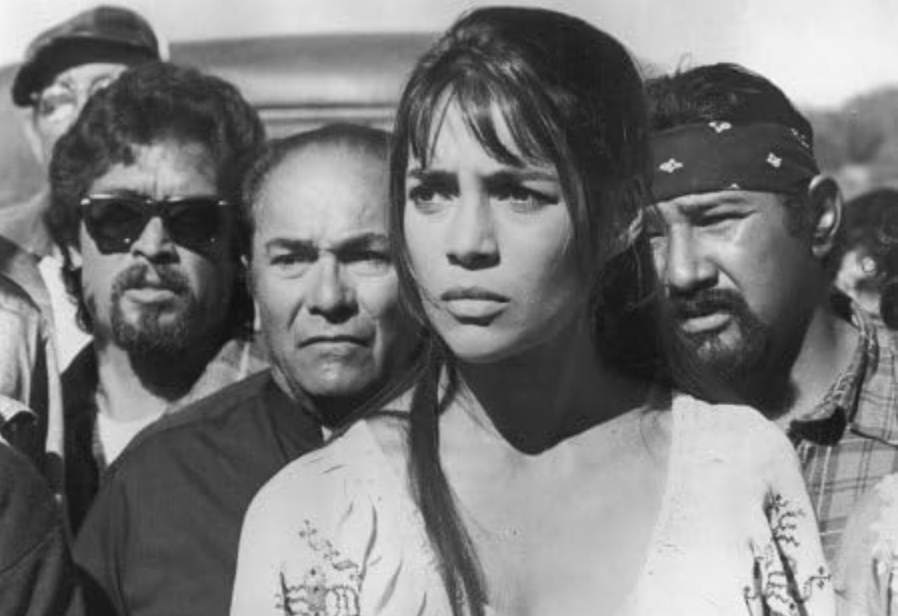
From the 1988 movie version of The Milagro Beanfield War novel.
When I read The Milagro Beanfield War last week, I thought about several things: the socially conscious and frequently comedic nature of John Nichols’ impressive 1974 novel, the skill in which he depicted his quirky/decidedly un-affluent characters, the book’s great sense of place, the wordy novel being longer than it needed to be (it could have lost about 100 of its 445 small-print pages), the unfortunate fates of too many animals in the book, and…”cultural appropriation.”
That’s because Nichols was a white “Anglo” author writing about a (fictional) New Mexican rural community in which most of the residents are Hispanic.
Is this a bad thing? Not necessarily. Obviously, Hispanic writers writing about Hispanic characters and culture is often the ideal; I’m certainly a big fan of Gabriel Garcia Marquez, Isabel Allende, Julia Alvarez, Junot Diaz, Jorge Luis Borges, and others. Same for Black writers writing about Black characters and culture — whether the compelling storyteller is Toni Morrison, Alice Walker, Zora Neale Hurston, Octavia Butler, Chimamanda Ngozi Adichie, Zadie Smith, Buchi Emecheta, Terry McMillan, James Baldwin, Richard Wright, Walter Mosley, Wole Soyinka, or Chinua Achebe…etc. (At least a couple of these authors are biracial.)
But skilled white writers can — though of course not always — make the imaginative leap into the psyches of characters with different ethnic and racial backgrounds, just as skilled writers of color can do the opposite. The same for women writing about men and vice versa. It takes care, sensitivity, some lived experience, research, a thirst for not stereotyping, and more. (It helped that the California-born John Nichols lived in Spain and Guatemala, among other places, and then moved to New Mexico — where he remained for more than 50 years.)
John Steinbeck was another white writer pretty adept at depicting Hispanic culture — mostly notably in the at-times-quite-comic Tortilla Flat, but in other novels, too. He also did a darn good job with the Chinese-American character Lee in East of Eden.
Which reminds me that contemporary Vietnamese-American author Viet Thanh Nguyen created some believable white characters amid the indelible Vietnamese characters in The Sympathizer and The Committed.
While Harriet Beecher Stowe’s depiction of the title character in Uncle Tom’s Cabin has drawn very mixed reactions the past 172 years (I don’t think Tom was as stereotypical as some say), there’s little to criticize about Stowe’s excellent treatment of the prominent Black characters Eliza and George in her famous 1852 anti-slavery novel.
On the flip side, the biracial French author Alexandre Dumas created scintillating portrayals of white characters in The Count of Monte Cristo, The Three Musketeers, and various other works — while also doing a great job with his one novel (Georges) starring a Black protagonist.
I’ll add that white author John Grisham is very adroit at giving his readers three-dimensional Black protagonists in novels such as The Racketeer and The Judge’s List.
And the aforementioned James Baldwin expertly depicted the all-white cast of characters in Giovanni’s Room, one of the earlier novels with a gay theme.
Your thoughts about this topic?
My comedic 2024 book — the part-factual/part-fictional/not-a-children’s-work Misty the Cat…Unleashed — is described and can be purchased on Amazon in paperback or on Kindle. It’s feline-narrated! (And Misty says Amazon reviews are welcome. 🙂 )
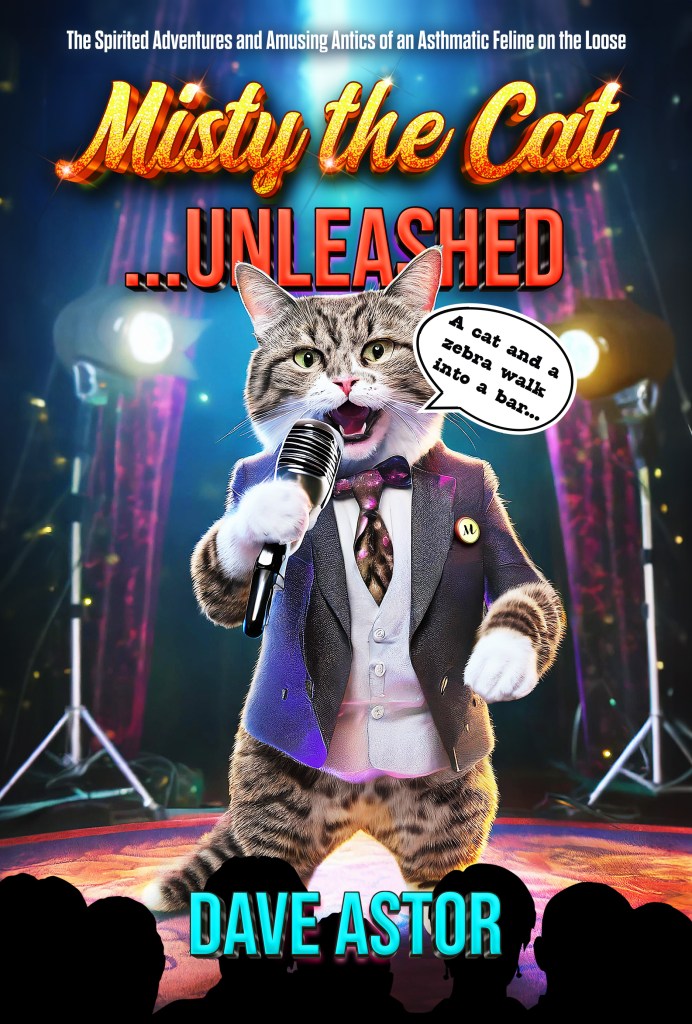
This 90-second promo video for my book features a talking cat: 🙂
In addition to this weekly blog, I write the 2003-started/award-winning “Montclairvoyant” topical-humor column every Thursday for Montclair Local. The latest piece — about topics such as my local library temporarily closing after its aged air-conditioning failed — is here.
 Dave Astor on Literature
Very thought provoking post Dave, I believe writers should have the liberty to create, dissect and revise characters. They shouldn’t be robbed of their creative freedom of conceiving characters of races and ethnicity, other than them. I know it’s a sensitive topic and many historically marginalized communities might consider it another form of colonization but I believe it can also help bridge differences and offer unique perspectives. I can think of the great South African writer Nadine Gordimer who despite being white created some amazing black protagonists in the apartheid era and portrayed their struggles and sufferings so poignantly. I’ve also marveled at the beautiful Indian landscapes and characters in Rudyard Kiplings’s works including his most famous “Jungle Book”.
LikeLiked by 1 person
Thank you, Tanya! Well said! I agree that any writer should be able to write about anything, as long as it’s done with sensitivity and — if necessary — with research. You’re right about Nadine Gordimer! I think Rudyard Kipling had a bit of a colonialist-attitude problem, but wrote vividly.
LikeLiked by 1 person
Yes ‘ sensitivity’ is the word, also agree regarding Kipling’s colonial mindset. I would say he portrayed the landscapes beautifully without any bias but can’t say that about his Indian characters.
LikeLiked by 1 person
I agree, too! Thank you for the follow-up comment!
LikeLiked by 1 person
I think each person who feels having a story to tell (and who has the patience to finish it and the skill to make it interesting for the others to read) should be allowed to tell his story, because, even if the subject is the same, no story told by two different people is identical to another. (Except plagiarism, a thing I am not referring to!). So people of different ethnicities can write the stories they want to, and certainly they would not be identical.
Besides the angle given by every writer’s (and reader’s alike) culture, age, experience, world view, there is also something else: imagination and research. Writing only from the perspective of your own culture (and your own time period) would be boring and limited. There is research, and there is imagination, and a writer can enter the skin and mind of any character: baby, toddler, drug addicted youngster, old mobster, shaman, housewife, lawyer, bandit, murderer, retired midwife, you name it. Also, they can explore the stories of cavemen, Roman legionaries and Gallic or Carthaginese merchants and their families, Aztec priests, Regency nobility, Australian natives, Tibet or Shaolin buddhist monks, any time and place dweller, including SF taking place in a future not yet existing.
They can tell stories in the point of view of a cat, of a non human extraterestrial spaceship leader or even of Death herself. It had been done before and it resulted interesting to read. Any forbidding would drastically cut on the freedom of individual expression and on the number of stories actually told vs imagined only.
LikeLiked by 2 people
Thank you, Marina! Your fantastic comment eloquently summed up many angles of this topic! Yes, writing and reading books from all kinds of perspectives is a wonderful thing. And, as you note, if authors only wrote from their own direct experiences, there’d be no sci-fi set in the future, no novels set in the past, etc., etc. Literature would be much poorer and limited.
LikeLiked by 1 person
I have written about characters from many time periods and places, from 1050 to present. Usually life is characterised by multi-culturalism and so are my writings. Not all characters are prejudiced and narrow minded, but some are. Like in life, in all times. And I am sure that my books, meant for the teens (and those who were once teens) from my country, make them understand a thing or two, and learn something about other cultures.
LikeLiked by 1 person
I appreciate the follow-up comment, Marina! Sounds like your writing has been wonderfully varied, diverse, and educational! Using a setting in 1050 had to require a LOT of research and imagination. 🙂
LikeLiked by 1 person
Entirely off-topic, but I wrote this after viewing Kamala’s interview by Bash, after Poe:
Ah, distinctly I remember it was in the campaign season;
As each dying media outlet wrought its ghost upon the screen.
Eagerly I wished the morrow;—vainly I had sought to borrow
From my books surcease of sorrow—sorrow for the lost perspective —
Sorrow over cloaked invective, now passed off as stuff insightful,
By the mediocre and the frightful
Re the rare and radiant candidate the angels name Kamala–
Blameless here for evermore.
LikeLiked by 2 people
It’s me! I made myself Anonymous, but it’s me!
LikeLiked by 1 person
jhNY, EXCELLENT poetry inspired by “The Raven,” even as Trump’s supporters are inspired by “The Raving”…
LikeLiked by 1 person
Not that I am quite qualified, but as an American, I feel best able to speak about the notion of cultural appropriation here, specifically as it applies to American music,, where it has been a hot topic for several years. First, I believe that for most of our history, there has been less emphasis on what we share here than what might seem to be separate ‘cultures’.
I have enjoyed more than a half-century’s interest in Black American music, pre-civil rights era. Early on, in blues music’s first revival,what many writers, mostly white, concluded about the conditions of its origin and the isolation of its practitioners– separateness of that music from the American mainstream– was more projection than fact.
Charley Patton, a 1920’s MS blues man, used to be the very model of that projection, treated as a rude and untaught son of the soil, a lonesome figure of the Mississippi Delta, who made his idiosyncratic songs up from scratch, often writing about people and places in his immediate area.
And he did write about those people and places.
But he also borrowed from Lemon Jefferson, Ma Rainey and even the Tin Pan Alley pop tune ‘Runnin’ Wild.’
Because he too had at least occasional access to recorded music, despite his rural Delta address. He even spent a week in New York City during a recording session!
It has been to some advantage to those gatekeepers who would direct the narrative that the notion of separate cultures is maintained. Ken Burns’ jazz series, excellent overall, suffers somewhat from underplaying the importance and quality of early white jazz bands and stars, but the fact remains that the first jazz recordings were of a white New Orleans jazz band, the Original Dixieland Jazz Band, whose repertoire was drawn on by musicians Black and white throughout the period.
And to belabor what should be obvious, the instruments on which the music was performed are,overall, of European origin. Most of the standards which form the songbook of the jazz repertoire are written by white people, while most of the most able and innovative performers of the repertoire have been Black.
American Black and white musicians, even in periods when they could not publicly perform together, jammed ‘after hours’, and not all that was exchanged in those sessions went in one direction only. And white musicians were in the vanguard of integration, by insisting, as Artie Shaw, Bennie Goodman, etc., did, on hiring Black performers, and they suffered from lost sales and shortened tours in the American south. Still, they persisted.
The banjo, hallmark of white country old time mountain music, was originally an African instrument. Tap dancing comes out of Irish clog dancing and Black dance tradition too.
Soul food and the food southern white country people ate are much more similar than they are two separate cuisines. As was their clothing.
We have always been together here,Blacks and whites, though mostly and historically to the overwhelming advantage of the white majority, and we have led lives that touch across racial lines throughout our shared history, whatever we have been telling ourselves about ourselves apart.
LikeLiked by 2 people
Thank you, jhNY! Great comment — an eloquent essay, really. So true that so-called “Black music” and so-called “white music” have various cross-cultural connections, borrow from each other, etc. And of course the cross-cultural connections extend to rock/pop music — with people like Elvis Presley strongly influenced by Black musicians, and white songwriters such as Carole King and Gerry Goffin often penning tunes performed by Black singers or groups (before King became a performer herself).
LikeLike
Thanks!
I tried to limit myself by sticking to an historical period, but as you noted,length was approaching critical mass.
LikeLiked by 1 person
Not a problem! CVS receipts are even longer than longish comments. 🙂
LikeLike
Hi Dave,
My book club has recently read a couple of books that really fit this interesting topic. A few months ago we read R.F. Kuang’s “Yellowface”. Written by an Asian American woman about a white woman who kind of steals the identity of a dead Asian American woman. She doesn’t feel too bad about it though because of how hard it is to be white. Being diverse is all the rage and she’s feeling a bit left out. Our group didn’t think too much of the book and I was confused by the messages of racism. Hard to be white? Gimme a break. Then one of the ladies at book club said at least it was an interesting insight into the publishing world, but I’m not so sure. I simply didn’t trust this author. According to her, most of the publishing industry is conducted through social media and they ignore white people. Maybe a fun story about writing and publishing and guilt and revenge, but I didn’t think it was particularly insightful.
Then last month we read “American Dirt” by Jeanine Cummins, a white woman writing about displaced people travelling through Mexico trying to get to the USA. I loved it. Every page was filled with danger and uncertainty about whether this group of characters would get to the other side of the border. But then all the online reviews tore the author to shreds because she has no lived experience of Mexico. The defence being that if we all have to stay in our lanes then John Steinbeck can’t have black characters and Agatha Christie can’t have male characters and absolutely no one will be allowed to write about the dragons. And of course that’s silly. But what happens when you walk away feeling like you have insight into Mexican culture only for Mexican people to say that’s not what it’s really like? It’s great that authors (and readers) have enough imagination to create fictional worlds they’ll never inhabit, but maybe it becomes problematic when it reads almost like non fiction?
The other argument about Cummins wasn’t necessarily that she was telling Mexican stories, but that the stories have already been told by Mexican people who just don’t get the same coverage as white people. And that made me feel a bit guilty and I wanted to check out some of these Mexican authors, but I’ve had my fill of the horror of trying to get to ‘The North’ for a little while so I’ll just have to stick to the white woman’s version of it, which doesn’t feel very right to me.
Dave, can I be completely random and comment on something that I wouldn’t mention anywhere else online. I know it’s a bit of a no-no to talk politics on social media, but I also know you don’t shy away from it, and even if there are things you disagree with, the conversation is always respectful. Anyway, I don’t like Trump. I didn’t like him when he won in 2016 and I really didn’t like him when he lost in 2020. But I think one of my biggest problems with him is how much support he has. It bothers me that so many people are completely ok with that level of racism and misogyny and weirdness. And then for the last few years it’s all just felt a bit meh. I still don’t like Trump, and if I could vote, I’d definitely vote against him. But then last month suddenly there was someone to vote for, not just someone to vote against. My initial reaction was that America would never embrace a Black woman as a serious candidate for the presidency but I’m so glad to be wrong. Again, it’s not just Harris that I’m excited about, but also the support from the American people. So exciting to hear such positive messages. I suddenly can’t wait for it to be November ❤
Susan
LikeLiked by 4 people
Thank you, Susan, for your great/wide-ranging comment! Yes, “cultural appropriation” by a white author can work — or not work — in the eyes of readers. I appreciate the examples of both, from your recent experience. And, yes also, when people say it’s hard to be white, it’s just total garbage. Pseudo-victimhood. Of course, many white people lead difficult lives because of poverty and/or many other reasons, but it’s still an advantage in most places to have white skin.
It is true that too often books by white authors about other cultures get more publicity and sales than books by authors of colors about THEIR cultures. That is very unfortunate.
I agree — it’s dismaying how awful Trump is, and even more dismaying about how much support he still has despite that. The Kamala Harris/Tim Walz ticket would be so much better in the White House. Harris is not as liberal as I would like, but compared to Trump? What a difference.
LikeLiked by 1 person
Thank you for posting this interesting post. I was thinking not too long ago that it seems to be a requirement nowadays for screenwriters and writers to include a variety of diverse characters into their stories in order to get funding, published, and produced. Although I don’t have a problem with that, I was thinking about how could I, as a straight, married white woman, accurately depict someone from another culture without sounding redundant, stereotypical, and ridiculous? When I worked in mental health for 15 years, I always treated people as individuals, regardless of any other considerations. But I see groups of people lumped together as if they were all the same. Sharing the same skin color or ethnic identity does not make people the same. In fact, these are superficial traits when it comes to accepting people as fellow humans. I wish we could get away from these superficial judgments and look at people as people. Since I have worked with Native Americans, LGBTQ+, and other groups, I could probably write a convincing novel or story, but only if I portrayed them as individuals and not just as part of a group.
LikeLiked by 2 people
Thank you, Dawn! Excellent observations! Yes, while members of any particular demographic group might have some similarities, it really does come down to the individual — and many individuals have similarities that totally transcend race, ethnicity, gender, etc. When authors “look at people as people,” to use one phrase from your eloquent comment, I suspect they’re already halfway there to creating three-dimensional characters different than they (the authors) are.
LikeLiked by 1 person
Thank you very much, Dave for this highly interesting thought! My husband and I are originally from the German speaking part of Switzerland, but have been living in the South or Italian speaking part for 50 years. Despite of all these years, after having worked here or have our daughter and friends here, we often times feel different in our behaviour, feeling etc. This means we will never become Ticinesi, but I am convinced that to live with “foreigners” or read about them helps us to learn from them or see the differences and this seems to me very precious.
LikeLiked by 2 people
Thank you! (Is this Martina?) Interesting that people can live a very long time in one place yet still feel, or be considered, somewhat different than people who have lived there even longer. I feel that at times in my New Jersey town of Montclair, where I’ve lived for 31 years but a number of people are lifelong residents. 🙂
Love this line of yours: “I am convinced that to live with ‘foreigners’ or read about them helps us to learn from them or see the differences and this seems to me very precious.” I agree!
LikeLiked by 1 person
From what I recall of reading about how an immigrant acquires full-fledged German citizenship,it is, or was not long ago, possible to be a third-generation person of Turkish ethnicity there, and still not be altogether a German citizen.
LikeLiked by 2 people
Hi Dave, an interesting post as always. I can’t add much to what has already been said on this topic other than I findwiting about animals and their plight a lot less fraught than writing about people.
LikeLiked by 2 people
Thank you, Robbie! I hear you that writing about animals can be a “safe zone.” It’s an excellent observation.
LikeLike
I very much like this point of view, Roberta!
LikeLiked by 1 person
I can’t think of a book outside of all mentioned.
Life is not a cookie cutter event.
How crazy would it be if white people were only allowed to eat vanilla cookies, black people chocolate cookies, old people only prune cookies and hispanics to only eat oatmeal cookies?
Sometimes I feel this is happening in our world.
We need to delve cross culture, cross race, cross social castes, cross religion, cross everything if we are to get along with understanding in a shrinking world.
Many problems here, with some refusing to look at other sides, even willing to kill in the name of their race, religion, colour etc.
Like you suggest, with insight and sensitivity it’s okay. It has to be, or we lose humanity. The arts are a perfect area to utilize this.
Books are just one area of this sensitive cultural appropriation situation.
All of the arts are effected.
If I buy some earrings made by an aboriginal person in an authentic design, must I be aboriginal to wear them?
Are we not allowed tributes in our arts? Where is the line between a tribute and appropriation?
An aside:
About 5 years ago I read about a completely unknown white female artist who was trying to sell her paintings. She loved native art, and tributed the designs in her work.
She was called out as a cultural appropriator. It made news, and suddenly she was not unknown anymore. Her art sold like hotcakes.
I’ll shut up now.
Thank you for broaching this subject, Dave! Many are afraid to.
LikeLiked by 3 people
Thank you, Resa! Many excellent points, excellently and passionately said. I agree that crossing cultures and the other “boundaries” you mentioned can lead to a better and more peaceful world at a time when the digital age does indeed mean a shrinking world. And, yes, not just crossing “boundaries” with books but with other arts and in various non-arts areas. “Multicultural” is one of my favorite words. 🙂
LikeLiked by 2 people
Thank you, Dave.
Yes, Multicultural is a cool word, and that is exactly what the USA & Canada are.
It is what the world is becoming.
It is what many are killing over.
LikeLiked by 3 people
All too true, Resa. As much as you, I, and many, many others love multiculturalism, many people unfortunately hate and fear it.
LikeLiked by 2 people
Agree!
Sadly detrimental.
LikeLiked by 1 person
Yes. 😦
LikeLiked by 1 person
😦
LikeLiked by 1 person
Hi Resa, an excellent commentary. I don’t think I could add much to what you have said here. Interestingly enough, this isn’t as big an issue in Africa as it appears to be elsewhere in the world. Authors are encouraged to be multiracial in their writing here, regardless of their own race and cultural background. Maybe its because we have so many cultures here and 11 official languages.
LikeLiked by 3 people
That is great to hear, Robbie!
LikeLike
That is most interesting!
I find it clear and pragmatic thinking that multiracial writing is encouraged.
11 languages, wow!
Yay for Africa!
LikeLiked by 1 person
It’s nice to think we get this right!
LikeLiked by 2 people
Yes!
LikeLiked by 1 person
I think what we’re seeing with cultural appropriation is a rejection of the New Criticism we older folk were taught in college. That is still my stance as a writer and a reader. A text should be approached on its own terms apart from the identity of the author. That said, I think it’s understandable that someone from a traditionally marginalized group would feel some resentment when an author with a “mainstream” identity writes from the marginalized point of view. I think it’s up to each writer to decide whether they have the life experience and the writing chops to pull off writing from a particular point of view. There are times when I decide that a particular experience is not my story to tell.
LikeLiked by 3 people
Thank you for those thoughts, Liz! Yes, one can understand the resentment of some authors from “marginalized” groups who see “mainstream” authors write about their group — and perhaps have more sales success with the result than “marginalized” authors might. But it can be okay for “mainstream” authors to make the attempt if their heart and writing skills are in the right place.
LikeLiked by 2 people
You’re welcome, Dave. I agree.
LikeLiked by 1 person
🙂
LikeLiked by 1 person
“it’s understandable that someone from a traditionally marginalized group would feel some resentment when an author with a “mainstream” identity writes from the marginalized point of view.” How could such resentment be “understandable”? Or justified? What’s the resentment about? This thinking only promotes hate and limits writer’s creativity, potential and freedom. I have seen my native culture being misrepresented in film and literature, but that’s creative domain and freedom to imagine. We all humans and learn and grow, and we certainly can imagine the world and another culture from our own perspective and have a right to write about it. Yes, we should not clearly and intentionally be offensive towards another culture, but we certainly can write about other marginalised cultures and not feel like offending someone. Half of classic books would not be written at the age they were if people thought like that. Maybe that explains why thy are so few good books out nowadays. It is because of this over-sensitivity and desire not to offend, we see authors pulling out their books and tiptoeing in fear around topics. That’s ludicrous, dangerous, promotes hate (and not stops it), and has the status of dictatorship.
LikeLiked by 1 person
Thank you for the comment, Diana. I agree that any author should write about anything — whether it’s directly from their experiences or not. But I do understand why some writers from traditionally marginalized groups might feel some resentment; for instance, their work might not get the same publishing contracts, the same media exposure, etc., as white writers who put elements of marginalized groups’ experiences in their work.
LikeLike
I apologize.
LikeLike
An interesting and controversial topic, Dave. There’s very little that I can add to Rebecca’s excellent response. For me, immersion has also been critical in creating authentic characters outside of my own gender, race, ethnic, and cultural life experiences. But, as Rebecca mentions, this can be overcome with extensive research.
LikeLiked by 4 people
Thank you, Rosaliene! I agree that “cultural appropriation” can be fraught and controversial. As you say so well, overcoming that really does depend a lot on immersion and/or extensive research — and the writer being as sensitive as possible.
LikeLiked by 3 people
I agree, sensitivity is also key.
LikeLiked by 1 person
Yes!
LikeLiked by 1 person
I always liked Ralph Waldo Emerson’s quote: “What is done for effect is seen to be done for effect. What is done for love is felt to be done for love.”
LikeLiked by 1 person
That’s a FABULOUS quote (that I’ve never seen before). Thank you!
LikeLike
I’ve read about recent anger toward writers for creating work that uses themes and characters that don’t “belong” to the writers’ own culture. It’s appropriate for me to think about this because my mysteries are about the Swiss. However, since I am a Swiss citizen (as well as an American) and have lived in Bern for thirty-six years with my Swiss husband, I think I’m qualified to write about this culture.
Of more concern to me is that A FONDNESS FOR TRUTH, the third mystery in my Polizei Bern series, involved a lesbian couple. One woman is a native Swiss, and the other is a second-generation Sri Lankan Tamil immigrant. As Marie recommended, I took care. I did interviews and research beforehand and gave a draft of the MS to a few lesbians and Tamils to read and critique. Can those few readers represent whole cultures? No. But at least they could read sensitively–and I think they did. Ultimately, it’s up to the writer to tell a story with accuracy and empathy. Then, readers have to approach the story with an open mind. There’s always a risk that the author may get something wrong. But that’s true even when someone writes about their own culture, right?
LikeLiked by 4 people
Thank you, Kim! A number of excellent points!
Your being in Switzerland for 36 years certainly makes you more than qualified to write about Swiss themes, even as people without that familiarity with Swiss life might write well about the country with enough research, sensitivity, etc. And great that you showed your “A Fondness for Truth” manuscript to people from relevant communities. That can’t hurt, and can only help. 🙂
I totally agree that authors writing about their own cultures can also get things wrong!
LikeLiked by 4 people
This is a wonderfully interesting post (and comments) Dave. It’s also fascinating personally. I’ve been both criticized for putting strong female characters into my books, and complimented for doing it well. It’s not easy. and I rely on the insight and experience of some women I admire. When I first considered the idea, I did some research. There’s even a Reddit (sub, maybe) on ‘males writing women characters.’
People are people, and, as several comments mention, we interact and observe other types of people, people from other cultures, races, genders and gender-identities. I think writers can absorb enough of that experience to incorporate good characters from outside their own pigeon hole.
LikeLiked by 4 people
Thank you, Dan! Very well said! Yes, authors can certainly learn a lot about the opposite gender by observing their parents, siblings, spouses/partners, children, friends, workmates, and others from the opposite gender. Having strong female characters in your books is greatly to your credit! “People are people” — absolutely.
LikeLiked by 4 people
I think it’s fine to criticize how a writer presents a group to which they don’t belong, but wrong to say they must not do it at all. I’ll bet some writers have been too intimidated to try, fearing accusations of “cultural appropriation.”
LikeLiked by 5 people
Thank you, Audrey! That’s well put, and I agree. I’m sure some writers have indeed shied away from focusing too much on other cultures. Maybe in some cases having some secondary characters from other cultures but not lead characters.
LikeLiked by 3 people
I think you’re right about some writers’ being too intimidated to try writing from the point of view of a person whose race or ethnicity is different from their own.
LikeLiked by 3 people
You welcome Dave. I’ve always loved the Southwest, esp. the sunrises and sunsets.
LikeLiked by 2 people
I’ve seen some of those sunsets during visits to Arizona. Beautiful!
LikeLiked by 1 person
Dave – this is one of your most extraordinary posts for you are dealing with cultural identify and the ability write about what was never personally experienced. This goes to the heart of writing and storytelling!
I am in awe of writers! They possess an extraordinary talent for empathy and imagination, allowing them to delve into the lives and cultures of others, even if they have never experienced them firsthand. Through extensive research, observation, and a deep understanding of human emotions, they can create authentic characters that resonate with readers. I believe that this ability to transcend personal experience often stems from a writer’s keen insight into universal themes, such as love, loss, and identity, which connect us all regardless of background. The art of storytelling enables writers to explore diverse perspectives, enriching their narratives and fostering a deeper appreciation for the complexities of different cultures and societies. This profound insight is a testament to the power of literature to bridge gaps and cultivate understanding among people from various walks of life.
For example, Rachel Kadish’s work in “The Weight of Ink” exemplifies this talent, as she adeptly captures the thoughts and emotions of individuals from the 1600s, the mid 1900’s, and contemporary times. Her meticulous character development and historical context bridges the gap between different eras, allowing us to connect with experiences that are both foreign and familiar. This ability to transcend time and space highlights the power of storytelling and its role in fostering a deeper understanding of diverse human experiences.
“Our life is a walk in the night, we know not how great the distance to the dawn that awaits us. And the path is strewn with stumbling blocks and our bodies are grown tyrannous with weeping yet we lift our feet. We lift our feet.” Rachel Kadish, “The Weight of Ink”
LikeLiked by 7 people
Thank you, Rebecca! Quite an insightful and elegantly expressed comment touching on all kinds of things relevant to this topic — including the fact that, despite their differences, humans have much in common. Love, loss, and more are indeed experienced by everybody. And, yes, authors’ imaginative leaps into something they never personally experience can extend to writing about life hundreds of years ago. Also, many science-fiction writers of course focus on scenarios they never experienced firsthand. (For instance, as far as I know, Ray Bradbury never traveled to Mars and Octavia Butler never traveled back in time. 🙂 ) Last but not least, that’s a powerhouse of a quote from Rachel Kadish. Sobering and inspiring.
LikeLiked by 4 people
I am so pleased you mentioned science-fiction writers. I have often wondered if these writers really did have the capacity time travel into the future. What many predicted in their writing has come true. Consider Dick Tracey and his watch!!!
LikeLiked by 4 people
Yes, Rebecca! It does seem like some writers time-traveled; Jules Verne is among those who come to mind. And that Dick Tracy watch was indeed incredibly prescient on the part of cartoonist Chester Gould!
LikeLiked by 3 people
I thought “The Weight of Ink” was a superb book, Rebecca, and I appreciate your using it to show that writing about the past is also a kind of cultural “appropriation” that some writers, like Kadish, do superbly and others clumsily. If we started forbidding authors to write about subjects they haven’t experienced personally, literature would be the poorer.
LikeLiked by 4 people
How very well said, Kim. If we impose restrictions on writers regarding cultural appropriation, we may indeed risk impoverishing literature. Literature thrives on the exchange of ideas, experiences, and perspectives from diverse cultures. By forbidding writers from drawing inspiration from cultures outside their own, we could stifle creativity and limit the richness that comes from cross-cultural dialogue. There is a balance that is required to honour all cultures – that is why I stand in awe of writers like Rachel Kadish.
LikeLiked by 5 people
Thank you, Kim and Rebecca! I definitely need to read “The Weight of Ink.”
Kim, your line “if we started forbidding authors to write about subjects they haven’t experienced personally, literature would be the poorer” is spot-on. As was your response to Kim, Rebecca.
LikeLiked by 2 people
Bravo, Rebecca!
LikeLiked by 2 people
Thank you, Rosaliene! I second that. 🙂
LikeLiked by 2 people
Thank you!🤗🤗🤗
LikeLiked by 2 people
My pleasure 😀
LikeLiked by 2 people
I was confronted by a different critical perspective in grad school, when the professor of the first literature seminar I took challenged me directly to tell her, “Just where is this universal blob who is having all these universal experiences?” I, of course, crumbled into a sad little pile of “I don’t know.” That said, the implicit goal of the seminar was to fit the literature to a particular literary (or, more accurately, sociological) theory.
LikeLiked by 3 people
It seems to me that literary works — and the characters in them — can be a mix of universal and personal. Your professor, Liz, sounded a bit snarky.
LikeLiked by 3 people
A bit. 😏
LikeLiked by 2 people
😂
LikeLiked by 2 people
Oh, Liz. I confess that I felt a flash of anger when I read “Just where is this universal blob who is having all these universal experience.” So I waited a day to make a comment. Encouraging diverse and competing ideas in classrooms is crucial for promoting critical thinking and creativity among students. To be allowed to explore various perspectives and develop informed opinions is truly a gift. Nurturing a culture of open-mindedness, enriches learning experiences. Obvious this professor could use a teachable moment in this regard!! YIKES!
LikeLiked by 3 people
I refrained from mentioning the condescending “Oh, you writers” comment.
LikeLiked by 2 people
Grrrr!
LikeLiked by 2 people
😦
LikeLiked by 2 people
Hi Rebecca, a thoughtful comment as always. It feels as if everything in life has become so political correct it is impossible to write anything interesting at all. Anything you do will be criticized either for ignoring a point of view, or appropriating a point of view. It is difficult to win. That being said, my WIP collection of short stories has a few from the Zulu POV.
LikeLiked by 3 people
Your comment is spot-on, Robbie. It’s unfortunate that writers might feel they have to cautiously “thread the needle.”
LikeLike
It seems that political correctness has become a contentious issue in contemporary society. To “thread the needle” – as Dave notes – is not easy to balance fostering a respectful discourse and preserving the freedom to speak candidly. That is why I stand in awe of writers!
LikeLiked by 1 person
It has and it is difficult.
LikeLiked by 2 people
Thank you for this brave, thoughtful blog on a sensitive issue, Dave.
I’ve been steeped in Latino culture for decades, and have devoted most of my life to my Dominican character Desiree. As you can imagine, I’ve run into quite a few of these accusations over the decades. Always from white people, never from Latinos, who seem to adore my fictional family 🇩🇴
I think that a work written from a unique point of view can be a blast for the writer and the reader. Hopefully editors & agents will someday remember that!
LikeLiked by 6 people
Thank you, Robert, for the kind words and for sharing your personal experiences dealing with this at-times thorny issue! Your being steeped in Latino culture for decades certainly gives you the knowledge and credibility for the Dominican character and fictional family you created. And, yes, it’s interesting to consider what agent and editor “gatekeepers” think about all this.
LikeLiked by 2 people
“As you can imagine, I’ve run into quite a few of these accusations over the decades. Always from white people, never from Latinos, who seem to adore my fictional family 🇩🇴” Interesting. Why do you think that is?
LikeLiked by 1 person
That’s a great question, Liz! I would be very interested in seeing Robert’s response.
LikeLiked by 1 person
Thanks, Dave! I would be interested in Robert’s response as well.
LikeLiked by 1 person
Bobby (a.k.a. Robert Berardi) here (I’m having a little trouble logging on today). Anyway…
When I started my comic strip, it ran in Latin Teen & Latin Scene magazine. The female Dominican editor loved everything about it & pretty much gave me creative carte blanche, as it were. Then I had a wonderful editor at United Media (Dave, you know Amy) who was at the time married to a Puerto Rican man. She understood the characters, their psychologies, the bits of Spanglish, the foods, the slang. She was replaced by a white male editor who had no idea how to develop the strip. The Spanglish dialogue… was it “correct”? Did I say anything offensive? He couldn’t be sure. So the edgy irreverent stuff I was able to do with a Latina (and Latina by marriage) editor was out. And then I was out. Got picked up by Creators, and the same thing happened. If I were Latino, the (white) editor would have trusted my ability to properly capture the culture, and his/her own ability to edit the work. And of course, if I were myself & the editor were Latino/a, they’d quickly recognize the authenticity of the work. But a white guy editing a (borderline-) white creator? We both feel a bit off-balance.
The gatekeepers in publishing are definitely looking for diversity, which is theoretically great. I wrote a children’s book, and picked up a writer’s market. The dozens of editors & agents interviewed were asked, “Do you think there’s a problem with diversity in children’s publishing?” They all said yes, and I wondered why: a casual look at the shelves of the children’s book section in Barnes & Noble reveals a wonderful amount of diverse voices (and cute little faces) from all over the world. Then I went to an SCBWI convention and saw that the crowd of editors & agents was overwhelmingly white. The speakers all said they were looking for #ownvoices. Wanting to work with authors and illustrators from once- (and in some cases still-) marginalized backgrounds is totally understandable.
But you know, I teach in a South Bronx high school, and my more creative students have “o.c.’s” (original characters). Though my students are black, Dominican, Puerto Rican, and Jamaican, the characters they write about are usually Japanese, in the manga style.
Billy Joel, when asked how/why he wrote about Allentown when he didn’t grow up there, he said, “Writers have this thing called imagination.”
So until we get some people of color in the publishing industry itself, I’m afraid we’re stuck with a stay-in-your-lane system.
LikeLiked by 3 people
Thank you, Robert, for your detailed and sobering reply. Yes, it would help a LOT if there was more diversity among the people who are publishing world/media world “gatekeepers.” It sounds like your experience with syndicates and other outlets was quite fraught at times; so much depends on the luck of getting the right person/outlet who will help decide one’s creative fate.
(And, yes, I know/know of Amy. 🙂 And my wife, who teaches French at a community college in the Bronx, has a similar mix of students in her classes as you do in your high school.)
LikeLiked by 1 person
Thanks for sharing these observations which I found really interesting. 🙏🙏🙏
LikeLiked by 2 people
You’re welcome, Luisa, and thank you for your comment! Glad you liked the post. 🙂
LikeLiked by 2 people
I loved it, as usual 🙏🤗🙏
LikeLiked by 2 people
Thank you again, Luisa! 🙂
LikeLiked by 1 person
Hi Dave, and thanks for another thought-provoking topic. In a nutshell, I agree with mariezhuikov’s comments – but it’s a difficult thing nevertheless. Louis de Bernieres is English, but appears to have done a good job of Greek/Italian/German characters in ‘Captain Corelli’s Mandolin.’ On the other side of the argument, I have a white Canadian friend on Facebook who’s written about First Nation and Black African characters – and got taken apart for it in reviews, as in ‘this is a necessary story, BUT it shouldn’t be told by this writer.’ Why not? The author is in her 80s with a wealth of experience of the multicultural nation of which she’s a member. In my own experience – if I may use it – my first novel ‘Fairytales Don’t Come True’ has two women as main characters, one white, one black. It’s not ‘fashionable’ in the UK these days to write about all-white/all black/all any other race that makes up my own multicultural nation. I don’t aim to be fashionable in any area of life, I never have done – but I aim to reflect real life, as far as I can. The white girl is young, and I was a young white girl once, although I had to speak to another woman who’d followed her profession, as that was never a part of my own life. The black woman is middle-aged, trying to fit into ‘the white man’s world’ of her adopted country (her parents were West Indian immigrants), and tries so hard that she’s ‘more white than the whites’ who surround her. The characters in my books come from many races and creeds – Jewish, Palestinian, Greek and more, and they’re all based on people I’ve known in my long life. We can’t help but write about our own experiences, and that includes the people we’ve known from all over the globe – bur as mariezhuikov says, care must be taken. Thanks again for your usual interesting subject. 🙂
LikeLiked by 6 people
Thank you, Laura! I agree that Louis de Bernieres did an excellent job with “Captain Corelli’s Mandolin” — including making that ethnic “leap” with his characters.
As for your own first novel “Fairytales Don’t Come True,” it sounds like you did quite well navigating multiculturalism. It’s very true that we learn/absorb a lot from diverse people we’ve met over the years that can eventually be direct or indirect fodder for books. If an author lived a very “homogenous” life, that wouldn’t be so easy.
LikeLiked by 5 people
I think the ‘homogenous’ life will soon be consigned to history – so we have to ‘appropriate’ the other cultures that exist all around us. 🙂
LikeLiked by 4 people
“I think the ‘homogenous’ life will soon be consigned to history” — that’s a consignment I would be happy to see!
LikeLiked by 2 people
It’s happening. I think you’d have to live as a hermit to remain outside the culturally-mixed global society of today. 🙂
LikeLiked by 3 people
Definitely happening in a lot of places ( 🙂 ), with some outliers. ( 😦 )
LikeLiked by 2 people
I’m back! Someone else has just posted a review of ‘Giovanni’s Room’, by black American author James Baldwin, whose work I need to read. This book’s about ‘a white American expatriate who must come to terms with his homosexuality,’ He was gay, but not white, and a successful author – another point for the argument of writing about the wider society around you. 🙂
LikeLiked by 2 people
Thank you, Laura! A coincidence that that review was posted a day after I mentioned James Baldwin’s novel! “Giovanni’s Room” definitely diverged from such other Baldwin works as “Go Tell It on the Mountain” (his great debut novel).
LikeLiked by 2 people
Aaah! I just looked back at your article, and saw his name in the middle. I must have lost him in the crowd of other great authors you’ve named in there. Still, it did remind me that I need to read some of his work – ‘Another Country’ has been on my TBR for too long. 🙂
LikeLiked by 2 people
Not a problem, Laura! “Another Country”? I’d like to read that, too.
LikeLiked by 2 people
Sounds like complex, well-rounded characters with loads of potential for dramatic (and comedic?) interactions. Kudos!
LikeLiked by 4 people
Yes – as well as both good/bad (or whatever you want to call them) sides to characters, there’s the comic/tragic tension. Shakespeare recognised that life’s never one nor the other, which is why his tragedies have comic elements incorporated, and his comedies have tragic potential (like Hermia in A Midsummer Night’s Dream running away with Lysander, who she loves, because she’s been threatened with death if she doesn’t marry Demetrius, her father’s choice of husband for her). If we can manage to mix all these together, with the addition of various emotions, we ought to have a recipe for success, lol. Thanks for your comment! 🙂
LikeLiked by 3 people
Hi again. I think I just put the wrong answer to your comment – doh. I had another one in mind entirely, from another post regarding the need for characters/stories to be a mix. I guess it applies to this topic of cultural appropriation (or not) too – a good mix of everything in this multicultural global society is what we must have in this day and age to create ‘real’ stories. Sorry about the mix-up. 🙂
LikeLiked by 2 people
A mix of comic and tragic, and a mix of cultures, are among the ingredients in a great literary recipe!
LikeLiked by 2 people
I think life would be pretty boring if all writers just stuck to their own race. But appropriate care must be taken.
LikeLiked by 7 people
Thank you, Marie! I agree! Your two lines summed things up VERY well.
LikeLiked by 3 people
amen!
LikeLiked by 1 person
Thank you to Susi for recommending “The Milagro Beanfield War”!
LikeLiked by 2 people
So glad you liked the book Dave. I had the wonderful fortune to experience and appreciate the diversity of New Mexico having lived in Arizona actually between Nogales Mexico and Tuscon. I loved the area and the people. My neighbors and I would have barbecues with lots of cerveza then play yahtzee all night long. So The Milagro Beanfield War was a great read for me since it always reminds me of that time and that area . As for other writers who I believe have given us a wonderful depiction of another culture and race totally unlike their own would be Memoirs Of A Geisha by Arthur Golden, Black Narcissus by Rumer Godden, and of course, Out Of Africa by Isak Dinesin. Nice theme Dave. Thanks Susi
LikeLiked by 4 people
Thank you, Susi, for your comment — and thank you again for recommending “The Milagro Beanfield War”! Great that you’ve lived in the Southwest, and that John Nichols’ novel reminded you of that very interesting area. Also, I appreciate your three other examples of books by authors writing out of their cultural “zone”!
LikeLiked by 3 people