Expecting an A, Getting a B

Some famous novels just don’t live up to the hype for some readers.

My latest experience with this involved Anthony Doerr’s All the Light We Cannot See, a bestseller that won the 2015 Pulitzer Prize for Fiction and, as of today, had amassed a whopping 228,425 reviews on Amazon — with an average rating of 4.5 out of 5 stars.

Not that I disliked Doerr’s 2014 book when I finally read it last week; I’d give it a B. But I was expecting more — more transcendence, perhaps.

As a number of you know, All the Light We Cannot See is a World War II novel that alternately focuses on gifted blind French girl Marie-Laure and German prodigy Werner, who was pulled into the Nazi war effort for his radio expertise. Will the two teens eventually meet?

Among my disappointments with the novel: Too long for its content. Writing that was periodically beautiful while periodically straining too hard to be beautiful. Constant jumping around in time that seemed unnecessary. Not as much dramatic tension as the circumstances would warrant. Some hard-to-believe coincidences. More than one major unresolved plot line. Etc.

I did like that the main part of the novel’s conclusion defied expectations. And, along with several interesting secondary characters, the young Marie-Laure and the young Werner were quite well-drawn amid the carnage of World War II’s battlefields.

Which reminded me of the title of this 2024 song:

Anyway, my feeling about All the Light We Cannot See is just one reader’s opinion; many people obviously love Doerr’s bestseller. But I have personally found quite a few World War II novels to be more compelling — among them several Erich Maria Remarque titles, Elsa Morante’s History, Kristin Hannah’s The Nightingale, Kate Quinn’s The Huntress, Leon Uris’ Mila 18, and Herman Wouk’s War and Remembrance, to name a few.

Another well-regarded novel that disappointed me was also a Pulitzer winner: Marilynne Robinson’s 2004-published Gilead, about a minister and his much younger second wife. I found a lot of the book boring — and its May-December marriage off-putting. Not my expected reaction given that I loved Robinson’s 1980 debut novel Homecoming. (Gilead was the author’s second book despite not arriving until 24 years later.)

Then there’s Mardi, a Herman Melville novel I finally read in 2022. Though it started quite well, and had some great writing, it eventually became overlong and tedious. After having previously read most of Melville’s novels, novellas, and short stories, it became my least favorite work of his.

A year later, in 2023, I very belatedly got to Dan Brown’s mega-bestseller The Da Vinci Code. An intricately plotted page-turner, but the often-clunky writing kept me from becoming completely engrossed.

When an author writes a masterpiece, another masterpiece is not super-likely to be in the offing. Such was the case with Amor Towles, whose A Gentleman in Moscow is absolutely terrific. I then read Towles’ The Lincoln Highway, which was excellent but didn’t reach the same rarified heights.

Hilary Mantel’s Wolf Hall has been widely acclaimed for, among other reasons, its rather quirky “third person present tense” writing style. I did kind of admire that approach (as well as the author’s prodigious research), but found the historical novel to be periodically confusing as I wended my way through…its rather quirky “third person present tense” writing style.

In a somewhat-related 2019 post, I mentioned several other novels that didn’t live up to my expectations — though I thought they still ranged from good to very good. They included Charlotte Bronte’s Villette, Donna Tartt’s The Secret History, and John Updike’s Rabbit, Run.

Any thoughts about, or examples of, this theme?

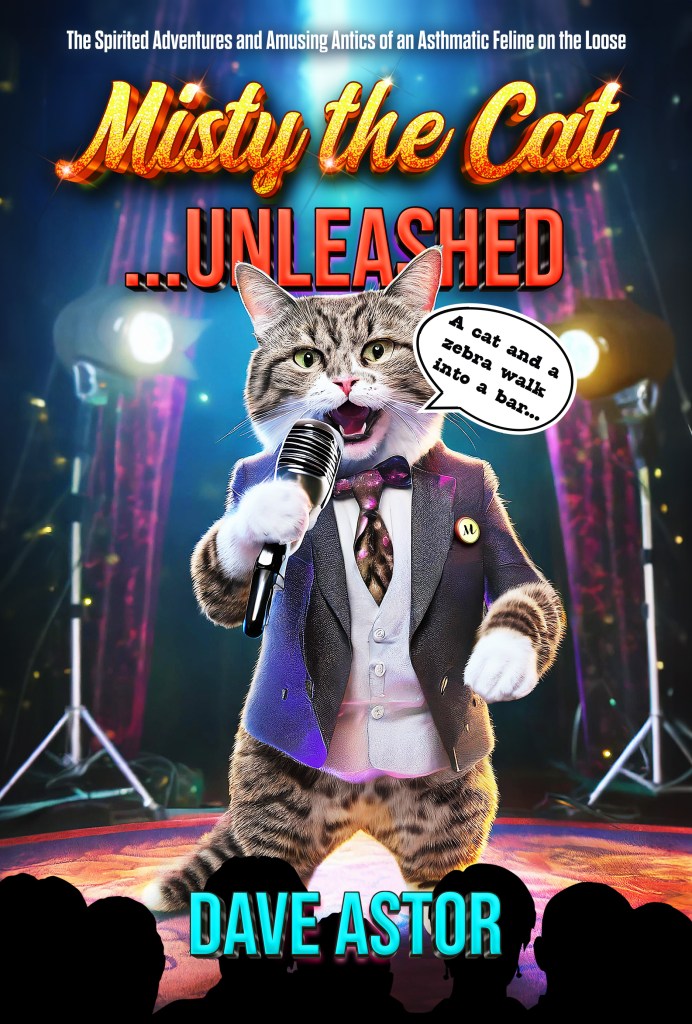
My comedic 2024 book — the part-factual/part-fictional/not-a-children’s-work Misty the Cat…Unleashed — is described and can be purchased on Amazon in paperback or on Kindle. It’s feline-narrated! (And Misty says Amazon reviews are welcome. 🙂 )

This 90-second promo video for my book features a talking cat: 🙂

In addition to this weekly blog, I write the 2003-started/award-winning “Montclairvoyant” topical-humor column every Thursday for Montclair Local. The latest piece — about the start of fall, a new library director, a new fire chief, and more — is here.
When Authors Become Municipal Auteurs

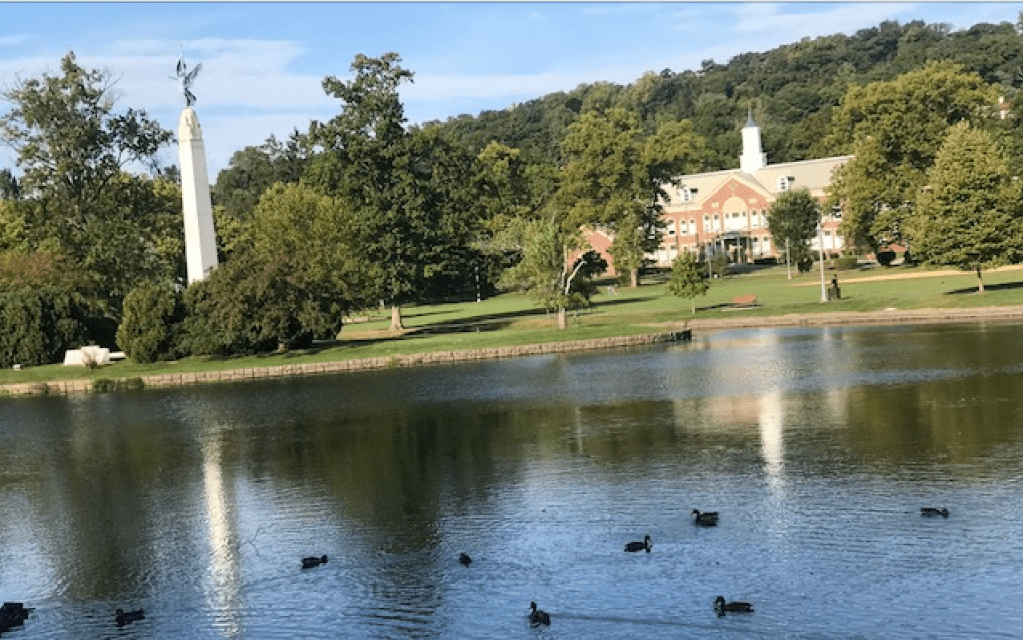
Edgemont Park in my town of Montclair, New Jersey. (Photo by me, 9-21-2024.)

I’m doing something different for this week’s blog post — reprinting my local “Montclairvoyant” humor column from this past Thursday, September 19. Why? This particular Montclair Local piece melds news in my New Jersey town with a literature theme. Some of my local references will not be understood by non-Montclair residents, but I think the column will still be an entertaining read as various famous novels and authors are mentioned.

My weekly Local column is always in a question-and-answer format — with me doing both the asking and the replying. So, I’m conversing with myself. Obviously, I have some psychological issues. 🙂

As usual with my weekly Sunday literature blog posts, there’s a link to my weekly Thursday humor column at the very end of today’s piece, where you can see local reader comments and my replies. Some weeks just a few exchanges, other weeks many.

DEAR MONTCLAIRVOYANT,

Montclair’s government operates under the Faulkner Act, which was explained at a recent meeting hosted by our two councilors-at-large. That Act gives a township manager lots of power, right?

Sincerely,

Clare Mont

Too much power, as granted by an Act named after late Montclair mayor Bayard Faulkner rather than author William Faulkner, whose 1932 novel Light in August chronicled 31 Montclair sunrises last month.

DEAR MONTCLAIRVOYANT,

Not true. But the Faulkner Act makes me think that other forms of local government could be named after novelists. Some examples, please?

Sincerely,

Nitwit for Lit

I’ll start with the Jane Austen Act, which mandates that 21st-century councilors wear clothes from the 1810s and put a needed-but-expensive new Municipal Building and Police Headquarters in Mansfield Park.

DEAR MONTCLAIRVOYANT,

There’s no such park in our town. What about the Stephenie Meyer Act, named after the author whose Twilight vampire novels have a high school setting?

Sincerely,

There Will Be Blood

That Act forbids Council meetings from taking place the same evening as Back to School Night, which was held at Montclair High on September 11. So, none of the impressive teachers that evening wore Dracula baseball caps.

DEAR MONTCLAIRVOYANT,

Are Dracula baseball caps even a thing? What about the Toni Morrison Act, named after the author of such novels as Beloved and Jazz?

Sincerely,

Sula Solomon

That form of government prevented the talented musicians at September 14’s Montclair Jazz Festival from going into executive session.

DEAR MONTCLAIRVOYANT,

A day later, the September 15-to-October 15 National Hispanic and Latino Heritage Month began, and it’s being celebrated in various ways in and near Montclair. Your thoughts as the parent of a Guatemalan-American daughter?

Sincerely,

Latina Heritage, Too!

I’m reminded of the Gabriel Garcia Marquez Act that allows a resident’s OPRA request to remain hidden for One Hundred Years of Solitude before the requested public records are released.

DEAR MONTCLAIRVOYANT,

That seems exaggerated. On September 18, a special election was held to fill the seat of the late U.S. Rep. Donald Payne Jr. in a congressional district that includes part of Montclair. Is there a form of government that evokes a political novel?

Sincerely,

G.O. Peeved

Yes, the Robert Penn Warren Act named after the All the King’s Men author born early enough (1905) to walk from his native Kentucky to New York City for the 1910 opening of the old Penn Station.

DEAR MONTCLAIRVOYANT,

Penn Station and Robert Penn Warren are not related. What about the Marcel Proust Act?

Sincerely,

Remembrance of Pings Past

That Act, named after an author known for his LONG multi-volume opus In Search of Lost Time, codifies Council meetings that last more than five hours — a frequent occurrence in Montclair. After midnight, a pumpkin turns into another pumpkin.

DEAR MONTCLAIRVOYANT,

Interesting take on Cinderella’s transportation. Is there a form of government that allows a resident to make a Council meeting public comment when not physically present at a Council meeting? (A resident currently can’t do that in Montclair.)

Sincerely,

Peak Speak

The Alexander Pushkin Act allows virtual commenting, but only if the resident has the same name as Pushkin characters Eugene Onegin or Tatyana Larina.

DEAR MONTCLAIRVOYANT,

Seems rather limiting. Other current councilors besides Montclair’s at-large ones have also held or will soon hold community meetings. Is there an Act besides the Faulkner law that encourages those welcome meetings?

Sincerely,

Feedback to the Future

Not the Anne Bronte Act, because that author wrote The Tenant of Wildfell Hall rather than The Councilor at Edgemont Park House.

My comedic 2024 book — the part-factual/part-fictional/not-a-children’s-work Misty the Cat…Unleashed — is described and can be purchased on Amazon in paperback or on Kindle. It’s feline-narrated! (And Misty says Amazon reviews are welcome. 🙂 )

This 90-second promo video for my book features a talking cat: 🙂

In addition to this weekly blog, I write the 2003-started/award-winning “Montclairvoyant” topical-humor column every Thursday for Montclair Local. The latest piece — which is reprinted in the above blog post — is here.

More Than One Ghost in This Post

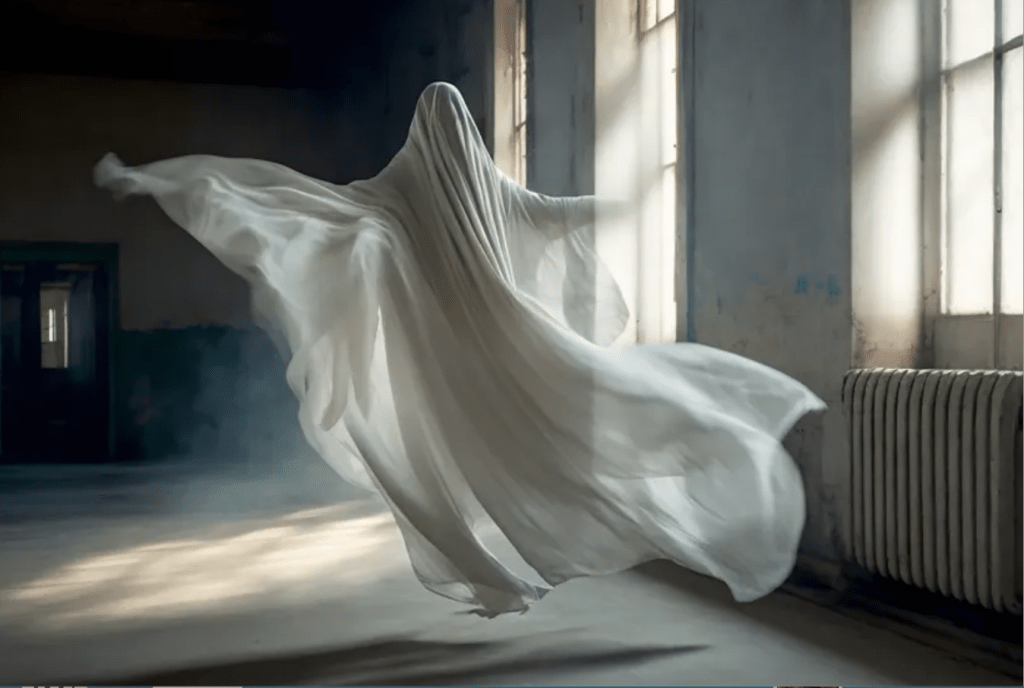
A petrifying poltergeist protagonist. (Getty Images.)

Halloween is still six weeks away, but I wanted to discuss novels and short stories that include ghosts (after having written somewhat-similar posts in 2016 and 2021).

Why? I recently finished Elin Hilderbrand’s The Hotel Nantucket, and while that compulsively readable 2022 novel includes many compelling characters and plot lines, the highlight might be the presence of a 1922-murdered ghost still floating around the book’s Massachusetts hotel in the 2020s. That specter is 19-year-old Grace Hadley, who is bitter, funny, mischievous, and good-hearted. She keeps up on 21st-century trends, too.

A brief interlude: Three more wonderful reviews of my Misty the Cat…Unleashed book have appeared! 🙂 Author/blogger Carolyn Haynes wrote one of them on September 8, “Purrs of Wisdom” blogger Ingrid King wrote another last month that I saw belatedly, and Geri Rombach wrote still another review for the current issue of Pet Scene magazine. Links near the end of this post. Thank you very much, Carolyn, Ingrid, and Geri! 🙂

Late last year, I read George Saunders Lincoln in the Bardo — populated almost exclusively by ghosts stuck in purgatory, including President Lincoln’s recently deceased son Willie. An odd novel that’s not exactly a page-turner, but haunting.

Also a ghost of sorts hovering between life and death is Nora Seed of Matt Haig’s intriguing The Midnight Library, which I read in 2022. While in the cosmic library of the novel’s title, Nora experiences various personal timelines that might have been.

I read Toni Morrison’s famed modern classic Beloved a number of years ago, but somehow neglected to include it in my aforementioned 2016 and 2021 posts. The formerly enslaved Sethe believes there is a spirit named Beloved who is the deceased daughter she killed to prevent her from becoming a slave.

Novels and stories with ghosts mentioned in my 2016 and 2021 posts include — among others — Charles Dickens’ A Christmas Carol, Peter Straub’s Ghost Story, Shirley Jackson’s The Haunting of Hill House, Henry James’ The Turn of the Screw, J.K. Rowling’s Harry Potter series (whose supernatural characters include the hilarious Peeves the Poltergeist), Edith Wharton’s many excellent ghost stories, Oscar Wilde’s humorous tale “The Canterville Ghost,” Graham Greene’s short shocker “Proof Positive,” and Dickens’ story “The Signal-Man.”

Ghosts in literature definitely give authors a chance to use their imagination, scare their readers, create dark humor, and more.

Any fiction with ghosts you’d like to discuss? And I should mention that ghosts rhyme with (blog) posts. 🙂

Carolyn Haynes’ review of Misty the Cat…Unleashed: 🙂

Ingrid King’s review: 🙂

Geri Rombach’s review: 🙂 It appears on page 35.

My comedic 2024 book — the part-factual/part-fictional/not-a-children’s-work Misty the Cat…Unleashed — is described and can be purchased on Amazon in paperback or on Kindle. It’s feline-narrated! (And Misty says Amazon reviews are welcome. 🙂 )

This 90-second promo video for my book features a talking cat: 🙂

In addition to this weekly blog, I write the 2003-started/award-winning “Montclairvoyant” topical-humor column every Thursday for Montclair Local. The latest piece — which includes a weird take on a valuable baseball card, a welcome change in gas station ownership, a too-big townhouse proposal, and more — is here.

Tracking Author Trajectories

The career trajectories of novelists can be very different — depending on how many good ideas are in their brains, how prolific these writers are, their health, their lifespans, sales, critical acceptance, whether the authors do series or stand-alone books or both, etc.

A brief interlude to say that Rebecca Budd — the wonderfully skilled Canadian podcaster and blogger who often comments here and who many of you know — interviewed me about my 2024 Misty the Cat…Unleashed book. You can click on the link near the end of this blog post to listen to the conversation.

Back to this week’s trajectories theme…

There are of course “one-hit wonders” — with a single published novel during an author’s lifetime — such as Emily Bronte (Wuthering Heights), Margaret Mitchell (Gone with the Wind), and (if one considers Go Set a Watchman an early draft of To Kill a Mockingbird) Harper Lee.

Then there are authors whose first or first few books are excellent and/or very successful before things either level off or go somewhat downhill. For instance, Gabriel Garcia Marquez’s and Joseph Heller’s best books were their debut novels One Hundred Years of Solitude and Catch-22, respectively.

Conversely, there are authors who start with so-so (at best) novelistic efforts and then quickly or more gradually hit their masterful strides. Examples of wordsmiths who took the fast-improvement route after mediocre debut books include Edith Wharton and Jack London (never thought I’d put those two in the same sentence 🙂 ). Those who did a slower build include Cormac McCarthy and Rosamunde Pilcher; actually, it wasn’t until she was in her 60s and had written more than 20 novels that Pilcher made a spectacular leap from good to great with The Shell Seekers.

Fyodor Dostoevsky started good (Poor Folk) and ended spectacularly (The Brothers Karamazov), with the amazing Crime and Punishment written in mid-career. George Orwell’s authorial career concluded with his two best novels: Animal Farm and Nineteen Eighty-Four. Of course, Dostoevsky and Orwell died before becoming “senior citizens,” so they might have penned some lesser works if they had lived longer.

Authors who started strong, continued strong through mid-career, and then did less well or didn’t publish as much in their later years? Mark Twain is among those who come to mind.

I’m leaving out some “categories,” but I’ll end by mentioning a number of authors who started out fairly or very strong and then sustained or are continuing to sustain that skill level for virtually their entire careers. Charles Dickens and George Eliot are past novelists among that group.

Living writers who’ve been churning out one excellent novel after another for decades include — among various others — Joy Fielding, Kristin Hannah, Barbara Kingsolver, Walter Mosley, Outlander series author Diana Gabaldon, and Jack Reacher series author Lee Child (who is gradually turning over his thriller franchise to younger brother Andrew).

If anything, several of the authors listed in my previous paragraph are doing some of their best work during the past few years. For instance, the 1955-born Kingsolver’s latest book (Demon Copperhead) won the 2023 Pulitzer Prize for fiction and her previous novel (2018’s Unsheltered) was terrific. I haven’t yet read the 1960-born Hannah’s latest novel (The Women) but her three releases before that (2021’s The Four Winds, 2018’s The Great Alone, and 2015’s The Nightingale) were among her very best. And the 1945-born Fielding hit home runs with Cul-de-sac (2021) and The Housekeeper (2022). I just read The Housekeeper, about a too-good-to-be-true aide who moves into the home of a gravely ill woman, and it’s a top-notch suspense thriller with a couple of knock-out surprises.

Your thoughts about, and examples of, this topic?

Rebecca Budd’s podcast: 🙂

My comedic 2024 book — the part-factual/part-fictional/not-a-children’s-work Misty the Cat…Unleashed — is described and can be purchased on Amazon in paperback or on Kindle. It’s feline-narrated! (And Misty says Amazon reviews are welcome. 🙂 )

This 90-second promo video for my book features a talking cat: 🙂

In addition to this weekly blog, I write the 2003-started/award-winning “Montclairvoyant” topical-humor column every Thursday for Montclair Local. The latest piece — about the start of the school year and another too-pricey new residential building in my town — is here.

When Museums Are Fictionally Exhibited

The Metropolitan Museum of Art in New York City. (Photo: Google Arts & Culture.)

Museums are interesting places, educational places, entertaining places, sometimes mysterious places, and sometimes intimidating places, so why not include them in some fiction?

I just read Metropolitan Stories, a group-of-short-tales-as-novel set in New York City’s renowned Metropolitan Museum of Art. Among the intriguing wrinkles in Christine Coulson’s 2019 book are the presence of some ghosts and the fact that paintings and sculpture in the Met’s massive collection can experience emotions, have memories, etc. There’s even a chapter that would have worked as a Twilight Zone episode. But Coulson also focuses on various flesh-and-blood museum staffers — some rather eccentric.

Also set at the Met is The Goldfinch, at least in the first part of Donna Tartt’s novel — when a tragic gallery bombing gets the sprawling, dynamic plot rolling. The 2013 book won the Pulitzer Prize for fiction.

The American Museum of Natural History in NYC is the setting for The Night at the Museum. While I haven’t read Milan Trenc’s 1993 children’s book, I did see the popular 2006 movie version in which we got to visualize the museum’s exhibits come to life after sunset. I think some of us have fantasized about that. 🙂

Getting out of NYC, among the Chicago locations where the two protagonists in Audrey Niffenegger’s 2003 novel The Time Traveler’s Wife find themselves are the Art Institute and the Field Museum. Being in places like that can telegraph things like a character’s education level and cultural awareness.

But not always. The working-class members of the wedding party in Emile Zola’s 1877 novel The Drinking Den feel out of place when they roam The Louvre in Paris, though of course there are plenty of working-class people who are avid museum-goers.

The Louvre is more prominent in Dan Brown’s 2003 novel The Da Vinci Code; for instance, that museum is where a certain curator (who’s also a leader of a secret society) meets his fate.

I know there are various other novels with at least partial museum settings. Any you’d like to name? Any thoughts on this topic?

My comedic 2024 book — the part-factual/part-fictional/not-a-children’s-work Misty the Cat…Unleashed — is described and can be purchased on Amazon in paperback or on Kindle. It’s feline-narrated! (And Misty says Amazon reviews are welcome. 🙂 )

This 90-second promo video for my book features a talking cat: 🙂

In addition to this weekly blog, I write the 2003-started/award-winning “Montclairvoyant” topical-humor column every Thursday for Montclair Local. The latest piece — about restaurants and other places no longer in my town, and the sad demise of a 250-year-old tree after a recent storm — is here.