Some famous novels just don’t live up to the hype for some readers.
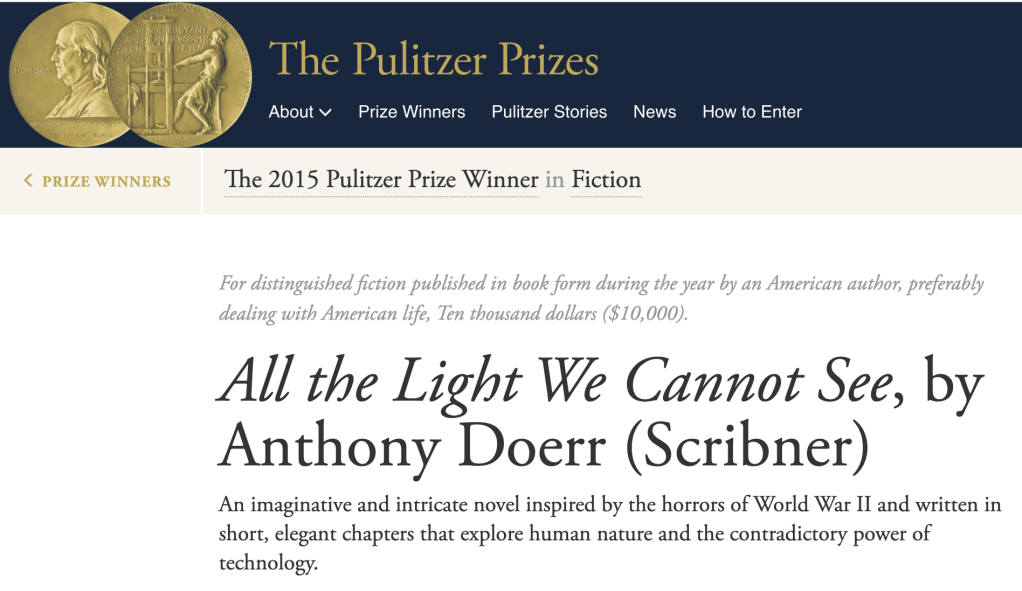
My latest experience with this involved Anthony Doerr’s All the Light We Cannot See, a bestseller that won the 2015 Pulitzer Prize for Fiction and, as of today, had amassed a whopping 228,425 reviews on Amazon — with an average rating of 4.5 out of 5 stars.
Not that I disliked Doerr’s 2014 book when I finally read it last week; I’d give it a B. But I was expecting more — more transcendence, perhaps.
As a number of you know, All the Light We Cannot See is a World War II novel that alternately focuses on gifted blind French girl Marie-Laure and German prodigy Werner, who was pulled into the Nazi war effort for his radio expertise. Will the two teens eventually meet?
Among my disappointments with the novel: Too long for its content. Writing that was periodically beautiful while periodically straining too hard to be beautiful. Constant jumping around in time that seemed unnecessary. Not as much dramatic tension as the circumstances would warrant. Some hard-to-believe coincidences. More than one major unresolved plot line. Etc.
I did like that the main part of the novel’s conclusion defied expectations. And, along with several interesting secondary characters, the young Marie-Laure and the young Werner were quite well-drawn amid the carnage of World War II’s battlefields.
Which reminded me of the title of this 2024 song:
Anyway, my feeling about All the Light We Cannot See is just one reader’s opinion; many people obviously love Doerr’s bestseller. But I have personally found quite a few World War II novels to be more compelling — among them several Erich Maria Remarque titles, Elsa Morante’s History, Kristin Hannah’s The Nightingale, Kate Quinn’s The Huntress, Leon Uris’ Mila 18, and Herman Wouk’s War and Remembrance, to name a few.
Another well-regarded novel that disappointed me was also a Pulitzer winner: Marilynne Robinson’s 2004-published Gilead, about a minister and his much younger second wife. I found a lot of the book boring — and its May-December marriage off-putting. Not my expected reaction given that I loved Robinson’s 1980 debut novel Homecoming. (Gilead was the author’s second book despite not arriving until 24 years later.)
Then there’s Mardi, a Herman Melville novel I finally read in 2022. Though it started quite well, and had some great writing, it eventually became overlong and tedious. After having previously read most of Melville’s novels, novellas, and short stories, it became my least favorite work of his.
A year later, in 2023, I very belatedly got to Dan Brown’s mega-bestseller The Da Vinci Code. An intricately plotted page-turner, but the often-clunky writing kept me from becoming completely engrossed.
When an author writes a masterpiece, another masterpiece is not super-likely to be in the offing. Such was the case with Amor Towles, whose A Gentleman in Moscow is absolutely terrific. I then read Towles’ The Lincoln Highway, which was excellent but didn’t reach the same rarified heights.
Hilary Mantel’s Wolf Hall has been widely acclaimed for, among other reasons, its rather quirky “third person present tense” writing style. I did kind of admire that approach (as well as the author’s prodigious research), but found the historical novel to be periodically confusing as I wended my way through…its rather quirky “third person present tense” writing style.
In a somewhat-related 2019 post, I mentioned several other novels that didn’t live up to my expectations — though I thought they still ranged from good to very good. They included Charlotte Bronte’s Villette, Donna Tartt’s The Secret History, and John Updike’s Rabbit, Run.
Any thoughts about, or examples of, this theme?
My comedic 2024 book — the part-factual/part-fictional/not-a-children’s-work Misty the Cat…Unleashed — is described and can be purchased on Amazon in paperback or on Kindle. It’s feline-narrated! (And Misty says Amazon reviews are welcome. 🙂 )

This 90-second promo video for my book features a talking cat: 🙂
In addition to this weekly blog, I write the 2003-started/award-winning “Montclairvoyant” topical-humor column every Thursday for Montclair Local. The latest piece — about the start of fall, a new library director, a new fire chief, and more — is here.
 Dave Astor on Literature
True, meant to write “ Pre-Revolution”
LikeLiked by 1 person
Certainly a golden age (Dostoevsky, Tolstoy, Turgenev, Pushkin, Gogol, Chekhov, etc.). I’ve also liked some later Russian writers such as Gorky, Bulgakov, Pasternak, and Ostrovsky.
LikeLike
I found Gabriel Garcia’s “ 100 years of solitude” very heavy and clunky with all the magic realism. I know it’s very acclaimed even got the author a noble prize and has sturdy fan following but I felt it wasn’t as good as it was made out to be. I believe it could be partly due to my own lack of understanding of the specific culture and social milieu or as my husband puts it due to “ my unrealistic expectations” …
LikeLiked by 1 person
Thank you, Tanya! I hear you — “One Hundred Years of Solitude” is not the easiest read. I liked it a lot overall, but I can understand people having some mixed feelings about it. And when a novel is considered to be among the greatest of its century, that’s a LOT of expectations to live up to.
LikeLiked by 1 person
I guess when assessing a literary work lot depends on one’s perspective and reading style. I’ve always had trouble finishing voluminous novels/ books so that could be a factor too in my take on “ One hundred….” Coz I liked Marquez ‘s other works such as “ Love in the time of Cholera”, “ Chronicles of Death Foretold” etc.. I can say same for the likes of Tolstoy and Dostoevsky, enjoyed their short stories more than their longer works.
LikeLiked by 1 person
I’m the opposite as far as Marquez goes; “One Hundred Years of Solitude” is my favorite of the four novels of his I’ve read. But I agree that a number of Tolstoy’s shorter works, such as “The Kreutzer Sonata” and “Hadji Murat,” are terrific!
LikeLiked by 1 person
That’s amazing to know Dave and you are correct some of the shorter works on Tolstoy are brilliant. Time and again I go back to the writings of post revolution Russian writers…. Thank you for sharing this amazing post as always!
LikeLiked by 1 person
Russia has indeed had some amazing writers from various eras, Tanya!
LikeLiked by 2 people
thanks much for visiting my site. I would be thrilled if you’d write a guest blog post for my site. If you think it might be fun or helpful to have my followers (who total about 10k across my various social media) meet you, here’s the link for general guidelines:
LikeLiked by 3 people
Thank you very much, da-AL! Unfortunately, my schedule is just too crazy to contribute to your excellent site. But I do appreciate the offer.
LikeLiked by 1 person
Now I see that you’d kindly let me know before. Which is to say that’s how much I enjoy your posts and sorry I forgot I’d already asked. Wishing you a great week ahead 😊
LikeLiked by 1 person
Not a problem, da-AL! It’s impossible to remember everything. 🙂 My schedule is actually now busier than when you last asked. 🙂 Thank you for the kind words, and wishing you a great week, too!
LikeLiked by 1 person
Hi! I would love your thoughts on Donna Tartt’s: The Secret History! I brought a copy last week and it’s waiting to be read! I understand and agree when you feel some books do not live up to the hype!!!
LikeLiked by 4 people
Thank you for the comment, Sharon’s Writers Tidbits! I liked but didn’t love “The Secret History,” though it was certainly impressive for a debut novel. 🙂 I thought Donna Tartt’s third novel — “The Goldfinch” — was fantastic!
LikeLiked by 1 person
Hi Dave! Thank you so much for your comments! Interestingly, I really want to read The Goldfinch! I’ve read some good reviews about it!! Thanks once again. Sharon
LikeLiked by 1 person
You’re very welcome, Sharon! “The Goldfinch” is one of those long novels that doesn’t seem long enough. 🙂
LikeLiked by 1 person
Thanks again Dave! ‘The Goldfinch’ will certainly be added to my list!!!
LikeLiked by 1 person
🙂
Hope you enjoy it!
LikeLiked by 1 person
Hi Dave
A few years ago I read Pearl S Buck’s “Pavilion of Women” which I enjoyed. Then you and bebe convinced me I also needed to read “The Good Earth” which I finished last night. I thought it started really strong and I could see why people rave about it, but in the end I was disappointed. I thought it went on too long and went in directions that bothered me. Then I thought I wonder what Dave’s topic is this week (a bit delayed for me as I’m on holidays and out of my normal routine) and can I make my disappointment fit? And as always, you seem to have created a topic that perfectly fits the book I just finished. I’d happily recommend Buck to anyone, but I found “The Good Earth” more a B+ than the A I was hoping for.
I haven’t read “All the Light We Cannot See” but it’s on my shelf. For some reason I’ve never been super keen to read it. Too much hype maybe? But thanks to this I’ll probably lower my expectations even more which might go in Doerr’s favour!
Sue
LikeLiked by 4 people
Thank you, Sue! Yes, definitely some books that start strong before fading somewhat — in some cases longer than they need to be.
And, yes, when a novel gets a LOT of hype, it’s not always to be trusted. If I lowered your expectations for “All the Light We Cannot See,” I guess I provided a service. 🙂
LikeLiked by 3 people
Absolutely agree about Mantel – I found that book very confusing.
LikeLiked by 4 people
Thank you, Senior reader! Unfortunate, because there were also a number of impressive aspects to “Wolf Hall.” But, yes, some definite confusion.
LikeLiked by 3 people
I read the first Harry Potter book to see what the hoopla was all about and was disappointed. But the movie was wonderful because the director brought all the characters to life. I tried to read the first “Twilight” book and could not finish it because the writing was so atrocious. There again, it was the movie that saved the series. The same with “50 Shades of Gray.”
LikeLiked by 5 people
Thank you, Dawn!
I agree that the “Harry Potter” movies were VERY well done — the first one, and the subsequent ones. (I also enjoyed the “Harry Potter” books.)
I’ve never read the “Twilight” or “50 Shades of Grey” books or seen the movies, but glad to hear you liked the films!
LikeLiked by 2 people
It must be the coward in me (who just might take up more room than I know) that read all the comments to the end in the hope that somebody writing in would name my disappointment,so that I might agree and slink off. But my entry is unmentioned,probably because most readers found more in it to love than I managed to do.
Which is not say I found nothing– the steeplechase, the harvest, the character of Anna’s slippery, convivial brother, the doings of a number of secondary characters too– I read with pleasure.
Bur overall, I felt underwhelmed,even knowing that the author considered it be his first successful attempt at writing a novel– despite having already written his most famous.
The character for whom the book was named remained a cipher overall, her motivations never quite clear to herself or me or the other characters, so far as I could tell. There seemed to be in her a driving,yet somehow innocent will to break free from conventions of every kind, yet no sense of how to live or what to live for once she tore herself away from family, lover and society.
And Kostya! His interminable yet vague musings on peasantry and its uses and essences yielded no book, despite the firmness of his intentions and the solitary studies he undertook, but ran through the novel like a promising seam in a mine that, after much sweat and digging, produced but a smattering of gold.
But I did find interest in the social conventions and strictures that dictated the behavior,or at least the well-ordered hypocrisy of most of St. Petersburg’s upper crust, and it was Balzacian, especially the way that adjustments were seamlessly made after the deadly incident at the railway station by all who knew the deceased, as if she had been an uncontrollable– if often beloved– irritant while she lived, who could now be covered until smoothed over and publicly forgotten, like a pearl in the shell of an absent-minded oyster.
It’s not that I regret having read it. If anything, I regret having waited so late in life to have taken it up. It was certainly worth reading, and I would even recommend it, but for me, its preceding reputation– Faulkner , when asked to name the three greatest novels, repeated the title of this one three times– led me to expect something I did not quite find in print.
I blame myself.
The novel? Leo Tolstoy’s Anna Karenina.
LikeLiked by 4 people
Thank you, jhNY! A superb and descriptive essay! I can see you liked “Anna Karenina” a good amount but didn’t find it to be A++. I’m actually kind of partial to Tolstoy’s novellas such as “The Kreutzer Sonata,” “Hadji Murat,” and “The Death of Ivan Ilyich.” That author didn’t always need to be long to be great.
As for Faulkner, a bit of “Anna Karenina” hyperbole on his part.
LikeLiked by 2 people
Thanks for the compliment– I could have gone on and on,and would have, were it not for the ‘th,dr’ phenomenon which even affects my own attention when surfing the interwebs. Basically, my disappointment revolves around the character of Anna.
As a portrait of a society on transition, for good or ill, emphasis on the top-drawer set, Anna Karenina is a wonder, especially for me, as juxtaposed with Petersburg, a novel by Andrei Bely, which takes place in 1905, and was published during the First World War.
Not so many years separate these novels,but the exhaustion of certainties held by the beneficiaries of a doddering, feudal social order is pervasive, as is the unrest and restlessness of the crowded streets. The fault-lines which will eventually shatter Russian society are visible in Tolstoy’s novel, but the whole holds clumsily together throughout.
I have read Petersburg, despite so many books so little time, twice. To Tolstoy’s novel, though pleasures and insight I missed the first time through no doubt await, I doubt I will return.
In the course of slogging through, I did manage to purchase the book twice, because one never is wise to bring a fat Russian novel to an Irish bar. After drinks, in celebration of my birthday, and not so much to forget, I left my first copy on a bench therein.
LikeLiked by 2 people
A bar is not a bad place to leave a novel. Maybe some customer will end up reading the book in addition to reading the label on their bottle of beer. 🙂
If a book offers an astute view of society along with depicting a character not quite as well as hoped, that’s still a novel worth reading.
LikeLiked by 1 person
Especially that particular bar, Swift’s Hibernian, named for the Dean, which features several varieties of whiskey, and the best Guinness on tap in the city, but no television. The likelihood of a reader finding the book there is high, and I’m happy to provide, now I’ve gotten over being a little mad I’d left it behind– way downtown and east, and far from my habitual stomping grounds.
As for the character of Anna, I’m not sure Tolstoy ever got past some notion of a resident and implacable depravity in her, whereas I thought she might have been better understood as a heedless person desiring to live in a state of absolute romantic happiness, in a world without states, a world of flux. He does not seem to be comfortable attempting to imagine her thoughts, but keeps his distance throughout.
LikeLiked by 3 people
I like the idea of a bar with no TV!
And a VERY interesting second paragraph. It can be hard for an author to truly get in the head of a character of the opposite gender.
LikeLiked by 1 person
I also had problems with Anna Karenina in the novel, she seemed like a melodramatic heroine in an otherwise realistic narrative. I found her the least believable major character in the entire novel.
LikeLiked by 2 people
Well said, Tony!
LikeLike
Maybe I worded it rather clumsily, but I meant that “Anna Karenina” was a better novel than “Jane Eyre” but Jane was a better written, more convincing character than Anna. I felt that Tolstoy disapproved of his protagonist morally even though he pitied her while Charlotte Bronte’s heroine was partly based on the author’s life and experiences.
LikeLiked by 1 person
Thanks for the clarification, Tony! Yes, Charlotte Bronte definitely had affection for, and related to, her Jane Eyre character. Jane was not as autobiographical as Lucy Snowe of “Villette,” but, from what I’ve read, did indeed have some of Charlotte’s qualities.
LikeLike
I also found that as a character, Anna was even less believable than Jane Eyre, even though as a novel “Anna Karenina” is far more realistic than “Jane Eyre” which is generally regarded as Gothic fiction.
LikeLiked by 1 person
I guess we differ, Tony — I found Jane Eyre to be very believable as a character. And I agree that Charlotte Bronte’s book had some Gothic elements, but I don’t think of it as Gothic novel per se.
LikeLike
If you press Ctrl + F you can search the page for something specific. Not that I’m suggesting you skip reading the comments as they’re often as enjoyable as Dave’s essays 🙂
I’ve read both “War and Peace” and “Anna K” and found Tolstoy as a whole to be disappointing. That could be me and my lack of attention span, or maybe I got a bad translation? I sometimes think about re-reading them, but they’re just so long! I can however recommend the short story “Master and Man” which Dave recommended to me some years ago and has stayed with me in a way that the longer novels didn’t.
LikeLiked by 3 people
Sue, I agree that Tolstoy’s short stories and novellas can be VERY appealing/compelling!
LikeLiked by 1 person
Despite my opener, I tend to read all the comments under Dave’s essay each week— but this time I was reading in hope I might join with someone else who found AK less in some ways than anticipated. I too have found more satisfaction in Tolstoy’s shorter fiction, but I did immerse myself happily for a few days in War and Peace many years ago, which is probably why I expected to be more appreciative of AK than I was.
LikeLiked by 1 person
I have not read any of the books you mention, but I have read a book that did not live up to my expectations.
Of Human Bondage.
It’s been awhile, but I remember thinking that it was dragging on and on. It drove me crazy, and I never did finish it. I read about 3/4.
Perhaps if I had read to the end, it would have redeemed itself to me, somewhat. However, I just couldn’t take it any more.
I can think of only 1 other book I started, and did not finish.
Like you say, Dave, “just one reader’s opinion”.
LikeLiked by 4 people
Thank you, Resa! I overall liked “Of Human Bondage” a lot, but it was indeed rather long — and the central relationship between Philip and the awful Mildred was excruciating. I thought the ending of the book was satisfying. I’m also a fan of several other Maugham novels: “The Razor’s Edge,” “The Moon and Sixpence,” “The Painted Veil,” and “Cakes and Ale.”
LikeLiked by 3 people
Ah, “The Razor’s Edge”. I’ve always meant to read that.
I know you liked this book, so thank you for understanding!
🤗
LikeLiked by 2 people
Not a problem, Resa. 🙂
“The Razor’s Edge” is definitely worth reading — and it’s a lot shorter than “Of Human Bondage.”
LikeLiked by 3 people
Yay! Thanks Dave! 🙂
LikeLiked by 2 people
🙂
LikeLiked by 3 people
I agree, Resa – it was long and a very difficult book for me to read, but I had to read it to the end as it was required reading (grade 11). I’m glad that I reached the conclusion because I had these takeaways: We are not alone in our struggle for identity and self-discovery. That human relationships are complex and unexplainable. That we behave contrary to what we perceive ourselves to be – that the freedom we seek may just be beyond our reach. And in the end, healing comes at unexpected times.
Would I read it again – no, but I am glad it was a required reading. At times, I had Frances, my mother read portions of it because the emotional content was too difficult for me to read alone.
LikeLiked by 3 people
I understand about Frances helping you read it. Your are so lucky!
I really like your take aways. Thank you for sharing those. They are great ideas/lessons to have learned.
Interesting that you say after all you got out of it – “Would I read it again – no, ”
I feel that way about “In Cold Blood”. (although non-fiction)
LikeLiked by 3 people
I agree with your assessment of All the Light We Cannot See. It had such potential.
LikeLiked by 5 people
Thank you, Leslie! The premise and the characters were definitely there; the execution of the storyline, not as much.
LikeLiked by 4 people
Hi Dave, I also enjoyed A gentleman in Moscow. It is often the endings of books that disappoint me. My Story Empire post tomorrow is about this very thing.
LikeLiked by 4 people
Thank you, Robbie! Nice to hear about another fan of “A Gentleman in Moscow.” 🙂 Such a great book. And, yes, endings of novels — even first-rate novels — can too often disappoint. Fortunately, I thought the conclusion to “A Gentleman in Moscow” was very satisfying. I look forward to your Story Empire post!
LikeLiked by 2 people
Yes, I agree that A Gentleman in Moscow was good.
LikeLiked by 3 people
🙂
LikeLiked by 3 people
Two 19th century classic novels that I found disappointing were “Madame Bovary” (no sympathetic characters), and “Jude the Obscure” (a convoluted and totally unbelievable ending).
LikeLiked by 5 people
Thank you, Tony! You’re right that those two novels do have some off-putting elements. I liked both, but didn’t absolutely love either.
LikeLiked by 2 people
I usually shy away from books (and movies for that matter) that are over-hyped. They set an expectation, and I feel that anything short of that will disappoint. I remember reading War and Remembrance well after the hype drained, and I enjoyed it. I remember reading The Hotel New Hampshire during the hype, and I was most disappointed.
I have to say, Dave, you write a very good negative review.
LikeLiked by 5 people
Thank you, Dan! 🙂 I tend to speak negatively of books sparingly; if I don’t like something, I usually just don’t write about it. But I imagine Anthony Doerr would not lose sleep over some obscure blogger publicly giving his blockbuster novel a B. 🙂
I admire your approach to the over-hyped! I also tend to avoid books and movies like that. But once in a while I’ll succumb, in order to see what the excitement is all about.
“War and Remembrance” and its “The Winds of War” prequel were brilliant! As for John Irving, he can get a little too cutesy, but I have liked some of his novels a lot — including “The Cider House Rules” and “A Prayer for Owen Meany.”
LikeLiked by 3 people
I have thought about your subject of this week, Dave, and I have come to the conclusion that, in my case, it may be that if I do not like a certain book very much, it can be that it is too difficult for me from the language level as well as maybe from that of science. I remember especially Shakespeare! Thank you very much for this thought – provoking post.
LikeLiked by 7 people
Thank you, Martina! Great points about language and science! Among the reasons why a person might not find a book to be as compelling (and readable) as expected.
I tried reading Shakespeare and Chaucer in the English of their times, and much preferred the modern-English versions despite those being less “authentic.”
LikeLiked by 5 people
It’s a pleasure to read about your experiences! 🙂
LikeLiked by 4 people
Much appreciated, Martina! 🙂
LikeLiked by 3 people
Hi Martina, I can see how language would be a problem. I can manage Shakespeare but Chaucer is impossible. I need a translation. When I read Divine Comedy, I thought about how lucky I was to read it as a translation into current English.
LikeLiked by 5 people
How nice to see that I’m in good company, Roberta, and I am thankful for your advice and emotions! Fortunately I saw some Shakespeare inspired operas a Verona, such as Macbeth and Falstaff by Giuseppe Verdi, Otello by Rossini or Hamlet by Ambrois Thomas.
LikeLiked by 4 people
I agree, Martina -Shakespeare should always be on a play or on a great film, and opera is more than wonderful.
LikeLiked by 5 people
How wonderful to hear this! Many thanks, Chris.
LikeLiked by 4 people
That is lovely, Martina
LikeLiked by 3 people
I also enjoyed the Divine Comedy (in English, of course). My one was from Dorothy L. Sayers – her translation and her introduction were both very well done, and that made all the difference, I thought.
LikeLiked by 5 people
absolutely, and let’s hope that everybody reached the top of the tree!
LikeLiked by 4 people
Dorothy L. Sayers was SO multi-talented!
LikeLiked by 3 people
I‘m sorry but I don‘t know this famous lady!
LikeLiked by 4 people
Martina, Dorothy L. Sayers was a great mystery novelist, among other things. 🙂
https://en.wikipedia.org/wiki/Dorothy_L._Sayers
LikeLiked by 3 people
Many thanks, Dave, for your kind information and I have already googled her and will certainly try to find out more about this very special lady!
LikeLiked by 2 people
You’re very welcome, Martina! 🙂
LikeLiked by 2 people
I also read that one, Chris. Thanks for adding your thoughts.
LikeLiked by 5 people
There’s no doubt that I approach books that have been highly praised with much higher expectations and am therefore more likely to be disappointed, even if the book is a B, as Dave says, and not an F. Since I’m a mystery writer, I expect a lot from mysteries that are hyped, and one that I actively disliked was GONE GIRL (2012). I guess I shouldn’t explain why since that would be a spoiler, but it’s about such unpleasant/awful, manipulative people that I had trouble finishing it, even though it’s a thriller. I need to have sympathy for at least ONE person in a book to enjoy it.
LikeLiked by 6 people
Thank you, Kim! Great point about higher expectations for highly praised books — expectations that are often not met.
I haven’t read “Gone Girl,” but it’s definitely as famous as “All the Light We Cannot See.” Sorry you weren’t a big fan, and, yes, a novel not having any sympathetic characters is not ideal. Without such a character, almost everything else about the book has to be amazing to make it appealing.
LikeLiked by 4 people
Thank you Dave!
LikeLiked by 4 people
You’re welcome!
LikeLiked by 2 people
Thanks for the review of All The Light… I have been wanting to read it, but I really hesitate doing so primarily because I loathe anything involving the history of the Nazi regime, truth or fiction. Consequently, it has to be a really exceptional book before I venture into the horror of it. Same with Zone Of Interest by Amis. I can’t bring myself to read it nor watch the movie. While part of me is curious, the other part of me knows I don’t have to go there, where all is dread and hopelessness. Seems a lot of books are becoming more and more like the movies or else the author has the movie of the book already in his/her head. As a result, the periphery is unneccesary just cut to the chase and summarize the rest. I think of authors like Henry James, Somerset Maugham, Tennesee Williams et al, whereas in their books the fascination lies in the many events and multitude of characters preceding said chase. What to some may appear tedious, to others is beautifully thorough. Interesting theme Dave. Again, thanks. Susi
LikeLiked by 5 people
Thank you, Susi! I hear you about novels featuring the Nazi regime. Beyond painful to relive that awful history. It IS satisfying to see that regime ultimately defeated in fiction as it was in real life, but at an unimaginable cost.
I also hear you about some books being too cinematic and not having enough buildup. Of course, someone like Henry James could be overly slow, especially in his later novels. But when he got the balance right (as in “The Portrait of a Lady”), it was wonderful.
LikeLiked by 2 people
Yea started on All The Light…but put it away. I agree about James–my fav being Turn Of The Screw which is definitely overly slow. Re: Nazis and James, I think I sent you that parody video of Hitler choosing to read Turn Of The Screw for his dictators book club. Ha. I’d like to say Nazism was defeated, but there remain some misguided individuals who keep trying to resurrect it. Yet this is the deal: they’ve never lived through it so they know not of what they speak. I mean the aftermath had to be as tragic. Having survived it only to spend the rest of one’s life wondering how it came to be, why it came to be and the utterly pointlessness of it, which in an odd manner kind of summarizes Turn Of The Screw. History and PTSD, seems there’s no way round it. Thank God for all the beautiful moments. Susi
LikeLiked by 4 people
So true, Susi, that the Nazis of 1933-1945 were defeated but versions of their sick views remain. 😦
I found “The Turn of the Screw” to be a little too subtle, but was still glad I read it.
And, yes, with all the bad in the world, the good moments are to be welcomed and cherished.
LikeLiked by 2 people
I agree on Kristin Hannah’s “The Nightengale” was a compelling novel, still stays with you after it ends. I think the next book I may take out of library is another light, “, Light Between Oceans” by ML Stedman, have you read this one, Dave?
Michele, E & P way back
LikeLiked by 4 people
Thank you, Michele! Yes, “The Nightingale” was riveting. I’m a BIG fan of Kristin Hannah’s novels.
I read “The Light Between Oceans” several years ago. Rather depressing, but excellent. (Yes, definitely a number of books with “Light” in their titles!)
LikeLiked by 2 people
Dave, I cannot speak much about disappointing Pulitzer winners, but have found this to be true of a few of the Booker Book Prize winners. I suppose the judges’ criteria don’t always align with storytelling that move us. With regards to Anthony Doerr’s “All the Light We Cannot See,” I did not read the novel but was very moved by the movie adaptation. War can bring out the best and worst in human nature. Yet, as occurred in World War II, all the light in us that we don’t usually see triumphed over evil. That light is still much needed in our times.
LikeLiked by 4 people
Thank you, Rosaliene, for the eloquent words! Glad you were moved by the screen adaptation of “All the Light We Cannot See”! Sometimes, that can distill the best parts of a novel. (I haven’t seen it myself.)
And, yes, sometimes the choices for prizes are head-scratchers.
As for World War II, it was indeed one of the rare wars in modern times that had to be fought.
LikeLiked by 3 people
🙂 ❤
LikeLiked by 3 people
🙂
LikeLiked by 3 people
It’s a bummer when you hear a lot of hype around a book or movie, and your experience doesn’t reach the expectations that the hype produced. I listened to the audio version of “All the Light We Cannot See” and enjoyed it. But I didn’t go in with super high expectations.
Recently, I picked up Isabel Allende’s “The House of the Spirits” — after hearing great reviews of the book. Well, I put it to the side after reading 100 pages. The style is summarizing. I don’t feel immersed in the story. For years, I grappled with the advice of “show, don’t tell” and the distinction between the two. I feel this book is a solid example of telling. I might come back to the book after a while, though, and read it in sections.
LikeLiked by 5 people
Thank you, Dave! Yes, it can be disappointing when expectations aren’t met. Mega-bestsellers definitely vary when it comes to whether they’re worth the hype or not.
“The House of the Spirits”? I actually liked it a lot, which goes to show that opinions of novels can vary a lot. One of the things I enjoy about literature and the discussing of literature. 🙂
LikeLiked by 4 people
I agree about discussing literature. It’s really neat to hear what other readers glean from books they’ve read. We can certainly have different experiences, and what we like about books.
LikeLiked by 3 people
Yes, that’s endlessly interesting! Different people indeed react to the same book in different ways.
LikeLiked by 3 people
Hi Dave, I think a lot of older classic books include a lot of telling. I’ve always thought that in the past, readers didn’t travel or know as much as modern readers so a lot more scene setting and description was included. I could read FR from the Madding Crowd it was so boring
LikeLiked by 4 people
An excellent observation, Robbie, about why older novels needed more scene-setting and description!
LikeLiked by 2 people
Good point about those older books 👍
LikeLiked by 2 people
😊🩵
LikeLiked by 3 people
An engaging post, as usual, Dave. I haven’t read the book which disappointed your expectations, but I’ve had similar experiences. I’ve just finished ‘Kairos’ by Jenny Erpenbeck, which won the Booker Prize this year. Having not kept up with what was going on in Booker Land I hadn’t heard of it, and had no expectations. I couldn’t resist buying it on special offer–but it didn’t quite work, for me. I won’t go on about that, but my review will be posted in the next few weeks. Before now–and I’ll probably get shouted down for this–I couldn’t get on with Gabriel Garcia Marquez. I tried ‘Love in the Time of Cholera’, thought it was probably me, so tried ‘One Hundred Years of Solitude’. No. Sorry. Neither worked. I suspect a knowledge of the history of GGM’s native Colombia is needed to understand the subtleties of his writing, and maybe it loses in translation. Whatever the cause, I won’t be reading anymore of his. I’ve never read ‘The Da Vinci Code’, and somehow I don’t feel like I’m missing out. I’ve tried to watch the film twice, and fallen asleep on both occasions. ‘Villlette’ I studied for A level, and yes, Lucy Snowe is a bit of a pain. I found it mostly interesting for its basis in her time working in Belgium and falling in love with the married M. Heger, then using him in ‘The Professor’ and later in ‘Villette’. Overall, I guess when books are marketed as something extra-special they’re set up for a fall from the start! 🙂
LikeLiked by 5 people
Thank you, Laura! Many interesting elements in your comment!
Gabriel Garcia Marquez is certainly not an easy writer. I first read his “One Hundred Years of Solitude” and had some difficulty getting absorbed in it but ended up thinking it was really impressive and compelling. I found “The General in His Labyrinth” often tedious, and “Chronicle of a Death Foretold” so-so. “Love in the Time of Cholera” had a number of great moments, but much of it felt very sexist.
“Villette” also has a number of great moments, and, as you noted, its autobiographical elements are fascinating.
I totally agree with your last line!
LikeLiked by 4 people
Thank you, Dave. I’d never ‘trash’ the merits of a book just because it wasn’t to my personal taste – and I’ve read some books of which I wasn’t expecting much but ended up loving. Just the way it goes, I suppose. 🙂
LikeLiked by 3 people
Yes! That’s the flip side! Low or middling expectations before loving a novel can be thrilling for a reader. I’ve recently experienced that with Elin Hilderbrand; I wrongly expected her novels to be almost totally escapist but found them to have some important things to say in addition to being entertaining.
LikeLiked by 3 people
I think I like that more than being disappointed by an overhyped book – being surprised at how good an underhyped one is. 🙂
LikeLiked by 3 people
I agree that that’s a more appealing scenario! 🙂
LikeLiked by 3 people
I couldn’t get into One Hundred Years of Solitude either, Laura. A total mismatch between that book and me. I’ve come to accept that sometimes happens, just like with people. There are enough other books not to worry about it.
LikeLiked by 3 people
I’m glad it’s not just me. I’m okay with Magic Realism elsewhere, in Salman Rushdie for example, but this just didn’t work for me. As you say, no need to worry about it, just a pity. 🤔
LikeLiked by 4 people
Oh, Dave – this post is serendipity for I have recently encountered the same feeling of disappointment. I understand that in the literary world, certain books gain fame and accolades, often hailed as masterpieces by critics and readers alike. But, sometimes I simply do share their enthusiasm. Perhaps my disconnect may stem from personal taste. I recognize that what resonates with one reader may not strike a chord with me. The themes, writing style, or even the cultural context of a celebrated book can feel alien to my experience. The question I ask myself – should I abandon a book? After all, shouldn’t reading be an enjoyable and enriching experience?
The decision of whether to abandon a good book simply because I do not like it is a complex one for me. Literature often serves as a reflection of diverse experiences and perspectives, offering insights that may not resonate with everyone. Abandoning a book simply due to personal dislike can limit my understanding and appreciation of different narratives. I think that there is a balance somewhere that everyone must find for themselves.
I am currently reading “The Dovekeepers” by Alice Hoffman, which has not captured my imagination as, for example, “The Weight of Ink” by Rachel Kadish. (I know – everyone loves Alice Hoffman). But here is the interesting part. I can’t put the book down. Alice Hoffman’s style of writing, her complex characters draws me ever closer to the narrative. Perhaps that is the balance that I’m looking for!!
“I wept to think that life went on even when so much had been lost, that rain still fell and myrtle grew between the rocks.” Alice Hoffman, The Dovekeepers
LikeLiked by 10 people
Thank you, Rebecca! Many great thoughts and astute observations!
Yes, personal taste is a big factor in whether we’ll end up liking a widely popular novel.
It sounds like there is enough in “The Dovekeepers” to keep you going, and I understand. A novel can be well worth reading even if it’s not completely riveting us. I’m glad I read “All the Light We Cannot See” even though it was more a B than A experience for me. B is still a good grade, and it can also be interesting to see if a bestselling, prize-winning book lives up to the hype. Curiosity is a strong motivation!
As for giving up on a book or not, I’ve found that I’ve been doing that more as I grow older. Only so many years left to read, and I might as well spend that reading time not torturing myself. Still, I’ll finish at least nine of every 10 novels I start, even as the ratio might have formerly been more like 49 of every 50.
LikeLiked by 5 people
I agree – curiosity is a very strong motivation!!!! As Frank Zappa said so well: “So many books, so little time.”
LikeLiked by 5 people
An all-time quote by Frank Zappa! 🙂
LikeLiked by 3 people
Profound comment Rebecca….. and Dave I felt the same re Wolf Hall. I gave up on it eventually. But I have enjoyed other Mantel books.
LikeLiked by 6 people
Thank you, Shehanne! I suppose I should try another Hilary Mantel novel. 🙂
I managed to finish “Wolf Hall,” but it was a bit of a struggle.
LikeLiked by 3 people
I think highly of her A Place of Greater Safety, about the French Revolution. It took me two readings to conclude that, however. Her use of point of view is extremely skillful.
LikeLiked by 3 people
Thank you, Audrey, for that mention of another Hilary Mantel book! Her writing skill and a major historical event like the French Revolution sound like a potent combination.
LikeLiked by 2 people
You’re welcome, Dave. It can be tough reading at times, as you may expect.
LikeLiked by 2 people
Yes! 🙂
LikeLiked by 2 people
I was really looking forward to it. But it just didn’t click. and yet like that the accolades…
LikeLiked by 3 people
Many thanks, Rebecca, for your feelings and I just would like to tell you that I loved The Weight of Ink!
LikeLiked by 4 people
It was a wonderful narrative Martina. She had a great way of going back and forth in time!!!
LikeLiked by 4 people
And, I think, it also asked for quite some courage,effort and renunciation to achieve success!
LikeLiked by 3 people
Hi Rebecca, for me reading is a pleasure so if a book doesn’t interest me then I TNF it. I have treated several books this way including War and Peace. The behaviour of the characters just irritated me to much.
LikeLiked by 3 people
I know exactly what you mean, Robbie. I used to believe that once I started a book, I had to finish it, but I’m realizing that time is precious. I simply don’t have the luxury to read books that aren’t right for me.
LikeLiked by 2 people
Exactly 😊
LikeLiked by 3 people
I absolutely loved A Gentleman in Moscow.
LikeLiked by 5 people
Thank you, Jennifer! I agree — a fantastic/beautifully written novel with a surprising amount of depth, action, and intrigue considering that almost of all it takes place inside a hotel.
LikeLiked by 4 people
Exactly! They’ve made a series out of it on
Showtime but I haven’t seen it.
LikeLiked by 3 people
I haven’t seen that 2024 series, either; I hope it did the book justice.
LikeLiked by 3 people
I haven’t read All the Light yet so can’t comment. My biggest disappointment was Go Set a Watchman by Harper Lee. I actually wished I hadn’t read it.
LikeLiked by 7 people
Thank you, Darlene! I totally hear you.
I decided not to read “Go Set a Watchman” when it came out after hearing a good deal of negative stuff about it (Atticus Finch having a less-admirable personality, the sick/elderly Harper Lee perhaps not being in a state of mind to have really approved the publication, the money-grab nature of the publication, “GSAW” being billed as a different novel when it was probably an early draft of “To Kill a Mockingbird,” etc.).
LikeLiked by 5 people
You were wise not to read it. I hadn’t planned to but it was on a charity sale table for one euro so thought I would check it out. Big mistake.
LikeLiked by 3 people
I would have tried to read it, too, if I had spotted it as a bargain at a charity sale. 🙂
LikeLiked by 3 people
I decided the same. It was published so long after her death that from the outset it seemed to be a money-making venture by the administrators of her estate. From what I’ve heard about it I suspected it to be a first–or at least early-draft of ‘To Kill A Mockingbird’, and plenty of others seem to agree, yourself included, Dave. It seems to have died a death since.
LikeLiked by 3 people
Thank you for your thoughts, Laura! Yes, “Go Set a Watchman” has not endured in a significant way since its 2015 publication. I hope Harper Lee’s estate didn’t make tons of money from it, but it probably did. 😦
LikeLiked by 3 people
I suspect you’re right, unfortunately. A great shame – I liked remembering her as one of those authors who only published one book – but what a book! I still think of her that way, of course, given my opinion of ‘Watchman’, but it tarnishes her reputation somehow. 😦
LikeLiked by 3 people
Yes, some tarnishing of Harper Lee’s legacy, but not really her fault. Given that “GSAW” was probably an early draft of “TKAM,” her one-book-wonder status remains intact, as you note. 🙂
LikeLiked by 3 people
Thank goodness. 🙂
LikeLiked by 4 people
🙂
LikeLiked by 3 people
I remember being actually shocked at how clunky the writing was in The DaVinci Code. One novel I remember being disappointed with is Bret Lott’s Jewel, which was his second novel after The Man Who Owned Vermont, which I loved. One thing I’ve noticed is that some debut novels are followed by second novels that just don’t measure up. I have the sense that the debut novel is based on personal experience, while the second novel isn’t. (Of course, I could be just talking through my hat.)
LikeLiked by 7 people
Thank you, Liz! Yes, “The Da Vinci Code” writing is QUITE clunky; I suppose the compelling plot helped to at least partly make up for that. And while I haven’t read any subsequent books by Dan Brown, I assume his writing improved. I remember that the first “Harry Potter” book, while brilliant in terms of story and characters, was not especially well-written; J.K. Rowling’s writing quickly got better.
And, yes again, there can be a “sophomore slump” with a second novel — and the reason you mentioned for that sounds very plausible.
LikeLiked by 5 people
You’re welcome, Dave!
LikeLiked by 3 people
🙂
LikeLiked by 3 people
I recently read the debut novel, Remarkably Bright Creatures by Van Pelt, because so many friends loved it, and I had a hard time getting past the intelligent/communicative/talking octopus, which seemed like a manipulative literary device. What was the point? If her second novel includes a talking animal, I will skip it.
LikeLiked by 7 people
Thank you, Madeline! I’ve heard about “Remarkably Bright Creatures,” but haven’t read it. Given that I recently wrote a book “narrated” by a cat, I suppose I’m not against talking animals in books. 🙂 Perhaps Misty the cat and the octopus can have a televised debate. 🙂
LikeLiked by 5 people
I liked Remarkably Bright Creatures, octopus and all. 😊
LikeLiked by 4 people
I love how a book can evoke different opinions!
LikeLiked by 3 people
It happens all the time! I’m always looking for novels that are different from anything else I’ve read and this one fit the bill. 😊
LikeLiked by 3 people
Great to read a variety of fiction!
LikeLiked by 3 people
Five of the seven people in my book club liked (or even loved) RBC; two of us, not so much. Six of us loved the Guncle; one gave up on it after the first few pages. I, too, love the different reactions.
LikeLiked by 3 people
Madeline, it can be admirable to be in the minority — and it takes some courage to express that to the majority.
LikeLiked by 2 people
Your cat is funny. The octopus…well, I look forward to the debate.
LikeLiked by 3 people
Thank you, Madeline! 🙂 I appreciate that!
Ha! 😂 I think Misty would narrowly win the debate 9-8. (Nine cat lives vs. eight octopus arms. 🙂 )
LikeLiked by 2 people
Thank you to Susi, M.B. Henry, Mary Jo Malo, Mary Kay Fleming, and Terri Barnes for mentioning “All the Light We Cannot See.”
LikeLiked by 4 people