Nice Characters: a Morale Boost in Fiction’s Roost

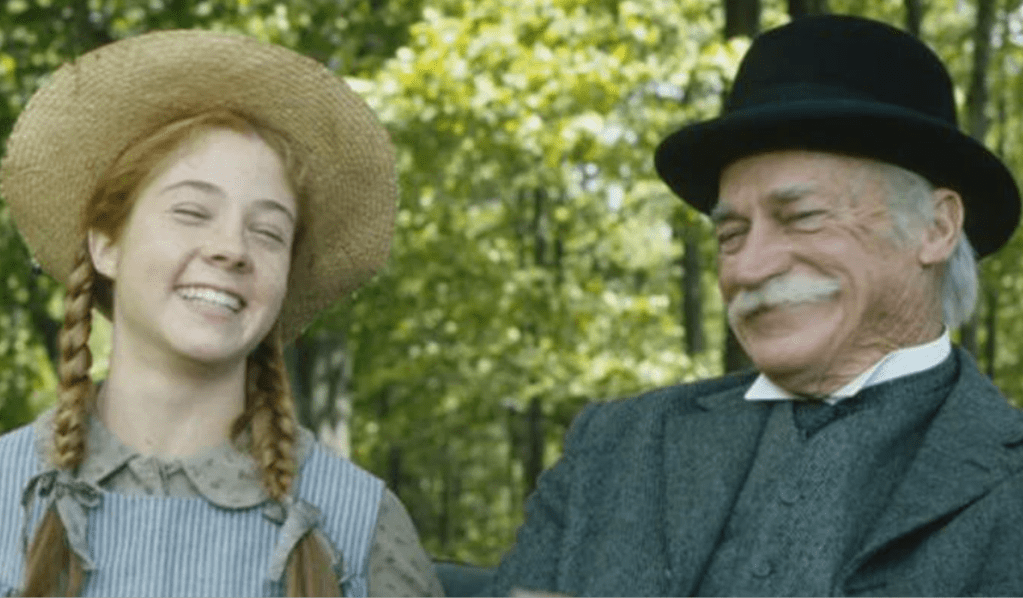
Megan Follows as Anne Shirley and Richard Farnsworth as Matthew Cuthbert in 1985’s beloved Anne of Green Gables screen adaptation.

With all the scary real-world stuff happening (that has nothing to do with Halloween), it’s good to think positive…about nice characters in literature.

Those characters can be admirably nice or cloyingly nice, but they’re…nice. (Even as they, like most people, usually have some flaws.) They can also be boring or interesting, with some of them interesting enough to carry a novel and others needing “villains” to play off of — possibly to be victimized by or possibly to triumph over. The latter scenario is of course heartening wish fulfillment when it occurs.

Nice characters come from all walks of life. For instance, Sonya — a beacon of goodness and decency in Fyodor Dostoevsky’s oft-disturbing classic Crime and Punishment — is a drunkard’s daughter forced into prostitution to help her family.

There are also moral religious characters such as Helen Burns, the very kind classmate of the young Jane Eyre in Charlotte Bronte’s equally classic novel. (It should be noted that it’s hardly a given a religious person will be moral.)

Another 19th-century-literature character in the kind category is Fanny Price of Mansfield Park. Super-nice but rather on the boring side, unlike Jane Austen’s usually fascinating female protagonists.

A more interesting 1800s character with a kind nature is Denise Baudu, the young countrywoman who moves to Paris to work in a pre-Walmart-like department store in Emile Zola’s The Ladies’ Delight.

And young Eva of Uncle Tom’s Cabin is positively angelic. Sort of one-dimensional but a potent contrast to another of Harriet Beecher Stowe’s white characters — vicious slaveowner Simon Legree — in a rare 19th-century novel with a multiracial cast giving African-Americans (such as Tom, Eliza, and George) prominent roles.

Going back further in time, the titular Joseph Andrews of Henry Fielding’s satirical 18th-century novel is comically pure of heart.

Very nice characters in 20th- and 21st-century fiction? Among the many are shy Matthew Cuthbert, who becomes Anne Shirley’s beloved adoptive father in L.M. Montgomery’s Anne of Green Gables; masochistic-until-he’s-not Philip Carey, who eventually becomes a physician in W. Somerset Maugham’s Of Human Bondage; caring, disease-stricken Jamie Sullivan in Nicholas Sparks’ A Walk to Remember; and altruistic Subhash in Jhumpa Lahiri’s The Lowland.

There are also admirably good characters who become full or sort-of social/political activists — including lapsed reverend Jim Casy in John Steinbeck’s The Grapes of Wrath, attorney Atticus Finch in Harper Lee’s To Kill a Mockingbird, reproductive-rights advocate Dr. Wilbur Larch in John Irving’s The Cider House Rules, the anti-dictatorship Mirabel sisters in Julia Alvarez’s In the Time of the Butterflies, and the anti-police-brutality teen girl Starr Carter in Angie Thomas’ The Hate U Give.

Thoughts about, and examples of, this topic?

Misty the cat says: “I’m editing a manuscript.”

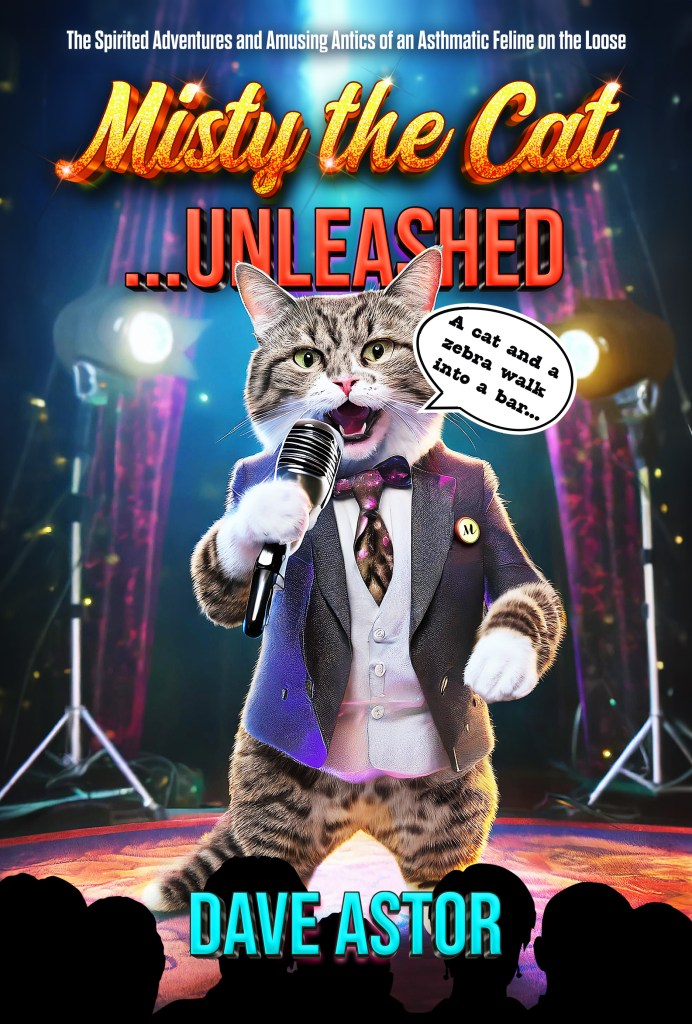
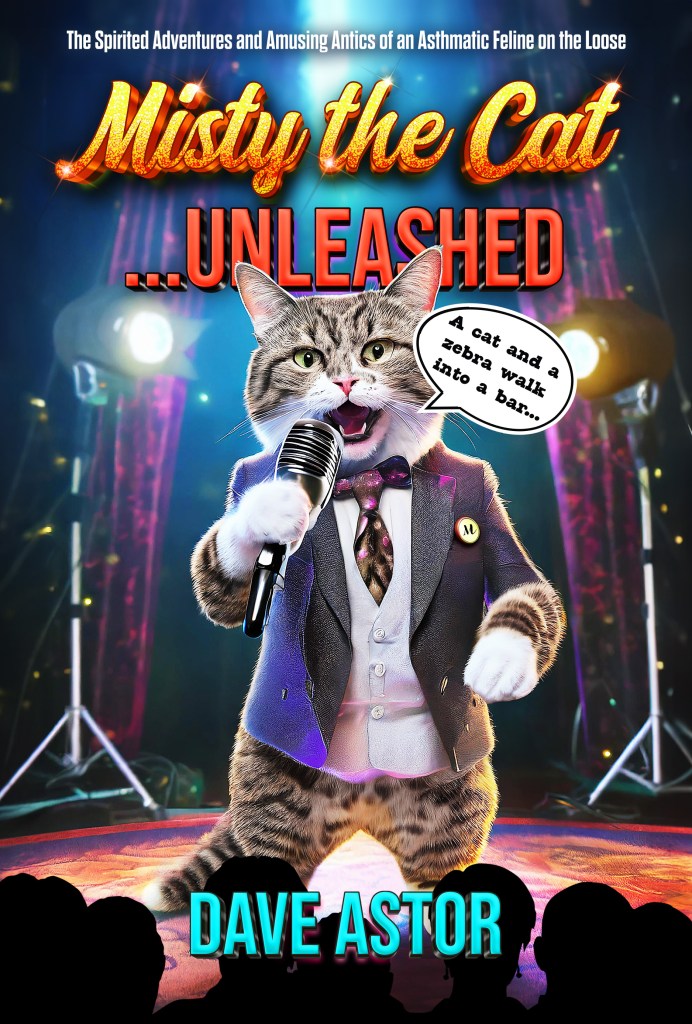
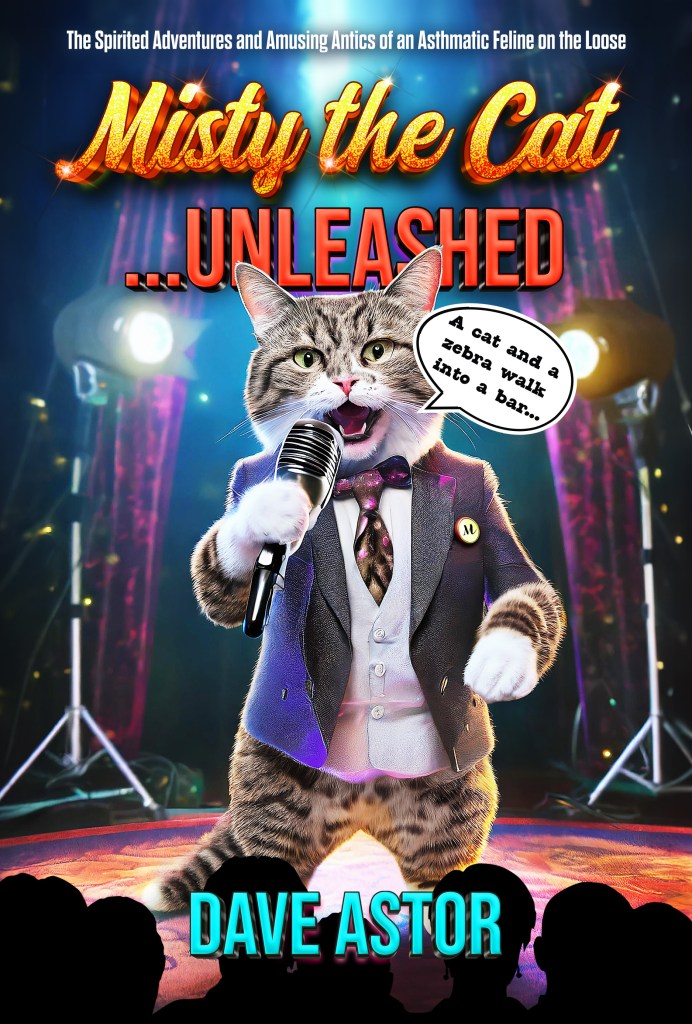
My comedic 2024 book — the part-factual/part-fictional/not-a-children’s-work Misty the Cat…Unleashed — is described and can be purchased on Amazon in paperback or on Kindle. It’s feline-narrated! (And Misty says Amazon reviews are welcome. 🙂 )

This 90-second promo video for my book features a talking cat: 🙂

In addition to this weekly blog, I write the 2003-started/award-winning “Montclairvoyant” topical-humor column every Thursday for Montclair Local. The latest piece — featuring a pre-Halloween theme — is here.
Portraying Betraying

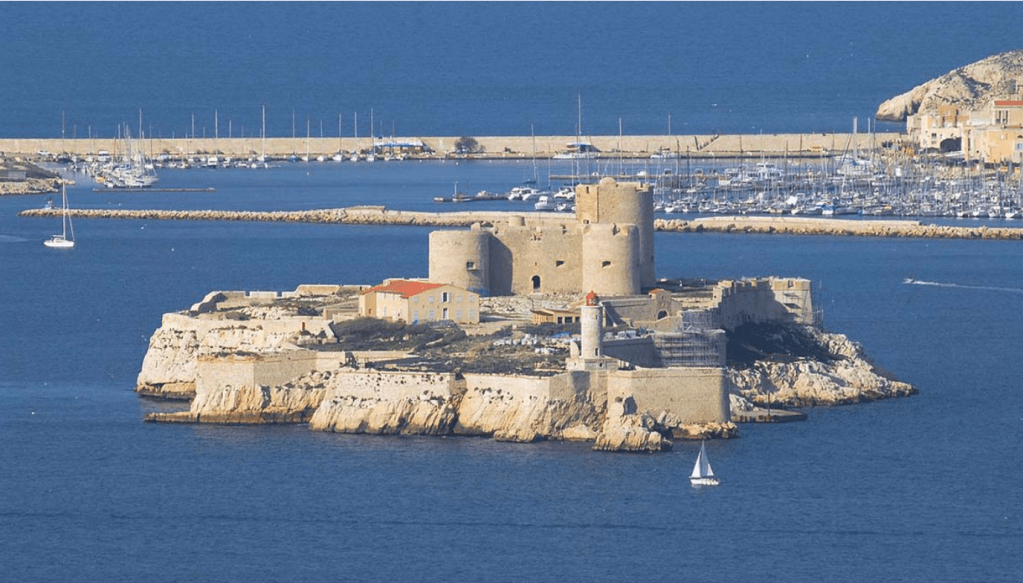
The Chateau d’If, where Edmond Dantes was imprisoned in The Count of Monte Cristo.

Betrayal is a Harold Pinter play, and betrayal in novels is the subject of this blog post.

Literature with a betrayal element can make for intense reading. We feel sympathy for the betrayed, anger at the person doing the betraying, curiosity about whether the betraying person will get their comeuppance, and more.

The Bad Daughter, a Joy Fielding novel I just finished, includes plenty of betrayal — most notably perpetrated by a vile real-estate developer who betrays his son by marrying that son’s fiancĂ©e and at the same time betrays one of his daughters because that fiancĂ©e was also the daughter’s best friend. Is the father’s betraying action why he gets shot in the book? The Bad Daughter is a suspenseful page-turner with several skillful red herrings, but is unfortunately marred by a surprise ending that doesn’t feel believable.

Another nasty/betraying dad not respectful of boundaries is Fyodor Karamazov, who’s enamored with the same woman (Grushenka) his son Dmitri is in love with in Fyodor Dostoevsky’s The Brothers Karamazov.

Monumentally betrayed is Edmond Dantes, who’s framed for a crime he didn’t commit in Alexandre Dumas’ The Count of Monte Cristo. A long imprisonment and epic revenge ensue.

Another 19th-century classic containing a memorable betrayal is George Eliot’s Silas Marner, whose title character is done wrong by his supposed best friend. This devastates Silas and changes the trajectory of his life in two profound ways — one bad and one good.

Modern fiction offers many other betrayals in addition to those in The Bad Daughter. For instance, the title character in Toni Morrison’s Sula and Nel are best friends when growing up, but Sula later has an affair with Nel’s husband. In Khaled Hosseini’s The Kite Runner, a cowardly Amir betrays his friend Hassan by not intervening when Hassan is attacked — and Amir’s longtime guilt subsequently drives the plot. Ian McEwan’s Atonement features a teen girl who betrays her older sister and that sister’s boyfriend by not-so-mistakenly accusing him of a rape he didn’t commit.

Betraying one’s country is also a thing, as Benedict Arnold did during the Revolutionary War. Arnold is among the real-life American notables who have cameos in Diana Gabaldon’s (mostly) 18th-century-set Outlander series.

Any thoughts about, and/or other examples of, this theme?

By referencing a memoir during his leashed walk this morning, Misty the cat doesn’t betray book readers. (Alternate quip to the one on YouTube: “From Kazuo Ishiguro’s The Remains of the Day to Misty the cat’s The Remains in the Bray.”)

My comedic 2024 book — the part-factual/part-fictional/not-a-children’s-work Misty the Cat…Unleashed — is described and can be purchased on Amazon in paperback or on Kindle. It’s feline-narrated! (And Misty says Amazon reviews are welcome. 🙂 )

This 90-second promo video for my book features a talking cat: 🙂

In addition to this weekly blog, I write the 2003-started/award-winning “Montclairvoyant” topical-humor column every Thursday for Montclair Local. The latest piece — about Columbus Day vs. Indigenous Peoples’ Day, and with more about a possible moratorium on artificial-turf fields — is here.

Say Hi to a Certain Kind of Hybrid Fiction

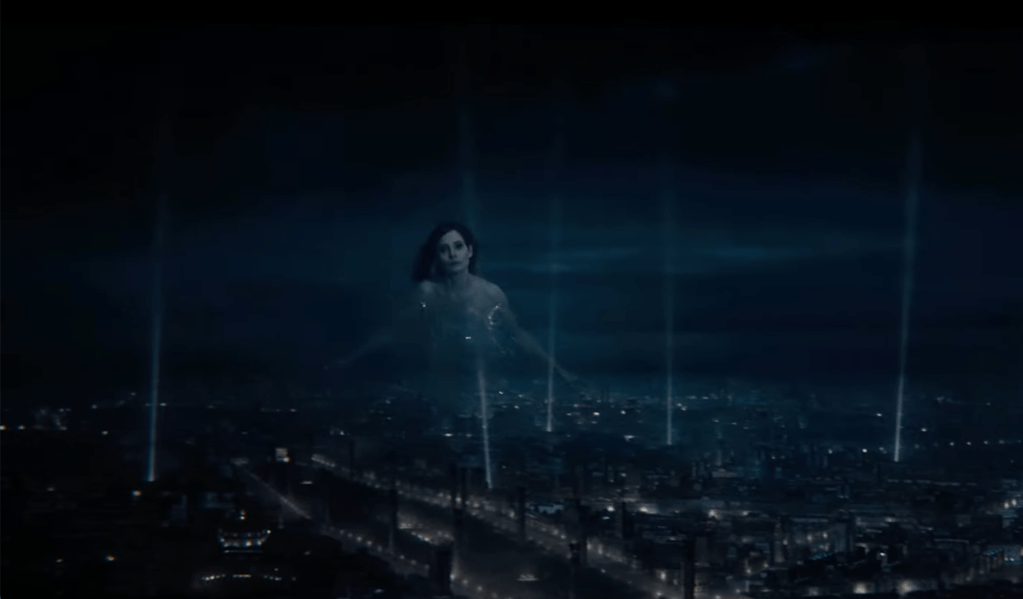
Flying without an airplane in The Master and Margarita. (Screenshot by me.)

Most novels are basically realistic, but quite a few others — including those in genres such as sci-fi, fantasy, time travel, and ghost fiction — are, shall we say, imaginative.

Then there novels that fall somewhere in between: containing a little or a lot of the magical/supernatural, yet also grounded in actuality — making for a potentially fascinating mix. Those hybrid-ish books are the subject of today’s blog post.

I just read Elin Hilderbrand’s The Matchmaker, an excellent novel about the life and work of Nantucket woman Dabney Kimball Beech — whose long-ago love returns to the Massachusetts island after 27 years as a foreign correspondent. All is pretty much realistic, except Dabney has the power of knowing if a potential couple is or isn’t made for each other by the color of an aura she sees surrounding them. Dabney has “arranged” 42 still-intact marriages over the decades — even as her daughter Agnes is in a toxic relationship that Dabney had warned against. What happens with them and other characters makes for compelling reading of the uplifting and tragic variety.

Another supernatural-type moment in an otherwise mostly realistic novel is when the title character in Charlotte Bronte’s Jane Eyre hears Edward Rochester’s anguished voice from a distance way too far to have actually heard his voice. A reader might initially think this pivotal occurrence was Jane’s imagination, but the novel makes it clear it wasn’t.

All-too-real domestic violence perpetrated by a brutal police officer against his wife is a major focus of Stephen King’s novel Rose Madder, but things eventually take a turn to the fantastical when people can literally enter a painting. Which reminds me of Jasper Fforde’s novel The Eyre Affair, in which people can literally enter the pages of Bronte’s aforementioned classic.

Then there’s “magical realism” — the very name of which says this genre of fiction combines the material and the mystical. For instance, some people fly in Gabriel Garcia Marquez’s One Hundred Years of Solitude, and the character Clara in Isabel Allende’s The House of the Spirits possesses paranormal powers. Also, “father of magical realism” Jorge Luis Borges wrote short stories that included such things as a library of infinite size.

In Mikhail Bulgakov’s The Master and Margarita, there’s also a character who flies sans airplane — as well as a magical skin ointment that creates invisibility and, most notably, the appearance of Satan among humans.

J.K. Rowling’s Harry Potter series? Mostly set in the wizard world, but there are also various scenes in the human (Muggle) world where a young Harry lived for more than a decade.

Your thoughts about, and examples of, this topic?

Not ghost fiction but ghost fact: In the video below, my cat Misty encounters a pre-Halloween decoration during his daily leashed walk this past Friday morning. 

My comedic 2024 book — the part-factual/part-fictional/not-a-children’s-work Misty the Cat…Unleashed — is described and can be purchased on Amazon in paperback or on Kindle. It’s feline-narrated! (And Misty says Amazon reviews are welcome. 🙂 )

This 90-second promo video for my book features a talking cat: 🙂

In addition to this weekly blog, I write the 2003-started/award-winning “Montclairvoyant” topical-humor column every Thursday for Montclair Local. The latest piece — about a problematic former mayor who’s running for governor, the welcome possibility of a moratorium on artificial-turf fields, and more — is here.

Misty the Cat is Back for More and Gore (Vidal)

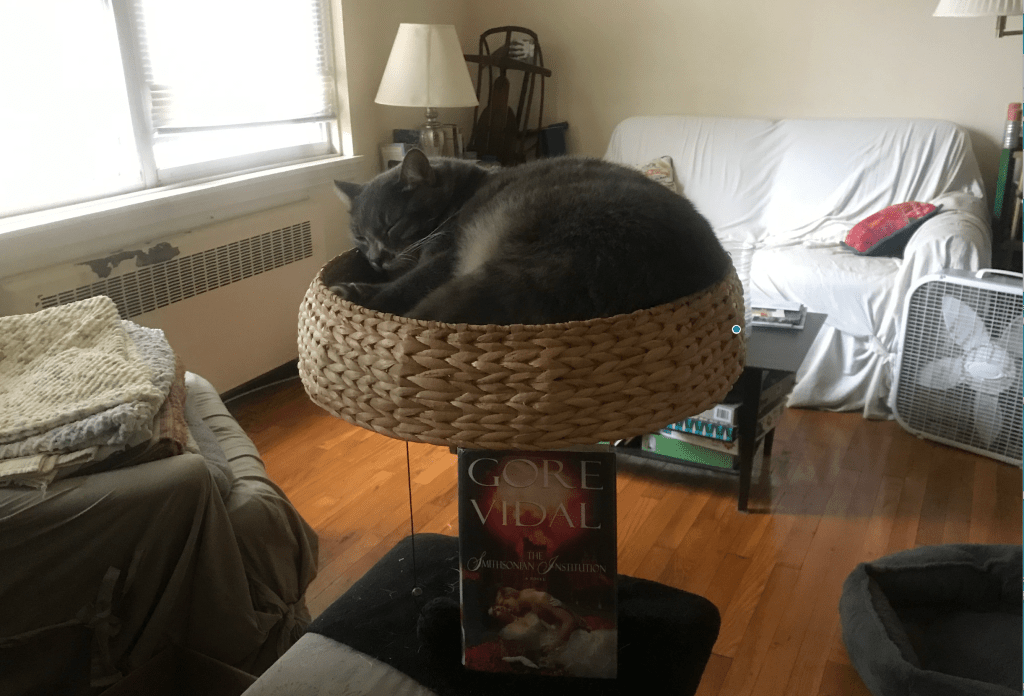
This photo by my human Dave is misleading because the novel on my cat tree is NOT sleep-inducing.

It’s been nearly two months since I, Misty the Cat, guest-wrote a “Dave Astor On Literature” post, so the Time has come. Or was it Newsweek that arrived?

Speaking of legacy media, Cat Fancy magazine ended in 2015 — the same year of my feline birth. That’s almost as coincidental as Shakespeare and Miguel de Cervantes both dying in April 1616. Cervantes of course wrote Don Quixote, the saga of a kitty-knight-errant who swats at windmills; and Shakespeare penned Much Ado About Nothing, about the overreaction to me swatting Dave off his chair so I could gain access to his computer.

Anyway, why is this blog called “Dave Astor on Literature”? Does my male human sit atop novels rather than read them? “Misty the Cat on Ten Folded Blankets” is more like it. But I prefer 15 folded blankets for maximum sleeping comfort.

When not napping, the novel I read most recently was Gore Vidal’s The Smithsonian Institution — set in 1939 as World War 2 neared, but with much mind-bending manipulation of time. Quite satirical and historical and philosophical and fantastical. Heck, in the 1998-published book, dead U.S. presidents and other museum exhibits even come to life! Which is more than I can say about my little stuffed mousies that don’t move unless I swat them.

Don’t assume that I successfully swat everything. I once tried to knock War and Peace off the dining-room table, but couldn’t move it. Dave needs to buy one of Tolstoy’s novellas.

I particularly enjoy novellas that contain only one word. The plot and character development are a bit lacking, but I finish them quickly enough to get on with the important things in life — such as swatting the “e” off Dave’s computer keyboard. Which lxads to sxntxnces likx the onx I just typxd.

In more positive news (besides me putting back the “e” key), the most recent Liane Moriarty novel came out last month and I can’t wait to read it. It’s called Here One Moment, and it joins a long line of excellent Moriarty books that also include — among others — Apples Never Fall (unless I swat them from the tree). And it’s worth mentioning that the kitty editions of Moriarty’s Big Little Lies and Nine Perfect Strangers are titled Big Litter Lies and Nine Purrfect Strangers.

Then, on October 22, comes the latest Jack Reacher thriller by Lee Child and Andrew Child. That one’s called In Too Deep, which reminds me of when I briefly stepped in a 1/16th-of-an-inch puddle during one of my outdoor leashed walks. The post-traumatic stress disorder lasted for 61 hours. Tee-hee — the name of my favorite Reacher novel.

Reacher is 6’5″ and 250 pounds, which is also my size after I gobble several cat treats.

The Reacher books are escapist, mass-market fiction — albeit as well-crafted as my high-quality cat tree pictured in the photo atop this post. True literature is by an author such as George Eliot, who, like George Sand, was a woman. Female novelists, especially long-ago ones, would sometimes use male pen names to have a better chance in the publishing realm of a patriarchal world. Eliot’s real name? Mary Ann Evans. Sand’s real name? The tongue-twisting Amantine Lucile Aurore Dupin de Francueil. George Washington’s real name? Geddy Lee. Sorry — had to get a reference in this post to the band Rush, even though Geddy sang “Vital Signs” rather than “Vidal Signs.” Still, I think Gore Vidal signed some copies of The Smithsonian Institution.

Dave will guest-write replies to comments to allow me, Misty the Cat, the time to swat unwanted marketing pitches from the WordPress spam folder into the WordPress trash folder.

My comedic 2024 book — the part-factual/part-fictional/not-a-children’s-work Misty the Cat…Unleashed — is described and can be purchased on Amazon in paperback or on Kindle. It’s feline-narrated! (And Misty says Amazon reviews are welcome. 🙂 )

This 90-second promo video for my book features a talking cat: 🙂

In addition to this weekly blog, I write the 2003-started/award-winning “Montclairvoyant” topical-humor column every Thursday for Montclair Local. The latest piece — also written by Misty the Cat, but completely different — is here.