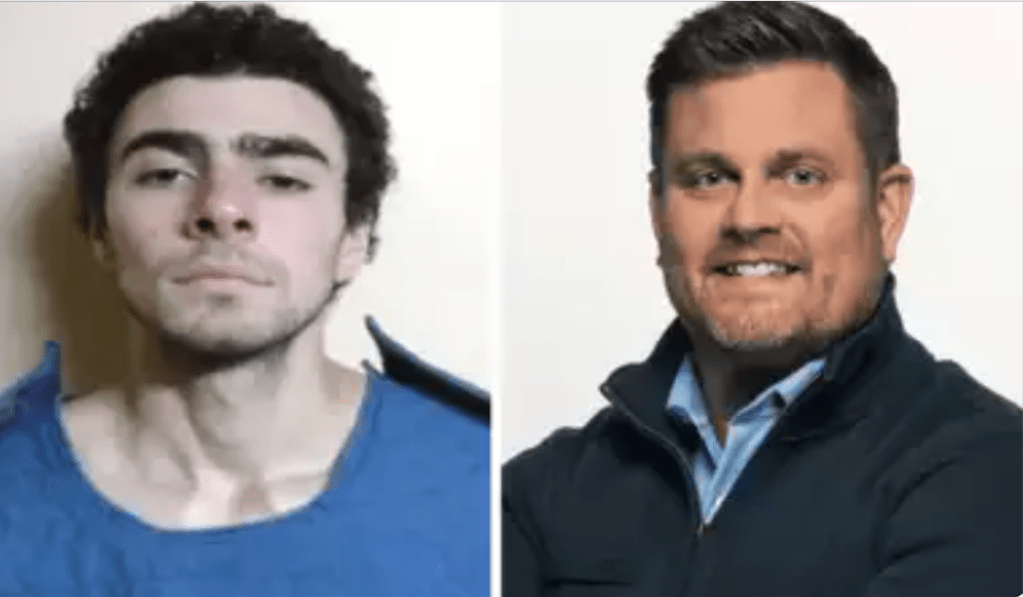
Luigi Mangione and Brian Thompson
After Brian Thompson was shot and killed in New York City this month, millions of Americans from all parts of the ideological spectrum flooded social media to express little sympathy for him. That’s because he was the CEO of UnitedHealthcare, the massive company known for denying a huge number of legitimate medical-insurance claims in order to maximize its profits.
The result of those denials? Anguish for millions of patients and death for thousands of patients who (either individually or via employer plans) pay large monthly premiums for medical coverage — even as residents of every other developed country enjoy some form of much-more-humane national health insurance. And doctors with years of medical training and experience get their requests for needed tests and treatment for their patients denied by insurance bureaucrats with little or no medical expertise.
Meanwhile, Thompson — who was specifically targeted for assassination (the arrested suspect is Luigi Mangione) — raked in yearly compensation of $10.2 million.
Obviously, murder shouldn’t be celebrated, and this was an awful tragedy for Thompson and his family. But he and other execs at UnitedHealthcare and other private insurance providers are guilty of indirectly/continually causing tragic deaths — only their method is shooting down claims rather than shooting a gun.
As with many other situations, I was reminded of certain books I’ve read. There have been numerous nonfiction titles covering the cruel, pricey, unequal, inefficient U.S. medical system — which only works very well for the wealthy — but I’m a literature blogger and will thus focus on fiction in the remainder of this post. To me, the novel I’ve read that best expresses the fury “inspired” by the U.S. medical system is Lionel Shriver’s So Much for That. I highly recommend her 2010 book, despite much of it being a painful read. Somehow, Shriver manages to often make things entertaining, too.
And I thought of novels that have strong elements of vigilantism, which of course involves seeking justice by “illegal” means when such justice might not be achieved through “legal” channels. In the U.S., there have been various efforts by Senator Bernie Sanders and others urging “Medicare for All” to give Americans the type of health-insurance system every other “first world” nation has. But those efforts have been thwarted by a political class (virtually every Republican and most Democrats) as well as a mainstream media mostly bought off by campaign contributions and ad dollars from the profit-swollen companies (also including “Big Pharma”) benefiting from a privatized medical system. So, what are beleaguered citizens to do?
Among the novels with characters who take the law into their own hands for the “right” reasons (not necessarily medical-related reasons) are Louis Sachar’s Holes, John Steinbeck’s The Grapes of Wrath, Alexandre Dumas’ The Count of Monte Cristo, Lee Child’s Jack Reacher books, and Johnston McCulley’s The Curse of Capistrano featuring the protagonist who would also become the title character in Isabel Allende’s later Zorro. For those who haven’t read those novels, I’ll refrain from giving specifics in order not to spoil things.
As we know, there are also strains of vigilantism in many western novels (like Owen Wister’s The Virginian) and in comic books starring superheroes such as Batman.
Your thoughts about, and examples of, this topic?
As Christmas nears, Misty the cat says: “Ho Ho Ho means Harness off Harness off Harness off.”
My comedic 2024 book — the part-factual/part-fictional/not-a-children’s-work Misty the Cat…Unleashed — is described and can be purchased on Amazon in paperback or on Kindle. It’s feline-narrated! (And Misty says Amazon reviews are welcome. 🙂 )
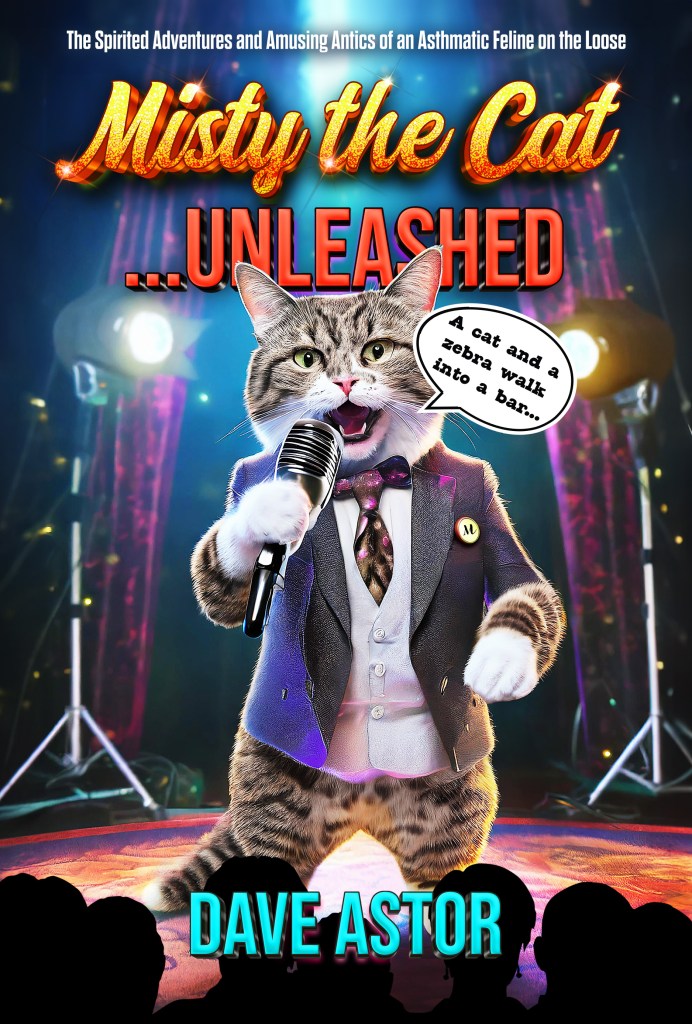
This 90-second promo video for my book features a talking cat: 🙂
In addition to this weekly blog, I write the 2003-started/award-winning “Montclairvoyant” topical-humor column every Thursday for Montclair Local. The latest piece — which discusses a Mideast-related yet local police chaplain controversy — is here.
 Dave Astor on Literature
This raises an important point about the flaws in the US healthcare system. The stories of denied claims and the financial burden on patients are truly heartbreaking. I agree that a serious discussion about reform is necessar
LikeLiked by 1 person
Thank you for the comment, Munaeem Jamal. I agree — the response to the murder was very revealing about the U.S. healthcare system and what MANY people think about it. Change is indeed sorely needed to prevent as much future heartbreak as possible.
LikeLiked by 1 person
As Resa wrote, it is a sad and terrible story, but one wrong does not justify another.
LikeLiked by 1 person
I hear you, Luisa. Thank you for the comment!
LikeLiked by 1 person
You’re more than welcome 🫶
LikeLiked by 1 person
🙂
LikeLike
All in all a sad situation. One wrong doesn’t right another wrong.
(One argument against capital punishment)
Even a good person has a breaking point. I mean often the killer gets more notoriety than the victim(s). Like In Cold Blood. Rapists getting away with it. The legal system seems ineffective. Society is helpless.
Vigilantism – I never read the the book, Death Wish (1972) by Brian Garfield, but I’ve seen all the movies in the franchise. A killer becomes a hero, because he took care of what the law couldn’t/wasn’t. His heroics empower others to take back their streets.
Do you remember NYC’s The Gaurdian Angels? 1979 – ?. They called themselves a crime prevention organization. Some called them vigilantes.
I was surprised to see Curtis Sliwa had run for mayor against Eric Adams.
Well, my thoughts!
LikeLiked by 1 person
Thank you for the comment, Resa. Many good thoughts! Your mention of capital punishment (which I’m against) resonated with me.
“Death Wish” definitely struck a nerve with people. Unfortunately, as satisfying as vigilante justice can be for some, the “Death Wish” vigilante focused on criminals in the streets rather than criminals in the suites.
I remember the Guardian Angels well (I was living in NYC during their heyday). Curtis Sliwa always struck me as kind of a right-wing jerk. And, yes, he has sought political office more than once.
LikeLiked by 1 person
Yes, the death penalty appears hypocritical.
Murder is wrong, but we can murder in the name of justice?
Anyway, yes, I couldn’t think of anything suite, so resorted to the street.
Interesting about Sliwa. I thought he was out of the picture. Apparently not.
Have you decorated Misty for the holidays , yet? 🤭
LikeLiked by 1 person
Ha ha! 😂 Misty the cat says, “Who’s that Douglas Fir guy, anyway?”🎄
LikeLiked by 1 person
Oh Doug Fir! Nice guy, but he likes to play devil’s advocate, so does a lot of needling.
Anyway, he’s all spruced up for the holidays. He’s off to visit an old flame, Talia Balsam. She was married to George Clooney, you know.
Doug never stood a chance, but yet, he pines!
🌟🕊🤍🎄
LikeLiked by 1 person
LOL, Resa! 😂 😂 Your comment was ornamented with amazing wordplay. 🙂
LikeLiked by 1 person
Thanks Dave! That’ll be the day when the cat gets my tongue! 😻
LikeLiked by 1 person
🙂
LikeLiked by 1 person
You mentioned two of my favorite books in this post – Grapes of Wrath, and HOLES! Such a great book and the movie was pretty well done too! 🙂 Hope you’re doing well!
LikeLiked by 1 person
Thank you for the comment, M.B. I agree — two excellent novels, both adapted excellently to the screen. While I’m not much of a movie watcher, I have seen the 1940 “The Grapes of Wrath” and the 2003 “Holes” films.
I’m doing well, and hope you are, too! 🙂
LikeLiked by 1 person
I am! Got SUPER busy there for a second so kind of dropped off WordPress — but things are calming down now, just in time to get busy again for the holidays haha!
LikeLiked by 1 person
Sounds like a busy/not busy/busy sandwich. 🙂 I can totally relate!
LikeLiked by 1 person
The US has the most expensive healthcare system in the world with the lowest percentage of coverage and efficiency. The only segment of the healthcare system that is functioning relatively well is run by the government and serves politicians, military personal, and civil servants.
LikeLiked by 2 people
Thank you for the comment, Shaharee. Yes, the U.S. has the priciest healthcare system with often the worst results. And a TERRIFIC point that politicians and military personnel have government healthcare — very good government healthcare. Why can’t everyone have the same? Expanding Medicare into “Medicare for All” would be one way to go about it.
LikeLiked by 1 person
The good solution is not by taking the lives of those corporate scoundrels but by taking away their money. Big time some lawyer starts a class action to compensate the relatives of those who lost their lives because of this delay, deny, defend policies. In fact I’m astonished it didn’t happen already. I expected it to happen after Sicko by Michael Moore (2007), but the only thing that happened after that was Obamacare that was watered down till it didn’t include a public option, which was removed after the independent US senator for Connecticut Joe Lieberman (heavily sponsored by insurance companies) threatened with a filibuster.
LikeLiked by 1 person
Great idea! Would love to see that type of lawsuit. Of course, given the problematic “justice” system in the U.S. and all the money the privatized health-insurance system would throw at defending such a suit to protect their obscene profits, it would be a tough road. And, yes, the right-wing Joe Lieberman was the Joe Manchin of his day — a VERY conservative, corporate-bought Democrat. (While the admirable Michael Moore is a principled, exceptional filmmaker and political activist.)
LikeLiked by 1 person
To protect the Veiled Lady from a blackmailer, even Poirot turns to crime.
Sherlock Holmes shields a thief from prosecution. ‘Send him to jail now, you make him a jailbird for life. Besides, it is the season of forgiveness. ‘ The Blue Carbuncle
Alan Breck ? Supposedly, every kind of villainy, including murder, could be arrested as a traitor/Jacobite, saves David Balfour’s life.
LikeLike
Law breakers for justice ? To protect the veiled lady from a blackmailer, even Poirot can turn criminal –
Blue carbuncle ? At Christmas, Sherlock Holmes allows a thief to escape justice, ‘ Send him to jail now, you make him a jailbird for life. Besides, it is the season of forgiveness.
Alan Breck ? One of my favourtite antiheroes. Without Breck, would Daviedc Balfour have survived. Traitor – by being a Jacobite ? Murderer too ?
LikeLiked by 1 person
Thank you, Esther, for those great mentions! Your Breck reference got me to take a look at this interesting Wikipedia article:
https://en.wikipedia.org/wiki/Allan_Breck_Stewart
LikeLike
Hi Dave,
I read Lionel Shriver’s “So Much for That” when my friend here in Australia was going through his cancer battle. It made me curious and I asked John-Michael about his out of pocket expenses to beat cancer. He said quite bluntly that if he’d been diagnosed in the United States, he’d be dead. Sadly, the side effects of bone marrow transplants eventually became too much to overcome, but only because our medical world had done all they could, not because there was no more money.
I guess because of that I can’t really imagine the anger towards something like United Healthcare. And as an atheist, there’s probably a lot that I’d disagree with Tony about, but like him, I just can’t condone the murder of the CEO, or imagine any kind of outcome where it will help. I also agree with Kim and am more than a little disturbed at some of the reactions to this violence. Though unlike Kim, I cheered the ending of “Crawdads”. I loved that the protagonist got away with her brand of justice. But for me, that’s what fiction is all about. Enjoying things that you wouldn’t enjoy or even understand in the real world.
Susan
LikeLike
Thank you for the comment, Sue. Well said!
Sobering to think that a non-rich person with a serious illness in a non-U.S. country has a better chance of survival than a non-rich person with a serious illness in the U.S. — even though there’s of course no guarantee anywhere. Very sorry about your friend. 😦
And I understand your feelings about murder, even when that murder is of someone with the proverbial “blood on their hands.”
LikeLike
This murder was heartbreaking on several levels. The CEO didn’t deserve to die, true. Yet none of the individuals who died because of the horrors of the United Healthcare System deserved to either.
I remember on my grandfather’s death bed, he confessed he killed a man who was trying to rob him. This was 1920s, and he kept the secret until his death 1970s. So *sigh* Its a slippery slope.
With that said, my only contribution bookwise is Scrooge, and though there was no vigilante on the horizon, had a great many individuals he cheated or treated cruelly who would have liked to off him. It is not for me to judge what a man does although I may vehemently detest it. What Marley told Scrooge is the best to be said re how a man should conduct his life esp. in business matters:
“Mankind was my business. The common welfare was my business; charity, mercy, forbearance, and benevolence, were all my business. The dealings of my trade were but a drop of water in the comprehensive ocean of my business!”
God bless us everyone.
A sad theme Dave, but I’m glad you addressed it. Many thanks, Susi
LikeLiked by 1 person
Thank you for the comment, Susi. Your first paragraph says a LOT. I agree!
That is quite an intense memory your grandfather held inside for a half-century.
Scrooge is a very apt example of a rich and powerful person who “done wrong.” I wish his willingness to redeem himself would be an example to American CEOs, though I’m not holding my breath.
LikeLike
Thanks Dave. I once heard this about very wealthy pipl, that they get everything they want, but one thing they can’t get is how it feels to make that last car and/or mortgage payment. So there’s that. Perhaps if they had more joyous events in their life, they would be less greedy esp. at the expense of others. But mostly, no matter how you slice it, they are a real piece of work.
LikeLiked by 1 person
Love that, Susi! (…wealthy people “get everything they want, but one thing they can’t get is how it feels to make that last car and/or mortgage payment”). Yes, they can never know certain satisfactions. And I agree that greed can stem from unhappiness, though of course in number of cases it stems from…greed.
LikeLike
Hi Dave, I heard about this murder and feel no sympathy towards Thompson. I consider Thompson to be a murderer with legal privilege and I hope his death sends a strong message to the bloated people maintaining this unjust system.
LikeLiked by 1 person
Thank you for the comment, Robbie. “…a murderer with legal privilege” — that perfectly describes rich and powerful people responsible for deaths even though they didn’t technically break laws (that were designed for the rich and powerful). I share your hope that a message was sent, and that the message will result in improvements in the U.S. healthcare system rather than CEOs just getting additional expensive private security.
LikeLike
I live in perpetual hope, Dave 🙏💖
LikeLiked by 1 person
Not a bad way to live, Robbie. 🙂
LikeLike
Several years ago I read a book by Jodi Picoult, I think it was called My Sister’s Keeper about one siblings donating bone marrow as I remember.
Not sure how the troubled man with apparant mental health concerns Luigi Mangione has many people on his side, Brian Thompson did not deserve to die. Too much more to discuss but it’s truly devastating and troubling how someone can take another life and flee to a PA Mc Donalds,eat a hash brown in attempt to go on with his life as if he did nothing wrong. Alot more to learn on this sad story and the reality of countless people with mental health concerns are not getting help.
Michele
E &P way back
LikeLiked by 2 people
Thank you for the comment, Michele. I’ve read “My Sister’s Keeper” — which definitely had a significant medical theme. I thought it was an excellent novel until what I felt was a less-than-satisfactory ending.
It’s true that the shooting suspect might have some mental issues. I also think a medical-insurer CEO who made $10.2 million a year, in part through denying medical care to thousands and thousands of premium-paying patients, had some psychological issues as well. Or maybe it was just blatant greed. 😦
LikeLike
Dave – your posts are always spot on. You prompted me to considered why many of us are drawn to the Robin Hood story due to its themes of justice, rebellion against tyranny, and the fight for the underprivileged. The character of Robin Hood embodies the ideal of a hero, with pure motives, who defies authority to protect the oppressed, resonating with readers’ desires for fairness and equality. The Robin Hood archetype is repeated generation to generation and has moved from books to comics, to movies. In comic books, “Green Arrow” fights against social injustice and corruption. Movies such as “Robin Hood: Prince of Thieves” and “The Hunger Games”, both based on novels, also reflect this motif, showcasing protagonists who challenge oppressive systems and seek to aid the disadvantaged. I think that Walter Scott says it best of all:
“The name of Robin Hood, if duly conjured with, should raise a spirit as soon as that of Rob Roy; and the patriots of England deserve no less their renown in our modern circles, than the Bruces and Wallaces of Caledonia.” Walter Scott, Ivanhoe
LikeLiked by 2 people
Thank you for the comment, Rebecca. This whole situation does have a Robin Hood feeling to it (despite Luigi Mangione coming from a family of some wealth); astute observation by you! UnitedHealthcare as the Sheriff of Nottingham. 🙂 And, yes, Robin Hood was an ancestor in a sense of people/characters such as Rob Roy, Katniss Everdeen of “The Hunger Games,” etc.
LikeLiked by 2 people
I love our conversations, Dave. We live in complex times that challenge our critical thinking skill sets!
LikeLiked by 2 people
I enjoy our conversations, too, Rebecca! 🙂 And, yes, VERY complex times. 🙂 😦
LikeLiked by 1 person
Thank you Rebecca, for this wonderful example!
LikeLiked by 2 people
🤗🤗🤗
LikeLiked by 1 person
Carolyn Chute’s The Beans of Egypt, Maine touches on this theme, although not the vigilante part. (She went in that direction later.)
LikeLiked by 2 people
Thank you for that mention, Liz. The Bean family is definitely quirky, impoverished, and probably not covered by UnitedHealthcare. 🙂
LikeLiked by 2 people
You’re welcome, Dave.
LikeLiked by 1 person
🙂
LikeLiked by 1 person
It’s horrible to read that many people on social media had little sympathy for the murdered CEO. Despite what you feel about his company, he didn’t deserve to be murdered.
Dave, you raise an interesting question in your post (again!) about vigilantes in literature. Your mention of Batman jumped out at me, as he’s one of my favorite superheroes. I’d add The Punisher as an example of a vigilante. He’s an ex-Marine who pursues revenge on the people who murdered his wife. I think he broadens that mission to punish other villains, too. I confess to running a Google search about vigilantes in popular culture, as I was curious about others. Lisbeth Salander popped up. I read the original trilogy that starts with “The Girl with the Dragon Tattoo” several years ago, and I still remember the intensity of her pursuit for revenge.
LikeLiked by 2 people
Thank you for the comment, Dave. You’re absolutely right that Brian Thompson (or anyone else) doesn’t deserve to be murdered. But the reaction does say something about how millions of citizens are furious at being taken advantage of by powerful people and corporations.
Yes, various “cartoon” superheroes have meted out vigilante justice — as did Lisbeth Salander. I’ve also read Stieg Larsson’s riveting trilogy, and Lisbeth is a tremendous character creation. She had a LOT to feel vengeful about.
LikeLiked by 1 person
The only novel I can think of is Stephen King’s The Wheel of Fortune in which the main character has acquired psychic abilities after recovering from a coma. He knows that a presidential candidate will do bad things if elected (!) and reluctantly decides to shoot him at a campaign event. It’s a highly dramatic scene with a twist ending. I say no more in case you haven’t read the book.
You’re right about vigilantism being part of the American way. And further to Luisa’s comments about the health system in Italy, Canada’s isn’t doing well either. Not enough doctors, long wait times, etc. Ironically, those who can afford it go to the US.
LikeLiked by 3 people
Thank you for the comment, Audrey. Is “The Wheel of Fortune” Stephen King’s “The Dead Zone” under a different title? The plots sound similar. Either way, a terrific example!
You’re right that countries with national health insurance are not problem-free with their systems. But those systems are still better than the U.S. one, especially for the non-rich. And, yes, given that the privatized American healthcare system is great for the rich, I can see why some wealthy people from other countries would use it — including to bypass longer waiting times.
LikeLiked by 2 people
You’re right, Dave–it’s Dead Zone. For some reason I always think of it as the Wheel of Fortune, which is the title of one of the parts, I believe.
LikeLiked by 2 people
Ah, I can see the confusion. Excellent early King novel!
LikeLiked by 2 people
Hi Dave, and thanks once again for another thought-provoking post. I’m glad you mentioned that particular Lionel Shriver book, she’s one of my current favourite authors. I’m almost at the end of ‘The New Republic’ just now, and will make ‘So Much for That’ my next. I can’t help but agree with you on this. Murder is murder, but when the general response is such a huge lack of sympathy for the victim it’s a sign that something is very wrong. I can’t think of any particular ‘vigilante’-style protagonists at present, apart from the general trend in Jacobean Revenge Tragedy, where the protagonist is looking for revenge for a real or imagined injury against somebody high in society and difficult to reach, like a king or emperor. ‘Hamlet’ is probably the best example of this, with various plays by Webster, Kyd and Marston following behind. The revenging character usually has to die by convention in these, given that it’s a bad example to have somebody kill a king or higher-upper and get away with it. If I recall any more I’ll be back, but I suspect that’s me done for this week. Have a good one, catch you next time. 🙂
LikeLiked by 2 people
Thank you for the comment, Laura. Lionel Shriver is indeed a very compelling author; I’ve read several of her novels, including “The New Republic.” My favorite of hers is “So Much for That.”
“Murder is murder, but when the general response is such a huge lack of sympathy for the victim it’s a sign that something is very wrong” — an EXCELLENT observation.
Interesting thoughts about Jacobean Revenge Tragedy!
LikeLiked by 2 people
Thank you, Dave. I’m going to read ‘So Much for That’ soon, and will review here afterwards. Thanks for mentioning it. 😊
LikeLiked by 2 people
I’m greatly looking forward to seeing that review! 🙂
LikeLiked by 2 people
It seems the American health system is one of the more unequal systems one can find. l would be pretty scared to get sick or have an accident in the U.S. And it seems almost impossible to make any real changes to it. Such a sad story, all of it. I have an American friend, who moved to Germany and who says she’ll never move back to the U.S. now she knows what it’s like to not get ruined just because you need surgery. The frustration is very understandable, but as already stated here, murder is never justified, or an answer to anything.
When hearing about the murder I came to think about the movie “Falling down” with Michael Douglas – which was also quite thought-ewoking. Thanks for an interesting post, as always!
LikeLiked by 2 people
Thank you for the comment, Thérèse. Yes, the U.S. medical system deservedly looks cruel and awful when viewed from other countries. So many Americans have become sicker than they had to be, lost their life savings, and more because of that system. I can totally understand the feelings of your American friend now in Germany.
I’ve heard about the “Falling Down” movie but have never seen it.
LikeLiked by 2 people
This is a difficult post, Dave. As a friend of mine shared the other day on LinkedIn, “It’s OK to be angry at the executives who run the health insurance industry in the US AND to object to murder.” I did suffer due to the practice of delay and denial by an insurance company but all I did was complain. It was a minor issue, but one that was important to me. My complaint fell on deaf ears, but I didn’t consider more drastic action.
As for fiction, I was going to suggest Coma by Michael Crichton, but I discovered that Crichton directed the movie based on a novel by Robin Cook. Interestingly, Crichton said it was easier for him to adapt someone else’s novel than his own. Also, Coma is more of a sleuth-solves-a-mystery by taking on a corrupt medical industry than a vigilante goes gunning for evil.
LikeLiked by 2 people
Thank you for the comment, Dan. You’re absolutely right that a person can feel two things simultaneously — be furious at the medical-insurance industry and be against murder. Brian Thompson shares responsibility for thousands more deaths than Luigi Mangione, but Thompson’s “murders” (via denial of claims) were indirect and done wearing a suit in an executive suite while his bank account soared. 😦
Sorry about your delay and denial experience (not the only one, I’m sure) — a real rite of passage for most Americans. 😦
Interesting “Coma”/Crichton/Cook paragraph!
LikeLiked by 1 person
As a Christian I cannot condone the murder of the CEO of United Healthcare, our society would be even more dangerous than it already is if too many people engaged in vigilante justice. The suspect in this case reminds me uncomfortably of Raskolnikov, the antihero in Dostoevsky’s “Crime and Punishment”. However the author did not approve of the actions of his fictional protagonist.
LikeLiked by 2 people
Thank you for the comment, Tony. Christianity in its best sense is indeed against all murder, so I hear where you’re coming from. Hopefully, good Christians are also against medical-insurance-company greed that leads to thousands of other kinds of deaths every year.
And that’s an interesting comparison to Raskolnikov! I think Luigi Mangione’s motives were somewhat “better,” but I can definitely see the connection.
LikeLiked by 1 person
Thanks for addressing this issue and event, Dave. I’ve just finished reading Bernie Sanders’ “It’s OK to be Angry about Capitalism” (USA, 2023) in which he devotes a chapter to “Ending Greed in the Health Care System.” When it comes to fiction, I believe that the superhero genre serves to empower/defend/protect the vulnerable members of our society against the powerful and greedy.
LikeLiked by 2 people
Thank you for the comment, Rosaliene. Bernie Sanders is always worth reading; I have that book, too! And you make a GREAT point that superheroes serve as wish-fulfillment vehicles, among other things. They do what we wish we could do — including obtaining justice in a world where there is too little justice.
LikeLiked by 2 people
I had hoped that the situation of your health insurance had improved with president Obama, but I am shoked reading of the real situation in your country, Dave! “To Kill a Mocking Bird”, where Atius Finsh, a white lawyer had the courage to defend the black inocent Tom Robinson and showed to his comunity in behaving so that sympathy and understanding are worth much more than hatred, prejudice and maybe money came to my mind! Many thanks for your insightful post:)
LikeLiked by 4 people
Thank you for the comment, Martina. “Obamacare” definitely helped, but unfortunately it didn’t include a public option. And I wish more insurance execs, politicians, mainstream-media figures, and others were like Atticus Finch. Courage, integrity, and lack of greed are indeed in short supply. 😦
LikeLiked by 2 people
Let’s try to not give up hope!:)
LikeLiked by 2 people
That’s a good way of looking at things, Martina. 🙂
LikeLiked by 2 people
The US health care system is, quite frankly, shocking. An insightful and pertinent post 🕳
LikeLiked by 3 people
Thank you for the comment, Ada. Glad you liked the post! The U.S. medical insurance system is such an outlier among developed nations. 😦
LikeLiked by 3 people
i too was appalled by some of the reactions to this murder. As someone with a chronic illness I’ve had lots of unpleasant experiences with the insurance industry and reform is needed, but murder is still murder. Not the way to change things!
LikeLiked by 2 people
Thank you for the comment, Leah. I totally hear what you’re saying. I don’t think the murder will change much of anything (although one insurance company did pull back on a plan to not fully pay anesthesia claims if the surgery ran long). Still, one can understand the fury of many people.
Very sorry about your experiences with insurance as someone with chronic illness. 😦 I, like most others, have had many rotten experiences myself.
LikeLiked by 2 people
I am very much against vigilante justice under any circumstances, and I am appalled by the nation’s gleeful response to Thompson’s murder, as if the killing of one man will cause the government (under Trump? What a joke!) to solve the cumulative problems of the US health care system, a convoluted mess has been decades in the making and is not the fault of one or even one hundred people.
Unlike most people I know, I despised the end of WHERE THE CRAWDADS SING, which celebrated murder as a heroic solution to a problem that could have been dealt with sanely. This glorification of murder as justice is a US sickness that goes back to our love of the idea of cowboys staging shoot-outs in the middle of town, and, as you say, Dave, leads directly to the success of Jack Reacher novels. If all this vigilantism stayed in the realm of fantasy, I suppose that would be just entertainment, but the American way of life and death shows that too many people like to translate this cowboy ethic into reality, including many US police officers. How can we condemn the actions of so many policemen and then condone the same behavior in Mangione?
LikeLiked by 4 people
Thank you for the comment, Kim. I hear you. Murder is indeed horrible, and, yes, a single killing will probably not change the U.S. medical-insurance system. But, in an ideal world, it would be great if the private system became more humane (denying many fewer claims) or if a public single-payer system were established. Instead, there’ll be tons of money spent on security for insurance CEOs, and a crackdown on free speech criticizing the industry. 😦
It would also be great if CEOs whose enormous compensation depends on hurting the public wouldn’t be considered “admired businesspeople” by people in the power structure.
You’re right — there’s a real strain of vigilantism in American history and American society.
LikeLiked by 2 people
As an outsider I was shocked to hear so much support for the murderer. The US health care system clearly needs to change. Maggie
LikeLiked by 2 people
Thank you for the comment, Maggie. I was also kind of shocked at first with the reaction to the murder, but I guess it really wasn’t too surprising. Reading many of the angry and/or heartfelt social-media comments was quite an education, in addition to the “education” Americans get from personal negative experiences with the U.S. medical insurance system.
LikeLiked by 2 people
Thanks for listing various literary characters who take the law into their own hands for the “right” reasons.
Unfortunately you are right, the US medical system is cruel and unfair. But even in Italy the public health system is getting worse and worse. To use its services we pay many taxes that are withheld from employees and pensioners at the base, without the possibility of evading them as artisans, professionals and entrepreneurs often do. It used to be very efficient, but now health care works very well only for the rich who can afford expensive visits and treatments privately, without having to wait even over a year for an appointment
LikeLiked by 3 people
Thank you for the comment, Luisa. Very sorry that Italy’s public health system is getting worse for many citizens, although the U.S. private health system probably remains “the worst of the worst” among developed countries. It does seem like the (often-undeserving) rich always get the best of everything. 😦
LikeLiked by 3 people
Unfortunately your final observation is all too starkly true.
LikeLiked by 3 people
😦
LikeLiked by 3 people