Immigration in Lit Amid the Latest Nativist Snit

AP Photo/Gregory Bull

With Donald Trump back in the White House, many (mostly non-white) immigrants are threatened with deportation and more. Not just “illegal” immigrants, but “legal” ones, too. Deportation is of course a cruel, messy, expensive, family-shattering process that might wreak havoc on the United States economy.

Immigrants bring many positives to their new country — hard work, diversity, doing jobs many native-born citizens won’t do, etc. And studies have shown that immigrants, whether “legal” or “illegal,” commit fewer crimes than their native-born peers.

Why do so many people want to move to the U.S. or other countries? They might be fleeing poverty or danger. They might be seeking opportunities not available to them in their nation of birth, or seeking to live amid different social mores. And “first world” nations have created conditions in less-powerful countries that increase immigration — including economically exploiting those “third world” countries, sanctioning them or backing their dictatorial leaders, and hurting them with the global climate change that energy-overusing “first world” populations largely cause.

Then there’s the scapegoat scenario — blaming immigrants (not to mention trans people) when the real problems in countries such as the U.S. are oligarchs, billionaires, too-powerful corporations, widening income inequality, etc.

I should add that any country needs some limitations on how many new citizens it lets in. Unfortunately, the over-the-top way Trump is going about things in the United States is not the smart or decent immigration approach — certainly not deserving to be a role model for the rest of the world.

Anyway, now that I’ve blathered on for five paragraphs, it’s time to mention novels with memorable immigrant protagonists. These characters are depicted expertly by their authors, and we can of course relate to these fictional creations for all kinds of reasons — including partly because many of us are descendants of immigrants, or have immigrants in our extended families, or are immigrants ourselves. (I’m the U.S. grandson of immigrants from Eastern Europe, and my adopted younger daughter is from Guatemala.)

Given that the U.S. is a “nation of immigrants,” a number of examples I’ll offer are novels I’ve read with characters who came to America from various countries. But there will be other countries of destination cited, too.

Characters who move to the U.S. are from Nigeria in Chimamanda Ngozi Adichie’s Americanah, from Afghanistan in Khaled Hosseini’s The Kite Runner, from India in Jhumpa Lahiri’s The Namesake, from China in Amy Tan’s The Joy Luck Club, from Vietnam in Viet Thanh Nguyen’s The Sympathizer, from the Dominican Republic in Junot Diaz’s The Brief Wondrous Life of Oscar Wao, from Iran in Andre Dubus III’s House of Sand and Fog, from Ireland in Colm Toibin’s Brooklyn, and from Greece in Jeffrey Eugenides’ Middlesex.

Among literature’s examples of immigration to countries other the U.S. are Nigeria to England in Bucha Emecheta’s Second Class Citizen, Bangladesh to England in Zadie Smith’s White Teeth, New Zealand to Australia in Colleen McCullough’s The Thorn Birds, and Morocco to France and back to Morocco in J.M.G. Le Clezio’s Desert, to cite a few examples from those I’ve read.

The immigration themes in these and other novels can be compelling in various ways: the drama of leaving one’s homeland for reasons (some mentioned earlier in this post) such as war, repression, threat of death, poverty, and wanting better opportunities; the culture shock involved in settling in a new place; how the immigrants — and their children and grandchildren — adapt to that new place; nostalgia for one’s former country; negative encounters with those native citizens who are anti-immigrant even though their ancestors might have been immigrants…

As readers get absorbed in all this drama, they also learn a lot about the places the characters left and move to. Learning can go down especially easy in fiction; I’ve read nonfiction books about various countries, but often better understand the history, customs, culture, and other aspects of those nations when reading novels with immigration themes.

By the way, two of Trump’s three wives — including current spouse Melania — were immigrants. And Usha, wife of Trump’s vice president JD Vance, is the daughter of immigrants.

Any immigration-themed novels you’d like to mention and discuss? Any general thoughts on this topic?

Misty the cat says: There are at least three ‘King of Pain’ novels, but I’m the King of Pane.

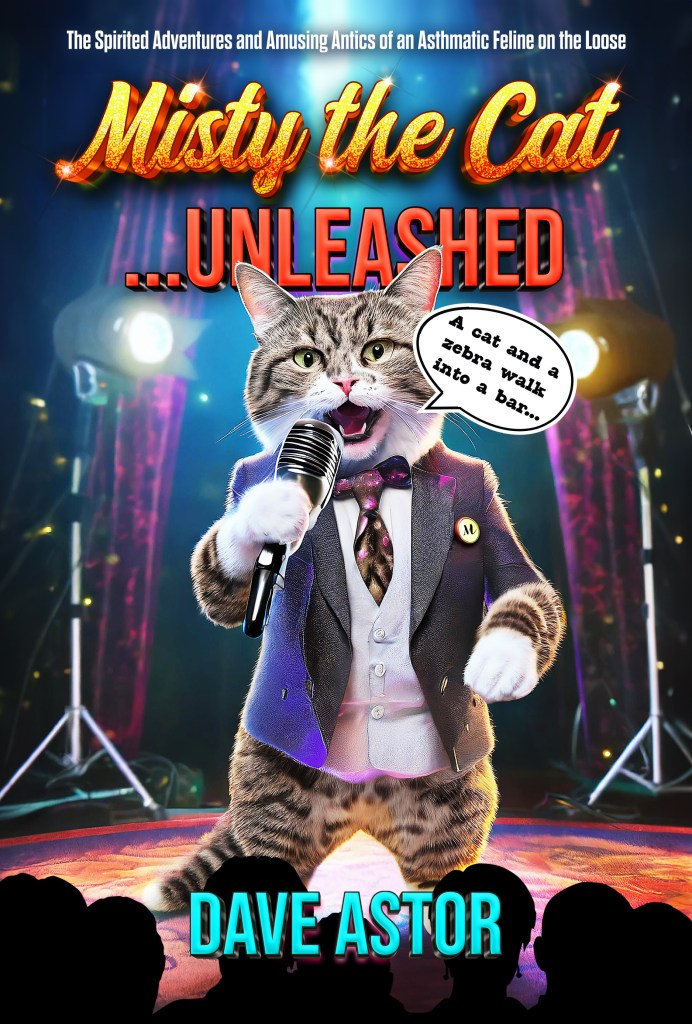
My comedic 2024 book — the part-factual/part-fictional/not-a-children’s-work Misty the Cat…Unleashed — is described and can be purchased on Amazon in paperback or on Kindle. It’s feline-narrated! (And Misty says Amazon reviews are welcome. 🙂 )

This 90-second promo video for my book features a talking cat: 🙂

In addition to this weekly blog, I write the 2003-started/award-winning “Montclairvoyant” topical-humor column every Thursday for Montclair Local. The latest piece — which has a passport theme — is here.

The Good and the Bad Are Half-Ugly (Inside)

Martin Luther King Jr. (right) and Donald Trump (wrong).

Tomorrow, January 20, will see a mind-boggling juxtaposition of the good and the bad. It’s when the United States marks Martin Luther King Jr. Day to honor the renowned civil rights leader (actually born on January 15) and also when the reprehensible Donald Trump is again inaugurated as President of the United States.

Makes one think of excellent novels I’ve read that have very good and very bad characters and/or dizzying highs and dizzying lows.

Such as Fyodor Dostoevsky’s The Brothers Karamazov, in which one of the three brothers (Alyosha) is in the MLK category and another (Mitya) is closer to a Trump type.

Or Wilkie Collins’ The Woman in White, whose characters range from upstanding (such as Walter Hartright and Marian Halcombe) to evil (Percival Glyde and charismatic Count Fosco).

Or Henry James’ The Portrait of a Lady, which features the sympathetic Isabel Archer and the scheming Gilbert Osmond.

Or Charlotte Bronte’s Jane Eyre, whose title character deals with the lows of a painful orphan upbringing, an awful boarding school, romantic heartbreak, and homelessness. And the highs of finding some independence and that aforementioned romance.

Or Jane Austen’s Persuasion — in which its protagonist, Anne Elliot, faces romantic loss and romantic found.

Or George Eliot’s Silas Marner, whose title character suffers betrayal and later an unexpected event that turns his life around.

Or Harriet Beecher Stowe’s Uncle Tom’s Cabin, in which one character (Eliza) makes a harrowing escape from slavery and another (Tom himself) eventually succumbs to slavery’s awful yoke.

Or Robert Louis Stevenson’s Strange Case of Dr. Jekyll and Mr. Hyde. I don’t think I have to explain that one. 🙂

Good and bad, and highs and lows, are of course part and parcel of real life — and great fodder for making novels more dramatic. If anything, many fictional works enhance the roller-coastering of personalities, emotions, and events. Which Trump would know if he ever read a book.

Though my post concentrated on 19th-century literature, you’re welcome to name novels from any time period that fit today’s theme. 🙂

Misty the cat says: “I jump in windows to avoid Aldous Huxley’s ‘The Doors of Perception.'”

My comedic 2024 book — the part-factual/part-fictional/not-a-children’s-work Misty the Cat…Unleashed — is described and can be purchased on Amazon in paperback or on Kindle. It’s feline-narrated! (And Misty says Amazon reviews are welcome. 🙂 )

This 90-second promo video for my book features a talking cat: 🙂

In addition to this weekly blog, I write the 2003-started/award-winning “Montclairvoyant” topical-humor column every Thursday for Montclair Local. The latest piece — about more lawsuit news in my town and other topics — is here.

Bringing You a Barrage of Book Birthdays

A toast to novels with significant anniversaries in 2025.

It’s time for my annual first-half-of-January post featuring novels with major round-number anniversaries. I’ll mostly look at novels that are turning 25 (published in 2000), 50 (from 1975), 75 (from 1950), and 100 (from 1925 — a century-ago year with a stellar 12 months of books). I’ll focus on novels I’ve read, and you’re welcome to mention ones you’ve read. 🙂

Where to begin? With Michael Chabon’s 2000-released The Amazing Adventures of Kavalier & Clay. It stars two male characters loosely based on Superman’s co-creators and other real-life cartoonists, and won the Pulitzer Prize for fiction.

Speaking of awards, 2000 also saw the publication of one of Margaret Atwood’s best: her Booker Prize-winning The Blind Assassin, starring two sisters and featuring a novel within that novel.

In the top tier of her output, too, was Barbara Kingsolver’s out-in-2000 Prodigal Summer, in which separate story lines expertly come together at the end.

There was Zadie Smith’s terrific debut novel White Teeth as well. That turn-of-the-millennium book mixes multicultural interactions, humor, and more.

The year 2000 also saw the publication of Harry Potter and the Goblet of Fire — the fourth in J.K. Rowling’s blockbuster wizard-world series, and the book that saw the author start to write quite-long-but-still-page-turning novels.

Lee Child’s fourth Jack Reacher novel, Running Blind, appeared in 2000, too — and it’s thrilling like the rest of the series, before and after.

John Grisham was his usual readable self with 2000’s The Brethren, about three ex-judges perpetrating a scam from jail.

And Rosamunde Pilcher’s final novel, the poignant Winter Solstice, came out 25 years ago, too.

Moving backwards to 1975, that was the year of Stephen King’s second novel: the gripping ‘Salem’s Lot. Wow — the still-prolific King’s career has passed the half-century mark!

Plus James Clavell’s very immersive Shogun, set in Japan circa-1600. And E.L. Doctorow’s Ragtime, mixing fictional and real people during the early 1900s. And Judith Rossner’s harrowing Looking for Mr. Goodbar, mixing sex and violence.

In 1950, memorable releases included Ray Bradbury’s short-stories-as-novel The Martian Chronicles, Isaac Asimov’s sci-fi classic I, Robot, Patricia Highsmith’s psychological nail-biter Strangers on a Train, and C.S. Lewis’ children’s fantasy The Lion, the Witch, and the Wardrobe, among others.

Turning to novels published in 1925 — 100 years ago! — we can only start with The Great Gatsby. (Leonardo DiCaprio is pictured atop this post in the 2013 movie version of F. Scott Fitzgerald’s iconic book.)

Other iconic or near-iconic titles published in 1925 included Virginia Woolf’s Mrs. Dalloway, Franz Kafka’s The Trial, Theodore Dreiser’s An American Tragedy, W. Somerset Maugham’s The Painted Veil, Sinclair Lewis’ Arrowsmith, and the second installment of L.M. Montgomery’s Emily trilogy. Plus one of Willa Cather’s lesser-known titles — The Professor’s House — and Georgette Heyer’s Simon the Coldheart.

I think the only novel I’ve read from 1875 — a century-and-a-half ago — was The Mysterious Island by Jules Verne. And nothing from 1825, 1775, and 1725, though I’ve read a number of books published not long before or after those years.

Misty the cat says: “Now that I’ve read ‘The Outsiders’ novel, it’s time to go inside.”

My comedic 2024 book — the part-factual/part-fictional/not-a-children’s-work Misty the Cat…Unleashed — is described and can be purchased on Amazon in paperback or on Kindle. It’s feline-narrated! (And Misty says Amazon reviews are welcome. 🙂 )

This 90-second promo video for my book features a talking cat: 🙂

In addition to this weekly blog, I write the 2003-started/award-winning “Montclairvoyant” topical-humor column every Thursday for Montclair Local. The latest piece — about another lawsuit in my town and a couple of contentious Council meetings — is here.

The Year 2024? That’s That, With Stats

Now that the 10th-anniversary year of this blog has come and gone, I want to offer my VERY grateful thanks to all visitors and commenters. I love the conversations! 🙂

Last year, 2024, saw “Dave Astor on Literature” get by far its most annual views (56,862) and visitors (39,689). Also, the 52 posts (one every Sunday!) elicited 5,702 comments — averaging about 110 a week.

The “lucky 13” posts with the most comments last year:

1. “Faking a Look at a Presidential Book,” November 10, 185 comments.

2. “When Genres Are Happy Together,” November 24, 179 comments.

3. “Batman and Robin Aren’t the Only Dynamic Duo,” August 18, 167 comments.

4. “Expecting an A, Getting a B,” September 29, 150 comments.

5, “Gaslighting, Gaza, and Genocide,” May 5, 145 comments.

6. “Book Titles Get a New Look Thanks to Trump the Crook,” June 2, 140 comments.

7. “Misty the Cat…Unleashed Is Unleashed into the Book World,” June 16, 139 comments.

8. “Prose and Politics,” March 24, 137 comments.

9. “The Art of the Con,” March 17, 134 comments.

10. “Reading Painful Novels Can Be Worth the Pain,” January 14, 129 comments.

11. “From Russia With…Courage,” February 18, 127 comments.

12. “More Than One Ghost in This Post,” September 14, 124 comments.

13. “The Art of Depicting Large Families in Novels,” May 12, 123 comments.

My most-read post of 2024 was actually one I published in 2018: “Strong Female Characters in 19th-Century Fiction.” Not only the most-read piece in 2018 but in 2019, 2020, 2021, 2022, and 2023, too. Keeps popping up in online searches, I guess. 🙂

The countries that accounted for the most views of my blog in 2024? See the statistical image below. Readership came from 182 of the world’s 195 countries!

One final number: I read 54 novels last year.

Thank you all again! And back to actually discussing literature next week. 🙂

Misty the cat says: “Marcel Proust wrote In Search of Lost Car.”

My comedic 2024 book — the part-factual/part-fictional/not-a-children’s-work Misty the Cat…Unleashed — is described and can be purchased on Amazon in paperback or on Kindle. It’s feline-narrated! (And Misty says Amazon reviews are welcome. 🙂 )

This 90-second promo video for my book features a talking cat: 🙂

In addition to this weekly blog, I write the 2003-started/award-winning “Montclairvoyant” topical-humor column every Thursday for Montclair Local. The latest piece — about calls for a cursing councilor to resign, and more — is here.