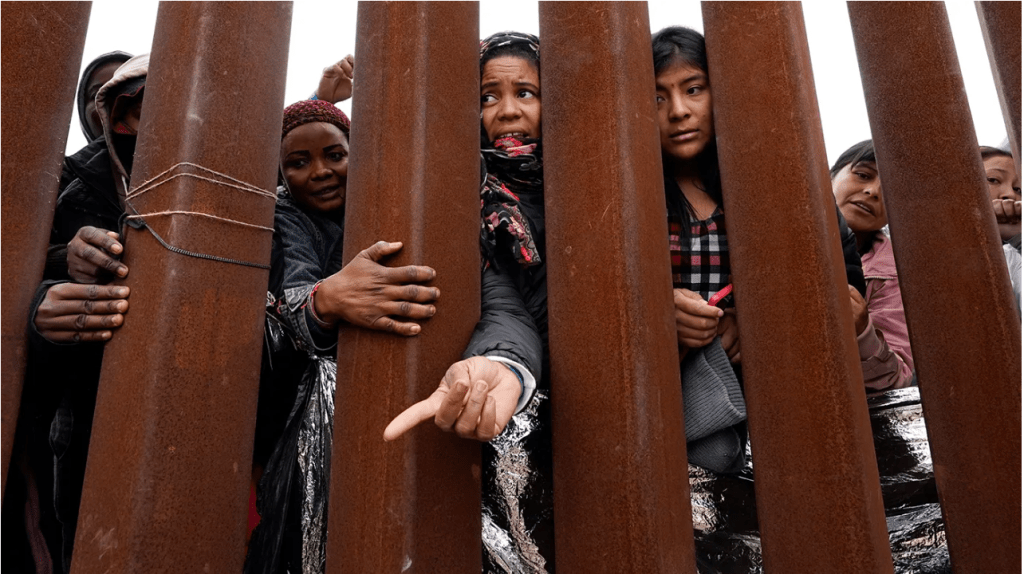
AP Photo/Gregory Bull
With Donald Trump back in the White House, many (mostly non-white) immigrants are threatened with deportation and more. Not just “illegal” immigrants, but “legal” ones, too. Deportation is of course a cruel, messy, expensive, family-shattering process that might wreak havoc on the United States economy.
Immigrants bring many positives to their new country — hard work, diversity, doing jobs many native-born citizens won’t do, etc. And studies have shown that immigrants, whether “legal” or “illegal,” commit fewer crimes than their native-born peers.
Why do so many people want to move to the U.S. or other countries? They might be fleeing poverty or danger. They might be seeking opportunities not available to them in their nation of birth, or seeking to live amid different social mores. And “first world” nations have created conditions in less-powerful countries that increase immigration — including economically exploiting those “third world” countries, sanctioning them or backing their dictatorial leaders, and hurting them with the global climate change that energy-overusing “first world” populations largely cause.
Then there’s the scapegoat scenario — blaming immigrants (not to mention trans people) when the real problems in countries such as the U.S. are oligarchs, billionaires, too-powerful corporations, widening income inequality, etc.
I should add that any country needs some limitations on how many new citizens it lets in. Unfortunately, the over-the-top way Trump is going about things in the United States is not the smart or decent immigration approach — certainly not deserving to be a role model for the rest of the world.
Anyway, now that I’ve blathered on for five paragraphs, it’s time to mention novels with memorable immigrant protagonists. These characters are depicted expertly by their authors, and we can of course relate to these fictional creations for all kinds of reasons — including partly because many of us are descendants of immigrants, or have immigrants in our extended families, or are immigrants ourselves. (I’m the U.S. grandson of immigrants from Eastern Europe, and my adopted younger daughter is from Guatemala.)
Given that the U.S. is a “nation of immigrants,” a number of examples I’ll offer are novels I’ve read with characters who came to America from various countries. But there will be other countries of destination cited, too.
Characters who move to the U.S. are from Nigeria in Chimamanda Ngozi Adichie’s Americanah, from Afghanistan in Khaled Hosseini’s The Kite Runner, from India in Jhumpa Lahiri’s The Namesake, from China in Amy Tan’s The Joy Luck Club, from Vietnam in Viet Thanh Nguyen’s The Sympathizer, from the Dominican Republic in Junot Diaz’s The Brief Wondrous Life of Oscar Wao, from Iran in Andre Dubus III’s House of Sand and Fog, from Ireland in Colm Toibin’s Brooklyn, and from Greece in Jeffrey Eugenides’ Middlesex.
Among literature’s examples of immigration to countries other the U.S. are Nigeria to England in Bucha Emecheta’s Second Class Citizen, Bangladesh to England in Zadie Smith’s White Teeth, New Zealand to Australia in Colleen McCullough’s The Thorn Birds, and Morocco to France and back to Morocco in J.M.G. Le Clezio’s Desert, to cite a few examples from those I’ve read.
The immigration themes in these and other novels can be compelling in various ways: the drama of leaving one’s homeland for reasons (some mentioned earlier in this post) such as war, repression, threat of death, poverty, and wanting better opportunities; the culture shock involved in settling in a new place; how the immigrants — and their children and grandchildren — adapt to that new place; nostalgia for one’s former country; negative encounters with those native citizens who are anti-immigrant even though their ancestors might have been immigrants…
As readers get absorbed in all this drama, they also learn a lot about the places the characters left and move to. Learning can go down especially easy in fiction; I’ve read nonfiction books about various countries, but often better understand the history, customs, culture, and other aspects of those nations when reading novels with immigration themes.
By the way, two of Trump’s three wives — including current spouse Melania — were immigrants. And Usha, wife of Trump’s vice president JD Vance, is the daughter of immigrants.
Any immigration-themed novels you’d like to mention and discuss? Any general thoughts on this topic?
Misty the cat says: “There are at least three ‘King of Pain’ novels, but I’m the King of Pane.“
My comedic 2024 book — the part-factual/part-fictional/not-a-children’s-work Misty the Cat…Unleashed — is described and can be purchased on Amazon in paperback or on Kindle. It’s feline-narrated! (And Misty says Amazon reviews are welcome. 🙂 )

This 90-second promo video for my book features a talking cat: 🙂
In addition to this weekly blog, I write the 2003-started/award-winning “Montclairvoyant” topical-humor column every Thursday for Montclair Local. The latest piece — which has a passport theme — is here.
 Dave Astor on Literature
I Think Donald Trump Is on the same level as Anton LaVey, Alexandrian Wicca, Alex Sanders, Rick Owens,
LikeLiked by 1 person
I Think Donald Trump Is definitely not the King of United States
LikeLiked by 1 person
I totally agree, Cosima! Thank you for the comment.
LikeLike
I Think Melania Trump Is a Godless Woman😱
LikeLike
LikeLike
I Think Melania Trump Is on the same level as Meghan Markle, Carlton Gebbia, Brittany Mahomes, Eva Braun, Katie Britt, Belle Gibson, Marina Abramović, Virginia Thomas, Amber Heard, Hailey Bieber, Patrizia Reggiani, Leona Helmsley, Hilaria Baldwin, Michele Lamy, Elizabeth Holmes, Casey DeSantis, Louise Linton, Kimberly Guilfoyle, Elaine Chao, Heather Mills, Julia Fox, Kelly Lary, Lotta Volkova, Martha Alito’s, Lara Trump, Rebekah Neumann, Oksana Grigorieva, Bianca Censori, Anna Sorokin,
LikeLike
That’s quite a rogues gallery!
LikeLike
I Think Melania Trump Is on the same level as Carlton Gebbia, Marina Abramović, Lotta Volkova, Michele Lamy,
LikeLike
I’m not familiar with those four other names, but Melania Trump is certainly at a low level in all-time “First Lady” rankings.
LikeLike
Such a timely topic, Dave! Several years ago, I enjoyed reading “The Same Sky” by Amanda Eyre Ward. It centers around a brave young woman left in Honduras with a grandmother. She wants to help her younger brother join their mother in TX. The mother had gone ahead earlier, taking just one of the young twin brothers with her. A very emotional story!
LikeLiked by 1 person
Thank you, Becky! “The Same Sky” sounds like an excellent book about the immigrant experience — an experience which of course can be quite fraught, and, as you say, emotional. That 2015 novel is on my to-read list. And it has a great title!
LikeLiked by 1 person
Yes, that title says so much.
LikeLiked by 1 person
It really does!
LikeLiked by 1 person
What I really hate is the way some of my fellow Christians trash immigrants when the Bible clearly says we are to welcome them. The Bible is chock full of “immigrant stories,” but none suggest we should scapegoat and otherwise mistreat them.
LikeLiked by 1 person
Thank you, Debi Sue! Yes, it’s appalling when too many Christians treat immigrants in a very un-Jesus-like way. And of course Christians don’t have a monopoly on religious people not acting the way they should. So hypocritical and inconsistent. 😦
LikeLiked by 1 person
I’ve read a number of these books, David, and I’ve carried the lessons with me for years about the trials of immigration. It’s no easy task and often takes a generation to smooth out. I’m the daughter of an immigrant too. The Rapist doesn’t read or he may be a little more thoughtful about his cruelty toward other human beings (who aren’t rich and white).
LikeLiked by 1 person
Thank you, Diana! Yes, immigration isn’t easy even in the best of circumstances; what Trump and his administration are doing is beyond inhumane. 😦 It would indeed be nice if Trump read more — might increase his empathy a bit for people, including those who are not rich and white. Then again, any chance of empathy from him isn’t happening. 😦
LikeLiked by 1 person
I agree, sadly, Dave. I’m not sure he’s capable of it.
LikeLiked by 1 person
At this point in his life and career, the chances are indeed nil. 😦
LikeLiked by 1 person
Hello Dave,
It’s now Thursday, and I have not been able to come up with a book I’ve read.
However, as my mother-in-law was 1st generation Japanese Canadian, and spent young formative years in a internment camp during WWII (her brother was in the army and fought with Canada in the European theatre), I have been wanting to read: Hotel on the Corner of Bitter and Sweet by Jamie Ford.
What a sick time, then and now! No discrimination, just chuck ’em all in!
I’ll end with – I am horrified that trump is turning Gitmo into an internment camp for migrants.
LikeLiked by 1 person
Thank you, Resa! Sorry about your mother-in-law’s experience when she was young. Those internment camps were terrible. Yes, everyone considered “guilty” because of their ethnicity. I think “Hotel on the Corner of Bitter and Sweet” is very worth reading; I’m glad I got to it a year or so (?) ago.
Trump? One horrible thing after another. 😦
LikeLiked by 1 person
Thanks Dave!
It’s not just that they were in a camp over the war.
Her father’s fishing boat, (they lived on Vancouver Island) their house, all the heirlooms her mother brought from Japan, all possessions, were all confiscated. When the war was over, they got nothing back, were not allowed to go home but sent to Toronto.
What a shame humanity can be. We treat animals like shi! and treat humans like animals.
I’m so happy I’m veggie. I was vegan, but I had bone issues, which dairy (which I dislike so it was like ..pizza .. bocconcini salad.. cottage cheese …white no taste cheese) fixed fast.
Now I am back trying a new vegan diet with almond milk and more tofu. I try to take a calcium pill once or twice a week, but they can cause kidney stones and heart plaque. I had a bone scan last July and will have one in July again to see how it’s working.
Anyway, Americans who voted for the stain are guilty of putting humans in a camp. It reeks of hitler.
Sorry for the mini rant!
LikeLiked by 1 person
Awful, on every level. 😦
A diet without meat and dairy (something we have in common) is wonderful but there can be issues. I hope your vegan “end-around” ultimately works, but, if not, I can totally understand being vegetarian rather than vegan.
LikeLiked by 1 person
Thanks… of course it costs more to buy from free range happy cows, but that is what I do.
🤞on the bone scan
LikeLiked by 1 person
Totally worth it when cows are less miserable. 🙂
Hope July’s follow-up bone scan has good results!
LikeLiked by 1 person
Me too!
LikeLiked by 1 person
Sad! Because We are all Gods Creation but Good shell always over rule wrong. God’s word always prevails
LikeLiked by 1 person
Thank you, Blog! While I’m not religious myself, I agree with the concept that everyone (well, almost everyone) is worthy and should be treated as such — immigrants included.
LikeLiked by 1 person
I enjoy stories based on the immigrant experience. One that really stuck with me is The Beekeeper of Aleppo.
LikeLiked by 1 person
Thank you, Darlene! I enjoy fiction based on the immigrant experience, too. 🙂 And I appreciate the mention of “The Beekeeper of Aleppo”!
LikeLiked by 1 person
Excellent post. Appreciate the literature about immigrants recommendations.
LikeLiked by 1 person
Thank you very much, equipsblog! 🙂
LikeLiked by 1 person
You are welcome. Pat
LikeLiked by 1 person
Thanks again, Pat!
LikeLike
Hope enough of us awake in time, Dave.
LikeLiked by 1 person
That would be nice, Pat. I think a majority of U.S. citizens are “awake” about this, but certain politicians and certain media outlets and certain other interests don’t care what the majority thinks. 😦
LikeLiked by 1 person
Really hope 🤞you are right.
LikeLiked by 1 person
Some of Henry James’ work such as “Daisy Miller” and “The Portrait of a Lady” deal with American expatriates in Europe (mainly Italy). I’m not too sure what’s the difference between expatriates and immigrants except that expatriates generally are more affluent (maybe you or one of your readers can clarify this point for me).
LikeLiked by 1 person
Thank you, Tony! Great observation that there are a number of expatriate characters in Henry James’ work! (I’ve read about a dozen of his novels.) The impression I get is that (often-wealthy) expatriates are in another country temporarily (albeit for many years in some cases) and that they might perhaps remain citizens of their country of birth. But I don’t know for sure.
LikeLiked by 1 person
Some of the earliest immigrant stories I’ve read are written by observers rather than the immigrants themselves, like Willa Cather’s “O Pioneers!” and “My Antonia” and Upton Sinclair’s “The Jungle.” Then there’s the early twentieth-century novel of a Jewish immigrant, Abraham Cahan’s “The Rise of David Levinsky,” which my father told me he was assigned to read in school. The title is a reference to Howells’s “The Rise of Silas Lapham.” Lately I’ve been reading the earliest fictional treatment of Chinese immigrants in a collecction called “Mrs. Spring France” set in San Francisco.
LikeLiked by 1 person
Correction, that should be “Mrs. Spring Fragrance.”
LikeLiked by 1 person
Thank you! Yes — immigrant fiction can be from the point of view of the immigrants or from (often non-immigrant) observers. For instance, as you know, “My Antonia” is not “told” by Antonia but rather by Jim Burden — perhaps an opposite-gender stand-in of sorts for Willa Cather herself.
LikeLike
Hi Dave, this concept of immigrants is interesting. At what point are you no longer an immigrant. My husband can trace his ancestors back to Willem Pretorius for whom the city of Pretoria is named. Is he an immigrant? Are my sons immigrants because I was born in the UK? Where does it start and end?
I recently read The Unbearable Lightness of being which includes a failed immigration attempt become the Russians stopped people leaving.
LikeLiked by 1 person
Thank you, Robbie! Those are excellent questions. I suppose one can always remain a descendant of immigrants. 🙂 I appreciate hearing about your family history!
Interesting/heartbreaking to think of another aspect of immigration you mentioned: countries stopping people from leaving — often when they have VERY good reasons to want to leave.
LikeLiked by 1 person
Yes, that is usually why people leave, because they believe they have to for some good reason. Few people really wants to leave their homeland, it is really hard to do so.
LikeLiked by 1 person
Totally agree, Robbie!!
LikeLiked by 1 person
Hi Dave,
I’ve been listening to JD Vance lately and he absolutely stated that there is a difference between the good guys and bad guys. Like with January 6 2021. The really bad people who attacked police would absolutely have to do the time for their crime. No pardon at all. The same goes for immigrants, only the drug dealers and mental patients (though I’m not sure why these are bad guys? I thought we were trying to take the stigma out mental illness?) and people who eat pets will be deported.
But if you’re looking for a book about people fleeing danger to hopefully find safety in America then I highly recommend Jeanine Cummins “American Dirt” about a woman and her son who get on the wrong side of a drug kingpin and need to get out of Mexico. Spoiler – there may or may NOT be actual eating of dogs and cats.
Sue
LikeLiked by 2 people
Thank you, Sue! Then of course JD Vance didn’t say a word when Trump’s pardons of the January 6 thugs he (Trump) inspired included rioters who had attacked law-enforcement officers. Vance is SUCH a suck-up, but, hey, that’s how he got to be vice president. 😦 And, yes, of course law-abiding, “legal” immigrants are and will be among those swept up in Trump’s appalling deportations.
That big Trump/Vance lie of hard-working Haitian people in Ohio eating cats and dogs — ugh, ugh, ugh. 😦
I’ve definitely heard a lot about “American Dirt,” but haven’t read it.
LikeLike
Oh Dave, you’re making it sound like I can’t trust what Vance is saying! Next you’ll tell me that the war in Ukraine didn’t end in November 😦
LikeLiked by 1 person
LOL, Sue! 😂 I’m pretty sure Vance and Trump tell the truth somewhere between 1% and minus 1% of the time.
LikeLike
American literature has been enriched lately by so many novels and stories told by immigrants and children of immigrants, too many to name really. But in thinking about this, I could come up with only a few early novels about immigrants. Willa Cather’s “My Antonia,” about Bohemians and “O Pioneers!” about Swedes. “The Jungle,” by Sinclair about Lithuanian immigrants in Chicago. One of the earliest novels about Jewish immigrants is “The Rise of David Levinsky” by Abraham Cohan, a book that my father said he was assigned in high school. And I recently discovered the short stories of Sui Sin Far, set in San Francisco’s Chinatown and written in the early twentieth century.
LikeLiked by 2 people
Thank you! Several great mentions! I’ve read “My Antonia” (excellent) and “O Pioneers!” (pretty good) and “The Jungle” (one of the most impactful novels ever published). And the Abraham Cohan and Sui Sin Far works sound really interesting.
LikeLike
If you’re ever looking for a nonfiction book about immigrants, “Solito” is awesome!
LikeLiked by 3 people
Thank you, Marie! I just looked at some descriptions of “Solito” online, and the book sounds very compelling. I appreciate you mentioning it!
LikeLiked by 1 person
Like every American not of 100% Indigenous descent, I’m the product of immigrants, recently on my mother’s side (grandparents from Ukraine) and farther back on my father’s side (Irish, Scottish, maybe French, and who knows what?) But although immigrants from these countries suffered prejudice (think of all the signs that said, “No Irish”), they all had the advantage of being European. Trump’s anti-immigrant actions are about racism, not foreigners, if you ask me.
I love and recommend a set of children’s books written in the fifties by Sydney Taylor. The first in the series is ALL-OF-A-KIND FAMILY, and it’s about five sisters and their parents, Jewish immigrants from Germany and Poland, living on the Lower East Side in New York in the first decade of the 1900s. The books are based on Taylor’s own life, and the stories of the children’s small adventures and mishaps (like losing a library book) are warm, loving, and often touching. If there were ever a set of books to make someone grow up believing in the worth of foreigners settling in America, it is these.
LikeLiked by 2 people
Thank you, Kim! Nice to hear about the various ethnicities in your family history, and your thoughts on the Trump administration’s anti-immigrant push. I totally agree that racism is a huge part of this; if a large number of white Europeans were entering the U.S., the Trump administration would say barely a word. True — as you note — that there was some anti-Irish, anti-Italian, etc., sentiment during earlier immigration waves, but nothing like the invective aimed at people of color. 😦
The children’s books you mentioned sound wonderful, and I greatly enjoyed your description of them. 🙂
LikeLiked by 2 people
I don’t have other novels on this topic to suggest, but I want to thank you for writing about immigration. Your post is level-headed. That’s appreciated in a topic that has some people shouting and pointing fingers at each other. You make great points about the positives that immigrants bring to our country and how they commit fewer crimes. I didn’t realize that J.D. Vance’s wife is, like Melania, an immigrant.
LikeLiked by 2 people
Thank you, Dave! I appreciate the kind words about the piece. 🙂 Hearing so much anti-immigration sentiment these days is demoralizing, especially given that the family trees of millions and millions of people have immigrants in them.
I just double-checked where Usha Vance was born, and it turns out she is the daughter of immigrants rather than an immigrant. My stupidity for not making sure of that fact before first publishing the post. Now corrected.
LikeLiked by 2 people
It wasn’t stupid at all. Just a detail that needed correcting.
LikeLiked by 1 person
🙂
LikeLiked by 1 person
“Then there’s the scapegoat scenario — blaming immigrants (not to mention trans people) when the real problems in countries such as the U.S. are oligarchs, billionaires, too-powerful corporations, widening income inequality, etc.”
Exactly. It is so depressing to see the rich and greedy use the same old scapegoating tactics again and again and again throughout history . . . and that they keep getting away with it every time. As if humanity never learns.
Lovely idea for a post . . . I think that what is so special about these immigrant narratives in fiction is that they really do invite us to experience immigration through an individual or family’s eyes, which brings an emotional immediacy and directness to the topic that a more distant, non-fiction approach usually does not possess. As someone from an immigrant family who now lives back in the maternal country of origin, it’s a subject close to my heart.
LikeLiked by 4 people
Thank you, RussophileReads! Yes, it SO demoralizing that the scapegoat approach works again and again. When a lie is repeated often enough… 😦
And a GREAT observation in your second paragraph! Novels focusing on one or a small group of immigrants really do personalize things — humanizing a situation that can often be (deliberately) twisted, stereotyped, etc., by politicians, media people, and others trying to demonize immigrants.
Last but not least, you have had a very interesting immigration experience yourself!
LikeLiked by 3 people
Thank you very much, Dave, for your thoughts about imigration and I believe that the books you have mentioned widened my outlook on other cultures, but also about our own!
In this context I would like to mention the Swiss writer Plinio Martini from Ticino, Switzerland and his masterpiece “Rock Bottom” in English and “Il fondo del sacco” in Italien. The story is set in the first half of the 20th century when people here in the South of Switzerland were very, very poor and therefore had to emigrate to the USA and tried to pursue the American dream. It shows very well the
the two sides of the project! This impressive book seems to be still read in schools.
LikeLiked by 2 people
Thank you, Martina! Plinio Martini’s book sounds very compelling. Glad you mentioned it! People from so many different countries ended up in the U.S. at various times and for various reasons — and of course some fared better than others. Hope those in “Il fondo del sacco”/”Rock Bottom” did okay.
LikeLiked by 2 people
I very much enjoy your answer, Dave! I remember that the protagonist was very homesick and after years in America he manages to return to his beloved valley, but nothing is anymore the way it had been!
LikeLiked by 2 people
That’s poignant and heartbreaking, Martina — finally going home, but things have changed so much. It’s still home, though.
LikeLiked by 2 people
Yes,:):) but illusions have failed
LikeLiked by 3 people
😦
LikeLiked by 1 person
HI Martina, thank you for this book recommendation. It sounds very interesting. I will look for it on Amazon.
LikeLiked by 1 person
Wow, Roberta, that would be great! Amazon should have it. So I hope that I can invite you for a cup of tea in order to discuss the book! I keep my fingers crossed for you.
LikeLiked by 2 people
This book is out of print in English and out of stock as a second hand book. It’s a pity.
LikeLiked by 1 person
😦
LikeLiked by 1 person
Roberta, I phoned the library, which had it translated and the lady on the phone told me that Rock Bottom is only available on Amazon.it and Amazon.de/ kindle. I don’t know, if you can manage that. I’m sorry and best regards Martina
LikeLiked by 2 people
That is very kind of you, Martina. I will see if I can find it there 🙏💗
LikeLiked by 1 person
I have found it immediately♥️♥️
LikeLiked by 2 people
I did find it. Thank you 🙏
LikeLiked by 1 person
💐👏
LikeLiked by 2 people
I looked through my Goodreads list briefly, and there are lots of immigrant books, but I’ll mention two: Julie Otsuka’s “When the Emperor was Divine”, about the Japanese internment camps, and Michael Chabon’s “The Yiddish Policeman’s Ball” in which after WWII the Jews settle in Alaska–though they only have a 60 year lease–but it touches not only on displacement but on governments, religions and of course the ways all humans are the same no matter where they come from.
I have great-grandparents on both sides who were immigrants, but, not being Native American, all my ancestors were immigrants. If you’re being technical, most Mexicans have Native American genes, so actually have more right to be in the Southwestern US than any of the people complaining about them. (K)
LikeLiked by 5 people
Thank you, memadtwo! Two excellent examples, well-described! Your first reminds me that Isabel Allende’s “The Japanese Lover” and Jamie Ford’s “Hotel on the Corner of Bitter and Sweet” also deal compellingly with the setting up of Japanese-American internment camps in the U.S. A racist, unenlightened act by an otherwise mostly admirable Roosevelt administration.
And you’re right that everyone in the U.S. other than Native Americans has immigrant (or enslaved) ancestors — and that Mexicans have more historical ties to the U.S. than many U.S. residents do.
LikeLiked by 2 people
You have given us many good book suggestions! Too many books, too little time…
LikeLiked by 1 person
I know the feeling… 🙂 😦
(And I get many great book suggestions from people who comment here!)
LikeLiked by 1 person
Hi Dave! Another excellent post about a profound subject! I agree with your point about gaining more information on a country from fiction than from non-fiction books on the same subject. Case in point the outstanding, ‘The Kite Runner’, I didn’t realize they had such snowy winters for example. I got a really good grasp of Afghanistan – from a work of fiction. Thanking you. Sharon
LikeLiked by 5 people
Thank you, Sharon! Yes, we can consciously or subconsciously learn a LOT about a country from fiction, and in an entertaining way. 🙂 I also learned many things about Afghanistan from “The Kite Runner.”
LikeLiked by 2 people
Middlesex by Jeffrey Eugenides is more than anything (including the inconvenience the title so cleverly refers to), although much more at the same time, the heartbreaking, funny and enthralling story of three generations of Greek immigrants. And a VERY good book.
LikeLiked by 2 people
Thank you, Dingenom! Great point, and very well said. “Middlesex” indeed feels like it emphasizes the gender fluidity situation — and it does — but the multigenerational (Greek) immigrant story is an enormous part of that terrific novel.
LikeLiked by 1 person
I am also the grandson of immigrants, Dave. I like to think they brought a lot to this country.
I’m going to highlight Immigrant Secrets: The Search for My Grandparents by John Mancini. It lands somewhere between non-fiction and historical fiction, but it’s an excellent read, well researched and it’s a story that while true reads like amazing fiction. In addition to a fascinating story, it illustrates the life and struggles of early immigrants.
LikeLiked by 4 people
Thank you, Dan! Your grandparents, and other immigrants of various generations, did indeed bring a LOT to the U.S.
“Immigrant Secrets: The Search for My Grandparents” sounds fascinating and impressive in its hybrid way!
LikeLiked by 2 people
Thanks, Dave. The mention of ‘Roots’ and your other texts causes half-realised stirrings of other texts out there. It seems like half the planet’s on the move for4 most of the time. 🤔
LikeLiked by 3 people
You’re absolutely right, Laura. There are countless people on the move, whether voluntarily or involuntarily.
LikeLiked by 3 people
I think the novel Black Narcissus by Rumer Godden about a group of British nuns who go to the Himalayas to establish a school and hospital is a fairly good example of immigration based on religious reasons. No matter how well meaning their purpose, they were not fleeing danger nor economic hardship which seems a rather odd endeavor to me since they experienced both during and after. Also the book Papillon by Henri Charriere as re forced displacement and/or forced migration. Great theme Dave. Must say I had to consider the above since they aren’t what one might call traditional immigrant stories. Susi
LikeLiked by 3 people
Thank you, Susi! I like both those examples a lot. Religious ardor can lead to some interesting travel. Sometimes, it unfortunately involves trying to convert “the natives” — an arrogant approach that has never appealed to me. Leave them alone! I’m thinking of St. John Rivers in “Jane Eyre,” Nathan Price in “The Poisonwood Bible,” etc.
“Papillon” was quite a page-turner!
LikeLiked by 2 people
Susi’s comments and your own here bring to mind Kurtz, in ‘Heart of Darkness’, and the critique of colonialism in that story. This takes me on to the Kipling short story ‘The Man Who Would Be King’, with a similar critique and the message that, however well they might rule, the invading colonisers have no right to do so. The film made of that story was wonderful. Fascinating stuff. 😊
LikeLiked by 4 people
Yes, colonialists have no right to be colonialists.
LikeLiked by 3 people
A good and up-to-the-minute topic, Dave. Off the top of my head, there’s ‘The Beekeeper of Aleppo’ concerning immigrants to the UK, and ‘Songbirds’, concerning far-East-Asian women migrating to Cyprus for economic reasons. It’s noteworthy that Christi Lefteri, the author of both, comes from a Cypriot family which migrated to the UK after the invasion of Cyprus in 1974. Aside from that … how about ‘Villette’, by Charlotte Bronte? A bit off the wall, but Lucy Snowe goes to work in a fictional country based on Belgium – her experiences based on the author’s own. It was not intended to be a permanent move, I think, but she’s an economic migrant of sorts. Even further back, how about my old friend the Bard, and ‘The Tempest’? Prospero has been exiled–with his daughter–to a small island, rendering him effectively an immigrant. The only other person there was Sycorax (now dead) and her son Caliban–who rages at one point that ‘this was my island’. Not quite, as his mother was exiled there also, setting up a case of ‘I was here first’. Some of the shipwrecked men from Prospero’s homeland (he’s lured the ship to be wrecked there) discuss what a great place the island is, in a sort-of ‘Let’s colonise’ way. I’d also like to mention ‘Not My Country’ by A E Dean, which takes place in the imagined 2030s and concerns the relationship between a disillusioned immigrant to the UK and an elderly native-born woman, both of whom are trying to leave the country. If I think of any more I’ll be back, but I see you’re already getting a great response to this subject. Have a good week. 🙂
LikeLiked by 5 people
Thank you, Laura! Yes! Charlotte Bronte did that semi-autobiographical traveling in “Villette” via the Lucy Snowe character. And I appreciate your many other terrific examples of “strangers in a strange land.” (Or maybe not so strange.) Sometimes a move is indeed involuntary; reminds me of the protagonist in Colleen McCullough’s “Morgan’s Run,” sent as a prisoner from England to Australia. And one could extend that concept even further to someone like Kunta Kinte in Alex Haley’s “Roots,” with the brutal forced transatlantic nightmare to slavery.
Have a good week, too!
LikeLiked by 3 people
Dave, thanks for addressing this complex issue of immigration. I agree that fictional stories of coming to America can help us better understand and appreciate the push and pull factors of the immigrant experience. I’ve read and enjoyed most of the novels you’ve mentioned. As a poetry lover and advocate, I’ve also connected at an emotional level when reading poetry by diverse first- and second-generation immigrant Americans.
LikeLiked by 2 people
Thank you, Rosaliene! Yes, immigration-theme novels can be educational, moving, and inspiring. And I’m glad you mentioned that poets can also convey the immigrant experience in deep ways. (I know you’ve featured a number of exceptional poets in your blog. 🙂 )
LikeLiked by 2 people
My pleasure, Dave. I enjoy the diverse themes you bring to your weekly posts 🙂
LikeLiked by 2 people
I appreciate that, Rosaliene. 🙂 Thank you!
LikeLiked by 2 people
🙂 ❤
LikeLiked by 2 people
🙂
LikeLiked by 2 people
An important post, Dave. I can’t imagine why anyone goes along with such a harsh and inhospitable attitude … I can’t at this time, think of any examples in literature, but I think the US will experience lots of impacts on farming, food supplies, and the rebuilding of areas hit by disaster. A blogger has noted that immigrants helped rebuild NOLA after Hurricane Katrina, and many immigrants also helped rebuild areas of my own state after the 4/27/11 tornado outbreak. So what happens to CA … Oh wait, they’re not getting any funds to help, anyway …
LikeLiked by 3 people
Thank you, Leah! Stopping or limiting immigration will definitely have a major economic impact across various industries and job categories; you offered several excellent examples of that. I’m also thinking of hospital staffing, home health aides, etc. As for California, yes, Trump is reluctant to give disaster aid to blue states, even though Democrats have never hesitated to give disaster aid to red states. Also, California pays a lot more in taxes than it gets back from the federal government.
LikeLiked by 2 people
The Giver of Stars by Jo Jo Moyes features a British woman who thinks the American she is marrying will give her a glamorous life in New York City and ends up in Kentucky. The Tea Girl of Hummingbird Lane by Lisa See is from China and adopted by parents in the U.S. A Fall of Marigolds Meissner is about immigrants coming through Ellis Island. I could go on (I tend to read books about immigrants). Two of my favorites are by Kristi Lefteri–one about immigrants to the U.K., The Beekeeper of Aleppo and Songbirds, about immigrants to Greece. Great topic.
LikeLiked by 3 people
Thank you, Madeline! I appreciate your many excellent examples of immigration-themed fiction! That had to have been disappointing for the character who thought she’d be in New York City but ended up in Kentucky. (Not that the latter is bad; I’ve enjoyed my visits there. But NYC is…NYC. 🙂 )
LikeLiked by 1 person
It would be like someone from the States marrying a Brit and thinking she is getting a Prince or Duke and ending up with a guy who runs a mine in Cornwall. I love Cornwall, but…expectations.
LikeLiked by 1 person
Yes! Expectations, exactly!
LikeLike
A profound post, Dave. I thought that I would speak from my side of the border. Canada is often described as a land of immigrants, reflecting its rich tapestry of cultures and backgrounds. The country’s immigration policies have historically welcomed individuals from diverse nations, contributing to its multicultural society. Without question, this blend of cultures has shaped Canadian identity, influencing everything from cuisine to festivals. The ongoing influx of immigrants continues to play a vital role in Canada’s economic growth and social fabric, reinforcing the notion that it is indeed a nation built on the contributions of those who have chosen to make it their home.
Canadian immigrants have made significant contributions to literature. Sri Lankan-Canadian poet and fiction writer, Michael Ondaatje, often explores themes of identity and belonging. Joy Kogawa is known for her poignant reflections on the Japanese-Canadian experience during World War II. Rupi Kaur’s poetry resonates with themes of feminism and cultural heritage. Madeleine Thien explores the complexities of family and history. These authors reflect their unique backgrounds and contribute to a broader understanding of Canadian society through their storytelling.
P.S. we are not the 51 State!!!
LikeLiked by 3 people
Thank you, Rebecca! Ha — 😂 — Canada is indeed not the 51st state, despite Trump’s weird grab bag of geographic gyrations in his brain. It would be better if the U.S. became Canada’s 11th province. Take us, please! 🙂
Canada has definitely been welcoming to immigrants. Not perfect, by any means, but a much better example to the world than the U.S. during much of the latter’s history. Your first paragraph is quite eloquent.
Very glad you mentioned some great Canadian immigrant writers! Your comment suddenly made me remember “A Fine Balance” author Rohinton Mistry — another great Canadian immigrant writer, from India. I should have included him in my post!
LikeLiked by 2 people
Come to our side, Dave!! LOL!!! Immigration is essential, but complex. We need to address the infrastructure to accommodate new Canadians – we need more homes, more hospitals, more support systems etc.
LikeLiked by 3 people
LOL! 😂 Packing my bags as I keyboard this reply. 🙂 Yes, immigration is far from a simple matter, and countries need a LOT of things to be in place to be prepared for it.
LikeLiked by 1 person
Thank you very much, Rebecca for your interesting contribution to Dave’s post.
LikeLiked by 2 people
Thank you for your heartwarming comment!!! Isn’t it fun to meet up at Dave’s place?!!!!
LikeLiked by 1 person
The horrible things that the characters in A Fine Balance suffer are examples of why many people who are able leave their countries and go elsewhere.
LikeLiked by 1 person
SO true, Audrey! Most people don’t want to leave their home country unless there is a VERY good reason. Thank you.
LikeLiked by 1 person
I can’t think of any immigrant-related books off the top of my head, but I’m read plenty of short stories about the immigrant experience. The Best American Short Stories series features them regularly.
LikeLiked by 3 people
The Joy Luck Club is one that I have/had. (I’m not sure if my copy survived two interstate moves in 10 months…)
LikeLiked by 3 people
Thank you, Alex! “The Joy Luck Club” is a great novel! And I hear you about books not always surviving major moves. 🙂 😦 Hope it turns up for you!
LikeLiked by 2 people
Thank you, Liz! I must have read some short stories with immigration themes, but I can’t immediately think of any offhand. Given that there’s often a significant narrative arc to an immigration saga, a short story would have to be done quite skillfully to get all that in.
LikeLiked by 2 people
You’re welcome, Dave. The short stories I’m thinking of focused on particular moments/ephiphanies of the experience of being a stranger in a strange land.
LikeLiked by 2 people
Ah, I see. That makes sense. Focusing on a specific moment or epiphany can say a lot.
LikeLiked by 1 person