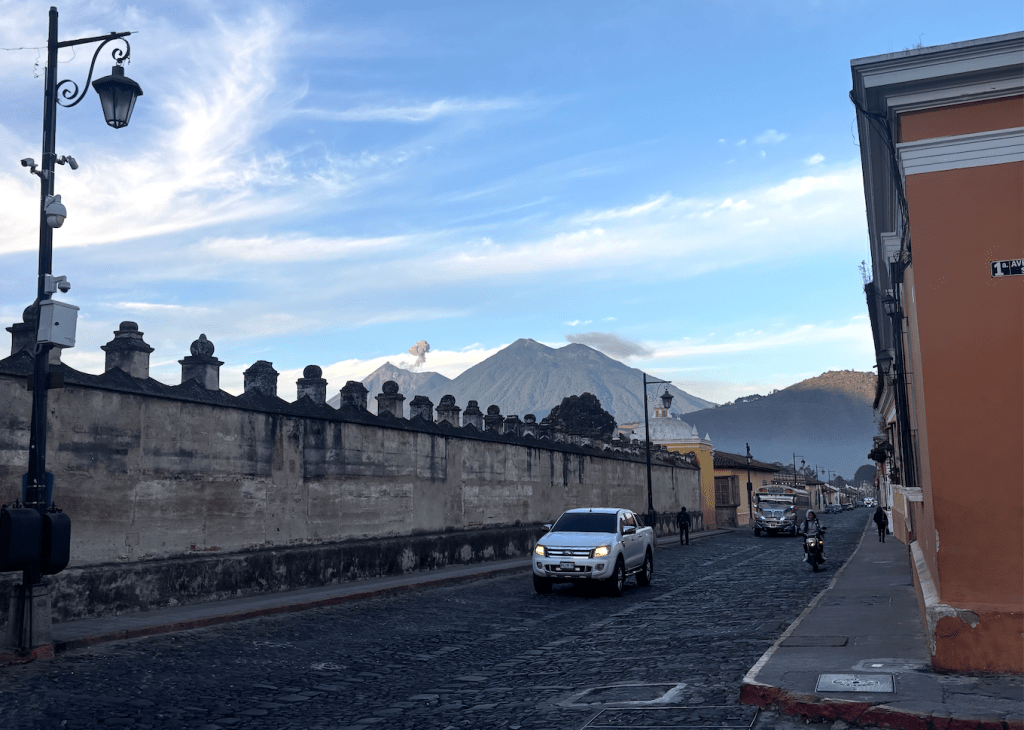
A street in Antigua, Guatemala, that has nothing to do with the topic of this literature post. 🙂 (Photo by me on January 8.)
Glad to be back! I missed writing a post last week because of a trip I took with my wife Laurel and younger daughter Maria to Guatemala, where Maria was born. A memorable visit that included stops in Guatemala City, Tikal, Antigua, Panajachel, and Guatemala City again.
Today, as I do every January, I’m going to mention well-known novels — many of which I’ve read, some of which I haven’t — reaching major round-number anniversaries. So, in 2026, novels published in 2001 are turning 25, 1976-released books are turning 50, 1926 novels are turning 100, etc.
The first 2001 novel that came to mind was Richard Russo’s riveting Pulitzer Prize winner Empire Falls, set in a Maine blue-collar town.
Released that year, too, was Jonathan Franzen’s The Corrections, about a couple and their three adult children. I liked it better than the author’s much-touted Freedom, though that 2010 novel was pretty good as well.
Also, Yann Martell’s Life of Pi, which features a boy stranded on a boat with a tiger after a shipwreck; Sue Monk Kidd’s The Secret Life of Bees, which has a lot to say about female relationships as well as racism; Ann Patchett’s Bel Canto, a riveting look at a mass-hostage situation; Amy Tan’s The Bonesetter’s Daughter, about a Chinese-American woman and her immigrant mother; Ian McEwan’s Atonement, which I found both compelling and annoying; John Grisham’s semi-autobiographical A Painted House; Neil Gaiman’s fantasy tour de force American Gods; and Jasper Fforde’s clever The Eyre Affair.
Kristin Hannah’s peak as an author was yet to arrive, but her somewhat-early-in-career 2001 novel Summer Island was quite absorbing as it focused on a fraught mother-daughter relationship and rapprochement.
In the series realm, Diana Gabaldon’s fifth Outlander novel (The Fiery Cross) and Lee Child’s fifth Jack Reacher novel (Echo Burning) came out 25 years ago.
The year 2001 also saw the publication of Carlos Ruiz Zafon’s The Shadow of the Wind and Dennis Lehane’s Mystic River, neither of which I’ve read.
In 1976, the most famous release was Alex Haley’s Roots, which was of course the multi-generational American slavery saga about Kunta Kinte and his descendants.
There was also Margaret Atwood’s third novel Lady Oracle, about a woman with multiple identities; and Marge Piercy’s Woman on the Edge of Time, a sci-fi-ish work whose lower-income protagonist is unjustly committed to a psychiatric institution.
Notable 1976 books I haven’t read include Anne Rice’s debut novel Interview with the Vampire and Judith Guest’s made-into-a-memorable-movie Ordinary People.
Exactly a century ago — 1926 — saw the appearance of Ernest Hemingway’s The Sun Also Rises, which I thought was good not great.
An underrated classic that year was L.M. Montgomery’s The Blue Castle, about a young woman who gets very bad news that turns out to be very good news.
There was also Colette’s The Last of Cheri, the sequel to the 1920 Cheri novel about the relationship between a younger man and older woman; and My Mortal Enemy, one of Willa Cather’s lesser works.
Well-known 1926 novels I haven’t read include Agatha Christie’s The Murder of Roger Ackroyd and Upton Sinclair’s Oil!
Published 150 years ago, in 1876: Mark Twain’s iconic The Adventures of Tom Sawyer, about a rascally boy and his friend Huckleberry Finn.
That year also saw the release of Daniel Deronda, George Eliot’s final novel and one of her best. Its title character, who discovers he’s Jewish, interacts with some very memorable people.
In addition, there was Thomas Hardy’s not-famous-but-interesting The Hand of Ethelberta.
Two 1826 highlights were Mary Shelley’s apocalyptic, late-21st-century-set The Last Man and James Fenimore Cooper’s The Last of the Mohicans that unfolds in 1757 during the French and Indian War. Two novels with “Last” in the title that lasted.
And in 1726, 300 years ago, Jonathan Swift’s iconic Gulliver’s Travels was published!
Any thoughts on the novels I discussed? Any other titles you’d like to mention from those anniversary years? (I’m sure I missed some.)
Misty the cat says: “Tofu falling from the sky was not on my 2026 bingo card.”
My comedic 2024 book — the part-factual/part-fictional/not-a-children’s-work Misty the Cat…Unleashed — is described and can be purchased on Amazon in paperback or on Kindle. It’s feline-narrated! (And Amazon reviews are welcome. 🙂 )
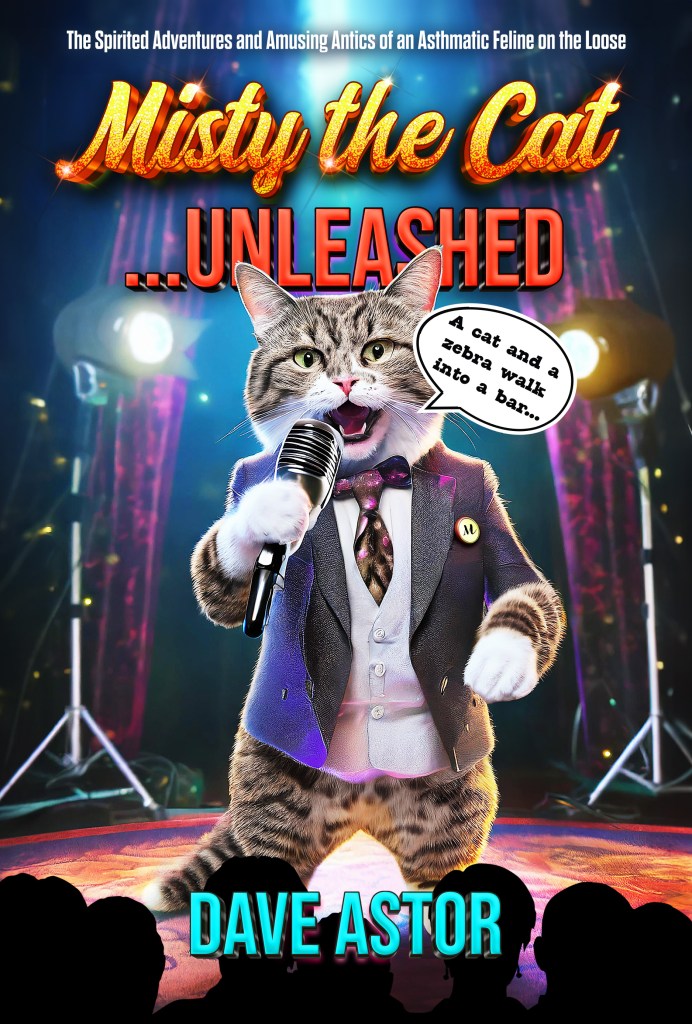
This 90-second promo video for the book features a talking cat: 🙂
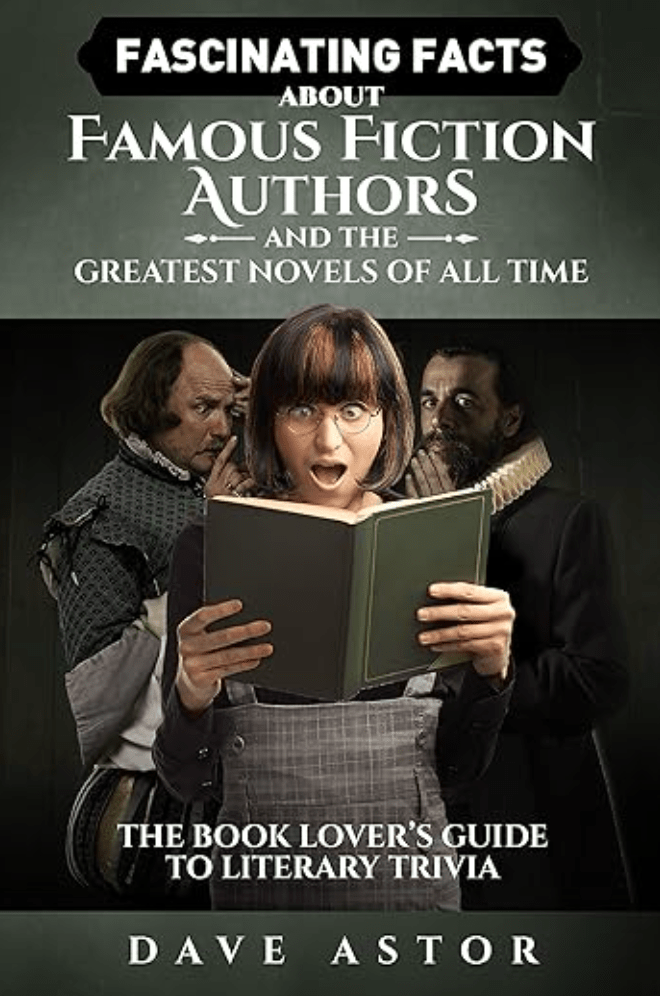
I’m also the author of a 2017 literary-trivia book…
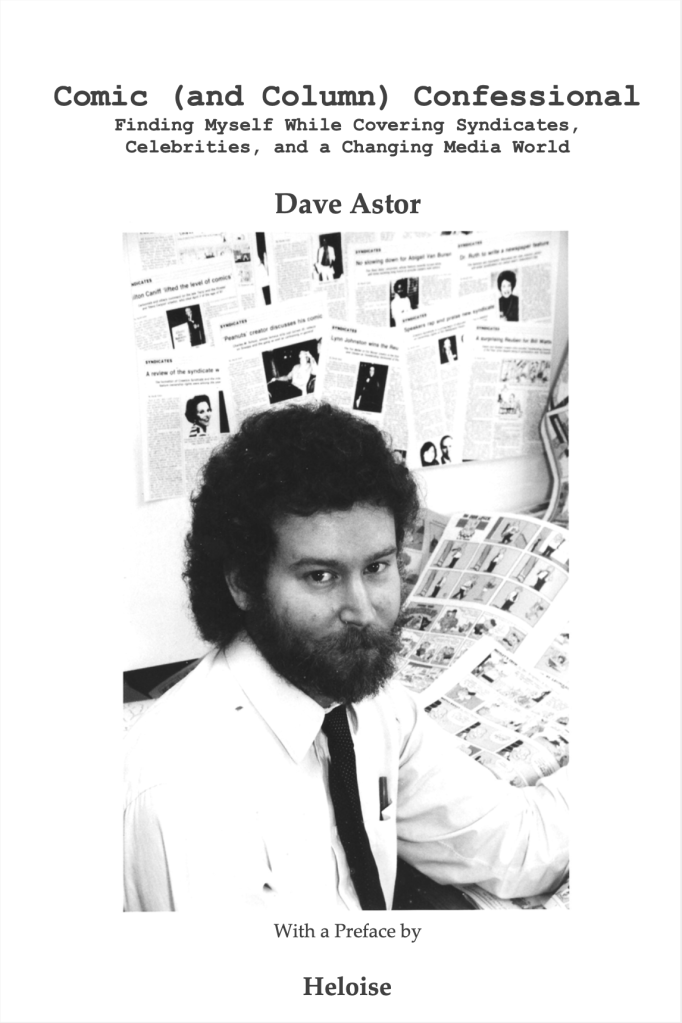
…and a 2012 memoir that focuses on cartooning and more, including many encounters with celebrities.
In addition to this weekly blog, I write the 2003-started/award-winning “Montclairvoyant” topical-humor column every Thursday for Montclair Local. The latest piece — about two meetings, a local anti-ICE protest, and more — is here.
 Dave Astor on Literature
Thanks, http://Www.joseluiscarreniotroncoso.wordpress.com
https://aws.amazon.com/es/profile
LikeLiked by 2 people
Dan, that sounds like an amazing trip for you all!
Wow! So many terrific literary tomes here and I’ve read a lot of them. 2001 was a bumper year. I hadn’t realised Kristin Hannah published a book already then as it’s only recently I’ve become a huge fan of her work. ‘Roots’ takes me back but must have read it in the mid-eighties as a teenager. My copy is rather tatty as I loved it so much! Recently I had a longing to reread this superb book but oh, the letters are so small!
LikeLiked by 2 people
Thank you, Annika! It was an amazing trip. 🙂 And 2001 was indeed an amazing year for fiction. 🙂
Kristin Hannah started writing books in the 1990s, I think, and I also was late to reading her work — starting just three (?) years ago. Since then, I’ve read about a dozen of her novels; she is indeed a fantastic author. “The Women,” “The Four Winds,” “The Great Alone,” “The Nightingale”…
I hear you about “Roots.” And about books with small print. 🙂
LikeLiked by 1 person
It seems that last year you decided to close some backlog in your literary canon reading. That was one of the first things I did before I decided to give writing a try. Very inspirational. You covered lots of territory during your visit to Guatemala in this week. It took us three months, but then we traveled on a shoestring: little money but plenty of time.
LikeLiked by 2 people
Thank you, Shaharee! Hope your writing went well in 2025!
Wonderful that you spent three months in Guatemala — albeit with little money. We definitely crammed a lot into a week (perhaps too much; we were exhausted 🙂 ), but we might never get to Guatemala again, so… We did have somewhat more money than when I traveled to various places on a shoestring in my 20s, and U.S. dollars go a long way in Central America.
LikeLiked by 1 person
It was a very productive 2025, but it came at the cost of my reading time. My major accomplishment was bringing my epic historical fantasy “The Maharajagar” to its conclusion after five years of constantly running out of steam and inspiration. In between I’ve put the last hand on my Standard Literary Theory and in the visual art department finished some works that are themed around the alchemy of chaos. Right now I’m kind of nursing a burnout and working on my neglected and anyway underdeveloped social skills.
LikeLiked by 1 person
Congratulations on finishing “The Maharajagar” and on your other 2025 work! Totally understand that reading can take a backseat at times when one is busy with other things.
LikeLiked by 1 person
I’ve read a hand full of these – some of them very recently like Life of Pi! I hope you had a great trip! 🙂 I’ve been traveling around myself, which is why I’ve been MIA around here! 🙂
LikeLiked by 2 people
Thank you, M.B.! Reading “Life of Pi” is quite an adventure. 🙂 And I hope your recent travels have been enjoyable!
LikeLiked by 1 person
Definitely! I had a great time in London!
LikeLiked by 1 person
A great city to visit! 🙂
LikeLiked by 1 person
I Remember some of these books being publish (1976). That would make me somewhat old as well. Are you sure 1976 was 50 years ago? It’s not some temporal trick…
LikeLiked by 2 people
Thank you, Dan! Ha! 😂 I have strong memories of 1976, too, and I agree that it doesn’t feel like 50 years ago. 😲
LikeLiked by 1 person
What an insight into those past years of publishing. I would recommend the Spanish Shadow of the Wind and the concept of a cemetery for books. Revolving around a bookshop, and the sinister edges of Franco’s dictatorship in a vey well described setting of past Barcelona. Quite edgy.
LikeLiked by 2 people
Thank you, navasolanature! I’m definitely getting some enthusiastic recommendations for “The Shadow of the Wind.” 🙂 I appreciate your excellent summary of it!
LikeLiked by 1 person
Hi Dave, do, do read this book, I loved it. It’s The Shadow of the Wind by Carlos Ruiz Zafor… and also the other three by him, which I have also read, and enjoyed them a great deal. It is, in fact, a series called ‘Cemetery of Forgotten Books’. How could I not like something like this? Just wonderful, I would say – the genres cover mystery, thriller and gothic. Very pleasing!
LikeLiked by 2 people
Thank you, Chris! “The Shadow of the Wind” is definitely on my list; fingers crossed that my local library has it. 🙂 I appreciate the enthusiastic recommendation!
LikeLiked by 1 person
Welcome back Dave! I trust your travels went well!
You have mentioned some brilliant books, as always! I agree with you on ‘The Sun Also Rises’ by Ernest Hemingway. I reviewed it on this site a few years ago. Whilst a good book, it didn’t knock my socks off, so to speak.
Why did you find ‘Atonement’ annoying? It is definitely on my TBR pile! Interestingly, I am also yet to read Agatha Christie’s, ‘The Murder of Roger Ackroyd’ as I have heard so much about it.
I think Dennis Lehane is great crime/thriller writer. I haven’t read, ‘Mystic River’ but have read ‘Darkness, Take My Hand’ (1996), very chilling!
Great post Dave! Welcome back, once again!
Sharon
LikeLiked by 2 people
Thank you, Sharon! An enjoyable trip in many ways. 🙂
“The Sun Also Rises” did feel kind of so-so to me compared to Hemingway’s later work such as “For Whom the Bell Tolls” — which I really liked.
I thought “Atonement” was very well written, but the character Briony really irked me the way she ruined two lives and then seemed proud of turning the mess she created into a novel.
Thanks again!
LikeLiked by 1 person
Thank you the feedback, Dave! It’s very much appreciated!
‘For Whom the Bell Tolls’, sounds intriguing!
Thanks again, Dave!
Have a great week! ☺
LikeLiked by 1 person
I think “For Whom the Bell Tolls” is Hemingway’s best novel, Sharon, but I haven’t read all of them. 🙂
Have a great week, too!
LikeLiked by 1 person
Thank you Dave, for your kind wishes for the week!
For ‘Whom the Bell Tolls’ will be added to the list!
With best wishes!
Sharon
LikeLiked by 1 person
Best wishes to you, too, Sharon! 🙂
LikeLiked by 1 person
Thank you!
LikeLiked by 1 person
You’re very welcome, Sharon! 🙂
LikeLiked by 1 person
☺
LikeLiked by 1 person
With pleasure have I read about your holidays in Guatemalo together with your family, Dave, but I suppose without Misty!
I rembember “Sue Monk Kidd’s The Secret Life of Bees” that explores the power of women and how their connections among themselves can heal many wounds! Many thanks for your interesting list of precious books!
LikeLiked by 2 people
Thank you, Martina! We missed Misty very much while we were in Guatemala; fortunately, we have a great cat-sitter who lives in our apartment complex who visited Misty three times a day and gave him his asthma medication twice a day.
Excellent description of “The Secret Life of Bees” by you! 🙂 A very interesting and inspiring novel.
LikeLiked by 1 person
👏🥰
LikeLiked by 1 person
🙂
LikeLike
I’m glad you had a good (and untroubled) trip.
Two books on this list I read and liked were The Life of Pi and American Gods. I never warmed up to Jonathan Franzen or Ann Patchett, though all of their books came to me highly recommended.
And I remember liking Gulliver’s Travels but it’s been a long time. I wonder what I would think about it now?
LikeLiked by 3 people
Thank you, Kerfe! “Life of Pi” and “American Gods” are quirky, memorable novels! I agree that Jonathan Franzen, while a very good writer, is somewhat overrated. And, re “Gulliver’s Travels,” it is indeed interesting to think of how we might feel about a book if revisiting it years later. It’s also been a long time for me since reading Jonathan Swift.
LikeLiked by 1 person
Welcome back Dave. I hope you enjoyed your break.
LikeLiked by 1 person
Thank you, Shehanne! Definitely a memorable trip. 🙂
LikeLiked by 1 person
Glad you enjoyed it.
LikeLiked by 1 person
Guatemala is definitely a friendly, interesting, and beautiful country. 🙂
LikeLiked by 1 person
Dave, it’s great to have you back! How wonderful that you could take your daughter to visit her birthplace in Guatemala. In this crazy world we now live in, I pray that Maria will stay safe and well.
It’s unbelievable that Gulliver’s Travels is now 300 years old. Just yesterday, it was required reading in our elementary school (Guyana). Tom Sawyer and Huckleberry Finn now 150 years old? No way! To an Agatha Christie fan, her novels, even at 100 years old, are timeless. Fifty-year-old Alex Haley’s Roots opened new imaginings about my own African ancestral roots.
May there always be books that stand the test of time and remind us of our shared humanity.
LikeLiked by 3 people
Thank you, Rosaliene! Given that my younger daughter is a person of color, we did have some anxiety going through U.S. Customs under the current Trump regime. 😦 But no problems, fortunately.
It IS kind of amazing thinking about how old certain novels are! “Gulliver’s Travels” is pretty readable for something written 300 years ago, and “Tom Sawyer” was one of my favorite books as a kid.
Re “Roots,” I think I saw the riveting TV mini-series before reading the novel. I can imagine the impact the book had on you with your African ancestral roots.
Loved your comment’s last line!
LikeLiked by 2 people
Dave, the situation may have been different on her return, if she had traveled alone. Who knows?
LikeLiked by 1 person
True, Rosaliene. 😦 She has flown alone a few times, but not internationally. Anything could happen under this vicious presidential administration. 😦
LikeLiked by 2 people
Good to have you back, Dave, and ‘m glad that you had a good trip. That’s a great list, and I admire your hard work in finding out and listing so many great books with special anniversaries this year. I’ve by no means read them all, but ‘Daniel Deronda’ I have, along with ‘A Painted House’ – my first Grisham, read only last year – and ‘The Life of Pi’,’The Last Man’, ‘The Last of the Mohicans’ and ‘The Hand of Ethelberta’. All great stories, although it’s been a while since I read them all. So many great books, so little time! 🙂
LikeLiked by 2 people
Thank you, Laura! The Web certainly makes it easy to check the publication dates of novels. 🙂
“A Painted House” is definitely one example of how Grisham can write other kinds of compelling novels besides great legal thrillers.
And I found “Daniel Deronda” so absorbing that I was rereading passages from it for several weeks after finishing it about 10 (?) years ago. Few authors have written a final novel that good. (I suppose Dostoevsky would be one of them with “The Brothers Karamazov.”)
LikeLiked by 1 person
I still have to read ‘The Brothers Karamazov’. I started it last year but couldn’t get going with it; I had too much else going on. I need to try again. And ‘Daniel Deronda’ is excellent. 🙂
LikeLiked by 1 person
“The Brothers Karamazov” is not the easiest of novels to get through; I found Dostoevsky’s “Crime and Punishment” more readable. But when “TBK” is good, it’s VERY good.
LikeLiked by 1 person
I’ll make sure to read it this year, Dave. You’re not the only person to recommend it. Stay safe. 🙂
LikeLiked by 1 person
A worthy 2026 plan! 🙂
LikeLiked by 1 person
Like others who’ve commented, it was fun checking this list of “anniversary” books for what I’ve read (like AMERICAN GODS, which I remember finding fascinating but haven’t thought about in a while) and what I should read, like BEL CANTO. I recommend MYSTIC RIVER (Dennis Lehane) as a disturbing but brilliant book. Also ORDINARY PEOPLE, even if you’ve seen the movie.
Wanted to add how much I like the photograph of Antigua, Dave. Very impressive mountains.
LikeLiked by 2 people
Thank you, Kim! Antigua was one of the more picturesque cities I’ve ever visited — with its cobblestone streets, very old buildings, beautiful mountains/volcanos in the background, etc. Tricky walking on those uneven streets, though. 🙂
I appreciate the various book mentions, and definitely have the “Ordinary People” novel high on my to-read list. I looked for it during my last library visit just before the Guatemala trip, but it was checked out. 😦 The movie is terrific.
LikeLiked by 1 person
You mention so many wonderful books here, Dave, as well as a few that are still on my TBR list. Why on earth have I not read Daniel Deronda yet? My husband recommended it to me years ago. This year I will do it! 😄
LikeLiked by 2 people
Thank you, Jennifer! Glad you liked the post! I found “Daniel Deronda” to be kind of a revelation — not as famous as “Middlemarch,” “Silas Marner,” and “The Mill on the Floss,” but a really gripping novel featuring one of Eliot’s most memorable characters (Gwendolen Harleth) and a very early look at Zionism. If you do read “DD,” I’d be interested in hearing what you think of it.
LikeLiked by 1 person
I will keep you apprised. 😊
LikeLiked by 1 person
🙂
LikeLike
Welcome back, Dave!
Okay, just to display my literary prowess, Winnie the Pooh The House at Pooh Corner by A.A.Milne was released in 1926.
Although I’m sure that J.D. Salinger wasn’t trying to beat Winnie onto the stands by releasing The Catcher in the Rye a few months earlier that year.
And I would be totally remiss not to mention that Grand Avenue by Joy Fielding was released in 2001.
Misha sends a big virtual fur ball of love to Misty.
LikeLiked by 3 people
Thank you, Resa! Yikes! I should have mentioned “Grand Avenue,” which I liked a lot (as you know).
Winnie the Pooh and J.D. Salinger in consecutive paragraphs — epic. 🙂
Misty who witnessed today’s snow says hello (back to Misha)!
LikeLiked by 1 person
Dave,
Thing about you not mentioning “Grand Avenue” is that I got to! 🤭
Catcher in the Pooh? 😺 (I swear that’s a Misha joke meant for Misty!)
LikeLiked by 1 person
Yes, Resa, my not mentioning “Grand Avenue” was a silver lining. 🙂
Ha ha. 😂 😂 Misha is a comedian — love it!
LikeLike
Thank you so much for this sweeping post of literature, Dave. Reading through it reminded me that January 1, 2026 is Public Domain Day, that quiet moment each year when stories are returned to all of us. This year, works published in 1929 enter the public domain, and it’s a powerful group. Virginia Woolf’s A Room of One’s Own now belongs fully to readers everywhere, as do Ernest Hemingway’s A Farewell to Arms, William Faulkner’s The Sound and the Fury, and Dashiell Hammett’s The Maltese Falcon.
What strikes me, reading your list alongside this, is how clearly it shows that books endure because stories endure. They carry our humanity forward. Our questions, our longings, our attempts to make sense of the world. Books, stories, poetry keep speaking across generations and centuries. That, to me, is the quiet miracle behind every anniversary.
As Virginia Woolf one wrote: “Lock up your libraries if you like; but there is no gate, no lock, no bolt that you can set upon the freedom of my mind.”
LikeLiked by 4 people
Thank you, Rebecca! Those are some notable novels entering the public domain! And, yes, anniversaries remind us that certain books endure, for various reasons: they speak to universal human emotions, have memorable characters, feature memorable plots, offer beautiful prose, etc. And that’s a great Virginia Woolf quote that feels very timely.
LikeLiked by 1 person
Virginia had a way with words, didn’t she!!!
LikeLiked by 1 person
She did indeed, Rebecca!
LikeLiked by 1 person
A Painted House is a masterpiece that made me feel right back in elementary school back in Russia. we only lived there for three years at the house of my stepfather’s parents. it was a very memorable period in time, it was over in 1993 when we moved back to Ukraine leaving my stepfather behind. this novel by John Grisham captures my feelings from those years perfectly fine.
LikeLiked by 2 people
Thank you, Milena! That was definitely a great Grisham novel, and not one of his legal thrillers. Glad the book evoked some strong childhood memories for you!
LikeLiked by 1 person
It definitely did
LikeLiked by 1 person
🙂
LikeLike
1726, Gulliver, of course… and as a surgeon, Lemuel can write with authority about safeguarding & financial/legal abuse of seniors. Just make it impossible. No chance of involving the Struldbrugs in new wills, because of their age, nothing would be valid. Laputa ? Who would empty the bins ?
1926, great year for crime classics, including the murder of Roger Ackroyd and Clouds of Witness. Arguably would be very difficult to film the first Sayers/Wimsey book, Whose Body. (1923) Radio best for such a horrific crime.
Centenary, and I realise this is possibly a thought crime, but I always detested Pooh , much preferred William books. .
LikeLiked by 2 people
Thank you, Esther! Winnie the Pooh was too cutesy in its way, but I guess I could see the appeal — especially to kids. I definitely want to read “The Murder of Roger Ackroyd,” but it’s always checked out of my local library. Perhaps I should do the sensible thing and reserve it, but when a novel I’m looking for isn’t there, I just move on to the next one on my too-long list. 🙂
LikeLike
25 years ago Stephen King wrote Dreamcatcher and Black House, neither of which I’ve read.
LikeLiked by 1 person
Thank you, Robbie! Those are two Stephen King works I haven’t read, either. I did read and love King’s 2002-published novel “From a Buick 8,” so I suppose I could mention that next year. 🙂
LikeLiked by 1 person
Yes. I’m reading Skeleton Crew and have just finished The Mist. I can’t get over what a fantastic writer Stephen king is. He deserves his fame.
LikeLiked by 1 person
Great that you’re a King fan, and I agree that he’s an excellent writer!
LikeLiked by 1 person
A most interesting post, Dave. I’ve read several of these books, mainly the older ones as I don’t read much in the modern line.
LikeLiked by 2 people
Thank you, Robbie! I hear you about reading older lit; that was also my focus when I was younger. Lately, I’ve been mostly reading more-recent fiction (21st century and latter 20th century) for whatever reason, but things might change back again at some point. 🙂
LikeLiked by 1 person
Maybe you’ve run out of older books 🌈🤗
LikeLiked by 1 person
That was definitely part of it, Robbie; I read a LOT of the classics. But there are still quite a few I haven’t gotten to. 🙂
LikeLiked by 1 person
What a fascinating and interesting list.
I have never read Agatha Christie’s “The Murder of Roger Ackroyd,” but I saw it on TV last night: what a coincidence!
LikeLiked by 3 people
Thank you, Luisa! That IS a coincidence. 🙂 I definitely want to read that Agatha Christie mystery!
LikeLiked by 2 people
🙏🤗🙏🤗🙏
LikeLiked by 1 person
🙂
LikeLiked by 1 person
For 1976, I’ll go with Kiss of the Spider Woman, a River Runs through It, and Gnomes. (My dad loved Gnomes, which he received for Christmas.) Winnie the Pooh came out in 1926! Just out of curiosity, why did you find Atonement both compelling and annoying. I’ve read it, but I don’t recall being annoyed by it.
LikeLiked by 3 people
Thank you, Liz! Four great anniversary mentions — two of which I’ve read (“A River Runs Through It” and “Winnie the Pooh”) and one of which I’ve seen the movie version (“Kiss of the Spider Woman”).
Re “Atonement,” I know it’s really well written, but the havoc-wreaking teen character Briony really irked me — as did the ending that kind of turned the whole mess she made of things into a novel of hers. (I think that was the ending; I haven’t read the book in about 20 years. 🙂 )
LikeLiked by 2 people
I, too, liked Atonement and found it irritating, although I don’t remember why I found it irritating. I kind of remember the teen character as being a spoiled brat, but it was a long time ago.
LikeLiked by 2 people
Madeline, from what I remember, I think Briony was indeed spoiled — and pretty much ruined two people’s lives.
LikeLike
You’re welcome, Dave! Thank you for answering my question about Atonement. It’s been a number of years since I read as well.
LikeLiked by 1 person
You’re welcome, Liz!
LikeLiked by 1 person
2001 was an outstanding year for books that stood the test of time. I read many of the ones on your list, but the best was The Shadow of the Wind. It is on my top 20 books of all time list. I own Empire Falls but haven’t read it. I must change that.
LikeLiked by 2 people
Thank you, Darlene! I completely agree — 2001 was a pretty amazing year for novels. After seeing your enthusiastic mention, it sounds like I could be reading “The Shadow of the Wind,” as you might be reading “Empire Falls.” 🙂 The premise of Richard Russo’s novel shouldn’t have made it a page-turner, but it was!
LikeLiked by 1 person
I meant to mention that your trip sounds amazing. Did your daughter enjoy seeing the place of her birth?
LikeLiked by 1 person
She did, Darlene! And during our first full day in Guatemala, we had a wonderful reunion with the foster family Maria lived with during the first 16 months of her life. 🙂
LikeLiked by 1 person
How special. I love that you took her back there.
LikeLiked by 1 person
Thanks! An almost-six-year-delayed trip; we had a visit planned for April 2020 that had to be canceled because of Covid.
LikeLiked by 1 person
Your post make ME feel old (not just the novels). I can’t believe some of them are that old already. Glad to hear you had a good trip!
LikeLiked by 2 people
Thank you, Marie! I totally hear you — hard to believe some of those novels were published 25 or 50 years ago. I also felt a bit old crazily traveling to several places and staying in multiple hotels in just one week. 🙂
LikeLiked by 1 person