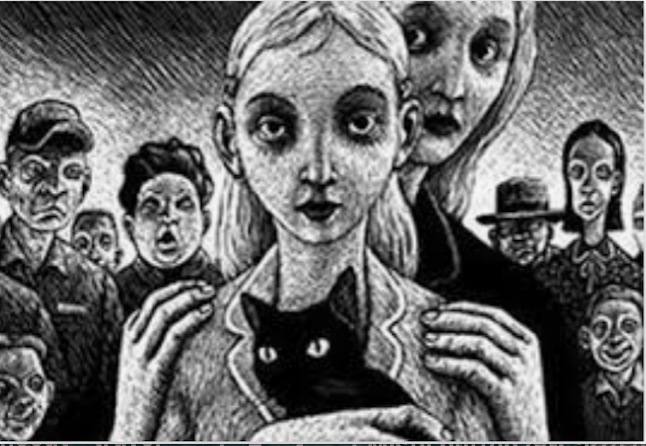
The sisters from We Have Always Lived in the Castle.
Seven years ago, I wrote a blog post about some of literature’s memorable sibling relationships — including those in The Mill on the Floss, Crime and Punishment, Little Women, The Grapes of Wrath, Go Tell It On the Mountain, The Poisonwood Bible, and The Blind Assassin, among other novels.
I thought I would update that today by discussing siblings in several books I’ve read since 2014, starting with two recently finished novels: Shirley Jackson’s We Have Always Lived in the Castle and Mary Renault’s The Praise Singer.
Why are literature’s sibling relationships potentially compelling? We like when fictional sisters and/or brothers get along, lament when they don’t, feel uneasy when they’re super-competitive with each other, see the unfairness if one sibling is much more intelligent/popular/successful/better-looking, hate if the parents blatantly favor one child over another, etc. Those of us with siblings can certainly relate to some or all of the above.
We Have Always Lived in the Castle is a quirky, disturbing novel (no surprise with Ms. Jackson) that often centers on the interactions between main character Mary Katherine and her decade-older sister Constance — who’s almost like a mother to “Merricat.” They live an isolated life, and…is one of those two young women guilty of having mass-murdered several of their family members?
The Praise Singer is a well-crafted historical novel focusing on ancient Greek poet Simonides. One interesting aspect of the book is the relationship between the protagonist and his older brother Theas when they’re both living at home as boys. Their father blatantly favors Theas — who’s more handsome, charismatic, and confident than Simonides. But Theas treats Simonides affectionately, encourages him, and defends him. Theas goes on to become a successful adult, even as his poet brother becomes widely famous.
Another historical novel is Julia Alvarez’s In the Time of the Butterflies — in which three of the four Mirabel sisters become revolutionaries opposing the Dominican Republic’s Trujillo dictatorship at great risk to their lives. The trio (Patria, Minerva, and Maria Teresa) have quite different personalities, and don’t always get along, but share a hatred of the brutal regime. The fourth sister (Dede) is less revolutionary, and takes a somewhat divergent path in life.
As in The Praise Singer, there is unfortunate parental favoritism in Betty Smith’s A Tree Grows in Brookyn. Katie Nolan prefers her son Neeley over her daughter Francie, yet Francie (the novel’s protagonist) and her younger brother get along well for the most part — taking some psychological comfort in their companionship as they deal with a charming but often-irresponsible alcoholic father.
Also getting along well are Jemmy and Mandy — the young son and younger daughter of Brianna and Roger, who bounce around in time more than once in Diana Gabaldon’s Outlander novels. The two kids (the grandchildren of Brianna’s 20th-century-born mother Claire and 18th-century-born father Jamie) are a familar touchstone for each other during their unorthodox lives.
An example of a dysfunctional sibling relationship is the one between Hank and Leland in Ken Kesey’s Sometimes a Great Notion. Hank is more confident and physically stronger than his more intellectual half-brother Leland, and the oil-and-water mix between the two helps fuel a lot of the drama in the novel.
Any novels you’d like to mention with memorable sibling characters?
My literary-trivia book is described and can be purchased here: Fascinating Facts About Famous Fiction Authors and the Greatest Novels of All Time.
In addition to this weekly blog, I write the 2003-started/award-winning “Montclairvoyant” local topical-humor column for Baristanet.com. The latest weekly piece — about my town’s bus service resuming, LGBTQ news, and COVID’s effect on two parades — is here.







 Dave Astor on Literature