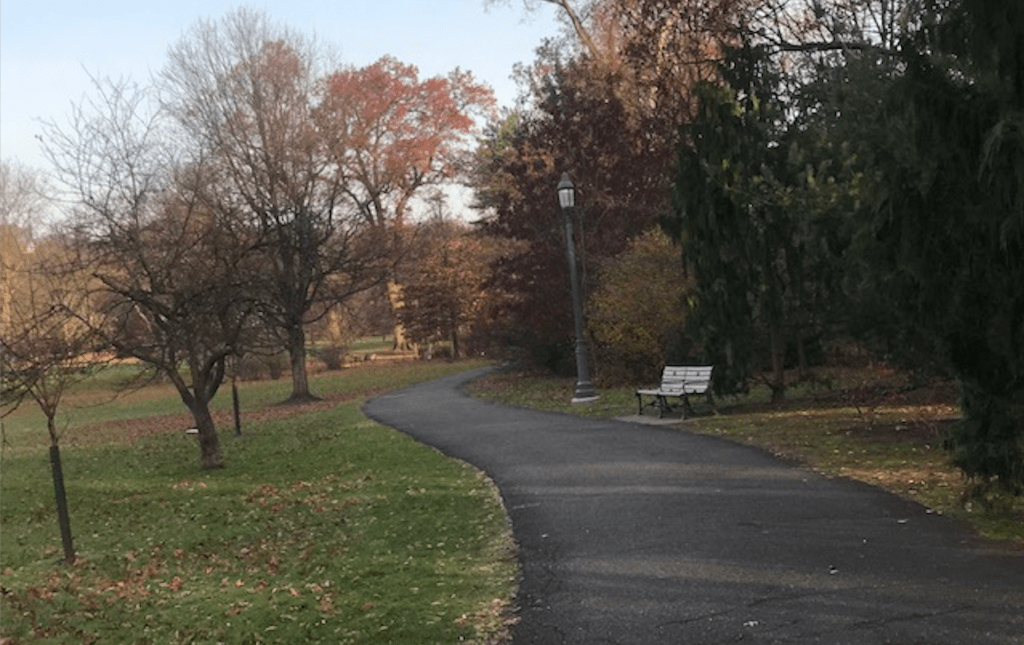
A photo I took this past Friday during a walk in a local park.
As someone who takes a long stroll almost every day, I like to see walking in literature.
Of course, memorable walks in fiction are usually not just for relaxation or exercise. They need to have some drama attached — whether positive drama, such as when romantic couples amble along, or mixed or negative drama like much of the rest of this blog post will show.
So, let’s begin trekking down the path of examples…
The first novel that came to mind was Walter Scott’s The Heart of Mid-Lothian (1818). In it, working-class protagonist Jeanie Deans trudges about 400 miles/644 kilometers from Edinburgh to London to seek a royal pardon sparing her sister Effie from a death sentence. It’s my favorite of Scott’s many great novels.
As I stay with 19th-century literature for a minute, I’ll mention that memorable walks can occasionally occur indoors, too. One of the most vivid parts of Emile Zola’s 1877 novel The Drinking Den (L’Assommoir) is when Gervaise and Coupeau and their wedding party trudge through the Louvre — a joyful, tense, chaotic scene that presages a union that will be happy and then disastrous.
Walking is also involved in escapes (as is running). I thought of Harriet Beecher Stowe’s 1852 classic Uncle Tom’s Cabin, in which Eliza frantically tries to flee slavery on foot with her young son in her arms. Also, Louis L’Amour’s 1987 novel Last of the Breed has Native-American protagonist Joseph Makatozi make a break from Soviet imprisonment and then walk hundreds of miles across Siberia trying to elude his would-be captors.
In Jean M. Auel’s The Plains of Passage (1990), the fourth installment of the Earth’s Children series that began with The Clan of the Cave Bear, prehistoric couple Ayla and Jondalar hike the enormous distance from what is now Ukraine to what is now France.
There’s also lots of wearisome walking during the epic journey of the “good guy” characters in J.R.R. Tolkien’s The Lord of the Rings (1954) — as there is with the father and son in Cormac McCarthy’s post-apocalyptic The Road (2006).
I haven’t read The Long Walk (1979) by Stephen King or The Unlikely Pilgrimage of Harold Fry by Rachel Joyce (2012), but know each novel has much moving of feet.
Animals in fiction can tread huge distances, too, as exemplified by Luath and Bodger the dogs and Tao the cat traveling approximately 300 miles/483 kilometers through the Canadian wilderness to try to return home in Sheila Burnford’s 1961 novel The Incredible Journey.
I’ll conclude with Nicholas Sparks’ A Walk to Remember, which the title of this blog post referenced. If I’m remembering correctly, the title of that moving 1999 novel refers to a wedding-day walk down the aisle of young characters Landon and the terminally ill (?) Jamie. Not a long walk, but a very important one.
Thoughts about, and examples of, this topic? And a relevant video:
My literary-trivia book is described and can be purchased here: Fascinating Facts About Famous Fiction Authors and the Greatest Novels of All Time.
In addition to this weekly blog, I write the 2003-started/award-winning “Montclairvoyant” topical-humor column every Thursday for Montclair Local. The latest piece — about being the parent of a student athlete — is here.





 Dave Astor on Literature