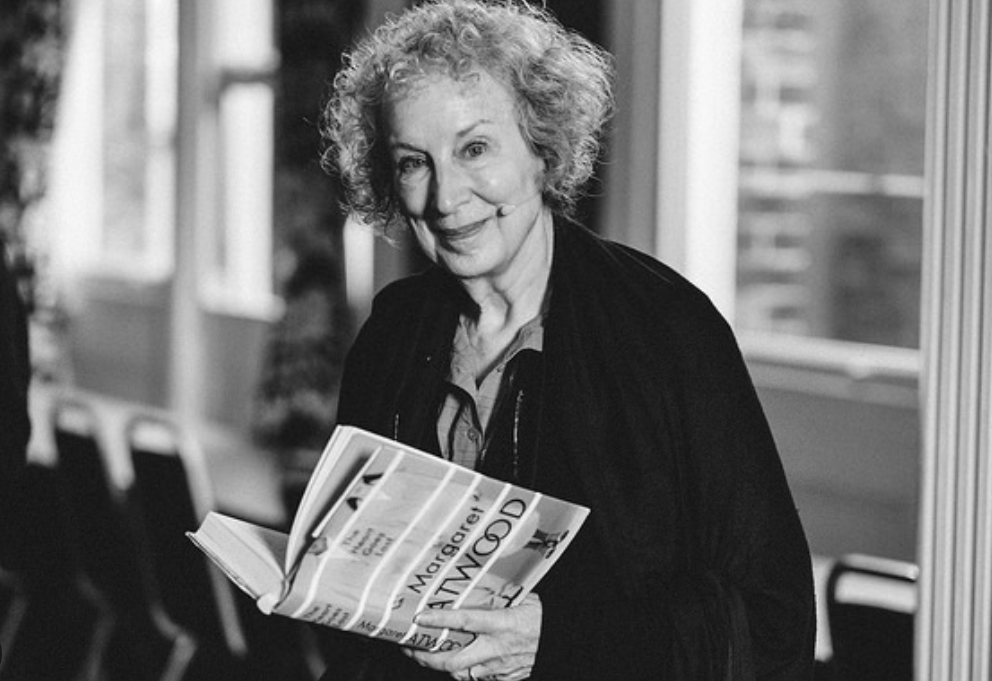
Margaret Atwood (photo by Chris Boland/Flickr www.chrisboland.com/cambridge).
If you really like a writer, even their “lesser” novels can be appealing.
I recently experienced that with The Heart Goes Last by Margaret Atwood — a 2015 novel, by one of my favorite living authors, that I had somehow failed to read before. Far from her best book, but it’s still a fairly engrossing, socially conscious, and at times funny work of speculative fiction about people escaping a U.S. turned dystopian for a closed U.S. community where they all alternate between a house and a prison. A community that, not surprisingly, turns out to be rather dystopian, too. The weirdly humorous parts? Well, for one thing, prepare to meet multiple Elvis Presleys and Marilyn Monroes.
Willa Cather, whose authorial career ended a year after Atwood was born, is best known for My Antonia and Death Comes for the Archbishop. But she also wrote a number of other novels ranging from good to very good — including The Song of the Lark (about an opera singer), One of Ours (a World War I novel), and Shadows on the Rock (historical fiction set in Quebec City).
James Hilton is also best known for two novels — the moving Goodbye, Mr. Chips and the eye-opening Lost Horizon — but some of his not-as-scintillating works, including So Well Remembered, are rather nice, too.
Maugham is most famous for Of Human Bondage, and also pretty famous for The Painted Veil, The Razor’s Edge, and The Moon and Sixpence. But there’s a pretty good sleeper amid the Maugham canon: Cakes and Ale, which is more compelling than its title might indicate.
Aldous Huxley? The iconic Brave New World is practically synonymous with his name, but he wrote several not-iconic novels that are quite readable — including the not-dystopian Point Counter Point.
Getting back to favorite living authors, I give many of Liane Moriarty’s novels an A or A+. But even the one I liked least — Truly Madly Guilty, focusing on a fateful barbecue — more than held my interest.
Good but not terrific Jane Austen? Northanger Abbey. Charles Dickens? Hard Times. Herman Melville? Omoo. Anne Bronte? Agnes Grey. Mark Twain? Pudd’nhead Wilson. John Steinbeck? The Wayward Bus. Isabel Allende? The Japanese Lover. Donna Tartt? The Little Friend. Etc.
Anything you’d like to say related to this week’s theme?
My literary-trivia book is described and can be purchased here: Fascinating Facts About Famous Fiction Authors and the Greatest Novels of All Time.
In addition to this weekly blog, I write the 2003-started/award-winning “Montclairvoyant” topical-humor column for Baristanet.com every Thursday. The latest piece — about a time machine, a bridge, and a $1,000 (!) dessert — is here.