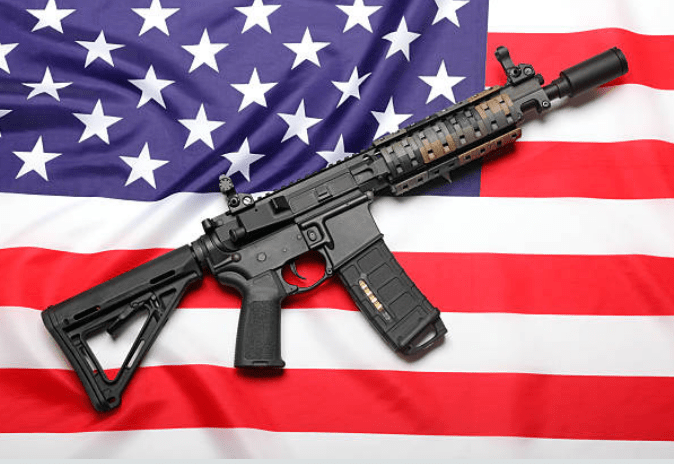
America’s ghastly Republican politicians and ghastly gun makers continue to support the proliferation of military-style weapons repeatedly used to massacre people, and continue to oppose common-sense measures such as universal background checks. But they won’t be completely satisfied until the world’s great novels are rewritten to reflect their sick preference for gun “rights” over human lives.
For instance, they might argue that Jane Austen really meant Pride and Prejudice‘s first line to be “It is a truth universally acknowledged that a single man in possession of a good fortune must be in want of an AR-15.”
I guess early-19th-century publishers who avoided positive assault-rifle mentions in their books were “woke” liberal commies who backed banning Trump from Twitter.
The far-right death cult also believes the opening of Charlotte Bronte’s Jane Eyre would be much improved if it read “There was a strong possibility of an elementary-school shooting that day.”
If there were no shooting, it would be a disappointment for that cult far exceeding Jane and Rochester’s regret about not having met on The Dating Game TV show.
Moby-Dick? America’s “pro-life” weapon worshippers feel Herman Melville would have had much higher initial sales if his masterpiece started with “Call me Rambo” rather than “Call me Ishmael.”
Heck, if that novel’s narrator had been packing enough heat to dispatch Pequod first mate Starbuck, perhaps a certain coffee chain wouldn’t be seeing all that “socialist-icky” unionization. (A 2022 development I’m thrilled about.)
Many U.S. bullet bros tend to be fans of Russia’s murderous leader Putin, but are miffed at Russia’s Leo Tolstoy for not starting Anna Karenina with a different first line. The NRA’s literary pros have that prose fixed: “Happy families are all alike; every unhappy family is unhappy because it doesn’t have as many guns as Tolstoy had children.”
If inquiring minds want to know, Leo and Sophia had 13 kids — but only two were manufactured by Smith & Wesson.
America’s gun ghouls are doubly mad at Charles Dickens for not using his immortal first and last A Tale of Two Cities passages to mention hardware that inflicts maximum 21st-century carnage. The revisions: “It was the best of body armor; it was the bestest of body armor” and “It is a far, far bigger stash of ammo that I have than I ever had before.”
Our Mutual Friend might be the undertaker. Or, rather, one of many undertakers.
F. Scott Fitzgerald was a prose master, but the Republican killer cadre would want the last passage of The Great Gatsby to be even more sublime: “So we bleat on, a minority against a gun-safety majority, putting U.S. citizens ceaselessly into their graves.”
Actually, the ultra-conservative sickos who think gun “rights” are more important than human lives wouldn’t like the way I rewrote Fitzgerald’s famous closing line. They can all go to hell — though Satan might consider them too evil to welcome.
My literary-trivia book is described and can be purchased here: Fascinating Facts About Famous Fiction Authors and the Greatest Novels of All Time.
In addition to this weekly blog, I write the 2003-started/award-winning “Montclairvoyant” topical-humor column for Baristanet.com every Thursday. The latest piece — which also discusses guns, as well as some landlords ignoring my town’s new rent-control law — is here.






 Dave Astor on Literature