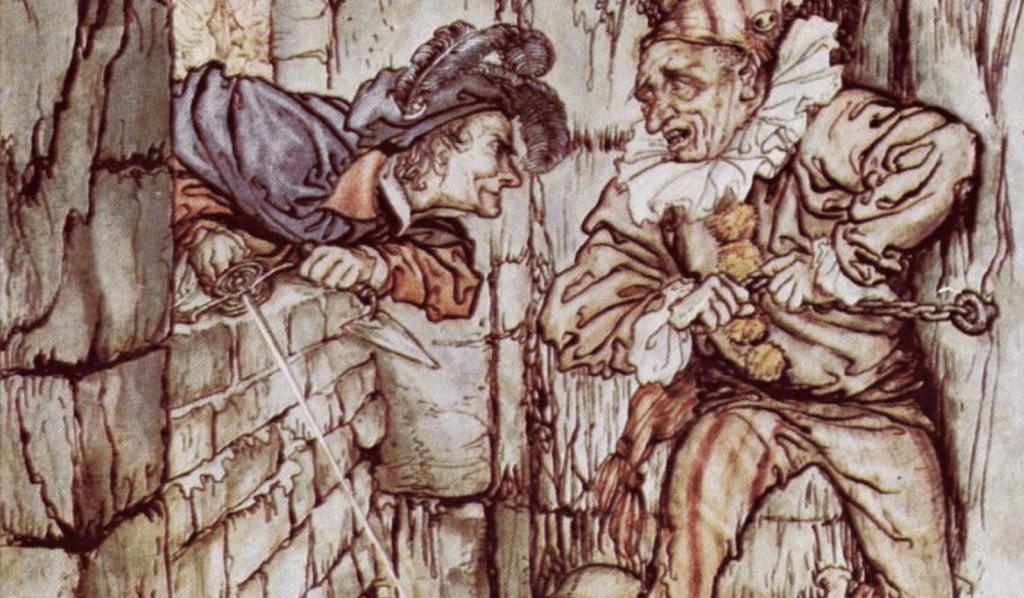
Arthur Rackham’s “Cask of Amontillado” illustration from 1935.
Today is Halloween, so I’ve made the frightfully unoriginal decision to discuss novels and stories I’ve found scary or spooky or disturbing or whatever. They include general literature, horror fiction, ghost tales, mysteries, dystopian books, apocalyptic offerings, adventure sagas, sci-fi, etc.
When one thinks of horror writing, the first author names that come to mind — well, come to my mind at least — are Edgar Allan Poe, H.P. Lovecraft, Shirley Jackson, and Stephen King. I’ve read multiple works by all four, and the ones that most creeped me out by each were “The Cask of Amontillado” story (Poe), “The Colour Out of Space” story (Lovecraft), “The Lottery” story (Jackson), and the Misery novel (King).
MANY honorable mentions, of course, among them “The Pit and the Pendulum” story (Poe), the At the Mountains of Madness novella (Lovecraft), the We Have Always Lived in the Castle novel (Jackson), and the ‘Salem’s Lot novel (King).
Then there are numerous dystopian and apocalyptic novels with multiple gut-wrenching moments — including Mary Shelley’s The Last Man, Albert Camus’ The Plague, George Orwell’s 1984, Margaret Atwood’s The Handmaid’s Tale, and Suzanne Collins’ The Hunger Games trilogy, to name just five works.
Other novels that will haunt your dreams include Octavia Butler’s Kindred (a 20th-century Black woman is yanked back in time to the slave-holding U.S. South), Mary Shelley’s Frankenstein, Agatha Christie’s And Then There Were None, William Peter Blatty’s The Exorcist, Bram Stoker’s Dracula, Sir Walter Scott’s The Bride of Lammermoor, Robert Louis Stevenson’s Strange Case of Dr. Jekyll and Mr. Hyde, H. Rider Haggard’s She, Ray Bradbury’s Something Wicked This Way Comes, and Jack London’s The Sea-Wolf, to again name only a few. Oh, and Cormac McCarthy’s Blood Meridian — all those sickening massacres perpetrated by white men in America’s Old West and the book’s big, pale, hairless, terrifying Judge Holden character.
I’m not a huge fan of Shirley Jackson’s The Haunting of Hill House or Henry James’ The Turn of the Screw, but I’m sure many people would differ. 🙂 Those two novels just didn’t scare me much.
Other great short stories perfect for Halloween? One is Richard Connell’s thriller “The Most Dangerous Game,” about a person being hunted like an animal (a theme later chillingly used by Richard Matheson in his novel Hunted Past Reason). Also, Charlotte Perkins Gilman’s disorienting feminist tale “The Yellow Wallpaper,” Graham Greene’s macabre shocker “Proof Positive,” Edith Wharton’s unnerving dog-ghost tale “Kerfol,” Charles Dickens’ eye-opening “The Signal-Man,” and E.T.A. Hoffmann’s disquieting “The Sandman.” Also, various episodes of Rod Serling’s iconic Twilight Zone TV series were converted into stories collected in books — I have one!
I’ve obviously only scratched the surface here. Your favorite fiction appropriate for Halloween (whether works I mentioned or those I didn’t)?
My literary-trivia book is described and can be purchased here: Fascinating Facts About Famous Fiction Authors and the Greatest Novels of All Time.
In addition to this weekly blog, I write the 2003-started/award-winning “Montclairvoyant” local topical-humor column for Baristanet.com. The latest weekly piece — about a significant election this Tuesday — is here.



 Dave Astor on Literature