Problematic Parents in Literature

Author Amy Tan

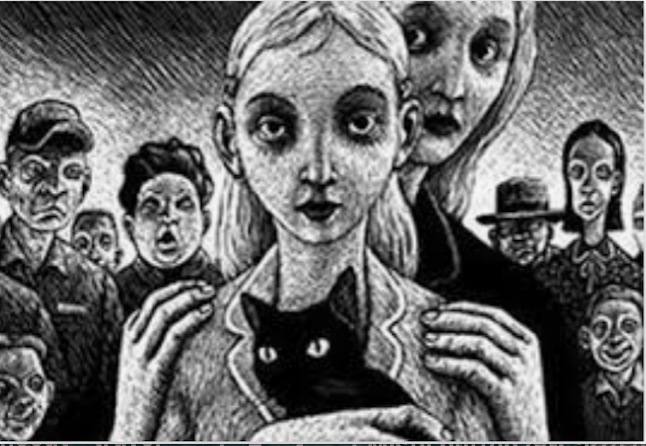
Many of us have or had them: problematic parents. (I’ve been there.) Then we add insult to injury by voluntarily reading the depictions of problematic parents in more than a few novels. Of course, that can be also be cathartic, depending on the book — and great novels are worth reading even when they, and because they, push our emotional buttons.

There was certainly a less-than-stellar parent in the San Francisco-set first half of Amy Tan’s excellent The Bonesetter’s Daughter, which I read last week. Ruth’s elderly mother LuLing is pushy and embarrassing — and has undermined, and not respected the privacy of, the now-40-something Ruth since Ruth was a kid. We cheer for Ruth when she pushes back at least somewhat against this exasperating parent.

Then things get more complex in the novel’s second half, which chronicles LuLing’s life in China as a girl and young woman. LuLing goes through so much trauma that we understand why she became so neurotic — neuroticism that ends up coloring Ruth’s personality, too.

Will LuLing and Ruth reach some sort of reconciliation when things return to San Francisco near the book’s conclusion?

Relationships with problematic parents can improve (as is the case between daughter Anne and her adoptive mother Marilla in L.M. Montgomery’s Anne of Green Gables) or they can remain bad or worsen (think daughter Bela and her mother Gauri who abandons Bela in Jhumpa Lahiri’s The Lowland). Another abandoning parent, the evil Cathy in John Steinbeck’s East of Eden, is no peach, either.

The novel I read before The Bonesetter’s Daughter — Betty Smith’s A Tree Grows in Brooklyn, which I discussed last week in a different context — also features parents with some issues. Johnny the dad and Katie the mom are basically good-hearted people, but the former is an often-irresponsible alcoholic and the latter favors son Neeley over her bright daughter Francie — the book’s appealing young protagonist.

Echoes of George Eliot’s The Mill on the Floss, in which the parents favor son Tom Tulliver over their smarter and more likable daughter Maggie.

The bad choice to play favorites not only involves male vs. female children but can also have an orphan angle. The titular character in Charlotte Bronte’s Jane Eyre is treated badly by her Aunt Sarah in a household where Sarah’s children (Jane’s cousins) fare much better. Also the situation for Harry Potter in the home of his Aunt Petunia and Uncle Vernon, both of whom dote on their thuggish son Dudley while behaving abominably toward Harry.

Returning to hard-drinking dads in fiction, among the many examples is Huck Finn’s father in Mark Twain’s The Adventures of Huckleberry Finn. “Pap” Finn is a drifter who resents Huck bettering himself even as he begs his son for booze money.

Many other 19th-century novels also have irksome parents. For instance, the father of the three brothers in Fyodor Dostoevsky’s The Brothers Karamazov is a vile guy who took little interest in his trio of boys when they were growing up. Things are no better after they reach adulthood — with dirty-old-man dad even competing with eldest son Dmitri for the affections of the young woman Grushenka.

One last nod to recent literature: daughter Jordan is suspicious of her stepmother in Kate Quinn’s The Huntress. Could the new wife of Jordan’s American father be an escaped Nazi with a murderous past? That’s a LOT more than problematic.

Some annoying (and worse) fictional parents you’d like to mention?

My literary-trivia book is described and can be purchased here: Fascinating Facts About Famous Fiction Authors and the Greatest Novels of All Time.

In addition to this weekly blog, I write the 2003-started/award-winning “Montclairvoyant” topical-humor column for Baristanet.com. The latest piece — about a councilor in my town criticizing scandal-plagued New York Gov. Cuomo, for whom he used to work — is here.

Fiction With COVID Frisson

This past Thursday, March 11, was the one-year anniversary of when the World Health Organization declared a global pandemic and various countries went into COVID lockdown. It’s also the one-year anniversary of COVID coloring my reaction to the content of non-pandemic novels — at least a little.

No surprise there. One’s life can affect how we react to literature, and COVID has had a huge impact on our lives. When reading fiction in 2020 and 2021, I sometimes overtly and sometime subconsciously thought of the pandemic.

The latest instance for me, this past week, involved A Tree Grows in Brooklyn. Betty Smith’s poignant, memorable, semi-autobiographical coming-of-age novel may have been published in 1943, but parts of it really resonated in this time of coronavirus.

How? A Tree Grows in Brooklyn‘s young, bright, impoverished, early-20th-century protagonist Francie Nolan has vivid school experiences as a preteen/teen that reminded me that my similarly aged younger daughter has been doing remote instruction since March 2020. The requirement that Francie get the smallpox vaccine before starting school reminded me of the COVID-vaccine shots now sweeping the planet. Francie living in a city neighborhood of tenements reminded me how crowded milieus are unfortunately conducive to spreading disease. And the novel’s Brooklyn setting reminded me that, despite my living just 12 miles west of New York City (where I worked for several decades and continued to visit fairly often), I haven’t traveled there for over a year.

(The photo atop this blog post is from 1945’s A Tree Grows in Brooklyn movie.)

When reading other novels last year such as Angie Thomas’ The Hate U Give and Chimamanda Ngoze Adichie’s Americanah, I thought once again of COVID’s racial and economic disparities — with people of color and people of lower incomes much more affected.

Heidi? As I finally got to Johanna Spyri’s classic last year, all that fresh air in the mountains of Switzerland sure sounded non-pandemic-y — though the novel included a major secondary character who was ill.

Gail Honeyman’s Eleanor Oliphant Is Completely Fine? Many haven’t been able to say the same during the pandemic, though that novel’s title was mostly meant to be ironic.

While enjoying Lee Child’s/Andrew Child’s Jack Reacher novel The Sentinel this year, I fantasized about the powerful Reacher punching out COVID.

And during the pandemic’s early days of March 2020, I read Liane Moriarty’s Nine Perfect Strangers — about nine imperfect guests at a health resort. I was lamenting at the time that my wife and I had just canceled an April 2020 family vacation, but, then again, there was the silver lining of there being no chance of staying in lodgings as weird and scary as the one Moriarty depicted. 🙂

Every novel I mentioned in this post was published before COVID, but that doesn’t mean they didn’t spur pandemic-related feelings. And in coming years, of course, a not-insignificant chunk of literature will undoubtedly reference this time of coronavirus.

Has some of the fiction you’ve read during the past year made you think of COVID? Any examples you’d like to offer?

Then there is fiction directly about pandemics and such, which I covered last year.

My literary-trivia book is described and can be purchased here: Fascinating Facts About Famous Fiction Authors and the Greatest Novels of All Time.

In addition to this weekly blog, I write the 2003-started/award-winning “Montclairvoyant” topical-humor column for Baristanet.com. The latest piece — about a settlement that will bring some of my town’s teachers back into schools next month — is here.

Authors and Readers Throw Their ‘Wait’ Around

One great but also frustrating aspect of loving literature is anticipating the next novel in a series. Or anticipating an author’s next standalone novel. Or, back in the golden age of serialization, anticipating the next chapters of a novel.

After finishing the eighth Outlander book during a 2020 binge-reading of Diana Gabaldon’s riveting series, I wanted so badly to continue with the ninth novel. Unfortunately, Go Tell the Bees That I Am Gone wasn’t out yet (it might appear later this year). I don’t blame Ms. Gabaldon — authors work at their own pace, she’s very busy with various projects, and her Outlander romance/adventure novels are long and carefully researched and thus take years to write. Plus I was lucky in a way to discover the series late — meaning I could read the first eight books (published between 1991 and 2014) without waiting for the next one to be written.

(Pictured above are Caitriona Balfe as time-traveling 20th-century English physician Claire and Sam Heughan as 18th-century Scottish warrior Jamie in the popular Outlander TV series.)

There’s also plenty of anticipation, but more publishing-date certainty, for the addictive Jack Reacher novels by Lee Child (now being co-written by his brother Andrew). A new Reacher thriller arrives every fall like Halloween — with both having treat appeal. Book number 26 expected this autumn.

Of course, probably the most famous modern book-anticipation phenomenon involved J.K. Rowling’s seven Harry Potter novels published from 1997 to 2007. I and my 1989-born older daughter — like millions of others — COULD NOT WAIT for each new installment to appear. As many people reading this will remember, quite a few bookstores even opened at midnight the day a new Potter novel was first available.

We also look forward to new stand-alone novels written by authors we love. Depending on how prolific the writer is, the wait might be long or short. We know that someone like Stephen King or Joyce Carol Oates will churn out one novel after another, so there’s not TOO much waiting. But in other cases…

Take Marilynne Robinson. I loved her first novel, Housekeeping, which came out in 1980. Then there wasn’t another, Gilead, until 2004 — nearly a quarter-century later. Unfortunately, I found Gilead rather boring, though it somehow won the Pulitzer Prize for fiction. Then Robinson wrote three more novels between 2008 and 2020. Didn’t see THAT coming.

There are also authors known for long, often-literary works that take many years to write. For example, Donna Tartt has authored only one stand-alone novel per decade — in 1992, 2002, and 2013; the third the excellent The Goldfinch. Could there be a fourth novel in two or three years? Maybe. Hope so.

Then there’s the serialization phenomenon most associated with the 19th century, as readers eagerly anticipated the next installment from novelists such as Charles Dickens. Even excitedly meeting ships as new chapters arrived. And if readers suddenly became less eager, authors could adjust. A famous instance of that was when Dickens, after about a half-dozen years of enormous popularity, found interest lagging in his being-serialized Martin Chuzzlewit novel. So the English author changed the plot on a dime to send Martin to the United States, and 1840s readers were hooked once again.

Which authors, series, and novels have you greatly anticipated?

My literary-trivia book is described and can be purchased here: Fascinating Facts About Famous Fiction Authors and the Greatest Novels of All Time.

In addition to this weekly blog, I write the 2003-started/award-winning “Montclairvoyant” topical-humor column for Baristanet.com. The latest piece — about teachers finally getting the okay for COVID vaccinations, and about new luxury apartments in my town even though it desperately needs more affordable housing — is here.

The Beginning of Literary Wisdom

How does the habit of reading “grown-up” novels start? One might have parents with a love of literature that gets passed on to the next generation. Or one might have teachers who spark an interest in fiction. Or one might latch onto literature on one’s own. In most cases, the progression is children’s books to YA novels to more adult stuff.

I’m going to tell you how I became an avid reader of novels, and then ask how a bent for fiction came about for you.

My parents seldom read books — there were only a handful in the house, and they almost never visited the local library. So it was my own intrinsic love of reading, and some teacher influence, that led me to a love of literature. When very young, I not only enjoyed kid-oriented novels but short biographies of historical figures and baseball players. Many of those books were quite nice, albeit not totally riveting. It wasn’t until 10th and 11th grade that “grown-up” fiction became a revelation for me, and I owe it all to three novels.

During those two high school years, English teachers assigned Jane Eyre, The Grapes of Wrath, and Native Son. I first read those novels because they were required, and then reread them on my own during holiday breaks and the summer — reveling in unforgettable characters, plots, and prose.

(Jane Eyre is pictured above in one of the many screen adaptations.)

Those terrific books were also painful — dealing with depressing subjects such as the effects on people of misogyny, racism, class differences, mental illness, fraught family relations, and more. The three novels helped me truly realize for the first time just how powerful stories and the written word could be, and that combining sad and inspirational subject matter could pack an emotional wallop.

Among the uplifting aspects of those often-downbeat novels were Jane Eyre’s independent streak during a highly patriarchal time, the Joad family’s stick-to-itiveness in the face of personal tragedy and social injustice in The Grapes of Wrath, and the possibility of interracial cooperation in a deeply bigoted United States that could be envisioned in the long conversations between criminal defendant Bigger Thomas and his lawyer Boris Max in Native Son.

I’m very appreciative of Charlotte Bronte’s, John Steinbeck’s, and Richard Wright’s work — and of the way that work helped create a hunger to read hundreds of other novelists during ensuing years and decades.

How did “grown-up” fiction become a major thing for you? Did any particular novels seal the deal?

My literary-trivia book is described and can be purchased here: Fascinating Facts About Famous Fiction Authors and the Greatest Novels of All Time.

In addition to this weekly blog, I write the 2003-started/award-winning “Montclairvoyant” topical-humor column for Baristanet.com. The latest piece — about a judge’s shocking rent-control-reversal ruling — is here.

The Pleasures of Reading Novels from Long Ago

I don’t read as many old novels — pre-1900 ones — as I used to. Not that I still don’t love lots of long-ago books. A number of my very favorite novels are 19th-century ones: Jane Eyre, Crime and Punishment, Daniel Deronda, Moby-Dick, Germinal, Persuasion, The Count of Monte Cristo, The Woman in White, The Portrait of a Lady, The Last Man, etc., etc. But I’ve already read many old novels (though far from all) I’ve wanted to read, and no more old novels can be produced because it’s…um…no longer pre-1900. Whereas, from what I hear, new books are continually being published.

That said, I still like to read pre-1900 novels once in a while. It can be such a pleasure, partly because those books chronicle a significantly different time in terms of culture, societal norms, and so on — though human emotions were of course pretty similar. Plus the writing itself back then tended to be different than modern fiction writing: novels were often longer, often took their time letting the plot unfold, often had richer prose, and often were more descriptive. Heck, they had to be — it made sense to minutely describe places and vistas most readers of that time never visited and obviously couldn’t google in pre-airplane, pre-digital days. On the negative side, sometimes the prose got TOO wordy and convoluted, and pre-1900 was sadly a more patriarchal, more racist time — though things today are hardly hunky-dory.

Anyway, this is a long way of arriving at the fact that I’m currently reading and enjoying a 1869 novel: Lorna Doone by Richard Doddridge Blackmore. The sprawling tale by an author with a sprawling name is by no means my favorite 19th-century work of fiction, but it’s pretty darn good as it tells the story of young John Ridd’s love for Lorna — an exemplary person living amid the Doone clan of mostly criminal types who had killed John’s father. Plenty of political machinations and other stuff also go on in the book, which is set in the latter 1600s but is recounted many years later by an elderly Ridd. (He and Lorna are pictured atop this blog post in one of the screen adaptations of Blackmore’s novel, which of course also inspired the name of a cookie introduced in 1912.)

John is a bit unusual as a narrator. Not especially smart, which he often humbly admits as he recounts his life in the novel, but possessing plenty of common sense and courage and decency. Plus his descriptions of nature — John works on and oversees his family’s farm in England — are exquisite and partly explain the book’s typical-of-the-19th-century length: 646 pages of small type. I have a couple-hundred pages to go.

Blackmore died exactly in 1900 — my arbitrary dividing line between older and newer novels.

Are you someone who likes to occasionally read pre-1900 novels? Why or why not?

My literary-trivia book is described and can be purchased here: Fascinating Facts About Famous Fiction Authors and the Greatest Novels of All Time.

In addition to this weekly blog, I write the 2003-started/award-winning “Montclairvoyant” topical-humor column for Baristanet.com. The latest piece — which includes more on my school district’s unfortunate lawsuit against the local teachers union — is here.

The Solace of Crime Fiction

As I followed the Trump impeachment trial this past week, I felt fury. Fury at the way Trump incited a far-right white mob (shown above) to storm the U.S. Capitol building on January 6, fury at Trump’s Big Lie that the election was stolen from him, and fury that the U.S. Senate did not convict him despite his undeniable guilt — caught on video and in tweets — because most Republican members of that “august” body are gutlessly terrified of, or want to cater to, Trump’s base.

The trial also made me think that crime fiction is comforting in a way. I know that sounds strange given all the mayhem and pathologies in such novels, but at least the reader can count on seeing wrongdoers punished — either through the court system or vigilante justice. Not always, of course, but usually. A contrast to real life, where wealthy, powerful, Caucasian bad guys like Trump almost never get the punishment they deserve. So, the conclusions of most crime novels are wish-fulfillment that soothes our psyches a bit.

I don’t want to give spoilers, but we all know examples of novels that leave readers with a “crime didn’t ultimately pay” message — even if the punishment is sometimes rather delayed, as in Alexandre Dumas’ The Count of Monte Cristo and Diana Gabaldon’s Outlander series. (Both of which are not crime, thriller, mystery, or detective fiction per se, but other kinds of fiction can of course have some of those elements.) Heck, it would be hard to sustain a successful series of crime novels if there were little or no consequences for the wrongdoing characters. It would just be too depressing for readers who get enough of that when following real-life news.

Yes, the offenders almost always eventually get their comeuppance in novels by the likes of Raymond Chandler, Lee Child, Agatha Christie, Wilkie Collins, Arthur Conan Doyle, Janet Evanovich, Sue Grafton, John Grisham, Dashiell Hammett, P.D. James, Stieg Larsson, Walter Mosley, Louise Penny, Dorothy L. Sayers, Lisa Scottoline, etc. — though often not before some good people get killed or badly hurt.

If you read crime fiction, do you find it somewhat comforting for the reason I mentioned?

My literary-trivia book is described and can be purchased here: Fascinating Facts About Famous Fiction Authors and the Greatest Novels of All Time.

In addition to this weekly blog, I write the 2003-started/award-winning “Montclairvoyant” topical-humor column for Baristanet.com. The latest piece — which supports my town’s teachers in their reluctance to return to in-person instruction before being vaccinated — is here.

‘Boring’ Protagonists Don’t Have to Mean Boring Books

The past week was a rare seven days of being way too busy with various things to write my usual Sunday literature post. So, I’m re-publishing a piece I wrote nearly eight years ago, with some revisions. Here it is:

When a key character in a novel is passive and/or modest, that spells trouble for the book — right? Not necessarily.

A seemingly boring protagonist might have emotional and intellectual depth beyond what first meets a reader’s eye. And we frequently feel empathy for a shy character, who often has a good reason for being bashful. Even if a low-key protagonist doesn’t have much dimension, more charismatic characters can pick up the slack in a Seinfeld sort of way: Jerry wasn’t always interesting on that sitcom, but his eccentric buddies Elaine, George, and Kramer certainly were.

Among the novels starring an uncharismatic character is Jane Austen’s Mansfield Park. We understand why Fanny Price is timid — she’s a “poor cousin” treated in a subservient way after moving into the affluent home of her uncle and aunt. Fanny also has to bear the constant gibes of another aunt — the ultra-annoying Mrs. Norris, who later inspired the name of a cat in J.K. Rowling’s Harry Potter series. And Fanny (pictured above in 1999’s Mansfield Park film) is mostly devoid of the wit Austen gave many of her characters. But she is kind and ethical, and, as the novel goes on, we realize Fanny is also wiser and smarter than we might have initially thought. Indeed, at least one edition of Mansfield Park has back-cover copy saying Fanny “was Austen’s own favorite among her heroines.” Hard to believe, but…

Lena Grove of William Faulkner’s Light in August is a different story. She shows some gumption by traveling alone to find the man who got her pregnant, but she’s mostly clueless — thinking Lucas Burch will welcome her arrival when in fact the jerk fled because he wanted no part of fatherhood. Lena dully and placidly lets events unfold, and the guy (Byron Bunch) who falls in love with her is semi-comatose as well. Much of the novel’s excitement is provided by livelier characters such as Joe Christmas, a mill worker/bootlegger haunted by his probable African-American ancestry in a racist South and by his surreptitious affair with an eccentric older woman (Joanna Burden).

Another thing that makes Light in August, Mansfield Park, and other novels with uncharismatic major characters potentially compelling is when the authors (such as Faulkner and Austen) are stellar writers. As the cliche goes, they could make a grocery list sound interesting.

Then there’s Being There, which may be better known as a movie than novel. Chance the gardener in Jerzy Kosinski’s book is a simple man who somehow gains the ill-deserved reputation as a sage of great wisdom. Chance may be boring, but the premise of the novel is not.

Another short novel, Billy Budd, features a title character who’s almost spookily passive — except for the one fateful instant when the goaded sailor lashes out. But the almost-biblical drama of the book, and Herman Melville’s superb writing, carry the reader along.

The much more recent Flight Behavior by Barbara Kingsolver includes the indecisive Cub, who’s way too accommodating to his bossy parents despite being an adult. He’s married to the livelier, brainy Dellarobia, who wishes Cub would think for himself. Dellarobia’s frustration with her husband’s passivity is a key component of the book and its conclusion.

Then there are characters who, because of social norms, are passive in some situations but not in others. In The God of Small Things, the otherwise capable Mammachi docilely accepts physical abuse from her nasty husband Pappachi, but is later far from meek when going ballistic over her daughter Ammu’s involvement with the kind and admirable “Untouchable” Velutha. Meanwhile, Velutha has to act meekly among the people “above” him in India’s class structure, but is friendly and engaging with Ammu’s twin children Rahel and Estha, who love him in Arundhati Roy’s powerful novel.

Can you name some fictional works with protagonists or co-protagonists who are docile, shy, and/or boring?

My literary-trivia book is described and can be purchased here: Fascinating Facts About Famous Fiction Authors and the Greatest Novels of All Time.

In addition to this weekly blog, I write the 2003-started/award-winning “Montclairvoyant” topical-humor column for Baristanet.com. The latest piece — about a whether-to-return-to-school-during-COVID debate that sparked an unfortunate lawsuit against my town’s teacher union — is here.

A Guest Literature Post By My Cat

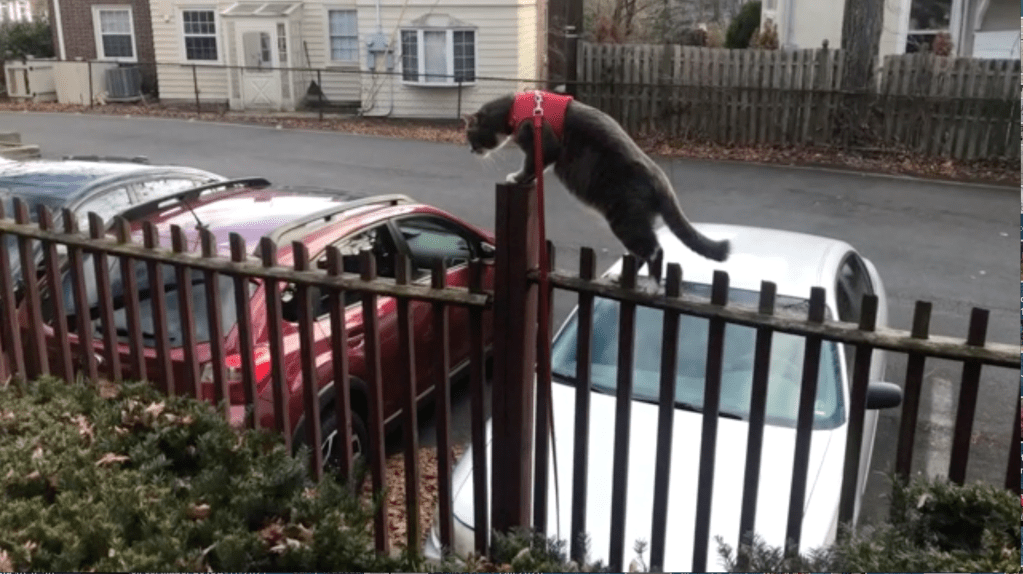
Those of you who are Facebook friends of mine know that I post a short video most mornings of my cat Misty (above) taking his daily leashed/harnessed walk on the grounds of my garden-apartment complex. Misty’s strolling expeditions have helped make him a very smart cat, and now he’s asking to take over my literature blog for this week. So, here goes…

“After my human read the latest Jack Reacher novel last week, I read it, too, and let me tell you the impressive Reacher clearly has more than nine lives after again surviving many fights. That book — The Sentinel — is the first of the 20-plus Reacher novels co-written by Lee Child’s brother Andrew Child, and it was interesting to see how it differed from Lee’s solo efforts. Jack seems more talkative, and there aren’t any of the romantic interludes found in many other Reacher books, but The Sentinel is certainly still satisfying. (< That’s a-litter-ation.) The novel does lack cats, but, heck, even Margaret Atwood’s Cat’s Eye isn’t feline-focused – and there isn’t an ophthalmologist in…ahem…sight.

“I’ve also read Of Human Bondage, which I figured would have something to say about the small subset of humans who put harnesses on their cats for outdoor walks. But, no-o-o, W. Somerset Maugham’s novel was about a guy who wanted to become a doctor — not a veterinary doctor! — while finding himself embarrassedly enamored with an abrasive waitress who didn’t even serve Fussie Cat wet food to her restaurant patrons.

“Jane Austen? Her decision to write Persuasion rather than Purrsuasion is troubling, but it’s more believable for humans rather than cats to get married at the end of a novel. The expectation is that Austen’s more appealing humans will live ‘happily ever after,’ which is not always the case when one coughs up hairballs.

“I’ve read All Quiet on the Western Front, too, and found it rang true until things got noisy on the western front of my apartment complex. Now I’m having doubts about the believability of Erich Maria Remarque’s book title, even though I myself created the western-front-of-my-apartment-complex noise by pawing around a dumpster.

Steppenwolf? Well, I did see a fox step in (my line of vision). I Hesse-d…um…hissed at it.

“When not spotting foxes, deer, squirrels, chipmunks, and birds during my walks, I like to munch on grass. Ironweed was a problem until I decided to use it as floss. Thanks, William Kennedy.

“The titles of A Tale of Two Cities and The Tale of Genji both misspell “tail,” but Charles Dickens and Murasaki Shikibu didn’t have the benefit of online dictionaries. I’m amazed that Shikibu’s novel was written a thousand years ago — that’s almost as long as it’s been since I was last fed. Or maybe it just seems that way; I was actually fed about five minutes ago.

“Windows are like TV for cats, which is why I’m always happy when novels are turned into TV miniseries. Alex Haley’s Roots, L.M. Montgomery’s Anne of Green Gables, George Eliot’s Daniel Deronda, Marcel Proust’s In Search of Lost Garfield the Lasagna-Loving Cartoon Cat

“My human is telling me that the Proust title I just cited doesn’t exist, but you gotta admit lasagna is a more substantial meal than madeleines.

“I will now step off my human’s laptop keyboard and let a bunch of monkeys try to write a Shakespeare sonnet. Bananas are on the house.”

Misty’s musings were a bit disjointed, but…

My literary-trivia book is described and can be purchased here: Fascinating Facts About Famous Fiction Authors and the Greatest Novels of All Time.

In addition to this weekly blog, I write the 2003-started/award-winning “Montclairvoyant” topical-humor column for Baristanet.com. The latest piece — in which school buildings (the brick-and-cement structures themselves) talk about when they should reopen during COVID — is here.

Ate Is Enough

Food in fiction! It’s fun, it’s relatable, and it can tell readers something about the novels’ characters and settings.

I previously discussed food in fiction in 2012, when writing about books for The Huffington Post. Yes, that piece was published more than eight years ago — a span of time during which a person can build quite an appetite…for writing about food in fiction again. This post will mention some of the novels I talked about back then, along with various books I’ve read since.

On Friday, I finished The Hundred-Foot Journey, a compelling novel whose India-born protagonist Hassan Haji (seen above in the 2014 movie version) eventually becomes a top chef in Paris. Author Richard C. Morais’ word pictures of Indian cuisine (which Hassan first cooks) and French cuisine (which Hassan shifts to and becomes even more expert at) are intensely vivid, reflect all kinds of cross-cultural currents, and depict the conviviality of sharing excellent restaurant meals. Heck, I’m not sure I’ve ever read a more food-focused novel. One caveat: As someone who doesn’t eat meat, I found the descriptions of killing animals, and preparing carnivorous dishes, off-putting.

Another recent novel with a food element is Liane Moriarty’s Nine Perfect Strangers, set at a health resort where things take a disturbing turn. But the resort’s food is quite good, making for an interesting juxtaposition.

The title character in Jorge Amado’s Dona Flor and Her Two Husbands is admirable in various ways, with one of them being her expertise as a cook and cooking teacher.

Tita de la Garza in Laura Esquivel’s Like Water for Chocolate is stymied in love by her mother, and is only able to truly express herself when she cooks.

Food also lends itself to humorous scenarios, as when large/buffoonish protagonist Ignatius J. Reilly of John Kennedy Toole’s A Confederacy of Dunces operates a hot dog cart in New Orleans and ends up eating much of the product himself.

Some novels with restaurant settings don’t focus a huge amount on the food but more on the eateries as hubs where people gather and certain dramas might play out. That’s the case in Fannie Flagg’s Fried Green Tomatoes at the Whistle Stop Cafe, where hungry hobos are always welcome; and Richard Russo’s Empire Falls, whose protagonist Miles Roby runs a far-from-chic grill in Maine. Diner-type eateries also pop up in various Jack Reacher thrillers, illustrating Jack’s “everyman” preference for basic food. (I’m currently absorbed in 2020’s The Sentinel, the first Reacher novel Lee Child co-wrote with his brother Andrew.)

Lack of food can be a riveting aspect of some novels for an obvious reason: People can’t survive without eating. One powerful aspect of Andy Weir’s The Martian is Mark Watney’s struggle to create enough food to stay alive when stranded on Mars.

Going way back to 1749, Henry Fielding’s novel Tom Jones accentuated the potentially sensuous aspects of a meal by conflating food with sex.

In the short-story realm, Isak Dinesen’s “Babette’s Feast” is a culinary extravaganza better known for its movie version.

Books with strong food elements I mentioned in my 2012 post? Joanne Harris’ Chocolat, T.C. Boyle’s The Road to Wellville, Emile Zola’s The Belly of Paris, and Margaret Atwood’s The Edible Woman, among others. Plus Darryl Brock’s baseball novel If I Never Get Back, which has one of my favorite food scenes: Born-in-the-20th-century time traveler Sam Fowler gets so bored with mediocre 19th-century American “cuisine” that he goes to a home in a Chinese neighborhood and pays a total stranger to cook him a delicious meal.

Your favorite novels with food content?

My literary-trivia book is described and can be purchased here: Fascinating Facts About Famous Fiction Authors and the Greatest Novels of All Time.

In addition to this weekly blog, I write the 2003-started/award-winning “Montclairvoyant” topical-humor column for Baristanet.com. The latest piece — about a major rent-control victory in my town — is here.

Feminism in Fiction

This look at feminism in post-1900 literature has two timely inspirations: Margaret Atwood and…Donald Trump.

I just read The Testaments, Ms. Atwood’s excellent 2019 sequel to 1985’s The Handmaid’s Tale. And sore loser Trump is about to (hopefully) leave the White House this Wednesday, January 20.

Trump has been rightly criticized for many things during his dumpster fire of a presidency. The lies, the criminality, the incompetence, the cruelty, the blatant racism, the homophobia, and more. So, it can get a bit lost just how misogynist Trump and his ilk have also been.

There are the more than 20 credible pre-presidency rape and other sexual misconduct allegations against Trump, the crudely sexist remarks, the pathetically few women he named to top administration positions, etc. Of course, amid Trump’s toxic machismo, the females in Trump’s mostly male orbit have been awful in their own right — including wife Melania, daughter Ivanka, press secretary Kayleigh McEnany, former education secretary Betsy DeVos, former United Nations ambassador Nikki Haley, and others. Complicit, complicit, complicit.

The fictional Gilead in The Handmaid’s Tale and The Testaments feels like an extreme (?) version of the far-right Trump/far-right Republican/far-right evangelical vision for America. Atwood’s authoritarian fictional republic has made women second-class citizens — stripping the older ones of their former professions, not allowing the younger ones to have intellectual jobs, forcing teen girls into marriages with much older men, and other patriarchal outrages that of course include Gilead’s handmaid system of child-bearers with no rights. There’s also all kinds of corruption and violence. One of Atwood’s accomplishments in both The Handmaid’s Tale and The Testaments is creating unforgettable women characters who either fight against the system (overtly or subtly) or come to grudgingly accept it (under duress). Also impressive is that Atwood is near the top of her writing game in the sequel despite her turning 80 the year it was published. My only significant criticism of The Testaments is that its nail-biting conclusion is too short.

Anyway, I’m limiting this piece to post-1900 literature with feminist elements because I covered many earlier novels with such elements in this 2018 post. There are many novels I can discuss, but I’ll focus on just a few.

The title alone of Buchi Emecheta’s Second Class Citizen tells the reader that the 1974 novel will have feminist aspects. Its protagonist, Adah, is a smart and resourceful woman who battles sexism from society and her husband in an effort to get the education she desires and do the work she wants to do. She moves from Nigeria to England, but both places are frequently not hospitable for ambitious women. Racism is in the mix as well.

Both sexism and racism are also faced by characters in Alice Walker’s The Color Purple (1982).

Women taking leadership roles is obviously a feminist thing, and we see that in Octavia E. Butler’s Parable of the Sower. That novel’s leader is Lauren Oya Olamina, whose take-charge personality is sorely needed in a society that has crumbled due to climate change, huge economic inequality, and corporate greed. (Do those three mega-problems ring a bell? This prescient science-fiction book was published in 1993.) Lauren even founds a new religion of sorts!

Eliza Sommers, the Chilean protagonist in Isabel Allende’s Daughter of Fortune, goes to mid-19th-century California against her parents’ wishes and even spends much of the 1998 novel disguised as a man in order to live more freely.

Looking back at a 1910-published novel, Colette’s The Vagabond features music-hall dancer Renee Nere and the very familiar push-and-pull on her life between work and romance.

There are also feminist novels that at least partly focus on the right of women to make independent decisions about sexual matters — with two examples being Erica Jong’s Fear of Flying and Rita Mae Brown’s lesbian-focused Rubyfruit Jungle. Both, coincidentally, published in 1973. Fannie Flagg’s Fried Green Tomatoes at the Whistle Stop Cafe (1987) also deals compellingly with a lesbian relationship, albeit more-closeted in this case.

Women working in traditionally “male” professions is another mark of feminist novels, with Ms. Flagg offering a great example of that with the women World War II pilots in 2013’s The All-Girl Filling Station’s Last Reunion. (I wish “Women” rather than “Girl” was in that title, but “Girl” might have been used ironically.) There’s also a memorable Russian female WWII pilot in Kate Quinn’s The Huntress (2019).

Plus Claire Fraser of Diana Gabaldon’s 1991-launched Outlander series of time-travel novels is a medical doctor in both the 1960s (when that was relatively unusual for a woman) and during the 1700s (when that virtually never happened).

Women having control over their own bodies is certainly an aspect of feminism, meaning novels that sympathetically look at abortion fit this post’s theme. One example is John Irving’s The Cider House Rules from 1985 — the same publication year as The Handmaid’s Tale.

Your favorite 20th- or 21st-century novels with feminist elements?

My literary-trivia book is described and can be purchased here: Fascinating Facts About Famous Fiction Authors and the Greatest Novels of All Time.

In addition to this weekly blog, I write the 2003-started/award-winning “Montclairvoyant” topical-humor column for Baristanet.com. The latest piece — about my town’s reaction to the Trump-incited white riot at the U.S. Capitol building — is here.