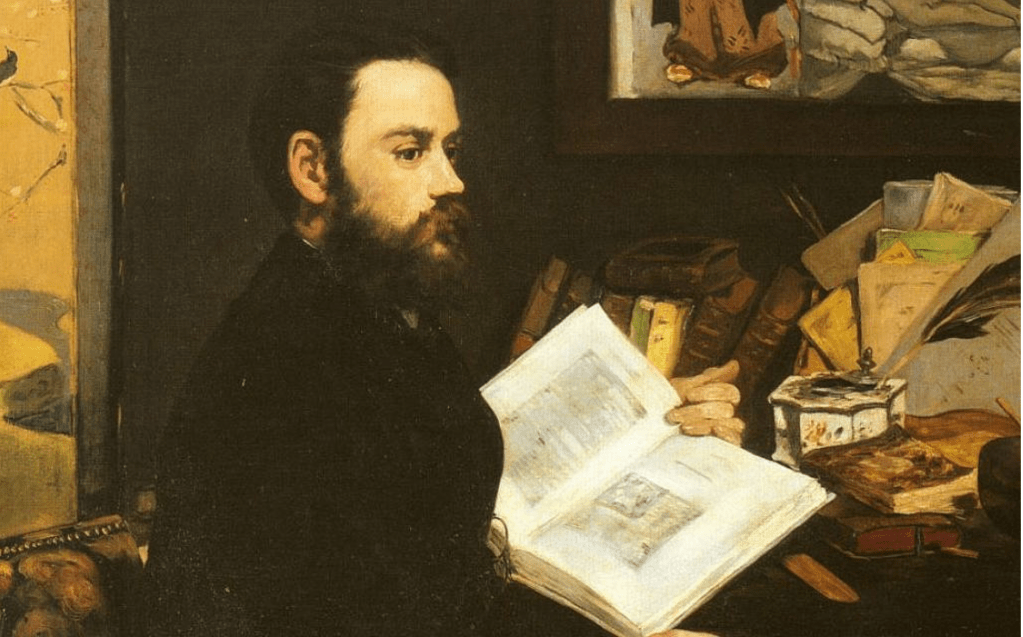
Emile Zola, as painted by Edouard Manet in 1868.
The almost-over 2021 is the 150th anniversary of the first of the 20 novels in Emile Zola’s Rougon-Macquart cycle. So, I’m writing this appreciation of the French author just in time. 🙂
Zola is nowhere near the best-known novelist of the 19th-century, but he’s in the top couple dozen — and I’m a big fan.
While Zola had some writing success before 1871, notably with the 1868 potboiler Therese Raquin, it’s the Rougon-Macquart cycle for which he’s most remembered. Those vivid novels are considered “naturalist” and realistic, with each heavily researched book focusing on a specific theme — art, trains, laborers, retailing, alcoholism, prostitution, etc., in 19th-century France — while also offering gripping plots and compelling three-dimensional characters. The Rougons and Macquarts are two family branches, the first more upper class and the second more working class, whose members share various hereditary tendencies that tend to be on the negative side. In a number of cases, each of those women and men are secondary characters in some of the 20 books and get a star turn in others.
A major inspiration for Zola was earlier French novelist Honore de Balzac, whose “The Human Comedy” cycle also took a societal approach and also included characters who turned up more than once.
Zola’s 20-book series began with The Fortune of the Rougons in 1871, started to hit its stride with the third novel — The Belly of Paris (1873) — and then entered masterful mode with the seventh entry: The Drinking Den (1877), about an admirable, hardworking woman slammed by circumstances. The mature, riveting works that followed included Nana (1880), about a prostitute; The Ladies’ Paradise (1883), about a big department store that, a la Walmart, overwhelms mom-and-pop shops; Germinal (1885), which depicts a mining strike and is almost universally considered Zola’s crowning achievement; The Masterpiece (1886), about a struggling painter; and The Beast in Man (1890), featuring a breathtaking railroad theme.
Interestingly, Zola might be best-known to some readers as the writer of the newspaper-published “J’Accuse” open letter defending Alfred Dreyfus, a Jewish officer wrongly accused of treason by the French army. Zola’s courageous 1898 public stand against anti-Semitism resulted in plenty of critical and legal pushback — even forcing him to flee France for a time. So much pushback, in fact, that Zola’s 1902 death at age 62 by asphyxiation from a blocked chimney is considered a possible murder.
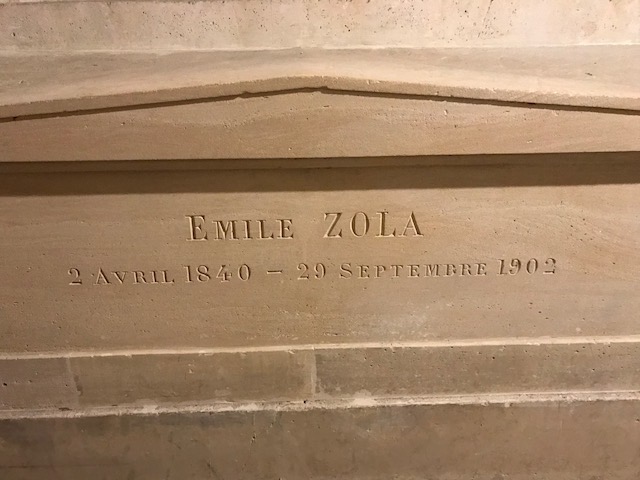
Yet many people admired Zola for his principles and his writing, and he would eventually be honored with burial in France’s Pantheon building, where I took this photo of his crypt during a 2018 visit to Paris:
I have one other slight connection with the author, having heard a talk by his scholar great-granddaughter 14 years ago in Aix-en-Provence, the city in the south of France where my French professor wife Laurel was also giving a paper at an Emile Zola-themed academic conference. One memorable part of the 2007 Aix visit was a long conference-attendee hike up beautiful Mont Saint-Victoire to see the dam Zola’s father was involved in building.
If you’ve read any of Zola’s work, any thoughts about it?
My literary-trivia book is described and can be purchased here: Fascinating Facts About Famous Fiction Authors and the Greatest Novels of All Time.
In addition to this weekly blog, I write the 2003-started/award-winning “Montclairvoyant” topical-humor column for Baristanet.com every Thursday. The latest piece — about my town’s township attorney belatedly resigning after making a racist remark — is here.