Misty the Cat: Mentioning Novels Isn’t Novel for Me

The Sun Also Rises on my kitty self. (Photo by Dave the biped.)

I, Misty the cat, have returned to write another guest post about “books, books, books.” Which sounds like a chicken saying “buk, buk, buk.” Why did the chicken cross The Road? To get to the other side of Cormac McCarthy’s 2006 novel.

Not funny was last month’s news that the late McCarthy had a relationship with a girl that started when she was 16 and he was 42. That’s sleazy Lolita territory, which reminds me that Vladimir Nabokov also authored Pale Fire about a blaze slathered with enough sunscreen to prevent it from getting burned. Not exactly an Elin Hilderbrand “beach read.” Nor was Andre Dubus III’s novel House of Sand and Fog, which I could’ve pierced with a beach umbrella if I had it in paperback rather than hardcover. I, the feline writing this post, live in the House of Broadband Blog. Actually an apartment, but the wifi is decent.

Late autumn isn’t swimming weather, but November 30 was the 150th anniversary of L.M. Montgomery’s birth. She of course wrote the iconic Anne of Green Gables, an exceptional YA novel. YA means Young Adult as well as Yowling Adult, which describes Dave after I grabbed his laptop to write this post. He’ll get over it, especially when I give him a newfangled quill pen and parchment paper to scribble this week’s shopping list. First seven items: cat food, cat chow, cat cuisine, cat edibles, cat victuals, cat nourishment, and cat sustenance.

Moving to my book list, I recently read Nelson DeMille for the first time — his novel The Quest. Quite exciting once I got over my first disappointment about the book’s tired trope of focusing on white visitors to a “third world” country — and my second disappointment that the quest was for a holy relic rather than a cat treat at peak freshness. A good chunk of DeMille’s story takes place in Ethiopia, where injera is a food staple. That pancake-like bread is slightly spongy, so a big-enough piece would make for an excellent cat bed. But my local pet store only sells cat beds with inedible cushioning; Goodnight Moon will never be the same.

Speaking of children’s books, The Cat in the Hat‘s title character is a rather slim kitty — certainly slimmer than me, a feline who starts his midnight snacking at noon. I’ve read that Dr. Seuss based his tall feline’s look on the Uncle Sam he had previously drawn in his political cartoons, which reminds me that I’m weighing a presidential run in 2028. To practice for my future time in the Oval Office, I occasionally walk in circles.

My favorite novels with at least some political themes, schemes, dreams, teams, screams, and memes? Among them are Robert Penn Warren’s All the King’s Men, George Orwell’s Nineteen Eighty-Four, J.K. Rowling’s The Casual Vacancy, Stephen King’s The Dead Zone, and Miguel de Cervantes’ Don Trumpote, co-starring Donald Trump’s loyal squire JD Vanza. Cervantes lived in Spain during the same circa-1600 era that James Clavell’s Japan-set novel Shogun unfolded. Little-known fact: Spain and Japan are walking distance from each other despite being 6,600 miles apart. Admittedly, the walk would take a year or two, even for a fast cat like me. The Inedible Journey without an injera cat bed.

Anyway, this month begins The Incredible Journey known as the march to the holiday season, meaning I might reread A Christmas Carol by Charles Dickens, who invented the CD when he initialed a document. There’s also Fannie Flagg’s excellent A Redbird Christmas, John Grisham’s so-so Skipping Christmas, and the classic song “I’m Dreaming of a White Pearl Harbor Day” — which you can hear on a CD player that Dickens also invented.

Yesterday, December 7, was Pearl Harbor Day. Today, December 8, is the seventh anniversary of when I was adopted into my current home! That was in 2017, the year Aaron Judge hit 52 home runs as a rookie. Or was it 52 apartment runs as a rookie? No idea what his living arrangements were back then, or why Edith Wharton wrote The House of Mirth rather than The Yurt of Mirth. Maybe because her protagonist Lily Bart didn’t live in Mongolia?

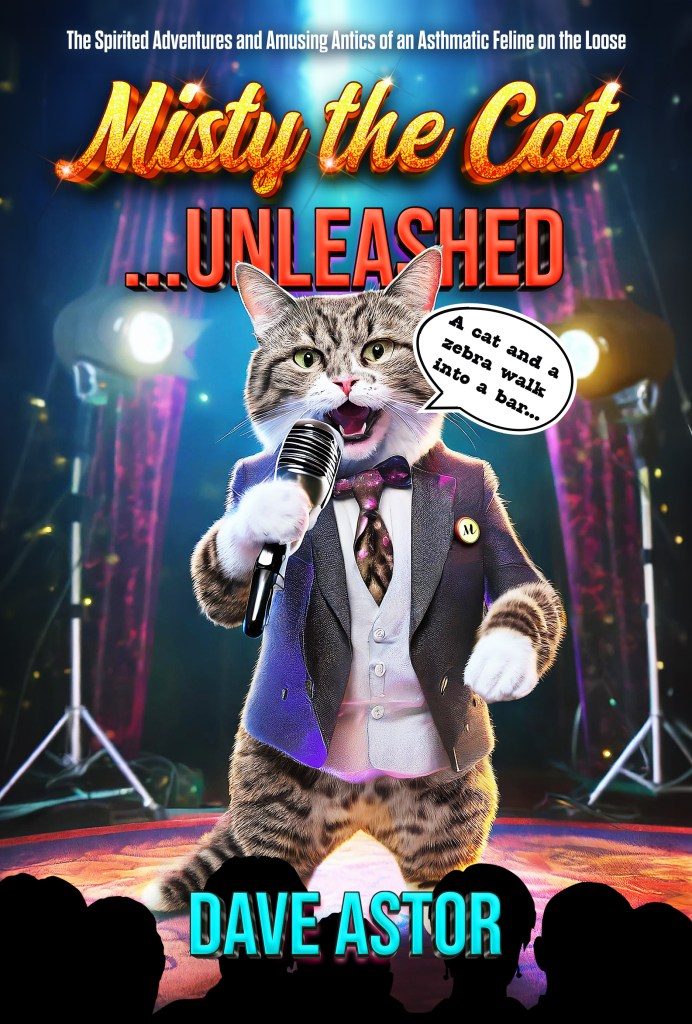
Getting back to the festive season, my Misty the Cat…Unleashed book would make a great holiday gift this month for the kitty lovers in your life. I co-wrote it with my human peep Dave, sort of like how Woodward and Bernstein co-wrote All the President’s Cats about the Watergate scandal, Richard Nixon, and his 1974 resignation — with no mention of cats. Surprisingly, Nixon didn’t blog about any of this at the time.

Dave will reply to comments, because I’m in serious pre-winter training to vigorously shred the wrapping paper on holiday gifts.

Misty the cat says: “Today’s my 7th adoption anniversary. I appreciate the celebratory lights.”

Dave’s comedic 2024 book — the part-factual/part-fictional/not-a-children’s-work Misty the Cat…Unleashed — is described and can be purchased on Amazon in paperback or on Kindle. It’s feline-narrated! (And I, Misty, say Amazon reviews are welcome. 🙂 )
This 90-second promo video for Dave’s book features a talking cat: 🙂

In addition to this weekly blog, Dave writes the 2003-started/award-winning “Montclairvoyant” topical-humor column every Thursday for Montclair Local. The latest piece — which includes a “Twelve Days of Christmas” theme — is here.

Prolific Prose Practitioners

There’s a saying that “everyone has a book in them,” but some authors have a LOT of books in them. They’re terrific at being prolific, churning out novels and other works as fast as cartoon bird Road Runner moves (but with fewer feathers).

Many high-speed authors average at least a book a year, with some putting out even more. The vast majority of prolific novelists write mass-audience fiction, because that kind of book can be rather formulaic and thus more quickly created than literary fiction. But there are challenging novelists who also write fast.

Some quick authors, such as James Patterson, have help from assistants — meaning they are not quite as personally prolific as they seem. According to Wikipedia, the 68-year-old Patterson has 150 books to his credit!

Of course, the number of books a novelist writes is not the only proof of productivity; the size of the works has something to do with it, too. For instance, Charles Dickens penned “only” 20 or so novels before dying at age 58, but a number of them are quite long.

And Dickens is an example of an author who also kept busy in other ways — giving speeches, performing in theatrical productions, etc. Meanwhile, some writers pack their schedules by not only penning novels, but short stories, plays, poems, children’s books, nonfiction books, articles, and/or reviews as well. Yes, all that quantity can make the quality suffer, but not always. Some people just write like the wind!

First, let’s look at some literary and classic authors with many books to their credit. For instance, France can boast of Honore de Balzac and Emile Zola, who each wrote about three dozen novels (among other works) before dying at ages 51 and 62, respectively. Given that they obviously weren’t published authors as kids and teens, that’s a ton of output during their adult years. Fellow French author Alexandre Dumas penned about 40 novels, 10 travel books, several plays, and more during his 68 years.

Some prolific novelists from other countries:

Sir Walter Scott wrote a whopping two dozen or so novels and other books between 1814 and his 1832 death at the age of 61. That was after he focused on his widely read poetry during the earlier part of his career.

Henry James, who lived to 72, authored about 30 novels and novellas plus tons of other fiction and nonfiction. And his subtle, intricate, psychological writing was not the kind to be knocked off easily.

Edith Wharton, who died at 75, had nearly the same output as her friend Henry even though she didn’t become a published author until her late 30s.

W. Somerset Maugham wrote 36 novels and short-story collections, 25 plays, 15 nonfiction books, countless articles, and more before dying at the age of 91.

John Updike penned nearly 30 novels, 17 short-story collections, and other works during his 76 years.

A very prolific living author with a literary bent is Joyce Carol Oates, 77 — who has written an astounding 44 novels, 11 novellas, and 38 short-story collections under her own name; 11 other novels under a different name; and more.

Alice Walker, now 71, has written a total of 30-plus novels, short-story collections, poetry collections, and nonfiction books.

Mass-audience novelists? One of the most productive of the past was mystery writer Agatha Christie, who penned 66 novels under her own name, six novels under another name, 17 plays, and more during her 85 years.

Prolific living authors in the mass-audience (but sometimes literary) realm include Dean Koontz (well over 100 novels since 1968), Stephen King (55 novels since 1974 — plus lots of other work), Sue Grafton (24 novels since 1982), John Grisham (29 novels since 1989), Lisa Scottoline (25 novels since 1993), David Baldacci (32 novels since 1996), and Lee Child (20 Jack Reacher novels since 1997).

Last but by no means least, the great Isaac Asimov wrote or edited an incredible 500-plus books — many not science fiction — before dying at age 72.

Oh, and William Shakespeare penned 37 plays and 154 sonnets during his 52 years.

Who are some of your favorite prolific authors? (You can also name some you don’t like. 🙂 ) Can there be quantity and quality?

(The box for submitting comments is below already-posted comments, but your new comment will appear at the top of the comments area — unless you’re replying to someone else.)

I’m writing a literature-related book, but still selling Comic (and Column) Confessional — my often-funny memoir that recalls 25 years of covering and meeting cartoonists such as Charles Schulz (“Peanuts”) and Bill Watterson (“Calvin and Hobbes”), columnists such as Ann Landers and “Dear Abby,” and other notables such as Hillary Clinton, Coretta Scott King, Walter Cronkite, and various authors. The book also talks about the malpractice death of my first daughter, my remarriage, and life in Montclair, N.J. — where I write the award-winning weekly “Montclairvoyant” humor column for The Montclair Times. You can email me at dastor@earthlink.net to buy a discounted, inscribed copy of the book, which contains a preface by “Hints” columnist Heloise and back-cover blurbs by people such as “The Far Side” cartoonist Gary Larson.

The Very Well-Traveled Caterpillar

We all remember great children’s books from when we were kids or parents of kids. I recently thought of one — The Very Hungry Caterpillar — when my family had a real-life experience with a fennel-consuming cousin of Eric Carle’s fictional character.

I’m going to recount that experience (straying from this literature blog’s usual approach) before ending with a list of several of my favorite children’s books and a request to name some of yours. It’s a true-life children’s story I’ll call…The Very Well-Traveled Caterpillar.

One afternoon last month, my younger daughter stepped off her school bus with a paper cup full of fresh fennel. On one of the stalks was a tiny black caterpillar Maria had named Spike — though she didn’t know if it was male or female. The bus ride was Spike’s first trip.

My wife Laurel ordered one of those soft caterpillar/butterfly cages online, but Spike’s “house” took more than a week to get delivered. Fortunately, Spike stayed on fennel stalks in that paper cup for several days, eating so much that Maria had to bring home new fennel from her school garden several times. Spike, who turned mostly green, grew so much that he (?) was soon perhaps 10 times his (?) original size.

But one day, Spike crawled off the fennel and paper cup and was nowhere to be found. We walked VERY carefully in the living room as we searched for about a half hour — finally spotting Spike on the floor atop one of Maria’s sandals. That was his (?) second trip, and a potentially dangerous one.

So as we continued to wait for delivery of the cloth-and-net cage, we found a large box to put the fennel and cup in. The next day, a certain mailing finally arrived, and we transported Spike from box to cage.

Spike — fortified by his (?) prodigious eating binge — attached himself to a stick we put in the cage and was encased in a chrysalis by June 22. But we were leaving June 24 for a trip to Indiana, with a return planned for June 29. The chrysalis stage was supposed to be 7-10 days, but what if Spike emerged earlier? Obviously, he (?) had to travel with us in the car.

Passenger Spike spent the first day cruising west from New Jersey through Pennsylvania — carried into rest stops, the inside of a fast-food restaurant, and then a hotel room in eastern Ohio. The next day, it was more of the same until we arrived in Indianapolis — where the National Society of Newspaper Columnists was meeting.

But there was more travel to come. As I attended the great NSNC conference, Spike joined Laurel and Maria in visiting a former Indiana State University work colleague of my wife’s in Terre Haute. So the car-cruising/cage-and-chrysalis-covered caterpillar almost made it to Illinois.

Then came a return to Indianapolis, where Spike accompanied us and friends from Bloomington to a restaurant lunch before we headed back east. More rest stops, more fast-food eateries, and another hotel stay before Spike found himself (?) in New Jersey again on June 29. Still in the chrysalis.

Several days later, Spike finally emerged as a large butterfly — mostly black, with some brilliant coloring. According to Maria, his (?) coloring indicated he (?) was…female.

Spike couldn’t immediately fly — her wings needed to dry. But when she began flapping frantically around the cage an hour later, we knew it was time. We walked to the patio area of our garden-apartment complex, slowly unzipped the cage, and Spike soared high into the air. Not west or east, but south, before disappearing above the treetops.

Believe it or not, Spike’s freedom came on July 4 — Independence Day.

So that’s the story of The Very Well-Traveled Caterpillar. My favorite children’s books? Several by Dr. Seuss, of course; Susan Meddaugh’s Martha Speaks series (talking dog!); Eric Litwin’s Pete the Cat books; Faith Ringgold’s Tar Beach; Bernard Waber’s Lyle, Lyle, Crocodile; Ludwig Bemelmans’ Madeline; Robert Munsch’s Love You Forever; Margaret Wise Brown’s Goodnight Moon; and various others. (I’m talking fictional “picture books” aimed at younger kids. 🙂 )

What are your favorite children’s books? And what are some books — kid or adult, with or without caterpillars — that you connect with real-life experiences you’ve had?

One more question: Why didn’t I discuss Go Set a Watchman in this column? Well, Harper Lee’s eagerly awaited novel won’t be released until July 14, and I’m not sure when I’ll read it. It was dismaying to see, in an advance New York Times review, that the beloved Atticus Finch is depicted as a racist in the book — and there are of course questions about whether Ms. Lee truly consented to the financially lucrative publication of this To Kill a Mockingbird “sequel” (set in the 1950s) written before TKAM (set in the 1930s). But feel free to discuss Go Set a Watchman here!

The box for submitting comments is below already-posted comments, but your new comment will appear at the top of the comments area — unless you’re replying to someone else.

Note: My next column will post Monday, July 20, rather than the evening of Sunday, July 19 — when I’ll be seeing a U2 concert at Madison Square Garden with my adult daughter. I’m sure the band will do better in MSG than pro basketball’s Knicks! 🙂


For three years of my Huffington Post literature blog, click here.

I’m writing a literature-related book, but still selling Comic (and Column) Confessional — my often-funny memoir that recalls 25 years of covering and meeting cartoonists such as Charles Schulz (“Peanuts”) and Bill Watterson (“Calvin and Hobbes”), columnists such as Ann Landers and “Dear Abby,” and other notables such as Hillary Clinton, Coretta Scott King, Walter Cronkite, and various authors. The book also talks about the malpractice death of my first daughter, my remarriage, and life in Montclair, N.J. — where I write the award-winning weekly “Montclairvoyant” humor column for The Montclair Times. You can email me at dastor@earthlink.net to buy a discounted, inscribed copy of the book, which contains a preface by “Hints” columnist Heloise and back-cover blurbs by people such as “The Far Side” cartoonist Gary Larson.