The ‘Winter’ of Our Book Content

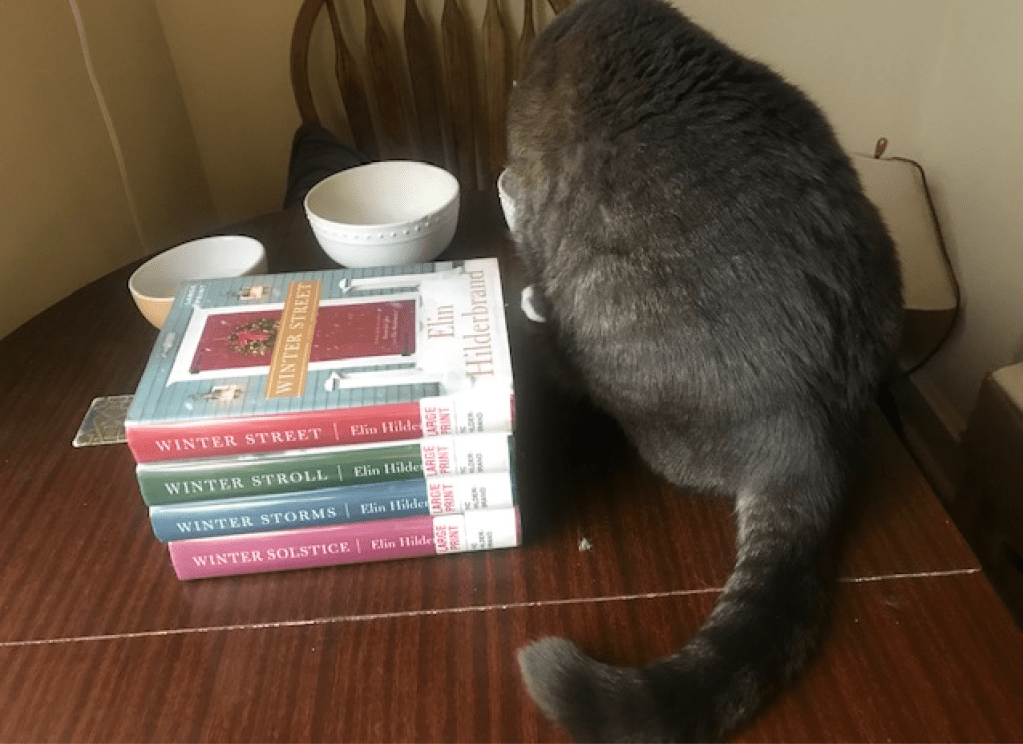
Misty the cat thinks these books have a BACK story. (Photo by me.)

It’s early winter in part of the world, so thoughts turn to novels with…the word “Winter” in the title. Okay, maybe most readers’ thoughts don’t turn to that, but I needed a blog topic this week. πŸ™‚

I just finished reading Winter Street, the first of a four-book Elin Hilderbrand series that continues with Winter Stroll, Winter Storms, and Winter Solstice. The mostly Nantucket, Massachusetts-set Winter Street focuses on the Quinn family as it goes through a dramatic Christmas week that includes a marital separation, other relationship issues, an engagement, no word from a son fighting in Afghanistan, another son facing an insider-trading charge, etc. Yes, Christmas time is not always a 100% happy time. The book obviously deals with some heavy issues, yet often retains a light touch.

Another accomplished contemporary author, Kristin Hannah, wrote Winter Garden. Not on the level of her best novels such as The Nightingale, The Great Alone, The Four Winds, and Firefly Lane, but still pretty good. Winter Garden is about two very different sisters and their cold, mysterious mother — who’s originally from snowy Russia during the period of Stalin’s iron rule.

The late Rosamunde Pilcher’s final novel, Winter Solstice, is I think the second best of her many books — behind only her terrific The Shell Seekers. Winter Solstice (published before Hilderbrand’s novel of the same name) unfolds amid a cold-weather gathering of people from various generations.

Of course, there’s John Steinbeck’s also-final novel, The Winter of Our Discontent, which has the overarching theme of trying to maintain integrity in a corrupt society. It’s one of Steinbeck’s deeper books, though not as compelling as The Grapes of Wrath and East of Eden.

Among the “Winter”-titled novels I haven’t read are Isabel Allende’s In the Midst of Winter and Laura Ingalls Wilder’s The Long Winter (part of The Little House on the Prairie series). I should also mention George R.R. Martin’s The Winds of Winter — the lengthy, long-delayed, not-yet-finished sixth novel in his A Song of Ice and Fire series that started with A Game of Thrones.

Then there are plays such as Shakespeare’s The Winter’s Tale and James Goldman’s The Lion in Winter.

Any thoughts about, and/or examples of, this theme?

On yet another rainy winter morning, Misty the cat says: “I’d build an ark, but the lumber yard’s closed.”

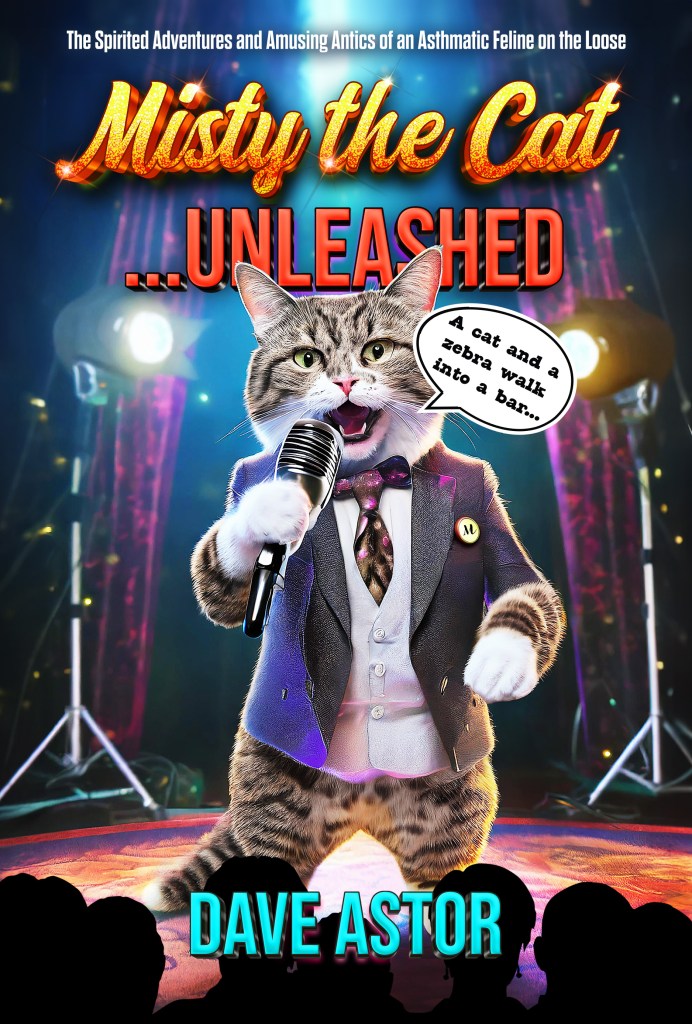
My comedic 2024 book — the part-factual/part-fictional/not-a-children’s-work Misty the Cat…Unleashed — is described and can be purchased on Amazon in paperback or on Kindle. It’s feline-narrated! (And Misty says Amazon reviews are welcome. πŸ™‚ )

This 90-second promo video for my book features a talking cat: πŸ™‚

In addition to this weekly blog, I write the 2003-started/award-winning “Montclairvoyant” topical-humor column every Thursday for Montclair Local. The latest piece — which discusses an “F-bomb” controversy and much more via a poem co-starring Santa Claus — is here.

California Theming

To thank one of the most anti-Trump states in the recent presidential election, California will be the subject of this blog post.

I’ll discuss uplifting as well as depressing novels set partly or completely in The Golden State — whether it be Los Angeles, San Francisco, or less-urban locales.

Last week, I read Walter Mosley’s Devil in a Blue Dress, an excellent crime novel set in Los Angeles — with protagonist Easy Rawlins taking a memorable side trip to the famous Santa Monica Pier. Visiting L.A. and Santa Monica this past summer added to my enjoyment of the book, though it takes place in a much earlier 1948 California filled with disturbing racism that would warm Donald Trump’s shriveled heart.

Among many other crime novels with a California milieu are Thomas Pynchon’s spoofy Inherent Vice (set in 1970s L.A.) and Dashiell Hammett’s iconic The Maltese Falcon (set in 1920s San Francisco).

Beautiful S.F. is one of two metropolises (along with New York City) featured in Robin Sloan’s quirky Mr. Penumbra’s 24-Hour Bookstore. And the greater Bay Area is where the action happens in Philip K. Dick’s post-apocalyptic Dr. Bloodmoney and Andre Dubus III’s House of Sand and Fog, and where some of the story unfolds in Khaled Hosseini’s The Kite Runner.

Immigrants are a big part of the California story, and that’s reflected in Dubus’ book (an Iranian-American is one of three protagonists) and Hosseini’s novel (which features a family from Afghanistan). The Golden State is also a place where people already in America go to start anew, as is the case with Gauri in Jhumpa Lahiri’s The Lowland. Plus real estate is a “yuuge” thing in California, where a dispute over ownership of a modest home sparks the major plot explosion in Dubus’ novel. Then there’s that state’s abundant good weather…unless you start thinking about things like droughts that lead to devastating fires. And the fabled Pacific Ocean, as mentioned in Devil in a Blue Dress and many other California-set novels.

Of course, the movie business is “bigly” associated with California, too, and we see that in novels such as F. Scott Fitzgerald’s absorbing but unfinished The Last Tycoon, Nathanael West’s The Day of the Locust, and Charles Bukowski’s hilariously satirical Hollywood that fictionalizes the author’s experience writing the real-life film Barfly.

Other novels set partly or completely in The Golden State? Isabel Allende’s Daughter of Fortune (California Gold Rush!), Dave Eggers’ The Circle (Silicon Valley vibe), Maria Semple’s This One Is Mine (which includes music-industry elements), Darryl Brock’s time-traveling If I Never Get Back (20th- and 19th-century scenes in San Francisco), Karl Alexander’s same-genre Time After Time (H.G. Wells and Jack the Ripper go back to 1970s S.F.), etc.!

We can’t forget that John Steinbeck used a certain state as the setting for many of his novels — including The Grapes of Wrath, East of Eden, Of Mice and Men, Tortilla Flat, Cannery Row, Sweet Thursday, The Wayward Bus, and To a God Unknown, to name a few. (He did occasionally place his fiction in other locales, such as Europe for The Moon Is Down and Long Island, N.Y., for The Winter of Our Discontent.)

Also, Jack London started The Call of the Wild and ended White Fang with scenes in California, while his Martin Eden is set mostly in Oakland and The Sea-Wolf begins on a San Francisco ferry.

Of course, there are many other California-based novels. What are some of your favorites that I have or haven’t named?

(The box for submitting comments is below already-posted comments, but your new comment will appear at the top of the comments area β€” unless you’re replying to someone else.)

I’ve finished writing a book called Fascinating Facts About Famous Fiction Writers, but am still selling Comic (and Column) Confessional — my often-funny memoir that recalls 25 years of covering and meeting cartoonists such as Charles Schulz (“Peanuts”) and Bill Watterson (“Calvin and Hobbes”), columnists such as “Dear Abby” and Ann Landers, and other notables such as Coretta Scott King, Walter Cronkite, and various authors. The book also talks about the malpractice death of my first daughter, my remarriage, and life in Montclair, N.J. — where I write the award-winning weekly “Montclairvoyant” humor column for The Montclair Times. You can email me at dastor@earthlink.net to buy a discounted, inscribed copy of the book, which contains a preface by “Hints” columnist Heloise and back-cover blurbs by people such as “The Far Side” cartoonist Gary Larson.