
Luigi Mangione and Brian Thompson
After Brian Thompson was shot and killed in New York City this month, millions of Americans from all parts of the ideological spectrum flooded social media to express little sympathy for him. That’s because he was the CEO of UnitedHealthcare, the massive company known for denying a huge number of legitimate medical-insurance claims in order to maximize its profits.
The result of those denials? Anguish for millions of patients and death for thousands of patients who (either individually or via employer plans) pay large monthly premiums for medical coverage — even as residents of every other developed country enjoy some form of much-more-humane national health insurance. And doctors with years of medical training and experience get their requests for needed tests and treatment for their patients denied by insurance bureaucrats with little or no medical expertise.
Meanwhile, Thompson — who was specifically targeted for assassination (the arrested suspect is Luigi Mangione) — raked in yearly compensation of $10.2 million.
Obviously, murder shouldn’t be celebrated, and this was an awful tragedy for Thompson and his family. But he and other execs at UnitedHealthcare and other private insurance providers are guilty of indirectly/continually causing tragic deaths — only their method is shooting down claims rather than shooting a gun.
As with many other situations, I was reminded of certain books I’ve read. There have been numerous nonfiction titles covering the cruel, pricey, unequal, inefficient U.S. medical system — which only works very well for the wealthy — but I’m a literature blogger and will thus focus on fiction in the remainder of this post. To me, the novel I’ve read that best expresses the fury “inspired” by the U.S. medical system is Lionel Shriver’s So Much for That. I highly recommend her 2010 book, despite much of it being a painful read. Somehow, Shriver manages to often make things entertaining, too.
And I thought of novels that have strong elements of vigilantism, which of course involves seeking justice by “illegal” means when such justice might not be achieved through “legal” channels. In the U.S., there have been various efforts by Senator Bernie Sanders and others urging “Medicare for All” to give Americans the type of health-insurance system every other “first world” nation has. But those efforts have been thwarted by a political class (virtually every Republican and most Democrats) as well as a mainstream media mostly bought off by campaign contributions and ad dollars from the profit-swollen companies (also including “Big Pharma”) benefiting from a privatized medical system. So, what are beleaguered citizens to do?
Among the novels with characters who take the law into their own hands for the “right” reasons (not necessarily medical-related reasons) are Louis Sachar’s Holes, John Steinbeck’s The Grapes of Wrath, Alexandre Dumas’ The Count of Monte Cristo, Lee Child’s Jack Reacher books, and Johnston McCulley’s The Curse of Capistrano featuring the protagonist who would also become the title character in Isabel Allende’s later Zorro. For those who haven’t read those novels, I’ll refrain from giving specifics in order not to spoil things.
As we know, there are also strains of vigilantism in many western novels (like Owen Wister’s The Virginian) and in comic books starring superheroes such as Batman.
Your thoughts about, and examples of, this topic?
As Christmas nears, Misty the cat says: “Ho Ho Ho means Harness off Harness off Harness off.”
My comedic 2024 book — the part-factual/part-fictional/not-a-children’s-work Misty the Cat…Unleashed — is described and can be purchased on Amazon in paperback or on Kindle. It’s feline-narrated! (And Misty says Amazon reviews are welcome. 🙂 )
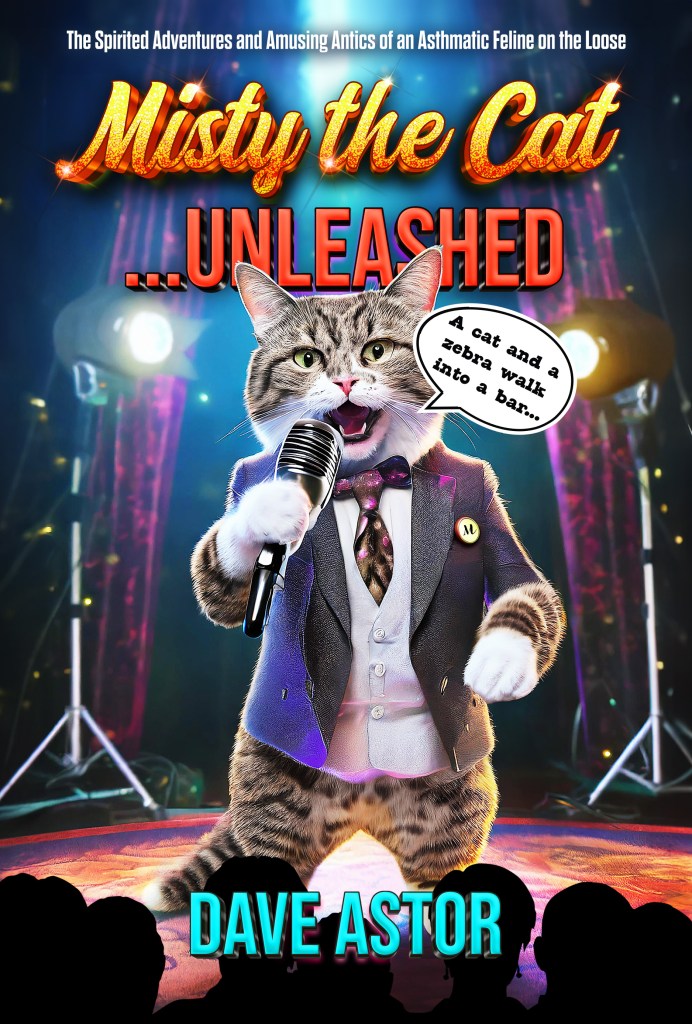
This 90-second promo video for my book features a talking cat: 🙂
In addition to this weekly blog, I write the 2003-started/award-winning “Montclairvoyant” topical-humor column every Thursday for Montclair Local. The latest piece — which discusses a Mideast-related yet local police chaplain controversy — is here.
 Dave Astor on Literature