Feline Post Includes Mentions of Jane Austen and ‘The Host’

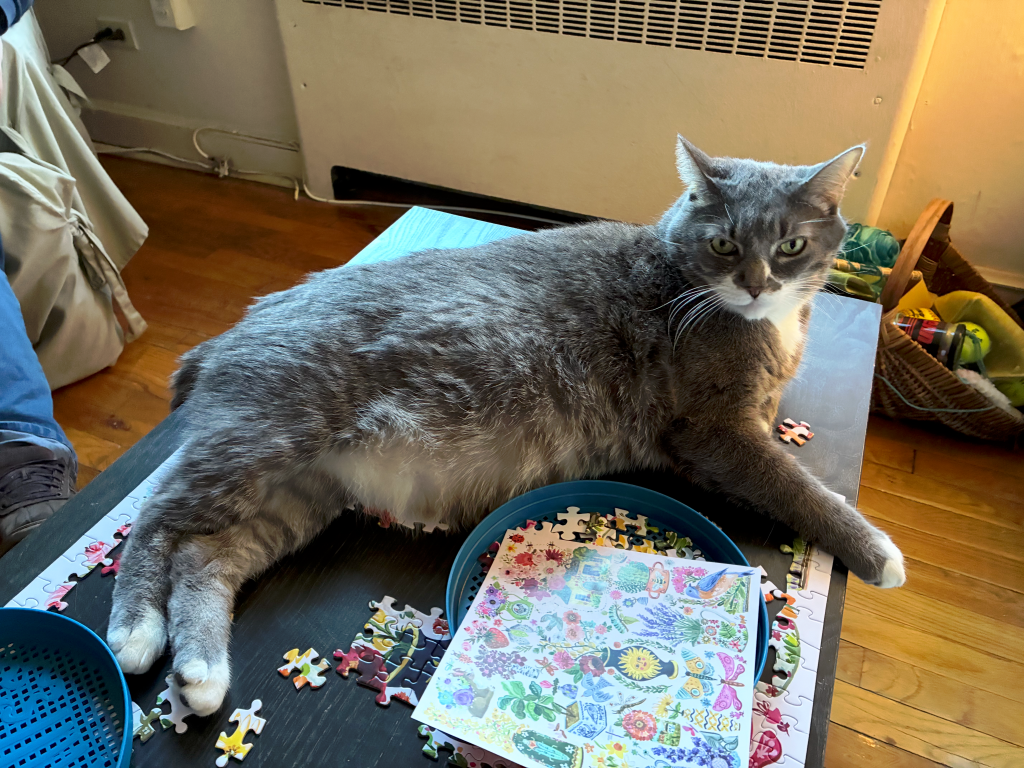
I, Misty the cat, say: “Putting together a guest blog post is like putting together a puzzle.” (Photo of my kitty self taken by my adult female human Laurel.)

Misty the cat here, returning for my every-two-month takeover of Dave’s blog — which I do by gunpoint, minus the gun. This is a particularly memorable time for me to post because tomorrow is the 8th anniversary of my adoption into my forever family, from whom I’ve received everything I could desire except a bed the size and shape of Buckingham Palace. King Chuck III has some ‘splaining to do.

And in nine days — December 16 — there’ll be a milestone moment for literature: the 250th anniversary of Jane Austen’s 1775 birth! Rebecca Budd, who comments here every week, has already posted about that anniversary in one of her great blogs. The year 1775 was also significant for being the start of the American Revolutionary War and for Apple’s rollout of the iMusket 9.

Back to Austen. I’m often (well, never) asked how I rank her six novels, and here’s my kitty answer: 1, 2, 3, 4, 5, 6. Oh, you want titles, too? 1) Persuasion. 2) Pride and Prejudice. 3) Sense and Sensibility. 4) Mansfield Park. 5) Emma. 6) Northanger Abbey. This is also Dave’s order of faves (rhyme alert!), which means we were both bribed by the same literary scholars. Austen’s early 19th-century books have aged well…partly because I keep them in my wine cellar. Actually, I don’t have a wine cellar. No cat does.

And today, December 7, is the 84th anniversary of the 1941 attack on Pearl Harbor, an event vividly depicted near the end of Herman Wouk’s compelling novel The Winds of War. If those winds had become strong enough, Wouk’s book would’ve been titled The Hurricanes of War — storms that fall alphabetically between Hurricane Violin and Hurricane Xylophone.

The Winds of War was followed by Wouk’s epic War and Remembrance — the title of which has the initials “WAR.” Coincidence? Well, Hurricane Coincidence falls alphabetically between Hurricane Bassoon and Hurricane Didgeridoo.

My current reading? I, Misty the cat, recently finished Twilight author Stephenie Meyer’s The Host, an excellent work of sci-fi that stars a being who lives inside a human body. So, no, the book is not a historical novel about Johnny Carson, who was not related to The Heart Is a Lonely Hunter author Carson McCullers, who was a top-notch writer but apparently didn’t know that a heart can’t hunt animals without a permit and that vegans prefer Fannie Flagg’s novel Fried Green Tomatoes at the Whistle Stop Cafe. Also, American frontiersman Kit Carson was not a feline like me.

Natty Bumppo did the frontiersman thing, too, in James Fenimore Cooper’s five “Leatherstocking” novels that included The Last of the Mohicans. Cooper was an American contemporary of aforementioned Englishwoman Jane Austen, and there are even rumors that they collaborated on a novel called The Last of the Emmas. So I’m puzzled (see photo) that we later had people such as actresses Emma Thompson and Emma Watson.

The latter of course played Hermione Granger in the Harry Potter movies based on the J.K. Rowling novels. Seven books, eight movies, and nine lives (experienced by cats like me). Plus there are 10 characters in Agatha Christie’s famed mystery novel And Then There Were None, whose plot focuses on the number of dry-food pellets left in my bowl after I finish eating. No mystery where those pellets went.

Which books do I want for Christmas? Charles Dickens’ A Christmas Carol, Fannie Flagg’s A Redbird Christmas, John Grisham’s Skipping Christmas, Betty Smith’s A Christmas Tree Grows in Brooklyn, Anthony Burgess’ A Christmas Orange, Fyodor Dostoevsky’s Christmas and Punishment, Aldous Huxley’s Brave New Christmas, Barbara Kingsolver’s Demon Christmashead, E.M. Forster’s A Passage to Christmas, Chinua Achebe’s Christmas Falls Apart

Dave will reply to comments as I either finish the puzzle I’m photographed with or swat every piece of that puzzle into January 2026.

I, Misty the cat, say: “There’s gotta be a sidewalk sale around here somewhere.”

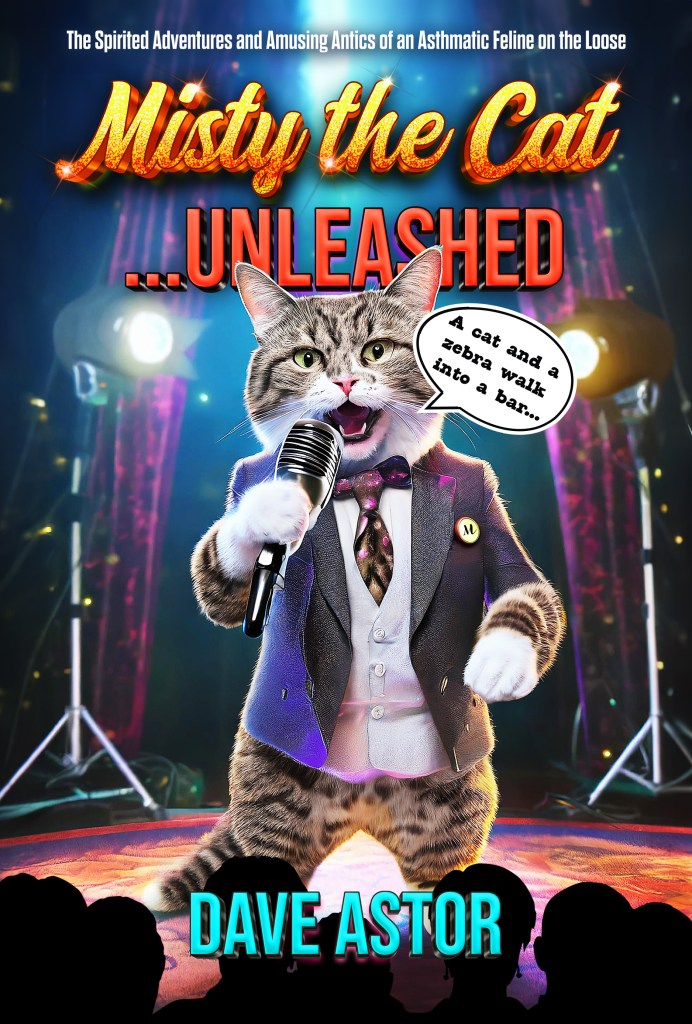
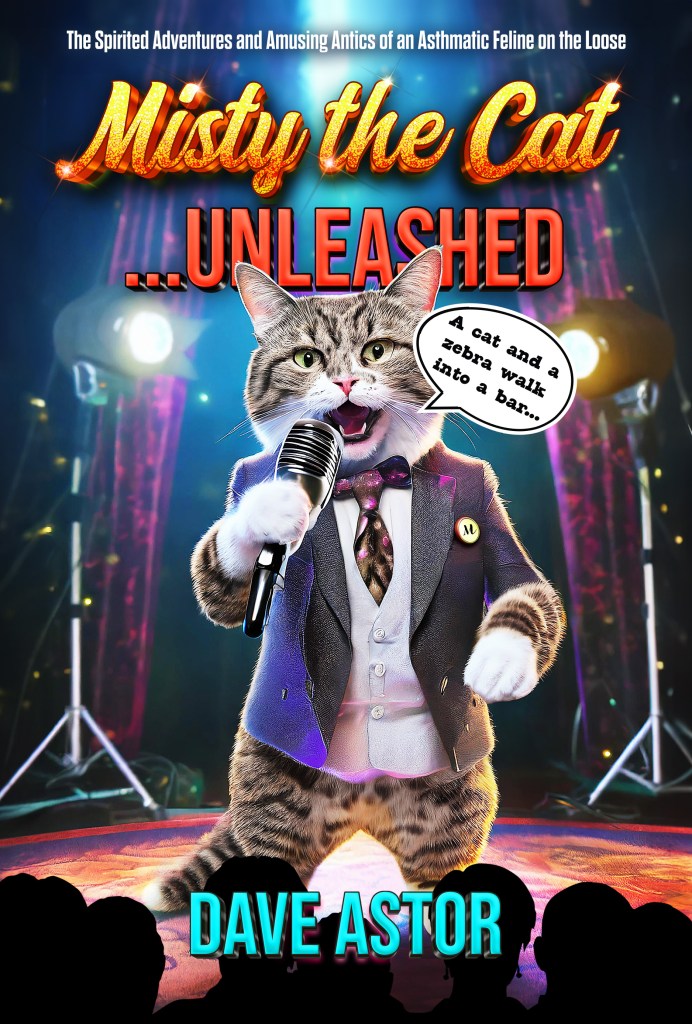
Dave and my comedic 2024 book — the part-factual/part-fictional/not-a-children’s-work Misty the Cat…Unleashed — is described and can be purchased on Amazon in paperback or on Kindle. It’s feline-narrated! (And Amazon reviews are welcome. 🙂 )
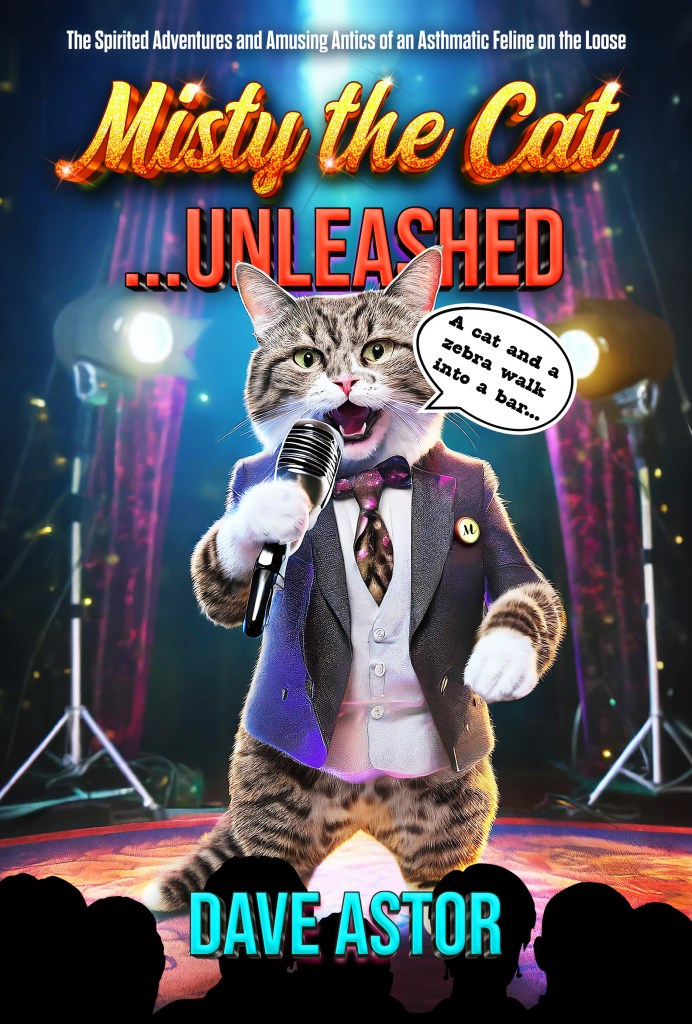
This 90-second promo video for the book features a talking cat: 🙂

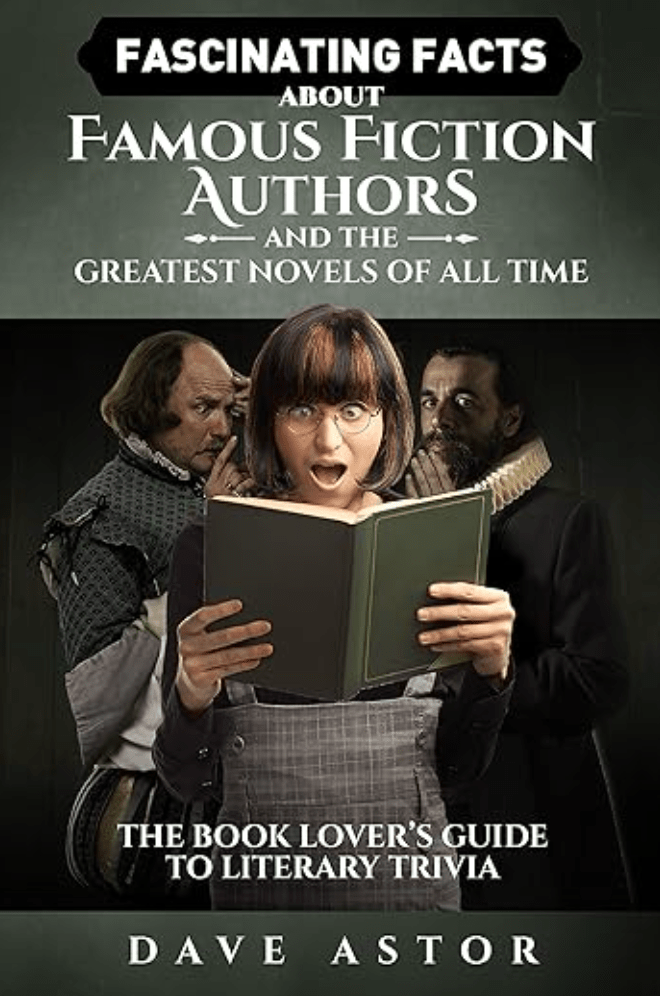
Dave is also the author of a 2017 literary-trivia book

…and a 2012 memoir that focuses on cartooning and more, including many encounters with celebrities.

In addition to this weekly blog, Dave writes the 2003-started/award-winning “Montclairvoyant” topical-humor column every Thursday for Montclair Local. The latest piece — from which Sir Walter Scott should remove himself from discussion of a referendum-halting court decision — is here.
Weekly Post, Monthly Theme

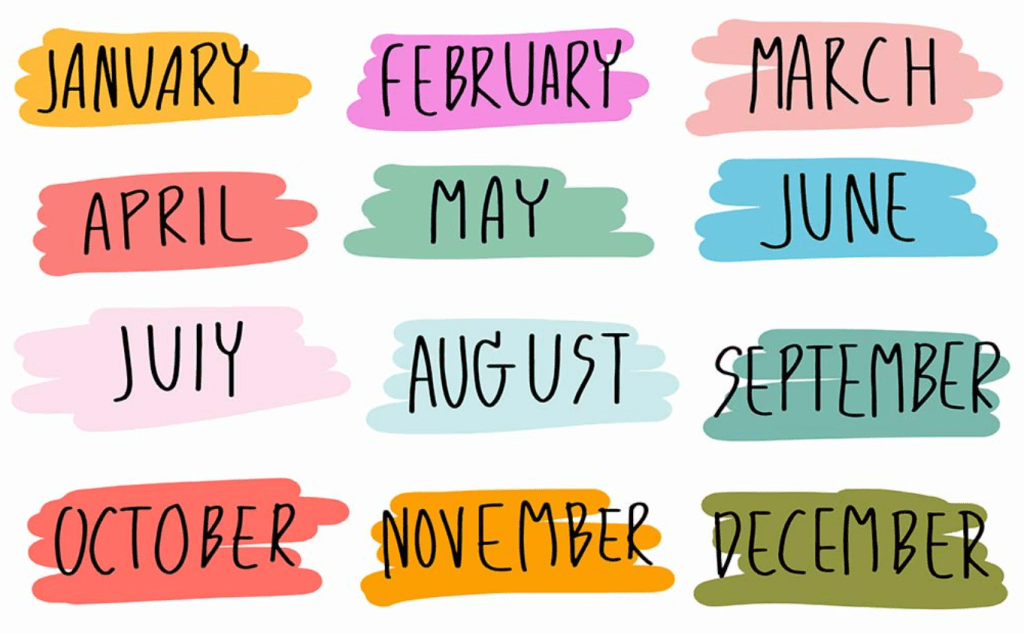
August has arrived, and thoughts not only turn to the approaching start of the school year but also to…Light in August.

Yes, some novels have months in their titles, and William Faulkner’s 1932 book is no exception. It also happens to be my favorite Faulkner work as the author unspools a “Southern Gothic” story about a man (Joe Christmas) who passes as white but thinks he has some African-American ancestry, a pregnant woman (Lena Grove) searching for the would-be father, and others.

Now let’s work back to previous months. Nadine Gordimer wrote July’s People, a novel set in a near-future version of South Africa where apartheid had ended. This was before apartheid actually ended, at least officially, about a decade after Gordimer’s 1981 book was published.

There’s also Three Junes by Julia Glass, whose 2002 novel has an intriguing tri-format set in 1989, 1995, and 1999.

Various novels include May and April in their titles, but I haven’t read any of them. 🙂

March? We have Geraldine Brooks’ March, but — rather than referring to the third month of the year — the title of the 2005 novel is the last name of the father from Louisa May Alcott’s Little Women as Brooks focuses on that dad’s harrowing Civil War experiences. There’s also Middlemarch, but that’s the name of a fictional English town in George Eliot’s 1871-72 classic.

I haven’t read any novels with February, January, December, or November in the title, but they do exist — including Gustave Flaubert’s…November (1842).

Going further back in the realm of months, we have Tom Clancy’s 1984 Cold War thriller The Hunt for Red October.

Have I read any novels with September in the title? Nope. But the Earth, Wind & Fire song “September” was pretty good.

Watch for a Misty the cat guest blog post next week! He was adopted in December (of 2017).

Any novels you’d like to mention with a month manifestation?

Misty the cat says: “There are twin beds, queen beds, king beds, and hall-floor beds.”

My comedic 2024 book — the part-factual/part-fictional/not-a-children’s-work Misty the Cat…Unleashed — is described and can be purchased on Amazon in paperback or on Kindle. It’s feline-narrated! (And Misty says Amazon reviews are welcome. 🙂 )

This 90-second promo video for my book features a talking cat: 🙂

I’m also the author of a 2017 literary-trivia book

…and a 2012 memoir that focuses on cartooning and more.

In addition to this weekly blog, I write the 2003-started/award-winning “Montclairvoyant” topical-humor column every Thursday for Montclair Local. The latest piece — which has a quirky percentage theme — is here.

Is There Reader Zest for Lists of Best?

Lists of the best books ever, the best books from a certain time period, etc., can be many things — including fun, annoying, puzzling, interesting, and valuable for nudging us to read or reread certain novels. (Though I prefer the great recommendations I get via the comments under this weekly blog. 🙂 )

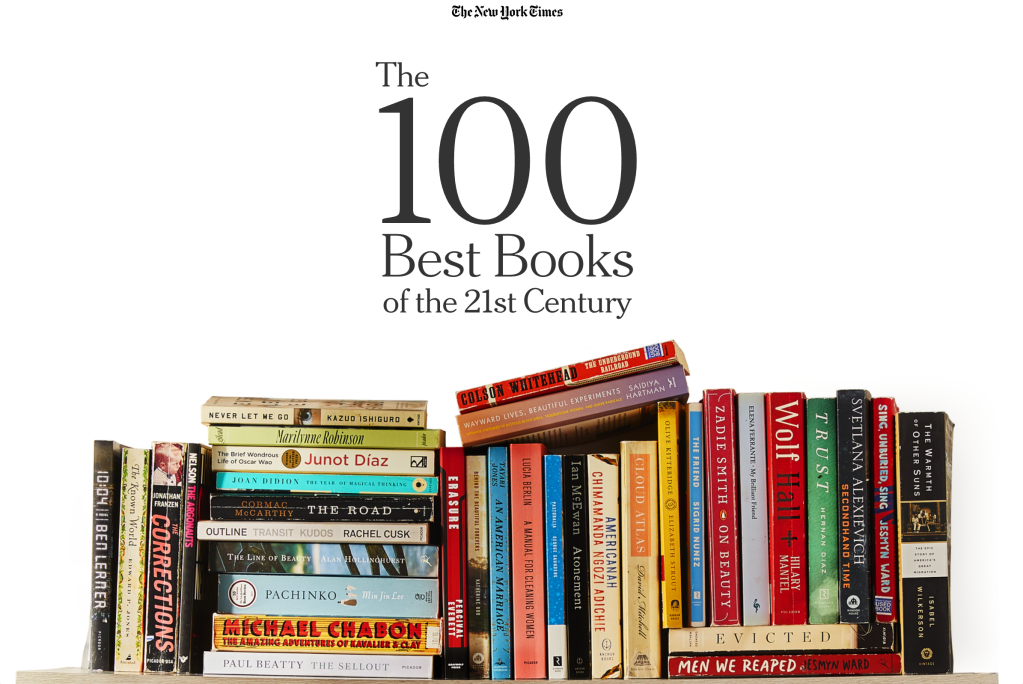
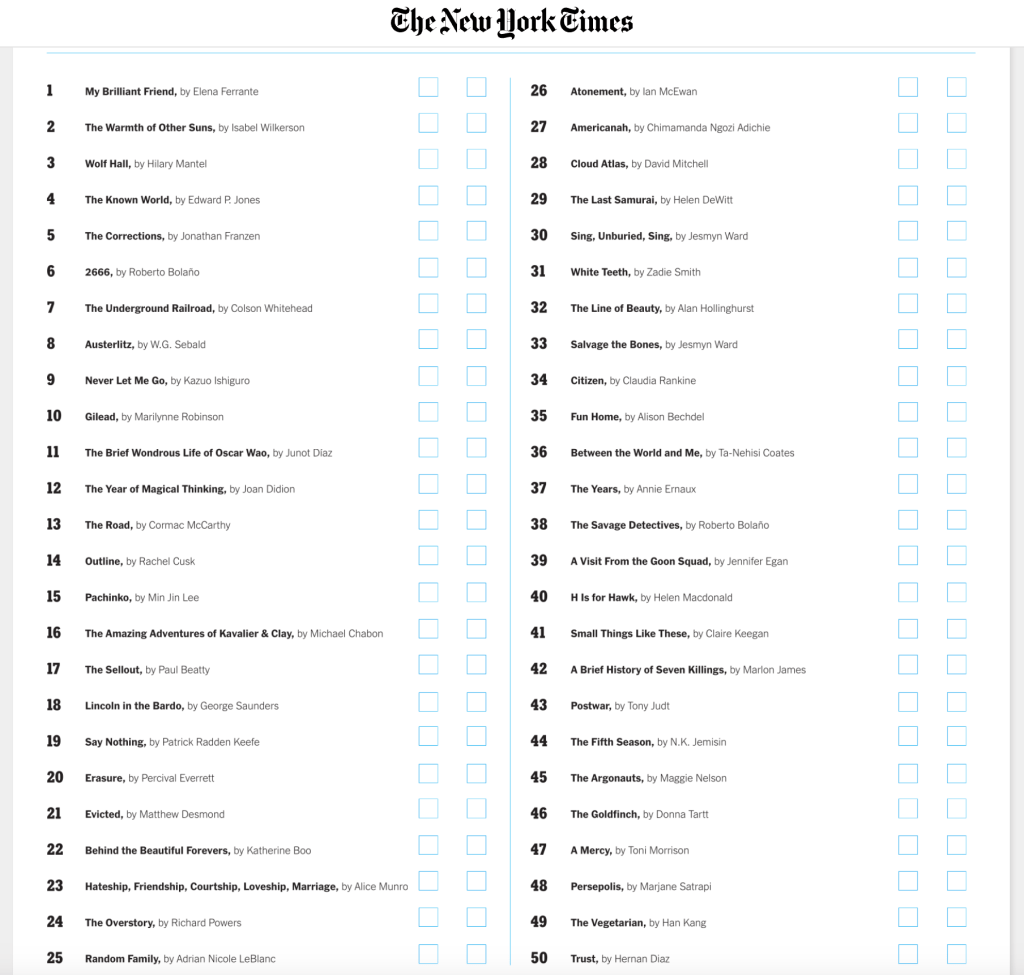
So, I had the usual mixed emotions about the list I most recently saw: “The 100 Best Books of the 21st Century,” re-highlighted on The New York Times website a week or so ago. (The link is here. If you end up hitting a paywall, the list also appears in two screen shots I placed below.)

The NYT’s methodology? “As voted on by 503 novelists, nonfiction writers, poets, critics, and other book lovers — with a little help from the staff of The New York Times Book Review.”

There are many excellent titles on the Times list, of course, and it turned out that I’ve read 24 of them. But, as with other rankings I’ve seen over the years, I thought there were a number of books that shouldn’t have been there but were or should have been there but weren’t. Not surprising given that we all have different opinions — one reason why “best” lists can be fascinating.

Among the novels I was happy to see — even as I might have put them higher or lower on the Times list — were Jonathan Franzen’s The Corrections (5th), Michael Chabon’s The Amazing Adventures of Kavalier & Clay (16th), Richard Powers’ The Overstory (24th), Chimamanda Ngozi Adichie’s Americanah (27th), Zadie Smith’s White Teeth (31st), Donna Tartt’s The Goldfinch (46th), Jeffrey Eugenides’ Middlesex (59th), Barbara Kingsolver’s Demon Copperhead (61st), Viet Thanh Nguyen’s The Sympathizer (90th), and Ann Patchett’s Bel Canto (98th).

Among the novels I thought were ranked too high were Marilynne Robinson’s Gilead (10th), George Saunders’ Lincoln in the Bardo (18th), Ian McEwan’s Atonement (26th), and Kate Atkinson’s Life After Life (51st). Why? I found the first book boring, the second highly original but at times tedious, the third marred by what I thought was an awful ending, and the fourth rather confusing. Other readers might feel differently. 🙂

Then there are authors and novels I felt should have been on the Times list. Where was Kristin Hannah? (The Great Alone would have been one possibility). Liane Moriarty? (Perhaps with Big Little Lies.) Amor Towles? (A Gentleman in Moscow.) Richard Russo? (Empire Falls.) Lionel Shriver? (So Much for That.) Lisa Genova? (Still Alice.) Margaret Atwood? (The Blind Assassin and/or Oryx and Crake.) J.K. Rowling? (Maybe one of her Harry Potter novels published post-2000, though it can be hard to choose one book from a series. And if you wanted to name the whole Potter series, the first three books were pre-2000, in the latter 1990s.)

Also, at least one other Barbara Kingsolver novel — I’d pick Unsheltered — deserved to be on the Times list.

Any 21st-century novels you’d like to mention/discuss? Thoughts on the Times top-100? General thoughts on “best” book lists?

Misty the cat says: “Fannie Flagg wrote ‘A Redbird Christmas,’ meaning this redbird is months late.”

My comedic 2024 book — the part-factual/part-fictional/not-a-children’s-work Misty the Cat…Unleashed — is described and can be purchased on Amazon in paperback or on Kindle. It’s feline-narrated! (And Misty says Amazon reviews are welcome. 🙂 )

This 90-second promo video for my book features a talking cat: 🙂

I’m also the author of a 2017 literary-trivia book

…and a 2012 memoir that focuses on cartooning and more.

In addition to this weekly blog, I write the 2003-started/award-winning “Montclairvoyant” topical-humor column every Thursday for Montclair Local. The latest piece — which names many famous songs — is here.

Novelists and Other Nobel-Nabbing Names

Like those who comment under this blog, I take pride in having read many fiction writers. But, for me, a look at the list of “Nobel Prize in Literature” recipients punctures that pride a bit.

That major honor was first offered in 1901, and since then 112 people have won it. But I’ve read only 31 of those writers — in some cases, only a small sample of their work.

Those 31: Rudyard Kipling (1907 winner), Rabindranath Tagore (1913), Anatole France (1921), William Butler Yeats (1923), George Bernard Shaw (1925), Sinclair Lewis (1930), Eugene O’Neill (1936), Pearl S. Buck (1938), Herman Hesse (1946), T.S. Eliot (1948), William Faulkner (1949), Par Lagerkvist (1951), Ernest Hemingway (1954), Albert Camus (1957), Boris Pasternak (1958), John Steinbeck (1962), Aleksandr Solzhenitsyn (1970), Pablo Neruda (1971), Saul Bellow (1976), Isaac Bashevis Singer (1978), Gabriel Garcia Marquez (1982), William Golding (1983), Wole Soyinka (1986), Nadine Gordimer (1991), Toni Morrison (1993), V.S. Naipaul (2001), Orhan Pamuk (2006), Doris Lessing (2007), J.M.G. Le Clezio (2008), Mario Vargas Llosa (2010), and Alice Munro (2013).

(Kipling, 42, was the youngest of the 112 winners and Lessing, 88, the oldest — with 64 the average age.)

Why haven’t I read more Nobel recipients? Well, there are many great non-Nobel authors to enjoy. 🙂 Also, I’m drawn to many works by female authors, and women have unfortunately won the prize only 14 times. Then there’s the matter of some authors being little known in the U.S. (or even their own countries) until winning the prize; some not having English translations of their work before (and in certain cases even after) receiving the Nobel; some having a reputation for not being easy to read; and some hailing from countries with which I might feel I don’t have enough cultural knowledge to fully appreciate their writing. I like to read sometimes-challenging authors from a fairly wide range of countries, but I could do better.

Since 1901, the most Nobel recipients have come from France (15), followed by the United States and United Kingdom (10 apiece), Germany and Sweden (8 apiece), Italy and Spain (6 apiece), etc. Among the many other countries represented in the winners’ circle have been Australia, Belarus, Canada, China, Colombia, Guatemala, Iceland, India, Ireland, Japan, Mauritius, Mexico, Nigeria, Poland, Russia, Saint Lucia, and Turkey.

The Nobel has certainly spurred me to read some writers for the first time — including J.M.G. Le Clezio and Alice Munro. Other writers I’ve read with little or no thought of them having been Nobel recipients (Sinclair Lewis, William Faulkner, John Steinbeck, and others).

Here’s a link to the list of Nobel literature recipients. How many have you read? Who are your favorites? Any other thoughts on the prize and the authors who’ve won it?

(The box for submitting comments is below already-posted comments, but your new comment will appear at the top of the comments area — unless you’re replying to someone else.)

I’m writing a literature-related book, but still selling Comic (and Column) Confessional — my often-funny memoir that recalls 25 years of covering and meeting cartoonists such as Charles Schulz (“Peanuts”) and Bill Watterson (“Calvin and Hobbes”), columnists such as “Dear Abby” and Ann Landers, and other notables such as Coretta Scott King, Walter Cronkite, and various authors. The book also talks about the malpractice death of my first daughter, my remarriage, and life in Montclair, N.J. — where I write the award-winning weekly “Montclairvoyant” humor column for The Montclair Times. You can email me at dastor@earthlink.net to buy a discounted, inscribed copy of the book, which contains a preface by “Hints” columnist Heloise and back-cover blurbs by people such as “The Far Side” cartoonist Gary Larson.