Anti-‘Woke’ Folk Should Do a Literary Soak

Colson Whitehead photo by Chris Close/Doubleday.

The Trump Administration’s countless nasty actions during its first six weeks include a crusade against DEI (Diversity/Equity/Inclusion) in the United States — a crusade that once again shows that Donald and company are white supremacists. They’re also sexist, anti-LGBTQ+, uncaring about people with disabilities, etc.

Their wrongheadedness has meant, among other things, firings of many federal employees who are not white males and crackdowns on merit-based multicultural hiring. Buttressing everything is the Trump Administration’s racist view that Caucasian men are the most competent people for any job — a view proven false time and time again, including when one looks at Trump’s grossly unqualified white male picks for Cabinet posts and other high positions.

Some on the anti-DEI bandwagon acknowledge that racism, misogyny, and homophobia once existed but contend that they’re now things of the past. Yes, things have gotten better, but true equality is still a distant goal. Also, there has of course been much recent backsliding into intolerance “thanks” to Trump, many of his fellow Republicans, some Democrats, and others.

One way people can see the very problematic nature of an anti-DEI attitude is to read novels. Many fictional works spotlight talented characters who are not white males, and often depict the challenges those characters face in a world still teeming with bias.

For instance, I’m currently reading Kate Quinn’s excellent 2021 novel The Rose Code — in which the abilities of World War II codebreakers Osla Kendall, Mab Churt, and Beth Finch are inspiring, as are the struggles of those three young Englishwomen against sexism and being underestimated.

But for the rest of this post, I’m going to only mention novels featuring impressive Black female and male characters who give the lie to alleged white male superiority as they often deal with a LOT in a society that devalues them and too often threatens them.

Just before starting The Rose Code, I read Colson Whitehead’s Pulitzer Prize-winning 2019 novel The Nickel Boys — and there’s no doubt that African-American character Elwood Curtis is smarter, nicer, and harder-working than any other teen (Black or white) we “meet” in the segregated northern Florida of the early 1960s. But a racist criminal “justice” system sends Elwood to a brutal juvenile reformatory on a charge he’s innocent of, and the results are not pretty — including what we learn in the powerful twist near the book’s conclusion.

But that was more than 60 years ago, you say? Whitehead, who also sets The Nickel Boys in more-recent times, shows how prejudice never completely goes away; it continues to reverberate. Trauma lingers across many a decade (as does a much smaller amount of intergenerational wealth among Black people compared to white people).

A few other memorable characters whose lives were at least partly affected by America’s warped racial dynamics include Joe King Oliver of Walter Mosley’s Down the River unto the Sea (2018), Starr Carter of Angie Thomas’ The Hate U Give (2017), Ifemelu of Chimamanda Ngozi Adichie’s Americanah (2013), Kiki Belsey of Zadie Smith’s On Beauty (2005), Celie of Alice Walker’s The Color Purple (1982), Dana Franklin of Octavia E. Butler’s Kindred (1979), Macon Dead III of Toni Morrison’s Song of Solomon (1977), Kunta Kinte of Alex Haley’s Roots (1976), John Grimes of James Baldwin’s Go Tell It On the Mountain (1953), the unnamed narrator of Ralph Ellison’s Invisible Man (1952), Bigger Thomas of Richard Wright’s Native Son (1940), and Janie Crawford of Zora Neale Hurston’s Their Eyes Were Watching God (1937). I found every one of those novels well worth reading, and I wish everyone trashing DEI would read them, too.

There are of course many bias-slammed Black characters skillfully created by white authors, too. Among them are Donte Drumm, a teen who ends up on Death Row for a murder he didn’t commit in John Grisham’s The Confession (2010); and the also falsely accused Tom Robinson in Harper Lee’s To Kill a Mockingbird (1960). Hmm…kind of similar story lines, 50 years apart.

Some of the characters mentioned in this post “overcome,” some do not.

Your thoughts about, and examples of, this topic?

Misty the cat says: “The grass will get greener this spring or when I buy a big can of green paint.”

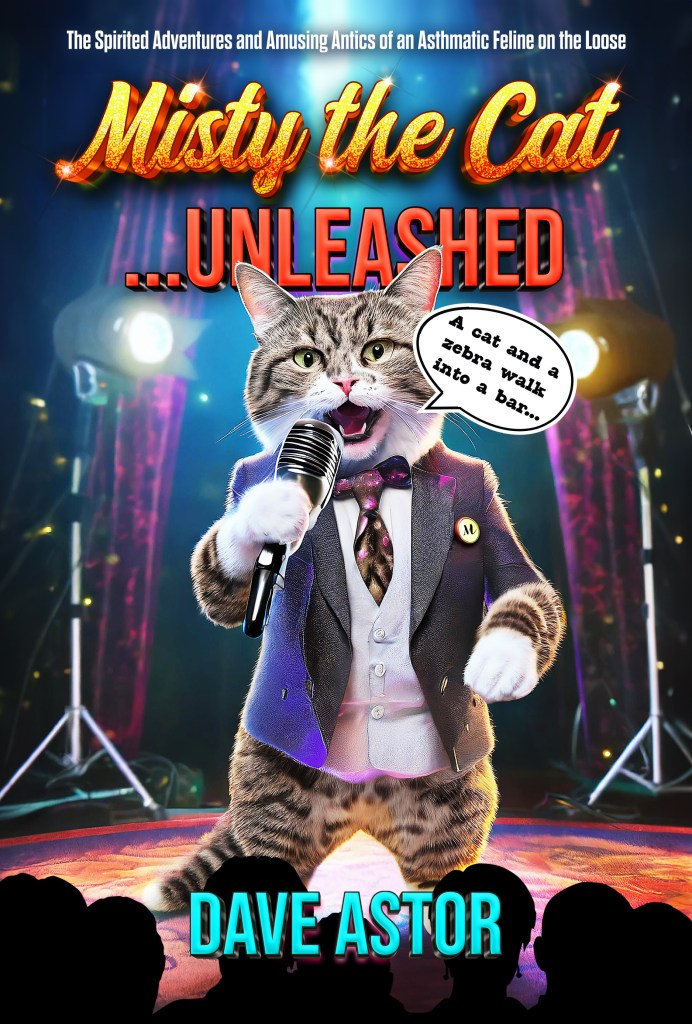
My comedic 2024 book — the part-factual/part-fictional/not-a-children’s-work Misty the Cat…Unleashed — is described and can be purchased on Amazon in paperback or on Kindle. It’s feline-narrated! (And Misty says Amazon reviews are welcome. πŸ™‚ )

This 90-second promo video for my book features a talking cat: πŸ™‚

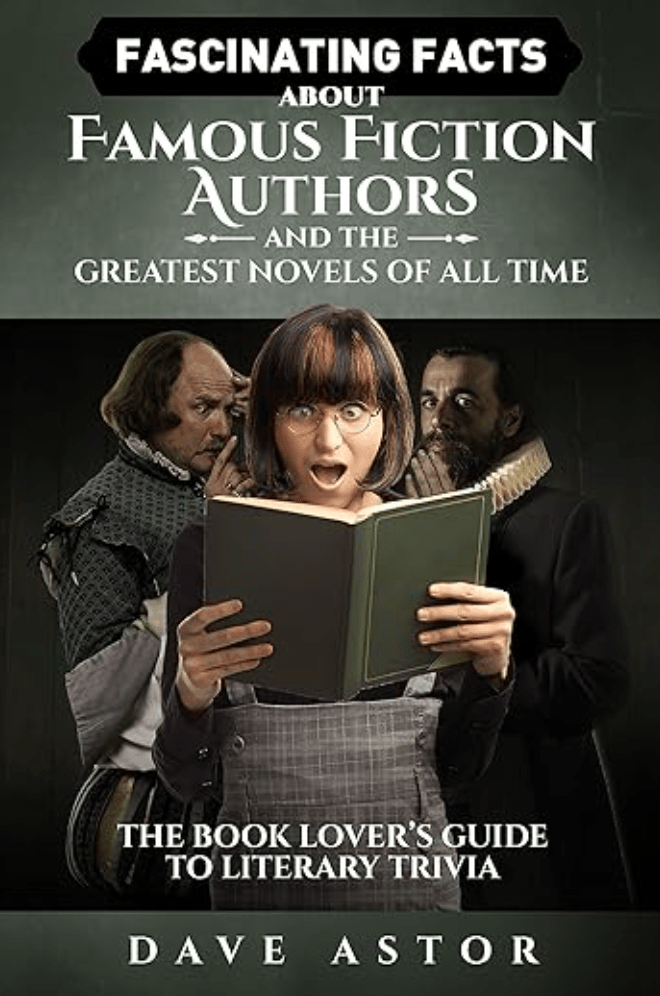
I’m also the author of a 2017 literary-trivia book

…and a 2012 memoir that focuses on cartooning and more.

In addition to this weekly blog, I write the 2003-started/award-winning “Montclairvoyant” topical-humor column every Thursday for Montclair Local. The latest piece — about a newly hired township manager, bad sidewalks, and more — is here.

The Good and the Bad Are Half-Ugly (Inside)

Martin Luther King Jr. (right) and Donald Trump (wrong).

Tomorrow, January 20, will see a mind-boggling juxtaposition of the good and the bad. It’s when the United States marks Martin Luther King Jr. Day to honor the renowned civil rights leader (actually born on January 15) and also when the reprehensible Donald Trump is again inaugurated as President of the United States.

Makes one think of excellent novels I’ve read that have very good and very bad characters and/or dizzying highs and dizzying lows.

Such as Fyodor Dostoevsky’s The Brothers Karamazov, in which one of the three brothers (Alyosha) is in the MLK category and another (Mitya) is closer to a Trump type.

Or Wilkie Collins’ The Woman in White, whose characters range from upstanding (such as Walter Hartright and Marian Halcombe) to evil (Percival Glyde and charismatic Count Fosco).

Or Henry James’ The Portrait of a Lady, which features the sympathetic Isabel Archer and the scheming Gilbert Osmond.

Or Charlotte Bronte’s Jane Eyre, whose title character deals with the lows of a painful orphan upbringing, an awful boarding school, romantic heartbreak, and homelessness. And the highs of finding some independence and that aforementioned romance.

Or Jane Austen’s Persuasion — in which its protagonist, Anne Elliot, faces romantic loss and romantic found.

Or George Eliot’s Silas Marner, whose title character suffers betrayal and later an unexpected event that turns his life around.

Or Harriet Beecher Stowe’s Uncle Tom’s Cabin, in which one character (Eliza) makes a harrowing escape from slavery and another (Tom himself) eventually succumbs to slavery’s awful yoke.

Or Robert Louis Stevenson’s Strange Case of Dr. Jekyll and Mr. Hyde. I don’t think I have to explain that one. πŸ™‚

Good and bad, and highs and lows, are of course part and parcel of real life — and great fodder for making novels more dramatic. If anything, many fictional works enhance the roller-coastering of personalities, emotions, and events. Which Trump would know if he ever read a book.

Though my post concentrated on 19th-century literature, you’re welcome to name novels from any time period that fit today’s theme. πŸ™‚

Misty the cat says: “I jump in windows to avoid Aldous Huxley’s ‘The Doors of Perception.'”

My comedic 2024 book — the part-factual/part-fictional/not-a-children’s-work Misty the Cat…Unleashed — is described and can be purchased on Amazon in paperback or on Kindle. It’s feline-narrated! (And Misty says Amazon reviews are welcome. πŸ™‚ )

This 90-second promo video for my book features a talking cat: πŸ™‚

In addition to this weekly blog, I write the 2003-started/award-winning “Montclairvoyant” topical-humor column every Thursday for Montclair Local. The latest piece — about more lawsuit news in my town and other topics — is here.

Bringing You a Barrage of Book Birthdays

A toast to novels with significant anniversaries in 2025.

It’s time for my annual first-half-of-January post featuring novels with major round-number anniversaries. I’ll mostly look at novels that are turning 25 (published in 2000), 50 (from 1975), 75 (from 1950), and 100 (from 1925 — a century-ago year with a stellar 12 months of books). I’ll focus on novels I’ve read, and you’re welcome to mention ones you’ve read. πŸ™‚

Where to begin? With Michael Chabon’s 2000-released The Amazing Adventures of Kavalier & Clay. It stars two male characters loosely based on Superman’s co-creators and other real-life cartoonists, and won the Pulitzer Prize for fiction.

Speaking of awards, 2000 also saw the publication of one of Margaret Atwood’s best: her Booker Prize-winning The Blind Assassin, starring two sisters and featuring a novel within that novel.

In the top tier of her output, too, was Barbara Kingsolver’s out-in-2000 Prodigal Summer, in which separate story lines expertly come together at the end.

There was Zadie Smith’s terrific debut novel White Teeth as well. That turn-of-the-millennium book mixes multicultural interactions, humor, and more.

The year 2000 also saw the publication of Harry Potter and the Goblet of Fire — the fourth in J.K. Rowling’s blockbuster wizard-world series, and the book that saw the author start to write quite-long-but-still-page-turning novels.

Lee Child’s fourth Jack Reacher novel, Running Blind, appeared in 2000, too — and it’s thrilling like the rest of the series, before and after.

John Grisham was his usual readable self with 2000’s The Brethren, about three ex-judges perpetrating a scam from jail.

And Rosamunde Pilcher’s final novel, the poignant Winter Solstice, came out 25 years ago, too.

Moving backwards to 1975, that was the year of Stephen King’s second novel: the gripping ‘Salem’s Lot. Wow — the still-prolific King’s career has passed the half-century mark!

Plus James Clavell’s very immersive Shogun, set in Japan circa-1600. And E.L. Doctorow’s Ragtime, mixing fictional and real people during the early 1900s. And Judith Rossner’s harrowing Looking for Mr. Goodbar, mixing sex and violence.

In 1950, memorable releases included Ray Bradbury’s short-stories-as-novel The Martian Chronicles, Isaac Asimov’s sci-fi classic I, Robot, Patricia Highsmith’s psychological nail-biter Strangers on a Train, and C.S. Lewis’ children’s fantasy The Lion, the Witch, and the Wardrobe, among others.

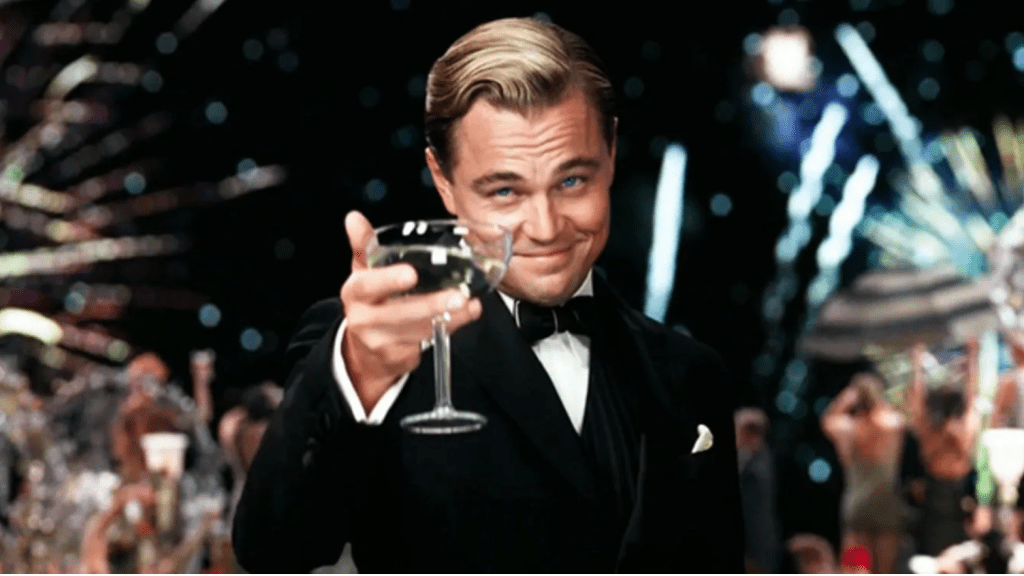
Turning to novels published in 1925 — 100 years ago! — we can only start with The Great Gatsby. (Leonardo DiCaprio is pictured atop this post in the 2013 movie version of F. Scott Fitzgerald’s iconic book.)

Other iconic or near-iconic titles published in 1925 included Virginia Woolf’s Mrs. Dalloway, Franz Kafka’s The Trial, Theodore Dreiser’s An American Tragedy, W. Somerset Maugham’s The Painted Veil, Sinclair Lewis’ Arrowsmith, and the second installment of L.M. Montgomery’s Emily trilogy. Plus one of Willa Cather’s lesser-known titles — The Professor’s House — and Georgette Heyer’s Simon the Coldheart.

I think the only novel I’ve read from 1875 — a century-and-a-half ago — was The Mysterious Island by Jules Verne. And nothing from 1825, 1775, and 1725, though I’ve read a number of books published not long before or after those years.

Misty the cat says: “Now that I’ve read ‘The Outsiders’ novel, it’s time to go inside.”

My comedic 2024 book — the part-factual/part-fictional/not-a-children’s-work Misty the Cat…Unleashed — is described and can be purchased on Amazon in paperback or on Kindle. It’s feline-narrated! (And Misty says Amazon reviews are welcome. πŸ™‚ )

This 90-second promo video for my book features a talking cat: πŸ™‚

In addition to this weekly blog, I write the 2003-started/award-winning “Montclairvoyant” topical-humor column every Thursday for Montclair Local. The latest piece — about another lawsuit in my town and a couple of contentious Council meetings — is here.

The Year 2024? That’s That, With Stats

Now that the 10th-anniversary year of this blog has come and gone, I want to offer my VERY grateful thanks to all visitors and commenters. I love the conversations! πŸ™‚

Last year, 2024, saw “Dave Astor on Literature” get by far its most annual views (56,862) and visitors (39,689). Also, the 52 posts (one every Sunday!) elicited 5,702 comments — averaging about 110 a week.

The “lucky 13” posts with the most comments last year:

1. “Faking a Look at a Presidential Book,” November 10, 185 comments.

2. “When Genres Are Happy Together,” November 24, 179 comments.

3. “Batman and Robin Aren’t the Only Dynamic Duo,” August 18, 167 comments.

4. “Expecting an A, Getting a B,” September 29, 150 comments.

5, “Gaslighting, Gaza, and Genocide,” May 5, 145 comments.

6. “Book Titles Get a New Look Thanks to Trump the Crook,” June 2, 140 comments.

7. “Misty the Cat…Unleashed Is Unleashed into the Book World,” June 16, 139 comments.

8. “Prose and Politics,” March 24, 137 comments.

9. “The Art of the Con,” March 17, 134 comments.

10. “Reading Painful Novels Can Be Worth the Pain,” January 14, 129 comments.

11. “From Russia With…Courage,” February 18, 127 comments.

12. “More Than One Ghost in This Post,” September 14, 124 comments.

13. “The Art of Depicting Large Families in Novels,” May 12, 123 comments.

My most-read post of 2024 was actually one I published in 2018: “Strong Female Characters in 19th-Century Fiction.” Not only the most-read piece in 2018 but in 2019, 2020, 2021, 2022, and 2023, too. Keeps popping up in online searches, I guess. πŸ™‚

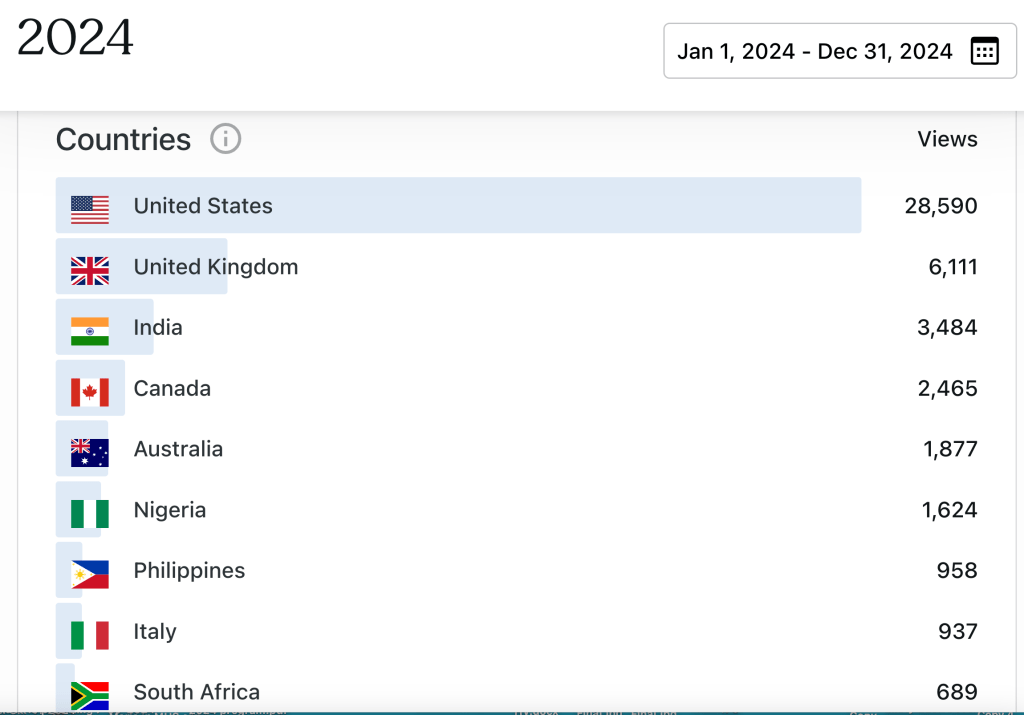
The countries that accounted for the most views of my blog in 2024? See the statistical image below. Readership came from 182 of the world’s 195 countries!

One final number: I read 54 novels last year.

Thank you all again! And back to actually discussing literature next week. πŸ™‚

Misty the cat says: “Marcel Proust wrote In Search of Lost Car.”

My comedic 2024 book — the part-factual/part-fictional/not-a-children’s-work Misty the Cat…Unleashed — is described and can be purchased on Amazon in paperback or on Kindle. It’s feline-narrated! (And Misty says Amazon reviews are welcome. πŸ™‚ )

This 90-second promo video for my book features a talking cat: πŸ™‚

In addition to this weekly blog, I write the 2003-started/award-winning “Montclairvoyant” topical-humor column every Thursday for Montclair Local. The latest piece — about calls for a cursing councilor to resign, and more — is here.

Guest Literature Post by Donald Trump! (Again)

Credit: Free Books Photos

In early 2017, soon after reprehensible right-winger Donald Trump first became President of the United States, I wrote a certain post. Now that Trump will depressingly occupy the White House again, I’m bringing back that post, revised and updated. Hopefully, my blog will return to “normal” next week. πŸ™‚

I, Donald Trump, demanded to write a guest literature piece, and I always get what I want. Sure, I don’t read novels or know much about any of them, but I do read the backs of McDonald’s “Happy Meal” containers. Lots of back story, ya know?

Actually, I know a yuge amount about fiction, but more the “alternative facts” kind than the literary kind. I’m a fabulous fabricator! Liane Moriarty wrote Big Little Lies; I’m more into Big BIG Lies.

Anyway, I was told I should read The Ambassadors by Henry James, but I already have a list of the corrupt, distasteful envoys I’ll appoint for various countries. Including Chile, which McDonald’s has on its menu, though misspelled as chili. And my weird, startling, extremist, incompetent, fox-guarding-the-henhouse cabinet picks? They make Stephen King’s Misery seem upbeat.

The Red Badge of Courage? Believe me, bravery is for losers. I showed more courage getting Vietnam War deferments for alleged bone spurs in my heels, even though I played sports at the time with no problem. They called me The Natural — inspiring a Bernard Malamud novel that later became a movie starring one of those Hollywood “libtards,” Robert Redford, who’s no relation to Robert Redtesla. My best buddy Tesla guy Elon Musk owns the now-fascist-friendly X, formerly Twitter and still the Roman numeral for the low level of Musk’s social IQ.

Also, I bigly love Theodore Dreiser’s Sister Carrie character. I’d like to grab her by the [deleted]. Make An American Tragedy Great Again? I’m on it!

You see, I have immense respect for women. But was George Eliot transblender or something? George is a guy’s name, but that 19th-century scribbler looks female in photos. Lock her up!

And the clever nicknames I come up with! “Sleepy Joe Biden,” “Crazy Kamabla,” “Tampon Tim,” “Deranged Jack Smith,” and “George Slopadopolus,” to name a few. From the past, there was also Chris “Agatha” Christie; And Then There Were None: cabinet positions for him in 2017.

I also know history, because I know everything! Toni Morrison was the lead singer of The Doors, Harper Lee surrendered to Ulysses Grant, Richard Wright co-invented the airplane, and the BrontΓ« sisters were at the 2017 Women’s March on Washington. I always have a Tan, but it’s not Amy.

Another George: Orwell. Love, love, LOVE the oppressors in Nineteen Eighty-Four! I even tried doublethink, but I can’t think once most of the time. Ask Herman Melania, my wife’s ancestor, who wrote about a big white male — that’s me! Captain Ahab sounds kind of Muslim, doesn’t he?

My wife Melania was an immigrant, but an okay one because she’s white. I have promised to deport millions of “other” types of immigrants. Sure, it will ruin their lives, devastate communities, and wreck the U.S. economy. My response? The Art of Me Saying “Big Deal.”

No new non-white immigrants, either; Jorge Luis Borges and Gabriel Garcia Marquez will never cross our southern border while I’m racist-in-chief, um, sexual-predator-in-chief, um, commander-in-chief. It helps that those two Hispanic writers are dead. Not much border-crossing potential there.

The Blacks, The Blacks. Why didn’t E.B. White use the name E.B. Very White? The title of Jack London’s White Fang novel rocks. I heard about Zora Neale Hurston’s 1937 classic Their Eyes Were Watching God — thrilling that those eyes were watching me nine years before I was born.

Flowers for Algernon — also thrilling! It gave me a chance to mentally mock the disabled for pages and pages. Can you beat that? Which reminds me that I’ll encourage the police to beat up any Americans who oppose me. The Hate U Give? Nope, not the Angie Thomas novel. The Hate I Give.

Mark my words, I’m really going to build a wall this time — paid for by Mexico (aka American taxpayers). We’ll build that big, beautiful fence at The Border: a novel by Cormac McCarthy, whose last name reminds me of one of my heroes, Joe McCarthy.

Jim Casy of The Grapes of Wrath was a commie, wasn’t he? Not the good kind like Vladimir Putin. Although I don’t read any books, I love Russian literature — including War and War and Crime and No Punishment for Me. But Anna Karenina? Overrated! Blood coming out of her whatever (after she was hit by a train). And Alexander Solzhenitsyn? I like authors who don’t get jailed.

Did I mention I drained the swamp? So I could have a dry place to burn books by liberal, pinko writers. Ever read Fahrenheit 451? The same number as my IQ. It’s genius-ly high! But I actually never really drained the swamp — I made it swampier.

My second presidential administration — Trump 2.0 — will be like a dystopian novel come to life again. I have no idea what dystopian means, but right-wing media nut Ben Shapiro and my nasty vice president-elect JD Vance mentioned that word one day. I think of those two as The Sound and the Fury. Me? Pride and Prejudice.

It Can’t Happen Here? It already has.

Misty the cat says: “I’m waiting for the window to open, even though Godot’s not inside.”

My comedic 2024 book — the part-factual/part-fictional/not-a-children’s-work Misty the Cat…Unleashed — is described and can be purchased on Amazon in paperback or on Kindle. It’s feline-narrated! (And Misty says Amazon reviews are welcome. πŸ™‚ )

This 90-second promo video for my book features a talking cat: πŸ™‚

In addition to this weekly blog, I write the 2003-started/award-winning “Montclairvoyant” topical-humor column every Thursday for Montclair Local. The latest piece — about a problematic proposed townhouse plan and more — is here.

Different Approaches to Reading Sequels

When we finish a great novel that’s part of a series or has sequels, it’s a wonderful feeling to know there’s more to come. But how to go about it? Do we focus on those books for weeks or months on end, ignoring the work of other authors? Or do we read the next installments sporadically over a longer period of time while mixing in different writers?

There’s no right answer, of course — it’s whatever the individual reader prefers. And if the next installment hasn’t been written/published yet, obviously fiction fans will read other authors as they eagerly await a serial saga’s continuation.

The pros and cons of each approach? If one reads a series or sequels while ignoring novels by different writers, one can achieve wonderful immersion and momentum, really get to know the characters, more easily remember foreshadowing from previous books, and pick up other kinds of nuances. On the negative side, a bit of sameness can set in. And think of all the literary variety temporarily being missed!

My most memorable experience with both approaches involved J.K. Rowling’s stellar Harry Potter series. Starting in the late 1990s, I waited each year or so for the next installment. A painful wait, but there were plenty of months to read other authors. Then, several years after the seventh and last of the Potter novels was published, I went back and reread them one after another — with no non-Potter book in between. It was a terrific experience, partly for the reasons mentioned in the previous paragraph.

I also consecutively read James Fenimore Cooper’s five “Leatherstocking” novels (The Last of the Mohicans, etc.). I don’t care that Mark Twain hated those books; I liked them a lot.

And of course when you have a compelling trilogy, you might as well read all three books in a row — as I did with Suzanne Collins’ The Hunger Games and its two sequels, Stieg Larsson’s The Girl With the Dragon Tattoo and its two sequels, Cormac McCarthy’s All the Pretty Horses and its two sequels, and J.R.R. Tolkien’s The Lord of the Rings. (For me, there was a gap between reading Tolkien’s trilogy and an earlier reading of The Hobbit prequel.)

Recently, it was Martin Cruz Smith’s work that had me wrestling with how to go about reading sequels. I liked his Gorky Park so much last month that I quickly borrowed the first two sequels from the library. Polar Star (claustrophobically set on a fishing ship) was almost as good, as was Red Square. But I did manage to squeeze another author’s book — Philippa Gregory’s very good historical novel Earthly Joys — between Gorky Park and Polar Star. Which made me want to read the Earthly Joys sequel Virgin Earth. πŸ™‚ But when I visited my local library this past Friday, Virgin Earth wasn’t there, so I borrowed the five other Gorky Park sequels! (Havana Bay, Wolves Eat Dogs, Stalin’s Ghost, Three Stations, and Tatiana.)

Other times, months or even years go by before I get to the next installment. That was the case with John Steinbeck’s Cannery Row and its sequel Sweet Thursday.

Or it can be a little of both approaches. For instance, I read L.M. Montgomery’s Anne of Green Gables and its first three sequels consecutively, and then later got back to the other sequels.

There’s also the case of reading some sequels but not all of them. I enjoyed Walter Mosley’s first two Easy Rawlins mysteries and Sue Grafton’s first four Kinsey Millhone alphabet mysteries, but not quite enough to immediately continue with more. But I might get back to them!

And how about reading a series mostly out of order? I’ve done that with Lee Child’s Jack Reacher novels, partly because some of the books were at my local library only some of the time.

How do you read series and sequels?

Because of some travel, I will not be posting columns March 25 and April 1. I look forward to returning with a new piece on April 8! I’ll still respond when I can to any comments under already-published columns.

My 2017 literary-trivia book is described and can be purchased here: Fascinating Facts About Famous Fiction Authors and the Greatest Novels of All Time.

In addition to this weekly blog, I write the award-winning “Montclairvoyant” topical-humor column for Baristanet.com. The latest weekly piece — about topics such as a mayor’s interference in the search for a schools superintendent — is here.

Reading Gaps: Mine, and Yours?

Because of all the time I spent trying to promote my new literary-trivia book during the past six weeks, I ironically managed to read only one novel (Jorge Amado’s interesting Dona Flor and Her Two Husbands).

That’s not a good thing for a literature blogger. πŸ™‚ Also, the near-total absence of fiction negatively affected my mood (as did the various new outrages from America’s mean-spirited Republican leaders). Novels can be fun, relaxing, exciting, educational, and/or take you to “another place.” Suddenly, for the first time since a previous reading gap a couple of decades ago, I wasn’t getting much of that.

You don’t know what you’ve got ’til it’s gone, to quote Joni Mitchell.

But I’m now getting back to reading more fiction again — starting with Fanny Burney’s 1778 novel Evelina, which I’m in the middle of. One highlight of that often-funny book is the hilarious way English and French characters fling insults at each other. But there’s also deeper stuff about a woman’s place in society, the complexity of relationships, family, country life vs. London life, and more.

It’s fascinating to experience any kind of life at that time through the eyes of a female author. I’ve read and enjoyed a number of 18th-century novels — Voltaire’s Candide, Jonathan Swift’s Gulliver’s Travels, Henry Fielding’s Joseph Andrews, Daniel Defoe’s Robinson Crusoe, etc. — but, up until now, none by women, for the simple reason that there weren’t a whole of published books by them back then. Rigid gender roles, sexism, patriarchy, and all that — which of course persisted into the 19th century, yet we thankfully still got Mary Shelley, Jane Austen, the Bronte sisters, George Eliot, Louisa May Alcott, and other revered 1800s female authors.

One can definitely see the 1752-born Burney’s influence on Austen, who took her Pride and Prejudice title from a phrase in Fanny’s Cecilia novel. Other interesting facts (outlined in a chapter of my literary-trivia book): Burney wrote four novels and eight plays, kept a journal for 72 years (from 1768 until her death in 1840), worked in the court of King George III from 1786 to 1790, and underwent a harrowing mastectomy in 1811.

The next novels in my queue: Donna Tartt’s first book The Secret History (I loved her third novel The Goldfinch and mostly loved her second novel The Little Friend) and then Dream Palace by Amanda Moores, who happens to be the wife of a very well-read regular commenter here — jhNY.

What have been your experiences (if any) with reading gaps? Why did you read little or no fiction for a period of time? How you did you feel about that? What got you back to reading fiction?

Here’s a review of, and a video interview about, my new literary-trivia book Fascinating Facts About Famous Fiction Authors and the Greatest Novels of All Time.

In addition to this weekly blog, I write the award-winning “Montclairvoyant” topical-humor column for Baristanet.com, which covers Montclair, N.J., and nearby towns. The latest weekly column, about my congressman’s awful vote for Trumpcare, is here.

If You Were Trying to Convince People to Read Fiction, What Would You Say?

Most people who follow this blog are avid fans of literature. But we all have family and friends who don’t read any or much fiction — unless they stumble across a Donald Trump speech. πŸ™‚

Everyone has their own interests and time constraints, so I never harangue the book-averse for not reading more novels. You’re probably the same way. But what if you hypothetically took aside people who don’t read literature and tried to convince them to do so? What would you say? What arguments would you use? (And I don’t mean threatening to smack them with a hardcover copy of War and Peace.) This column will consist of my hypothetical talking points, and then I’ll ask for yours.

I would tell the book-averse that reading fiction is fun and entertaining — as well as relaxing in some cases and exciting in other cases.

Educational, too. You learn about different locales (in the U.S. or abroad or even outer space), you learn about different cultures, and you learn about different time periods. You also learn about things that are a little harder to pin down — such as the variety of human emotions.

Literature can also be comforting. There’s something soothing about letting your mind go to another mental place, and about realizing that people from thousands of miles away or centuries ago might have similar thoughts as you. Part of this can involve learning from history so we’re not doomed to repeat it, to paraphrase the famous phrase attributed to George Santayana — whose writing included fiction.

Not soothing but also very important is how literature can take us OUT of our comfort zone and challenge us to look at things in a different way than we’re accustomed to.

Can you get all of the above from, say, watching TV programs or movies? Some of it. Yet images on a screen SHOW you things; you don’t use your imagination as much as you do when seeing things only in your mind’s eye when reading.

On a more prosaic level, reading fiction will give you interesting things to talk about (at parties and elsewhere) — including lines like: “Harumph — I just saw yet another film not as good as the novel it’s based on.” πŸ™‚

And reading literature means you’re monetarily supporting some very creative author minds. Not to mention helping independent bookstores, if that’s how you roll when shopping for fictional works.

When hypothetically trying to convince people to read literature, it wouldn’t hurt to urge them to start with popular page-turners — and then hope those readers eventually throw some older or modern classics into the mix.

I realize much of what I said in this piece is obvious, but…okay, okay…books are also good for propping up the legs of uneven tables. Unless you use a Kindle, which might not do as well in that table-leveling capacity…

What would you tell literature-avoiding family members or friends to try to get them in fiction-reading mode?

(The box for submitting comments is below already-posted comments, but your new comment will appear at the top of the comments area β€” unless you’re replying to someone else.)

I’m writing a literature-related book, but still selling Comic (and Column) Confessional — my often-funny memoir that recalls 25 years of covering and meeting cartoonists such as Charles Schulz (“Peanuts”) and Bill Watterson (“Calvin and Hobbes”), columnists such as Ann Landers and “Dear Abby,” and other notables such as Hillary Clinton, Coretta Scott King, Walter Cronkite, and various authors. The book also talks about the malpractice death of my first daughter, my remarriage, and life in Montclair, N.J. — where I write the award-winning weekly “Montclairvoyant” humor column for The Montclair Times. You can email me at dastor@earthlink.net to buy a discounted, inscribed copy of the book, which contains a preface by “Hints” columnist Heloise and back-cover blurbs by people such as “The Far Side” cartoonist Gary Larson.