The ‘Winter’ of Our Book Content

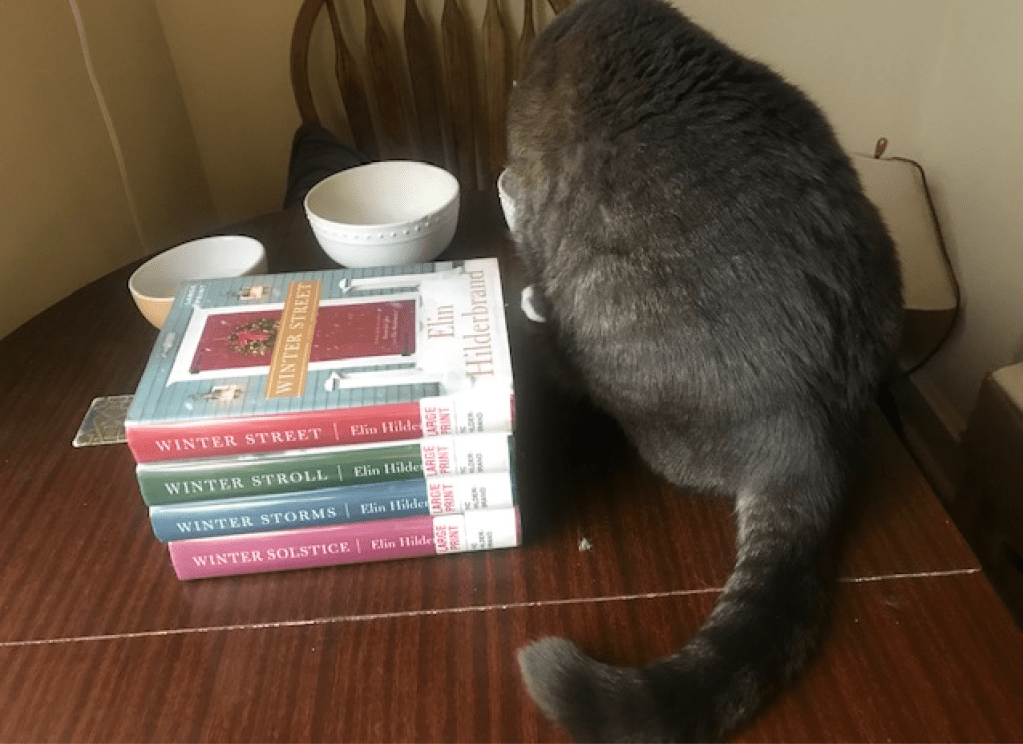
Misty the cat thinks these books have a BACK story. (Photo by me.)

It’s early winter in part of the world, so thoughts turn to novels with…the word “Winter” in the title. Okay, maybe most readers’ thoughts don’t turn to that, but I needed a blog topic this week. ๐Ÿ™‚

I just finished reading Winter Street, the first of a four-book Elin Hilderbrand series that continues with Winter Stroll, Winter Storms, and Winter Solstice. The mostly Nantucket, Massachusetts-set Winter Street focuses on the Quinn family as it goes through a dramatic Christmas week that includes a marital separation, other relationship issues, an engagement, no word from a son fighting in Afghanistan, another son facing an insider-trading charge, etc. Yes, Christmas time is not always a 100% happy time. The book obviously deals with some heavy issues, yet often retains a light touch.

Another accomplished contemporary author, Kristin Hannah, wrote Winter Garden. Not on the level of her best novels such as The Nightingale, The Great Alone, The Four Winds, and Firefly Lane, but still pretty good. Winter Garden is about two very different sisters and their cold, mysterious mother — who’s originally from snowy Russia during the period of Stalin’s iron rule.

The late Rosamunde Pilcher’s final novel, Winter Solstice, is I think the second best of her many books — behind only her terrific The Shell Seekers. Winter Solstice (published before Hilderbrand’s novel of the same name) unfolds amid a cold-weather gathering of people from various generations.

Of course, there’s John Steinbeck’s also-final novel, The Winter of Our Discontent, which has the overarching theme of trying to maintain integrity in a corrupt society. It’s one of Steinbeck’s deeper books, though not as compelling as The Grapes of Wrath and East of Eden.

Among the “Winter”-titled novels I haven’t read are Isabel Allende’s In the Midst of Winter and Laura Ingalls Wilder’s The Long Winter (part of The Little House on the Prairie series). I should also mention George R.R. Martin’s The Winds of Winter — the lengthy, long-delayed, not-yet-finished sixth novel in his A Song of Ice and Fire series that started with A Game of Thrones.

Then there are plays such as Shakespeare’s The Winter’s Tale and James Goldman’s The Lion in Winter.

Any thoughts about, and/or examples of, this theme?

On yet another rainy winter morning, Misty the cat says: “I’d build an ark, but the lumber yard’s closed.”

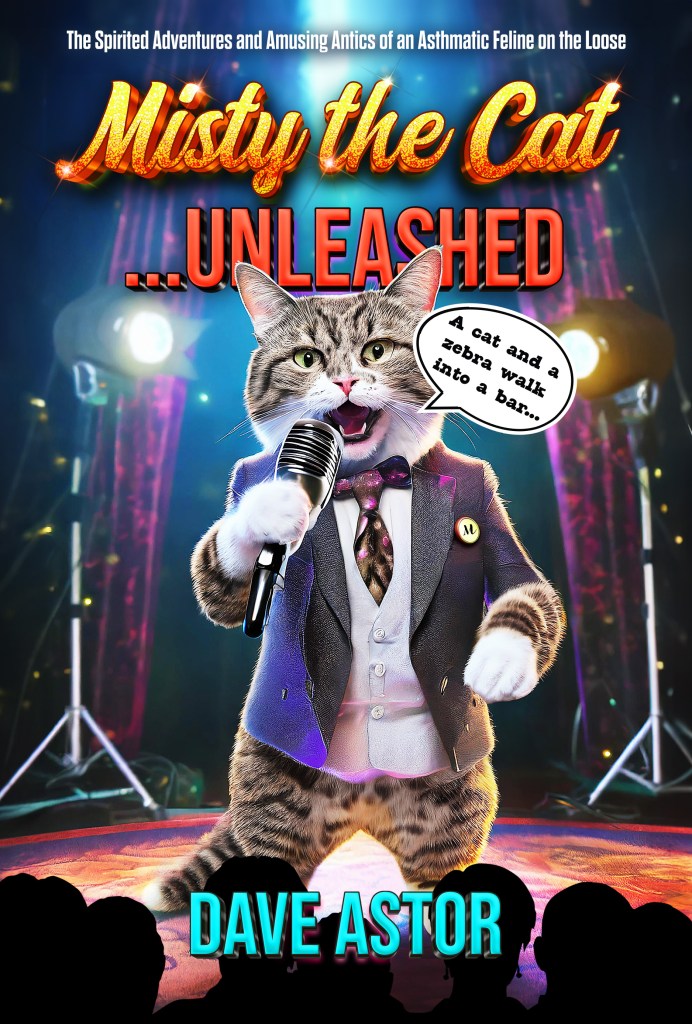
My comedic 2024 book — the part-factual/part-fictional/not-a-children’s-work Misty the Cat…Unleashed — is described and can be purchased on Amazon in paperback or on Kindle. It’s feline-narrated! (And Misty says Amazon reviews are welcome. ๐Ÿ™‚ )

This 90-second promo video for my book features a talking cat: ๐Ÿ™‚

In addition to this weekly blog, I write the 2003-started/award-winning “Montclairvoyant” topical-humor column every Thursday for Montclair Local. The latest piece — which discusses an “F-bomb” controversy and much more via a poem co-starring Santa Claus — is here.

Frigid Fiction

Much of the U.S. last week experienced record cold temperatures — including a painful 8 degrees Fahrenheit in my town as I wrote this blog post. At least that single-digit number had the silver lining of being 443 degrees short of the burn threshold of books, according to Ray Bradbury.

Of course, the bitter weather made me think of novels in which characters face low temperatures rather than the heat that consumed books in Bradbury’s Fahrenheit 451. And I’m aware of having penned a somewhat similar piece about wintry literature five years ago for The Huffington Post (which treated its bloggers and commenters…coldly), but this piece has lots of new material and was written from scratch.

Among other literary attributes, cold weather and its often-accompanying dose of snow help create drama — with sheer survival sometimes at stake. Wintry fiction also makes us lament that the non-affluent are affected more by the elements than the rich. And for those reading cold-filled novels in warm homes or warm climes, it’s all vicarious — we’re not the ones freezing.

Russian novels are obviously among the first books that come to mind when thinking of fictional works with bone-chilling scenes in some or all their pages. These novels include, among many others, Leo Tolstoy’s War and Peace (just ask Napoleon), Fyodor Dostoyevsky’s The House of the Dead, Boris Pasternak’s Doctor Zhivago, and Aleksandr Solzhenitsyn’s One Day in the Life of Ivan Denisovich — with the second and fourth of those books set in Siberian prison camps.

Then there are Scandinavian novels (a number of them mysteries) with teeth-chattering locales — for instance, Stieg Larsson’s The Girl With the Dragon Tattoo, Peter Hoeg’s Smilla’s Sense of Snow, and John Ajvide Lindqvist’s Harbor.

And Canadian literature has plenty of shivering scenarios in novels ranging from Louise Penny’s How the Light Gets In to Mordecai Richler’s Solomon Gursky Is Dead (Jewish guy among the Eskimos!), to cite just two examples.

But authors from many other countries have obviously also tackled the cold — including Jack London in The Call of the Wild and White Fang, Charlotte Bronte in Jane Eyre, Herman Melville in Pierre, Edith Wharton in Ethan Frome, Willa Cather in My Antonia, Erich Maria Remarque in Spark of Life, L.M. Montgomery in The Blue Castle, Rita Mae Brown in Rubyfruit Jungle, Donna Tartt in The Secret History, Fannie Flagg in A Redbird Christmas, Jhumpa Lahiri in The Namesake, Audrey Niffenegger in The Time Traveler’s Wife, Maria Semple in Where’d You Go, Bernadette (which actually takes its characters to Antarctica), Joyce Carol Oates in Solstice, Alistair MacLean in Where Eagles Dare, Stephen King in The Shining, Lee Child in the Jack Reacher novel 61 Hours, and Andy Weir in The Martian.

Short stories with cold and snow? Hans Christian Andersen’s “The Little Match Girl” (freezing was never so tragically poignant), James Joyce’s “The Dead,” Tolstoy’s “Master and Man,” London’s “To Build a Fire,” etc.!

What are your favorite fictional works with wintry elements?

My 2017 literary-trivia book is described and can be purchased here: Fascinating Facts About Famous Fiction Authors and the Greatest Novels of All Time.

In addition to this weekly blog, I write the award-winning “Montclairvoyant” topical-humor column for Baristanet.com. The latest weekly piece — guest-written by my cat ๐Ÿ™‚ — is here.