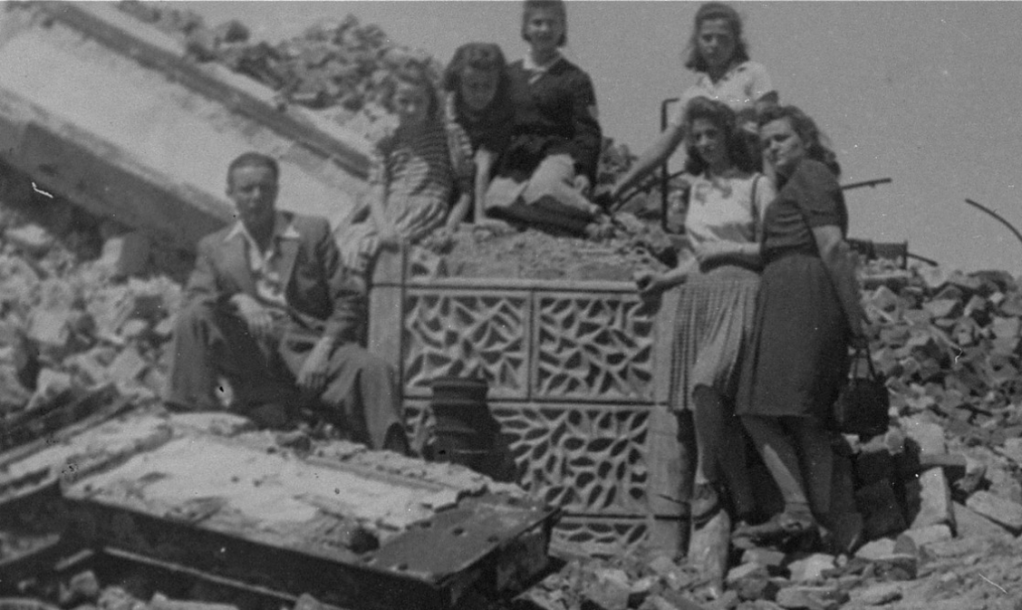
In this 1945 photo, survivors of the Jewish Underground pose atop the ruins of the Mila 18 bunker in the former Warsaw Ghetto. (United States Holocaust Memorial Museum, courtesy of Leah Hammerstein Silverstein.)
Sometimes, heroic people in literature are depicted as almost superhuman. That can be enjoyable in a novel, even as those characters aren’t exactly realistic. But when heroic people have plenty of flaws yet still act bravely when the chips are down, well, attention must be paid.
I thought about that last week while reading Leon Uris’ Mila 18 — a gripping, heartbreaking historical novel that culminates with 1943’s desperate armed uprising against the Nazis by Jewish residents trapped in the Warsaw Ghetto. Before that resistance action, we meet the women and men who will directly or tangentially take part, and, while some are almost saint-like, a number of others are far from perfect. Several are excessively cautious or possess nasty tempers or are having extramarital affairs or are not the best of parents, etc. It makes their eventual heroism more relatable, and makes readers who themselves are imperfect contemplate what they might have done in that situation. Go down fighting before facing near-certain death against a brutal force with infinitely more firepower? Or acquiesce to being transferred to concentration camps for the slim chance of being chosen for slave labor amid everyone else being genocidally murdered?
Other novels — often wartime-set books — that feature flawed, realistic, relatable heroines and heroes include Herman Wouk’s War and Remembrance, Kate Quinn’s The Alice Network, Stephen Crane’s The Red Badge of Courage, J.K. Rowling’s Harry Potter series, etc.
In the latter two works, there is a clear arc from cowardice to courageousness for Henry Fleming (the soldier protagonist of Crane’s classic) and for Harry Potter’s Hogwarts schoolmate Neville Longbottom.
Quinn’s The Alice Network focuses on a World War I spy ring of women who feel far from fearless inside but intrepidly do what needs to be done.
The main characters in War and Remembrance‘s large cast are members of the Henry family — father, mother, two sons, one daughter — who all have personal lives that are checkered to some extent. But they mostly do the right thing during World War II, with one paying the ultimate price.
A character who bravely fights all kinds of self-doubt is Adah of Buchi Emecheta’s Second Class Citizen. She determinedly attends school in Nigeria even though discouraged as a girl from doing so, and even gets beaten for her desire for an education. She eventually relocates to England, deals with racism there, and escapes an abusive husband she had made the bad decision to marry — all while juggling a career and parenthood.
Then there’s of course Sydney Carton, in Charles Dickens’ A Tale of Two Cities, who’s a lazy and alcoholic attorney before gradually reaching the point where he finds redemption by making one of literature’s most heroic decisions.
Your thoughts on this topic?
My literary-trivia book is described and can be purchased here: Fascinating Facts About Famous Fiction Authors and the Greatest Novels of All Time.
In addition to this weekly blog, I write the 2003-started/award-winning “Montclairvoyant” topical-humor column for Baristanet.com every Thursday. The latest piece — again about a court case that makes some of my town’s leaders and their attorneys look pathetic — is here.
 Dave Astor on Literature
Such an interesting topic, Dave. I’m glad you included “The Alice Network” and from the comments I’ve read, I have a list of books to consider.
LikeLiked by 3 people
Thank you, Dan! “The Alice Network” and the other Kate Quinn novel I’ve read, “The Huntress,” are outstanding. She’s one of the best younger authors out there (still only 41).
LikeLiked by 2 people
She is a talented young woman.
LikeLiked by 3 people
Yes!
LikeLiked by 2 people
Hi Dave, I did read Mila 18, but years ago when I was in high school. I agree about Henry and Red Badge of Courage is a marvelous book. What about Scarlett from Gone with he wind. She overcomes her flaws at the end although we never know if its too late. There s also Ralph from Lord of the Flies who steps up at the end, again perhaps too little too late. There is also Nora Seed from The Midnight Library also manages to overcome her flaws in the end. Lastly, Pip and Estella both overcome their character flaws in the end (depending on which ending you read).
LikeLiked by 4 people
I had to come back and add Guy Montag from Fahrenheit 451 who was quite flawed and changed over the course of the book.
LikeLiked by 2 people
Thank you, Robbie! Outstanding examples of flawed characters who showed determination and bravery! Their flaws made their eventual determination and bravery that much more inspiring. (Fortunately for Nora Seed, she had a number of different lives to experiment with. 🙂 )
LikeLiked by 2 people
Yes, Nora was lucky. I think the idea behind that book was very intriguing.
LikeLiked by 2 people
Absolutely intriguing, Robbie!
LikeLiked by 2 people
Hi Dave,
Apologies in advance for this, but I feel like my answer to everything for a while is going to be TJ Klune’s “The House in the Cerulean Sea”. It’s an absolutely wonderful story about Linus Baker who saves the lives of some extraordinary children. But he has his flaws including voluntarily working for a government which seems to have come straight from the pages of “Nineteen Eighty Four”. He’s a lonely man and quite apathetic. Actually, even though I’m only about two thirds through, I’ve just realised these very special children will possibly save his life just as much as he does theirs ❤
LikeLiked by 4 people
Thank you, Susan! Excellent comment! Some novels are indeed “the answer” in multiple blog-topic categories. 🙂 “The House in the Cerulean Sea” was also highly recommended to me in a Facebook comment a few weeks ago. Yes, the people that flawed heroic people help can also help the flawed heroic people.
LikeLiked by 1 person
A fascinating discussion generated by this week’s topic, Dave. I’m hard-pressed to think of a flawed character who engages in a heroic act. Most of the flawed characters I’ve encountered don’t overcome their flaws. The only character that came to mind is the minister in Joy Williams’s short story “Taking Care.” He lets his family take advantage of him, which could be viewed as weakness, but he takes care of his daughter’s baby after she runs off (again) in a way that can only be described as heroic.
LikeLiked by 5 people
What about A Wrinkle in Time that you recommended to me, Liz? Charles Wallace has to overcome his flaws to be saved by his sister. A very good book, BTW.
LikeLiked by 3 people
Did I recommend that one? I haven’t read it.
LikeLiked by 3 people
I thought it was you but maybe it was Rebecca. It is a lovely book. I enjoyed it a lot.
LikeLiked by 3 people
🙂
LikeLiked by 3 people
Thank you, Liz! I think you’re right that the vast majority of flawed people (or not-very-flawed people, for that matter) never rise to the level of some kind of heroism — either because they don’t have it in them or they don’t have the opportunity. But your example of one of the exceptions, in “Taking Care,” sounds like a good one!
LikeLiked by 2 people
“Taking Care” is one of my favorite short stories.
LikeLiked by 2 people
That’s saying something, Liz!
LikeLiked by 2 people
Particularly considering how long ago I first read it!
LikeLiked by 2 people
I love it when a story sticks with a person for a long time!
LikeLiked by 2 people
As do I! Another one from the same time period is “The Handsomest Drowned Man in the World.” They called him Estaban . . .
LikeLiked by 2 people
Gabriel Garcia Marquez! I’ve read several of his novels, but never any of his short stories. 😦 Will have to remedy that at some point.
LikeLiked by 2 people
Yes! It’s a wonderful story!!
LikeLiked by 2 people
Sounds like it!
LikeLiked by 2 people
Sounds like I shall be adding Mila 18 to my reading list! 🙂 And I do love a good mention of the Alice Network, as it still holds a top spot in my Historical Fiction favorite reads list. It’s hard for me to narrow down this category into one book, since I gravitate towards the “flawed human” heroes and villains, and it makes up a big portion of my reading list! I guess a big one that popped into my head was an all-time favorite – the Count of Monte Cristo. Lord knows he’s pretty flawed, but you can’t help rooting for him in spite of it.
LikeLiked by 4 people
Thank you, M.B.! “The Alice Network” is such a compelling novel, including its portrayal of spy Eve Gardiner as a young woman during WWI and as an older woman years later. A flawed heroine. And, yes, Edmond Dantes became quite a flawed hero after being framed and spending years in prison. Hard to blame him, and one applauded his revenge!
LikeLiked by 2 people
Dave, I’m going small here.
Although considering the issues with gun violence in the USA, perhaps small is large.
In Joy Fielding’s riveting “Cul-de-sac”, Maggie McKay lives in abject fear, is a coward in the face of life, and is all but married to her gun.
Separated and with children, her gun is the only way she manages to carry on.
After experiencing devastating events, and finally faced with an absolutely terrifying situation; she makes an heroic decision and takes action.
The many imperfect residents of the everyday cul-de-sac, all have guns. Not all are heroes in the end.
I don’t want to be a big spoiler here, so I’ll leave it at that.
LikeLiked by 4 people
Thank you, Resa! “Cul-de-sac” sounds VERY intriguing! And the book — which I see was published in 2021 — sounds quite timely in today’s gun-soaked era. If my library has it, it will be my fourth Joy Fielding novel read.
LikeLiked by 2 people
Dave,
It’s worth a read!
Joy takes every day lives of ordinary people, and exposes the unordinary within.
I love the suspense!
As I mentioned before…it’s a mini “Grand Avenue” with guns.
LikeLiked by 3 people
“Joy takes everyday lives of ordinary people, and exposes the unordinary within” — great line, Resa!
And, as I’ve mentioned, I liked “Grand Avenue” a lot. If I have to add guns, so be it. 🙂
LikeLiked by 2 people
Lol! It’s a “MINI” Grand Avenue! 🙂
LikeLiked by 3 people
🙂
LikeLiked by 2 people
HI Resa, this sounds fascinating. Thanks for the recommendation.
LikeLiked by 3 people
Oh! Joy Fielding is a great writer. It is a worthy read, and quite topical!
LikeLiked by 2 people
A looked this up and then I remembered The HOusekeeper so I do actually know this author.
LikeLiked by 3 people
It’s way better than “The Housekeeper”, although, “The Housekeeper” is still a fab read. My fave book by her is “Grand Avenue”.
I might be biased, as she is a relative, but I don’t think so.
LikeLiked by 3 people
How wonderful that she is a relative.
LikeLiked by 3 people
When I read your comment about Mila 18 by Leon Uris, I immediately thought of Sophie’s Choice by William Styron and her absolutely horrible secret, which she had to live with and which made her, in my eyes, a heroine and the consequences for which she had to pay a very high price. I am very thankful of not having been forced to this kind of decision! Thank you Dave for this most precious post.
LikeLiked by 4 people
Thank you, Martina! Excellent mention of “Sophie’s Choice” and the mind-numbing, traumatic, involuntary decision she had to make. She was indeed a heroine in a way just to be able to continue psychologically surviving after what the Nazis forced her to do.
LikeLiked by 1 person
🌺🌻
LikeLiked by 3 people
🙂
LikeLiked by 1 person
HI Martina, I hope you are well. Sophie’s Choice is the most compelling book I’ve ever read. The choice she was forced to make was so unbelievably inhuman. I have never forgotten that story and sometimes I look at my sons and I think of it. It makes me feel sick.
LikeLiked by 3 people
Good morning Roberta and your personal words gave me joy🤣I above feel that I am getting old and slow! About Sophie’s choice I can just confirm your deep emotions concerning that most terrible decision, which fortunately we didn’t have to take!
I wish you all the best 🌷
LikeLiked by 4 people
HI Martina, my parents are aging and it is difficult for both of them, but my mother especially, to have to accept she can’t do as much now. She’s had to give some things up. I have encouraged her into drawing which gives her much pleasure. I also let her do some of the lighter cooking so she feels useful. I don’t want to overtax her but I know she needs to feel that she still contributes so I look for ways to give her that. I just don’t think I could bear such a decision as Sophie had to make. It would kill me. Have a wonderful week.
LikeLiked by 2 people
Oh, yes, Roberta, it is very important, especially, when getting older to be able to do what one likes or find new occupations, which can give a sense of life! I have a big garden to take care of and three regular friends with whom I read books and I very much enjoy being able to read the posts of some very efficient bloggers, who do not mind my occasional contributions! By the way at the moment we are reading “La présence de la mort” by C.F.Ramuz, It’s an absolutely touching book about climate change, which this writer wrote already in 1922, but people then didn’t understand it! It’s probably why it hadn’t been a success and I didn’t find it in English.
Aren’t we lucky, Roberta, of having been spared of certain experiences.
All the best to you, too:)
LikeLiked by 3 people
Hi Martina, we are most fortunate. I hope you have a lovely weekend and the weather is good.
LikeLiked by 2 people
:):)
LikeLiked by 3 people
Wonderful to see a post about an enduring theme in film and literature because humans endure and no-one knows whether or how until they are in a situation where they are tested. And of course, the more flawed that character is, the better. Just talking about that the other week with my Mr when we watched this film on Netflix called Black Crab which after a good start totally failed to engage us because suicide missions require that we know these characters, their fears, their flaws, their pasts and what they are fighting for and we didn’t. That is what makes The Magnificent Seven more than a Western. Aliens more than some Sci-fi trip to the stars. Charles Darnay is all very well in A Tale of Two Cities but he’s not who we are rooting for, or who keeps us glued to the page. I’ve read Jack Eisner’s The Survivor, which is autobiographical about the fall of the Warsaw Ghetto and it was after seeing The Wall, which is a film about that uprising.
LikeLiked by 4 people
Thank you, Shehanne! VERY well said. Yes, an author needs to have readers intimately know specific characters before and while they’re being heroic or not, so we understand why they made the decisions they did. And those characters should be three-dimensional. You offered great examples of works that do all that successfully or unsuccessfully! Historical fiction that focuses mostly on the macro without giving us a close look at a few (flawed) characters just doesn’t draw us in as much.
LikeLiked by 2 people
Absolutely. Thank you Dave.
LikeLiked by 3 people
And thank YOU, again, Shehanne!
LikeLiked by 2 people
I read Mila 18 a long, long time ago. Leon Uris introduced me to historical fiction. I used to collect his books. I love QB VII , Trinity, The Haj, Armageddon.
LikeLiked by 3 people
Thank you, Arlene! A great author to introduce you and others to historical fiction! “Mila 18” is the first book of his I’ve read. He’s a very powerful writer, and really does his homework.
LikeLiked by 1 person
“The Kite Runner, book came out 20 years ago! Info notated from Wikipedia “it tells the story of Amir, a young boy from the Wazir Akbar Khan district of Kabul. The story is set against a backdrop of tumultuous events, from the fall of Afghanistan’s monarchy through the Soviet invasion, the exodus of refugees to Pakistan and the United States, and the rise of the Taliban regime.”
Thinking now, 20 years later,US no longer in Afghanistan, was costing billions a month. I do feel for women, girls,not getting an education, they deserve to. All the people are suffering now under Taliban. Yet perhaps it was time for the US to leave.
Indeed depressing the myriad of atrocities going on all over the world, moving backwards, not forwards. Women were making inroads through education, now lives are turned upside down,freedoms repressed, adds to psychological problems, fear. I do try to stay hopeful but it’s not always easy in our precarious world. Take away rights of one group it effects all of us. Despicable Florida Governor, you wake up.
Well at least DJT was indicted, sad for our country,how did we elect this vile man? How is it that his ilk, many in Republicans can still support this weasel? One can be a convicted felon and still run for President. 😡
LikeLiked by 4 people
Thank you, Michele! “The Kite Runner” is an excellent novel! I think Amir’s friend Hassan was more heroic than Amir, but the kind-of-problematic Amir does show some bravery at a certain point, so he might fit the theme of this blog post more. 🙂
I agree that it was long past time for the U.S. to leave Afghanistan, and I don’t think most American leaders cared much about the abysmal treatment of females in that country (including not being allowed to attend school). The U.S. was in Afghanistan first as misplaced revenge for 9-11 (which was mostly the fault of Saudi terrorists) and then to make money year after year for weapons manufacturers. 😦
Yes, Trump is awful, as is DeSantis.
LikeLiked by 2 people
HI both, I was reading about Trump and DeSantis earlier today. It is frightening and unbelievable for people everywhere. I feel as if humanity as a species is going backwards at a very rapid pace. Hugs.
LikeLiked by 3 people
Thank you, Robbie. Yes, both Trump and DeSantis are mean-spirited, backward-thinking men. They are of course different in some ways — Trump is more entertaining and queasily charismatic, and DeSantis is more organized and efficient, but both really are vicious people.
LikeLiked by 2 people
Scary that people follow them.
LikeLiked by 2 people
Yes. 😦 The fact that so many people follow them is scarier in a way than Trump and DeSantis themselves. 😦
LikeLiked by 2 people
Yes, it is the same here with some of our political leaders. The world has gone mad.
LikeLiked by 2 people
A real shame. 😦
LikeLiked by 2 people
I love this post! And the true story sounds like a fascinating read. There is nothing more interesting than reading about how everyday people became heroic to helps others or to stop bad people from doing worse.
I never really liked novels where the hero/heroin has special powers or was almost too good to be true. That’s why I’ve written my novel’s MCs as realistic as possible – and some readers don’t like them because they’re maybe a little too real.
LikeLiked by 4 people
Thank you, Sara! It’s great, and wise, that you make your protagonists as realistic as possible. I agree that characters who are almost superhuman and too good to be true can be off-putting, even if they give readers a temporary (metaphorical) “sugar high.”
LikeLiked by 2 people
True it’s a little boring to me when characters are almost super human. It’s not as relatable.
LikeLiked by 2 people
Excellent point about how an almost-superhuman character might not be that appealing to readers AND an author.
LikeLiked by 2 people
Thank you. It’s really cool you wrote this post. It’s a reminder to read more biographies/memoirs about amazing everyday people being courageous and beating the odds.
LikeLiked by 3 people
Those can be the best kinds of biographies and memoirs! 🙂
LikeLiked by 2 people
Yes. ☺️
LikeLiked by 2 people
🙂
LikeLiked by 2 people
“Whether I shall turn out to be the hero of my own life, or whether that station will be held by anybody else, these pages must show.”
― Charles Dickens, David Copperfield
With that said, I’d like to add Maugham’s Razor’s Edge as well as Steinbeck’s East of Eden primarily since all the characters in these novels are pretty much heroes of their own lives –inasmuch as they either got in the way or they got out of the way. They teach first responders that one dead rescuer is no rescuer at all, but yikes! that’s a very slippery slope. Last mention “A Hero’s Journey” by Joseph Campbell. Great theme Dave. Susi
LikeLiked by 3 people
Thank you, Susi! Great, relevant Dickens quote! And “The Razor’s Edge” protagonist Larry Darrell is an interesting character — a war hero of sorts, but even more heroic in a way when he tries to find some meaning in life after his traumatic WWI experiences.
LikeLiked by 1 person
I am delighted that you read and enjoyed Mila 18 by Leon Uris, Dave. The idea of hero and heroism is a complex conversation. Deep within us, we want to engage in heroic acts, to be bold and act with courage. Heroes and heroines inspire us to seek excellence, to show empathy, and a strong sense of moral responsibility. Consider Joseph Campbell’s hero archetype which describes the journey of a hero through a series of stages. An individual receives a call to adventure, and embarks on a journey that leads to a confrontation with a powerful adversary and returns to the ordinary world transformed.
I agree Dave, that Leon Uris created flawed heroes (in all of his novels), who do not appear to be heroes, but when they are confronted with evil, they accept the challenge, knowing that they may endure hardship, even death.
I think the best quote that speaks of heroism is from J.R.R. Tolkien
I wish it need not have happened in my time,” said Frodo.
“So do I,” said Gandalf, “and so do all who live to see such times. But that is not for them to decide. All we have to decide is what to do with the time that is given us.
J.R.R. Tolkien, The Fellowship of the Ring
A great conversation, Dave – one that Don and I continued over coffee this morning. It is in the action that we find our courage.
By the way, I have decided to read Trinity. You will recall that I started to read it in my early 20’s and then stopped because of the difficult topic. I think I’m ready for it now.
LikeLiked by 8 people
Thank you, Rebecca! Your words about responding heroically (or not) in tough times were very eloquently stated.
And your mention of “The Lord of the Rings” was a great one — various characters in that trilogy, and in “The Hobbit,” responded heroically even if they weren’t “warrior” types. Most notably the hobbits themselves — Bilbo, Frodo, Samwise, etc.
Like you, I will read more of Leon Uris. And, yes, there are some novels we’re not ready for until we’re older. I wish you luck with “Trinity.”
LikeLiked by 4 people
Will keep you up to date!! Many thanks!!!
LikeLiked by 3 people
Thank you, Rebecca!
I’m guessing I’ll read “Exodus” the next time I get to Leon Uris, but will see…
LikeLiked by 1 person
When it comes to books, Dave, I find that it is always, “but we will see”. It’s so easy to get distracted with new books! Books are like candies – you want them all at the same time!😂😂😂
LikeLiked by 3 people
Ha, Rebecca! 😂 That’s the truth! (“The Three Musketeers” novel literally turned into a candy bar… 🙂 )
LikeLiked by 1 person
😂😂😂
LikeLiked by 1 person
🙂
LikeLiked by 1 person
Ah Rebecca, you always find the best quotes. That one is perfect.
LikeLiked by 3 people
I agree, Robbie! Rebecca is a quote savant! 🙂
LikeLiked by 2 people
As individuals, we never truly know how we would respond when violence strikes our home, community, or country. Flawed fictional heroes and heroines give me hope that, in spite of all my fears, I, too, would somehow rise to the occasion and do my part in defending home and country. Even our soldiers on the front-lines must face their own fears as revealed in the powerful novel “The Yellow Birds” by Kevin Powers (USA, 2012) of a harrowing story about the friendship of two young men trying to stay alive on the battlefield in Iraq.
LikeLiked by 6 people
Oops. That should read “The Yellow Birds.”
LikeLiked by 3 people
Fixed. 🙂
LikeLiked by 1 person
Thanks, Dave 🙂
LikeLiked by 2 people
You’re welcome, Rosaliene! 🙂
LikeLiked by 2 people
Thank you, Rosaliene! So true that we never know how we’ll respond until if and when we’re in a desperate situation. Part of it of course depends on what the specific situation is, what the alternative options are (if any), etc.
And I appreciate the mention of “The Yellow Birds”! It does sound harrowing and intense — and the needless U.S. invasion of Iraq and subsequent war weren’t that long ago.
LikeLiked by 4 people
Have you read Czeslaw Milosz’ book Seizure of Power? It also covers the Warsaw Ghetto from inside, and the aftermath.
LikeLiked by 3 people
Thank you, Michael! I have not. Interesting; I see that 1955 novel predated “Mila 18” by six years; I wonder if Leon Uris used it as part of his extensive research. What did you think of “The Seizure of Power”?
LikeLiked by 2 people
It was surprisingly well written, lucid, and firmly handled a lot of material. I would say it was a success. I have not seen much to back this up, though.
LikeLiked by 3 people
I appreciate your thoughts, Michael! I put “The Seizure of Power” on my to-read list for down the road; I don’t want to soon revisit the absolute horror of what’s depicted in “Mila 18.”
LikeLiked by 2 people
And I will loom up ‘Milo 18’.
I’m currently reading a cult history, The Hunger Winter 1944-45.
In preparation, perhaps?
LikeLiked by 3 people
Books set during World War II are intense…
LikeLiked by 1 person
Even heroes are human. Nobody is perfect. Thank you for sharing.
LikeLiked by 5 people
Thank you, henhouselady! Perfectly stated, and you are absolutely right.
LikeLiked by 2 people
Indeed. I find this to be a great point, with many interesting aspects to it. Take some of the Homer’s heroes, from Achilles to Odysseus, and put them through Dave’s imperfection lens. It’s been argued that if Odysseus wasn’t driven so much by seeking personal glory, many of his (mis)adventures would not have happened. And while adventures sound fun on the surface, through that lens you see how many of Odysseus’s people lost their lives in his quest for personal glory, deaths that were otherwise avoidable, for example with the Cyclops. Oh, and those adventures kept him from returning home for a little longer than was absolutely necessary, too 🙃
LikeLiked by 6 people
Thank you, Endless Weekend! Great observations about Homer’s work!
Yes, some heroes are in it more for the glory than for helping their fellow humans. Perhaps the results of ill-motived heroism end up being the same, perhaps not.
And, yes again, there can be needless deaths when the heroism isn’t accompanied by at least some focus on avoiding such deaths.
Oh, and you’re right that some heroes would rather be out “hero-ing” than being back home. Not exciting enough there, or maybe a desire to avoid family responsibilities.
LikeLiked by 5 people
Beautiful list of imperfect characters who become heroes: round characters, like real people, not stereotypes
Thanks a lot for your analysis
LikeLiked by 5 people
Thank you, Luisa! “…round characters, like real people, not stereotypes” — so well said!
LikeLiked by 2 people
Pleasure is all mine, dear Dave🙏
LikeLiked by 3 people
Much appreciated, Luisa! 🙂
LikeLiked by 2 people
Thank you to Rebecca Budd for recommending Leon Uris!
LikeLiked by 4 people