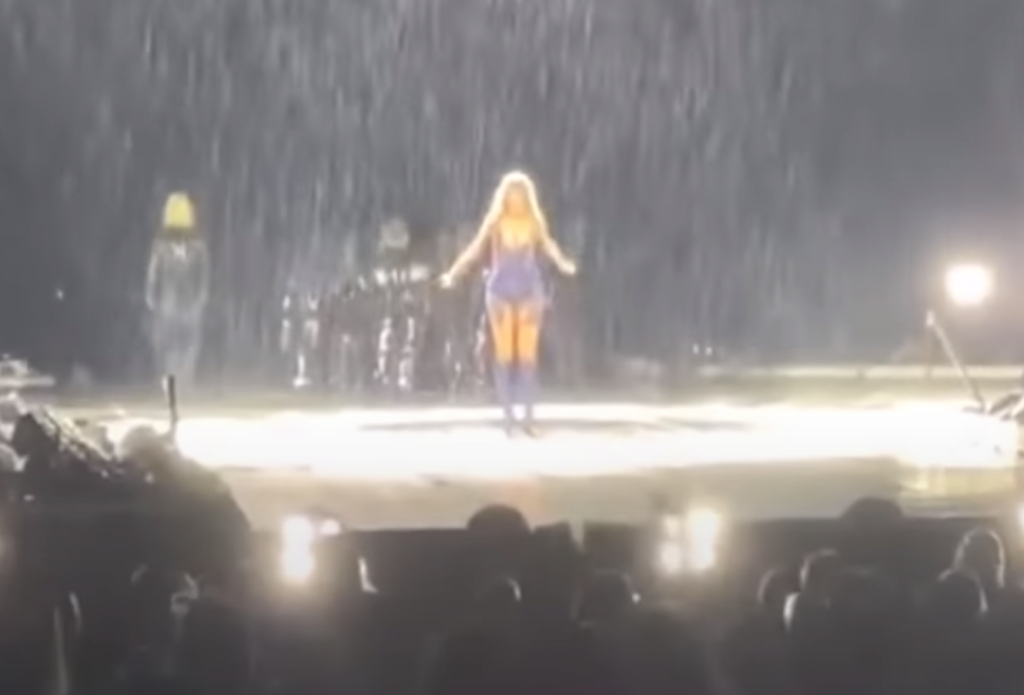
Oh, what the heck, a screen shot I grabbed off YouTube of Taylor Swift singin’ in the rain.
Sometimes, bloggers have no idea what to write for their next post. Such was the case with me this past Friday, trying to think of a topic as the rain poured down.
I looked out the window and decided to write about…rain. In literature. Fiction’s precipitation can be quite atmospheric, set a mood, reflect a character’s state of mind, be a plot element, portend nature’s growth, and more.
There’s an evocative scene or two of rain in A Gentleman in Moscow author Amor Towles’ debut novel Rules of Civility, which I had finished the previous night. Set mostly in 1938 New York City, the 2011 book stars a young, plucky, literature-loving ( 🙂 ) career woman named Katey Kontent (!) and is full of elegant writing such as these damp-weather words: “Come September, despite the waning hours, despite the leaves succumbing to the weight of autumnal rains, there is a certain relief to having the long days of summer behind us; and there’s a paradoxical sense of rejuvenation in the air.” Not a bad passage to read when it’s almost September.
Published in 1939 — a year after Rules of Civility is set — The Grapes of Wrath features days of torrential rain near book’s end. Sometimes a downpour is just a downpour, as the 1939-deceased Sigmund Freud might have said, but the rain in John Steinbeck’s classic novel also symbolizes the gloom and despair of the ever-more-impoverished Joad family as they struggle to survive after economic conditions forced them to migrate to California.
Rain and other bad weather is of course potentially even more catastrophic for homeless characters, as the Joads became.
Another example of relentless, dramatic rain near the end of a masterful novel is in the unforgettable scene that concludes George Eliot’s The Mill on the Floss.
There’s also the symbolic four-plus years of rain after the brutal massacre in still another classic novel — Gabriel Garcia Marquez’s One Hundred Years of Solitude. It’s as if the sky is mourning the many murdered workers.
On a more personal scale, Jane Eyre‘s memorable storm and lightning-split tree at a moment of great happiness for Ms. Eyre and Edward Rochester foreshadows that the star and co-star of Charlotte Bronte’s novel will soon be experiencing rough times.
In Toni Morrison’s Song of Solomon, the exhausted Hagar character being soaked by rain when returning home from a shopping trip is among the novel’s pivotal scenes.
Some novels of course literally have a certain weather event in the title, with Garth Stein’s The Art of Racing in the Rain one example.
There’s also significant rain in Charles Dickens’ Bleak House, Herman Melville’s Moby-Dick, Mark Twain’s Adventures of Huckleberry Finn, J.D. Salinger’s The Catcher in the Rye, Yann Martel’s Life of Pi, and many other fiction books.
Including this passage from William Faulkner’s novel As I Lay Dying: “It begins to rain. The first harsh, sparse, swift drops rush through the leaves and across the ground in a long sigh, as though of relief from intolerable suspense. They are as big as buckshot, warm as though fired from a gun; they sweep across the lantern in a vicious hissing…”
Examples of, and thoughts about, today’s topic?
My literary-trivia book is described and can be purchased here: Fascinating Facts About Famous Fiction Authors and the Greatest Novels of All Time.
In addition to this weekly blog, I write the 2003-started/award-winning “Montclairvoyant” topical-humor column for Baristanet.com every Thursday. The latest piece — about a mayoral withdrawal, a developer’s bait-and-switch, quarterback Aaron Rodgers moving close to my town, and more — is here.
 Dave Astor on Literature
Nicely written and researched
LikeLiked by 1 person
Thank you very much, mukulmanku! 🙂
LikeLike
Fortuitously, as it turns out, this week I’ve been reading another book plucked from my tottering piles of them, where it has waited for my attention for maybe a decade, a Dover reprint of Robert Van Gulick’s “The Haunted Monastery,” It’s not the sort of book I’m usually drawn to, since it is a type of historical fiction, and mostly, I like history, and I like fiction, but I don’t like them meeting up.
But the type it is is my type: a mystery, set though it is during the Tang Dynasty China (approx 7-10th century AD). The protagonist is a man named Judge Dee Jen-djieh, magistrate of Han-Yuan, who– and now I arrive at the week’s theme– suffers a broken axle on the cart in which he, his three wives and his assistant are traveling, and must seek shelter at a nearby Taoist monastery during an unrelenting downpour which carries on into the wee hours.
In that time, the judge, an unexpected but important guest, witnesses a seemingly impossible act of violence taking place in a room across from his quarters, and later, a performance of Taoist mystery drama. He meets a resident philosopher, the abbot of the monastery, several actors and acrobats, a trained bear, a brother disguised as his own sister, a novice, a poet, among others, mostly monks. Though he came down with a cold after being soaked in the rain, and was knocked on the head from behind, Dee’s mental powers work well enough that, by the time the weather has cleared and the axle is repaired, he has solved 4 murders and one attempt, while also consigning the depraved killer to a grisly fate.
Van Gulick (1910-67), linguist, diplomat, historian, came by his detective honestly– by first translating an 18th century Chinese mystery tale about the actual Tang Dynasty Judge Dee, Die Renjie.
LikeLiked by 1 person
Thank you, jhNY! “The Haunted Monastery” sounds truly amazing — and, yes, a coincidence that your reading of it and my theme this week collided. Loved your summary of the novel, while being impressed at the efficiency of the multiple murder-solving by its protagonist. Guinness Book of World Records stuff. 🙂
LikeLike
(Possible spoilers) The tragic climax of Thomas Hardy’s “The Return of the Native” took place during a nocturnal rainstorm.
LikeLiked by 1 person
Thank you, Anonymous! I remember the rain in that Hardy novel. Great mention!
LikeLike
Right away, upon viewing the week’s topic, my example in print came back to me, though the time between my reading and now is over 40 years. Only to be expected, I suppose, when the place is an abandoned church in Mexico, and the storm is so violent and extensive that the protagonist, seeking shelter, drives a Ford roadster through its locked doors and parks on the altar as darkness closes in.
John Howard Sharp, an American opera singer who has lost power in his voice, is the desperate driver behind the wheel. Soaked to the skin, he dons vestments he found in a storeroom, and commandeers some sacristy candles for light enough to build a fire on the floor, where he cooks up dinner for himself and his traveling companion and owner of the car– Juana, a prostitute, who is frightened by his sacrilege, which later, as the evening progresses, includes his over-consumption of communion wine. After, he rapes her on the altar.
The storm roars on without respite, floods abound, and the pair must spend another day in the church, where, after catching an unlucky iguana, they make a meal of it, and fall under the sway of the aphrodisiacal powers of iguana meat.
The novel is James M. Cain’s “Serenade”, published in 1937, three years after the publication of “The Postman Always Rings Twice”. And all I have described is but a small, weird portion of the storyline, much of which concerns the fitful restoration of Sharp’s voice and confidence, and ultimately, his career in New York and Hollywood, with threads of violence, sexual ambivalence and self-loathing throughout.
Cain, of the hard-boiled school, would hardly be expected to know all he seems to about opera and professional singing, but he harbored unrealized hopes of just such a career as a young man, and brought knowledge gained to this strange, fast-paced and compelling book.
LikeLiked by 1 person
Thank you, jhNY! Quite a vivid and disturbing scene — vivid and disturbing enough to stick with you for all those years. Some book passages can do that. Your description was superb, and I need to read James M. Cain for the first time, but “Serenade” might not be my entry into Cain-dom. 🙂
LikeLike
Bet you’d like reading “Mildred Pierce” to start, then if so inclined, move on to “The Postman Rings Twice” and “Double Indemnity”. After, if still enthralled, a “Serenade” may be in your future…
I’ve read ’em all, and regret nothing! Or put another way, I regret much, but not time spent with a Cain novel.
LikeLiked by 1 person
Would love to read one or all of those first three you mentioned! My local library needs a better Cain collection! Will keep a lookout…
LikeLike
With a hey, ho, the wind and the rain
The rain it raineth every day.
LikeLiked by 1 person
Had to look that up. 🙂 From Shakespeare’s “Twelfth Night.” Nice! Thank you, Esther!
LikeLike
“The rain it raineth on the just
And also on the unjust fella;
But chiefly on the just, because
The unjust hath the just’s umbrella.”
― Charles Bowen
LikeLiked by 1 person
Hilarious, and an example of an unequal world. 😂 😦
LikeLike
Thanks. Eng Lit, at school. Dram Soc did the play too. Our teacher was fascinated by all Shakespeare’s weather – linked Titania’s famous speech to real weather and famine, late 1590’s
LikeLiked by 1 person
Sounds like an interesting teacher you had, Esther! (Shakespeare masterfully handled so many themes.)
LikeLike
I have been stuck in a heat sink for the last month, temps to 104+, leaves dropping from trees, plants shriveling, and lots of grasshoppers; however, I discovered a monstrous spider web on my porch this morning which usually means it will be an early winter. Currently, I’m praying to the water spirits to send some rain which brought to mind N. Richard Nash’s play The Rainmaker vs. The Long Rain by Ray Bradbury and/or the effects of too much rain vs. too little. Looking forward to your next themes perhaps fire and ice, yikes! Thanks Dave, Susi.
LikeLiked by 2 people
Thank you, Susi! Sorry about your brutally hot weather. Hoping you get some rain soon — in real life, not just in fiction. My younger daughter was in Phoenix a month ago, and it was scorching. 😦
LikeLiked by 1 person
Bless her heart. It’s really sweltering there. Gila Bend, Arizona is always the hottest place in the US.
LikeLiked by 2 people
And getting hotter… 😦 Thank you for the reply, Susi!
LikeLiked by 1 person
First I thought of “Heart of Darkness” by Joseph Conrad.
After all it takes place on the Congo river where it rains 117 days a year. Still,I recall the white fog, not rain per se.
“When the sun rose there was a white fog, very warm and clammy, and more blinding than the night.”
Then “Wuthering Heights” by Emily Brontë came to mind, with the drenching storms of the moors.
I seem to remember it raining most of the time in that story.
Great theme, Dave!
LikeLiked by 2 people
Thank you, Resa! It has been so long since I read “Heart of Darkness” that I don’t remember details of the rain element. But if it rains 117 days a year on that river, I supposed there’s roughly a 33% chance of precipitation…
And, yes, “Wuthering Heights”!
LikeLiked by 2 people
Or, it feels it.
Thanks Dave!
LikeLiked by 2 people
🙂
LikeLiked by 2 people
The great divorce and the thoughts about Hell and Heaven also seems to be a book worth reading,Roberta! Many thanks🌻
LikeLiked by 2 people
I am so pleased that you mentioned rain scenes in literature, Dave. The first thing that came to mind was not about books with rain scenes, but rather the many books that I read during a downpour. Vancouver is famous for rain in winter, so you can imagine how many books that I have read listening to rain pelting windows.
But back to the books that I recall having rain! Recall “Pride and Prejudice” by Jane Austen, the rain serves as a backdrop for a pivotal moment between the two main characters, Elizabeth Bennet and Mr. Darcy. The rain intensifies the emotions of the scene, adding drama and tension to their encounter.
And then there is a rain scene is “The Great Gatsby” by F. Scott Fitzgerald. The rainstorm that occurs during a climactic moment in the story reflects the characters’ inner turmoil and the tragic consequences of their actions.
I found that the rain in “Wuthering Heights” by Emily Bronte added a sense of foreboding and unease because it was often associated with the wild and passionate nature of the characters and the tumultuous relationships between them.
Another stellar post and follow-up discussion, Dave!
LikeLiked by 4 people
Thank you, Rebecca! Yes, when one reads a book during a downpour — whatever the weather being depicted in the book — it can be a memorable experience! (And maybe inspire a blog post, as it did for me.)
And those are excellent mentions by you of three classic novels with significant rain scenes! In your concise descriptions, you really honed in on how rain helps create mood, atmosphere, tension, fear, etc. (In addition to creating puddles. 🙂 )
LikeLiked by 2 people
Love those puddles!!!
LikeLiked by 1 person
🙂
LikeLiked by 1 person
Hi Dave, I don’t think I’ve mentioned The Great Divorce here. It is by CS Lewis and is about the type of person that ends up in Hell (and would rather stay there) and those who go to Heaven. Anyhow, the description of rain in that book is rather fascinating “The narrator inexplicably finds himself in a grim and joyless city, the “grey town”, where it rains continuously, even indoors, which is either Hell or Purgatory depending on whether or not one stays there.” Have you read this book? I also read The Screwtape Letters which I enjoyed very much.
LikeLiked by 3 people
Robbie – C.S. Lewis is a brilliant writer. Loved the Screwtape Letters.
LikeLiked by 3 people
Thank you, Rebecca. I liked The Great Divorce more than the Screwtape Letters. It was such an interesting study of human natures and the concept of Hell which is down a crack in the earth.
LikeLiked by 2 people
Thank you, Robbie! Rain even inside — wow! “The Great Divorce” sounds very interesting.
Unfortunately, I haven’t read much of C.S. Lewis. Just an illustrated young-person’s version of “The Lion, the Witch and the Wardrobe” that my older daughter had many years ago.
LikeLiked by 2 people
Hi Dave, CS Lewis’ works are quite religious (even The Chronicles of Narnia were off a strong Christian base), but I think his stories are fantastic. If you are interested, this is the link to my review of The Great Divorce: https://roberta-writes.com/2020/05/20/bookreview-classicchallenge-the-great-divorce-by-c-s-lewis/
LikeLiked by 2 people
Excellent review, Robbie! Sounds like a VERY inventive and intriguing book. I’ll see if my local library has “The Great Divorce” during my next visit in early fall.
LikeLiked by 2 people
I think you will enjoy it, Dave. I found it fascinating.
LikeLiked by 2 people
I’m sure I would! 🙂
LikeLiked by 2 people
For me, Dave, your topic about rain has just come at the perfect moment, when I thought that I couldn’t stand the 37 degrees anymore and the relief now as the rain and life has finally come back is unbelievable! When Pit in GREAT EXPECTATION speaks about the undeterminable windy blasts of rain and mud, mud and mud I was very touched because of the importance it often has in washing away our blindness! Many thanks:)
LikeLiked by 5 people
Thank you, Martina! There’s definitely something to be said for rain and cooler weather as autumn approaches. 🙂 Sorry it has been so hot where you are.
Dickens certainly wrote skillfully about rain — among many other things!
LikeLiked by 3 people
👍and I agree with you concerning Dickens!
LikeLiked by 3 people
🙂
LikeLiked by 2 people
Hi Martina, I thought of this same book. Great minds think alike – smile!
LikeLiked by 3 people
Hi Roberta, your words really make me smile!😀
LikeLiked by 3 people
I’m glad to know that – smiling is wonderful
LikeLiked by 3 people
🥰🌻
LikeLiked by 2 people
I have this on the front of every year’s dairy cover “Life isn’t about waiting for the storm to pass it’s about learning to dance in the rain”…and yes even at my age I do still dance in the rain…
LikeLiked by 4 people
Thank you, Carol! Those are very wise words, and nicely stated! Adapting to circumstances is a rather good thing. 🙂
LikeLiked by 3 people
You can’t dance in the rain here. You’d get struck by lightening – giggle.
LikeLiked by 3 people
Same here I’ m just careful-smile-x
LikeLiked by 3 people
Rain can be so atmospheric and cinematic. It’s my euphoria. 🙂
LikeLiked by 4 people
Thank you, Sara! Very well said! Rain can indeed put a person in a great mood, if it doesn’t get destructive. 🙂
LikeLiked by 2 people
True 😝
LikeLiked by 2 people
🙂
LikeLiked by 2 people
🙂 🙂 :0 🙂 🙂 🙂
LikeLiked by 2 people
James Lee Burke has a1987 mystery titled, The Neon Rain. Set in NOLA, where it rains often. It’s been a long time since I’ve read it, so I can’t recall the scenes in rain, but all of Burke’s work is poetic. If movies count, I’m obsessed with Blade Runner (seen it some 20 times) and the line “All those moments will be lost in time, like tears in rain”. I can’t recall if that line’s in the Phillip K. Dick book the movie’s loosely based on, Do Androids Dream of Electric Sheep, but I don’t think so. (My poor recall is due to age and poor health.)
LikeLiked by 3 people
Thank you, Leah! I’ve had James Lee Burke and “The Neon Rain” on my to-read list for a while; glad you mentioned it! Such an evocative title, and of course New Orleans is an evocative city (been there three times).
Rain/rain references in movies? “Singin’ in the Rain” also comes to mind. 🙂 Somehow I’ve never seen “Blade Runner.”
Sorry about your health.
LikeLiked by 3 people
“Singing in the Rain” for sure. If you do ever watch Blade Runner be sure it’s the Theatrical Cut with the voice-over. IMO taking out the voice-over took out the philosophical depth. It’s not just an adventure/sci-fi.
LikeLiked by 3 people
I agree with Leah regarding the voice-over version of ‘Blade Runner’, although I thought I might be in the minority along with my brother and my ex-wife. The narration gives it that noir-ish Phillip Marlowe tone to it, putting it in that tradition. That’s another thing about James Lee Burke’s Dave Robicheaux novels. They’re first person narratives and Dave is definitely a world weary character with weaknesses and flaws (mainly his alcoholism and his tendency to solve many problems with violence).
LikeLiked by 3 people
As someone who deosn’t like voice-overs I loved the one in Bladerunner. It is indeed Marlow-esque.
LikeLiked by 3 people
Thank you, Leah, Brian, and Shehanne, for the information and thoughts about which “Blade Runner” version is best! Good to know. 🙂 And, Brian, I appreciate your thoughts on Dave Robicheaux. Sounds like an intriguing, far-from-perfect character.
LikeLiked by 2 people
Interesting topic, Dave. Before I answer it improperly, let me add that I enjoyed the MontClairVoyant article you linked to. I laughed at the thought of the Green Bay Packers moving company.
I don’t have a fiction example, but I recall reading about the storm in ‘The Autobiography of Benjamin Franklin’ which was required reading in American Literature, which I took during my sophomore year at WVU. It wasn’t fiction, but Franklin wrote with a certain amount of whimsy.
LikeLiked by 3 people
Thank you, Dan! I read Benjamin Frankin’s autobiography many years ago, and agree that he had the writing knack — and could be quite droll. The rain, the kite, and electricity made for quite a moment.
And glad you enjoyed that “Montclairvoyant” column! Kind of you to say that. 🙂
LikeLiked by 2 people
I wouldn’t want to read it again, but it came to mind. Then I realized it wasn’t fiction (as far as we know).
LikeLiked by 2 people
Ha! 🙂 I think many autobiographies/memoirs have at least some fiction in them.
LikeLiked by 2 people
You’ve got some of the best here Dave, Jane Eyre are two that instantly came to mind. Huckleberry Finn, the Salnger, also. I was thinking of Wuthering Heights that scene where Heathcliff overhears Cathy talking to Nelly and clears off basically and she runs out into the storm looking for him. And then where that takes the story next and Cathy’s character. Also there’s a cracking use of a storm and what reads like a monsoon frankly in Mildred Pierce where she’s so determined on confronting her sponging lover, having planned how and when she will do this for weeks, she sails out in this terrible weather—the one thing she never planned for but it’s hell or highwater now–messes up the whole thing, crawls home basically, having abandoned her fancy shoes for galoshes probably lucky to be alive, having also had to abandon her car. A great post AND idea for a post. Always wonderful when the elements get woven into a story.
LikeLiked by 3 people
Thank you, Shehanne! “Wuthering Heights” is a great mention! The weather and landscape help make Emily Bronte’s novel so atmospheric, literally and figuratively. “Mildred Pierce” is a great mention, too; I must read that James M. Cain novel — which my local library never seems to have on its shelves when I look. I totally agree that it’s “wonderful when the elements get woven into a story.”
LikeLiked by 3 people
There’s also that storm scene in Gone With The Wind where Scarlett gets Melanie to Tara in a cart through the remnants of the South falling down about itself. As a Dundonian I am shocked I missed books where the Tay Rail Bridge disaster –where in poet McGonagall’s words, alas he was very sorry to say 99 lives were taken away(In fact the estimate is 75 but 99 goes better)–features prominently. There’s Hatter’s Castle By Cronin, A Drink For the Bridge by Alanna Knight and The Night He Left by Sue Lawrence, to name a few. In fact it’s rich fodder for authors given they never got all the bodies and there’s debate re how many people were on the train as it was ticket stubs issued but there might have been season ticket holders who went uncounted.
LikeLiked by 2 people
Fascinating, Shehanne. I hadn’t been aware of that 1879 bridge disaster. Just read about it on Wikipedia after seeing your comment. Fodder indeed for books — the immense tragedy, the poor bridge design, etc.
LikeLiked by 2 people
Well, the wind tears up the Tay at an angle as it is and the place where the bridge is is also at an angle, throw in the height etc of the original girders and it was always going to be an accident waiting to happen, rahter than afeat of engineering. Ulysses S Grant who came to Dundee pronounced that bridge a ‘mighty long bridge for a mightly little town’ and it was the longest rail bridge in the world in terms of design. The tops of the original pillars in that centre bit where it collapsed are still visible. But yes it is fodder and has turned up in various books. Some built round the disaster, others, as in Hatter’s Castle, where a character dies. I’ve just named a few there but there’s others.
LikeLiked by 2 people
That is very interesting information, Shehanne! Sounds like a LOT more care and intelligence needed to be put into that bridge’s planning and construction. Of course, history is full of hubris, stupidity, making accidental mistakes, deliberately cutting corners, etc. 😦
LikeLiked by 2 people
Oh yeah. There’s some hell of a winds come up that river off the North Sea and some that blow straight over from the north. So you need something really substantial not sub standard. The road bridge is nearer the river mouth. It’s not curved but it’s far higher at the Fife side than the Dundee side. When we lived over in Fife–with a view of the rail brdige actually–we were on it every other day and some of the wind buffets as you approached the Fife side had you clinging hard to the steering wheel ergo the control of the car. There was one epic day when I was driving home in the middle of a storm when one of the windscreen wipers caught the other and pinged it clean across the car bonnet and over the side and of course, you are not allowed to stop. . . So I’m driving in this with one wiper and it is on the passenger side.
LikeLiked by 2 people
Yikes! That wind, and that windshield wiper incident: scary!
Reminds me of when I was a young newspaper reporter and had to cover a hurricane. I drove my little Volkswagen Beetle to a temporary shelter to interview the occupants, the wind bouncing the car from lane to lane, and then when I arrived and opened the car door the wind practically blew the door off its hinges. All for insanely low pay. 🙂
LikeLiked by 3 people
My God. At least the door never flew off its hinges and hit you Dave. Sounds like you’d have got damn all compensation if it had.
LikeLiked by 2 people
Yes, the door luckily held — though it was kind of loose after that. I suppose young people do crazy things sometimes, including when keeping their job depends on it.
LikeLiked by 2 people
Wuthering Heights is a great mention, Shey. I was talking about the Bronte Museum today. Such a memorable visit for me.
LikeLiked by 3 people
During my one visit to England, I didn’t get a chance to travel to the Brontes’ realm (I was mostly in London); wish I had!
LikeLiked by 2 people
HI Dave, I planned our entire trip to the UK in 2019 around visiting the Bronte Museum. Luckily, hubby is very accommodating and we have a system: 1 vote for the girls and 1 vote for the boys. I am the only girl – haha – so I get 50% of the venue choices.
LikeLiked by 2 people
Ha, Robbie! 🙂 Nice voting system. 🙂 And very wise to plan a UK trip around visiting the Bronte Museum. If I go to the UK again, I’ll do the same. I did “see” the three Bronte sisters at the wax museum in London, but hardly a substitute for where they lived.
LikeLiked by 2 people
There is a lot of their personal belongings at the museum. I read The Brontë Cabinet: Three Lives in Nine Objects by Deborah Lutz prior to going so I knew the stories behind many of the items.
LikeLiked by 2 people
Must have been amazing to see those belongings, Robbie! (I’m not only a big fan of “Jane Eyre” and “Wuthering Heights” but like Anne Bronte’s “The Tenant of Wildfell Hall” a lot, too.)
LikeLiked by 2 people
It was, very memorable. Charlotte was a very tiny person. Her shoes are a size 4.
LikeLiked by 2 people
I’ve heard about her size! Small physically, huge as a writing talent.
LikeLiked by 2 people
Haworth. Gosh we went there once years ago. It is quite a place.
LikeLiked by 3 people
I really enjoyed it.
LikeLiked by 3 people
It was quite something to see where they lived actually.
LikeLiked by 3 people
It was and I loved those tiny books from their childhood. A very strange family.
LikeLiked by 3 people
Robbie… I honestly think you have said it all there.
LikeLiked by 1 person
Wuthering Heights was the first book that came to mind, Shey!!
LikeLiked by 2 people
She used nature and emotion in all her poetry. xxx Rebecca.
LikeLiked by 2 people
Your topic about rain immediately brought to mind the Caribbean Modern Classic, Corentyne Thunder by Edgar Mittelholzer (1909-1965), born in then British Guiana where there are only two seasons: the rainy season and the dry season. In the world of the protagonist, Ramgolall, an old East Indian cow-minder, the rainy season is part of Earth’s natural rhythms and the goodness/harshness of life (p. 29): “It must have rained during the night. Bad for the cane-cutting on the [sugar] estates, but good for the pasture. The cows would have much green grass to eat.”
LikeLiked by 4 people
Thank you, Rosaliene! I just put “Corentyne Thunder” on my list; sounds like a modern classic indeed! And rain is definitely a mixed thing, in literature and in real life. Necessary and wonderful, but potentially very destructive.
LikeLiked by 2 people
Dave, I hope that you can find “Corentyne Thunder” in your library. The novel was first published in the UK in 1941. The new edition was published by Peepal Tree Press (UK) in 2009.
LikeLiked by 2 people
I hope so, too, Rosaliene! My local library has quite a good, diverse collection for a suburb — meaning there’s at least a chance “Corentyne Thunder” will be there. 🙂
LikeLiked by 2 people
Let me know if a copy is not available.
LikeLiked by 2 people
Fingers crossed. 🙂 Just did a library trip a few days ago, so my next visit will probably be in late September or early October.
LikeLiked by 2 people
You’ve stumped me on this one, Dave. The only rain that comes to mind is in the novel I’m currently working on. One chapter is titled “Then the Rains Came.”
“Rain ran in languid rivulets down the window. It had been raining for three days straight, and getting the cows to pasture in the morning and back to the barn in the afternoon had become a muddy slog for Paul, but the cows were docile, and he had unlimited patience for them.
Flossie had been in a state at breakfast, instructing Hazel to boil their drinking water, warning Paul to stay out of the barn, beseeching Homer to take them all to higher ground on the mountain. Claire finally had to wheel her back to her room to calm her down enough to eat. What a heavy burden for an old woman to carry, Hazel mused, to relive the grief of losing her husband to the flood waters every time it rained.” [Vermont’s catastrophic flood of 1927]
The metaphorical rain that the actual rain leads up to is the assassination of Robert Kennedy.
LikeLiked by 4 people
Thank you, Liz! That’s a great, REALLY well-written excerpt from your in-progress novel! And, yes, rain can be metaphorical — especially when it’s long and/or drenching.
LikeLiked by 3 people
You’re welcome, Dave! I’m glad you enjoyed my example. As luck would have it, the local newspaper confirmed that the time frame for this chapter (June 1968) was the rainiest June on record.
LikeLiked by 3 people
Great that your novel’s metaphorical downpours have total basis in fact! 1968 was a hell of a memorable and tragic year.
LikeLiked by 3 people
It was. Those events have a role in the novel.
LikeLiked by 3 people
Hard to find a more dramatic, fodder-for-a-novel year than 1968!
LikeLiked by 3 people
A fabulous extract, Liz. I missed you at the writing club on Saturday.
LikeLiked by 3 people
Thank you, Robbie. I got the days mixed up; I thought the group met on Sunday. I was very disappointed to miss it!
LikeLiked by 3 people
Oh, I am sorry to hear that. I nearly missed it too because Zoom was doing weird things and I thought I had the wrong time.
LikeLiked by 3 people
This is brilliant, Liz!
LikeLiked by 2 people
Thank you, Rebecca!!
LikeLiked by 2 people