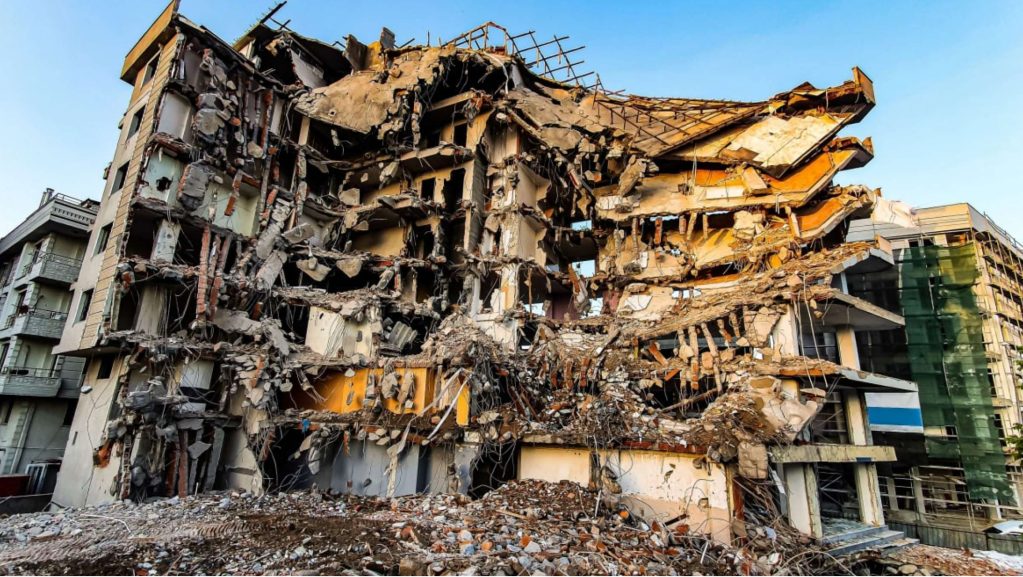
As the cycle of tragedy in the Mideast continues — decades of vicious oppression of Palestinians by Israel, vicious attacks on Israel by Hamas, all the deaths, etc. — among the words that describe the ghastly situation is: disaster. And since this is a book blog, I’m going to write about disaster in literature.
There are of course novels about devastating wars, novels about the unimaginable horror of the Holocaust, and so on, but I’ve covered those topics before. This post will be mostly about one-off disasters happening within a relatively small window of time.
As we read about these situations — fictional but reminiscent of, and sometimes based on, real disasters — there is of course much drama amid the dread. Instances of courage, instances of cowardice, wondering if the characters will survive, etc.
Before I knew last week that I would write this post, I happened to be reading Chitra Banerjee Divakaruni’s compelling novel One Amazing Thing — about nine people in an unnamed American city trapped in a passport/visa office when a major earthquake hits. The interpersonal dynamics among this multiracial group are fascinating as they try to control their fear while thinking of ways to escape or at least survive until possible rescue. Meanwhile, they pass some of the agonizing hours telling at-times-enthralling tales to each other about their lives — making the novel almost a short-story collection of sorts.
I also thought of Ann Patchett’s Bel Canto, about attendees at a posh party in a South American country who are taken hostage. In this novel, the interaction is not only between the party guests but also between the guests and the attackers during what turns out to be a four-month standoff. Good vs. evil? It’s more complicated than that.
Paul Gallico’s The Poseidon Adventure? A tidal wave turns a cruise ship upside down. Not ideal. But quite riveting as the surviving passengers try to save themselves.
In Donna Tartt’s The Goldfinch, a museum bombing is the focus only of the first part of the novel, but that bombing sets off a series of consequences, actions, and events that drive the rest of the Pulitzer Prize-winning work.
What will happen at the end of the book hangs over Nevil Shute’s On the Beach. Nuclear war has devastated much of the Earth, a massive radioactive cloud is heading toward Australia, and the novel’s characters in and near Melbourne know it’s coming.
Your thoughts about, and examples of, this topic?
My literary-trivia book is described and can be purchased here: Fascinating Facts About Famous Fiction Authors and the Greatest Novels of All Time.
In addition to this weekly blog, I write the 2003-started/award-winning “Montclairvoyant” topical-humor column every Thursday for Baristanet.com, which has merged with Montclair Local. The latest piece — about the split-vote approval of a controversial redevelopment in my town — is here.


I just read a news item that Israel and Hamas has agreed to a cease fire. I believe that Trump must have put pressure on Netanyahu to accept this cease fire in return for American aid. Hamas has been greatly weakened but they still seem to be in control in Gaza.
LikeLiked by 1 person
Thank you for the comment, Tony. I hope the ceasefire does happen — and holds. And, yes, you’re absolutely right that Trump deserves some credit for it. He did indeed put pressure on Netanyahu — one corrupt authoritarian to another. If only Biden, months and months ago, had put pressure on Israel to stop the genocide by threatening to withhold U.S. aid and weapons shipments. But he was too weak, too scared of AIPAC donors, too pro-Israel, too anti-Palestinian, etc. A huge stain on Biden’s presidency.
LikeLike
I came across an Arab proverb quoted in a non-fiction book which I read in 9th grade which has haunted me ever since ” Peace is the dream of the wise, war is the history of man”.
LikeLiked by 1 person
Thank you, Tony! That’s a GREAT quote. And, yes, haunting and sobering.
LikeLike
I must say its rather difficult to read sci-fi books without a nuclear disaster being mentioned and/or anti-utopias as well as negative utopias which eventually turn into disasters. I can only think of one book re: a disaster that turned out fairly well which is The Wonderful Wizard of Oz, although Dorothy Gale and friends faced mini disasters all along the way. And then there are the wrong place/wrong time disasters where one is set upon by a murderous fiend/fiends such as the Clutter family In Cold Blood by Capote or those individuals killed by the Manson family. Its sad to say I never knew a time where there wasn’t a war or murderous fiends I can accept a rogue wave, a tornado, earthquake, etc; however, I don’t think I’ll ever reconcile myself to the thought a man would take up arms against his fellow man when we all have to contend with the wraith of mother nature; however, I guess its just the human material.
LikeLiked by 1 person
Forgot to say, thanks for the theme Dave. Susi
LikeLiked by 1 person
Thank you, Susi, for the interesting, wide-ranging comment! Yes, sad, negative, and even dystopian things/events are more likely in sci-fi and other literature (because they’re more likely in real life). Depressing but true. 😦 And, as you say, even many books with at least semi-happy endings put their characters through a lot along the way. Last but not least, I agree that humankind should concentrate on fighting climate change instead of each other. Not a chance, though. 😦
LikeLike
In my comment I meant wrath not wraith, ha. Gotta say Mother nature has a much bigger arsenal.
LikeLiked by 1 person
LOL, Susi! 😂
I’m a fan of John Steinbeck’s “The Grapes of Wraith.” 🙂
LikeLike
I can’t think of a fiction book about a 1 off disaster, that I’ve read.
Does a mini personal disaster count?
I’m thinking of the classic “Captains Courageous” by Kipling.
It’s a disaster for the young boy who falls off a ship, and is saved by fishermen who can’t return him until fishing season is over.
It’s a disaster for his family,..
The first book that came to mind was not fiction.
Alive: The Story of the Andes Survivors … Piers Paul Read
Thanks for the topic, Dave!
LikeLiked by 1 person
Thank you, Resa! A personal mini-disaster is still a disaster for that person. 🙂 😦 I appreciate that fiction example — as well as your nonfiction example covering a wider disaster. Many nonfiction books would fit my blog topic this week.
LikeLiked by 1 person
Yes, unfortunately many, many non-fiction books fit the bill this week.
Also unfortunate is that many non-fiction sad realities are in the making for those books to be written.
Not many Cinderella stories these days.
Best to you and hugs for Misty!
I lost one of my babies 2 days ago. I’m so happy I hugged him and hugged him.
LikeLike
Very, very sorry about the passing of your kitty, Resa. 🥲 That is so difficult. My condolences.
LikeLiked by 1 person
Thank you, Dave! He was so adorable and fluffy. 🥲
LikeLiked by 1 person
They don’t live anywhere near long enough. 😦
LikeLiked by 1 person
Agree! That makes them extra special special. 😻
LikeLiked by 1 person
Yes! 🙂 😦
LikeLiked by 1 person
…. I’m so happy I don’t eat animals! I’m happy you don’t either.
I know I’m pulling this out of the blue. Thank you!
LikeLiked by 1 person
A very, VERY good thing, Resa! 🙂
LikeLiked by 1 person
🙂
LikeLiked by 1 person
On the topic of favorite novel endings, I’m certain I’ve mentioned IB Singer’s generational family saga, “The Family Moskat”. In the present context, the novel is again pertinent.
As German bombs begin to rain down of Warsaw, one of the characters, a deeply religious and studious man, runs down the street shouting “Death is the Messiah! Death is the Messiah!”
What followed, beyond the novel’s end, was the Holocaust and the killing fields and all the horror of the Second World War.
LikeLiked by 1 person
Thank you, jhNY! That is quite a sobering conclusion, with plenty of truth. And, yes, still relevant despite the novel coming out in 1950. (Just looked that up.) I haven’t read “The Family Moskat,” but have found I.B. Singer’s short stories to be very compelling.
LikeLike
It is hard to get factual, unbiased information about the Israeli-Hamas War, two examples are Shani Louk the young Israeli woman whose body was abused by Hamas, whether or not she was alive at the time, and even more importantly whether the explosion (which caused hundreds of deaths) at Al-Ahli Hospital was caused by an Israeli air strike or by a rocket fired from Gaza by Islamic Jihad which exploded in midair and fell on hospital grounds.
LikeLiked by 1 person
You’re right, Tony — the fog of war and all that. It doesn’t help that there are a lot more journalists in Israel than in Gaza, and that the cutoff of electricity in Gaza isn’t exactly conducive to reporters and “amateur” media observers keeping cell phones and computers charged.
LikeLike
Dave, I was surprised that I`ve never have read the book, now I need to find the book
LikeLiked by 1 person
LikeLike
Thank you, Bebe! Definitely worth reading, and not very long — just over 200 pages.
LikeLiked by 1 person
Thanks Dave, I`ll look for the book now.
LikeLiked by 1 person
I’d be interested to hear what you think!
LikeLiked by 1 person
Nothing funny about this cartoon but would be a disastrous one to what is happening to America today.
LikeLiked by 1 person
Thank you, Bebe! Jim Jordan is SO despicable. 😦
LikeLiked by 1 person
Agreed…how this can be happening to America is beyond me.
LikeLiked by 1 person
Unfortunately, no surprise. 😦
LikeLike
Very interesting Chitra also speaks my other language .
LikeLiked by 1 person
Great, Bebe!
LikeLike
Natural disaster stories always interest me and to some degree it’s interesting to see/imagine how one could survive something terrifying like a rogue wave or flood or something like that. War is tough for me – I find many war movies interesting, but the gruesome parts are hard. It’s tough for me to stomach since it’s people causing those battles, but a good war story can captivate people and move them, too.
LikeLiked by 1 person
Thank you, Sara! Yes, readers of disaster fiction often think of how they’d react and what they’d do if they were in the characters’ situation. And war stories (whether movies or novels) can indeed be hard to take and hard not to be compelled by at the same time.
LikeLiked by 1 person
Yes indeed. Disaster fiction is so interesting. Historical wars are so interesting, too. Like WWII of course, but also the Napoleonic Wars. Hopefully one day war will only be in history and in fiction.
LikeLiked by 1 person
“Hopefully one day war will only be in history and in fiction” — that would be wonderful. If only…
And, yes, the Napoleonic Wars have been covered or referenced in many a novel. “War and Peace,” “The Count of Monte Cristo,” etc.
LikeLiked by 1 person
I know. If only. :,(
Yes that’s very true! Those are very popular books centered around the Napoleonic Wars! Even Jane Austen’s works were around that time – she didn’t write directly about the war, but was influenced by that time frame. The Hornblower series about a midshipman who becomes a captain of a warship is interesting, too. I loved the TV series adapted after the book.
LikeLiked by 1 person
Yes, Sara, definitely the Jane Austen era. It has been a while since I read her six novels, but I think at least one of them (“Persuasion”?) had a character away in the military (Navy?) even though the book’s focus was on the “home front.”
I’ve heard about the Hornblower novels and TV series but have not read or watched them.
LikeLiked by 1 person
Yes that’s true. In real life her brother fought at war too. Thats cool you’ve read Austen!
They’re interesting stories if you enjoy that time period. 🙂 🙂 🙂 You definitely know your literature!
LikeLiked by 1 person
Jane Austen’s brother fighting at war definitely much have had a huge impact on her.
I’m a fan of Austen’s novels, with “Persuasion” and then “Pride and Prejudice” my two favorites. Not my favorite author by any means, but very glad I’ve read her.
LikeLiked by 2 people
I like those two the best too. 😊
They’re so interesting. Pride and Prejudice has some Gothic elements then Persusasion is different from the other books. I know the feeling though. Sometimes a book isn’t your favorite but you’re glad you read it. 😊😊😊😊😊
LikeLiked by 1 person
I also gave someone some parting words last night that set boundaries but also left things open if he was willing to be more honest with me. It was very dramatic but it has to be done. No more games, only real.
I feel abit like a Jane Austen heroine, wondering if he shall return.
LikeLiked by 1 person
And I shouldn’t say I’m waiting. I just hope he can focus on himself first and work through some things. We may never cross paths again, but the possibility is always there.
And I’m so sorry for the TMI. Speaking of romantic Jane Austen stories made me think of him.
LikeLiked by 1 person
Thank you for the three comments, Sara! I definitely think “Persuasion” is underrated in the Jane Austen canon, so I’m glad to hear that it’s one of your two favorites by that author! And Austen’s characters, and their actions, are definitely relatable to the lives of people today — including yourself. Many of her characters feel very real, and human emotions haven’t changed much in 200 years. 🙂
LikeLiked by 1 person
Yes it’s interesting how the character becomes reunited with her past lover and there’s alot of misunderstandings in the mix too.
Yes very true – human emotions today are reflective of how people felt in the 1800s too. 🙂
LikeLiked by 1 person
The plot of “Persuasion” certainly holds a reader’s interest. Some wish-fulfillment, of course — two people “made for each other” whose relationship is stymied for years, followed by the inevitable Austen mostly happy ending.
LikeLiked by 1 person
Yes!
Unlike Austen, my own books usually don’t have a fully happy ending, but they’re nice for some books.
Ooh we were just talking about different endings! 😝
LikeLiked by 1 person
Endings that are not fully happy are more realistic!
LikeLiked by 1 person
Yeah that’s true!
LikeLiked by 1 person
🙂
LikeLiked by 1 person
😊
LikeLiked by 1 person
Also Stendhal’s “The Charterhouse of Parma”‘s opening pages– its realistic description of battle conditions during Waterloo having come from the author’s own experiences during Napoleon’s disastrous Russian campaign.
LikeLiked by 1 person
Great mention, jhNY!
LikeLike
A wonderful conversation about disasters, Dave. I now have titles to add to my TBR stack of book. I generally read non-fiction books that speak of disasters (Simon Winchester/Krakatoa), but I believe that the Richard Llewellyn’s bestselling and timeless classic, “How Green Was My Valley” is relevant. The novel includes a coal mine disaster. I have often wondered why we are drawn to “disaster” stories. Perhaps they give us a glimpse into the human experience during times of extreme adversity. They remind us of the fragility of our existence, allowing us to confront our personal fears of loss and grief.
I must leave you with one of my favourite quotes from “How Green Was My Valley:
“But you have gone now, all of you that were so beautiful when you were quick with life. Yet not gone, for you are still a living truth inside my mind. So how are you dead, my brothers and sisters, and all of you , when you live with me as surely as I live with myself.” Richard Llewellyn, How Green Was My Valley
LikeLiked by 1 person
Thank you, Rebecca! Yes, memorable books about disasters can be fiction or nonfiction. “How Green Was My Valley” (which I haven’t read) sounds like a great example in the novel realm. Very poignant quote from that book you cited at the end of your comment. And very insightful words by you about why many people might be drawn to reading about disasters.
LikeLiked by 1 person
Hi Dave, a good interlude to this posts. I’m watching it all unfold in horror. Books involving disasters … hmmm! John Wyndham, who I’ve mentioned before, used disasters as his settings for The Chrysalids (nuclear war), The Day of the Triffids (a meteorite shower that blinds humanity), The Kraken Wakes (attack by aliens which causes the polar ice caps to melt), and The Midwich Cuckoos (aliens impregnating all the women in an English village). I do believe Stephen King was influenced by John Wyndham and got some ideas from him (The Stand from The Day of the Triffids), and The Dome (for The Midwich Cuckoos). A few other books: The Second Mrs Astor (featuring the sinking of the Titanic), A Farewell to Arms (not WWI generally, but the Battle of Caporetto which resulted in the murder of Italian military leaders who retreated) and A Journal of the Plague Year by Daniel Defoe which features The Great Plague of London in 1664.
LikeLiked by 2 people
Thank you, Robbie, for all those great examples of this topic!
Interesting, re Stephen King, how some works are influenced by previous works — and in turn influence subsequent works.
I should mention, re “The Second Mrs. Astor,” that I’m not related to the rich Astors. 🙂 (My paternal grandfather changed his last name, or had it changed, at Ellis Island when he emigrated to the U.S. from Eastern Europe in the early 1900s.)
LikeLiked by 3 people
Hi Dave, an interesting choice of name by your grandfather. I’m not sure what happened to the Astor wealth. I’m sure there are still wealthy Astors about but both John Jacob IV’s sons sounded like washouts as people. Vincent was an alcoholic and John Jacob VI was a playboy from what I read about them. Vincent left his money to a foundation administered by his wife, Brooke Russel so that seems to be where the money ended up.
LikeLiked by 2 people
The children in wealthy families can indeed too often turn out badly, Robbie. Spoiled, selfish, greedy, not compassionate, capable of doing very negative things, etc. The U.S. has a certain recent ex-president who’s an excellent example of that…
LikeLiked by 2 people
Yes, indeed ❤️🔥
LikeLiked by 1 person
🙂 (Your comment.) 😦 (Trump.)
LikeLiked by 1 person
What a long list of books of horror books, Roberta! I vaguely remember the Kraken Wakes and the goose pimple those aliens gave to me!
LikeLiked by 3 people
Hi Martina, I suppose books that focus on natural disasters are very frightening because they are possible. The aliens scared me less than the rising waters and flooding in The Kraken Wakes.
LikeLiked by 2 people
I can of course understand your fear of natural disasters, Roberta, but for me aliens like AI who have seen the moment to take over the world, because the human beings are not capable to handle it themselves, make me really afraid ! 🥲All the best.
LikeLiked by 1 person
I have given you an answer to this comunication, Roberta, but now I have some doubts about whether you received it! I quite agree with concerning fears of natural disasters, which have increased these last years, but the technical aliens, such as AI, make me even moreafraid! All the best 🌻
LikeLiked by 2 people
Hi Martina, my apologies if I missed a comment. AI is a scary creation in every way. Have a wonderful weekend.
LikeLiked by 2 people
🌻👍🌺🦒🦣
LikeLiked by 2 people
Great examples Robbie!!!!
LikeLiked by 3 people
Thank you 😊
LikeLiked by 2 people
Thank you, Dave, for having proposed “One Amazing Thing “, which I have added to my reading list:) When I read your post yesterday, I immediately thought about a book exploring all wars and relationships, which had deeply touched me then. In the meantime I even found it on my bookshelf and the title is “REGENERATION” by Pat Barker. It starts with the following sentence: I am making this statements as an act of wilfull defiance of military authority, because I believe the war is being deliberately prolonged by those, who have the power to end it.
LikeLiked by 3 people
Thank you, Martina! Glad you mentioned “Regeneration,” which I found very compelling to read after you (if I remembering correctly) were one of the people to recommend it. Definitely a touching historical novel, with a superb beginning sentence.
LikeLiked by 2 people
Hi Martina, I hope you are well. I also really enjoyed Regeneration which was recommended in the comments on Dave’s blog. I found the psychological aspects very interesting. Sadly, the second book got off to a very different start which I didn’t like so I never finished it.
LikeLiked by 3 people
Dear Roberta, I‘m sorry for having forgotten that I had already mentioned it on Dave’s blog, but I’m also happy that you liked Regeneration! I’m quite well and hope the same for you🤣
LikeLiked by 3 people
Hi Martina, I often repeat mentions of books. So many of the best ones fit into more than one of his conversations. I enjoyed Regeneration very much, a great recommendation.
LikeLiked by 3 people
This is also true, Roberta 🤗 Have a nice evening!
LikeLiked by 3 people
I suppose that most habitants of the Gaza strip suffer of the so called Stockholm syndrome. They threw out the Palestinian Authority because of their corruption and nepotism, just to find out that the cure was worse than the disease. The Oslo agreements were deliberately undermined by the Hamas bombing raids, and then the Israelis elected Netanyahu in office, who pushed it even deeper into the abyss. And now you have a new radicalization on both sides of the debate. Have you ever wondered why Hamas is so insistent in keeping waging a war that they know they can’t win? When this war would be considered as a crime, the first thing the police would do is having a close look at those who’re benefitting from it. Netanyahu clings at his position to avoid prison on bribery charges and can only do so if he keeps the religious zealots in his coalition happy. On the Palestinian side the picture isn’t that clear to me, but there must be someone (or a group) who has a personal interest in keeping things festering.
LikeLiked by 3 people
Thank you, Shaharee! An excellent analysis with many great points. Yes, Hamas and Netanyahu do not have the well-being of the general populations of Gaza and Israel in mind.
LikeLiked by 3 people
A possible Palestinian scenario could be that the ayatollahs are pumping big money into some offshore bank accounts.
LikeLiked by 1 person
Almost anything is possible…
LikeLiked by 1 person
Disastrous amounts of work forced me to follow the blog from a distance. Enjoying some time off in New York, I offer War of the Worlds by H.G. Wells. About as catastrophic as it gets. It is a testimony to the greatness of Wells as a writer that the novel continues to succeed in exciting and entrancing a present-day readership exposed to the most stunning of computer generated or enhanced phantasy and science fiction.
LikeLiked by 3 people
Thank you, Dingemon! Sorry about all your work; I hope it has eased off a bit? H.G. Wells was masterful at depicting disaster scenarios in a number of novels, including “The War of the Worlds,” as you mentioned. And, yes, his books still seem quite timely and relevant despite many of them being well over 100 years old. I’m also a big fan of his “The Time Machine,” “The First Men in the Moon,” and “The Shape of Things to Come.”
LikeLiked by 3 people
Also “The Island of Dr Moreau”, though, as in many Wells pieces of fiction, the end comes too quick and too neat for my expansive taste. It did read to me as a metaphor for colonialism, though my interpretation may well be an outlier.
That book gave rise to the movie “The Island of Lost Souls”, starring maniac doctor Charles Laughton, and later to Adolfo Bloy Casares’ “The Inventions of Morell”, and later still, with a nod toward Wells and Casares (and ETA Hoffmann), to Angela Carter’s “The Infernal Desire Machines of Doctor Hoffman.”
I prefer all of these in the order listed, which also happen to be the order in which they were created. No doubt, Wells really started something!
LikeLiked by 1 person
Interesting observation about the endings of some H.G. Wells novels, jhNY! I see your point. And “The Island of Doctor Moreau” was certainly an influential book!
LikeLike
War of the Worlds (the book, not the movie which missed a lot of the point of the book) is a great recommendation. I really admired HG Wells depictions of the aliens as having become so advanced they really only had huge brains and relied on their machine creations to do everything the body could/should have done. It is such an interesting thought.
LikeLiked by 2 people
A very interesting thought by H.G. Wells indeed, Robbie! And I totally agree about “The War of the Worlds” novel being much better than the movie version.
LikeLiked by 2 people
💚
LikeLiked by 2 people
My thoughts ran to two books, Dave, but both are non-fiction. But they are wonderful narratives – ‘Isaac’s Storm’ by Erik Larson about the hurricane in Galveston in 1900, and ‘Dark Tide’ by Stephen Puleo about the 1919 Molasses Flood in Boston. Each are hard to put down.
A novel (that I think I mentioned for an earlier theme) is ‘Slaughterhouse-Five’ by Kurt Vonnegut which is about several things, including the fire bombing of Dresden.
LikeLiked by 3 people
Thank you, Dan, for those three excellent mentions! There are definitely some nonfiction books that are every bit as compelling as novels, and hurricanes and floods are certainly dramatic and devastating subjects. As for “Slaughterhouse-Five,” it’s a VERY memorable novel.
LikeLiked by 1 person
Some may question whether Stephen King writes “literature” with a capital “L,” but his book The Stand seems to fit the bill here. Pandemic wipes out much of the population, followed by a struggle between good and evil.
LikeLiked by 3 people
Thank you, Audrey! “The Stand” is an excellent mention — which makes me think of other pandemic novels such as Camus’ “The Plague” and Mary Shelley’s “The Last Man.” And I think Stephen King has some literary chops at times, even as he’s of course a mass-market-type author.
LikeLiked by 3 people
He is good at creating memorable characters and situations.
LikeLiked by 3 people
Very true — again and again and again. 🙂
LikeLiked by 3 people
Hi Audrey, I think Stephen King’s early works are definitely modern classics. He is one of the best authors in the American fold in my opinion. Genre aside, his writing is magnificent. The Stand definitely fits Dave’s bill for this week.
LikeLiked by 3 people
The news of the savage killings in Southern Israel by Hamas shocked me more than any news since the attacks on 9/11. The tragic irony is that many of the victims were relatively liberal Israelis who were sympathetic to Palestinians.
LikeLiked by 3 people
Thank you for the comment, Anonymous. Yes, the killings by Hamas were absolutely brutal. Unfortunately, brutal violence from both sides for years and decades. And if some of the victims are somewhat sympathetic to the other side, there is indeed some tragic irony there.
LikeLiked by 2 people
I am saddened to see that there is an upsurge of both antisemitism and hatred of Arabs in the U.S. Criticism of the Israeli government and of Palestinian leadership (especially Hamas) are both legitimate but it must not degenerate into ethnic hatred. I am logged out of WordPress because it recently printed out my email address. Best wishes Tony.
LikeLiked by 3 people
Totally agree, Tony. In an ideal world, opposition would be a response to the actions of people, not their ethnicity or religion.
LikeLiked by 2 people
Dave, please change to “The news of the savage killings of civilians in southern Israel by Hamas shocked me more…” Thank you for your kind attention.
LikeLiked by 1 person
Changed.
LikeLike
It’s interesting how one reacts during crisis and disaster. I found myself watching the most gruesome tv-series when one of my loved ones was dying many years ago. Something I would normally not feel well watching. But at the time, reality was so much worse than any fiction and it somehow gave me some solace. Today, seeing what is going on in the world, disasters piling on top of each other, I have a hard time bringing myself to watch or read grim stories. It’s just too much. Perhaps it is age, or it’s just being fed up with tragedies… and I am sure no fiction writer can top these real life disasters unfolding all around us right now… but I do feel an urgent need for more light than darkness at the moment. Thanks for a thought-provoking post!
LikeLiked by 3 people
Hi again, above comment is from me, I don’t know why it didn’t show 😉 / Thérèse
LikeLiked by 2 people
Thank you for letting me know, Thérèse!
LikeLiked by 2 people
Thank you, Anonymous! Very well stated! I totally hear you about depressing literature being either too much to bear or a solace of sorts when bad or downright tragic things are happening in our own lives and/or the world. It of course partly depends on one’s mood during a particular day, the way the author handles the subject, etc.
Sorry about the situation with your loved one years ago. 😦
LikeLiked by 3 people
I’m not sure this entirely fits, but your piece reminded me of it, Faulkner’s moving short story: “Turn About” a at times humorous, always interesting, but in the end, tragic story of the interaction of American fliers and British torpedo-boat raiders in WWI – and their common confrontations with death.
LikeLiked by 2 people
Thank you, Doug! I hadn’t realized Faulkner wrote a war story like that. From the adjectives you used to describe it, it does sound like a compelling and multifaceted tale.
LikeLiked by 1 person
A very appropriate topic for this catastrophic moment in the Middle East. When we least expect it, disaster can strike us at any time and place. I have not read the first two novels you’ve mentioned. Nevil Shute’s On the Beach left a lasting impression after I read it in my adolescent years. During a disaster, we are most vulnerable and often reveal our truest selves. Such situations provide opportunities for telling compelling stories of human connection and resilience.
LikeLiked by 4 people
Thank you, Rosaliene! Your last two lines were especially well said — as well as very true.
“On the Beach” was indeed depressingly riveting as its characters awaited the horrors to come.
And, yes, an absolutely catastrophic moment in the Mideast, including many civilians killed or injured and many others in grave peril. 😦
LikeLiked by 2 people
🙂 ❤
LikeLiked by 2 people
🙂
LikeLiked by 1 person
Great post Dave. Brain’s a bit fried after a hectic weekend but there’s Bainbridge’s Every Man For Himself, set onboard the Titanic.
LikeLiked by 5 people
Thank you, Shehanne! Any book about the ill-fated Titanic would qualify. 🙂 Come to think of it, I just remembered reading a novel by Robert Serling (brother of Rod Serling of “Twilight Zone” fame) called “Something’s Alive on the Titanic.” An okay, not great, book.
LikeLiked by 2 people
Well, let’s say the Titanic was a one off. There was not going to be any books re its other voyages. I’ve not read that one you mention. Bainbridge’s charactertisitc was stripped down prose so the book was not hugely long either.
LikeLiked by 2 people
A one-off event, indeed, Shehanne. Maybe the most famous one-off ever. But certainly more than a one-off number of books and movies about that tragedy.
LikeLiked by 2 people
I totally forgot Pompeii by Robert Harris.
LikeLiked by 2 people
Thank you for that addition, Shehanne! Pompeii is a legendary disaster.
LikeLiked by 1 person
Well my brain was abit fried but alas. me being me middle of the night last night it came to me that was another story re a disaster.
LikeLiked by 1 person
I hear you about the issue of brain overload!
LikeLiked by 1 person
Hi Shey, your weekend looked terrific based on your FB pictures. A great recommendation.
LikeLiked by 3 people
Awwww… that is so kind. We were very centrally sited which was good. And despite how expensive it is here right now, we managed to get all kinds of deals and things like the museums there are all free so…. yeah it is possible to have a good weekend without breaking the bank.
LikeLiked by 3 people
That is really good to know, Shey 💗. It is very expensive for us too.
LikeLiked by 3 people
I know. It is a real thought right now to do anything in a way, the rip off is so beyond belief. And I grew up poor and am saying that, which is prob why I get round a lot of this. But we were pretty happy re what we covered on a budget this weekend. May times get better xxxxxx
LikeLiked by 2 people
💗
LikeLiked by 2 people
This is a tough one. All the books I can think of are war novels. How about The Tempest?
LikeLiked by 4 people
Thank you, Liz! “The Tempest” sounds like a great example! I haven’t read or seen that Shakespeare play, but just looked at a summary of it online. 🙂
LikeLiked by 3 people
I enjoyed it when I studied it in college.
LikeLiked by 2 people
I’ve heard rumors that Shakespeare was a pretty decent writer. 🙂
LikeLiked by 3 people
So they say. 😉
LikeLiked by 3 people
Ha ha! 😂
LikeLiked by 3 people
Love the tempest!!! “We are such stuff as dreams are made on.” spoken by the character Prospero, which suggests that human existence is ephemeral and insubstantial, akin to the fleeting nature of dreams.
LikeLiked by 3 people
I think that has to be my favorite Shakespeare quote!
LikeLiked by 2 people
Mine too, Liz!
LikeLiked by 2 people
😀
LikeLiked by 2 people
What a wonderful quote indeed!!!
LikeLiked by 1 person
Thank you to Mary Jo Malo for recommending Chitra Banerjee Divakaruni!
LikeLiked by 2 people
Chita Banerjee Divakaruni is a brilliant writer. I just read “The Forest of Enchantments”. This is the story of Sita, the legendary heroine from the Indian epic Ramayana. The book explores Sita’s journey, from her childhood to her marriage to Lord Rama, and her subsequent exile and time spent in the forest. While not aligned with your topic of conversation, Dave, Sita’s journey is fraught with disasters, which reveals Sita’s resilience, courage and loyalty.
LikeLiked by 1 person
Thank you, Rebecca! I will have to read more of Chitra Banerjee Divakaruni. I appreciate the recommendation!
LikeLiked by 1 person