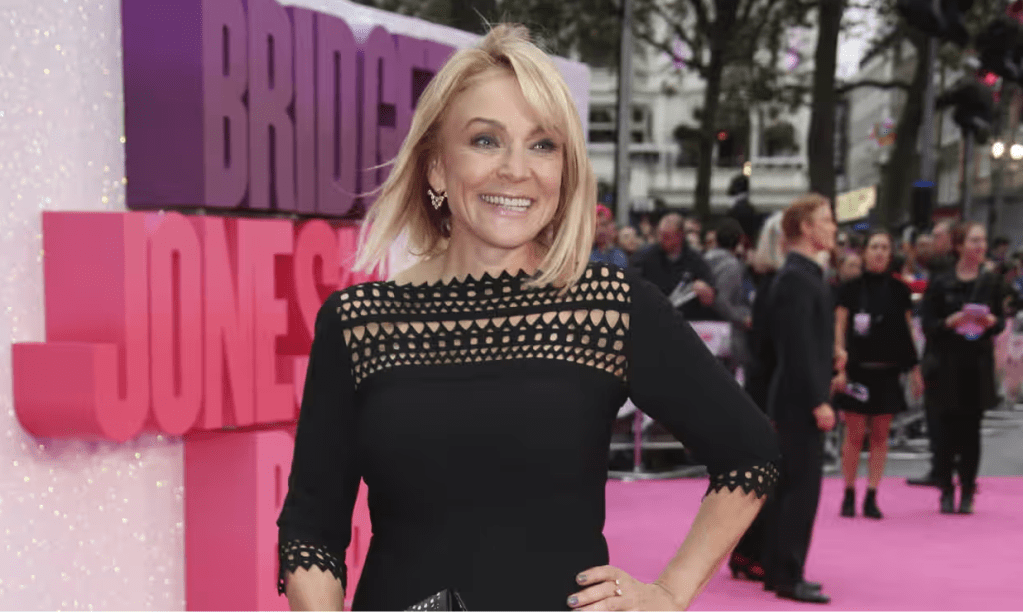
Helen Fielding. (Photo by Joel Ryan/AP.)
One of my reading maxims is “Don’t pigeonhole yourself.” That means I, as a male, often read novels by and about females. That means I, as a white person, am interested in books by and about people of color. That means I, as a “straight” person, like to read novels by and about LGBTQIA+ people. That means I, as an older person, enjoy the occasional young-adult novel. That means I, as an American, love many works by and about people from other countries. That means I, as an Earthling, gravitate toward some books by…well, maybe I should stop there.
Why avoid self-pigeonholing in reading? The answers are obvious: You learn more stuff, see things through different eyes, get a chance to empathize with those of diverse backgrounds, don’t get stuck in a reading rut, and so on.
This topic occurred to me as I read Bridget Jones’s Diary, which I’m currently about halfway through. Helen Fielding’s hilarious, at-times-poignant novel gives great insight into the psyches of women — well, particularly the psyche of one smart, funny, neurotic, self-deprecating, somewhat shallow (?), thirty-something woman. Definitely an education of sorts amid the entertainment, and a reminder that any male reading a novel like that will gain a better understanding of a female spouse or partner, and/or his mother, and/or his daughter(s), and/or his sister(s), and/or his women friends, and/or his female boss and co-workers, etc.
Bridget Jones’s Diary has been called “chick lit,” which I find a sexist and derisive way to categorize many wonderful works of fiction. Among my favorite women novelists — whether they lean to the lighter or heavier side in approach — are Chimamanda Ngozi Adichie, Isabel Allende, Margaret Atwood, Jane Austen, the Bronte sisters, Octavia E. Butler, Willa Cather, Colette, George Eliot, Diana Gabaldon, Kristin Hannah, Zora Neale Hurston, Barbara Kingsolver, Harper Lee, L.M. Montgomery, Liane Moriarty, J.K. Rowling, Mary Shelley, and Edith Wharton, to name a few.
Female authors of color are obviously part of the above list, and just as obviously I have enjoyed novels by male authors of color such as James Baldwin, Richard Wright, and various others. In our multiracial world, white readers can only benefit from including authors of color in their literature mix.
Young-adult novels give us a sense of what young people are thinking, and, when these books are read as grown-ups, evoke memories of our own youth. Some of the YA books I like best include L.M. Montgomery’s Anne of Green Gables and its sequels, Marjorie Kinnan Rawlings’ The Yearling, Angie Thomas’ The Hate U Give, Louis Sachar’s Holes, and John Green’s The Fault in Our Stars.
Among the novels with full or partial LGBTQIA+ themes I most like are Rita Mae Brown’s Rubyfruit Jungle and Alice Walker’s The Color Purple, to name just two.
Favorite fictional works by and about people from countries other than the United States? Way too many to mention, so I won’t — even though I’m a writer of relatively short blog posts who likes to avoid self-pigeonholing by occasionally writing longer blog posts. 🙂
Your thoughts about this topic?
My literary-trivia book is described and can be purchased here: Fascinating Facts About Famous Fiction Authors and the Greatest Novels of All Time.
In addition to this weekly blog, I write the 2003-started/award-winning “Montclairvoyant” topical-humor column every Thursday for Montclair Local. The latest piece — about a rather large proposed office building — is here.


Dear Dave
thanks for your post and quoting some non-white, not straight American authors. As a European writer I usually avoid USAmerican literature. It’s too action centred for my taste and tries to hard to make the reader identify with the dramatis personae. Of course, to get out of my pigeon hole means to read American novels for me.
I absolutely agree with you, pigeon hole reading makes our thinking one-dimensional. On the other hand it’s laziness that makes us do it.
We wish you a happy weekend
The Fab Four of Cley
🙂 🙂 🙂 🙂
LikeLiked by 1 person
Thank you, Klausbernd! I enjoyed your excellent comment. 🙂
Yes, not pigeonholing is a good thing. And I agree that a lot (too much) of American literature is action-oriented, fortunately with some notable exceptions. Action-oriented novels can be compelling, but they’re best as a once-in-a-while thing rather than as a steady reading diet.
Hope you’re having a great weekend, too!
LikeLike
This is exactly why I joined a library book club. I read almost entirely mysteries but wanted motivation to branch out. If I hadn’t, I probably wouldn’t have read YA The Hate U Give (Thomas) or fantasy The Rules of Magic (Hoffman). Most recently, I loved The Paris Bookseller (Maher), which is historical biographical fiction about Sylvia Beach. I still love mysteries, of course!
LikeLiked by 2 people
Thank you, Becky! Being in a book club is a GREAT way to diversify one’s reading! (I’m not in a book club myself, but consider this blog to be sort of/kind of an online book club. 🙂 ) Mysteries mixed with other kinds of books is an excellent…mix. And “The Hate U Give” is quite a novel!
LikeLiked by 1 person
Yes, all the discussion brought about by your posts IS like a book club!
LikeLiked by 1 person
Thank you, Becky! 🙂
LikeLiked by 1 person
You definitely learn more! I hate being pigeon-holed in anything! A really good post Dave!
LikeLiked by 1 person
Thank you! I definitely agree about learning more, and that avoiding pigeonholing is good in other things in addition to reading!
LikeLike
Three battered books on our shelves, from an older generation’s childhood, about the Ruggles family, ‘ working class’ . far too many kids , tired but loiving mum and dad. The first – The Family From One End Street won the Carnegie medal. No boats, no boarding school, no ponies. Two more, and in all three, scholarship child Kate knows there’s a different world beyond One End.
Pigeon holing ? Stigmatising ? Or closer to the lives of many child readers,
LikeLiked by 1 person
Thank you, Esther! I think many kid readers like a certain amount of predictability in their reading (which can also lead to reading a lot of series and doing more rereading than adults). As long as kids are reading, somewhat less variety is fine with me. 🙂
LikeLike
Dave, I love this: “Why avoid self-pigeonholing in reading? The answers are obvious: You learn more stuff, see things through different eyes, get a chance to empathize with those of diverse backgrounds, don’t get stuck in a reading rut, and so on.”
This is the reason why I absolutely abhor these book bans that I don’t understand the insane and extreme reasons given. This is why we have such a diverse world of books. You aren’t being forced to read what you don’t want to, but it is available in case you are curious. Just READ because our reading stats have been plummeting for some time now. Great message Dave! 📘📚📕
LikeLiked by 1 person
Thank you, Kym! 🙂 Excellent, relevant mention of dismaying book bans and how they can limit variety in reading. I also abhor those bans — which are of course designed to reduce independent thinking, among other things.
I appreciate the comment…VERY well said!
LikeLiked by 1 person
You are so very welcome Dave. I agree with you about the reduced independent thinking, and thank you for your candor my friend. No self-pigeonholing here! 😜 Make this weekend FANtabulous! 😍✨😘
LikeLiked by 1 person
Great that you avoid pigeonholing in your reading! (Those addicted to literary pigeonholing should try the 12-book process. 🙂 ) Have a nice rest-of-the weekend, too!
LikeLiked by 1 person
Thanks a million Dave and you do the same my friend. 😍💖🥂
LikeLiked by 1 person
You’re very welcome, Kym! 🙂
LikeLiked by 1 person
When younger I loved the Sherlock Holmes series by Arthur Conan Doyle. He was British and so were Holmes, and Watson.
They may be old fashioned today, in a world of forensics, but at the time were milestones in crime fiction.
I must note Gabriel García Márquez (Columbian) & the winner of the 1982 Nobel Prize in Literature.
His novel of the Buendía family (100 Years of Solitude) takes place in Columbia. Taking place in the early 1800’s until mid 1900’s, it’s also about another place in time.
I have read a half dozen of the authors you mention, so I feel somewhat read.
BTW – The Toronto Library system is still shut down due to the hacking. Sigh!
LikeLiked by 1 person
Thank you, Resa, for the mentions of the Sherlock Holmes series and “One Hundred Years of Solitude”! I’m a fan of both of those very different works. Arthur Conan Doyle was definitely a giant of 19th-century detective fiction, and Edgar Allan Poe and Wilkie Collins weren’t too shabby, either.
Sorry the Toronto library system is still recovering from the hacking. 😦
LikeLiked by 1 person
😦 It’s been 4 months!!!
RANSOMEWARE
“1 million books and 4 months later, Toronto’s library recovers from a cyberattack. More than four months after a ransomware attack shut down the Toronto Public Library’s computer systems, staff are finally putting a million stranded books back on the shelves.”
But I still can’t use my account!
LikeLiked by 1 person
Absolutely awful, Resa. 😦
LikeLiked by 1 person
Yes! 😦
LikeLiked by 1 person
Rereading a Russian novel, Andrei Bley’s “Petersburg” set in that city circa in 1905, after having read a few fantastic short stories by GB author Angela Carter, and before that a leftist noir by French author JP Manchette– and most mornings, waiting out my computer’s warm-up period, I read a Chinese Tang Dynasty era poem. As a reader, I do like to get around to places I otherwise could never be.
LikeLiked by 1 person
Thank you, jhNY! You definitely read a variety of things, often “off the beaten path.” Nice, diverse, current examples of you doing that in terms of countries and literary format!
LikeLike
I completely agree with you on this, Dave. I am always choosing different genres by authors from all walks of life. I do the same with the movies I watch. It’s boring to stick to only one type of story by one type of person. 🙂
LikeLiked by 3 people
Thank you, Jennifer! Sounds like you have a great approach to reading and watching movies! I agree — it’s much more interesting to enjoy a variety of creative things. 🙂
LikeLiked by 2 people
You also learn more about life this way, of course. 😊
LikeLiked by 1 person
Yes!!!
LikeLiked by 1 person
I’ll read anything apart from romance!
LikeLiked by 2 people
Thank you, Chris! I hear you. I’ve liked some romance novels on occasion, but it’s not a favorite category of mine, either. Of course, some “general fiction” is very romantic. 🙂
LikeLiked by 2 people
What an interesting subject, Dave, and I am also very greatful for having explained so well the expression Pigeonholing! I still remember, when I was still girl of about 14 years, that I read “Resurection” by Leo Tolstoy. A book about the Russian unjust law system. During a trial a young girl, who had been sexually abused by one of the jurors and who became aware of his sins was ready to atone for what he had done! This story still gives me goose pimples! I also read the Count of Monte Cristo when I was very young. In general, however, I read the great German writers, such as Hermann Hesse or for exemple “The Glas Bead Game”, Kafka “The Methmorphosis” or Martin Sutter “Small World”. I don’t mention Schiller and Goethe! So these seem to have been more or less books by men! When I started to really study the English language and to travel I had a great desire to learn more about the countries I visited and their cultures and I read many books by women and learnt a lot about their political systems or their lives, which often times were very different from Switzerland.
Last but not least, I think I also learnt a lot from AMERICANAH by Chimamanda Ngozi, who you also mentioned. Many thanks, Dave
LikeLiked by 2 people
Thank you, Martina! And I appreciate you outlining your very interesting reading experiences!
Reading Tolstoy at age 14 has got to have an impact; I didn’t get to his work until my 20s. Kafka and Hermann Hesse are memorable, of course; I finally read Hesse (“Steppenwolf”) about five years ago. Yes, there is a large percentage of male authors out there, especially decades and centuries ago; so refreshing that there are many more female authors in more-recent years. “Americanah”? A compelling novel. I think you were one of the people who recommended I read it. 🙂 Novels from countries other than our own teach us a LOT!
LikeLiked by 2 people
I’m very much enjoying your answer, Dave, and the fact that you read the “Steppenwolf”, which may also have helped you to understand that humour is soo important in order to find peace between our extreme sides and that it also helps when confronted with our negative sides!
You are right about “Americanah”, I had almost forgotten that post:)
LikeLiked by 2 people
Thanks, Martina! Great observations! Yes, “Steppenwolf” featured some very appealing humor amid the heavier content, and definitely had fascinating “duality” stuff going on.
LikeLiked by 2 people
Absolutely, Dave! 👍🌻
LikeLiked by 1 person
🙂
LikeLiked by 1 person
Hi Martina, reading Tolstoy at the age of 14 is a real accomplishment. Do you recommend “The Metamorphosis”? I actually bought it based on an Amazon recommendation but I haven’t read it as yet.
LikeLiked by 2 people
Absolutely, Roberta, it may make us think about the value of the human being and money!
LikeLiked by 1 person
Robbie, I can second Martina’s recommendation of “The Metamorphosis.” Powerful piece of writing.
LikeLiked by 1 person
Thank you, Dave.
LikeLiked by 1 person
Thank you, I’ll read it.
LikeLiked by 2 people
🤣🌺📕
LikeLiked by 1 person
Haha, I know I read everything.
LikeLiked by 2 people
Roberta, I also hope that you will tell us your opinion! Haha
LikeLiked by 1 person
I will. My review of The Sealwoman’s Gift will be live soon. I’ve fallen behind with reviews but am trying to catch up.
LikeLiked by 2 people
Good morning, Roberta, I‘m, of course, looking forward to that, but take your time 🌻
LikeLiked by 1 person
I agree with you, Dave. An example of my being rewarded for reading outside my usual fiction pigeonhole was when I was persuaded by a friend to try The Boys in the Boat (2014) by Daniel James Brown soon after it came out. A nonfiction book about rowing? Why would I read that? I loved it! And now I’ve read that it has been made into a movie (which hasn’t made it to Switzerland yet), so I imagine even more people will read the book.
LikeLiked by 3 people
Thank you, Kim! Great example of diversifying one’s reading! I’d like to read “The Boys in the Boat,” too, if I ever have the time to get to a nonfiction book. I’m especially interested because my daughter is on her high school crew team. 🙂 The team even had a group outing a couple months ago to see “The Boys in the Boat” film you mentioned. 🙂
LikeLiked by 1 person
As I started following authors, I found myself frequently starting a comment or review with, “I’m not normally a fan of…” I stopped after I realized that I am a fan of good writing. That can fall in any genre by any author.
LikeLiked by 3 people
Thank you, Dan! Your very-well-said comment really hit the nail on the head! Good writing can indeed draw us in no matter where a novel was written or by whom the novel was written.
LikeLiked by 3 people
I’m in complete agreement. When I discovered reading in my youth I read just about anything I could get my hands on, which meant I found certain types of books that I didn’t like–but how could I have known that, unless I’d read them? When the BBC embraced much better content than it does now, they often dramatised books by authors from other cultures, which is how I came to read Balzac’s ‘Cousin Bette’ and Zola’s ‘Nana’ amongst others. When I got to university in my 40s I studied Comparative Literature, which covers and compares world literature from the Classics onwards–in translation, but what a great way to discover Tolstoy and Turgenev, Ibsen, and the ‘1001 Nights’, to name a selection. Living in another country is a good way to discover the local literature, if you’re lucky enough to do so, so living in Egypt for two years gave me Nawal El Saadawi and Naguib Mahfouz–not to mention the work of another Brit abroad in Lawrence Durrell’s ‘Alexandria Quartet’ (I’d discovered his brother Gerald’s take on Greece in my youth too, and later found Kazantzakis for myself). My husband’s sci-fi tastes have informed my own too, so Frank Herbert, Isaac Asimov and Ursula K. Le Guin found their way into my TBR, and then there’s writing for the young–who doesn’t love ‘The Hunger Games’ from Suzanne Collins. Philip Pullman’s ‘His Dark Materials’ is generally taken to be YA, I think, but I also believe that he stated it to be written for anybody, of any age. I could go on but I think I’ve made my point–what a lot we’d all miss if we limited ourselves. Great post, many thanks for it. 🙂
LikeLiked by 3 people
Thank you, Laura! Great comment! Very nice to hear about your wide-ranging experiences with literature, and how that happened over the years.
So true that we don’t know what we like or don’t like until we read a variety of writing we like and don’t like. And, yes, living in a different country — as exemplified by your time in Egypt — can help introduce a person to literature from that country. Even visiting a country for a few days or a couple weeks can spur that as well.
I’m also a major Balzac and Zola fan, reading many of their novels a while ago. Also “Old Goriot,” “Eugenie Grandet,” “The Magic Skin,” “Germinal,” “The Drinking Den,” “The Masterpiece,” “The Beast in Man,” etc.
And, yes, “The Hunger Games” is basically YA, though it certainly doubles as an adult-oriented trilogy as well!
LikeLiked by 3 people
Yes, I didn’t realise that ‘The Hunger Games’ was classified as YA when I bought it, but it makes no difference. So many books, so little time …
LikeLiked by 2 people
Novels that blur the line between YA and adult fiction can be quite impressive!
LikeLiked by 2 people
I totally agree with you on this one. Reading books that you would otherwise not know to pick up, is partly why I enjoy being in a book club. Discussing them afterwards is also adding to the experience and widening your understanding and perspectives of the books.
LikeLiked by 2 people
Thank you, Thérèse! Great mention of book clubs and how they spur members to sometimes or often read what they might not have read on their own. Glad that you’re in a book club! I’m not, but I consider this blog to be a book club of sorts. 🙂
LikeLiked by 2 people
I also don’t pigeonhole myself as a reader, and that includes works of non-fiction, biographies, memoirs, poetry, and others. To see the world through the eyes of “the other” makes for greater understanding, tolerance/acceptance, and, hopefully, compassion. I haven’t read “Bridget Jones’s Diary,” but I’ve seen the movie.
LikeLiked by 2 people
Thank you, Rosaliene! Great reminder that reading variety also includes nonfiction books, poetry, etc.! I tend to focus on novels because that’s the point of my blog, but there’s so much else to enjoy and learn from. And, yes, to see through the eyes of other, perhaps quite different, people is VERY important and rewarding.
LikeLiked by 2 people
Dave, I know that your focus is on novels, but thought that I’d mention other books.
LikeLiked by 2 people
I’m glad you did, Rosaliene! 🙂
LikeLiked by 2 people
Being a part of the online writing community has broadened my reading horizons (which I didn’t know needed to be broadened).
LikeLiked by 6 people
Thank you, Liz! That’s a terrific point! So many great writers in the “blogosphere,” with a variety of approaches and working in a variety of genres. Plus all the reviews that introduce blog visitors to books, or remind them of books.
LikeLiked by 3 people
You’re welcome, Dave!
LikeLiked by 2 people
🙂
LikeLiked by 1 person
Hi Liz, this on-line community, including specifically you, Dave, and Martina, have broadened my reading horizons a great deal. I don’t always like the books recommended, I could not read Lincoln in the Bardo for example, I can’t make heads or tails of it, but most of the books recommended have been outstanding.
LikeLiked by 2 people
Your book recommendations have broadened many people’s reading horizons as well, Robbie!
“Lincoln in the Bardo”? I had mixed feelings about it, but, yes, it was rather weird and challenging.
LikeLike
Thank you, Dave. I think if I knew a bit more about Lincoln it would be an easier read but I don’t know much about the man.
LikeLiked by 1 person
Good point!
LikeLike
That’s good to know, Robbie!
LikeLiked by 1 person
My reading is definitely not systematic, so I seem to manage a fairly good mix of genres and literatures. But this post reminds me of something that bugged me while I was a cataloguing librarian in a large public library (from 1992 to 2016). We separated the fiction collection by genres. There were separate sections for Mystery, Science Fiction/Fantasy, Romance, and Westerns. Everything else was lumped together in General Fiction.
I argued against this arrangement. Supposedly it served the demand for convenience by readers who preferred those genres, which were the most popular. I thought it limited readers’ opportunities to explore other kinds of fiction. Also, with genre bending and blending, it meant we cataloguers sometimes put something in the “wrong” place, or had to do extensive checking to figure out the “right” place.
LikeLiked by 3 people
Thank you, Audrey! Un-systematic reading can be a good thing; lots of room for variety and serendipity. 🙂
And, yes, segmented library sections encourage segmented reading. My local library’s fiction section is similar, albeit with fewer categories — just three: general fiction, sci-fi, and mysteries. There’s definitely something to be said for having all fiction under…fiction, with people finding what they want by author last name. Good for you for arguing again shelf segmentation! And, yes again, it can be tricky to place novels that blend genres on segmented shelves. Should Mary Shelley’s “Frankenstein,” for instance, go in the sci-fi or general-fiction section? Wilkie Collins’ “The Woman in White” in mystery or general fiction? Etc.
LikeLiked by 2 people
Exactly! I would remind myself that nonfiction is classified to a high degree, so why not group fiction, but fiction is more fluid. It’s good for readers to splash around in the fictional pond!
LikeLiked by 2 people
True — nonfiction is often very segmented in libraries and bookstores. And I loved your line “It’s good for readers to splash around in the fictional pond.” 🙂
LikeLiked by 2 people
I agree, and I love your list of favorite authors. You have to read from a diverse field of writers. Margaret Atwood is my current favorite, but that will change once I finish reading her.
LikeLiked by 2 people
Thank you, henhouselady! I totally hear you about our favorites changing, even as our previous favorites stay near the top of our preferences. 🙂 I also love Margaret Atwood’s work — with my favorites of hers including (not in rank order) “The Handmaid’s Tale,” “The Testaments,” “The Blind Assassin,” “Alias Grace,” “The Robber Bride,” “Cat’s Eye,” and “Oryx and Crake.”
LikeLiked by 2 people
I am reading Aliss Grace now. I loved the Blind Assassin an The Maddaddam series.
LikeLiked by 2 people
“Alias Grace” is so good! Margaret Atwood can obviously create excellent historical fiction in addition to excellent speculative fiction. 🙂
LikeLiked by 2 people
Although it’s fine to have preferences, in my opinion it’s not so good to confine ourselves to one thing only re food, music, art. Why do so with literature? I love to read world lit. Consequently, I turn to Words Without Border. Here is a link to this wonderful organization: https://wordswithoutborders.org/ Thanks Dave for encouraging readers to explore their world. Susi
LikeLiked by 2 people
Thank you, Susi! I totally agree — we all have preferences, but it’s wonderful to have a diversified bunch of “sub-preferences” as well. 🙂 And I appreciate the link; it looks like a great organization and website!
LikeLiked by 1 person
Wholehearted agreement from me, and really I have lived my life this way from being a teenager immersed in Dostoyevsky, listening to Jamaican music in my 20s, reading South American literature as a young man, and more recently making sure I’d read some Chinese literature, some arabic novels, Portugese, Italian, South Africa etc etc. Great post
LikeLiked by 2 people
Thank you, Ralph! I’m very impressed with your wide-ranging tastes in literature and music!
Re Dostoevsky, I didn’t read him until I was an adult, but it was absolutely worth the wait. Re Jamaican music, I have fond memories of seeing a Peter Tosh concert in New York City when I was in my 20s, and still have a Bob Marley album from around that time.
LikeLiked by 2 people
well that’s just a small sample Dave. You saw Peter Tosh? Wow.
LikeLiked by 2 people
A great small sample of the many things you’re interested in!
Seeing Peter Tosh was kind of serendipitous. While traveling in Europe, I met someone from Belgium who visited the United States a few months later. She learned Peter Tosh was going to be performing in Manhattan and invited me along. I loved the concert.
LikeLiked by 1 person
I’m a stepping razor
Don’t you watch my size
I’m dangerous
Dangerous
LikeLiked by 1 person
A great Peter Tosh song!
LikeLike
I am in awe of your reading spectrum, Dave. You even read Nancy Drew based on my recommendation. A wonderful post – I’ll be back for the follow-up discussion.
I have a feeling that we don’t intentional tend to choose books based on our interests, preferences, and goals. When a book aligns with our tastes or offers valuable information, we are likely to be motivated to read it. On the other hand, books that do not resonate with us may seem less appealing, leading to neglect.
In my experience, I have discovered that I need to be more intentional in my reading choices. I recognize that reading a diversity of books exposes me to different perspectives, cultures, and experiences, broadening my understanding of the world. Other benefits for me include developing empathy, critical thinking skills, and open-mindedness.
We have many books, compared to the our limited time. I believe that engaging in a diversity of reading allows us to expand our time. Books allows us experience the breadth and depth of humanity’s story.
Dr. Seuss says it the best “The more that you read, the more things you will know. The more that you learn, the more places you’ll go.”
P.S. I have set my sights on Faust for 2024. YIKES!!!
LikeLiked by 7 people
Thank you, Rebecca, for the wise and well-said words! You also have very wide interests — in books, poetry, art, etc.! And I’m very glad that I read Nancy Drew (“The Secret of the Old Clock”). 🙂
It’s true that many people might choose certain kinds of books that fit their interests, sometimes almost in an automatic pilot kind of way — meaning it takes a bit of conscious effort to get outside our comfort zone. But SO worth that effort.
Dr. Seuss knew what he was talking about. 🙂
Good luck with Faust! A strong example of diversifying one’s reading!
LikeLiked by 2 people
Hello Rebecca, I will not be following you down the Faust rabbit hole but I am currently reading The Magic Mountain by Thomas Mann. I’m not actually sure who recommended it. So far, it is quite fascinating. You recommended Nancy Drew to Dave, but did you also recommend The Three Investigators by Robert Arthur Jnr. I have never forgotten The Dead Man’s Riddle which included London rhyming slang. I found it several years ago so I could read it to my sons.
LikeLiked by 2 people
I also enjoy mixing up my reading as I think, especially as a writer, it helps to broaden my scope. Anne of Green Gables is my all time favourite book and I recently listened to an audio version narrated by Sandra Oh. It remined me why I love that story so much. As for Bridget Jones, I was going through a bad batch, was about to have a big birthday I was not happy about and hubby took me away for the weekend to an island that required two ferry rides. I was reading Bridget Jones and was laughing so hard he wanted to know what was so funny. So I read some of it out to him. We laughed together and had a great weekend! Books can save your life. (or at least a weekend)
LikeLiked by 2 people
Thank you, Darlene! Great point about another benefit of diversifying one’s reading being the way that can help one’s writing!
“Anne of Green Gables” is one of my favorite books, and my favorite YA novel. Of course, L.M. Montgomery’s classic is basically a YA/grown-up novel hybrid. 🙂
And I love your memory of reading “Bridget Jones’s Diary” and how you and your husband reacted to it! It IS a laugh-out-loud-funny novel. Books can definitely have savior tendencies. 🙂
LikeLiked by 2 people
HI Darlene, have you read Emily of New Moon by LM Montgomery. I preferred this book to AOGG because I could really relate to Emily. She is the reason I started writing poetry as a child.
LikeLiked by 2 people
I have read all of the Anne of Green Gables books but not Emily of New Moon. I’ve heard they are good as well. I did not relate to Anne, except for her overly active imagination, but I loved her so much. (and still do) Her spunk and determination appealed to me. Also the description of PEI. A good writer is a good writer whatever they write! It’s so great to know that a Canadian author has appeal all over the world. xo
LikeLiked by 1 person
I loved the “Emily” trilogy, Robbie and Darlene! Probably L.M. Montgomery’s most autobiographical work. I’m also a huge fan of Montgomery’s “The Blue Castle.”
LikeLiked by 1 person
I loved The blue Castle. I must put Emily on my TBR list.
LikeLiked by 1 person
“The Blue Castle” is indeed great! As you know, funny and poignant — with a very strong plot premise.
LikeLiked by 1 person
Thank you to Robbie Cheadle and Annika Perry for recommending “Bridget Jones’s Diary”!
LikeLiked by 2 people
Hi Dave, I’m delighted that Bridget Jones gave you a laugh. I still haven’t written my review; I have a significant backlog of reviews – eek! I don’t think in terms of women’s fiction or men’s fiction, I read what I fancy. I have recently read three war books by Jeff Shaara, Interview with a Vampire, A Town like Alice and The Chequer Board both by Neville Shute (I intend to read On the Beach), all of which have been phenomenal. I also read The Sealwoman’s Gift and I have actually written that review. I also read books from our writing community and a lot of poetry. I think I’m pretty well rounded with my reading choices.
LikeLiked by 2 people
Thanks again for the recommendation, Robbie! “Bridget Jones’s Diary” is SO funny, with other great elements in addition to the humor. I’m looking forward to seeing how the book ends (now two-thirds of the way through). I have my suspicions… 🙂 And I’m looking forward to your review!
In terms of reading a variety of novels, I’ve done that for long enough where it’s almost a subconscious thing rather than a checking-off-a-list thing.
I found “On the Beach” to be riveting.
LikeLike
I also don’t tick any boxes. I read what I fancy but what I fancy is fairly wide. Thanks for the recommendation for On the Beach.
LikeLiked by 1 person
You’re welcome! And I really like your comment’s first two lines. (“I also don’t tick any boxes. I read what I fancy but what I fancy is fairly wide.”)
LikeLike
Thank you, Dave
LikeLiked by 1 person
🙂
LikeLike