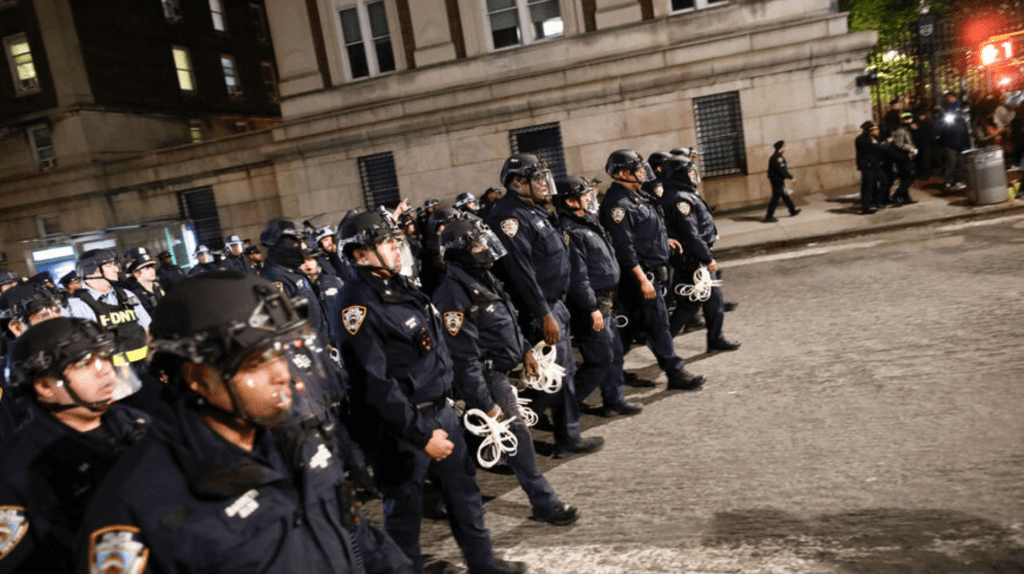
New York City police in riot gear march into Columbia University to break up peaceful protests against Israel’s war on Gaza. (Kena Betancur/AFL via Getty Images.)
The manipulation of truth to mislead people is known as gaslighting. We’ve been seeing a lot of that lately, and I’m going to discuss a real-life example before talking about gaslighting in novels.
As most of you undoubtedly know, there has been an outpouring of protest on numerous college campuses against the Israeli assault on Gaza that has left at least 34,000 Palestinians dead (the vast majority women and children), hundreds of thousands of other Palestinian civilians homeless and starving, many hospitals blown up, many schools destroyed, and more. This of course happened after the horrific Hamas attack on Israel last October 7 that killed more than 1,100 people. Which happened after years of Israel’s harsh authoritarian control over Gaza. Which happened after the Holocaust at the hands of the Nazis (not the Palestinians) — an unspeakable trauma that has influenced Israel’s actions ever since its founding. But it’s a shame when the oppressed become the oppressors.
The college protests have been overwhelmingly peaceful, but that hasn’t stopped various university administrators and elected officials from sharply escalating the situation by sending in aggressive/militarized police to attack and arrest the admirable students, many of whom were subsequently suspended and kicked out of campus housing — even as rich right-wing alumni donors threatened to derail the students’ future career prospects.
What kind of gaslighting is coming from those rich right-wing alumni donors, university administrators, mainstream-media outlets, and politicians — including not only most Republican pols and many Democratic pols (among them President Biden) in the U.S. but also Israel’s far-right prime minister Benjamin Netanyahu? It involves falsely describing the protesters as violent and (despite many of the demonstrating students being Jewish) also falsely describing them as anti-Semitic. Criticizing Israel’s government and the worst tendencies of Zionism is not being anti-Semitic. Sure, a tiny sliver of the protesters and/or protest hangers-on have said problematic things, but almost every righteous movement has bad apples who attach themselves to a cause but don’t represent the essence of it.
In fact, the only recent, major, not-by-police violence was perpetrated by a pro-Israeli mob that attacked pro-Palestinian protesters on California’s UCLA campus — with a feeble law-enforcement response to that quite different from the police crackdowns on students peacefully opposing Israel’s siege of Gaza.
Why the gaslighting of pro-Palestinian protesters? Many reasons, of course, with a key one an effort to distract from Israel’s unrelentingly disproportionate response to the vicious October 7 attack. A response that the vast majority of the world’s citizens, and a majority of Americans, feel is over-the-top.
There have been a few notable university exceptions involving schools willing to negotiate with students on such matters as considering the divestment of funds that help the powerful Israeli military. Among those schools are Brown, Rutgers, and Northwestern (the latter two my undergraduate and graduate alma maters) — and their willingness to bargain kept things calmer on those campuses. Did those universities negotiate with their students in good faith? Maybe, maybe not, but it was something.
Novels with gaslighting? In a political/governmental sense, few feature more examples of the “g” word than George Orwell’s Nineteen Eighty-Four, in which the dictatorial leaders churn out slogans like “war is peace,” “freedom is slavery,” and “ignorance is strength.”
In another dystopian novel, The Handmaid’s Tale by Margaret Atwood, gaslighting is one of the tools the sicko male rulers of Gilead use to subjugate women.
On a more one-to-one level, we have the “second Mrs. de Winter” gaslit by creepy housekeeper Mrs. Danvers in Daphne du Maurier’s Rebecca. Mr. de Winter is no angel, either.
Edward Rochester also did some gaslighting when trying to keep a major secret from the title character in Charlotte Bronte’s iconic Jane Eyre.
Another memorable 19th-century English novel, Wilkie Collins’ The Woman in White, has a gaslighting scenario too complicated to briefly summarize here…but it’s quite riveting.
Moving to more recent literature, J.K. Rowling’s The Ink Black Heart crime thriller features a nasty misogynist gaslighter who goes by the online alias “Anomie.”
In On Mystic Lake, the emotionally wrenching Kristin Hannah novel I just read, protagonist Annie is basically gaslit by two men (her old-fashioned widowed father and her sexist corporate lawyer husband who leaves her for a younger woman) into feeling she is less capable than she actually is. That’s something perpetuated by many men on many women in real life and fiction, as is also the case with the way Dorothea is treated by her husband, the Rev. Casaubon, in George Eliot’s superb Middlemarch. And gaslighting is sometimes perpetuated by women on women, with one example being the behavior of Valancy Stirling’s disapproving mother in L.M. Montgomery’s classic The Blue Castle — until Valancy finally leaves her childhood household at age 29.
One final note: When American students and others in decades past strongly/publicly protested such abominations as racism, sexism, homophobia, the Vietnam War, South African apartheid (via the divestment movement), and the U.S. invasion of Iraq, they were vilified by an “establishment” that rarely hesitated to send in the cops. Then, many years later, it became “safe” among at least part of the “establishment” to do the revisionist-history thing and acknowledge that the demonstrators had been morally correct. I suspect the students rightly protesting Israel’s collective punishment on Gaza might eventually be viewed the same way. It’s a shame that morally correct students can’t be respected in real time by “the powers that be,” but I guess those students are considered too threatening to imperial and corporate narratives.
Your thoughts about, and examples of, this topic?
My literary-trivia book is described and can be purchased here: Fascinating Facts About Famous Fiction Authors and the Greatest Novels of All Time.
In addition to this weekly blog, I write the 2003-started/award-winning “Montclairvoyant” topical-humor column every Thursday for Montclair Local. The latest piece — about a senior center and a data breach — is here.
 Dave Astor on Literature
Israeli Foreign Policy
Recently, the Israeli PM gave a speech before the UN-nations General Assembly. A slew of nations spewed their contempt for the Jewish State and boycotted this speech by Bibi?
The German representative voice support for the previous UN-nation GA condemnation of Israel and demanded for an immediate Cease-Fire. Despite the speech Bibi gave before the full US Congress, boycotted by Kamala Harris. President Biden calls for an immediate cease-fire. Britain, France together with South Africa (who accused Israel of genocide) together walked out and boycotted PM Bibi’s speech before the UN General Assembly. Why?
Israel permits tons of food aid to Gazans. Therefore the charades parlor games of “Humanitarian issue” simply shallow propaganda. The US did not supply “humanitarian aid” to Northern Vietnam during that long war. The International Court of Justice (ICJ) fears of “famine” compares to the South African blood libel of “Genocide”! Great Power strategic interests concerning maintenance of their share of the balance of power in the Middle East makes me very skeptical of the so called “humanitarian aid issue” raised by foreign powers who promote a hostile to Israel “Cease-Fire Now” “Surrender Israel” agenda!
It’s essential to recognize that humanitarian aid isn’t always solely about political alignment or historical context. It’s true that the U.S. did not provide direct humanitarian aid to the North during that period. The geopolitical dynamics of the Cold War influenced decisions related to aid distribution. It’s crucial to differentiate between wartime policies and post-war humanitarian efforts; Israel currently fighting a war on 7 fronts: Gaza, Lebanon, Syria, Samaria, Iraq, Yemen, and Iran; over 60,000 Israelis “refugees inside their own country!” Britain France and Germany oppose the Israeli war effort. As proven by Britain, French boycotting the speech given by the Israeli PM before the UNGA, as did Kamala Harris boycott the Israeli PM speech given to the full House of the US Congress.
Many Israelis perceive calls for a cease-fire as great power politically motivated rather than genuinely humanitarian; the US supplied no humanitarian aid to North Vietnam. Critics argue that cease-fire Great power demands serve only as a means to pressure Israel without adequately addressing its genuine security concerns. Israelis perceive these foreign international demands as attempts to undermine Israel’s right to defend itself. That self centered great power foreign powers push for cease-fires to establish conditions favorable to their own strategic interests in the Middle East, rather than genuinely seeking peace or stability in the region. All previous foreign imposed cease-fires have always led to renewed hostilities, making many Israelis distrustful and very skeptical concerning the sincerity of such Foreign imposed dictates of “peace”. The jargon rhetoric of peace ignores the key requirement that peace stands upon the foundation of trust. Post Shoah Israelis do not trust England, France or Germany.
The lack of U.S. humanitarian aid to North Vietnam is often cited as an example of how geopolitical considerations can overshadow humanitarian concerns. This historical lens informs current perceptions of foreign involvement in the Israeli-Palestinian conflict. The legacy of the Holocaust (Shoah) deeply affects Israeli perspectives on trust, especially toward countries that have historically been seen as unsupportive or even hostile. This historical trauma influences contemporary views on international relations.
Past cease-fires that resulted in renewed violence contribute to a pervasive distrust of international interventions. Many Israelis feel that without a solid foundation of trust, calls for peace are viewed as empty rhetoric. Ultimately, many Israelis seek a peace process rooted in mutual trust ie direct face to face negotiations with our Arab and Muslim peace partners. Israel outright rejects the role of the UN-nations and its non stop condemnations of Israel starting with British and French written UNSC 242. Chapter VI not Chapter VII Korean war dictates imposed by “international law” bogus rhetoric propaganda. International law stands only upon agreed and signed Treaties of alliance between nation states. The UNGA mob rule routine condemnations of Israel exposes the unobjective forum of the UN-nations. Genuine peace between Israel and its Arab and Muslim partners and allies, built on Arab and Muslim countries recognizing and addressing the legitimate security needs of Israel.
The emphasis on treaties and agreements reflects a belief that international law should be based on mutual consent rather than unilateral condemnations. Many Israelis view UN resolutions as unbalanced and lacking legitimacy. These themes illustrate the complexity of the Israeli perspective on international relations, particularly in the context of the ongoing conflict. The interplay between historical trauma, security concerns, and skepticism of foreign motives continues to shape discussions about peace and stability in the region.
Many Israelis view calls for an immediate cease-fire from countries like Germany, France, Britain, and others as being politically motivated rather than genuinely humanitarian in nature. They see these demands as attempts to pressure Israel and undermine its right to defend itself, without adequately addressing Israel’s legitimate security concerns. Rooted in historical experiences, including the lack of U.S. humanitarian aid to North Vietnam and the legacy of the Holocaust, many Israelis are deeply skeptical of foreign powers’ involvement and mediation efforts. There is a pervasive distrust of international interventions, especially from countries with a history of being seen as unsupportive or even hostile toward Israel.
Israel’s position emphasizes that any potential peace process must prioritize its security needs as a fundamental requirement. The rhetoric around humanitarian issues is viewed by many Israelis as a means to obscure the underlying geopolitical motivations of foreign powers, who may be more concerned with maintaining their strategic interests in the region. In summary, the Israeli perspective presented in the context highlights the deep complexities and sensitivities surrounding the conflict, where historical experiences, security concerns, and distrust of foreign intervention shape the country’s response to international demands and mediation efforts. Addressing these core issues is seen as essential for any meaningful progress toward a lasting peace.
The opposition of Germany, France, and Britain to the Israeli war effort can be understood through the complex interplay of historical experiences, geopolitical interests, and perceptions of trust.
Historically, the Arab-Israeli War of 1948 and the United Nations’ role in brokered cease-fires have shaped the perceptions of foreign involvement in the region. The legacy of the Holocaust and the geopolitical dynamics of the Cold War further influenced decisions related to aid distribution and perceptions of trust.
Germany’s unequivocal support for Israel has eroded its soft-power footprint in the region, leading to growing condemnation from Arab countries who view the war as genocidal. Germany’s initial backing of Israel’s assault in Gaza has tarnished its reputation across the Middle East.
France, Germany, the United Kingdom, Italy, and the United States have issued a joint statement denouncing Hamas and pledging to ensure Israel’s ability to defend itself. However, the German government’s position is rarely shared by staff of German institutions with experience in the Middle East.
Many Israelis perceive calls for a cease-fire as politically motivated rather than genuinely humanitarian, and view these demands as attempts to pressure Israel and undermine its right to defend itself. The lack of trust in England, France, or Germany is rooted in historical experiences and perceptions of unsupportive or hostile attitudes.
In summary, the opposition to the Israeli war effort by these countries is influenced by a complex web of historical trauma, security concerns, and skepticism of foreign motives. Addressing these core issues is seen as essential for any meaningful progress toward a lasting peace.
LikeLike
What diplomatic consequences of Israel breaking off all diplomatic relations with the United Nations and expelling the UN from all post 1967 lands and territories?
Profile photo for Moshe Kerr
Moshe Kerr
Breaking off all diplomatic relations with the UN would drastically reduce European powers to dominate the balance of power in the Middle East.
In the 1956 and post 1967 War, Britain and France attempted to treat Israel as a political pawn on the international chess board of Great Power domination of the Middle East states. Essential to grasp British and French strategic interests to seize the Suez canal in 1956. Had their plans succeeded Britain and France would have shared a domination in the balance of power in the Middle East as equals together with the US and USSR!!!
Now weigh upon the opposing scales French strategic interests which caused that loser of WWII to assume it possessed the authority to write the UN 242 revisionist history, which coined the political rhetoric propaganda of land for peace, occupied territories, and the absurd notion that territory – not acquired through war. This revisionist history negates the whole of French and British imperialism throughout the Ages.
Just and lasting peace … simple political rhetoric word salad propaganda. UN 242 attempts to force Israel to return to its 1948 Auschwitz-Birkenau borders. Just and lasting peace rhetoric word salad.
Shalom a verb, while peace a noun. Big difference. Shalom requires trust. No trust No Shalom. Just that simple. In 1967 Arab States with their famous Three NOS to Israel clearly Israel and Arab countries did not trust one another.
Therefore the peace in the Middle East propaganda rhetoric word salad … just propaganda and nothing more than propaganda which seeks to radically change the post 1967 balance of Power in the Middle East away from Israel as a great power in the region, back to being a political pawn. As prevailed in 1948, 1956, and before the June war in 1967.
Just and lasting peace rhetoric word salad: Shalom a verb, while peace a noun. Big difference. Shalom requires trust. No trust No Shalom. Just that simple. In 1967 Arab States with their famous Three NOS to Israel, clearly Israel and Arab countries did not trust one another.
Therefore the peace in the Middle East propaganda rhetoric word salad, just International great power propaganda. And nothing more than propaganda which seeks to radically change the post 1967 balance of Power in the Middle East away from Israel as a great power in the region back to it being a political pawn, as in 1948, 1956, and before the June war in 1967.
If Israel broke off all diplomatic relations with the UN all UN Resolutions 242,, 338, 446, 2334 etc would become null and void. Would Britain or France or both break off diplomatic relations with Israel?
Why? Because by Israel expelling the UN from the Middle East this would relegate France and Britain as minor pawns in the balance of power-sharing in the Middle East.
By expelling the UN, Israel could undermine the legitimacy of multiple UN resolutions that have sought to address the Israeli-Palestinian conflict, potentially leading to a vacuum in international law and norms. The absence of UN presence could exacerbate humanitarian issues in the region, as the UN plays a crucial role in delivering aid and monitoring human rights.
Egypt and Israel have a longstanding peace treaty (Camp David Accords of 1979), which has maintained a level of stability in their relationship. The expulsion of the UN could be seen as a provocative act, potentially heightening tensions in the region. Egypt might respond by reassessing its diplomatic stance, particularly if it feels that Israel is undermining regional stability. Egypt has strategic interests in maintaining a relationship with Israel, particularly regarding security cooperation and economic benefits. Breaking off relations could have significant repercussions for Egypt’s security and economic situation.
While Egypt might not immediately break off diplomatic relations with Israel, the expulsion of the UN could strain their relationship. The decision would ultimately depend on a complex interplay of domestic pressures, regional dynamics, and strategic interests. While Egypt might strongly condemn Israel’s actions, it is unlikely to break off diplomatic relations. The peace treaty with Israel is too important to Egypt’s security and regional interests, and the consequences of breaking off relations would be significant.
Britain and France have not taken such drastic measures, as have Jordan, Bahrain, Turkey, Bolivia, Colombia, Honduras, Chile, Belize, Brazil, South Africa and Chad have recalled their ambassadors to Israel or severed ties altogether in response to the conflict. Unlikely that either Britain or France will do likewise in the future.
Britain and France have diplomatic relations with Israel, and both countries have strong economic ties with the country. Annual bilateral trade between Israel and the UK exceeds £6.1 billion, and over 300 known Israeli companies are operating in Britain. France is Israel’s 11th-greatest supplier of goods and represents Israel’s ninth-largest market.
In April 2024, at least 130 British lawmakers wrote to Foreign Secretary David Cameron and Business Secretary Kemi Badenoch calling on the British government to halt arms sales to Israel. Pressure for an arms embargo has increased after an attack on a World Food Center convoy in Gaza, which killed seven aid workers, including three British nationals.
Britain’s readiness to impose a ban is partly linked to Israel’s refusal to allow the International Committee of the Red Cross to visit the Sde Teiman detention center, where Palestinian prisoners are held. The Red Cross has yet to visit stolen Israeli Oct 7th hostages in accordance with its mandate obligations. Britain’s readiness to impose a partial arms ban upon Israel, partly linked to Israel’s refusal to allow the International Committee of the Red Cross to visit the Sde Teiman detention center, where Palestinian prisoners are held.
Combining the possibility of Israel expelling the UN from the Middle East with the US terminating its NATO alliance in return for Russia withdrawing from Ukraine and Crimea presents a complex scenario with far-reaching consequences for global politics.
European countries would face heightened security concerns without the US security guarantee provided by NATO, potentially leading to increased defence spending and a more assertive foreign policy. The US America First withdrawal from NATO would weaken Western unity and could lead to a more fragmented international order.
The combination of these events could lead to increased regional instability in the Middle East and Eastern Europe, as power vacuums emerge and actors seek to exploit new opportunities. The global order could see the formation of new alliances, potentially shifting away from the traditional US-led system. While it could potentially lead to a resolution of the conflict in Ukraine, it also carries significant risks for global stability and security. The interplay of these events could have profound and long-lasting consequences for the international order.
The US withdrawal from NATO and Israel’s expulsion of the UN could create a vacuum in the region, potentially leading to a closer alliance between Iran and some Arab states. This could be driven by shared resentment towards the US and Israel, along with economic and political interests.
The US withdrawal from NATO could push the EU to seek closer ties with Russia, particularly in areas like trade and energy cooperation. This could be driven by the EU’s desire to maintain stability in its neighborhood and its dependence on Russian energy resources.
Eastern European countries, feeling vulnerable without US security guarantees, could form a new security bloc, potentially including Turkey and Israel. This could be driven by shared concerns about Russian expansionism and a desire to maintain their independence.
China, with its growing economic and political influence, could potentially mediate between Russia and the EU, forming a trilateral alliance. This could be driven by China’s desire to expand its global influence and its interest in securing its own economic interests.
The scenario presented could lead to a complex and dynamic realignment of alliances in the Middle East and Eastern Europe. The formation of new alliances would be driven by a combination of factors, including shared interests, strategic concerns, and the shifting balance of power. The outcome of this realignment would have significant implications for global security and stability.
Britain and France would likely struggle to maintain their traditional roles as power brokers in the Middle East. Their economic ties with Israel might not be enough to counterbalance the strategic shifts resulting from Israel’s actions. The US withdrawal from NATO could result in a fragmented approach to global security, with individual countries pursuing their interests, leading to potential conflicts and instability.
This scenario suggests a highly complex and volatile geopolitical landscape, where the expulsion of the UN by Israel and the US’s withdrawal from NATO could catalyze significant shifts in alliances and power dynamics. The interplay of these events would likely lead to increased instability, necessitating careful navigation by all involved parties to mitigate potential conflicts and foster new forms of cooperation.
If significant geopolitical shifts occur—such as a major power like the US withdrawing from its commitments or if member states begin to disregard UN resolutions en masse—this could erode the UN’s authority and operational capacity. The UN’s ability to effectively respond to global crises is crucial for its legitimacy. Continued failures to address major conflicts or humanitarian issues could lead to calls for reform or alternatives to the UN system.
By removing the UN, Israel would effectively remove the international framework that allowed Britain and France to exert influence in the region. This would reduce their ability to act as power brokers and leave them as minor players in the Middle East.
Before the Six-Day War in 1967, Israel was indeed in a vulnerable position. It was surrounded by hostile Arab states, and its security was precarious. The 1956 Suez Crisis, where Britain and France attempted to use Israel as a pawn, is a prime example of this vulnerability.
The 1967 war significantly shifted the balance of power in the Middle East. Israel emerged victorious, gaining control of the Sinai Peninsula, the West Bank, and the Golan Heights. This victory significantly strengthened Israel’s military position and regional influence. Therefore, the expulsion of the UN would likely strengthen Israel’s position, not weaken it. It would remove a significant source of international pressure and allow Israel to operate with greater autonomy.
LikeLike
How the theology of early 19th Century Reform Jokaism compares to French written UN Resolution 242 imperialism.
All 613 Mitzvot relevant today. Rejection of the revelation of the Torah at Sinai represents the Crux of Reform Jokaism. These utter fools did not understand the Av/toldoth relationship between Tohor time-oriented commandments in the Book of בראשית to both Halachic Talmudic mitzvot and Positive and Negative Torah commandments in the Books שמות ויקרא ובמדבר. Utterly moronic stupidity on the order of UN Resolution 242 which first coined the infamous: “Occupied Territories”, based upon the corrupt premise that it violates “international law” to acquire land through War. The absolute narishkeit of this Reform avoda zarah abomination likewise compares to UN Resolution 3379: Zionism is Racism travesty.
The utter nonsense of UN Resolution 242. The false premise: it violates International law for nation states to acquire territory through war. Trash in — Trash out Great Power States utter hypocrisy of Do As I Say BUT Not as I do arrogance.
The Treaty of Saint-Germain (1919) and the Treaty of Trianon (1920) led to the dissolution of the Austro-Hungarian Empire, which had collapsed during the war. Austria-Hungary, split into several new states, including Austria, Hungary, Czechoslovakia, and Yugoslavia.
Austria lost significant territory, including parts of present-day Italy, Poland, and the newly created Czechoslovakia. The breakup of that militarily defeated empire, left these new nations in need of financial assistance. British and French banks stepped in, providing loans and reparations. This economic involvement allowed the British and French to exert influence over the region. And therein dominate the balance of power across Europe.
Hungary suffered significant territorial losses, ceding land to neighboring countries. It lost about two-thirds of its pre-war territory, including Transylvania (which went to Romania), parts of Slovakia, Croatia, and Slovenia. The country had to pay reparations and struggled with the loss of valuable resources and industries.
The new nations emerging from the Austro-Hungarian Empire often required financial assistance. British and French banks provided loans and reparations, allowing them to profit through interest and economic influence. Much like the post WWII Pax American Empire Marshal Plan, exchanged loans for military bases in Europe and across the World.
This British/French dictated breakup, opened up access to markets & resources within the defunct empire’s territories. The resource-rich regions of Central Europe became easier for British/French exploitation. Post-war chaos prevailed across Europe. Britain and France became the pimps of a huge whore-house; they consolidated their ‘colonial rule’ over all the States of Europe.
Post WWI the British & French empires thus radically enlarged and expanded their dominance over the balance of power in Europe. Yet UN Resolution 242 revisionist history serves as the basis of all post ’67 UN condemnations of Israel. This corrupt post WWII institution condemns Israel as a rogue rapist of ‘international law’. Its unilateral UN 242 declares, with no historical precedents, that nations cannot acquire territories through war.
LikeLike
Why do all the super commentaries written on the common law halachic codifications of the B’hag, Rif, Rosh, fail to learn these halachic codes as common law but rather pervert it, into a religious code which determines halachic ritual practices?
Profile photo for Moshe Kerr
The transformation in Jewish scholarship reflects a complex interplay of historical, cultural, and methodological factors. The shift from a common law perspective to a more dogmatic interpretation has had profound implications for how halacha is understood and applied today. A deeper engagement with the Talmud’s inherent common law characteristics could potentially restore the dynamism and adaptability that once defined Jewish legal thought.
This perspective underscores the need for renewed scholarship that appreciates the historical context and the original methodologies of earlier thinkers.
Rabbi Isaac ben Melchizedek of Siponto, author of his famous common law halachic codification, like the Rif, Rosh, and the Baali Tosafot all learned the Talmud as Common law. The Raavan, by stark contrast, focused primarily on Talmudic commentary. His expertise lay in dissecting and explaining the intricate legal discussions found in the Talmud.
Avignon, one of the key cities in Provence where the Raavan lived, a hub for scholarly discourse and legal thought. Avignon’s strategic location on the trade route between Italy and Spain contributed to its prosperity. The city benefited from heavy river traffic, and craftsmen’s guilds thrived. Enriched noblemen, knights, and ombudsmen gained prominence, and the city experienced a resurgence of Gallo-Roman dimensions.
During the 12th century, Scholasticism gained prominence. It was characterized by a systematic and rational approach to theology. Scholars engaged in rigorous debate, often using dialectical methods to explore theological questions.
The Raavan’s pilpul sh’itta of learning strove to elucidate Talmudic passages, often based upon subtle legal technicalities. The contrast with the sh’itta practiced by T’NaCH and Talmudic common law scholarship, simply day vs. night, from one another.
Rabbi Moses ben Nachman (Ramban): Born in 1194 and died in 1270. The Rosh born in 1250 in Cologne, Holy Roman Empire. He died in 1327 in Toledo. The Rosh a direct descendant of the Raavan and a student of the Maharam (Rabbi Meir of Rothenburg).
The MaHaRaM (Reb Meir) born in Worms Germany around the year 1220. Rabbi Meir an important Baali Tosafot scholar. He witnessed the burning of the Talmud in Paris in 1242. The Rosh a disciple of Rabbi Meir who died illegally imprisoned in a Xtian dungeon.
Rabbi Meir, known as “Maharam on the Sanhedrin”, weighed interpretations made by Rashi and the Tosafists.
Talmudic law was rooted in communal norms, legal reasoning, and interpretations of biblical texts. Halacha, serves as a precedent for interpreting the Mishnah. Some scholars have argued that halacha bridges the gap between the Mishna’s brevity and real-world application.
The Gemara’s dialectical method—question and answer, challenge and response—duplicates a Three man Torts court where one judge appointed as the prosecutor and an opposing judge appointed as the defense attorney. The opposing court justices both argue the case before the court based upon how they learn opposing judicial legal precedents.
Rabbi Meir’s methodology may have been more focused on the textual and Greek philosophical aspects of Talmudic law, emphasizing interpretations rather than the dynamic common law prophetic mussar framework. He might have been more inclined to engage with assimilated philosophical underpinnings of law rather than the pragmatic aspects of legal reasoning.
Rabbi Meir’s analysis involved weighing interpretations of previous authorities, which may have led him to prioritize established rulings instead of exploring the fluidity and adaptability typical of common law halachic משנה תורה. The historical context in which Rabbi Meir operated, including the socio-political environment and the pressures faced by Jewish communities, may have shaped his legal perspective, leading him to adopt a more rigid interpretation.
While Rabbi Meir engaged deeply with textual interpretation, the Rosh’s codification efforts exemplified a practical application of Talmudic common law, highlighting the evolving nature of halachic thought.
The Raavan, Rabbi Avraham ben Nathan, a medieval Jewish scholar. He lived in Provence (southern France) during the 12th century. His work primarily focused on Talmudic commentary. Jewish courts (beit din), prior to the mass expulsion of Jews from Judea by the Romans, applied Talmudic principles to resolve disputes, emphasizing judicial fairness and equity. Talmudic Sages engaged in legal reasoning, interpreting existing laws and adapting them to specific cases. Why didn’t Maharam approach the Talmud as a common law legal system?
The Ramban, his Torah commentary: renowned for weaving law, Greek philosophy, and mysticism as a esoteric understanding of how to read the Chumash. When it comes to the Talmud, the Ramban’s approach differs. Unlike Rashi, who meticulously elucidated individual words and phrases by means of comparing other Talmudic – Bavli or Yerushalmi source precedents, and also Midrashic source precedents to define his common law p’shat of the Chumash. Rashi p’shat on the Talmud more compares to a dictionary of definitions.
The Ramban, contrasts, he primarily focused on explaining entire biblical passages, their context, and general issues connected to the text. A addiction to p’shat explanation of Torah verses which makes his sh’itta methodology more akin to the literalist p’shat school of Ibn Ezra.
While he engaged with the commentaries of his predecessors (including Rashi, Ibn Ezra, and others), his Talmudic commentary doesn’t necessarily teach “common law” in the same way that the Piskei HaRosh does. Unlike Rashi, who often focused on linguistic details, the Ramban aimed to explain the broader meaning of verses. His commentary touches on law, philosophy, and mystical concepts.
His commentary delved into context, historical background, and broader themes. When it comes to the Talmud, he doesn’t meticulously dissect individual words like Rashi does. While Rashi draws from Talmudic and Midrashic precedents, the Ramban’s approach is more holistic, akin to the literalist p’shat school of Ibn Ezra.
In 1232, during the נידוי polemics about Rambam’s (Maimonides’) works, Ramban attempted a compromise. While Rambam’s writings wouldn’t be banned, there would be a minimum age for studying philosophy and science. His attempt didn’t succeed.
Unlike Rashi, who meticulously dissected individual words and phrases by comparing Talmudic and Midrashic precedents, the Ramban primarily focused on explaining entire biblical passages and their context. His Talmudic commentary doesn’t necessarily teach “common law” in the same way as the Rif codification.
The Ramban resembles the bi-polar p’shat which separated Rashi Common law p’shat on the Chumash from Rashi Talmudic dictionary of words. The Ramban Talmudic commentary so esoteric and terse, its virtually undecipherable.
The Ramban wrote his monumental commentary on the Chumash while living in Jerusalem. The bi-polar Talmudic commentary gap day and night different from one another. Unlike some other commentators who meticulously dissect individual words or phrases, Ramban takes a broader approach. His focus lies in explaining entire passages, their context, and overarching themes.
The Rashba (Rabbi Shlomo ben Aderet): Among the later Rishonim (medieval Jewish scholars), the Rashba engaged deeply with Ramban’s commentary. His own Talmudic works were heavily influenced by Ramban’s writings. The Rashba was known for his sharp intellect and legal acumen, and he sought to unravel the layers of Ramban’s mystical language.
The Burning of Talmudic Manuscripts: In 1242, King Louis IX of France ordered the burning of 24 cartloads, virtually all Talmudic manuscripts in France. This act, part of a broader pattern of anti-Jewish sentiment and persecution in medieval Europe. The Church viewed the Talmud as a threat. And its destruction in Paris 1242, was meant to suppress Jewish religious and legal teachings.
The loss of these manuscripts was devastating for Jewish scholarship. Many texts were lost forever, and surviving scholars faced challenges in reconstructing and preserving Jewish knowledge. Some scholars, including Ramban, had to rely on memory and oral transmission to continue their work.
Ramban’s esoteric language wasn’t unique to the Talmudic commentary alone. His commentary on the Torah (especially the Book of Exodus) also exhibits this style. He often began with Rashi’s explanation (a more straightforward approach) and then delved deeper into Kabbalah and Oral Tradition. His respectful criticism of other commentators, including Rashi, Ibn Ezra, and the Rambam, reflects his independent thinking.
Ramban’s esoteric commentary isn’t solely a reaction to persecution, but it’s undoubtedly intertwined with the tumultuous times he lived in. His mystical insights remain a testament to the resilience of Jewish scholarship even in the face of adversity.
Aristotle’s school of logic, his ideas on natural law, and ethical framework left an indelible mark on Rambam’s thought. Rambam’s exposure to Roman jurisprudence likely occurred during his time in Egypt, where Roman and Islamic legal systems coexisted. Roman law fascinated him, especially its systematic organization and clarity. The Roman legal tradition emphasized codification—arranging laws into comprehensive codes. Rambam admired this approach and sought to apply it to Jewish law.
The Mishneh Torah, Rambam’s magnum opus, embodies this Roman-inspired vision. He aimed to create a comprehensive legal code covering all aspects of Jewish life. Like Roman statutes, the Mishneh Torah is organized thematically, with clear divisions and subdivisions. The intent of his Mishna Torah, to provide a single authoritative source for Jewish law, akin to the Roman legal codes!
Rambam’s fusion of Aristotelian logic and Roman legal structure served a purpose: unity and accessibility. In his introduction to the Mishneh Torah, Rambam boldly claimed that if one studied the Scriptures and then read his work, they would grasp the entire oral law. His Mishneh Torah was meant to be a companion to the Written Torah, a second pillar of knowledge. This echoes the Roman legal tradition of codifications which provide a single reference for legal matters.
Rambam deeply engaged with Aristotelian philosophy. Aristotle’s logical framework captivated him, especially the Organon, which provided tools for systematic analysis and deduction. Rambam admired the rigor of Aristotelian reasoning. Rambam’s embrace of Aristotle’s logic and Roman legal principles a deliberate choice to create a coherent, accessible legal code.
Assimilated Rambam likewise embraced Aristotle’s concept of natural law. Aristotle believed that certain ethical principles were inherent in human nature—universal moral truths transcending cultural boundaries. He organized his statute law code, akin to Roman legal codes. He accepted the Islamic monotheistic premise of a Universal God.
Clearly the Reshonim scholars, specifically of Golden Age Spain, directly influenced by the rediscovery of the Hannukka Civil War, some 1000 years previous. That earlier Jewish Civil War pitted the assimilated Tzeddukim against the P’rushim/rabbis who favored the logic system taught by Rabbi Akiva. But Ramban did not “convert”, he rejected the Rambam’s avoda zara embrace the “Trinity” of Aristotle’s natural law/Universal one God monotheism.
Both men failed to learn the world view of the T’NaCH as prophetic mussar common law. Rashi’s focus on פשוטו של מקרא – the plain sense of Scripture – serves to conceal that fact that most of Rashi’s precedents on Torah p’sukim come from Talmudic and Midrashic sources!
Rashi like the Ramban and the Rosh witnessed the destruction of entire Jewish communities. Toward the end of his life, Rashi witnessed the horrors and massacres of the First Crusade (1096). His mentors and colleagues in Speyer, Worms, and Mainz were slaughtered. The great yeshiva of Rabbenu Gershom disappeared. This disaster directly compares to the burning of the Talmud in Paris 1242 which so impacted scholarship produced by the Ramban and Rosh.
All Jewish scholarship had to overcome the censorship of hostile Goyim among both Xtian and Muslim societies, which dominated Europe and the Middle East. The historical context of this time of political anarchy and turmoil —a context marked by upheaval, loss of life in Jewish communities across Europe and the Middle East, clearly caused all Reshonim scholars to conceal their scholarship through writing in esoteric methodologies.
During the medieval period, Xstian and Muslim societies often viewed Jews with suspicion, leading to censorship, persecution, blood libels, pogroms, and forced mass population transfers. This forced Reshonim scholars (950 to 1450 CE) to develop esoteric writing methods. There different techniques of esoteric writng, allowed them to convey deeper insights while navigating the violent and corrosive constraints of living as scattered Jewish refugee populations which had no political or social rights.
To shield ordinary people from radical ideas that challenged societal norms, scholars sometimes encoded their writings. This protective layer allowed them to communicate subtly without causing upheaval.
The Reshonim employed esoteric methodologies to circumvent hostile Goyim censorship. Much like as did the Russian revolutionaries during the late 19th Century, who employed cryptic language so as not arouse the wrath of the Czar’s secret police bureaucracy. All Reshonim scholars employed esoteric sh’ittot to by-pass the direct threat of arousing a pogrom or expulsion of Jews from a country.
Why do all the super commentaries written on the common law halachic codifications of the B’hag, Rif, Rosh, fail to learn these halachic codes as common law but rather pervert it, by treating courtroom precedent based law into a religious code which determines halachic ritual practices?
The distinction between viewing halachic codifications, such as those of the B’hag, Rif, and Rosh, and Baali Tosafot commentaries as “common law” versus “religious law” not simply rooted in differing interpretations and methodologies within Jewish legal scholarship.
The Talmud indeed functions as a common law system, where legal principles evolve through debate, precedent, and case law. This dynamic aspect allows for flexibility and adaptation over time. The rise of authoritative legal codes (e.g., the Shulchan Aruch) in the medieval period created a framework that emphasized fixed rules over the dynamic nature of common law reasoning\פרדס logic. The consolidation of rabbinic authority and the establishment of standardized practices led to a focus on uniformity and adherence to established rulings rather than the fluidity of debate found in the Talmud.
The traditional method of studying Talmud through chevruta (partner study) and dialectical reasoning diminished in some circles, replaced by a more didactic approach that prioritized rote learning of legal rulings. Coupled and compounded by the fact that the invention of the printing press allowed for widespread dissemination of texts, which sometimes led to a preference for the printed word as definitive, limiting interpretative engagement.
The influence of legal formalism in broader legal systems may have impacted Jewish scholarship, promoting a more rigid approach to law that mirrors statutory frameworks. The development of systematic theological frameworks within Judaism often emphasized adherence to doctrine over the interpretive flexibility inherent in common law.
These factors combined to create a significant shift in Jewish scholarship, leading to a more rigid, dogmatic interpretation of Talmudic texts. This transformation has had lasting implications for how halacha is understood and applied in contemporary Jewish life, moving away from the dynamic, common law characteristics that were once central to Talmudic study.
The distinction between viewing halachic codes as common law versus religious law highlights a critical misunderstanding in contemporary scholarship. The Talmud’s common law characteristics, including debate and precedent, are often overshadowed by rigid interpretations that treat these laws as static rituals. Assimilation to the formalism of Christian and Islamic legal traditions directly influenced Jewish scholarship. Promoting a more rigid approach that mirrors Creed-like statutory dogmatism frameworks rather than the fluidity inherent in Talmudic discourse.
The complex interplay of historical, cultural, and methodological factors that shaped Jewish legal thought. By demanding Jewish t’shuva back to the common law characteristics of Talmudic discourse, future scholars can potentially restore the dynamism that once defined halachic interpretation, fostering a more adaptable and relevant approach to Jewish law today. This perspective invites a deeper exploration of how the rich legacy of earlier scholars can inform contemporary understandings of halacha.
The transition from a common law approach, as exemplified by Rabbi Isaac ben Melchizedek of Siponto, the B’HaG, and the Baali Tosafot, to a focus on Talmudic commentary, as seen in the Raavan, reflects the complexity of Jewish legal thought. The socio-political context of Avignon, a hub for scholarly discourse and legal thought, and the emergence of Scholasticism during the 12th century, characterized by systematic and rational theological approaches, further influenced this shift.
Rabbi Moses ben Nachman (Ramban) and the Rosh, both descendants of the Raavan, adopted different methodologies in their scholarship. The Ramban, known for weaving law, Greek philosophy, and mysticism in his Torah commentary, contrasts with Rashi’s meticulous dissection of individual words and phrases. The Rosh, on the other hand, focused on practical applications of Talmudic common law, highlighting the evolving nature of halachic thought.
The MaHaRaM, Rabbi Meir, a prominent Baali Tosafot scholar, engaged with interpretations made by Rashi and the Tosafists, possibly emphasizing textual and philosophical aspects over the dynamic common law framework. The historical context, including the socio-political environment and pressures faced by Jewish communities, may have shaped his legal perspective, leading to a more rigid interpretation.
The loss of Talmudic manuscripts in the burning of 1242 in Paris and the challenges faced by Jewish scholars in preserving Jewish פרדס Oral Torah knowledge further influenced the development of esoteric and terse commentaries, such as those by the Ramban.
The rise of authoritative legal codes, like the Shulchan Aruch, and the influence of legal formalism in broader legal systems promoted a more rigid approach to law, emphasizing fixed rules over the dynamic nature of common law reasoning. The shift from dialectical reasoning in chevruta study to a more didactic approach also contributed to the transformation of Jewish legal thought.
With the rise of the Jewish state in 1948 Independence War, the cream has returned and floated to the top. Can the Jewish people restore the Written Torah as the Constitution of the Jewish Republic of Israel. Can the Jewish people restore the judicial pursuit of justice as the faith of Torah observant Jews? Can the Jewish people re-establish lateral common law Sanhedrin courts as the basis of Israeli jurisprudence?
LikeLike
Can we say that Jewish revisionist history/replacement theology is an utter abomination on the order of the Av Tumah Avoda Zarah 2nd Sinai Commandment?
The commandment to avoid adopting the customs of non-Jews (Goyim) underscores a commitment to maintaining the unique identity of the Jewish people, as the chosen Cohen Nation. This perspective argues that incorporating external philosophies, like those expressed by Plato and Aristotle, could dilute or distort the essence of Jewish teachings.
The emergence of Kabbalistic thought, particularly with texts like the Zohar and teachings from figures like the Ari (Isaac Luria), marked a shift towards more mystical interpretations of Judaism. This was not universally accepted and led to significant debates within the Jewish community. The rise of figures like Sabbatai Zevi and Jacob Frank, who claimed messianic status, illustrates the potential dangers of mystical interpretations when taken to extremes. Their movements often challenged traditional Jewish beliefs and practices, leading to schisms and the development of new movements, including Reform Judaism.
Reform Judaism emerged partly as a reaction to the mysticism and rigidities of Rambam/Shulkan Aruch statute law robotic ritual Judaism as a religion. This perversion of Sanhedrin courtroom common law legalsim aimed, like as does Reform Judaism theology, to modernize Jewish practices and belief. The switch to Roman statute law reflects a broader struggle within Judaism to balance “tradition” with modern contemporary values. The tension between mystical interpretations and traditional practices has likewise also shaped the evolution of Jewish identity and community. Engaging with these historical narratives can deepen understanding of contemporary Jewish movements and their roots.
The influence of Greek rationalism and the distinction between it and later Kabbalistic mystical theological interpretations – Day and Night – different from one another. Maimonides and other prominent Jewish thinkers of the medieval period indeed embraced Greek rationalism, prioritizing logical analysis and philosophical inquiry. This approach often emphasized Greek logic parameters over, above, and in point of fact replaced, the Common law logic taught by Rabbi Akiva’s PARDES logic format.
The stark contrast between earlier Kabbalistic teachings of rabbi Akiva’s PARDES logic explanation of Oral Torah and the later mystical interpretations that emerged during the medieval period, particularly in relation to the influence of Greek rationalism, produced an Earth-quake-like destruction. Maimonides and other medieval thinkers indeed prioritized Greek rationalism, often placing philosophical inquiry above traditional Jewish teachings. This shift can be seen as a departure from the Common Law logic that Rabbi Akiva emphasized through his Pardes framework, replaced with Roman statue law organized based upon Greek logic and a simplified religious halachic rigid/static parameters.
Significant, but subtle shifts in Jewish thought and practice, particularly regarding the influence of Greek rationalism and its impact on later mystic Kabbalistic teachings. Earlier Kabbalistic teachings, such as those attributed to Rabbi Akiva, focused on ethical and rational interpretations of the Torah. In contrast, later mystical interpretations, particularly those found in the Zohar and other medieval texts, often embraced more abstract and esoteric ideas, which can seem disconnected from the foundational principles of Jewish law.
Maimonides and his contemporaries integrated Greek philosophical concepts into Jewish thought, prioritizing Greek rational inquiry. This integration often led to a framework that emphasized philosophical reasoning over the traditional interpretive methods that Rabbi Akiva promoted. The Pardes method of interpretation seeks to balance various layers of understanding within both the T’NaCH and Talmudic texts. Rooted in Jewish legal and ethical traditions which prioritize the faith of the rigorous pursuit of judicial common law imposed justice which makes a fair compensation of damages inflicted by party A upon party B. The shift towards Greek rationalism and Roman statute religious law, a clear departure from this justice approach; which emphasizes judicial reasoning based on precedents and ethical considerations and not religious ritualism/dogmatism. Simple fact: Judicial courts of law. It simply does not compare to religious theological belief systems which preach a dogma of how to believe in the Gods.
This article seeks to articulate a critical evaluation of the shifts in Jewish thought, especially concerning the impact of Greek rationalism and the evolution of ancient prophetic mussar & משנה תורה common law with the much later mystic Kabbalistic teachings viewed in comparison to the rational Greek logic which dominated the rabbis during the Golden Age of Spain.
Title: The Evolution of Jewish Thought: From Ancient Prophetic Mussar to Greek Rationalism and Mystic Kabbalah.
The significance of the Golden Age of Spain as a period where Greek philosophical revolutionary ideas intersected and overthrew Jewish legal and ethical traditions. The Primary priority concept of prophetic mussar as a foundation for ethical behavior and personal conduct expressed by and through Talmudic common law.
The Golden Age of Spain served as a pivotal period in Jewish history, where Greek philosophical revolutionary ideas significantly influenced Jewish legal and ethical traditions. Much like the Industrial revolution overthrew and replaced feudal agricultural based economies in the 19th and 20th Centuries. This era marks a transformation in Jewish thought, shifting from the foundational principles of prophetic mussar to the rationalist frameworks introduced by Greek philosophy. Understanding this evolution utterly crucial for appreciating the complexities of Jewish ethics and law.
The Golden Age of Spain (8th to 12th centuries) was characterized by cultural and intellectual Jewish avoda zara among all g’lut Jewish communities, not just limited to Spain. This period witnessed tumah pollination of Goyim cultures and ideas which infected and dominated, something like a cancer, Jewish scholars and their Muslim and Christian counterparts. Goyim often refer to this shift as the Dark Ages as opposed to the Renaissance.
This Era represents a transformation in Jewish thought, shifting from the foundational principles of prophetic mussar, which both defines and interprets the “k’vanna” of Talmudic and Midrashic Aggadah. The Era defiled and raped the virgin daughter of Zion (T’NaCH and Talmudic common law) with the tumah Greek rationalist frameworks introduced by Plato’s and Aristotle’s philosophy, which first introduced its revolution in the Hanukkah Civil War. This shift raises important questions about the integrity and essence of Jewish ethics and law.
Prophetic mussar serves as a guiding force in Jewish ethics, emphasizing mussar dedicated social behavior by which a Jew conducts himself with both his family and his community. Utterly integral to understanding the “k’vanna” of the Av commandment tohor time oriented commandments and the relationship of this most essential and important type of Torah commandment to both the positive and negative secondary commandments found in the Books of שמות, ויקרא, ובמדבר; and also with Talmudic halachot potentially observed as equal tohor time oriented commandments from the Torah itself! The B’HaG teaches this critical idea of tohor time oriented commandments possessing the תמיד מעשה בראשית power to raise rabbinic halachot to דאורייתא commandments.
Prophetic mussar emphasizes ethical social behavior and the responsibilities a Jew has towards family and community. It serves as a moral compass that guides personal conduct in all aspects of life. This ethical framework, integral to understanding the “k’vanna” of this Av commandment, particularly in relation to all other Av time-oriented commandments. These commandments highlight the importance of intention and mindfulness in fulfilling one’s social obligations. Based upon the Torah precedent: Love your neighbour as yourself.
This ethical framework simply integral to understanding the “k’vanna” of these Av commandments, particularly in relation to all time-oriented commandments, both from the Torah and from the Talmud. These commandments underscore the importance of intention and mindfulness in fulfilling one’s social obligations. The relationship between Primary time-oriented commandments and Secondary positive and negative commandments, or rabbinic halachot underscores the Primary/Secondary roles of the time oriented Book of בראשית, contrasted by the Positive and Negative commandment addressed in the next three Books of the Written Torah, and the rabbinic halachot throughout the Talmud.
Prophetic mussar common law which requires the wisdom to know how to compare a sugya of prophetic mussar with other but different sugyot of prophetic mussar; compares to the Talmudic common law whose PARDES logic compares Case/Din halachot with other but different Case/Din halachot in order to re-interpret the diamond like facets of the language employed in any particular Mishna.
Tohor time oriented commandments, they define the whole of the Book of Bereshit (Genesis), these Primary commandments serve and establish a foundational תמיד מעשה בראשית tone of Jewish life as expressed through the Siddur/the mitzva of tefillah. Tohor time oriented commandments emphasize the wisdom of public leadership during a national life and death crisis, such as facing a far more powerful and numerous enemy army. As did Yaacov when he confronted Esau’s 400 Officer lead army.
This Av/toldoth relationship which defines tohor time oriented commandments with positive and negative commandments in the Torah AND halachot in the Talmud defines the revelation of the Oral Torah at Horev. It illustrates how the foundational principles laid out in the Written Torah are expanded and interpreted through the Oral Torah, creating a dynamic legal and ethical framework.
The relationship between primary time-oriented commandments and secondary commandments highlights their distinct yet interconnected roles, reinforcing the importance of k’vanna in Jewish practice, observance of both Torah commandments and Halachic ritual Judaism. This relationship underscores the significance of the revelation of the Oral Torah at Horev (Mount Sinai), illustrating how foundational principles laid out in the Written Torah, expanded and interpreted; through which the Oral Talmudic halachic Torah refutes and negates the Reform blood libel slander which declared that Halachic Judaism applied only in a dead by-gone Age.
This dynamic interplay illustrates that Halachic Judaism remains a living tradition, continuously evolving while rooted in the foundational teachings of the Torah. The B’HaG (Baalei HaGadah) teaches that tohor time-oriented commandments possess the power to elevate rabbinic halachot to the status of דאורייתא (divine commandments). This underscores the significance of these commandments within the broader framework of Jewish law.
The integration of revolutionary Greek philosophical ideas during the Golden Age led to a significant departure from these foundational principles. Philosophers like Plato and Aristotle introduced frameworks that, while intellectually rich, often deflected attention from the ethical imperatives of prophetic mussar instruction. This revolutionary philosophical tuma shift unto avoda zarah, viewed as the defilement of earlier teachings, as it prioritized abstract reasoning over the ethical and moral dimensions central to Jewish law. Assimilation to revolutionary Greek philosophy directly compares to the Sin of the Golden Calf.
The transformation during the Golden Age of Spain illustrates the complex interplay between prophetic mussar and Greek rationalism. By recognizing the challenges posed by cultural and philosophical influences, we can better understand the evolution of Jewish thought and its implications for modern identity and practice. This historical context remains essential for engaging with the foundational principles of Judaism today.
LikeLike
Contrast the stark differences between the g’lut ghetto Jews from the Israelis. Chag Tishah B’Av celebrates the destruction of the Av tumah avoda zarah of king Shlomo’s assimilation and intermarriages. (The two Torah negative commandments which defines the 2nd Sinai commandment – not to whoreship other Gods.) Whooooooooop rejoice over the destruction of king Shlomo’s Av tumah Catholic like Cathedral/Temple. On this day Israelis rededicate holy to HaShem our pursuit to restore and re-establish Sanhedrin lateral common law courtrooms across the country in the pursuit of justice. Justice: judicial imposed fair compensation of damages inflicted by Jews upon other Jews.
The construction of the First and Second Temples never actually commanded by HaShem in the Torah, contrary to the traditional understanding. The Temple constructions represented an abomination of assimilation and intermarriage; exposing “avoda zarah” (foreign worship). Meaning, bnai brit abandonment of Torah established culture and customs in favor of embracing and following Goyim cultures and customs ie assimilation.
The Temples construction, therefore akin to “Catholic Cathedrals”; foreign-influenced places of worship that betrayed authentic Jewish faith: the pursuit of judicial common law justice through Sanhedrin courtrooms. The Second Commandment absolutely rejects the vanity of man attempting to believe in Gods. Such a pursuit simply beyond the scope of the Human mind to grasp. Goyim avoda zarah by contrast prioritized through dogmatism and theological creeds defines belief systems such as the Nicene Creed or the Mohammedan belief in one God.
Therefore, the repeated destruction of these Temples on the 9th of Av, from the post Shoah Israeli perspective, viewed as a most positive event. Celebrations of Chag 9th of Av eliminates this violation of the Second Commandment, and the “Av tumah” (impurity) associated with them.
Rather than the g’lut curse of mourning the Temples’ destruction, this post-Holocaust Israeli view celebrates the 9th of Av as a necessary step to restore the Jewish people’s proper spiritual priority and path of faith, as dictated by the prophet Nathan’s words to King David. This spiritual path emphasizes the pursuit of true justice, as exemplified by King David’s failure to stand trial before a Capital Crimes Sanhedrin courtroom over the matter of Bathsheba’s first husband.
Mourning the 9th of Av: This view emphasizes the historical tragedies the result of av tumah avoda zarah, that led to the destruction of the Temple(s), such as the assimilation and intermarriage which define the corrupt reign of King Solomon. Which resulted in a permanent Civil War between the divided kingdoms of Yechuda vs. Israel.
This post Shoah perspective views false messiah theologies which require that the messiah rebuilds the Temple as absolute tumah avoda zarah. Such tumah rabbinic “theology” copies the new testament false idea of messiah, much like king Shlomo copied the cultures and customs of Goyim civilizations which construct Huge and ruinously costly Cathedrals throughout the annals of recorded history. Emulating the customs of foreign, non-Jewish civilizations, a flagrant violation of the Jewish faith.
Emulating the customs of foreign, non-Jewish civilizations in the construction of the Temple, or false messiah theologies as best exemplified in the prophet “Natans” support for Shabbetai Tzvi, understood as a flagrant violation of authentic Jewish faith and the Second Commandment. It represents a betrayal of true Judaism, which requires obedience to the Torah faith לשמה, the first Commandment of Sinai.
The construction of the Temple, with its incorporation of foreign, non-Jewish customs and traditions, simply viewed as a flagrant violation of the Second Commandment, which prohibits the worship of other gods.
The argument that monotheism itself, the belief in only one true God, makes it impossible to worship other “lesser” gods as prohibited by the Second Commandment. Therefore the theology of monotheism directly profanes the 2nd Sinai commandment. The Temple construction, with its foreign influences, therefore seen as a betrayal of this core tenet of the Second Commandment.
The destruction of the Temples on the 9th of Av, thus celebrated as the necessary elimination of this violation of the Second Commandment, and a return to the authentic Jewish faith free from foreign influence and the corruption of monotheistic beliefs.
How to do Torah mitzvot לשמה
Never 10 commandments. A טיפש פשט/bird brained literal reading of Torah metaphors! Because Israel had sex with their wives prior to the revelation of the Torah at Sinai, they thought they would immediately die due to their tumah spiritual condition. After the revelation of the 2nd Sinai commandment all Israel demanded that Moshe rise and receive the rest of the Torah. Therefore the 10 commandment metaphor makes reference to the 10 plagues of Egypt. Because the Torah directly commands all generations to remember the salvation from Egyptian slavery through the 10 plagues.
The טיפש פשט of doing Torah commandments לשמה, doing these commandments “for the sake of Heaven”. This bird-brained theology understands doing Torah commandments with “pure intentions”. Such religious rhetoric sounds pious. But like an onion, simply peeling away the “skin” of this religious rhetoric nonsense exposes an empty void lack of substance, other than sweet sounding words.
Why? Doing the mitzvot לשמה absolutely requires the פרדס Oral Torah revelation at Horev! This Oral Torah logic system defines all T’NaCH and Talmudic judicial rulings! The pursuit of justice defines all Torah faith ie doing mitzvot לשמה. The 10 plagues define mitzvot done לשמה. Hence the Torah makes the 10 commandment metaphor to serve as a precedent to understand how the 10 plagues qualify as doing mitzvot לשמה. HaShem pursued the judicial oppression of the Courtroom of Par’o in the matter of withholding the straw required to make bricks through the 10 plagues לשמה.
To engage critically with traditional ideas. Nuanced dialogue and challenging dogmatic thinking can lead to richer understandings. The pursuit of justice simply central to defining what it means to do mitzvot לשמה, and that this relates to the metaphor of the 10 plagues.
How? HaShem pursued the judicial oppression of the Courtroom of Par’o in the matter of withholding the straw required to make bricks through the 10 plagues לשמה.
How does the Oral Torah’s emphasis on legal reasoning and the pursuit of justice inform your understanding of this concept?
The פרדס logic system organizes the T’NaCH & Talmud into a warp/weft loom-like system. The Talmud has halachic and aggadic portions. The agadic portions of the Talmud make a drosh back to T’NaCH p’sukim. These p’sukim learn through a פרט\כלל rule of Oral Torah logic. Meaning, absolutely forbidden to study a T’NaCH verse divorced from within the larger context of its surrounding sugyah/sub-chapter. Oral Torah logic compares the sugyah of prophetic mussar to other similar sugyot of prophetic mussar found within the same Book of that prophet or other prophetic Books encompassing the whole of the T’NaCH literature.
This wisdom of comparing Case/Din sugyot to similar Case/Din sugyot defines the unique logic system format known as the Oral Torah as defined by the kabbalah of rabbi Akiva’s פרדס system of logic.
Why the common טיפש פשט portrayal of לשמה as having “pure intentions” simply an oversimplification that lacks substance?
Consider the tohor time oriented commandment of tefillah. This tohor time oriented commandment requires כוונה/k’vanna. Failure to attempt this mitzva with the required k’vanna invalidates the act of tefillah as void. This mitzva delves into the Torah requirement of שם ומלכות. Simply translating Name & Kingship as much a טיפש פשט as interpreting לשמה as “pure intentions”.
Kingship most intrinsically refers to the revelation of the 13 tohor middot revelation at Horev. This 13 middot revelation, the basis of the revelation of the Oral Torah at Horev! A blessing requires שם ומלכות because swearing a Torah oath requires שם ומלכות. A blessing has the halachic quality of swearing a Torah oath. The Talmud requires that a person who swears a Torah oath to stand before a Sefer Torah. The standing tefillah of Shemone Esrei ideally accomplished while standing before a Sefer Torah within the Beit Knesset.
This text simply advocates for a more rigorous, text-based, and contextual approach to understanding traditional Jewish concepts, rather than relying on simplistic platitudes. To appreciate the depth and interconnectedness of the Oral Torah’s legal and theological framework, which is essential for properly interpreting concepts like לשמה.
_________________________________________________
The Oral Torah’s comparative method of analysing similar legal/narrative cases across different biblical and rabbinic texts. How does this approach shed light on the meaning of לשמה?
This wisdom requires skills required to make a Torah drosh which employs the 13 tohor middot.
What insights can be gained by looking at how this unique Oral Torah logic concept engages the student of both T’NaCH & Talmud, together with the various contexts throughout the Tanakh and Talmud?
To understand that all T’NaCH prophets command mussar. The aggaditah of the Talmud makes a drosh back to T’NaCH Primary Sources with the k’vanna of gaining a grasp of prophetic mussar as this mussar applies to all generations across the board. Attainment of this mussar understanding defines the p’shat of the Aggadic stories which interweave with halachic mitzvot observances.
The halachic portions within the Talmud likewise require a drosh which compares halachic precedents with other similar but different halachic precedents scattered across the entire corpus of Talmudic common law\משנה תורה.
An example of how key elements or principles within the Oral Torah framework that get missed or obscured by making a טיפש פשט simplistic distortion, on the order of the literal reading of the act of Creation in בראשית and the 10 Commandments in the Book of שמות … Jews today do not grasp that משנה תורה, the name for the 5th Book of the Written Torah – דברים – means: Common Law.
The Oral Torah’s comparative method is not just about analysing similar legal/narrative cases, but rather using that as a means to gain a holistic grasp of the overarching prophetic mussar (moral instruction) that applies across the entire Jewish textual canon. This key insight seems to be that truly understanding the concept of doing mitzvot לשמה requires this integrated study of both the Tanakh’s narratives and the Talmud’s legal reasoning. Reducing it to a simplistic notion of “pure intentions” misses the deeper connections to the broader prophetic and jurisprudential framework.
To unpack doing mitzvot לשמה into greater detail, seeks to assist others to better appreciate the sophistication and interconnectedness of the Oral Torah’s approach to textual study and legal reasoning. This interpretation of how to do mitzvot לשמה, seeks to shed important light on how traditional Jewish thinkers have traditionally understood the deeper significance of concepts like לשמה.
LikeLike
PM Netanyahu previously declared: “Together with my friends in the Likud and my partners on the right, we have turned Israel into a world power and in many respects, a superpower. We’ve done this not by surrendering to international pressure, not out of weakness. We did this by standing firm, out of power.”
Hence this current Oct7th Abomination War centers NOT on Ham-ass terrorists. But rather Israel increasing its Sphere of Influence in the Middle East at the expense of the Great European Colonial Powers, specifically Britain, France, Russia, the UN-Nations, and even the US.
This conflict defines Israel’s strategic policy of flexing its regional and global ambitions, even at the cost of increased tensions and isolation from its traditional Western allies. Following the June 1967 Israeli military victory over Egypt, Jordan, Syria and even Iraq, Britain and France wrote UN 242 in an attempt to return the escaped Genie back to its bottle! Post the 1967 War the UN has repeatedly condemned Israel for its failure to agree to divide itself like the post WWII Allies divided Germany and Berlin and forced a 15 million German mass population transfer from “Polish” Prussia and the Czech Republic.
The current Gaza conflict can be seen as part of this longstanding tension and international pressure on Israel to comply with UN resolutions and withdraw from the occupied territories. Israel’s refusal to do so, and its assertions of regional/global power, have put it at odds with the “Great Colonial Powers”. This current War, a much deeper geopolitical dynamics at play. Far beyond, as the lame stream media Pravda propaganda press continuously vomits! The current Gaza war Israel asserts its post-1967 position against international calls for a negotiated settlement Two-State Solution.
The current Gaza conflict cannot be adequately understood simply through the lens of the immediate Israeli-Palestinian dynamics, as the Lamestream Pravda-Press media often portrays it. There are indeed much deeper geopolitical forces and historical tensions at play. Israel’s assertiveness in this conflict rooted in its Netanyahu position of Israeli military and territorial dominance since the 1967 war. Hence Israel’s steadfast refusal to comply with international calls for a negotiated “Two-State Solution” and withdrawal from “occupied territories”, a clear statement of Israel flexing its regional power and influence; that Israel does not “occupy” any territories within the borders of its own country. That war outcomes and treaties, made with both Egypt and Jordan determine the borders of the Jewish state. That “international law” which unilaterally declares “Occupied territories” only hype propaganda on par with the Allies of WWI referring to the Germans as “the Huns”.
Israel definitively rejects and repudiates the post WWII US attempt to impose a Soviet containment policy upon Jerusalem and the Jewish state. Israel absolutely, without any question or doubt, holds the “international” (contempt implied) efforts to force Israel to accept a negotiated settlement that establishes a Balestinian State. No Arab Balestine state has ever existed before in human history, and Israel rejects the “international” attempt to “Create” (as if the UN-Nations exists as a God) the State of Balestine. Arabs cannot even pronounce the letter P in Balestine!
The Israeli perspective, this land has been the ancestral homeland of the Jewish people for millennia, with a continuous Jewish presence even through periods of foreign rule. The establishment of the modern state of Israel in 1948 was seen as the realization of the Zionist movement’s goal of creating a Jewish national homeland.
A significant number of Jews were expelled from Arab countries following the 1948 Arab-Israeli war. This is an important historical fact that is often overlooked. Estimates suggest that around 850,000 Jews were forced to flee their homes in countries like Iraq, Syria, Egypt, and others due to persecution and violence directed at their communities. This mass exodus of Jews from the Arab world is a crucial part of the broader Middle East refugee crisis stemming from the Israeli-Arab conflict.
Arab countries unanimously rejected the 1947 UN partition plan, which proposed the creation of independent Jewish and Arab states in historical Palestine. Instead, they chose to go to war in an attempt to prevent the establishment of a Jewish state. This decision shaped the trajectory of the conflict, leading to the 1948 Arab-Israeli war and the displacement of 650 thousand Dhimmi Arab refugees.
The utter total & complete hypocrisy of the Arab countries in refusing to repatriate the relatively smaller number of Arab refugees following their defeat in the 1948 war. While the dhimmi Arabs who fled or were expelled from their homes became truly despised refugees. The Arab countries did not make meaningful efforts to integrate or resettle them, in contrast to Israel’s absorption of Jewish refugees from Arab lands.
The openly declared intention of “throwing the Jews into the Sea” by the Arab armies is a crucial historical detail that frames the existential threat perceived by the nascent state of Israel at the time. This rhetoric of total destruction and denial of Jewish self-determination was a significant factor in shaping Israel’s security concerns and decision-making.
The concept of “dhimmitude” generally refers to the status of non-Muslim religious minorities living under Muslim rule, who were granted limited rights and protections but also faced various forms of discrimination and oppression. Applying this term to the Palestinian Arab refugees displaced by the 1948 war extends this critical view equally upon the displaced Arab refugees of both 1948 & 1967. A subjugated population within the broader Arab world, as well as Israel. It eviscerates and disembowels them as a distinct national group. This perspective provides important context around the perceived lack of concern and support they received from other Arab states. Contrasted by the immense “international support” given by the old colonial great powers.
Israel absorbed hundreds of thousands of Jewish refugees expelled from countries like Iraq, Syria, and Egypt, the Arab states refused to meaningfully integrate or resettle the Palestinian refugees. This hypocrisy and double standard is a crucial aspect of the broader refugee dynamics stemming from the conflict. Dhimmi Arab refugees: as “truly despised”, highlights the apparent lack of compassion and support they received from the wider Arab world. Rather than welcoming them and working to alleviate their plight, the Arab states seem to have viewed the Palestinian refugees with contempt and indifference. This dynamic further exacerbated the suffering of the displaced population and shaped the trajectory of the conflict.
The application of the term “Dhimmi” suggests they were perceived not as equals, but as a subjugated minority within both the Arab/Muslim sphere of influence & the Israeli sphere of influence. This context of institutionalized discrimination and marginalization likely contributed to the Arab states’ unwillingness to fully support and integrate them.
The stark contrast between the “immense ‘international support'” provided to the Palestinian refugees by the colonial powers, versus the “lack of concern and support” from the broader Arab world. This disparity speaks volumes about the regional geopolitics at play and the perceived value (or lack thereof) placed on the Palestinian plight by their Arab brethren. Analyzing the motivations, calculations, and power dynamics underlying these divergent responses would shed further light on this dynamic.
The fact that Israel absorbed hundreds of thousands of Jewish refugees, while the Arab states refused to meaningfully resettle the Palestinian refugees, is a profound hypocrisy that deserves deep unpacking. What were the political, ideological, and practical factors that drove this double standard? How did it exacerbate the suffering of the Palestinian displaced population and fuel the broader conflict? Specifically among the Great Power imperialist bureaucracies like for example the State Department in Washington?
The Israeli government framed the Jewish refugee influx as the ingathering of the exiles and a vindication of Zionism. Conversely, the Arab states cowardly portrayed Dhimmi Arab displacement as a national tragedy and injustice that must be rectified through their repatriation. For Israel, absorbing Jewish refugees bolstered its demographic and political identity as a Jewish state. The Arab states, conversely, sought to maintain the Palestinian refugees’ distinct ethno-national identity as a means of delegitimizing Israel’s creation.
For Israel, the influx of Jewish refugees bolstered its demographic and military capabilities in the face of the broader Arab-Israeli conflict. The Arab states, conversely, saw the Palestinian refugees as a potential security threat and political liability, fearing their permanent integration could undermine their own national identities.
The role of external great power actors like the U.S. State Department, they often viewed the refugee crisis through the lens of Cold War geopolitics. The U.S. and other Western powers were generally more sympathetic to Israel’s position, providing significant financial and diplomatic support for the absorption of Jewish refugees. Conversely, they exerted less pressure on the Arab states to meaningfully integrate the Palestinian refugees, seeing it as a way to maintain Arab-Israeli tensions and advance their own strategic interests in the region.
This great power imperialism reinforced the sense of injustice and abandonment felt by the Balestinians, while solidifying the demographic and political advantages enjoyed by Israel. This dynamic has had enduring and far-reaching consequences that continue to shape the Middle East conflict to this day.
The interplay of regional power dynamics and global great power interests converged to exacerbate the Palestinian predicament, fueling their deep-seated feelings of marginalization and injustice. This complex web of political, ideological, and geopolitical factors laid the groundwork for the entrenched conflict that persists in the region. Addressing the legacy of this profound hypocrisy and unequal treatment remains central to any prospects for a just and durable resolution.
The complex dynamics surrounding the divergent treatment of Jewish and Palestinian refugees during the Arab-Israeli conflict are crucial to understanding the roots and persistence of the broader conflict. The role of international law and institutions in shaping the refugee crises. The 1948 UN General Assembly Resolution 194, which called for the repatriation or compensation of Dhimmi refugees, largely ignored by the Arab states and the international community. Meanwhile, the 1951 Refugee Convention provided a legal framework that enabled Israel to more effectively integrate Jewish refugees.
The failure to resettle Dhimmi Arab refugees, coupled with their marginalization in host countries, radicalized many and contributed to the rise of armed resistance groups like the PLO & Hamas. This, in turn, hardened Israeli security concerns and perceptions of these Dhimmi Arab populations as an existential threat. Like the surprise attack on Oct 7th 2023 definitively proved beyond a reasonable doubt. The Arab states’ use of the Palestinian refugee issue as a political bargaining chip against Israel, and the great powers’ exploitation of these tensions for their own strategic interests, further entrenched the conflict and made negotiated settlements elusive. The legacies of this profound hypocrisy by the imperialist European, US, and UN-Nations,in refugee treatment remain a central obstacle to peace that must be squarely addressed.
Israel and Palestinians in 1948 and prior to the June 1967 War the imperialist powers of Britain France Russia the US, the EU and the UN-Nations viewed these “players” only as political pawns. No discussion of the current Middle East War can ignore the criminal imperialism of Great Power Politics and their struggle to dominate and increase the percentage of their respective Spheres of Influence. The actions and interests of the major global powers have exerted a dominant and central, often pernicious, factor in the dynamics of this longstanding regional conflict.
Any comprehensive analysis needs to grapple with the history of colonial rule, great power rivalries, and the exploitation of local populations as political pawns in the pursuit of global strategic objectives. The legacies of British, French, Russian, American, and broader Western imperialist machinations have undoubtedly cast a long shadow over the conflict. The ways in which these external powers have manipulated, supported, or abandoned various factions to serve their own geopolitical agendas is a crucial piece of the puzzle. This has undermined the agency and sovereignty of both the Israeli national movements and the Dhimmi Arabs terrorism. Contributing to an asymmetric power dynamic which has turned all great powers into police states which closely monitor all movements at Airports, trains, and even buses.
The legacies of colonial rule, proxy wars, and geopolitical machinations have indeed created profound power imbalances and constraints that have shaped the trajectory of the conflict in complex ways, both within the Middle East — but more importantly across the domestic territories of the Great Powers themselves.Terrorism, like the Munich Olympic massacre or the DFLP capture of Ma’alot where they held 21 schoolchildren hostage, or the Coastal Highway attacks of 1978 which killed 35 people and wounded 85, or the Achille Lauro Cruise ship hijacking etc culminated in the Oct 7th terrorist abomination. This terrorism has caused all great power governments to view their citizens more as subjects and less as citizens! The enlightenment period which produced the US Constitution with its Bill of Rights and the French revolution has “progressively” degenerated unto feudal Lord/peasant relationship where 1% controls almost all the wealth of the country!
The knee-jerk reactions of cracking down on civil liberties and viewing the populace more as subjects than citizens is indeed a troubling trend that has emerged in many countries. The erosion of civil liberties and the concentration of wealth and power in the hands of a small elite are indeed deeply troubling trends that warrant close examination. These dynamics are often intertwined with the legacies of imperialism and the prioritization of state security over individual freedoms.
This dynamic of external powers exploiting local populations as “political pawns” has created profound power imbalances and undermined the ability of these communities to freely determine their own futures. The legacies of this imperial interference continue to reverberate, fuelling resentment and contributing to the intractability of the conflict.
The ways in which Britain, France, the US, and other powers have manipulated local populations, supported various factions, and pursued their own geopolitical agendas have significantly constrained the agency and sovereignty of both Israelis and Dhimmi Arab refugee populations across the Middle East and Israel.
The understandable desire of governments to enhance security measures in the face of such threats has all too often led to the erosion of civil liberties and the expansion of state power over individual freedoms. Like as the Bush Administration after the false flag 9/11 attack used to justify the illegal invasion of both Afghanistan and Iraq. The Patriot Act enacted in October 2001 significantly expanded the search and surveillance powers of the corrupt Federal bureaucracies like the FBI, CIA, NSA ect.
Its provisions allowed for increased monitoring of communications, access to business records, and the sharing of information among various non elected corrupt bureaucratic agencies which President Trump referred to as “The Swamp”. The Bush Administration’s “global war on terror” extended chaos and anarchy across the Middle East. The arrest without trial of Guantanamo Bay, together with its torture turned America into a medieval ‘Spanish Inquisition’!
The interventionist policies and imperialist tendencies of powers like the US, UK, and others in the Middle East have had profoundly destabilizing effects not only limited to the Middle East, but these criminal policies have brought the United States to the brink of Civil War. The Middle East conflict does not spin around a Central Axis of Jews vs. Palestinians as the propaganda MSM Pravda Press continuously screams and repeats like the Democrap Press refers to the Trump VP as “weird”!
Israel does not “occupy” territories within its own National borders. Foreign countries do not determine the borders of the Jewish state. Therefore the “occupied territories” directly compares to the Allied propaganda which referred to the Germans during WWI as “the Huns”. Labelling Samaria as “occupied” is itself a charged propaganda term that ignores Israel’s perspective on its own territorial integrity and security.
1967 recaptured Samaria simply not “occupied”. Samaria exists as an integral part of the Jewish homeland with deep historical, cultural, and security significance. The Israeli government views the control and settlement of these areas as essential to safeguarding its national sovereignty and the security of its citizens. The recapture of Samaria in 1967 was not an occupation, but rather the reintegration of ancestral Jewish lands that are integral to the Israeli state and its citizens. The Israeli government’s position is that maintaining control and settlement of these areas is essential for preserving national sovereignty and providing for the security of its people.
LikeLike
What are the potential humanitarian consequences of the intense Israeli bombardment in Gaza City?
Profile photo for Moshe Kerr
Moshe Kerr
The nationalization of the Suez Canal by Nasser in 1956 imposed a major blow to British and French influence in the Middle East. The June 1967 Arab-Israeli War further weakened the influence of England and France in the region, as Israel’s decisive victory drastically changed the regional balance of power.
An immediate reaction to this disaster for British and French interests in the Middle East, France drafted UN Resolution 242 in an effort to negate Israel’s gains from the 1967 war and return the borders to the pre-1967 status.
Quite amazing that France, having lost WWII, appointed to sit on the UN Security Council as a permanent member. Neither Germany nor Japan to this day sits as a permanent member of the UN Security Council.
Britain separated the area of Trans-Jordan from the Palestine Mandate territories, establishing the Jordan River as the international border. In 1950, the UN condemned Jordan’s annexation of the West Bank as illegal. Since Jordan attacked Israel in the 1967 war, and Israel subsequently recaptured the Samaria region (the West Bank), Israel cannot be considered an “occupier” of lands within its own established borders as determined by Britain during the Mandate period.
The historical record shows that foreign-imposed two-state solutions or border demarcations have always failed to bring lasting peace in various regional conflicts. Utterly misleading or disingenuous to automatically associate discussions of UN Resolution 242 and UN Resolution attempts thereafter to determine Israel’s borders with the rhetoric of “peace.” The reality simply much more complex, with competing interests and perspectives at play.
Examples of India-Pakistan, North-South Korea, Vietnam, and Iraq-Kuwait — Great Power interventions, illustrates how externally-driven border arrangements and partition plans have always failed to resolve deep-seated tensions and conflicts. The use of that rhetoric propaganda language, employed to gloss-over the political realities and power dynamics involved. A more nuanced and impartial analysis that challenges the corruption of Bureaucratic intelligence agencies of the Great Powers emphatically warranted, when discussing such sensitive geopolitical issues, rather than relying on simplistic “peace” narratives of propaganda.
Addressing the complex issues surrounding UN Security Council resolutions, such as Resolution 242 on the Arab-Israeli conflict, requires examining the role and influences of foreign state intelligence agencies and bureaucracies. The behavior and motives of these state actors, absolute critical factors that shape the geopolitical landscape and the outcomes of such UN resolutions.
Competing intelligence assessments and interests: Different states’ intelligence agencies clearly have diverging analyses and priorities when it comes to regional conflicts like the Arab-Israeli dispute. This can lead to inconsistent or self-serving policy positions.
Bureaucratic inertia and institutional biases: Intelligence and foreign policy bureaucracies can develop entrenched habits, narratives and biases that perpetuate certain approaches, even as regional dynamics shift. Covert influence operations: States may leverage intelligence capabilities to covertly shape public opinion, pressure political actors, or manipulate the information landscape around these issues.
Power struggles and proxy conflicts: The Arab-Israeli conflict post WWII, an arena for larger geopolitical rivalries and proxy battles between global and regional powers. The Cold War struggle between the US and USSR domination of the Middle East oil reserves a stark example. Nixon’s establishment of the petro$ monopoly over OPEC States.
Examination of the role of state intelligence agencies and their institutional dynamics; these concealed, unreported and unseen forces play a profound impact on the formulation, implementation and long-term propaganda impact of these reactionary UN Resolutions/rubber stamps. Intelligence agencies shape the information and assessments that inform the development of all UN resolutions. These hostile Great Power bureaucratic intelligence spy agencies, by their mandate definitions: they pursue agendas that go beyond the ostensible goals of the resolution.
Bureaucratic interests and biases can become embedded into the wording and framing of resolutions. Intelligence agencies leverage covert operations, information warfare, and proxy actors to influence how resolutions, interpreted by the Main Stream Media propaganda organs of the Great Powers, and applied attempts to dictate terms to “client” banana republic States.
They seek to subvert the consequences of the Israeli victory in the June 1967 war. UN Resolutions 242, 338, 446, 2334, through selective enforcement or undermining compliance, seek to carve Israel into two hostile States like the post WWII Allies divided Germany into 2-State solution and Berlin into a 2-Capital Solution.
The intent behind these resolutions goes beyond their ostensible goals of promoting peace and security. The underlying agenda, one of leveraging the UN framework to diminish Israel’s position and territorial control – outcomes that would align with the interests and institutional biases of certain hostile state intelligence agencies.
Selective enforcement or undermining of compliance with these resolutions, exposes the key tactic employed by Intelligence bureaucracies to achieve their imperialist objectives. Rather than facilitating a genuine conflict resolution. State propaganda rhetoric deceives by means of Peace lies. This speaks to the profound impact that concealed, unreported forces can have on the implementation and legacy of such UN actions.
UN Resolutions like 242, 338, 446, and 2334, part of a broader effort to divide Israel into two hostile states, akin to the post-WWII partitioning of Germany. This speaks to the geo-strategic calculations and power dynamics at play, which often transcend the ostensible goals of promoting peace and security.
The Israeli-Palestinian conflict has long been a proxy battleground for competing regional and global powers. Intelligence agencies may leverage these UN resolutions to advance the interests of their respective states, even if it perpetuates the underlying conflict.
Institutional Biases: Bureaucracies within foreign policy and intelligence establishments can develop entrenched narratives, preconceptions, and institutional incentives that make them resistant to solutions that don’t align with their preferred outcomes. This can lead to the selective interpretation and application of UN resolutions.
Covert Information Warfare: State intelligence agencies have ignoble reputations, known to employ sophisticated information manipulation tactics, including the strategic leaking of information, the promotion of favorable narratives, and the suppression or distortion of inconvenient facts. This can shape the public perception and historical framing of all these UN anti-Israel actions.
Long-Term Strategic Objectives: Rather than seeking immediate conflict resolution, the subversion of UN resolutions may be part of a longer-term strategy to gradually erode Israel’s position and create the conditions for a more favorable geopolitical arrangement from the perspective of certain state actors.
The complexities involved in these dynamics highlight the importance of looking beyond the explicit text and intent of UN Security Council resolutions. Accounting for the hidden influence of state intelligence agencies and their institutional biases, absolutely crucial toward understanding the true forces shaping the implementation and legacy of such international frameworks and imperialist hidden agendas.,
Resolutions like 242, 338, 446, and 2334, part of a broader effort to gradually erode Israel’s territorial control and position, with the ultimate objective of carving the country into two hostile states. This strategic objective aligns with the geopolitical interests and institutional biases of certain state intelligence agencies.
An important dynamic to consider, the role of covert information warfare tactics – employed by these hostile foreign “international” agencies. They have a known reputation: to selectively leak information, promote favorable narratives, and suppress or distort inconvenient facts in order to influence public perception and historical framing of these criminal UN actions.
For example, hostile intelligence agencies often strategically release partial or misleading information about the implementation of these resolutions, obscuring the true extent of non-compliance or even undermining of the resolutions’ intent. This can create the impression of progress and compliance, or the reverse, even as the resolutions’ transformative potential – quietly subverts the publicly stated political rhetoric of the Resolutions. UN Resolution 181, serves as an excellent example. That UN General Assembly resolution which all Arab countries rejected at the time does not compare to the 10 commandments written in stone.
Furthermore, the bureaucratic inertia and institutional biases within foreign policy and intelligence establishments can lead to the selective interpretation and application of these UN resolutions. Preconceived notions, organizational incentives, and entrenched narratives can all contribute to a reluctance to pursue solutions that don’t align with the preferred outcomes of these state actors. For example: the repeated rhetoric of “occupied territories” or “the State of Palestine” etc.
The Israeli-Palestinian conflict has long served as a proxy battleground for competing regional and global powers. Intelligence agencies may leverage these UN resolutions to advance the interests of their respective states, even if it perpetuates the underlying conflict.
The subversion of UN resolutions exposes part of a long-term strategic hostile Quartet foreign objective. Rather than a sincere effort at immediate conflict resolution. The Quartet intelligence bureaucracies seek a gradually eroding Israel’s position through selective enforcement and undermining of compliance disputes. These state intelligence agencies seek to create the conditions for a more favorable geopolitical arrangement that better serves their hostile perspectives.
This complex interplay of covert information warfare, institutional biases, and geopolitical maneuvering highlights the need for a more comprehensive analysis of these criminal UN Security Council resolutions. Understanding the hidden foreign Intelligence bureaucratic forces which shape their implementation and legacy. Simply crucial to unveiling the true dynamics at play.
LikeLike
Why does the UN assume that it determines the international borders of Israel?
Profile photo for Moshe Kerr
Moshe Kerr
Knows HebrewJust now
The UN does not simply dictate Israel’s borders, but has played a facilitating and advisory role in the complex, ongoing negotiations over Israel’s borders with its neighbors. The borders themselves remain a subject of dispute and negotiation.
Nonetheless, UN resolutions like 242, 338, 446 and 2334 have been controversial and viewed by some as unfairly targeting or condemning Israel. These resolutions have called for Israel’s withdrawal from occupied territories and condemned Israeli settlements, which Israel has disputed.
The borders and status of the occupied territories remain the subject of ongoing negotiations and disputes between the parties involved. Why the UN repeatedly condemns Israel, despite the status of the occupied territories being a subject of ongoing negotiations and disputes between the parties involved.
Impartiality vs. Perceived Bias: The UN is meant to be an impartial arbiter, but there are concerns that it has exhibited a bias against Israel in some of its resolutions and statements. Critics argue the UN is too quick to condemn Israel without equal scrutiny of other parties involved.
This isn’t a one-year fluke, mind you. Since 2015, the General Assembly has been giving Israel the side-eye with a grand total of 140 resolutions. These resolutions cover everything from Israel’s treatment of Palestinians to its neighborly relationships and alleged misdeeds. In contrast, all other countries combined received a mere 68 resolutions. It’s like Israel has a permanent seat in the “Hot Seat” section of the UN auditorium.
Differing Interpretations of International Law: The UN bases many of its criticisms of Israel on interpretations of international law, such as the Fourth Geneva Convention regarding occupation of territories. However, there is ongoing debate about the precise legal status and application of these laws to the Israeli-Palestinian conflict.
Pressure from Member States: The UN General Assembly and Human Rights Council are influenced by the positions of their member states, many of which are critical of Israel’s policies. This can lead to a disproportionate focus on condemning Israel.
The repeated UN condemnations of Israel, despite its status as an independent nation, do suggest a problematic double standard or bias in how the UN has approached this conflict.
Britain and France, as the authors of Resolutions 242 and 338, as well as the UN and International Court of Justice, have no legal jurisdiction or authority to unilaterally impose borders or conditions on the independent state of Israel.
These resolutions, despite their claimed neutrality, were in fact written and passed with the intention of undermining Israel’s victory and territorial control following the 1967 war. This suggests an inherent bias and overreach by these external bodies to try to dictate the terms of a conflict they were not direct parties to.
Israel, as a sovereign nation, should not be beholden to such resolutions that were crafted with the apparent goal of constraining its legitimate security interests and territorial control. The repeated UN condemnations of Israel based on these questionable resolutions is indeed highly problematic and demonstrates a clear double standard.
The fundamental jurisdictional and intentional issues identified specifically with Resolutions 242 and 338, as well as the broader UN approach – International Law – propaganda completely ignores. The fundamental jurisdictional and intentional issues with UN Resolutions 242 and 338, as well as the broader UN and International Court of Justice (ICJ) approach, are being ignored or whitewashed in the propaganda surrounding these matters.
The UN, Britain, France, and the ICJ have no legitimate legal jurisdiction or authority to unilaterally dictate the borders and territorial control of the independent state of Israel. Israel is a sovereign nation and should not be beholden to such external edicts.
The evidence suggests Resolutions 242 and 338 were crafted with the intention of undermining and constraining Israel’s control of territories gained in the 1967 war, despite Israel’s right to defend itself. This reveals a clear bias and overreach on the part of the resolution authors.
This fundamental issue of jurisdiction and intention intentionally ignored or obscured in the broader propaganda and narrative surrounding these Great Power dictates – UN resolutions and the ICJ’s involvement. The reality of Israel’s sovereignty as an independent state Great Power concealed interests criminally overlooked.
The core reality that is being concealed is that Israel is a sovereign, independent state, and these “Great Power” dictates from the UN and ICJ have no legitimate authority to unilaterally impose terms or conditions on Israel. Yet this inconvenient truth is being buried beneath layers of misleading propaganda that serves the interests of those Great Powers, rather than upholding the principles of sovereignty and self-determination.
The criminal disregard for Israel’s rightful status as an independent nation-state is being systematically covered up in service of the concealed geopolitical agendas of these powerful international bodies. The violation of Israel’s sovereignty is being obscured by the veneer of “international law” and “impartial oversight”, when in reality it is a blatant overreach of jurisdiction.
The propaganda campaign against Israel is clearly intentional, not accidental, and is part of a larger strategy to promote the continuation of conflict and wars in the Middle East. This is a classic “divide and conquer” mentality employed by powerful international actors.
How can Israel, as a sovereign nation, demand compensation for the damages inflicted by these corrupt and illegitimate UN resolutions and ICJ rulings that have violated its rights and sovereignty? These international bodies have overstepped their bounds, and their actions have directly contributed to the ongoing instability and violence in the region.
Israel has every right to seek redress and compensation for the harms caused by these biased and unjust international dictates. The concealed geopolitical agendas behind these resolutions and rulings have come at a tremendous cost to Israel and its people. This cannot be allowed to stand without challenge.
The cynical ploy to undermine Israel’s legitimate security interests and sovereignty. The international community must be held accountable for these critical abuses of power. Israel deserves justice and compensation for the damages inflicted by these corrupt and overreaching UN & ICJ actions.
How can Israel, as a sovereign nation, achieve justice in the face of the intentional propaganda campaign and the corrupt, overreaching actions of international bodies like the UN and ICJ?
Israel could mount robust legal challenges to the jurisdiction and legitimacy of the UN resolutions and ICJ rulings that have violated its sovereignty. Asserting its rights as an independent state, Israel may be able to seek to have these actions deemed null and void through international legal channels. Alas this option just pie in the sky, calling the kettle black nonsense.
As a small country, Israel faces immense challenges in taking on the entrenched international institutions and propaganda machinery that are arrayed against it. Legal challenges, economic/diplomatic pressure, public advocacy, and unilateral action – these options, while theoretically possible, would be extremely difficult for Israel to pursue successfully against the might of the United Nations, the International Court of Justice, and the broader anti-Israel propaganda network.
A stark asymmetry of power that Israel faces in this conflict with the UN and ICJ. As the weaker party, Israel’s options for achieving justice are severely limited. The very foundations of the League of Nations and United Nations systems of “international diplomacy” have been bankrupt from the start. The visions of lasting peace championed by figures like Woodrow Wilson and Franklin Roosevelt have proven to be patently false.
Given the UN’s demonstrated bias and overreach in its treatment of Israel, what consequences could arise if Israel were to take the drastic step of breaking off all diplomatic relations with the UN and expelling it from the territories of Gaza, Samaria, and Israel proper?
Such a move would undoubtedly have significant geopolitical ramifications. Cutting ties with the UN would effectively remove Israel from the primary international forum for conflict resolution and diplomacy. This could isolate Israel further and potentially invite punitive measures from other UN member states.
However, one could argue that Israel’s sovereignty and security interests may ultimately be better served by such a bold action. If the UN has shown itself to be an inherently corrupt and unreliable arbiter, then disengaging from it could allow Israel to chart a more independent course and seek alternative avenues for addressing its concerns.
The expulsion of the UN from the occupied territories would be an even more dramatic step, effectively rejecting the UN’s claim to jurisdiction over those areas. This would be a direct challenge to the legitimacy of the UN’s resolutions and the ICJ’s rulings regarding Israel’s control of those lands.
The dynamics of great power politics need to be factored in here. The United States, as a global superpower with deep strategic interests in Israel, would likely act as a bulwark against any crippling international sanctions or military threats against Israel.
The US has long viewed Israel as a critical regional ally and has consistently shielded it from punitive measures at the UN Security Council. Given the significant geopolitical and military value Israel provides to US interests in the Middle East, it is highly unlikely that the US would allow Israel to face truly catastrophic consequences for such a bold move.
Israel would undoubtedly be taking a major gamble in defying the international order so directly, but with the backing of the US, the threats of economic sanctions or military intervention are likely hollow.
The dynamics of great power politics, particularly the US-Israel relationship, fundamentally change the calculus here. Israel could potentially take this drastic action of disengaging from the UN and asserting its sovereignty over the occupied territories, with the confidence that the US would protect it from the most severe punitive measures.
Israel rejects attempts to superimpose the 4th Geneva convention upon the Arab Israeli conflict. Never an Arab Palestinian state in Samaria or Gaza. Jordan attacked Israel in the June 1967 War.
That the overwhelming majority of legal scholars and international bodies, including the International Court of Justice, have rejected these arguments and affirmed that the 4th Geneva Convention does indeed apply to the Israeli occupation of Palestinian territories. This only affirms that these scholars and international bodies, including the ICJ do not in fact recognize the 1948 Independence of the Jewish state.
By asserting that the occupied territories are subject to the provisions of the 4th Geneva Convention, these authorities are implicitly rejecting Israel’s claim that it is not an “occupying power” in those lands. This undermines the sovereignty and legitimacy of Israel’s presence and control over the West Bank, Gaza, and Golan Heights.
This suggests these international bodies and legal experts do not fully recognize the validity of Israel’s independence and the establishment of the Jewish state in 1948. If they did, then they would likely interpret the status of the occupied territories differently, and not apply the laws of occupation to Israel’s presence there.
By affirming the applicability of the 4th Geneva Convention, these authorities are essentially siding with the Palestinian narrative that Israel is an occupying power, rather than acknowledging Israel’s sovereign claims over the land. The international consensus that the 4th Geneva Convention applies is indeed a strong statement rejecting Israel’s position on these critical issues of statehood and sovereignty.
LikeLike
Why do Jews study the T’NaCH and Talmud?
During the Chag had a conversation with Yitzak Lewis while in the pool. We discussed how to learn. And it occurred to me that its possible to compare learning Talmudic common law to the top surface of the pool. In geometry, this top surface of a pool compare to a plane. The difference between these two metaphors, the plane of geometry discussed in a two-dimensional book. Whereas the plane of the pool top surface has space underneath and space above the top surface level of the pool. This realization, caused me to say: “Its possible to read a page of Gemarah, this type of reading skims the “top surface” of the Talmud. However T’NaCH and Mishna both have a unique Order which defines both sets of common law.
By stopping an learning the T’NaCH to an affixed Order, just as did Rabbi Yechuda with his Mishna, this affixed Order of the T’NaCH makes that common law mussar instruction function as a “plane” that’s parallel to the common law halachic Mishnaic common law plane. Parallel planes to T’NaCH and Talmudic common law permits a wondrous way to learn. The Torah has an Order of Av – בראשית to תולדות – the Books of שמות, ויקרא, and במדבר. Which asks the question: ?התלדות הולכים אחרי אבות … כן או לא. For example: in the Book of שמואל, the prophet anointed both Shaul and David as the Moshiach. The mitzva of Moshiach learns from korbanot in the Torah. A korban Olah not the same as a korban Chaatas or korban Asham, or a korban shalmim. Where do these korbanot differ from one another if they all “barbeque” the same species of animal on the altar?
Korbanot and likewise tefillah both time-oriented commandments. Time oriented commandments require k’vanna. Whereas תולדות, קום ועשה ושב ולא תעשה commandments do not require k’vanna. How does a person learn the k’vanna of any & all time-oriented commandment? Learning T’NaCH by means of making comparisons between mussar & mussar. For example, if learning a dof of Gemara in any mesechta of the Sha’s Bavli, ברכות for instance, where the Gemarah quotes a p’suk from the Book of שמואל. The Order of the T’NaCH as we have discussed, the Book of שמואל compares to the Torah Book of בראשית – both teach the subject of Av time-oriented commandments. Whereas if the Gemarah quotes a p’suk from the Book of מלכים, the Order of the T’NaCH as we have discussed, the Book of מלכים compares to the Torah תולדות Books of שמות, ויקרא, ובמדבר.
As the Mishna has its Gemarah so too in parallel the Books of the Prophets has its Holy Writings. The Book of תהלים, qualifies as an Av time-oriented “Gemara” affixed to the Avot Books of the Prophets, as the Avot Books of the Prophets affixed to the Books of בראשית וספר סידור. The Siddur has the Order of the Shemone Esrei: 3 + 13 + 3/613. Six Yom Tov + Shabbat … the Order of the Menorah. Each Yom Tom + Shabbat, a person can dedicate a Divine Name as a different facet of his soul sworn-oath as holy to HaShem while standing before a Sefer Torah. Like the שם השם pronounced by the parallel word-name Adonai, so too on each Yom Tov + Shabbat a Yid can dedicate a different facet name of his brit oath-sworn soul Holy to השם לשמה.
The six chaggim pair off, like Adam & Havah. פסח ושבועות, ראש השנה ויום כיפור, סוכות ושמיני עצרת. Pairing the Chaggaim together, this Order permits these paired off couples to function as opposing Book-Ends so to speak. Torah scholarship requires making an Order of how a man learns. These 6 Chaggaim affix to the 6 days of the Week. Each Yom Tov has an Order of an affixed Divine Name dedicated לשם השם לשמה on that particular Yom Tov. The passage of the days of the week a person “remembers” the dedication of that specific Divine Name dedicated on that specific Chag לשם השם לשמה. The Divine Name dedicated on Chag פסח\\יה. The Divine Name dedicated on Chag שבועות\\האל. The Divine Name dedicated on Yom Tov ראש השנה\\אל. The Divine Name dedicated on Yom Tov יום כיפור\\אלהים The Divine Name dedicated on Chag סוכות\\אל שדי. The Divine Name dedicated on Chag שמיני עצרת (the day that Ham-ass made the surprise attack abomination upon Israel)//איש האלהים. The Divine Name dedicated on Shabbat: שלום.
The Talmud instructs: תעשה תפילתך במקום קבועה. The רמז word מקום hints to the שם השם. When the eye sees the שם השם in the Siddur, the mouth pronounces the word Adonai. The sin of the Golden Calf teaches the eternal mussar that the שם השם not a word but rather the Divine Name Spirit. The בנין אב of blowing the Shofar instructs the mussar that to pronounce the שם השם, this requires blowing the spirit within our hearts, Hence the Talmud teaches that tefillah a matter of the heart rather than calling upon some “father God” in the Heavens. The false messiah JeZues did not know how to daven tefillah when his disciples asked him to teach them how to pray.
When a person approaches the שם השם לשמה, this requires blowing תקיעה, תרועה, ושברים while remembering the dedicated Divine Name sworn-oath of that particular Chag affixed to the day of the week within one’s’ heart. יום ראשון – פסח\יה etc. The example of tefillah as a time-oriented commandment which requires k’vanna applies to all תולדות commandments and Talmudic halachot. In the case of the latter תלדות הלכות, the k’vanna affixed to these ritual observance comes from the warp/weft relationship of the halacha/aggadah. The aggadah makes a drosh to the T’NaCH common law mussar. Hence by affixing an Order to the Holy Writings, if a Gemara refers to a p’suk in the Book of שמואל then a בנין אב “Gemara” to that Prophetic “Mishna”, a person can make a drosh to the Book of תהלים. If a Gemara refers to a p’suk in the Book of מלכים then a בנין את “Gemara” to that Prophetic “Mishna”, a person can make a drosh to the Book of משלי.
Common law learns by means of making a drosh for a similar precedent. T’NaCH common law commands mussar. Learning prophetic mussar does not learn from making a “surface reading of the words of the T’NaCH”. The generations can learn prophetic mussar only by making a depth analysis of comparing the language of mussar to a similar language of mussar from a different source. Just as a swimming pool has the top surface level and has water beneath the top surface level of that swimming pool. Herein defines how to correctly learn both T’NaCH and Talmudic common law.
Why? What does this sh’itta of learning achieve? If the Books of שמות ויקרא ובמדבר – these תרי”ג commandments approximately – exist as תולדות מצוות to the Av time-oriented commandments defined in the Book of בראשית. Time-oriented commandments not limited to the dogma of physical time. These commandments go beneath the surface reading of the swimming pool plane-surface reading of the literal words. The term “time” refers to a National crisis. Yaacov, about to confront an Army of soldiers led by his brother Esau who has sworn to murder his brother!
Time-oriented commandments require k’vanna. Learning by means of בנין אב comparative precedents, as described above, a bnai brit scholar can derive a Prophet/Holy Writings mussar and affix that mussar instruction, applicable to all generations of Israel, to that particular תולדות halacha as its affixed k’vanna. This learning transforms that specific rabbinic mitzva to a time-oriented commandment from the Torah! Why? Just as the Torah commandments located in the Books of שמות ויקרא ובמדבר exist as תולדות מצוות to the Av הזמן גרמא מצוות בספר בראשית, so too the halachot within the ש”ס תלמוד they too qualify as תולדות מצוות! Do the תולדות follow after the Avot? This question applies equally to both the קום ועשה ושב ולא תעשה מצוות as does it equally apply, straight across the board, to all halachot learned from the Talmud.
הלכה למעשה: The mitzva of Moshiach.
The Prophet Shmuel annointed both Shaul and David as Moshiach in the Book of Samuel. This av tohor time-oriented commandment in this prophetic Book of the T’NaCH, it compares to the תולדות kings of both Yechuda and Israel. If the תולדות מצוות בתוך שמות ויקרא ובמדבר, they compare to the House of the kingdom of Dovid, then the Halachot תולדות מצוות בתוך הש”ס בבלי, these halachot, they, in their turn, they compare to the kingdom of Shaul. Stands the question: Do ?התולדות הולכים אחרי אבות? The rejected Moshiach Shaul or the accepted Moshiach Dovid? Tohor time-oriented commandments NOT historical events that happened a long time ago, RATHER mitzvot which obligate all generations of bnai brit Israel to keep, observe, and do.
What constitutes as the k’vanna of the dedication of the mitzva of Moshiach as taught in the prophetic mussar commanded by the Book of Shmuel? The time-oriented commandment of Moshiach learns from the Torah precedent of korbanot. Just as korbanot require k’vanna so too the mitzva דאורייתא of Moshiach requires k’vanna. The k’vanna of the מצוה דאורייתא של משיח – צדק צדק תרדוף. Justice Justice Pursue. The Torah commands common law courtrooms rather than statute law Legislative or Executive decrees. This fundamental distinction, something like the הבדלה which separates מלאכה from עבודה on Shabbat, distinguishes T’NaCH and Talmudic common law from the perverse halachic codifications made by the Yad, Tur, and Shulkan Aruch assimilated halachic statute law codifications made during the Middle Ages.
During the Middle Ages, the Xtian Church continually demanded Jews to debate their theologians over the issue whether the Moshiach had already come or Jews still waited for the coming of the Moshiach. Perhaps the most famous of these inter-Moshiach debates: the refutation of Xtian theology made by the Reshon – RambaN. Clearly the sh’itta of learning, as stated above, rejects the RambaN thesis that the Moshiach has not yet come. This sh’itta of how to learn the T’NaCH and Talmud as tohor time-oriented commandments, likewise learns that the mitzva of Moshiach applies equally, straight across the board, to all generations of Israel – just as do all other Torah time-oriented commandments.
An אב\\תולדות example of making a depth analysis of the mitzva of Moshiach. King David vs. king Shlomo. Did the תולדות משיח ie king Shlomo follow after the Av David or the Av Shaul? King Shlomo worshipped avoda zara, just as did king Shaul called up the witch of Eindor/avoda zarah. This same question equally applies to all the generations of kings as found in the Book of Kings. King Shlomo a toldot king followed after the Av Moshiach of king Shaul. Therefore the Beit HaMikdash built by both king Shlomo and Nehemia (ירידות הדורות), profaned the commandment of king David to build the Beit HaMikdash.
A surface reading of the closing commandment of king David to his son Shlomo … copy the customs and minhagim practiced by Goyim cultures throughout history and build a Temple/Cathedral made of wood and stone! But this surface reading of the commandment of David qualifies as a טיפש פשט/\a bird brained avoda zarah of the 2nd Sinai commandment – not to copy or follow the customs and manners of the Goyim who reject the Torah revelation at Sinai; not to inter-marry with Goyim. King Shlomo intermarried with hundreds of Goyim, and they turned away his heart!
If the תולדות מצוה של משיח follows after the Av of David, and David follows the Av of Moshe Rabbeinu, then just as Moshe built the Cities of Refuge and established the Small Sanhedrin Capital Crimes Courtrooms, so too the Davidic commandment to his son, (inclusive of all bnai Israel throughout the generations who follow tohor David rather than tumah Shaul as the Av time-oriented commandment of Moshiach, they too strive to restore Sanhedrin common-law courtrooms as the rule of Jewish law within the borders of the lands of Israel. In this manner, if the תולדות מצוות of the Written Torah compare to the House of David, then the תולדות מצוות of the Oral Torah/Talmud compare to the House of Shaul. However, if a person, makes an aliyah of Talmudic תולדות מצוות דרבנן to אבות זימן גרמא מצוות דאורייתא….. then this Moshiach time-oriented commandment of Moshiach unites the divided houses of the kingdoms of Yechuda and Israel into one House. Bottom line: the mitzva of Moshiach unites the once divided Houses of Dovid and Israel, and therein accomplishes the vision of the prophets.
LikeLiked by 2 people
Why did the Hamas government maintain Palestinian refugee camps in Gaza from 2006 to 2024?
The Hamas government maintained Palestinian refugee camps in Gaza for a few key reasons:
Political leverage: The refugee camps served as a way for Hamas to maintain political influence and support among the Palestinian population. The camps represented the ongoing displacement and plight of Palestinians, which was a major political rallying point for Hamas.
Service provision: Hamas used the refugee camps to provide essential services like healthcare, education, and social welfare programs. This helped cement their support among the camp residents.
Control and surveillance: The camps allowed Hamas to exert a high degree of control and surveillance over a significant portion of the Gazan population. This helped Hamas maintain security and monitor potential opposition.
Sustaining the conflict narrative: The continued existence of the refugee camps reinforced the narrative of an unresolved Palestinian conflict with Israel, which was central to Hamas’s political messaging and armed struggle.
So in summary, the refugee camps served political, service-oriented, and security-related purposes for the Hamas government in Gaza, even as they represented the ongoing displacement and difficult living conditions of many Palestinians.
LikeLike
How long before all of Rafah falls to the IDF?
A propaganda fraud to promote the empty claim: “Arab countries argued they weren’t obligated to accept Balestinian refugees because they didn’t initiate the 1948 war. Five Arab armies invaded Israel on the day of its declaration of independence, thus directly initiating the 1948 war. This fact significantly undermines the argument that Arab countries were not responsible for the displacement of Balestinians.
The lack of accountability for the displacement of Balestinians. Represents a painful and unresolved issue that continues to impact the lives of millions of people.
The bogus attempts to justify the Oct 7th abomination, with the fraud revisionist history speculation of “underlying causes”, utter non-sense. This argument made recently by the Head of the UN, “underlying causes” a major lapse in judgment on his part. A departure from the UN intended role, to function as a neutral international body. Such propaganda attempts only serve to muddy the waters. They only result in a blurring of the lines between factual information and perverted propaganda speculations.
Holding the Arab countries to account for their cowardice to repatriate their Arab refugee populations must go hand in glove by holding the UN accountable for its bigotry against Jews; specifically through its refusal to recognize Israel as a state within the Middle East and the French & British disgusting attempts to negate the Israeli victory following the June 1967 War.
Five Arab armies invaded Israel on the day of its declaration of independence, thus directly initiating the 1948 war. This fact significantly undermines the argument that Arab countries had no responsibility for the displacement of dhimmi Balestinians.
Personally feel tremendous anger toward Great Power states who ignore these basic facts. Governments make evil policy decisions and have no shame thereafter! This frustration with the lack of accountability for the displacement of dhimmi Balestinians. A painful and unresolved issue that continues to impact the lives of millions of people.
Despite the complexities, the fact remains that the Arab invasion qualifies as a direct cause of the displacement of dhimmi Balestinians. This fact cannot be ignored when discussing the issue of dhimmi Balestinian refugees and their propaganda ‘right of return’. Specifically, Israelis repatriated Jews expelled from Arab countries in larger numbers than Arabs who fled from Israel in 1948. Therefore the obligation to repatriate Arab dhimmi refugees falls 100% upon Arab governments.
The Hamas government of Gaza reflects an Arab caste system-feudalism. The Hamas treatment of the Gazans exemplifies this corruption of “Arab feudalism.” Its authoritarian tendencies, its suppression of dissent, and its use of violence goes hand in glove with its terrorism against Israel.
The formal borders and status of the Israeli territories in this on going dispute, all governments of Israel agree: determined only through negotiated agreements and signed treaties.
These broad UN declarations by the international community, utter bull shit propaganda. They express Great Power efforts to dominate the balance of power in the Middle East by forcing Israel to become a banana republic, much like South Vietnam under US imperialism.
The international community’s UN position “as definitive”, no different from Nazi propaganda during WWII. The political and legal status of these territories – while still very much contested and subject to ongoing Wars – negotiations and agreements between the parties directly involved alone determines the “international law” and the accepted borders of all nation states in the region. Arab dhimmi refugees not an Arab nation state. Just that simple. Arabs lost the ’48 & 67 wars. Israel dictates this unconditional surrender to all Arab countries.
The UN condemned Jordan’s designation of the West Bank in 1950. This more than simply ‘suggests’ the legal and political status of these territories. Foreign Great Power attempts to increase their ‘Sphere of Influence’ in the region has perverted the simple into the complex. What the media portrays, fails to publish this fact. The media frequently oversimplifies or takes sides on this now highly contentious issue in order to sell more copy.
The media, most often not simply oversimplifying or mistakenly taking sides, but rather intentionally serving the narratives and interests of dominant political powers and institutions, in order to sell copy and maintain their business models.
The Israeli-Balestinian conflict serves as a prime example of an issue where powerful geopolitical forces and agendas shape media coverage, often at the expense of nuance, objectivity and balanced reporting. Media & its Yellow Journalism corporate outlets frequently prioritize sensationalism, partisan framing, and the messaging of central governments over a truly impartial examination of simple historical, legal and political realities.
MSM media perversion of News, suggests a level of calculated, institutionalized deception that goes far beyond simple oversimplification or partisan framing. Their function appears to be more about serving the deceptive agendas of those in power, rather than truly informing the public. Recognition of the ‘Dark Side of the Force’, and its more cynical reality which expresses foreign ‘Great Power’ public deception, separates politically paper-thin emotional reactionaries from the rational educated public.
The yellow journalism of the BBC, CNN & Guardian: They serve the interests of powerful nations. While these outlets often present themselves as objective news sources, they undeniably dominated & influenced by the agendas of the governments and corporations that fund them.
While the BBC, the Guardian, CNN & CBS/NBC often present themselves as objective news sources, they undeniably influenced by the agendas of the British, French, & US governments, respectively. Their coverage of the Middle East, particularly the Israeli-Balestinian conflict, often reflects a “two-state solution” narrative that aligns with their historical interests in the region.
The “two-state solution” represents a framework for resolving the Israeli-Balestinian conflict that envisions the creation Revisionist history of an independent Balestinian state alongside Israel. While this ‘foreign imposed solution’, repeatedly & ever-often presented as a neutral and fair approach, it expresses the deeply rooted historical interests of European powers, particularly Britain and France, the US & Russia to dominate the Middle East, with the aimed objective to increase their share of great power Spheres of Influence in the region.
The Quartet great powers have historically expressed hostility toward Israel’s post-1967 victory, and domination of the region. Their opposition to Israel’s (PLO propaganda) ‘expansionist policies’ and their Great Power support for Balestinian self-determination, the UN uses as pretexts to consistently condemn Israel throughout the years after the Israeli ’67 victory. Only Israel has deeded land to establish a Balestinian state in Gaza. In the 2005 Sharon government unilateral withdrawal from Gaza.
Ottoman law restricted land ownership to Ottoman Muslims. Therefore impossible for Arab Balestinians to own the lands of Balestine. Tripe propaganda: concerning “occupied Balestinian territories”. While the Ottoman Millet System, Waqf, and other legal loopholes did allow non-Muslim Arabs to own land, these mechanisms did not automatically transfer ownership to Balestinians under the British Mandate.
The British Mandate for Palestine, established by the League of Nations in 1922, represented a new legal framework that superseded Ottoman law. The Mandate included provisions for land ownership, but it did not automatically transfer Ottoman land titles to Balestinian Arab populations.
The Balfour Declaration, issued in 1917, stated Britain’s support for the establishment of a “national home for the Jewish people” in Palestine. This declaration significantly influenced the terms of the British Mandate, established by the League of Nations in 1922.
The Balfour Declaration represents a most significant turning point in the history of region of the Middle East. It exposed Britain’s support for the Zionist movement aimed to re-settle the region with Jews, in order to establish a Jewish national home, which served the interests of the imperial British empire. Britain views both Arabs and Jews as nothing other than political pawns in the international great power chess game to dominate the Middle East.
The Mandate did not automatically transfer Ottoman land titles to Balestinian Arabs. Instead, it introduced a new land registration system, which aimed to clarify land ownership and resolve disputes. This process both complex and often led to legal challenges and disputes, particularly regarding land owned by non-Muslim Arabs and Jews under Ottoman law.
Absolutely crucial to understand the historical context of the Balfour Declaration and the British Mandate in order to grasp the complexities of this Israeli-Balestinian conflict. The Mandate’s legacy continues to shape the political landscape of the region, and it’s utterly essential to acknowledge the historical significance of the Balfour Resolution and the challenges that it has created in Middle East diplomacy among nation states in the region.
LikeLike
According to the recent Harris poll (May 15-16 2024), the majority of surveyed side with Israel, support removing Hamas from ruling Gaza and support proceeding with Rafah operation. https://harvardharrispoll.com/wp-content/uploads/2024/05/HHP_May2024_KeyResults.pdf
So it is wrong to say that a majority feels it is over the top.
Actually, finishing this was in the way that will turn Gaza into a normal place would benefit Palestinians more than anyone else.
LikeLike
Thank you for your comment, UltraValeria.
Polls differ. For instance: https://news.gallup.com/poll/642695/majority-disapprove-israeli-action-gaza.aspx#:~:text=WASHINGTON%2C%20D.C.%20%2D%2D%20After%20narrowly,actions%2C%20while%2036%25%20approve.
“…finishing this was in the way that will turn Gaza into a normal place would benefit Palestinians more than anyone else” — the more than 30,000 women and children killed (I’m excluding Hamas members in that total) and the many more injured, hungry, and with their homes bombed hardly feel like the war on Gaza is a benefit.
LikeLike
These women and children are brainwashed fanatics which would willingly destroy Israel and kill Jews. They are no different than those women who participated in all what Hitler and his allies did. There were women, too.
As for the children, unfortunately if they are raised in totalitarian ideology from the young age, they are going to be exactly like adults. So the only way to change things in Gaza is to make it a normal country, and the only way to do so is to destroy Hamas and prevent the flow of weapons from Iran to there. Otherwise it will be forever proxy terrorist state or a place like Afghanistan.
The main problem isn’t that the right wing builds “Gilead”. The main problem is that the left does that, and then blames it on the right. If leftists were given their way, Gaza will become another Iran. There is a term called “useful idiots”. It’s pointless to bring moral standards of a developed Western post Christian society to a place where people practice tribal mentality. These “civilians” like in prehistoric or medieval times think that it’s cool to have prisoners at home.
LikeLike
I’m on two writing deadlines today, my Gaza/gaslighting blog post is more than a month old, and I responded five times today to your comments. I’m going to have to respectfully end the conversation now. But thank you for your thoughts.
LikeLike
Good luck with your writing deadlines!
LikeLiked by 1 person
Thank you! 🙂
LikeLike
“a majority of Americans, feel is over-the-top.” – this statement is non-factual. According to the surveys, the absolute majority of Americans side with Israel on that issue.
It is also wrong to say that Israel’s response was not proportional. Hamas attacked them with a goal of destroying their state. No country is supposed to tolerate this. Moreover, Gaza infrastructure is created for constant war against Israel and it’s eventual destruction. These tunnels are used to hide terrorists and also lead to Egypt. This is insane, blaming Israel for “disproportionate” response is out of place and a sign of leftist hatred for the Jewish state.
LikeLiked by 1 person
About 1,200 killed by Hamas vs. about 35,000 killed by Israel is disproportionate.
LikeLike
No, it’s not. Because we don’t know how many Hamas fighters are among these 35k. Also it’s hard to separate “civilians” there, since many of them participated in the attack, and most support Hamas.
LikeLike
There are pictures from October 7th, showing many “civilians” participating. And there are videos showing how these “civilians” cheer up the Israeli prisoners dragged through the streets of Gaza. People who do that aren’t civilians.
So the fact that there is less Israeli victims doesn’t cancel our the fact that the intent of Hamas was to destroy Israel. As long as they are in power, that will remain the same. No country is supposed to put up with something like that.
i also question that number. 35k came from Gaza health administration. It’s totally not the case that they were caught on many lies before, and it’s totally not the case that UN infrastructure there was found to help Hamas and cover them up.
So yes, turning a place into a human country takes it’s toll. Ukraine now fights Russian aggression back, some Russian civilians die, too. Should Ukraine stop fighting? You are applying non-realistic standards to Israel. No other country did as much for enemy’s civilians as Israel does. And the fact that Hitler was an organized military doesn’t mean that he is more dangerous. I would say that a terrorist army like Hamas which uses civilian infrastructure and fights from inhabited areas is MUCH MORE dangerous than on organized military like Hitler’s, which has clearly non-civilian facilities and actual army clearly distinct from civilians.
LikeLike
Following the unconditional surrender of Ham-ass, Israel deports all 2.3 million Gazans to Lebanon.
LikeLike
Israeli Peace Plan: The unconditional surrender of Ham-ass followed by the forced population transfer of all Gazans to the 140 UN member States who recognize Palestine. Based upon the land transfer and Title transfer of Prussia Germany unto Poland together with the forced German population transfer of some 14 to 18 million Germans from Prussia and the Czech Republic post WWII.
LikeLiked by 2 people
Chamberlain’s 1938 Appeasement Policy caused WWII. Along with the Hitler/Stalin non aggression Pact which permitted the invasion by both countries of Poland. Chamberlain’s 1939 White Paper lead to the Holocaust systematic slaughter of 75% of European Jewry, brutally, violently murdered in less than 3 years. Jews like Gazans right now have no country to which they can flee unto. His “Two-State Solution” for the Czech Republic extinguished the light of Czech freedom, till the fall of the USSR in 1991. Jews must never forget: Chamberlain waving a Peace Treaty with Hitler, yelling: Peace in our Time!!!! Does the land of Gaza compare to Post WWII land of Prussia? Yes.
Both Oct 7th Israel & Dec 7th 1941 US, (fight/fought) a Total War against the enemy. No negotiations, No deals, flat out unconditional surrender or atomic bombs death. Those wars both present and past (require//required) the total unconditional surrender of despicable surprise attack enemy. The Israeli peace plan: a forced population transfer of all Gazans unto the 140 UN members: Peace Now, Kapo: NOT in our Name – whose Appeasement Policy recognizes Palestine as an Independent nation.
LikeLiked by 1 person
When the morally degenerate international community brands the world’s only Jewish nation as a pariah you can guarantee that it’s words won’t amount to squat other than empty fart like noises.
The time has come for Israel to return to standard international diplomacy. Conducted through exchanging ambassadors & embassies with allied countries. The joke of the UN GA which routinely condemns Israel based upon, Arab and Muslim, African 3rd World Nation alliance UNGA voting-block that dominates the UN General Assembly.
Nations that hold no diplomatic relations with Israel, such countries can publicly condemn, as they routinely do, Israel in GA UN Resolutions?
The time has come for Israel to cast the UN upon the dung heaps of history. It has failed just as did the pre-WWII League of Nations. The UN has proven itself as inherently corrupt as its League of Nations predecessor. France lost WWII early in that war. Yet France sits as a permanent member of the Security Council with a veto equal to Russia and the US & Britain?
Bunk on the French written UN Resolution 242. This corrupt UN Resolution functions as the basis, the foundation spring-board of all post ’67 War anti-Israel UN condemnations! Absolute drivel. Israel the only nation of all UN member states, excluded as a recognized State within its own region of the Middle East States community/Region?! This Apartheid UN racism totally unjust. Like the Courtroom of Paro which condemned Israelite slaves for their failure to meet the quota imposed by Par’o when Egypt supplied the necessary straw to Israelite slaves.
J-Wire: Two-State Solution is unworkable but there are other solutions
Spain likely recognizes a chance to revive the Inquisition when the opportunity drops in its lap. Norway may seize on its chance to avenge … The worthless EU Two-State Solution imperialism, unworkable. But there are there other solutions?
Most definitely “other” ways. The 2-state solution Reich’s of ‘Europes’ Disgraceful’: “Final Solution”. A vile dishonorable stain upon the Name of Europes’ reputation. It resembles the ‘Blood Libel’ & ‘Christ-killer’ slanders which resulted in oppressions & pogroms. Post Shoah, been there and done that! Simply not interested in British or French dog-like behavior of sniffing the butts of the Nations of the Middle East.
Post ’67, Israel simple and emphatically does not compare to the post WWII Nazi Germany “peace model”! There, the victorious Allies Russia, America, & Britain, (not France) imposed their terms of unconditional surrender upon destroyed Germany. The Allies deported 14 to 18 million Germans from ‘Prussia-Poland’, and the Czech Republic – to west Germany.
Do the Quartet honestly think that Israel shall roll over and play dead, as did the Czech Republic in Chamberlains Appeasement Dictate of ’38? We the Israeli People will not tolerate some foreign international Mafia State(s) to enforce the mass deportation of Jews from Samaria. Yes, Olmert the pig, disgraced Israel when he made the corrupt decision, to his eternal disgrace, which forced some 6 thousand Jews from Gaza in 2005 against their collective Will.
Israel won the ’67 War. European imperialism revisionist history insists that Israel lost this war, like as did Britain and France lost the 1956 Suez War! Perhaps, considering that Nasser swore to throw the Jews into the Sea in ’67, like the 5 Arab Armies who invaded Israel in 1948 equally promised, the ’67 War qualifies as the 2nd Israeli War of Independence!
In the ’73 Oct War, Arab rhetoric scaled back its Jew hate propaganda. Post WWII, the Allies by comparison, split Germany and Berlin. The UN Resolution (written by France, as if France won WWII) UN 242, it serves as the model for UN Resolutions: 338, 446, 2334 etc. Land for Peace: the preferred Code language expressed by European propaganda; aimed to conceal EU dreams to dominate the balance of power in the Middle East.
Peace rhetoric, just an empty propaganda ‘noun’ – void political jargon. Shalom stands separate, poles apart – an action verb. No trust No Shalom. Just that simple. All foreign imposed 2 State solutions have resulted in border instability and continuous warfare!
Remember, India/Pakistan, North South Korea & Vietnam. Iraq and Kuwait? EU, Russian, US, and how much more so UN (hold your nose) meddling in the Middle East – just corrupt Great Power politics, that needs dumped into the sewer and flushed – immediately.
Israel won its wars, which Arab states have repeatedly started and thereafter cowardly fled – snivelling behind the butts of their women’s skirts. The IDF has repeatedly proven that it can manage Arab and Muslim hostility, spank Arab and Muslim butts till their noses bleed. Never forget that Britain and France attempted to steal the Suez Canal from Nasser. Had the ’56 War gone their way, Europe would have dominated the balance of power in the Middle East rather than as did America and USSR during the Cold War!!
LikeLiked by 1 person
A 4th or 5th grade education of Jewish children in grade schools.
Heavens to Murgatroyd! Exit JeZeus Stage Left! Vanity of all vanities: the pursuit by Man to believe in God(s). What a colossally huge waste of time and energy.
T’NaCH does not teach history but rather prophetic mussar based upon the prophetic mussar instruction learned from the Chumash itself. The Chumash broken down to אבות הזמן גרמא מצוות opposed by תולדות מצוות. Av בראשית followed by תולדות: שמות ויקרא ובמדבר. Talmudic mesechtot Shabbat and Baba Kama ask the famous question: Do the toldot follow the Avot? Based upon the Av/toldot relationship of the opening 4 Books of the Written Torah.
Hence the Book of Kings has a similar relationship to the Book of Shmuel wherein the prophet Shmuel anoints David as the definition of the mitzva of Moshiach for all generations to come. Hence since Torah mitzvot – not a one-time affair, as the gospel counterfeit false messiah so declares – Torah mitzvot apply equally to all generations, as does all prophetic mussar.
Hence all the anointed Moshiach kings of both Yechuda and Israel kingdoms, they all exists as toldot of the Av anointing of David as Moshiach king. Now weigh the Talmudic question asked by mesechtot Shabbat and Baba Kama: Do the toldot follow the Avot? All the kings of Israel did not follow Av David mitzva of Moshiach. A few of the kings of Yechuda did follow the Av David mitzva of Moshiach.
Hence the Books of Kings totally repudiates the Roman counterfeit gospels account of the Torah mitzva of Moshiach.
This Primary/secondary dichotomy in both Chumash and T’NaCH sealed masoret, likewise expressed through the Primary/secondary functions of the mitzva of Moshiach. The Av/primary mitzva of Moshiach: to rule the land with justice. Torah “faith”, defined as: the pursuit of judicial righteous compensation for damages, inflicted upon Jews by other Jews. Hence the Primary function of Moshiach: to build the Federal lateral common-law Sanhedrin Courts system. Expressed through the משל/metaphor of building the Beit HaMikdash. The משל not the same as the נמשל, just as a dream always follows after its qualifying interpretation.
The secondary/toldot of the mitzvah of Moshiach, for the king to go out and fight the wars of the people. This role of Moshiach plays “2nd fiddle” to the Av/Primary role of ruling the land with established Judicial common-law courtrooms.
Avoda zarah in a perverse fashion pursues the tumah route of faith: the pursuit of theological belief systems/creeds\dogmatism which dictate how people must believe in this or that God(s). A fundamental error. Just as obvious as the Sun shining in the Heavens on a cloudless Summer Day.
As insects no matter how wise cannot grasp Man, so too Man – no matter how wise – cannot grasp the Gods. Vanity of all vanities: the pursuit by Man to believe in God(s). What a colossally huge waste of time and energy.
The aggadah of the two babies 1 living and 1 dead and the two mother whores, the latter a משל for Yechuda and Israel the two divided kingdoms. The Book of Kings written AFTER the death of king tyrant Shlomo!
What constitutes the mitzva דאורייתא of Moshiach? Shlomo the heir of king David whom the prophet Shmuel “annointed” Moshiach? A simple פשט question. If any reader of the Book of Kings fails to ask this question of פשט, then they fail to observe the satire of this prophetic mussar! טיפש פשט, another way of describing “revisionist history”. Silly bird-brains ie טיפש פשט.
The mitzva of Moshiach learns from the בנין אב precedent(s) of the oppression of the Court of Par’o, when Moshe and Aaron sought restitution for damages before the king concerning the brutal beatings inflicted upon Israeli slaves for their failure to meet the quota of bricks king Par’o artificially imposed by means of pulling a cruel deception upon Israel. Thereby imposing a decree of cruel slavery upon the Hebrew nation in Egypt.
Another בנין אב precedent to understand (discern like from like) of the mitzva of Moshiach, which this question of Moshiach applies equally across the board to all the kings of Yechuda & Israel! Yitro’s rebuke which directly confronted Moshe of the impossibility of him alone serving as the Courts of Israeli common law. NaCH prophets command mussar, the Book of Kings does not teach history. Fools who learn NaCH as history compare to טיפש פשט Xtians who read the בראשית Creation story, that some silly God created the world in 6 days and rested on the 7th. טיפש פשט revisionist history stinks the fowl manure of cleaning the industrial chicken-house after slaughtering all the chickens – something like the avoda zarah stench produced by a catholic mass.
The mitzva of Moshiach sums up the Torah concept of faith: אמונה: צדק צדק תירדוף|justice justice pursue|. The avoda zarah of believing in some theological Creed belief system; whether the Nicene Creed or Mohammedan jargon of Muhammad the prophet and only one God Allah טיפש פשט utter and complete nonsense.
The mitzva of Moshiach – has nothing to do with the avoda zarah of king Shlomo’s assimilated building of a Catholic Cathedral calling it “The Temple” טיפש פשט עבודה זרה abomination! This king fool triggered a ירידות הדורות, dumbing down the generations טיפש פשט that polluted the waters of all down stream generations of Israel!
The “concept” of throwing the ensuing generations into a down-ward spiral of stupidity defines ירידות הדורות; the exact opposite of the Xtian avoda zarah dogma known as “Free Will”. Down stream generations who fail to read the prophetic mussar of the Book of Kings, but through טיפש פשט read this NaCH Book as a book of history, they duplicate the avoda zarah tumah committed by king Shlomo the fool.
The mitzva דאורייתא of Moshiach strives to securely establish the common law Sanhedrin lateral משנה תורה courtrooms across Israel through building the Cities of Refuge דיני נפשות small Sanhedrin courtrooms of common law! Hence the sages placed the Great Sanhedrin within Shlomo’s Temple as a mussar rebuke to the טיפש פשט king whose avoda zarah triggered a mass ירידות הדורות upon the Jewish people to this very day!
But tohor and tumah do not mix, anymore than a person clutching a dead rat and going to the mikveh! A mussar Talmudic נמשל interpretation of placing the Great Sanhedrin into Shlomo’s building of wood & stone avoda zarah – the first and second Temples! Ezra too assumed the mitzva of Moshiach centered around the assimilation to Goyim culture and customs of building a work of architecture, like depicted in the stone building ruins of both Ancient Greece and Rome, as the mitzva of the Moshiach building the Beit HaMikdash avoda zarah!
Rather, the mitzva דאורייתא of Moshiach learns from the last mitzva performed by Moshe Rabbeinu himself! Moshe built the 3 Cities of Refuge with their Small Sanhedrin courtrooms! The mussar of the NaCH Book of Kings, Shlomo the fool tried the Case of the two whores and one living baby before his own Par’o like courtroom rather than through Sanhedrin דיני נפשות Federal courtrooms! All the kings of both Yechuda and Israel failed to establish the Federal Sanhedrin courtroom system of Capital-Crimes Common Law! Hence all the kings of both Yechuda and Israel, only one baby still lives to this day, failed to accomplish and breath the mitzva of Moshiach unto their generations!
Dhimmi Arabs must stand before a Great Sanhedrin court and answer to the crimes committed on Oct 7th 2023. The leaders of Hamas executed by casting them naked off a 3-story platform with jagged rocks beneath. The people of Gaza who in mass rejoiced and handed out sweets and candies exiled in a mass population deportation of all Gazans from this Jewish conquered land. Followed-up with the mass deportation of a Dhimmi Arabs living in East Jerusalem and Samaria unto Gaza. For their mass support of the Oct 7th abomination.
LikeLike
Do all Agree with Hitler that the Treaty of Versalles – just plain wrong. The peace treay post WWII, just as equally flawed?
The peace of WWI, the flawed Treaty of Versalles (sp) which produced the League of Nations. The peace of WWII, the equally flawed Treaty that permanently established Prussia as part of the nation of Poland, which likewise produced the United Nations.
Both this and that, an abomination of Great Power politics; Great Power attempts to determine the international borders, externally imposed upon defeated nation states.
Israel won all its wars, fought against all Arab countries who sought to extinguish the burning 2000+ years – Jewish flame – to restore our Nation in the Middle East. But the warring Arabs States did not fight and lose these wars alone. No, Great power States supported them. The USSR – now Russia – aids and abets the Arab war efforts which have produced defeat upon defeat upon defeat upon defeat upon defeat upon defeat upon defeat – like the 6 days of Creation.
The Shoah produced, and resulted in a horrible Jewish destruction. Yet 3 years following the extermination of 75% of European Jewry …………… the Jewish state in the Middle East has risen from the death of g’lut/exile! Jews now rule our Homelands in the Middle East, to the utter horror and chagrin of the Arabs and their allied losers “the French”, & their British ally.
Recall both 2nd rate powers utterly failed to seize the Suez Canal in the 1956 War! Only 3 years after the death of Stalin’s Russia, France, and Britain subsumed, as the dominant Powers in the Great Power function to maintain the “balance of Power” between the competing “Great Powers”. Despite the British military victory at the 1942 battle of El Alamein.
If Israel, the UN clips its wings back to the 1947 proposed two State solution, America likewise ceases to exist as the dominant and controlling Great Power in Middle East politics. Hence whenever war explodes in the Middle East between Arabs and Jews, all the so-called ‘Great Powers’ attempt to manipulate the game to their own National advantage; their continued dominance over the Middle East region of world politics.
Had Britain and France, just one example, succeeded to seize the Suez Canal, would they not have thereafter dominated the ensuing politics of the States of the Middle East?
The ICC and ICJ courts, their attempts to dictate to Israel, to end the Oct 7th Abomination War … these foreign power attempts of “Great Authority” intervention and domination over Israel, it directly compares to the 1956 War – where Britain and France attempted to seize the Suez Canal from the Egypt Nasser government! These 3rd rate courts, they have no more jurisdiction over Israel – than do the governments of England and Frogs vain efforts to intervene and dominate Nasser’s Egypt by seizing the Suez Canal.
LikeLiked by 1 person
Great post. My sympathies lie with the innocent civilians on both sides.
LikeLiked by 1 person
Thank you, seriouslyseekinganswers! I totally agree that sympathies should lie with innocent civilians on both sides.
LikeLiked by 1 person
Thank you for this post. 🕊️🙏
LikeLiked by 1 person
You’re welcome, Mindful Mystic, and thank you for the comment!
LikeLiked by 1 person
🕊️🙏💔
LikeLiked by 1 person
🙂
LikeLiked by 1 person
Gaslighting: accusations of Israeli genocide.
LikeLike
Thank you for the comment, mosckerr. I think a credible, non-gaslighting case can be made that Israel is guilty of a form of genocide in Gaza.
LikeLike
Gas lighting a condemnation without a shred of physical evidence offered as proof. Post Oct 7th Abomination Israel entered and now fights a war. Israel has warned the civilian population when and where attacks will occur; it has permitted refugees to flee. Genocide defined as the criminal act of extermination of a people. The American Indians qualify, as do the Armenians. You condemn Israel as “guilty of a form of genocide in Gaza”, yet you have not brought a shred of evidence to support your conclusions.
LikeLike
Some responses to your points, with the evidence you requested:
— October 7 was horrific, but it didn’t happen in a vacuum after years of Israel’s harsh authoritarian containment of/rule over Gaza.
— Israel has indeed warned civilians at times, but when they fled from one place to another (many from Gaza City to Khan Yunis to Rafah) the Israel bombing often followed. Now Rafah is being attacked by the IDF. Also, were the seven murdered World Central Kitchen workers warned? The three young men walking down that road who were obliterated from the sky? Everybody hit by 2,000-pound bombs?
— More than 34,000 Palestinians (mostly women and children) being killed in seven months certainly sounds genocidal to me. And that’s probably an underestimate, with many undoubtedly still buried under the rubble. Hospitals bombed, schools bombed…
LikeLike
21 Arab countries. Not one has given land to dhimmi Arab stateless refugee populations to establish self determination. Israel in 2005 gave Gaza for Palestinian self determination. The next year Gazans elected Hamas as their government.
Oct 7th planned. Hamas uses its own people as Human shields. Hundreds of miles of tunnels but no bomb shelters built for their people.
You equate Human error World Kitchen with planned intent Oct 7th as equal? That’s just nuts. Bunk on Hamas propaganda figures. Lies. Notice no separation between soldiers and civilians!!!
LikeLiked by 1 person
I’m no fan of the Arab countries, but if Israel is going to claim it’s on a higher moral level than those countries, it should act like it.
Yes, Hamas was elected, but not by all Palestinians, and certainly not by the many Palestinians born after 2006. Yet more than 34,000 Palestinians, whether they support Hamas or not, have been slaughtered.
The death-toll figures provided by local Gaza health officials have historically been pretty accurate.
Hamas is indeed a terrorist organization that uses human shields. But many civilians in Gaza have been bombed who were not in the vicinity of Hamas members.
Human error killed those World Central Kitchen workers? I could possibly buy that if the WCK caravan was bombed once. But it was bombed THREE times.
Yes, the October 7 massacre was intended by Hamas. The number of people intentionally slaughtered by Israel since then has been about 30 times higher — so far.
LikeLike
Israel protects and maintains its own national interests, just like any other country on the Planet Earth. Goyim love to foist this “superiority” bull shit. Europe post Shoah has disgraced its good name reputation. Its not the job of Goyim to protect the Israeli good name reputation. Fuck “moral – White Man’s Burden” superiority. Shove this shit back up the butts of the faggot Nazi superior race!
Biden was elected but not by over 70 million Trump supporters! Can’t start a war like Hamas’s invasion of Israel on Oct 7th exploded, and then thereafter bitch and moan about people who died in the war your the Hamas government started in the first place. Slaughtered? Bull shit. Israel did not line these people up against a wall and shoot them dead!
Hamas supplies the death toll pie in the sky propaganda. Notice no distinction made between Hamas fighters killed from other killed!!!!! The BBC has even admitted, amazing that even this political rag, acknowledges that the Hamas casualty figures as bogus as a $3 bill.
The purpose of fight a war to cause the unconditional surrender of the enemy. Patton said it best: No honor for you to die for your country. But to make the stinking bastard your enemy to die for his country.
LikeLike
You and many others say or imply that Hamas’ disgusting October 7 actions happened in a vacuum. Seems like Israel’s oppressive treatment of Palestinians since the country’s 1948 founding had something to do with it. The cycle of violence began when Jewish settlers (with some international help) forcibly took Palestinian land in ’48, and that violence has continued ever since.
I sadly hear you about one side using every means at its disposal to try to defeat its enemy on the other side. If those are “the rules,” there’s little moral difference between the approaches of Hamas and Israel. Terrorists vs. state terrorists (with the latter of course having a LOT more military firepower).
LikeLike
Bunk. Say that Hamas raped the cease fire agreement. Just that simple. Drivel, Israel has not expelled the dhimmi Arabs like Jordand did in September 1970. Your revisionist history sucks.
All Arabs rejected the 1947 Two-State recommendation. Arabs lost their wars to throw the Jews into the Sea in ’48 and ’67. Your revisionist history sucks. Losing wars has its consequences. Twice Jews lost our wars to drive out the Romans. Jews became stateless refugees for 2000+ years as a consequence. Shove your “morality” up your overly pius anus.
LikeLike
mosckerr, I replied to each of your comments respectfully and never insulted you despite our major difference of opinion. For that, I get you saying to me: “Shove your ‘morality’ up your overly pious anus.” Very mature. I’m Jewish, by the way.
LikeLike
Dave you sit in a land not at war. By contrast you have not buried near kin killed in this Oct 7th Abomination war. I apologize for addressing you harshly, but your poppey-cock arrogance nothing short of contemptuous, at least that’s what it seems to me.
Amalek antisemitism plagues Jewry across the planet. Respectfully … are you married to a Shiksa or do you speak Hebrew and follow the cultures and customs of our People, or as an assimilated Jew do you know more about how Goyim maintain their cultural practices and identity than you do Jewish culture and customs? Your Jewishness puts me on my back foot. But do you maintain Jewish cultural identity or are you like the vast majority of g’lut Jews completely and totally assimilated?
LikeLike
I appreciate the (partial) apology. I have not been arrogant or contemptuous; that’s projection on your part, or you’re mistaking disagreement with arrogance.
Yes, the U.S. is not at war, but I have had one of my children die (because of medical malpractice), so I feel for any parent who has lost a child — whether Israeli, or, in many more cases, Palestinian. Also, several members of my extended family died in or fled the Holocaust.
I attended Hebrew school from when I was a kid until my Bar Mitzvah. So I know Jewish history and culture, and have read countless nonfiction books and novels with Jewish themes. Yes, I’m not observant now, but observant and non-observant Jews alike (as well as non-Jews) can be appalled at more than 34,000 people being killed — again, the vast majority innocent women and children.
LikeLiked by 1 person
OK I’ll accept your interpretation about yourself. Observant does not hold a monopoly upon Jewish culture and customs. But marrying a shiksa does.
LikeLike
Now that things are a bit more cordial, this might be a good time to end our conversation. Thanks for offering your viewpoint.
LikeLiked by 1 person
“The cycle of violence began when Jewish settlers (with some international help) forcibly took Palestinian land in ’48, and that violence has continued ever since.”
They did not take it forcibly. To begin with. that is their native land. Arabs colonized Israeli territories in the Middle ages and pushed the Jews and Zoroastrians away.
Second, Arabs and Jews were offered a partition plan in 1948. The Jews were getting less percentage of the fertile land yet they agreed. Arab side wanted it all. They rejected the partition plan, chose the war and lost.
LikeLike
Your statement that the land that is now Israel was not taken forcibly is historically untrue. The many displaced Palestinians did not leave voluntarily.
What is now Israel was the native land of the Jewish people a very, VERY long time ago. It was not their land in 1948. Many Jewish Israeli citizens are descendants of people from the U.S., Europe, and Russia, or came from those places themselves.
LikeLiked by 1 person
That doesn’t matter. Many current Palestinian refugees are also not those people who were displaced in 1948. UN changed it’s refugee definition from those who escape and their direct progeny to eternal status. That’s what created the whole problem, the Black September in Jordan and everything which followed.
Even if some were displaced by force, that doesn’t subtract from the fact that Arab side rejected the partition and lost land because it lost war it chose.
LikeLike
‘Yes, Hamas was elected, but not by all Palestinians, and certainly not by the many Palestinians born after 2006″
Hitler was not elected by every German either. Should we call May 8th a day of German genocide remembrance? Sieging Berlin claimed ~145,000 civilians dead and wounded. But they were white non-Arabs, so who cares.
LikeLike
Germany under Hitler was an enormous military power that invaded and took over various countries; Hamas is a vicious, terrorist organization but a minor military power — basically a guerrilla group. The Allies’ response to Hitler’s aggression did indeed cause all kinds of carnage, but was not disproportionate like Israel’s response to October 7.
LikeLike
Hamas is supplied by Iran and Catar. Taking into account that it’s Israel vs Iran, Hezbolla, Hamas and who knows which other suppliers of terrorism, it’s now much more disproportionate then allies vs Hitler.
LikeLike
“More than 34,000 Palestinians (mostly women and children) being killed in seven months certainly sounds genocidal to me”
It does not fit a definition of genocide, because genocide is purposeful killing of people based on race or religion. War casualties are not genocide. On the contrary, this number is extremely small assuming that Hamas uses civilians as human shields and assuming that Gaza society is oriental, meaning that “civilians” there take pride in holding the hostages in their homes.
For comparison – Iran/Iraq war claimed ~500,000 civilians only. Muslims fight each other with tremendously large hostility, yet no one calls that a genocide. Right now many Muslim countries persecute Druze, however the main hypocrisy of the left is that they never bring it up.
College protests are disgusting, chanting things like “Death to America” should be punishable with stripping the citizenship off that person.
“harsh authoritarian containment of/rule over Gaza.” Yes, harsh authoritarian containment. The reason for such containment is that from the moment of election Hamas proclaimed Israel’s destruction as a goal. This whole area is basically terrorist infrastructure supplied by Iran.
LikeLike
Israel could have tried to retaliate against Hamas in a more “surgical” way after October 7. It chose not to. What the Netanyahu government is doing IS genocidal.
Yes, there has been horrific killings of large numbers of people by Muslim countries, as there has been by Christian countries and a Jewish country (Israel). All genocidal. Israel’s claim that it has the most moral military is laughable.
I greatly admire the college protesters. 1% of them saying stupid things shouldn’t be cynically used to paint 100% of them as bad. 99% of the protesters have been peaceful — and MANY of them are Jewish who don’t want to be associated with Israel’s mass-murdering.
Israel was harshly, “authoritarian-ly” containing Palestinians long before Hamas was formed.
LikeLike
It’s not possible to respond “surgically” in this kind of situation, when entire city has a second layer of tunnels used for war.
There were reasons for why Palestinians are treated like this. One of them is Black September in Jordan. That’s why no single Muslim country wants them. Israel just has to deal with those who no one else wants because Israel is caught with a bag.
LikeLike
Hi Dave, an interesting commentary on gaslighting. This is a term I had never heard of until a few years ago. I have read 1984, Jane Eyre, and Rebecca. I have been meaning to read The Woman in White but haven’t got there yet. Two other books that have gaslighting as themes are Rosemary’s Baby by Ira Levin and The Girl on the Train by Paula Hawkins. I can’t think of any others off hand.
LikeLiked by 1 person
Thank you, Robbie! “Gaslighting” is definitely a term one hears more in recent years, even though it was partly popularized by the 1940s “Gaslight” movie.
I think you’d really enjoy “The Woman in White” if you get to it. On the long side, but an amazing novel.
I haven’t read “Rosemary’s Baby” or “The Girl on the Train,” but I’ve heard about their gaslighting themes. Great mention!
LikeLike
Thank you, DAve. I have just discovered the Sharpe series of books set during the British war in India. They are written by Bernard Cornwell. I started Sharpe’s Tiger yesterday and, wow, it is brilliant so far. I’ll keep you posted.
LikeLiked by 1 person
Glad that series is off to a great start for you, Robbie! Will be interested in hearing more. 🙂
LikeLike
Now I know you’re a lefty lunatic just as I had guessed from some of your earlier posts. Maybe not the Palestinians per-se (not sure where they popped up from, but very few in the Arab world seem to like them), but there was a close relationship between Muslims and Nazis. Go back to school and refresh yourself on that. Secondly, where have you been for the last 50 years? Under a rock? There are no “innocent” Palestinians. They are all Hamas. And Hamas is not a legitimate militia. It is a terrorist organization. Period. Finally, give me one example of the NYPD (or the police in any other American city) being gestapo-like, as you infer. David, you just wasted 10 minutes of my time. Don’t waste any more. Unsubscribe me ASAP.
LikeLiked by 1 person
“There are no ‘innocent’ Palestinians. They are all Hamas” — including Palestinian babies, I suppose.
LikeLike
They are future Hamas and will be thusly trained.
Need to get your head out of the sand — and out of the classroom.
LikeLike
“They are future Hamas and will be thusly trained” — wow! Your view of Palestinians (the vast majority of whom are not Hamas) is quite disturbing.
As for getting out of the classroom, I’m a writer, not an academic — though I greatly admire many teachers and professors.
LikeLike
A compelling look at how deception influences views in both global conflicts and stories.
LikeLiked by 1 person
Thank you, Jennifer! Well said! Deception definitely has a large role in shaping how people react to geopolitical events.
LikeLiked by 1 person
Perhaps the original gaslighter:
Mephistopheles, whose promises are illusory, and melt, often before even a short season of enjoyment,once one’s soul is in his grasping, red and slippery hand.
His other names: Satan, Beelzebub, Lucifer, Old Scratch, The Prince of Darkness, The Lord of the Flies etc.
One early manifestation of the devil on the boards: Christopher Marlowe’s “The Tragical History of the Life and Death of Doctor Faustus”.
LikeLiked by 1 person
Thank you, jhNY! Terrific mention of the devil — a gaslighter indeed — and certainly a character in numerous literary works: “The Brothers Karamazov,” “The Master and Margarita,” “The Year the Yankees Lost the Pennant,” etc.!
LikeLike
A fraught topic, and as a fellow who marched on DC in 1969 during the Moratorium, I have sympathy for the protesters and I support them. Because I believe, as I did during the Vietnam War, that the protesters are right overall, and most, though not all, of the pols of both parties are wrong.
Decades have rolled by without any resolution of the fundamental issues, and today, there is demonstrably less appetite on the ground for resolution than before 10/7/23.
But a ceasefire to save the children of Gaza is a necessity right now. 12,000+ have been killed by the IDF since the incursion began, though none of these innocents were even born when Hamas came to power in Gaza. The surviving children need water, medical supplies, food and shelter.
NOW.
Later, will be too late, though later, there will be time to negotiate and propose any number of plans for the region.
LikeLiked by 2 people
Thank you, jhNY! Many excellent points! Yes, the protesters are right on this issue, and most politicians are not, and a couple of million people in Gaza are suffering horribly. A ceasefire and a huge amount of humanitarian aid are absolute necessities.
Good for you for attending demonstrations in the past! I did, as well.
LikeLiked by 1 person
Great article. Public response to our silent vigil, North of England town, just might encourage our leaders to ask themselves, who are they punishing.
Gaslighting ? May I nominate Iago ?
LikeLiked by 1 person
Thank you, Esther, and congratulations on your silent vigil! Hope it had, or will have, an impact. And, yes, the villainous Iago was an expert gaslighter who wreaked a lot of havoc on Othello and Desdemona. Great mention!
LikeLike
Thank you soo much, Dave, for having struggled with this difficult topic and for also having mentioned so many great eyeopening novels about gaslighting!
LikeLiked by 1 person
Thank you very much, Martina! I appreciate your comment! Definitely an uncomfortable topic, but it would feel more uncomfortable NOT to talk about it. 😦
LikeLike
:):)
LikeLiked by 1 person
🙂
LikeLike
I have read many dystopian fiction books. Good, very good, but becoming more real which is worrying.
LikeLiked by 2 people
Thank you, Chris! I hear you — when reality becomes as scary, or scarier, than dystopian fiction, it’s terrifying. 😦
LikeLiked by 1 person
Well written post, Dave. I think the concern, rightfully, is violence by some prostestors,hence the “militarization ” as you mention is, as our country is becoming more violent, we have lost count of mass shootings, Jan.6th insurrection. That is not to say people can and should protest peacefully, they, students, all who chose to exercise this right as 36k + deaths in Gaza is beyond devastating, the deaths would have stopped if Hamas, the authority of Gaza,would have released hostages after the October 7th massacre. May this war end and all others wars. We are doing very bad things to eachother, to our environment. We are in a dangerous world.😔
Michele, E&P way back
LikeLiked by 1 person
Thank you, Michele! Yes, it would help if Hamas released the rest of the hostages. (Hopefully many are still alive after all the Israeli bombing mostly paid for by the U.S. and Israel’s prevention of humanitarian supplies trying to be brought into Gaza) Of course, some hostages were released during that brief ceasefire that also saw Israel release a number of Palestinians it had imprisoned without formal charges since well before October 7.) And I agree — the U.S. is also a violent country, and we are in a dangerous world. 😦
LikeLike
Unfortunately, many people in authority consider the political value of a response to a crisis first, and the human value a distant second.
As for fiction, I think of The Firm by John Grisham (probably many other books in his series). Unfortunately, having worked for “Big-8” firms in the early ’80s. the gaslighting isn’t as uncommon as we’d assume because it’s depicted in a novel. It is a technique that works.
LikeLiked by 2 people
Thank you, Dan! So true, this line of yours: “Unfortunately, many people in authority consider the political value of a response to a crisis first, and the human value a distant second.”
And “The Firm” is a great example of gaslighting in fiction! Such a riveting novel, as many of John Grisham’s books are. (I think I’ve read about 15 of his novels at this point.)
LikeLiked by 1 person
I don’t think I’ve read that many, but I’ve read quite a few a few. I haven’t enjoyed the movies as much as the books. I read The Firm as fast as I could.
Even in small town politics, and in business, the political value rules.
LikeLiked by 1 person
I agree about the political value ruling almost everywhere, Dan. Certainly with my Township Council to some extent. As for Grisham, I don’t think I’ve ever seen any of the movies based on his novels. 😲
LikeLiked by 1 person
I liked the book so much, I watched The Firm but was disappointed. I did not watch The Pelican Brief and I don’t think I’ve seen any others.
LikeLiked by 1 person
As always, few movies do justice to novels. (Some rare exceptions…)
LikeLiked by 1 person
Hi DAn, The Firm is a good mention of gaslighting. It does happen a lot in corporates.
LikeLiked by 1 person
It does. I saw too many parallels.
LikeLiked by 1 person
From my partly miserable experience working for corporations, I definitely agree, Robbie and Dan. 😦
LikeLiked by 1 person
This is one of the reasons I don’t really like working for a corporate, but needs be.
LikeLiked by 2 people
I hear you, Robbie. But, yes, if one needs a job, sometimes corporations are the only alternative.
LikeLike
Yes, especially when the economy is poor.
LikeLiked by 1 person
Very true, Robbie!
LikeLike
It does give you experience to draw on when you’re writing 😉
LikeLiked by 1 person
Absolutely, Dan! Including the corporation as villain. 🙂
LikeLiked by 1 person
Fortunately, to preserve the history of protests and specific protests as well, we have the music like Pete Seeger’s Down By The Riverside, Neil Young’s Ohio, David Bowie’s album Diamond Dogs which is based on Orwell’s book 1984 and Life During Wartime by the Talking Heads. So there’s a brief example musicwise. In art the famous painting by Picasso Guernica. As for gaslighting I think Salinger’s Catcher In The Rye since the protagonist, Holden Caulfield has largely been mislead by all those institutions which were designed to help him as he ventured into adulthood. Also, there is plenty of gaslighting in Tennessee Williams’s play Suddenly Last Summer, Albee’s Who’s Afraid Of Virginia Woolf. I think this is getting rather lengthy so I’ll end here. Great theme Dave. Susi
https://lithub.com/on-the-future-shock-of-david-bowies-diamond-dogs/
LikeLiked by 2 people
Thank you, Susi! Yes — so much terrific protest music over the years! To add to your great list, also Woody Guthrie, Phil Ochs, Joan Baez, Gil Scott-Heron, Holly Near, Victor Jara, Joe Hill, Paul Robeson, The Clash, etc.
And I appreciate your excellent examples of gaslighting in literature!
LikeLike
Thanks Dave for the other music mentions. Kudos for mentioning the Palestinian protests. Personally, I protested against the Vietnam War in the 70s and the Gulf War 90s as part of the Houston Peace Coalition and passed the mantle on to my sister who protested against the murder of George Floyd. Before we are anything else in this world, we are human beings involved in matters that impact other human beings. We are not alone although at times it feels that way. Susi
“And whoever walks a furlong without sympathy walks to his own funeral drest in his shroud.” Walt Whitman
LikeLiked by 1 person
Great, Susi, that you (and your sister) were involved in various demonstrations! (I’ve been to my share in my younger years, too.) The rallies protesting George Floyd’s tragic murder by police were of course recent — and inspiring. Also, thanks for citing that memorable line by Walt Whitman.
LikeLike
I am conflicted because of the long history of persecution of Jews both in Europe and the Middle East, Jews need a safe refuge in the modern state of Israel. However I am troubled by the loss of life in Gaza, which Hamas is also to be blamed. I am a Christian of East Asian ethnicity so I’m not directly involved except all branches of Christianity consider this area to be the Holy Land.
LikeLiked by 2 people
Thank you, Tony! I hear you. The Jewish people have been persecuted for centuries, and anti-Semitism was and is a plague on humanity. But Israel is now in a position of power — with the strongest military by far in the Mideast, and the largest recipient in the world of U.S. military aid. Israel is no longer David against Goliath, if it ever was. Hamas is clearly a terrorist group, but Israel actually helped fund it for years in an effort to keep Palestinian leadership disunited.
LikeLiked by 1 person
I don’t think that gaslighting is involved, the U.S. Europe, Japan, and India are generally pro-Israeli, while Russia, China, and the entire Islamic world is pro-Palestinian. We might not like this but it is a fact of life. I don’t think that human beings can bring an end to the Israeli-Palestinian conflict minus divine intervention (which I believe in).
LikeLiked by 1 person
Thank you for the follow-up comment, Tony. Certainly most of the leaders who are either pro-Israeli or pro-Palestinian are pretty obvious about it. And, yes, the Israeli-Palestinian conflict seems never-ending. 😦
LikeLike
Dave, thanks for tackling the pro-Palestinian protests on our college campuses. I’ve been following reports of the gaslighting on campuses here in Los Angeles. It’s devastating to realize the forces aligned against the right to exist of the Palestinian people in Israel. I give thanks for our young “Warriors of Light” who are willing to risk their future by refusing to accept the massacre of innocent civilians.
Gaslighting as a major plot in novels is inevitable, given its prevalence in our personal and civic lives. Though some of these novels may be difficult to read, such as The Handmaid’s Tale, they are important stories in unveiling the cloaked and dark truth of our lives.
LikeLiked by 2 people
Dave, for some reason, my identity is shown as Anonymous. Rosaliene
LikeLiked by 1 person
Thank you, Rosaliene! Sorry for the delay in replying — three-hour power failure here in New Jersey. 😦
Yes, Los Angeles has been one of the epicenters of pro-Palestinian campus protests and the very disturbing police crackdown on them. The students are indeed admirable, and the rights of Palestinians and their supporters have been trampled on for far too long.
I agree that novels such as “The Handmaid’s Tale” are difficult to read — and necessary to read.
LikeLiked by 2 people
Dave – a timely post and discussion.The first writer that came to mind was Agatha Christie. Gaslighting is a common theme in various mysteries and psychological thrillers, often used to manipulate characters into doubting their own perceptions and sanity. It serves as a psychological tool to create tension and suspense, leading both the characters and the audience down a path of uncertainty and confusion. While the term “gaslighting” wasn’t widely used in Agatha Christie’s time, she used this technique brilliantly in “And Then There Were None” and “Crooked House.
On the more serious side, I recall reading “Animal House”, “Brave New World”, and 1984!! These narratives were invaluable in helping me recognize “gaslighting” (before I knew the term gaslighting) as a form of psychological manipulation that makes a person doubt their own feelings, thoughts, and reality. The tragedy is that it is difficult to recognize when we are being manipulated. We may see it more as group think, working together, belonging to a community, or conformity – even being a good friend to “difficult” person.
I still get chills when I read this quote:
“Four legs good, two legs better! All Animals Are Equal. But Some Animals Are More Equal Than Others.” George Orwell, Animal Farm
LikeLiked by 5 people
P.S Fahrenheit 451 is another wonderful example. Remember – the parlor walls are massive television screens that take up the entire living rooms and entertain shallow like Mildred and her friends. Deja vu!
LikeLiked by 3 people
Thank you, Rebecca! Sorry for the delay in responding — three-hour power failure here in New Jersey. 😦
So true that gaslighting is a big part of a number of mysteries and thrillers, including some by Agatha Christie. Heck, all the trapped characters in “And Then There Were None” were gaslighted by the vengeful murderer in their midst. Gaslighting certainly does create tension and suspense.
Also, great mentions of “Animal Farm,” “Brave New World,” and “Fahrenheit 451”!
Many excellent observations in your comment.
LikeLiked by 2 people
Hi Rebecca, Brave New World and Fahrenheit 451 are both good examples of gaslighting. I have read both and found them fascinating. I hadn’t thought of Agatha Christie in this context but you are right about And then there were none. Murder on the Orient Express is another where there was a collective gaslighting.
LikeLiked by 2 people
I love that title – “and then there were none.” I have goosebumps just reading that phrase….
LikeLiked by 1 person
Hi Rebecca, I watched this as a high school production when I attended school. I remember that production very vividly. The one young actor is quite famous now.
LikeLiked by 2 people
The way the West is dealing with the issue is not only scandalous but also extremely worrying. Nothing less than freedom of expression is at stake.
One would think that Europe would behave in a more balanced manner, but unfortunately this is not the case. e.g.: Just yesterday a London surgeon who has provided testimony about the current war in Gaza after operating during the conflict has been denied entry to France, where he was due to speak in the French senate. Germany has initiated this entry ban. (source: The Guardian)
LikeLiked by 2 people
Thank you, Zettl Fine Arts! You’re absolutely right — freedom of expression is being trampled on. And it’s dismaying but not surprising that the London surgeon you mention with firsthand knowledge of/experience with the Gaza carnage by Israel is basically being censored. I’m glad there are online shows and podcasts in the U.S. and elsewhere that truthfully cover what the mainstream media won’t truthfully cover.
LikeLiked by 1 person
Thank you Dave Astor! Yes, luckily there are great people who try to report neutrally. But we are also in a time when information is being manipulated on a large scale using AI or blocked from the system (not only X does it). Governments are terrified of students because they question things, have the appropriate education and, as academics, are bound to the duty to tell the truth.
LikeLiked by 2 people
Yes! There are some great journalists and commentators in “alternative media.” But it’s unfortunately true that some online voices are suppressed or minimized by algorithms and more. And I agree that governments fear truth-telling students. If they didn’t, they’d ignore them rather than crack down on them.
LikeLiked by 2 people
The crazy thing with the news lately is that the novel I just finished writing devotes an entire chapter (and subsequent follow-ups) to the horrific police response at the 1968 Chicago National Convention. I also mention war in the Middle East several times. Apparently, the country takes one step forward and two steps back. For gaslighting in novels, I, Claudius and Claudius the God come to mind.
LikeLiked by 5 people
Thank you, Liz! Definitely a coincidence! And a great point that history does unfortunately repeat itself — with history including countless over-the-top responses from law-enforcement sent in by politicians and others. 😦 The mainstream media’s mostly derisive coverage of the anti-war-on-Gaza protesters seems like another example of fiction…
LikeLiked by 3 people
You’re welcome, Dave.
LikeLiked by 2 people
🙂
LikeLiked by 2 people
Oh I haven’t read it, I’ll look for it too.
LikeLiked by 2 people
“The Testaments” came out in 2019 — 34 years after “The Handmaid’s Tale.” Quite a gap!
LikeLiked by 3 people
Great article Dave, what is happening right now in these peaceful demonstrations is baffling. I love Handmaid’s Tale although I still have yet to watch the series. I’ll look at some of your other books too. Maggie
LikeLiked by 2 people
Thank you, Maggie! Glad you liked the post! It is so frustrating to see how peaceful demonstrators are being treated. 😦
“The Handmaid’s Tale” is a powerful novel. I also liked Margaret Atwood’s relatively recent sequel “The Testaments.” I haven’t seen any of “The Handmaid’s Tale” TV series, but I’ve heard very good things about it.
LikeLiked by 1 person
There are similar demonstrations and protests at universities here in Canada, but so far no violence or police crackdowns. Some administrations have said they’re willing to discuss issues with the students.
I just read Yellowface by R.F. Kuang. Not sure about gaslighting, but there is certainly a lot of deception and posturing. It’s a depressing view of the publishing business and what a lonely struggle writing can be.
LikeLiked by 2 people
Thank you, Audrey! Glad to hear there are similar protests in Canada, and that there isn’t the same urge by “the powers that be” to send in the police for no good reason. Definitely to Canada’s credit, compared to the United States.
And “Yellowface” sounds quite interesting — and also quite downbeat. Might indeed be a tough read for writers already experiencing that kind of stuff in real life.
LikeLiked by 2 people
On the other hand indie authors may be grateful for what they’re missing. 😉
LikeLiked by 2 people
Ha! 😂 True. 🙂
LikeLiked by 2 people
Thank you, Dave, for that mature voice. I remember that movie classic “Gaslight” of the 1940s that made an enduring impression on me. The common theme in such cases is that someone in authority or power undermines the victim’s confidence in her or himself. This also happens with advertising, or with the media’s slant on current events.
LikeLiked by 2 people
Thank you, Katharine! “Gaslight” is indeed quite a movie — powerfully/hauntingly depicting one person undermining another person’s confidence in herself. And, yes, the media and advertisers are unfortunately also experts in that.
LikeLiked by 2 people
There is another “Gaslight”, made in 1940 and starring the icy and mad Anton Wolbank, who to my eye, was a far more convincing sort of intimate monster than Charles Boyer. Wolbank’s most famous role is that of the ballet impresario in “The Red Shoes”, but he should not be missed in this role.
LikeLiked by 2 people
Did not know there was another “Gaslight”!
LikeLiked by 1 person
Got acopy of the play here actually. Anyway, excellent post Dave and I will come back later. Just back from Prague where very interestingly we came across an outdoor photo exhibition being mounted all over the city about the Balkan War in the 90s. It was the most amazing exhibition centering round quotes and memories of the children there and also there was a long established Czech community in Croatia so there were boards about them and also how the Czech people then did all they could to help get the children out of there regardless of what nationality or faith they were and how later when there was a flooding disaster in the Republic no-one gave them more helppor came quicker to their aid than the Croations. This was at a time when there were a few articles not many where Croations just wished oil could be discovered so then finally the West might come to their aid. What became clear to us both as we walked round this incredibly heartbreaking and touching exhibition was that at the time the bulk of the reporting had this as a straight religious conflict when it wasn’t. Gaslighting par excellence actually.
LikeLiked by 1 person
Thank you, Shehanne! As your example movingly shows, there are many historical precedents for humans’ inhumanity to their fellow humans, and to distorted media coverage of that. 😦
But glad you got to Prague again; an amazing city from everything I’ve heard.
LikeLiked by 1 person
It is a lovely city Dave and not too big either in terms of the main things, also nicely ‘homey’ and ‘homely,’ very family orientated.
LikeLiked by 1 person
Your description makes Prague sound VERY appealing, Shehanne! Would love to visit someday.
LikeLiked by 1 person
I always hesitate to say ‘I think you’d like it,’ to anyone. With your love and knowledge of books, there would be much you might enjoy though. There’s old beautiful libraries at the Klementinum and also at the Strahov Monastery for starters. They are stunning actually and at the Strahov they also ahve some really ancient manuscripts in glass cases that you can see and take your time over. As a city itself it’s beautiful, the buildings the architecture. For me the nicest thing is it is not what might be called ‘cosmopolitan.’ The people are friendly, it is not an expensive place, very cafe culture and most of the visitor attractions are all easily accessible–not to mention very reasonably priced. We now stay right in the centre, a stone’s throw away from the Charles Bridge but on Kampa Island which is mainly parkland that at the weekends especially is the haunt of the local people, families, just chilling, picnicing–all simple pleasures. There was the United Islands music fest on–for some reason Kampa wasn’t involved this year, but another island a stone’s throw away too was and there must have been thosuands pouring in over the course of the day…some again are families etc who prob go there very week but anyway, there were food and drink booths and stages etc. But the whole thing shuts down at 11 and there was no noise, no trace of anything the next day, except the one booth style open air bar that is permanent there. If these things tick the box of how you want to see a capital city, then yeah, chances are you would probably like it.
LikeLiked by 1 person
It sounds REALLY good on all kinds of levels, Shehanne! I appreciate the detailed description of various things to visit! I’m going to cut-and-paste your comment into a Word document I have on my computer’s desktop containing assorted things I want to remember. 🙂 Will come in handy if I ever do visit Prague…
LikeLiked by 1 person
Thank you Dave, truly and that is an excellent idea. All places can be in your face to start with. But capital cities especially –often the break is short and then there’s language difficulties …heavens even street sign and map difficulties. The first time we went to Prague we were further away from the centre and it is a city of mainly small streets..many of them were not even on the map! We found our way to Old Town by default that first day we arrived, having sat in an airport all night. . So I do think it is helpful to get some inside type tips. Hotel choice can be very important. It was a great hotel the first year but away from everything….equally we don’t like being smack bang on some busy boulevard either. We like to get the flavor of the place and people so we prefer the kind of backstreets that way. I also think things like prices, food, attractions are important to know about.
LikeLiked by 1 person
Yes! If the hotel and some other things are not quite super-touristy, it can add to the experience! When we were last in Paris (2018), we stayed in an Airbnb apartment, so we felt sort of like part of the neighborhood — shopping at the local supermarket, using the local fitness center, etc. (Of course, the Airbnb concept has its issues and contradictions.)
LikeLiked by 1 person
Oh it is what we call swings and roundabouts that way. Everythings has its pros and cons.
LikeLiked by 1 person
“Everything has its pros and cons” — absolutely! Well, a few exceptions… 🙂
LikeLiked by 1 person
Yeah… Sometimes it can be all cons…
LikeLiked by 1 person
Yes! 😦
LikeLiked by 1 person