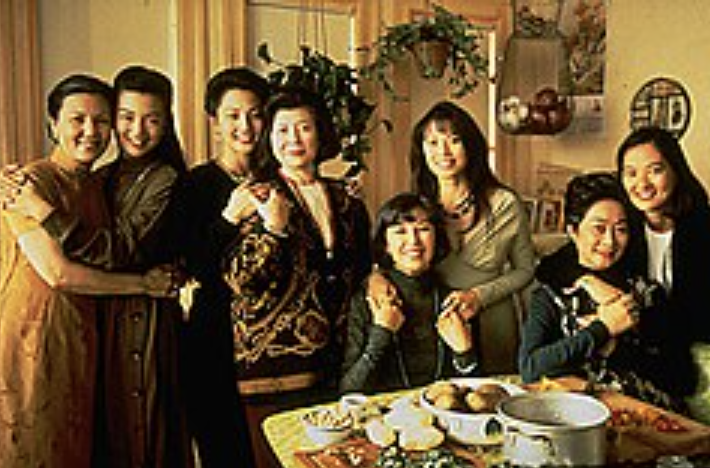
From ‘The Joy Luck Club’ movie.
Many humans like to be part of a group — whether it’s called a group, a club, an organization, an association, a society, a union, a gang, etc. Sometimes official, sometimes casual, often positive, occasionally negative, these groups offer camaraderie, a place for shared interests, strength in numbers, networking, etc. — with possible internal tensions in certain cases due to jealousy, different views, and so on.
I thought of groups last week when my application for membership in the Cat Writers’ Association was accepted after I submitted to the CWA a copy of my comedic new book Misty the Cat…Unleashed. It’s the second major organization I’m a member of, along with my longtime history as part of the National Society of Newspaper Columnists, where I was a board member from 2009 to 2023 and still copy-edit the NSNC newsletter. There’s also the wonderful blogosphere here, where I’m very happy to associate with other bloggers and commenters — including the people reading this post now.
And — you knew this was coming — groups can be a big part of some novels. Including, of course, Mary McCarthy’s The Group, about the life of eight friends after college. Another book with a gathering of people literally in its title is the World War II novel The Guernsey Literary and Potato Peel Pie Society by Mary Ann Shaffer and Annie Barrows.
Also a group-focused novel with a WWII theme is Fannie Flagg’s The All-Girl Filling Station’s Last Reunion, about a cadre of women pilots.
Moving backward in time to World War I, we have the spy ring of women in Kate Quinn’s The Alice Network.
We also have the secret society in Dan Brown’s The Da Vinci Code and the group of immigrant Chinese-American women who form The Joy Luck Club that gives Amy Tan’s novel its title.
Unions? We see them — or more ad hoc labor groupings — in such novels as Emile Zola’s Germinal, Jack London’s Martin Eden, John Steinbeck’s The Grapes of Wrath, Ken Kesey’s Sometimes a Great Notion, and Kristin Hannah’s The Four Winds.
Of course, groupings can be sinister, as with the Mafia guys in Mario Puzo’s The Godfather and the vicious 19th-century western gang of white guys in Cormac McCarthy’s Blood Meridian.
Any examples of, or comments about, this theme you’d like to offer?
My comedic new 2024 book — the part-factual/part-fictional Misty the Cat…Unleashed — is described and can be purchased on Amazon in paperback or Kindle. It’s feline-narrated! (And Misty says Amazon reviews are welcome. 🙂 )
In addition to this weekly blog, I write the 2003-started/award-winning “Montclairvoyant” topical-humor column every Thursday for Montclair Local. The latest piece — about yet another lawsuit against a township official, incompetence that led to the hacking of the municipal computer system, and other topics — is here.
 Dave Astor on Literature
Interesting and insightful article. Thanks for sharing!
LikeLiked by 1 person
Thank you very much, The Introverted Bookworm! 🙂
LikeLiked by 1 person
Lord of the Flies, Miss Brodie’s ‘set’ -Innocent fun on the fells and in the lakes for the imperialist* Swallows and Amazons, including the seven year old who couldn’t swim ? Better drowned than duffers ? Hint of eugeniucs in there ? Arrest their parents at once, charge them with child neglect
LikeLiked by 1 person
Thank you, Esther! Great examples of groups, all of which can make a reader uneasy and more. Vividly described! 🙂
LikeLike
Dave, your blog is an especially favorite group of mine. Thank you, for yet another insightful while remaining captivating post. 😃💕👏👏
LikeLiked by 1 person
Thanks so much for your very kind words, Carolyn! 🙂 I really appreciate them! I guess blogs about literature can be book clubs of sorts. 🙂
LikeLiked by 1 person
Hi Dave,
Despite being a big Stephen King fan, I only recently-ish read “It” for the first time. I wasn’t a big fan of the book, but I loved the idea of a group of misfit teenagers who called themselves The Losers.
And that got me thinking of other Stephen King groups. In “The Dark Tower” ka is the force that drives the world that Roland the last gunslinger is from. Tet is a group of people, so Ka-Tet is a group of people brought together by fate or destiny.
“The Stand” is about a virus that nearly ends mankind because people won’t just bloody wear a mask when they go out! Well, no, I might have made up that last part. But not a lot of people survive, and the ones who are immune (who don’t go to the dark side) call themselves The Free Zone. I’m pretty sure it’s because you can get vaccines there free of charge, but it has been a while since I read it so may be misremembering.
Sue
LikeLiked by 2 people
Hi, Sue! Thank you for your great, interesting take on various groups in Stephen King novels! I particularly enjoyed your masking/vaccine/Covid references/humor. 🙂 King was even more prescient in “The Stand” than we thought. 🙂
LikeLiked by 1 person
They called themselves “The Grand Dames”.
They were four women, and they all lived on Grand Avenue.
Of course I’m talking about Joy Fielding’s NYT best seller “Grand Avenue”.
I figured this would count, as there were 4 women in The Joy Luck Club”.
This is my contribution to this weeks topic.
Congratulations on getting into a Cat Writers Club! Way 2 go! Misty must be proud!
LikeLiked by 2 people
Thank you, Resa! 🙂 Misty is indeed happy about the CWA, and is aware that it has nothing to do with the CIA. 🙂
“Grand Avenue” is a terrific mention! My favorite Joy Fielding novel, and that’s saying a lot. (Because all her books are very good.) “Cul de Sac” is my second favorite of hers so far.
LikeLiked by 2 people
Yes, “Cul de Sac” has a lot of relevance in today’s USA.
Have you read “The First Time”? It’s another departure from Joy’s suspense writing.
I am hard pressed to pick a second between”Cul de Sac”, “The First Time” and “See Jane Run”.
“Grand Avenue” is my ultimate fave, too!
LikeLiked by 2 people
Very true about “Cul de Sac” and its current relevance. I still need to read “The First Time” and “See Jane Run”!
LikeLiked by 2 people
You probably will, eventually! 🤗
LikeLiked by 2 people
I’d like to! 🙂
LikeLiked by 2 people
🙂🙂
LikeLiked by 2 people
🙂
LikeLiked by 1 person
Hi Dave, a great discussion this week. Congratulations on your club acceptance. It’s always nice to belong to like minded groups. I have been bursting to add The Pickwick Papers by Charles Dickens and I am very glad that no-one else (I saw) mentioned it. There is also Little Women which featured clubs. You may recall that The Mammoth Hunters (one of the Earth’s Children books – I think three) had clubs (two kinds actually – one for bashing people and one for groups). It was through a club that Ayla learned how to make white leather using human urine. So interesting.
LikeLiked by 4 people
Thank you, Robbie, for all those GREAT examples — all from novels I’ve read. 🙂 Clubs ranging from prehistoric times to the 19th-century — love it! 🙂
LikeLiked by 1 person
Thank you for the thought provoking article. I like to think about books I’ve read that fit your requirements for the week.
LikeLiked by 2 people
Glad you liked the post, Robbie! 🙂
LikeLiked by 1 person
There are certainly unnumerous books, which concentrate on groups of people or animals, Dave! Ages ago I read “Group portrait with lady” by Heinricht Böll. The main character is Leni Pfeiffer, who fights together with her neighbours against the demolition of her apartment and together with her son she becomes the center of a counter-revolutionary group, which fights against Germany’s dehumanizing past under the Nazis. The writer won the Nobel Price. Thank you very much for your challenging idea!
LikeLiked by 4 people
Thank you, Martina! “Group Portrait with a Lady” sounds like a fascinating, compelling novel — now on my to-read list. VERY well summarized by you. And “Group” in the title!
LikeLiked by 3 people
:):)
LikeLiked by 2 people
🙂
LikeLiked by 1 person
Hi Martina, I hope you are well. Thank you for another wonderful book recommendation. I hope you are getting some lovely summer weather.
LikeLiked by 3 people
I’m touched by your question, Roberta, and can confirm you that I’m quite ok but getting older every day. Unfortunately the weather here in the South of Switzerland hasn’t been good at all in these last months and a few days ago the heavy rain in the Maggia valley and surrounding provoked a real disaster, whole villages were completely distroyed!
Heinrich Böll pubblished the book I mentioned in 1971 and it concerns the period around the second world war. The writer speaks about the individuals in that society, and the consequences it had on them in their everyday lives.
LikeLiked by 2 people
Very sorry about that awful weather, Martina. 😦
LikeLiked by 2 people
I understand. My elderly aunt aged 89, collapsed last week Saturday. Fortunately, she called me before it happened. I had to take her to the emergency room and she was in UCI in the hospital for 6 days and then on the ward for a few days. I discharged her yesterday and she is now at my house. Mom and I will look after her between us. It’s not easy getting old and family support is very necessary for good health and happiness. I am really sorry to hear about the disasters in Switzerland, that is very bad. Those poor people. The weather has been very wet in the UK too. In South Africa, we are having a drought and that is also horrible. Thanks for the author’s name. I appreciate it. Hugs and keep well.
LikeLiked by 2 people
It’s really great to still have such a niece like you and your mother in the surrounding to help, Roberta! There are certainly also interesting books speaking about the pro/negative sides of having the family nearby!!
And yes, the drought in South Africa is as much a problem as the rain and moorland in our part. Does man understand that changes in our way of living are necessary?
Hope you will enjoy it and wish you all the best in the meantime!
LikeLiked by 2 people
stly congrats to you two on joining the CWA. Secondly what a great topic. Groups of any sort offer so many personalities, scenarios,, possibilities. In reading terms it can even go back to our childhoods. Certainly when I was growing there were authors like Blyton–who i didn’t especially like–but who would churn out endless series on groups of children who never seemed to age, going on holiday year after year and encountering some mystery. I see a comment re the special girls in Jean Brodie. There’s also the boys in Lord of the Flies. Islands and school settings offer tremendous scope for groups–Robinson Crusoe obviously didn’t–as do clubs. The Joy Luck one is an an amazing book. And I remember reading the Group way back.
LikeLiked by 5 people
Thank you very much, Shehanne, for the comment and the congratulations! 🙂 Misty would like to attend a CWA gathering if the hotel room has a mini-fridge filled with treats. 🙂
Yes, groups can be endlessly interesting — and offer plenty of fodder for fiction. Including, as you note, groups of children who can be wild cards in terms of behavior given that they’re still learning social interaction and other things. Of course, many adults aren’t exactly mature, either. 🙂
LikeLiked by 2 people
Well Dave, I was going to add that I wonder if groups are so popular cos we see/don’t want to see/ know but then again don’t know ourselves, as a certain member of that group. We identify. But equally if challenged, we might not be that person at all. It is still good to have the belief. But also it is the trials the tribulations we also identify with and the getting through things that all count.
LikeLiked by 2 people
Excellent observations, Shehanne! Associating with a group is certainly among the things that help a person get a better sense of who they are.
LikeLiked by 2 people
A great mention, Shey – Lord of the Flies. A profound unforgettable read!!!
LikeLiked by 4 people
So’s Mutiny on the Bounty, Rebecca xxxxxxxxxxxxxxxxxxxxxxxxxxxxxxxxxxxxxxxxxxxxx
LikeLiked by 2 people
Yes!!!! Mutiny on the Bounty was a favourite of mine, Shey. I was 14 when I read it. Some of these passages were difficult for me to endure so I had my mother read those parts to me. I also read Pitcairn Island – another difficult but important read for me. I have yet to take on the third book in the series.
LikeLiked by 2 people
I watch the space Rebecca, xxxxxxxxxxxxxxxxxxxxx
LikeLiked by 2 people
I agree, Rebecca, that grim pig’s head is unforgettable.
LikeLiked by 3 people
Hi Shey, I must admit, I loved Enid Blyton. I was going to mention her books in my comment, in particular, The Famous Five and The Secret Seven which both comprised clubs or groups of children. Of course, she had many other books such as Mallory Towers and the St Clair’s series. I think she was an extraordinary writer and I believe she published 720 books.
LikeLiked by 3 people
720!!!! That even beats Isaac Asimov (500 or so).
LikeLiked by 1 person
I know, it’s incredible. But, she wasn’t a very good mother according to articles I’ve read. She just wrote and ignored her family.
LikeLiked by 3 people
Sad. 😦 To write 720 books, an author would have time to do virtually nothing else.
LikeLiked by 1 person
That’s right!
LikeLiked by 1 person
Yeah. Have you seen the TV series Enid? Helea Bonham Carter played her. I think Dave hits the nail in the comment below.
LikeLiked by 2 people
HI Shey, no, I don’t watch much TV but I have read about her life and her poor relationships with her children and ‘treachery’ (my word) towards her husband. She doesn’t seem to have been a nice person, but neither was Roald Dahl. It’s best not to delve into the lives of authors you like – ignorance is sometimes bliss.
LikeLiked by 1 person
She did indeed and she also had a small set about 3 chidlren, two cousins and a pal,(the Barney mysteries) who did not solve as many mysteries as the famous or secret bunch but I really enjoyed them. And I read some of her Mallory and St. Clare’s books. She contributed significantly –whatever anyone ses– to children’s literature. With me, it was doubtless down to reverse snobbery–lol–growing up in one of the hardest areas of the city. And again, reading some of the children’s stories where all the toys came to life and talked, to my kids–obviously work dates. But she was the first who came to mind when I thought of groups and books that had made me aware of groups.
LikeLiked by 3 people
I understand your reverse snobbery comments. My cousin in London asked me why I read books about spoiled rich English kids who went to boarding school, but I loved the books. I remember the Barney books. Barney had a monkey called Miranda.
LikeLiked by 1 person
Gosh I had forgotten that xxxxxx I guess while books are escapism, sometimes the reality intrudes and yo9u think what do I avhe in common here. xx
LikeLiked by 1 person
I loved the escapism, so it never bothered me. I read a very wide variety of books as a child.
LikeLiked by 2 people
Same here. Probably the local library in fact
LikeLike
The Cat Writers’ Association seems to be a worthwhile organization with a variety of writers as members. Congratulations on becoming one of them!
LikeLiked by 2 people
Thank you very much, Audrey! 🙂 The CWA does seem like a pretty impressive group.
LikeLiked by 2 people
I read “Dune” many years ago. I only remember how precious water was. People collected sweat and urine, I believe, and learned to drink it. I was disgusted then, but remembered the author, Frank Herbert. A couple of years ago, I found Herbert’s “Hellstrom’s Hive” in the library and checked it out. I found the concept fascinating. I wouldn’t have read it, except I was in the mood for sci-fii at the time and recognized the author. The ‘Joy Luck Club’ by Amy Tan, later, gave me an interesting perspective on immigrant groups to the US and how some bond.
LikeLiked by 2 people
Thank you, Katharine! Excellent example of how a book can grow on a person during a different time in their life. And nice to hear that Frank Herbert wrote another interesting book (perhaps several) in addition to “Dune” and its sequels. Also, I agree that “The Joy Luck Club” is one of those novels that really illuminates the immigrant experience in the U.S., along with novels like Chimamanda Ngozi Adichie’s “Americanah,” Khaled Hosseini’s “The Kite Runner,” Jeffrey Eugenides’ “Middlesex,” Junot Diaz’s “The Brief Wondrous Life of Oscar Wao,” Colm Toibin’s “Brookyn,” etc.
LikeLiked by 2 people
I’ll be checking soon on “The Women” by Kristin Hannah to see if I can reserve from my library. Different subject,non fiction, Amy Tan’s “The Backyard Bird Chronicles ” has beautiful drawings of avian friends done by Ms.Tan and writing,only as she can describe on how birds are fascinating and how we are all fortunate to be able to observe their magical world.
Michele 🐦 nerd
E &P way back
LikeLiked by 2 people
Thank you, Michele! I’m also looking forward to reading “The Women.” I’ve read every Kristin Hannah novel my local library has. 🙂 SUCH a great author.
Sounds like a VERY interesting/accomplished nonfiction Amy Tan book! And I enjoyed your bird sign-off. 🙂
LikeLiked by 1 person
How about sub groups (no pun intended–hang on) like the mutineers on the Bounty or the defectors in The Hunt for Red October?
Congratulations on joining the CWA.
LikeLiked by 3 people
Thank you, Dan, for the comment and the congratulations!
Those two examples, and the wordplay introducing them, work for me. 🙂 Other interesting groupings on ships include those in Herman Wouk’s “The Caine Mutiny” and “War and Remembrance.”
LikeLiked by 3 people
Great additions, DAn.
LikeLiked by 1 person
Mutiny on the Bounty in an excellent example, Dan!
LikeLiked by 3 people
Thanks Rebecca.
LikeLiked by 2 people
Fascinating theme, Dave. An association for cat writers!? Apart from the novels you’ve already mentioned, I can’t recall other titles. Considering that every great heist, political, or international thriller depends upon a criminal gang/group, organization, or association, there are probably lots more titles available.
LikeLiked by 2 people
Thank you, Rosaliene! Seems like there’s an organization for almost everything. 🙂
Your comment’s last line is undoubtedly true; there must be many, many novels with an organizational element, whether positive or negative.
LikeLiked by 2 people
Many concatulations to you and Misty on joining CWA! I’ve really enjoyed being part of it, though I can’t fully participate due to my bad health. I didn’t really have prior experience with arts groups, except for the informal outsider artists sticking together sorts.
LikeLiked by 2 people
Thank you very much for the “concatulations,” Leah, and for recommending that I apply to the Cat Writers’ Association! I’m glad and grateful that you did! Seems like a VERY friendly group that does a LOT of things. Sorry your health prevents you from participating in the CWA as much as you’d like to. 😦
LikeLiked by 2 people
Here’s more, and I can’t believe I didn’t think of this first sooner: The Fellowship of the Ring. Nuff said. Then there’s the rebellion/resistance which grows against the brutal regime of President Snow–with ‘Mockingjay’ Kasniss Everdene as its figurehead–in ‘The Hunger Games’. Finally (for now, anyway) there’s a wonderful short story by Isabel Allende entitled ‘The Schoolteacher’s Guest’ in which a small community comes together in a collective act of covering-up an act of justice/revenge. If any more come to me–at around 3am, as is normal–I’ll be back with them. Thanks again for the thought-provoking post! 🙂
LikeLiked by 2 people
Absolutely, Laura — “The Lord of the Rings” band representing the worlds of hobbits, humans, wizards, dwarves, elves, etc.! Great mention of “The Hunger Games” trilogy, too! And your mention of Isabel Allende’s story reminded me of that community (shudder) in Shirley Jackson’s tale “The Lottery.”
LikeLiked by 2 people
I hadn’t read the Shirley Jackson tale, but I just found it online. Shudder indeed! The community act of ‘The Schoolteacher’s Guest’ is so much more positive. 🙂
LikeLiked by 2 people
Yes, Laura, a community can get together to act for good or for evil!
LikeLiked by 2 people
Which reminds me of the urban ‘religious’ community which unjustly banishes Silas Marner, who leaves and is cleansed of the resulting bitterness to find himself again in a supportive country community. 🙂
LikeLiked by 2 people
Great mention, Laura! Yes, another “religious” community not behaving very religiously. “Silas Marner” is a superb novel.
LikeLiked by 2 people
It’s a favourite of mine, so beautiful. You’ve started something with this topic, people are banding together everywhere. I expect several more examples to hit me at some point. Until then, stay well. 😎
LikeLiked by 2 people
I agree, Laura. The second half of “Silas Marner” is SO heartwarming. And you’re right that this seems to be a topic people are very interested in. Clever line about “banding together.” 🙂 Be well, too!
LikeLiked by 2 people
Another great topic, Dave , and as usual I’ll have to give it some thought. To be going on with though, I’ve just finished a re-read of Frank Herbert’s ‘Dune’ and the follow-up ‘Dune Messiah’ (reviews to be posted on my website soon). If you know it, the action is derived from the sisterhood known as the Bene Gesserit, with their programme of selective breeding aimed at the production of a ‘Kwisatz Haderach’. Jessica, one the sisters, has disobeyed orders and produced a son, Paul, rather than the daughters she was ordered to conceive. I won’t say any more, but it’s the achievements of Paul that drive the story, and the actions of a group who wish to bring him down in the second book. Enough said. I’ll have a think about some others. 🙂
LikeLiked by 2 people
Thank you, Laura! I’ve never read “Dune,” but should someday! I appreciate your skillful and intriguing plot summary. A sisterhood certainly fits this topic!
LikeLiked by 2 people
I’ve never read Dune either! So many books – so little time. Sigh!!
LikeLiked by 3 people
Yes, Rebecca, frustrating to know there are many more books than time to read them. Plus, “Dune” is always checked out of my local library. 🙂 😦
LikeLiked by 2 people
It’s a great story. I’m not one much for sci-fi, but my husband is and read this back in the 70s, not long after it was published–so I had to read it too. After seeing the films made of it recently, and finding the 6 books now out there at a special price, I had to buy them. I haven’t read them all yet, but I think the first is the best. 🙂
LikeLiked by 2 people
Some sci-fi is definitely loved by people who are not huge sci-fi fans, Laura. That would include me, too. 🙂
LikeLiked by 2 people
I turned into a Trekkie too, after ‘Dune’ opened up the world of Sci-Fi for me. 🙂 I’ve also just remembered ‘The Bacchae’, in which the new god Dionnysus and his followers arrive in town, to the detriment of King Pentheus. 🙂
LikeLiked by 2 people
I’m an avid “Star Trek” fan, too! Especially the first four TV series: the original, Next Generation, Deep Space Nine, and Voyager. I guess I’m also a bigger sci-fi fan than I think I am. 🙂
LikeLiked by 2 people
I love them too, DS9 the best. It’s incredible what we find we enjoy, when we stop to look. 🙂
LikeLiked by 2 people
“Next Generation” was my favorite — helped by Patrick Stewart’s amazing acting as Capt. Picard. But the other three were all basically a close second for me. 🙂
LikeLiked by 2 people
I guess Jean Luc made it so. 😂
LikeLiked by 2 people
LOL, Laura! 😂 I give your reference a “Number One.” 🙂
LikeLiked by 2 people
😂😂😂
LikeLiked by 2 people
🙂
LikeLiked by 2 people
Rumer Godden’s IN THIS HOUSE OF BREDE is set in a convent. Since I’m a fan of Terry Pratchett’s Discworld novels, I’ll mention his series of books about the Ankh-Morpork City Guard, which are exceptionally clever and very funny. The first one is GUARDS, GUARDS.
LikeLiked by 2 people
Thank you, Kim! Excellent mentions! Terry Pratchett is indeed quite funny and satirical. I’ve read two of his Discworld novels (“Small Gods” and “Unseen Academicals”). And I must try Rumer Godden at some point!
LikeLiked by 1 person
I thought of “. . . And Ladies of the Club.” I remember reading back in the ’80s and enjoying it very much!
LikeLiked by 2 people
Thank you, Lee! I’ve heard a lot about that book but never read it. Yes, that would definitely fit this week’s topic!
LikeLiked by 1 person
Congratulations Dave and Misty on your acceptance into the “Cat Writers’ Association” Misty the Cat…Unleashed has humour and great insights. It is a true page turner.
I am fascinated by groups because I have found that being part of a community of creative individuals enhances our creative urgency. Surrounding ourselves with like-minded people who share our passion for creativity can inspire us, spark new ideas, and push us to think outside the box. You reminded me that many literary successes came from being part of a group.
Some of the most famous literary groups that I love exploring: the Bloomsbury Group, known for their intellectual discussions and influence on modernist literature, the Inklings, a literary discussion group that included notable authors such as J.R.R. Tolkien and C.S. Lewis, and the Algonquin Round Table, a gathering of writers, critics, and actors known for their wit and humor in the 1920s. These groups played significant roles in shaping literary movements and fostering creativity among their members.
Some examples of books that include groups of people are “The Lord of the Rings” by J.R.R. Tolkien, “Harry Potter and the Sorcerer’s Stone” by J.K. Rowling, and “The Great Gatsby” by F. Scott Fitzgerald.
“So long as you write what you wish to write, that is all that matters; and whether it matters for ages or only for hours, nobody can say.” Virginia Woolf, A Room of One’s Own
LikeLiked by 4 people
Thank you, Rebecca! I greatly appreciate the very kind comment about my “Misty the Cat…Unleashed” book and the CWA congratulations! A blogger named Leah suggested here that I try to join, so many thanks to her!
So true that being part of a group can help spark creativity. Synergy and all that. 🙂
And very glad you mentioned literary groups — some quite legendary!
Excellent examples, too, including the diverse assemblages trying to save their worlds from evil in “The Lord of the Rings” and the “Harry Potter” books.
Terrific final quote, as always!
LikeLiked by 1 person
Hi Rebecca, I have a crick in my scrolling finger from searching for your comment – haha! And, I’m late to the party so you and Shey have taken all my suggestions. I was going to mention Harry Potter and Lord of the Rings. Luckily, I have a few other books up my sleeves.
LikeLiked by 3 people
😂😂😂
LikeLiked by 2 people
Grin
LikeLiked by 2 people
Foot kissing apologies Robbie. xxxxxx But we know you won’t flag.
LikeLiked by 1 person
Hahaha!
LikeLiked by 1 person
How about her “special girls” in The Prime of Miss Jean Brodie?
LikeLiked by 5 people
Thank you, Liz! Great mention! That’s a masterful novel by Muriel Spark; it reminded me a bit of Kazuo Ishiguro’s later “The Remains of the Day,” with its subtlety and allusions to fascism.
LikeLiked by 6 people
You’re welcome, Dave! Jean Brodie is a fascinatingly complex character.
LikeLiked by 3 people
She is indeed, Liz!
LikeLiked by 2 people
One of my favourite books – and the film (Maggie Smith) and even a series on BBC. I was at school then – just the right time for me – ‘one of the girls’ – not me though.
LikeLiked by 4 people
Thank you, Chris! “The Prime of Miss Jean Brodie” IS a memorable and masterful book. I can see how it could especially affect a person if they’re a student while reading it. 🙂
LikeLiked by 1 person
I also saw the movie and the BBC miniseries. I thought the BBC version was better.
LikeLiked by 2 people
I’ve seen neither, Liz, but I’m not surprised to see “BBC” and “better” in the same sentence. 🙂
LikeLiked by 2 people