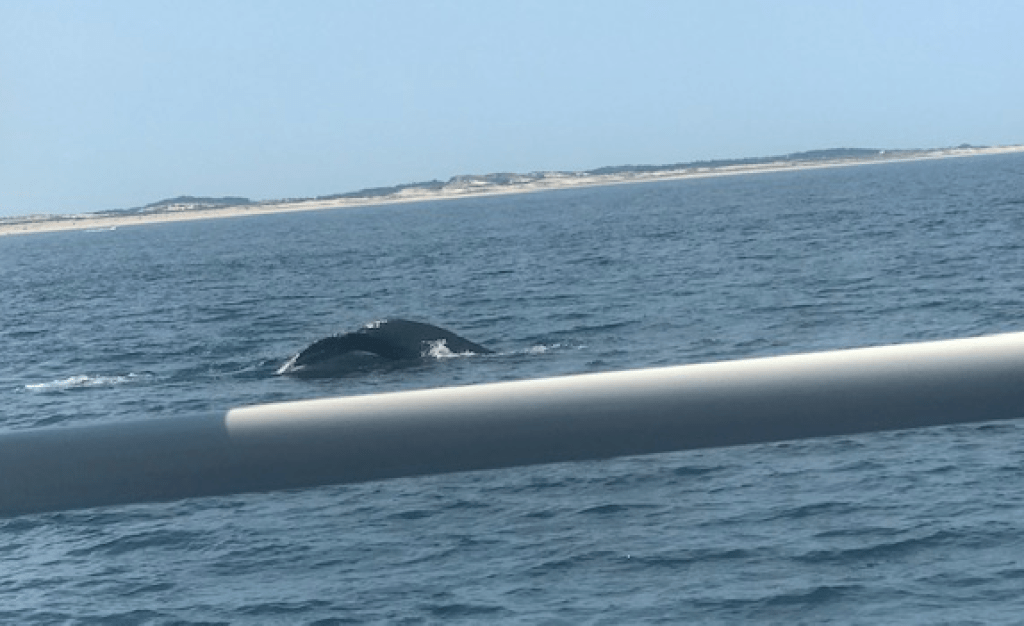
Whale sighting! (Photo by me.)
While vacationing in Massachusetts last week, my family and I visited Provincetown on August 1 to go whale-watching. We saw…whales…and I also saw the possibility of writing a blog post about an author who had a strong association with those mighty aquatic mammals.
That author of course is Herman Melville, who sailed the sea quite a bit as a young man before starting to write novels — some semi-autobiographical. He began as basically an adventure writer before getting much deeper with his fiction, even as his prose was rich yet readable from the start.
Oddly, Melville’s 1846 debut novel Typee — a partly fictional chronicle of his time in Polynesia — would be his best-selling work during his lifetime. It was followed by the pretty similar Omoo (1847) before Melville started to write in a more challenging way with Mardi. That 1849 novel had its moments, philosophical and otherwise, but overall was on the boring side.
Then came Redburn (also 1849) and White-Jacket (1850), two very good but not great sea sagas.
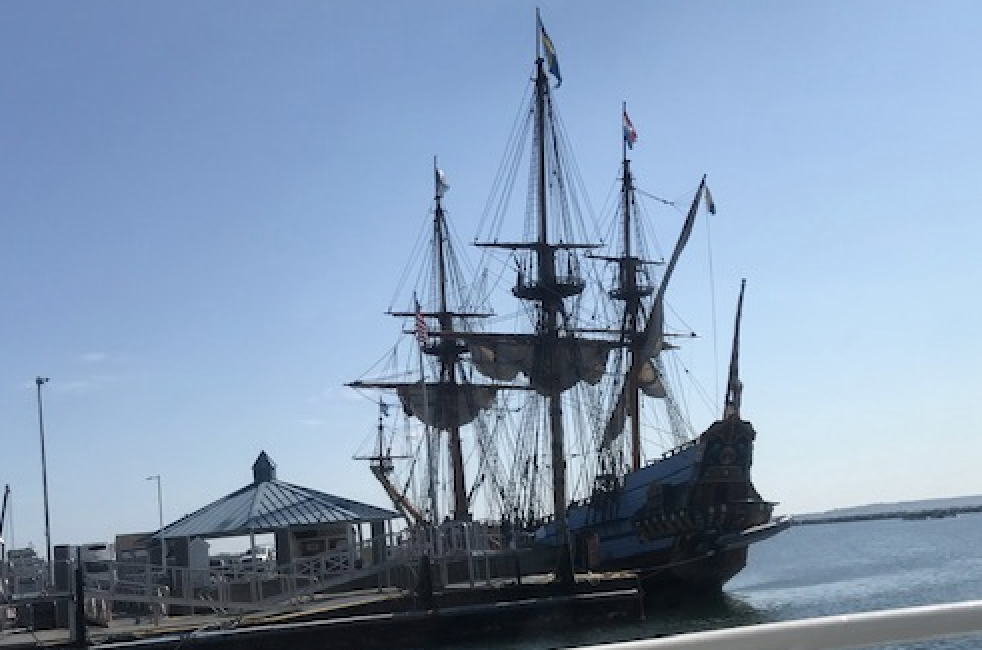
A ship in Provincetown. (Photo by me.)
The 1819-born Melville’s creative breakthrough was Moby-Dick (1851), about another epic sea voyage — this time loaded with symbolic/allegorical elements. That, along with the book’s scintillating writing and ultra-memorable characters, made for what is now considered one of the great American novels. But Moby-Dick sold poorly when published and was also unpopular with many critics — only becoming truly famous and appreciated decades after Melville’s 1891 death.
That was around the time of the posthumous 1924 publication of Melville’s final novel, the excellent Billy Budd.
At least Melville’s friend Nathaniel Hawthorne liked Moby-Dick, published a year after Hawthorne’s The Scarlet Letter — which received a much better contemporary response from readers and critics.
Melville’s bitterness over Moby-Dick‘s unenthusiastic reception was quite obvious in his 1852 novel Pierre, a land-set book (no ocean voyage) whose cast of characters includes…a bitter writer. That and the strong hints of incest in the story resulted in another sales and critical disaster for Melville, whose writing career mostly tanked at that point. Interestingly, many modern-day readers (including myself) find Pierre really compelling and way ahead of its time.
I haven’t read Melville’s novels Israel Potter (1855) or The Confidence Man (1857).
With proceeds from his writing scarce, a very unhappy Melville worked as a customs inspector in New York City from 1866 to 1885, while doing some (not exactly stellar) poetry on the side. In that inspector job, the author was known as a rare honest man in a corrupt institution.
I should also mention Melville’s 17 short stories. “I and My Chimney” is an example of how the writer was very funny when he wanted to be — as is also the case with his inn bedroom scene featuring Ishmael and harpooner Queequeg in the early land-based section of Moby-Dick.
There’s also “Benito Cereno,” a riveting sea tale (of almost novella length) about a slave revolt. Melville was rare among 19th-century authors in portraying characters of color (including the above-mentioned Queequeg) somewhat three-dimensionally.
(Speaking of Moby-Dick characters, first mate Starbuck inspired the name of a certain coffee chain.)
Perhaps Melville’s most memorable short story is the mesmerizing “Bartleby, the Scrivener.” There are few tales like it.
As I’ve mentioned before, nearly 20 years ago I visited the Pittsfield, Mass., house where Melville lived from 1850 to 1863. The window above the desk on which the author finished writing Moby-Dick has a view of a mountain that’s shaped sort of like a whale.
Any thoughts on this post, Herman Melville, and/or his writing?
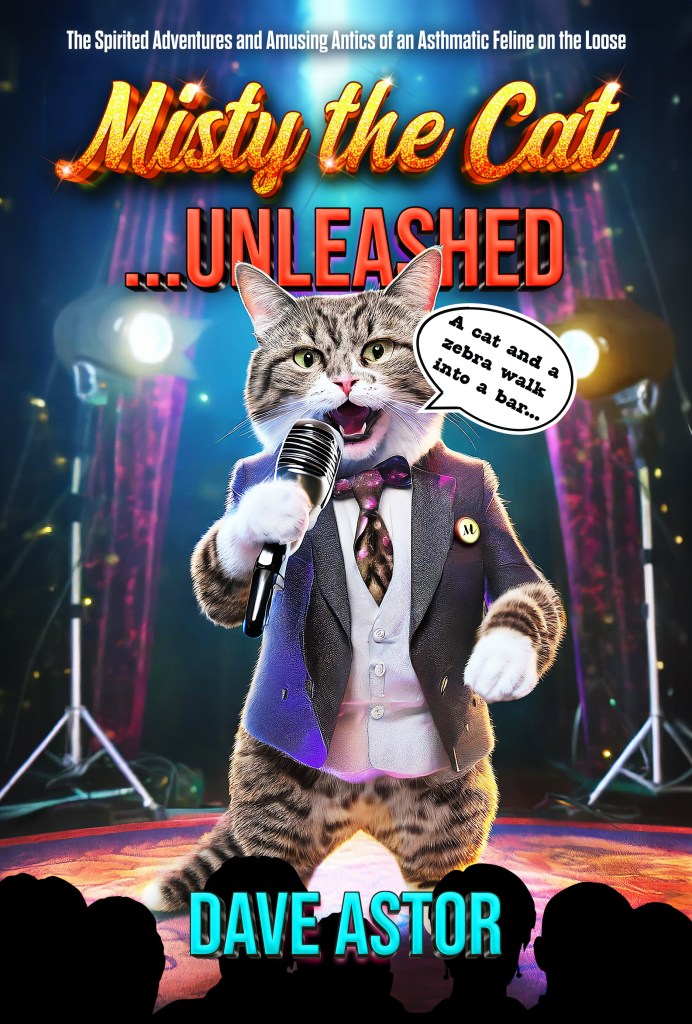
My comedic 2024 book — the part-factual/part-fictional/not-a-children’s-work Misty the Cat…Unleashed — is described and can be purchased on Amazon in paperback or on Kindle. It’s feline-narrated! (And Misty says Amazon reviews are welcome. 🙂 )
This 90-second promo video for my book features a talking cat: 🙂
In addition to this weekly blog, I write the 2003-started/award-winning “Montclairvoyant” topical-humor column every Thursday for Montclair Local. The latest piece — about an affordable-housing discussion and more — is here.
 Dave Astor on Literature
An interesting read, Dave, wish Melville would have lived long enough to see the true worth of his writing prowess. What a unique & interesting experience @ sharing the ocean with whales (I admire your adventurous spirt).
The closest I’ve been to whales are photos my daughter took on her honeymoon (An Alaskan Cruise) as they swam alongside the cruise ship. Such magnificent creatures. On a good note, it was great to read that Melville–during his 19-year stint as a customs inspector was honest in his dealings with others. Character matters.
LikeLiked by 1 person
Thank you, Gene! Yes, Herman Melville should have had a lot more well-deserved regard while alive. And much respect to him for being honest, as a customs inspector, in what was then a dishonest profession.
My whale-watching wasn’t too adventurous; we were on a pretty large boat. 🙂 Whales swimming along your daughter’s cruise ship — nice! 🙂 They ARE amazing creatures.
LikeLiked by 1 person
What a beautiful image of seeing whales in the sea. In my city we can see dolphins every time we go kayaking. The dolphins jump and play next to the boats.
LikeLiked by 1 person
Thank you, Nerja Holidays! Seeing dolphins whenever you go kayaking sounds wonderful! Fun, beautiful creatures. 🙂
LikeLike
Thanks for another great post, Dave! Loved the part about the whale-shaped mountain. Although we can never know exactly how the things a writer sees and senses found their place in the work, it’s fun to imagine.
LikeLiked by 1 person
Thank you, Donna! I share your love of that whale-shaped-mountain anecdote. 🙂 And, yes, the mental alchemy of what goes into writing is fascinating!
LikeLiked by 1 person
Always when I read, I think, but when I read Melville, I think differently.
LikeLiked by 1 person
Thank you, Anonymous! I love the way you expressed that!
LikeLiked by 1 person
Thank you for your synopsis of Melville’s life and work. For me, Moby Dick remains very high on my list of great American novels, and it’s interesting to note that it didn’t achieve its status until after Melville’s death, which makes me think of so many writers and artists who only achieved fame posthumously.
LikeLiked by 1 person
Thank you, Anonymous! Yes, a shame “Moby-Dick” didn’t get the contemporary sales and renown it deserved. It can be hard to figure those things out; there were certainly other “challenging” 19th-century novels that did well at the time.
LikeLike
Hi Dave, i must admit I have not read Moby Dick. My son, Greg, read it when he was younger. I have never felt overly drawn to that sort of book. I also haven’t ever read Treasure Island or Robinson Crusoe. I have read The Swiss Family Robinson and Coral Island as well as Lord of the Flies. It does seem to me that many great authors only become famous after they die.
LikeLiked by 2 people
Thank you, Robbie! Well, you’ve certainly read a LOT of novels — classics and otherwise; we all have some famous books we haven’t gotten to, or don’t want to get to. I’ve greatly enjoyed some seafaring novels (in addition to Melville’s work, Jack London’s “The Sea-Wolf” is among the titles that come to mind), even as some in that “genre” didn’t grab me.
Sadly, your comment’s last line is very true. 😦
LikeLiked by 1 person
Yes, it is the same with many famous artists and they died poor and unknown.
LikeLiked by 1 person
True, Robbie — the fate of too many authors, artists, and other creative people… 😦
LikeLike
Yes
LikeLiked by 1 person
I have vowed to give Melville a third chance with Moby Dick. I had to read it in high school, which meant, like every assignment from that teacher, ultimately parroting her assessment of the novel in our book reports. In an American Literature course in college, I had to read the Norton Critical Edition of Moby Dick, which I thought was the only way you could possible make that book worse. I think I’ve mentioned before, they now read Billy Budd in that course (which brings old man “in my day” comments to my mind.
I will read Moby Dick again, hopefully for enjoyment.
LikeLiked by 2 people
Thank you, Dan, for the interesting and wry comment! After two tries, it would be generous of you to make a third “Moby-Dick” attempt. 🙂 But, as you note, those first two tries were not under ideal conditions.
“Billy Budd” is certainly a more accessible novel than “M-D,” yet still pretty deep.
LikeLiked by 1 person
Hi Dave! I’ve only been whale-watching twice in my life, once off Boston and once off Vancouver Island, and both times were extraordinary and very moving. Despite being in awe of whales, I got halfway through MOBY DICK when I was seventeen, bogged down, and never tried again. I’ve never read a single Melville book. You inspire me to try!
LikeLiked by 3 people
Thank you, Kim! Glad you got to whale-watch twice, at two diverse North American locations. It IS an exciting and moving experience.
A person can definitely like whale-watching and not be a big fan of Herman Melville’s work. 🙂
LikeLiked by 1 person
As I tried to contribute some thoughts of mine to your exciting post about whale-watching experience and books in this respect yesterday, I am trying it once more today! First of all I have to admit that the personality or captain in Moby-Dick has never convinced me, because for me it’s really tragic, if we concentrate all our life just on revenge. On the other side I loved Ernest Hemingway’s “The old man and the sea”, because here, Santiago the fisher, despite of being very badly hurt, still call his adversary his brother. I also consider classics as absolut important, as Italo Calvino said, in order to compare other periods of time with our own and to think about the differences.
LikeLiked by 3 people
Thank you, Martina! Yes, not healthy to be THAT revenge-obsessed. Captain Ahab would certainly regret that, but I guess he couldn’t help it. A shame he dragged a ship’s crew into his pathology.
“The Old Man and the Sea” did have a bit more uplift.
And I totally agree that classic literature is a great way to compare previous times to our time!
LikeLiked by 3 people
I very much appreciate your opinons and only diverge with the first one in the sense that I am convinced that it takes a lifelong training in order to become able to come to grips with our emotions.
LikeLiked by 2 people
I hear you, Martina. 🙂 Many people should and do learn to have control over their emotions; Captain Ahab was not one of them.
LikeLiked by 2 people
🤣🌺
LikeLiked by 2 people
🙂
LikeLiked by 1 person
I have to admit I haven’t ready any of his works – they all seem quite intimidating! But I too have been whale spotting, back when I lived in California. It was a wonderful experience!
LikeLiked by 2 people
Thank you, M.B.! Given the busyness of our lives, we all have to pick and choose what we read. 🙂 I find some of Melville’s works to be on the dense side, with other works by him quite readable.
Great that you did some whale-watching in California!
LikeLiked by 2 people
Dave – do you believe in coincidence!!!? Well, I just learned today from an e-mail – “what happened today in the past” – that today August 5, 1850, Nathaniel Hawthorne and Herman Melville meet for the first time — in the company of Oliver Wendell Holmes and publisher James Thomas Fields — on a picnic expedition to Monument Mountain in Massachusetts. You and misty have a brilliant connection to past authors!!!
LikeLiked by 4 people
Wow, Rebecca — that IS a coincidence!!! 🙂
(Somehow I had thought Melville and Hawthorne met somewhat earlier, but I guess Melville only moved to Hawthorne’s home state of Massachusetts in 1850.)
LikeLiked by 2 people
I am beginning to believe in serendipity and coincidence when it comes to books and authors. I always thought that books had magic, but I didn’t think it was so powerful !
LikeLiked by 2 people
Yes!
I may have to reread W.P. Kinsella’s novel “Magic Time.” 🙂
LikeLiked by 1 person
Terrific tribute to an interesting writer, Dave.
Thank you!
I know of many of his works, but have only read Moby Dick.
An artist, in any genre of the arts, not making a full living from their work is a classic tale in itself.
“Whale” of a post Dave! 🤗🐳
LikeLiked by 2 people
Thank you, Resa, for the kind words and the end-of-comment humor! 🙂
You’re right that SO many (too many) authors and other creative people don’t make a full living from their books, art, music, etc. 😦
LikeLiked by 2 people
I think that’s why more don’t go into a career in the arts.
LikeLiked by 1 person
Very — and very unfortunately — true, Resa. 😦
LikeLiked by 1 person
❦
LikeLiked by 1 person
I eventually finished Moby-Dick (I only missed the chapter which listed all the whales). It was pretty good.
Also a tiny fact about the first mate called Starbuck: yes, there is a coffee chain called that, but I remember a well-known actor called Scully from X-Files, and her nickname was Starbuck too.
LikeLiked by 3 people
Thank you, Chris! Glad you liked “Moby-Dick,” at least to some extent. 🙂
Interesting bit of “X-Files” trivia! I watched that show occasionally back in the day, but hadn’t remembered the Starbuck nickname for Gillian Anderson’s Scully character.
LikeLiked by 2 people
Don’t forget the earlier science-ish fiction tribute to Starbuck: The name of the hotshot, ladies-man space fighter pilot in the original “Battlestar Galactica.” Later, the dude would be a lady in the “Galactica” remake.
LikeLiked by 3 people
Thank you, Don! I had no idea. 🙂 For whatever reason, I never saw the original 1970s “Battlestar Galactica” series. I guess my spaceship-show watching ebbed between the first “Star Trek” series and “Star Trek: The Next Generation.” 🙂
After a Wikipedia search, I see the character you’re referring to was played by Dirk Benedict, who I remember from the 1980s show “The A-Team.”
LikeLiked by 1 person
Yep,Dave, and the new Starbuck in the Galactica reboot of the 2000s was played by Katee Sackhoff. This time around, “Starbuck” wasn’t the character’s name, but her pilot call sign: Lt. Kara “Starbuck” Thrace. Yep, I’m a nerd for knowing that.
I like to say the original “Galactica,” cheesy as it was by today’s standards, helped me get through an otherwise brain-numbing eighth grade year.
LikeLiked by 1 person
Thanks for that info, Don!
The name “Starbuck” has certainly gotten around, for all kinds of characters.
Cheesy in entertainment can be good…very good. 🙂
LikeLike
Oh well, sorry about that…
I watched the ‘X-Files’ right from the start, and continued for years. I suppose that’s why I know it so well. I think I have all the series on DVD. By the way, Scully and her father have the two nicknames: Ahab and Starbuck, and I knew those before I started to read Moby Dick.😉
LikeLiked by 1 person
You are an “X-Files” expert, Chris! 🙂 And I didn’t realize that show’s creator/creators was/were kind of “Moby-Dick”-obsessed. 🙂
LikeLiked by 1 person
🤣
LikeLiked by 1 person
🙂
LikeLiked by 1 person
Thank you very much Dave for your very interesting post concerning your whale observing holidays together with your family! Maybe I do not so well remember Moby-Dick, but I know that I was disgusted by the captain’s lifelong hatred towards the white whale and his lifelong desire to take revenge. Another book, which I loved and is also about fishing is “The old man and the sea” by Ernest Hemingway. Here Santiago, despite being hurt by the big fish feels that the animal is his brother.
LikeLiked by 3 people
Thank you, Anonymous! You’re right that the revenge-obsessed Captain Ahab is not a likable character. There’s one point in the novel where he shows some vulnerability, but it’s a rare moment.
“The Old Man and the Sea” is definitely another memorable often-on-the-water book!
LikeLiked by 2 people
It’s so sad when writers are only appreciated once they’re dead! Glad to hear your whale watching was successful!
LikeLiked by 2 people
Thank you, Marie! It IS a shame when some authors don’t get their due when alive. Sometimes it’s just random bad luck; sometimes their writing is ahead of its time.
Yes, many whales made an appearance! 🙂
LikeLiked by 1 person
I loved the book In The Heart Of The Sea by Nathaniel Philbrick re the wreck of the whaling ship Essex which was also the inspiration for Melville’s Moby Dick. Indeed, it was rather heartbreaking the way whales were harvested. Makes me think of what has been done to animals for man’s comfort or needs when eventually technology surpassed the necessity for their deaths and their suffering. In addition, I am not surprised that people dislike reading Melville since his baroque style of writing can be a tedious endeavor. But what’s a sailor got to do during those long sea voyages other than write and write and write once the deck gets swabbed. I’m not saying I’m on team dislike Melville’s lit, rather I’m on team “Geezaloo, I just forgot what I read and now I’ve got to go back a few hundred pages and start over,” Ha. Susi
“Soon now, the faint tinkling of a broken filament will become another sound of another century.”
― Jane Brox, Brilliant: The Evolution of Artificial Light
LikeLiked by 3 people
Thank you, Susi! Great mention of the 2000 nonfiction book “In The Heart Of The Sea.” Reminds me that Edgar Allan Poe’s 1838 novel “The Narrative of Arthur Gordon Pym of Nantucket” was said to have been an influence on the 1851 “Moby-Dick.”
Excellent, sobering observation that whaling was VERY cruel to the poor whales — yet another example of humankind’s abysmal treatment of many animal species.
And I very much enjoyed your humorous take on reading Herman Melville’s at-times-challenging prose. 😂
LikeLiked by 1 person
OK, true confession time. I read the abridged version of Moby Dick that cut out the most boring bits about whaling. On the other hand, my dad read the unabridged version as an act of machismo.
LikeLiked by 3 people
Thank you, Liz! Ha! 😂 Smart move. I should have done that. Instead, I semi-skimmed the whale “tutorial” stuff as I eagerly tried to return quickly to the drama. As for your father, machismo or masochism? 🙂
LikeLiked by 2 people
As for my dad, a little bit of both, I would say.
LikeLiked by 2 people
Many “Moby-Dick” readers could be similarly labeled. 🙂
LikeLiked by 2 people
Promoting the idea of reading good literature puts you on the same page with Pope Francis, Dave, who just wrote a letter to future priests saying they need to read more: https://www.vaticannews.va/en/pope/news/2024-08/pope-writes-letter-on-how-literature-educates-the-heart-and-mind.html
Francis would be proud of you. Cheers, Bill.
LikeLiked by 2 people
Thank you, Bill, for the comment and the link! Very nice to know that Pope Francis is a fan of — and an advocate for the reading of — literature!
LikeLiked by 1 person
Your post tells me I really ought to read something by Melville! And your mention of Provincetown reminds me of a favourite book by Henry Beston called The Outermost House, about his experiences while living on Cape Cod. I gather the actual house was destroyed by a hurricane quite recently, however.
Whale-watching is popular here on the west coast, although sighting an actual whale is something else I have yet to do. I’m not much of a boater, but people sometimes see whales from the big ferry boats between Vancouver Island and the mainland, so maybe there’s hope.
Posthumous success is something I think about occasionally.
LikeLiked by 2 people
Thank you, Audrey! Cape Cod is definitely a great place to visit! In addition to Provincetown, we stayed in Chatham, visited friends in East Falmouth, played mini-golf in Harwichport, etc.
The water off Provincetown seems filled with whales, at least during the summer. Hope you eventually spot one or more on the West Coast!
I hear you about thinking about posthumous success — second in the rankings behind while-alive success. 🙂
LikeLiked by 2 people
Thanks Dave! This was very enjoyable to read.
LikeLiked by 2 people
Thank you very much, Anonymous! 🙂
LikeLiked by 1 person
Dave, thanks for this introduction to the work of Herman Melville. I’ve only read Moby-Dick but don’t recall being impressed with the book. It’s sad that he didn’t get recognition for his work during his lifetime.
LikeLiked by 2 people
Thank you, Rosaliene! As I and other commenters have mentioned, “Moby-Dick” evokes like and dislike. Certainly not a universally lauded novel. I happen to be in the “like” camp. 🙂 And, yes, Melville didn’t get anywhere near enough recognition in his lifetime after his initial popularity.
LikeLiked by 2 people
Your whale-watching pic reminds me of when we went on a similar trip in Iceland a few years back. I’d like to go to Monterey Bay to see them breaching the water – but as I’ve heard stories of boats capsizing when whales come up underneath or close to them I’ll probably pass! I read ‘Benito Cereno’ at university, and appreciated it for the message. ‘Moby Dick’ I read later, and I need to give it another go. I got bogged-down in all the pages of whale-facts, and then didn’t enjoy the main story. A friend studied it at university and proclaimed herself a competent whaling afterwards. I can relate to him as another writer who isn’t doing as well as they’d like in their lifetime lol, and hope that like him I’ll be famous after my decease. I shall have to read ‘Pierre’ though, it sounds as though I might like that one. Interesting post, thank you, Dave. 🙂
LikeLiked by 2 people
Thank you, Laura! Whale-watching in Iceland — very exciting! (My one visit to that country was a stopover in Reykjavik’s airport.)
Yes, the whale facts in “Moby-Dick” do bog things down a bit. A strong editor was needed there. 🙂
“Pierre” deserves to be better known. I stumbled on it at my local library when I was on a Melville reading binge more than a decade ago — and am glad I did.
Always a shame when great authors don’t reach a high level of fame until after they die. 😦
LikeLiked by 2 people
Their names live forever, I guess, but that’s not much comfort to them. 😦 I’ve found an inexpensive edition of ‘Pierre’ so will give it a go, and let you know. 🙂
LikeLiked by 2 people
Yes, little comfort in that. 😦
I hope you enjoy “Pierre”! Will be very interested to hear whether you do or not. Definitely not a “typical” Melville work.
LikeLiked by 2 people
What a fabulous experience, Dave – to see whales is the most awesome sight. No wonder you thought of Herman Melville. Your post prompted me to consider whether classics will continue to be read by new generations. Without question, reading Melville provides a deep dive into complex themes such as obsession, morality, and the human condition. His intricate narratives challenge readers to contemplate philosophical questions and explore the depths of human nature. But reading has changed considerably over the decades. What I am seeing is that classics are being restructured in gaming and visual applications.
I believe that the decline in reading classics today can be attributed to various factors such as changing educational curriculums focusing on more modern literature, the perception of classics as outdated or irrelevant, and the rise of technology leading to decreased attention spans and preference for digital media over traditional books. Classics often require more time and effort to understand due to older language styles and cultural references, which can be a deterrent for some readers seeking more immediate gratification.
BUT, despite these challenges, the value of reading classics lies in their timeless themes, enduring insights into human nature, and cultural significance that can enrich our understanding of the past and present.
So let’s keep reading classics.
I have just found an excellent book that is on the top of my reading pile by Italo Calvino, “Why Read the Classics.”
“All that can be done is for each of us to invent our own ideal library of our classics; and I would say that one half of it would consist of books we have read and that have meant something for us and the other half of books which we intend to read and which we suppose might mean something to us. We should also leave a section of empty spaces for surprises and chance discoveries.” Italo Calvino, Why Read the Classics?
LikeLiked by 4 people
I love the Italo Calvino quotation, and I agree about the Classics, which I love. I was saddened recently by a comment on an Instagram post, where the poster said she’d started a Classic but put it aside as she couldn’t understand the language. It’s a sad comment on how bad education has become. 😐
LikeLiked by 2 people
I share your sadness, Laura!!! Sigh…..
LikeLiked by 2 people
Thank you, Rebecca! A GREAT comment about the importance of the classics and why some people these days are not as interested in them as we’d like to see. I agree with your astute reasons for why that has happened.
Also, I second Laura’s opinion about the excellent Italo Calvino quote!
And, Rebecca, I agree with your description of why Herman Melville is such a deep writer in a number of his works.
LikeLiked by 1 person
LikeLiked by 2 people
How very well said, Anonymous – “so that we can reflect more”. I have learned over the years that reading is not a simple exercise. (And I continue to learn) Words and stories evoke responses – both physically and mentally. I find that I become intertwined with the narrative and the author. We owe a debt of gratitude to the writers and storytellers past and present.
LikeLiked by 1 person
Hello Rebecca, I think that classic books and poetry have always only appealed to selected readers who are more academic for want of another word. People who have a deeper appreciation of the written word. Prior to ‘Penny Dreadfuls’ (Penny Dreadfuls in Victorian England: On its Origin & Importance (highonbooks.co)) many working class people didn’t read at all. Penny Dreadfuls did encourage a much wider audience to read even if the books weren’t very highbrow literature. There will always be readers who just want to relax and enjoy some escapism and other readers who want to be mentally challenged on a higher level.
LikeLiked by 2 people
Agree with your comment, Robbie!
Whether people read “literary” books or “mass-market” books, I’m glad they’re reading. I like toggling between the two. 🙂
LikeLike
I read Indie books and classics. I rarely read traditionally published best sellers although I make some exceptions like The Second Mrs Astor and Hotel on the Corner of Bitter and Sweet.
LikeLiked by 1 person
A great mix, Robbie! And I really enjoyed “Hotel on the Corner of Bitter and Sweet” after you recommended it.
LikeLike
It’s a great book!
LikeLiked by 1 person
Yes!
LikeLike
Thank you Robbie – you brought up excellent thoughts that prompted me to explore the statistics on reading and literacy, which are sobering indeed. Reading is a precious gift and books and stories at the source of creative freedom.
LikeLiked by 1 person
People are all different. When I was at school, certain ‘lessor’ books like Agatha Christies didn’t count as proper books for our school reading record purposes. By the time my sons went to school, anything went as reading material, even comics and graphic novels which surprised me.
LikeLiked by 2 people
Well Dave, what an excellent post. You brought Melville to life for us. I am ashamed to say I have only read Billy Bud. I have always taken one look at Moby Dick an thought…nah but you have quite sold it to me, so there you go.
LikeLiked by 3 people
Thank you very much, Shehanne!
“Moby-Dick” has its ebbs and flows, and is certainly not loved by everyone. If you do read it, I hope you end up being an “M-D” fan. 🙂
LikeLiked by 2 people
I hope so too.
LikeLiked by 2 people
🙂
LikeLiked by 2 people
I am glad that you read Billy Budd, Shey! Everyone thinks that I am somehow related to him!! LOL!!!
LikeLiked by 2 people
Ha, Rebecca! 😂 Is Billy Budd’s relationship to you “second sailor, once removed”? 🤔
LikeLiked by 2 people
You always make me laugh Dave!!! Thank you!
LikeLiked by 2 people
🙂
LikeLiked by 2 people
LOVE it xxxx
LikeLiked by 2 people
Maybe I should have asked…are you??? LOL
LikeLiked by 2 people
Ha, Shehanne! 😂
LikeLiked by 2 people
😂😂😂
LikeLiked by 2 people
I am sure he really meant to write about Becca Budd.
LikeLiked by 3 people
😂
Herman Melville’s fiction could have used a few more female characters…
LikeLiked by 2 people
Exactly. That is why I have not truly embraced Herman…
LikeLiked by 2 people
Indeed he was fortunate I read that Billy book
LikeLiked by 2 people
Shehanne, not enough female characters was a definite drawback to Herman Melville’s work — as was also the case with Mark Twain, Cormac McCarthy, and some other authors. Male-character-centered writers had some exceptions in their fiction, but…
LikeLiked by 2 people
Yep. . . . .
LikeLiked by 2 people
Oh this is a very interesting topic, Shey and Dave. I have wondered why male writers often struggle to develop female characters in their narratives. Perhaps they don’t fully understand women’s experiences and perspectives and are worried that they will create stereotypical or one-dimensional portrayals. And of course there are the societal influence and ingrained biases. On the flip side, do women know how to create well-developed male characters? And this is why I stand in awe of writers. Writing is not for the faint of heart. My gratitude to writers, which include you both, for the stories that you share that give enjoyment and meaning to my life.
LikeLiked by 2 people
Thank you, Rebecca, for those astute thoughts! Many male authors do seem to feel more comfortable creating male characters, for reasons that include being able to relate to those characters’ experiences more. But, heck, writing fiction is at least partly an act of imagination — and male authors do have spouses, mothers, sisters, daughters, etc., for fodder and insight purposes. To be fair to Herman Melville, he did set much of his fiction on ships — certainly a male-dominated world in the 19th century.
LikeLiked by 2 people
Rebecca, I think that is very true. re experience actually. Personally as a woman I have only found a handful or male writers who can get under the female psyche, so I assume it is the same in reverse. I mean I can think of many who can snapshot a scene of traits and irritations if you like, but to me that is a diff thing.
LikeLiked by 2 people
Great post!
I loved your photos very much and I really appreciated the promo video of Misty the Cat
LikeLiked by 3 people
Thank you very much, Luisa!
Provincetown (the town and its surrounding waters) is a great place for photo-taking. 🙂
Glad you enjoyed the Misty promo video! I thought the guy who voiced it did an excellent job.
LikeLiked by 2 people
I agree: he did a great job!
Thanks a lot for your lovely reply, dear Dave
LikeLiked by 1 person
You’re welcome, Luisa! And thank YOU for your very nice response. 🙂
LikeLiked by 1 person
My sincere pleasure, dear Dave 🙏
LikeLiked by 1 person
🙂
LikeLiked by 1 person
I am drawn to seafarers’ tales, and Moby Dick was one of my all-time favorites. “The Rime of the Ancient Mariner” was another, by Coleridge, I believe a contemporary of Melville. But I would have to fact-check myself, because I am constantly jerked around by AI’s methods of channelling infomation in accordance with its own priorities.
LikeLiked by 3 people
Thank you, Katharine! Sea novels can definitely be compelling — also including Edgar Allan Poe’s “The Narrative of Arthur Gordon Pym of Nantucket,” Jack London’s “The Sea-Wolf,” Herman Wouk’s “The Caine Mutiny,” Patrick O’Brian’s “Master and Commander,” etc.
LikeLiked by 2 people
Thanks for the tips. I wish I had time to read, but Real Life interferes with concentration. My nephew advocates for reading aloud. It’s good exercise for mind, memory, and verbal skills. Of course he’s right, but I’m lazy.
LikeLiked by 2 people
Real life can indeed reduce reading time and concentration.
Reading aloud is not my thing, either, but there are certainly fans of that, as you note. 🙂
LikeLiked by 2 people
I remember to do it, sometimes . . .
LikeLiked by 2 people
🙂
LikeLiked by 1 person
My friend Ted suggested we read Moby Dick and discuss. I could not get into it but he slogged through (his description). I think I am not Melville’s intended audience, and I am ok with that. I find it interesting when i read references to Moby Dick in other works, usually young people who are fascinated by one of the characters.
LikeLiked by 2 people
Thank you, Madeline! While “Moby-Dick” does have its “sloggy” moments, I found the great moments dominated. But, yes, the novel evokes a wide range of “like it” and “dislike it” reactions.
LikeLiked by 1 person
I really must catch up with HM.
Moby Dick was really stand-out.
LikeLiked by 3 people
Thank you, Anonymous! Definitely some gems among Melville’s non-“Moby-Dick” work!
LikeLiked by 1 person