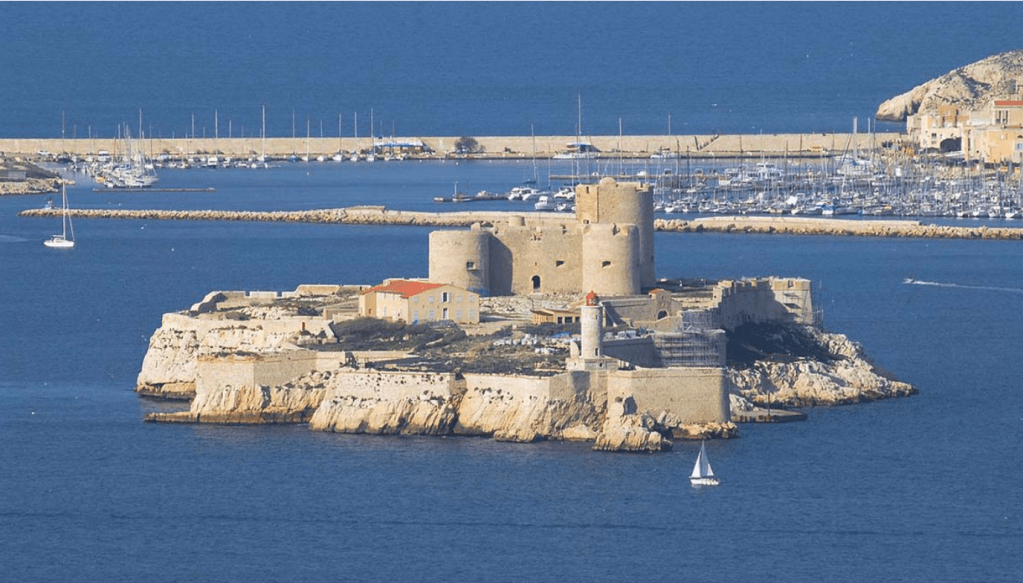
The Chateau d’If, where Edmond Dantes was imprisoned in The Count of Monte Cristo.
Betrayal is a Harold Pinter play, and betrayal in novels is the subject of this blog post.
Literature with a betrayal element can make for intense reading. We feel sympathy for the betrayed, anger at the person doing the betraying, curiosity about whether the betraying person will get their comeuppance, and more.
The Bad Daughter, a Joy Fielding novel I just finished, includes plenty of betrayal — most notably perpetrated by a vile real-estate developer who betrays his son by marrying that son’s fiancée and at the same time betrays one of his daughters because that fiancée was also the daughter’s best friend. Is the father’s betraying action why he gets shot in the book? The Bad Daughter is a suspenseful page-turner with several skillful red herrings, but is unfortunately marred by a surprise ending that doesn’t feel believable.
Another nasty/betraying dad not respectful of boundaries is Fyodor Karamazov, who’s enamored with the same woman (Grushenka) his son Dmitri is in love with in Fyodor Dostoevsky’s The Brothers Karamazov.
Monumentally betrayed is Edmond Dantes, who’s framed for a crime he didn’t commit in Alexandre Dumas’ The Count of Monte Cristo. A long imprisonment and epic revenge ensue.
Another 19th-century classic containing a memorable betrayal is George Eliot’s Silas Marner, whose title character is done wrong by his supposed best friend. This devastates Silas and changes the trajectory of his life in two profound ways — one bad and one good.
Modern fiction offers many other betrayals in addition to those in The Bad Daughter. For instance, the title character in Toni Morrison’s Sula and Nel are best friends when growing up, but Sula later has an affair with Nel’s husband. In Khaled Hosseini’s The Kite Runner, a cowardly Amir betrays his friend Hassan by not intervening when Hassan is attacked — and Amir’s longtime guilt subsequently drives the plot. Ian McEwan’s Atonement features a teen girl who betrays her older sister and that sister’s boyfriend by not-so-mistakenly accusing him of a rape he didn’t commit.
Betraying one’s country is also a thing, as Benedict Arnold did during the Revolutionary War. Arnold is among the real-life American notables who have cameos in Diana Gabaldon’s (mostly) 18th-century-set Outlander series.
Any thoughts about, and/or other examples of, this theme?
By referencing a memoir during his leashed walk this morning, Misty the cat doesn’t betray book readers. (Alternate quip to the one on YouTube: “From Kazuo Ishiguro’s The Remains of the Day to Misty the cat’s The Remains in the Bray.”)
My comedic 2024 book — the part-factual/part-fictional/not-a-children’s-work Misty the Cat…Unleashed — is described and can be purchased on Amazon in paperback or on Kindle. It’s feline-narrated! (And Misty says Amazon reviews are welcome. 🙂 )
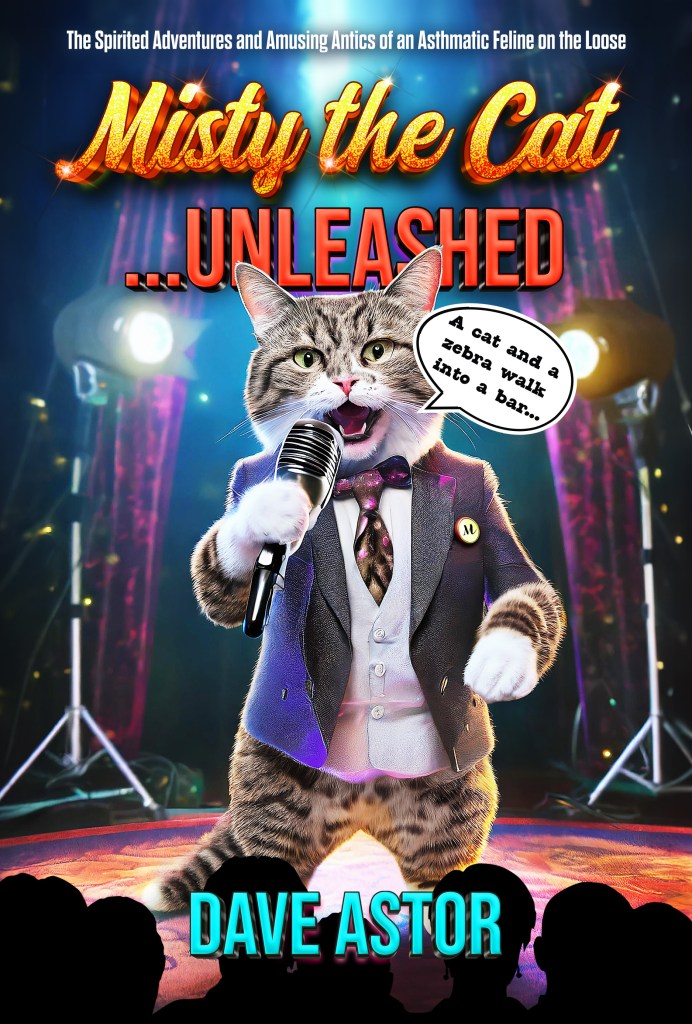
This 90-second promo video for my book features a talking cat: 🙂
In addition to this weekly blog, I write the 2003-started/award-winning “Montclairvoyant” topical-humor column every Thursday for Montclair Local. The latest piece — about Columbus Day vs. Indigenous Peoples’ Day, and with more about a possible moratorium on artificial-turf fields — is here.
 Dave Astor on Literature
“The Darkness at Dawn” is a historical novel by Pamela Roberts Lee that delves into the moral complexities and personal conflicts of early New England settlers. Set in 1634, the story begins with a ship of Puritans enduring a fierce storm en route to Boston. Among the passengers are 13-year-olds John Lee and…
LikeLiked by 1 person
Thank you, Pamela, for the mention of your novel! Sounds very interesting! Early New England settlers definitely had some “moral complexities,” as you note.
LikeLike
I appreciate the opportunity. I’ll take some time to review the details.
LikeLiked by 1 person
★★★★★★★★★★★★★★★★★★…8830stars
LikeLiked by 3 people
Thank you, admin226bc619d9!
LikeLike
Edward dantes was really a good person…his love was stolen by his best friend. Because they bothe really lovew each other (the lovers)
LikeLiked by 2 people
Thank you, perfectlyf5ee990945! You’re right that Edmond Dantes was a very good person. After he was framed and imprisoned, he of course understandably became an avenger, but still a good person.
LikeLike
Hi Dave! The Kite Runner has an unforgettable betrayal!! Brilliant book. Great post!!!
LikeLiked by 2 people
Thank you, Sharon! “The Kite Runner” does indeed have that. A pretty incredible book for a debut novel.
LikeLiked by 1 person
I agree Dave! A very incredible book for a debut!!!
LikeLiked by 1 person
🙂
LikeLike
Ah, The Bad Daughter not my fave Joy book, but still an enjoyable read, until like you say, the ending.
So, betrayal? Tale of Two Cities – Would Doctor Manet’s uncle Marquis Evremonde, who had Manet imprisoned for his (Evremonde’s) crime count?
On another betrayal –
I must tell you, that I watched the new Misty clip… Remains of the Bray .
When it was over, an image of an unhinged trump appeared.
I watched it again, hoping for a better remain of the bray, but no, unhinged trump was there, again.
Misty might want to launch a lawsuit!
LikeLiked by 2 people
Thank you, Resa! Until the ending, I felt “The Bad Daughter” was in the neighborhood as being one of Joy Fielding’s “A” novels. I guess even an excellent author doesn’t always “stick the landing.”
I read “A Tale of Two Cities” so long ago that I can’t remember the detail you refer to. 🙂
Ha! 😂 I suppose the dumpster reminded you of Trump? 🙂 Then there’s all the braying that narcissistic psychopath does…
LikeLiked by 1 person
Joy… well, no one is perfect. Although her novels are pretty consistent.
Yes… drumpster. Best to the US & the entire world in 2 weeks!
LikeLiked by 1 person
True, Resa, that Joy Fielding’s work is consistently excellent.
Thanks for the best wishes for November 5! The U.S. — and, as you note, the world — might need them…
LikeLiked by 1 person
🤞
LikeLiked by 1 person
Thank you Dave, for the many wonderful books about betrayal you presented us here. Maybe we can also add “The Remains of the Day” by Kazuo Ishiguro to this category because Stevens had been unshakably loyal to Lord Darlington, who in fact berayed him?
LikeLiked by 2 people
Thank you, Martina! “The Remains of the Day” and its betrayal element is a terrific mention! Such a great, subtle novel.
LikeLiked by 1 person
I must mention ‘The Prime of Miss Jean Brodie’ by Muriel Spark. That wonderful (yet floored) schoolteacher who called her ‘special girls’ – the crème de la crème – and her pupil Sandy’s betrayal.
LikeLiked by 2 people
Thank you, Chris! An excellent mention of a memorable novel! The interaction/relationship of teacher and students in Muriel Spark’s book was fascinating.
LikeLiked by 1 person
If you want to have a real life experience with betrayal, try to get involved with airbnb managers. We happen to have a little holiday rental, have got 3 different managers over the last 5 years, and ALL of them were cheating on us. When you point out the discrepancies between the utility bills and the occupancy, “It’s the cleaning lady who forgot to turn off the electricity” or something in that line … And oh oh when something breaks down: they don’t know any plumber, electrician, or whatever …. I am like 2000 miles (or more) away and have to fix it because well … I am the landlord. Airbnb guest breaks something? You get charged. Why? They don’t want to deduct it from the damage deposit because the guest could write a nasty review which would damage their “super host” status. Once tried to make an agreement that I would run the page and they deliver concierge service, but none of them wanted to take it. Why? If I would have to guess it’s because that way they can’t cheat on me.
LikeLiked by 2 people
Thank you for the comment, Shaharee. Very sorry about your experiences with airbnb managers. Sounds terrible. 😦 (My limited experiences with airbnb properties was renting one in 2018 and visiting one where relatives were staying last year.)
LikeLiked by 1 person
I wonder if someone wrote a book about it. Sometimes I have the impression that all those people involved in real estate first followed some course in how to cheat on you. It will of course not be into the official curriculum of said course but just delivered between nose and lips in sentences like ” And don’t do this or that because it might be legal and very profitable but it’s highly unethical”. That’s like saying to a ten years old old “Don’t climb into that tree”. Guess what will be their next move when they think that nobody is watching him.
LikeLiked by 2 people
Real estate and cheating do often go together. 😦 As for climbing trees, a real-estate person might be interested in the treehouse. 🙂
LikeLiked by 1 person
Hi Dave, betrayal is a good topic for a book. I have also read The Count of Monti Christo which is a beautiful and riveting book. I would add The Scarlett Letter because Hester and her child are effectively betrayed by her lover and his betrayal drives him mad. Another betrayed woman was Tess from Tess of the d’Urbervilles. She was betrayed by her father and by her rapist.
LikeLiked by 3 people
Thank you, Robbie! Great observation that there was betrayal (among other dramatic elements) in “The Scarlet Letter.” And Thomas Hardy was masterful at depicting the “b” word. Last but not least, I totally agree with your opinion of “The Count of Monte Cristo.”
LikeLike
Thank you, Dave.
LikeLiked by 1 person
You’re very welcome, Robbie!
LikeLike
Absolutely!
LikeLiked by 1 person
🙂
LikeLike
This is really interesting! Harold Pinter is my favourite playwright, and the topic of betrayal definitely caught his imagination. Plus, loving the photograph — makes me want to read the Count of Monte Cristo again (or maybe I’ll just watch the movie instead!).
LikeLiked by 2 people
Thank you, Ada! Harold Pinter was indeed an impressive playwright.
And I agree about that photograph! I visited the Chateau d’If in 2007 (during a trip to Aix-en-Provence and Marseille); it’s quite a haunting/memorable place that definitely increases the appreciation of Dumas’ riveting book.
LikeLiked by 2 people
I just finished reading The Storied Life of A.J. Fikry by Gabrielle Zevin. Directly related to someone betraying their marriage vows, another betrayal took place, having far-reaching effects…both positive and negative. I don’t want to name names as spoilers:) Zevin is a wonderful author, which I discovered when reading Tomorrow and Tomorrow and Tomorrow for library book club. I enjoyed this one equally.
LikeLiked by 3 people
Thank you, Becky! “The Storied Life of A.J. Fikry” and Gabrielle Zevin’s work in general sound excellent! If one really likes two books by an author, she or he is a keeper. 🙂
LikeLiked by 2 people
I agree, Dave!
LikeLiked by 1 person
🙂
LikeLiked by 2 people
This is a great topic — it reminds me of a series of storytelling videos that I saw a while ago. Maybe the series was on YouTube, but I can’t remember exactly. Anyway, the series included betrayal among the strong storytelling ingredients — along such stuff as the hero’s journey and finding allies to beat the villain. And betrayal can really pack a punch in a story. Also, thanks for including the video of Misty spotting the dumpster 🙂
LikeLiked by 2 people
Thank you, Dave! Sounds like a great series of videos you’re remembering! You’re right that betrayal is among the key storytelling elements — definitely in the top 10. (I just betrayed the numbers that are higher than 10. 🙂 ) And thanks for watching the Misty video!
LikeLiked by 1 person
Good points about novels that contain betrayal. I appreciated all the examples you gave
Thanks a lot for sharing!
LikeLiked by 4 people
Thank you very much, Luisa! 🙂 I appreciate the comment! 🙂
LikeLiked by 1 person
As always, you’re more than welcome, Dave 💙
LikeLiked by 1 person
🙂
LikeLiked by 1 person
I’d have to add Wharton’s Ethan Frome, which is so horrifically tragic that you can’t help having compassion for all the characters involved. It is betrayal and loyalty as a shared family experience. Then there is Du Maurier’s Rebecca, although I feel the character re the 2nd Mrs. DeWinter because of her youth and naivete is duped rather than betrayed. But there she is–stuck with living the rest of her married life to a murderer. One should really heed the old saying “follow your heart, but take your brains with you”. Albeit, there are instances esp with sociopaths such as Tom Ripley in Highsmith’s The Talented Mr. Ripley, that old saying fails miserably. Consequently, I think betrayal is a definitely a slippery slope involving a certain multidynamic. On one hand it can be perfectly innocent yet on the other hand it can be someone’s worst nightmare. Yikes. Great theme Dave. Susi
LikeLiked by 5 people
Thank you, Susi! “Ethan Frome” is a great mention! That tragic Edith Wharton novel is indeed riveting — packing a whole lot in under 200 pages. First Wharton book I read, and I was hooked on that author’s work.
I appreciate the other examples, too. As you allude to, betrayers can indeed range from being sociopathic to acting badly almost accidentally.
LikeLike
Thanks Dave. Yes Ethan Frome is like a bit of gossip one might hear Wharton sharing with a friend until everything goes south and then it’s all tmi. Wharton was most definitely, a great writer and a prolific one as well. Recently I have been listening to her ghost stories that’s why Ethan Frome was my first mention re betrayal. A link to her home in Massachusetts which appears to be a great place to visit:
https://www.edithwharton.org/
Re Misty’s adventures: I think Eat, Prey and Love is more a cat thing though not necessarily in that order. Ha. Susi
LikeLiked by 2 people
True about “Ethan Frome”! And Edith Wharton’s ghost stories are definitely among her top work. I’ve seen photos of her home, and it’s quite impressive. She came from money, and made a lot of her own money writing.
“Eat, Prey, Love” — ha ha! 😂 Brilliant!
LikeLike
Hi Dave,
I’m currently reading Glenda Larke’s “The Last Stormlord” which is all about a world with very little water. The world building has been fantastic with some parts of the world having more water and more power than other parts, but in the rich parts of town they’ve run out of people who can control the water, so they go hunting in the slums. Probably no shock that some poor little orphan boy is just sitting around waiting to find out he’s all chosen and stuff. I mean, it IS fantasy after all. The boy has been abducted by the bad guy and then rescued by the good guy. And on the page the good guy is really good. I like him a lot. But I have a terrible feeling that we’re going to find out that he saved the kid for his own selfish agenda and there’ll be all sorts of big time betrayal.
Speaking of fake rape charges, I just finished Garth Stein’s “The Art of Racing in the Rain” which had a kind of weird sexual assault scene that I felt didn’t quite fit what was mostly a charming story about a young man and his family….told through the eyes of his pet dog. Enzo’s voice was so very sweet that I was nearly weeping into my bacon and eggs at my local café.
In Stephen King’s “The Stand” the few survivors of a superflu band together and try to form a new society, including welcoming misfit Harold. But Harold never really feels like part of the team and does some pretty nasty things to the new town to try and make up for his own insecurities.
Every second page of George R. R. Martin’s “A Song of Ice and Fire” has betrayal, but probably none bigger than the epic red wedding scene.
I feel like I could go on and on! I’m suddenly thinking there’s nothing better than letting out a big gasp and crying I cannot believe they just did that!
Sue
LikeLiked by 5 people
Thank you, Sue, for all those excellent mentions! “The Last Stormlord” sounds depressingly intriguing, and I think its title is great. Excellent description by you!
I read “The Art of Racing in the Rain” a couple of years ago, and it is indeed a novel with a weird element. But I liked it overall, and I agree that the doggy narrator was wonderful.
Betrayal Barrage is almost George R.R. Martin’s middle name — if he were George B.B. Martin. 🙂
Yes, many fiction readers live for the “gasp”!
LikeLike
It’s an interesting subject, Dave. There’s nothing subtle about betrayal, and it takes a good writer to inject some sympathy for the betrayer.
LikeLiked by 2 people
Thank you, Dan! True about there being little that’s subtle about betrayal. And great point that it takes a lot of authorial skill to make a betrayer — or any fictional “villain” — at least partly sympathetic.
LikeLiked by 1 person
Romeo and Juliet both betrayed their families for love. It sounds kind of wrong but this is what they did essentially
LikeLiked by 2 people
Thank you, Milena! That’s an excellent, interesting mention. Not a bad reason for betraying, but of course things did not end well.
LikeLiked by 1 person
This story is an endless mystery to me, I don’t like teaching it at all, not even sure why. I think we often underestimate Shakespeare and somehow misrepresent him / them. Was it actually one person or a group of writers? Either way, betrayal is a popular topic within the realm of Shakespearean writing, with love, haterid, friendship and more
LikeLiked by 3 people
Very true, Milena, that there’s much betrayal in Shakespeare’s work — and that one of his strengths is that his plays have elements open to different interpretations.
I’ve heard that some scholars feel Shakespeare’s work might have been the product of more than one person. His output (and the quality of it) was amazing for someone who lived to only age 52.
LikeLiked by 1 person
Emma Bovary comes to mind. She betrayed her husband–and herself, in the end. For the most betrayals per word-count, I’d go with “I, Claudius” and “Claudius the God.”
LikeLiked by 4 people
Thank you, Liz! Great “Madame Bovary” and “Claudius” mentions! Having an affair or backstabbing in the political-affairs realm are two frequent scenarios for betrayal.
LikeLiked by 1 person
You’re welcome, Dave!
LikeLiked by 1 person
🙂
LikeLiked by 1 person
Anna Karenina comes to mind when I think of classic betrayal stories. One that has stuck with me forever is Emile Zola’s Thérèse Raquin. It is so good, the betrayal so intense and the result disastrous.
LikeLiked by 6 people
Thank you, Darlene! “Thérèse Raquin” is SO intense. As you probably know, that potboiler was Emile Zola’s first major success. And an excellent mention of “Anna Karenina”!
LikeLiked by 1 person
After commenting I thought of Doctor Zhivago (lots of betrayal there) and of course Gone With The Wind. Who didn’t the infamous Scarlet not betray? Including her sister by marrying her fiancé! It is evident that the theme of betrayal makes good fiction.
LikeLiked by 2 people
Two fabulous examples, Darlene! Memorable novels that became “major motion pictures.” Yes, some characters betray multiple times.
LikeLiked by 1 person
One of the great betrayal stories in history has to do with the 30 pieces of silver Judas Iscariot received for betraying Jesus. Wonder what the price of all that silver would be in today’s dollars. The world is full of great betrayal stories.
LikeLiked by 3 people
Thank you, Bill! That was indeed an epic/tragic betrayal. And the worth of those pieces of silver today would be unimaginable. Certainly worth more than cryto-currency. 🙂
LikeLike
An excellent example! The Bible has a number of betrayal stories within it.
LikeLiked by 1 person
Very true, Darlene!
LikeLiked by 1 person
Dave, I agree that “a betrayal element can make for intense reading.” Fielding’s novel “The Bad Daughter” sounds like quite a family entanglement of intrigue and betrayal. I imagine that it would take quite a lot of skill to have an ending that satisfies all readers. Since betrayal is present everywhere in our lives–personal, professional, organizations, and political–I imagine that, on closer examination, the majority of novels contain at least one element of betrayal.
LikeLiked by 4 people
Thank you, Rosaliene! Yes, plenty of toxic family dynamics in Joy Fielding’s mostly good “The Bad Daughter,” some of which I didn’t mention. 🙂 I hear you about how it’s hard for endings to satisfy every reader, but the conclusion in this novel was surprisingly far-fetched; most of the very talented Fielding’s endings are infinitely better. 🙂
Last but not least, so true that one can find some kind of betrayal in many novels — given, as you say, that there’s so much betrayal in real life.
LikeLiked by 1 person
I agree that “surprisingly far-fetched” endings can leave us dissatisfied. They can even spoil the entire reading experience 😦
LikeLiked by 2 people
You’re definitely correct that unsatisfying endings can put a damper on a whole book, though I’m still glad I read “The Bad Daughter.” 🙂
LikeLiked by 1 person
An excellent topic, Dave, as usual, with plenty of scope – but I’ll try to leave some for others. I guess we can begin back in Ancient Greek stories with Medea, who fell in love with Jason and betrayed her family to help him win the Golden Fleece, then was betrayed by him in turn when he dumped her for a princess who could help more with his ambitions – and we all know how that ended. Then there’s Ariadne, who helped Theseus kill the Minotaur before running away with him – only to be abandoned by him on the island of Naxos while he went off and married her sister, Phaedra, who betrayed him through her love for his son – another bad ending, with a theme of ‘betrayal begets betrayal’ emerging. Moving towards our own times, I felt so bad for Lily Bart in ‘The House of Mirth’. She had her faults, but she didn’t deserve what Bertha Dorset did to her. Finally (for now) I almost threw the book across the room with anger when I found out the children were betrayed by their mother and grandmother in ‘Flowers in the Attic’. Just as well I didn’t, as it was an eBook and I’ve have broken the phone I was reading it on! Thanks for another great workout of the little grey cells! 🙂
LikeLiked by 4 people
Thank you, Laura, for the examples and the humor! 🙂
So many themes first saw the light of (literary) day ancient times, as your great mentions illustrate. And, yes, Lily Bart was betrayed in “The House of Mirth,” and readers have immense sympathy for her despite there being some flaws amid her positive attributes. She certainly had more integrity than most other characters in the wealthy circles depicted in “The House of Mirth.”
LikeLiked by 2 people
I was destroyed by what was done to Lily. Unfortunately life’s full of betrayal, and I’ve used it in my own books more than once. What a world – but good grist to the mill of writers. 🙂
LikeLiked by 2 people
Yes, Lily Bart’s fate was devastating. And when it comes to potential book content, you’re so right that bad things can be good for authors.
LikeLiked by 2 people
It’s 6am and I’ve just thought of Suellen O’Hara waiting patiently for Frank Kennedy, only to have him stolen out from under her by Scarlett – although the effect is comic, for everyone apart from Suellen. 😂
LikeLiked by 2 people
I thought of this in the middle of the night too. That was a nasty bit of betrayal by Scarlett.
LikeLiked by 2 people
That was Scarlett being Scarlett. 😂 Poor Frank too.
LikeLiked by 2 people
The Scarlett Letter was “B.” 🙂
LikeLiked by 3 people
😂😂😂
LikeLiked by 1 person
Thank you, Laura! 🙂
LikeLiked by 3 people
I like how you’re taking us to Ancient Greek history here! It’s filled (littered? 🤓) with betrayal stories from Zeus who constantly (well, for sure repeatedly) betrays Hera, the story of Aphrodite and Hephaestus and Ares, the list is long, so much so that it makes me wonder: what stories are completely devoid of an element of betrayal?
LikeLiked by 3 people
Hi there, a great comment, and I think you’re right. We know about Ancient Greek life, I was taught, because the Greeks created their gods in their own image – so the repeated infidelities of Zeus, Aphrodite and the rest are in fact those of the society of the time. So I guess this illustrates that human existence at its worst is riddled with betrayals, and realistic fiction portrays these. We’re a wonderful species, aren’t we? 😂
LikeLiked by 2 people
😝 You have to laugh at it, because what’s the alternative? I think that that’s why I find behavioral economics so fascinating. It embraces the fact that we (humans, no insult intended 🤪) are illogical or irrational. Maybe that’s why Mark Twain’s depiction of our irrationality enchants us? From painting fences to him right out saying: “If you pick up a starving dog and make him prosperous, he will not bite you. This is the principal difference between a dog and a man”…
LikeLiked by 3 people
And the dog has the moral high ground. It’s survival instinct taken to the limit. In another comment I mentioned Scarlett O’Hara marrying Frank Kennedy, despite the fact that he was her sister’s beau. But what choice did she have? Frank had the money she needed to pay the taxes on Tara, and her veneer of ‘civilisation’ was thin. She did what she had to do unencumbered by moral values, and if we take her as a yardstick by which to measure survival, it encompasses success – albeit at a price. It’s actually a fascinating topic! 😎
LikeLiked by 2 people
Thank you for the fabulous conversation, Laura and Endless Weekend!
LikeLiked by 1 person
It was a pleasure, as always. 😊
LikeLiked by 1 person
🙂
LikeLiked by 1 person