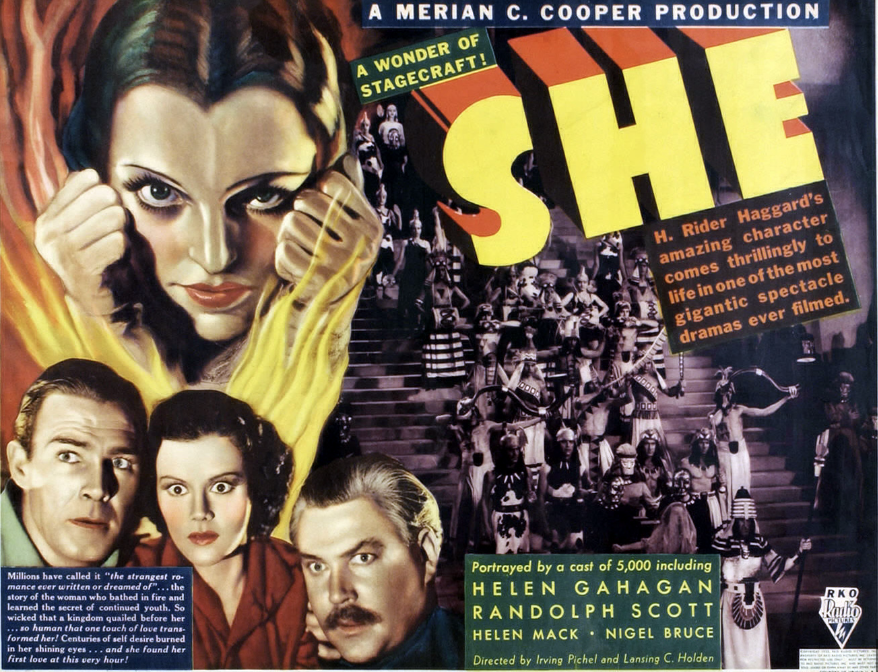
The 1935 movie version of the She novel.
Some literature offers readers content spanning at least two genres. Bonus!
It’s a blend that can make fiction richer and more interesting. Perhaps more challenging, too, but potentially very satisfying. All requiring some serious authorial skill and imagination, obviously. I’ll give some examples of this approach via multi-genre novels I’ve read.
My most recent experience was with Val McDermid’s The Skeleton Road, which combines a compelling murder mystery with well-researched historical fiction about the oft-brutal Yugoslav Wars of the 1990s.
Another example is Marge Piercy’s Woman on the Edge of Time, a novel that mixes a feminist/social-justice perspective with science fiction. Margaret Atwood’s The Blind Assassin also unites a realistic story with sci-fi, and Octavia E. Butler’s Kindred melds an anti-racism theme with time travel.
H. Rider Haggard’s novel She is squarely in the adventure genre yet contains a major fantasy element: Title character Ayesha is more than 2,000 years old — perhaps a bit longer than the usual human life span. 🙂
Anne Rice’s The Witching Hour straddles the fantasy and supernatural horror genres.
Fiction that includes ghosts usually has those ghosts interacting in some way with the real world, making for two genres of a sort. Among the novels in this realm are Charles Dickens’ A Christmas Carol, Jorge Amado’s Dona Flor and Her Two Husbands, and Elin Hilderbrand’s The Hotel Nantucket, to name a few.
Museum objects and exhibits come alive in Gore Vidal’s The Smithsonian Institution and Christine Coulson’s Metropolitan Stories — even as life is also depicted normally. So, fantasy and realism co-exist.
Then there are books that genre-blend in a different way; for instance, Vladimir Nabokov’s Pale Fire is part-novel and part-poem, while J.K. Rowling’s The Ink Black Heart mixes traditional prose with a blitz of chat conversations. Actually, chat conversations are not exactly a literary genre. 🙂
Your thoughts about, and examples of, this topic?
Misty the cat says: “The driver of that ‘On the Road’ car must be Jack Kerouac.”
My comedic 2024 book — the part-factual/part-fictional/not-a-children’s-work Misty the Cat…Unleashed — is described and can be purchased on Amazon in paperback or on Kindle. It’s feline-narrated! (And Misty says Amazon reviews are welcome. 🙂 )
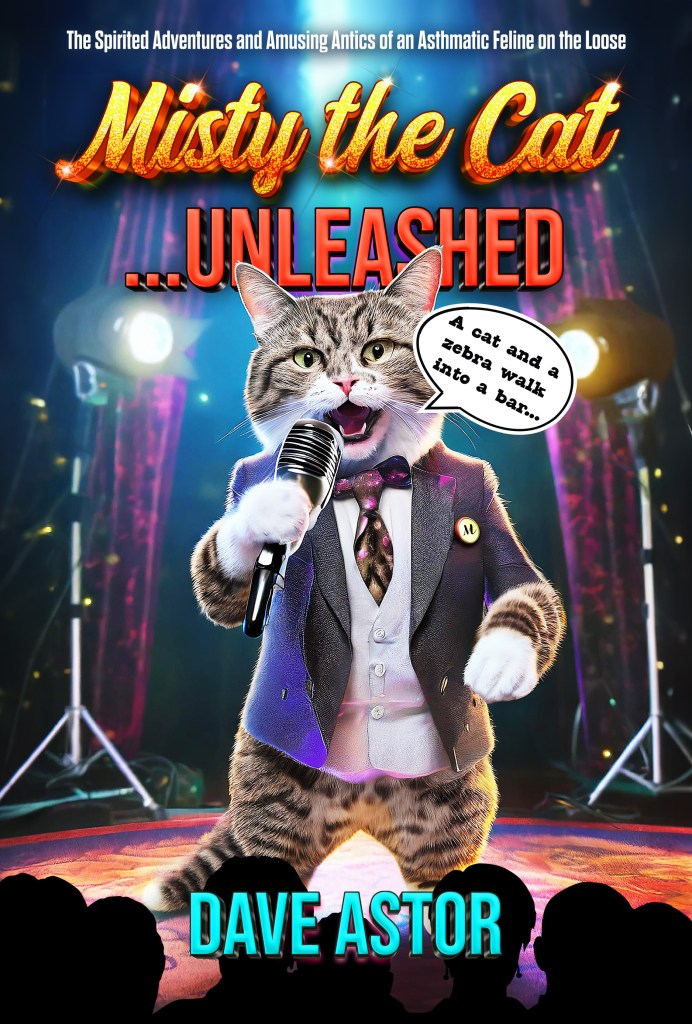
This 90-second promo video for my book features a talking cat: 🙂
In addition to this weekly blog, I write the 2003-started/award-winning “Montclairvoyant” topical-humor column every Thursday for Montclair Local. The latest piece — featuring a pre-election theme and more — is here.
 Dave Astor on Literature
Fascinating examples of genre blending! How do you feel a multi-genre approach affects character depth and world-building in these novels?
LikeLiked by 2 people
Thank you, Akhtar! I think a good author can create as much character depth and do as much world building in a multi-genre novel as in a single-genre novel. What do you think?
LikeLiked by 1 person
I agree! Multi-genre novels offer unique flexibility, allowing authors to explore complex character depth and rich world-building across genres.
LikeLiked by 1 person
Well said, Akhtar!
LikeLiked by 1 person
I appreciate the opportunity. I’ll take some time to review the details.
LikeLiked by 1 person
Thank you for the comment, giangsysy.
LikeLike
Dave, I’m much more socially conservative than almost all the commenters on your blog so I will try to explain why I think Trump won, Biden is very unpopular this year and when the incumbent is this unpopular his party always loses. Unlike successful Democratic presidential candidates such as Bill Clinton and Obama, Harris was unable to gain much support from swing voters. Her views on transgenderism are much more liberal than most Americans and legalizing marijuana is unpopular in the Rust Belt States where drug addiction is a serious social problem. Add to this inflation, uncontrolled illegal immigration and two major wars that started during the Biden Administration (even though he was probably not responsible for them) this creates a perfect storm. However I think that if the economy goes south in the next four years the Republicans will be defeated (Trump won’t be eligible to run again and most MAGA candidates who are NOT Trump have done poorly in the last few years).
LikeLiked by 1 person
Thank you for the comment, Tony. You certainly offered some plausible reasons for why Trump won and Harris lost; I agree more with some of those reasons than others. I think I’ll discuss the election in some way, shape, or form in my November 10 post this Sunday, so in a way I’ll be responding more to your comment then. 🙂
LikeLike
One thing I don’t understand is why Trump is so popular but Republicans who try to imitate him do worse than moderately conservative Republicans when they run against Democrats in swing states.
LikeLiked by 1 person
I guess it’s at least partly because Trump is more (perversely) entertaining, has more (perverse) charisma, and lies with more confidence.
LikeLike
How interesting — I’ve never considered genre blending before. I see what you mean, it does add a multilayered quality to the book, although I can’t think of any examples of my own off the top of my head! 🤔 You’ve got me pondering now (it’ll bother me all day trying to think of my own example lol!)
LikeLiked by 2 people
Thank you, Ada! Ha — 🙂 — for anyone, the pondering sometimes takes a while. 🙂
LikeLiked by 1 person
Hi Dave,
I’m not even going to pretend my comment has anything to do with the topic. I think it’s the middle of the night over there? I just got home from work and turned on the news and turned it right off again. On the plus side, at least he’ll never lose another one. Coz we all know after the 2025 riots he would have just done it all again three years later. It’s not much of a silver lining, but I’ll take anything that makes me feel even a tiny bit better.
Susan
LikeLiked by 2 people
Thank you, Susan. Yes, the Trump win is absolutely devastating. A far-right liar, felon, divider, sexual predator, misogynist, racist, homophobe, etc., is going back to the White House. The United States is a VERY sick country, or about half of it is. 😦
LikeLike
Pingback: Roberta Writes – Book review: Flatland: A Romance of Many Dimensions by Edwin Abbott Abbott #readingcommunity – Patty's Worlds
Joyce commented that too many writers are blocked by their preferred writing style and genre to such degree that it limits their ability to touch upon certain subjects. He was of the opinion that a the subject should define the writing style and genre and not vice versa.
LikeLiked by 3 people
Thank you, Shaharee! Those were wise words from James Joyce. Sometimes, limits can spark a certain kind of creativity (such as when comic strip cartoonists skillfully work within the confines of just a few panels) but busting through limits can lead to really good content by novelists.
LikeLiked by 1 person
Pingback: Roberta Writes – Book review: Flatland: A Romance of Many Dimensions by Edwin Abbott Abbott #readingcommunity
What about Cloud Atlas by David Mitchell? So many genres in that book and also various forms: diary, epistolary, narrative, interview, and ranging over a vast time-period. Six different voices; six different stories which are all linked, through time and space in a variety of subtle ways. Interesting. But I preferred one of his other books – Slade House (fantasy/horror/sci-fi).
LikeLiked by 2 people
Thank you, Chris! I’ve heard about “Cloud Atlas” and how genre-busting it is, but have yet to read it. From the way you and others have described the book, a VERY impressive achievement!
LikeLiked by 1 person
Hi Dave, a great topic this week that has elicited lots of interesting comments. I’m writing my own response …
LikeLiked by 2 people
Thank you, Robbie! I greatly look forward to seeing that! (I was offline the past few hours and am now in the process of catching up.)
LikeLike
I’m a little off-topic here, Dave, but I thought I’d mention Terry Pratchett’s Discworld books, which I love. They are fantasy, but they are also brilliant, laugh-out-loud satire. On top of that, many of them, particularly the set of books within the series that feature Commander Sam Vimes of the City Watch, are full of extremely astute commentary on current-day problems, including racism, sexism, religious fanaticism, and nationalism. All disguised by humor!
LikeLiked by 3 people
Thank you, Kim! I’ve read only two Discworld books — “Small Gods” and “Unseen Academicals” — but that’s enough for me to totally agree that Terry Pratchett was an expert at the multi-genre elements you mentioned. 🙂
LikeLiked by 1 person
There is also the funny aspect that he mixed some Polish vocabulary in the naming of his characters and places. So is Samuel Vimes made Duke of Sto Lat, which means literally Hundred Years in Polish and is also sung on birthday parties on the refrain of “Happy birthday to you”.
LikeLiked by 3 people
Thanks for letting me know that, Shaharee. I think his books are full of hidden jokes like that, and I probably only get some of them!
LikeLiked by 1 person
Wow, Shaharee! Terry Pratchett was SO clever!
LikeLike
Honestly, I have only watched the TV series, but I think Outlander novel series by Diana Gabaldon would count.
The YA Twilight stories (Stephenie Meyer)that mixes today with a 117 year old vampire seems in line.
A Ghost and His Gold by Roberta Eaton Cheadle is definitely a mixed genre. Excellent historical research into fiction combined with a today story plus paranormal activity may cross into 3 genres.
“On the Road“
🫰🏽snap 🫰🏽snap 🫰🏽snap
Misty is one Hep Cat! Yes, the term hep cat or hepcat was started by Cat Cattoway in the late 1930’s, but was used by the Beat Generation and is not forgotten today.
I think hep may have become hip by the time hippies arrived. Misty could answer that, being the resident meowthority on such matters. 😼
LikeLiked by 5 people
Thank you, Resa, for those various examples of cross-genre novels by Diana Gabaldon, Stephenie Meyer, and Robbie (whose many creative talents also cross genres). I love the “Outlander” books, and, from seeing YouTube clips, the TV series seems to do them justice.
Misty is more familiar with The Treat Generation than The Beat Generation, and sometimes recoils when he hears a dog…”Howl”…yet is a fan of the writings of Allen Ginsberg, Jack Kerouac, etc. So, hip was a hep replacement? Orthopedic surgeons should know that…
LikeLiked by 4 people
But of course, the Treat Generation.
I should have known.
Yes, OS’s should be onto that. Then again, they may not be the heppest cats in town. Like me, I’m old fashioned. I’m also on the old side, and my hep hurts.
Hey, just think, if hip hadn’t replaced hep, there’d be Hep Hop Music.
LikeLiked by 3 people
Ha ha! 😂 Your reply was a…treat. 🙂
LikeLiked by 2 people
😂
LikeLiked by 2 people
🙂
LikeLiked by 1 person
Hi Resa, thank you for mentioning A Ghost and His Gold. It is definitely mixed genre as is Through the Nethergate and all my short stories in And the Grave Awaits. I always include history and supernatural fantasy in my stories for adults. I have not read Outlander as I’m not a series reader. My mother loves it and so does my aunt.
LikeLiked by 2 people
Great that you’re a frequent mixed-genre writer, Robbie!
As for “Outlander,” I wasn’t intending to read the whole series when I finally got to the first book about five years ago, but I became totally hooked. Spent a portion of the 2020 Covid year reading the next seven novels, and then read the ninth installment when it came out a while later.
LikeLike
Hi Dave, that is great to know. Books were my Covid survival tool.
LikeLiked by 1 person
Novels were indeed a great solace and distraction during that time!
LikeLike
🪻🌺
LikeLiked by 1 person
🙂
LikeLike
Welcome! ❦
I really liked Outlander at first, but have moved on.
LikeLiked by 1 person
That’s interesting. I always grow fatigued by series which is why I don’t generally read them. My mom loves series.
LikeLiked by 2 people
For me, it depends on the series, Robbie. For instance, I eventually stopped reading the respective mysteries by Sue Grafton and Janet Evanovich, but have not tired of “Outlander” and the Jack Reacher books. The “Anne of Green Gables” sequels varied; some were excellent, some merely good.
LikeLike
The only series I ever read and read and read was Nancy Drew, when I was a kid.
LikeLiked by 1 person
Sounds good to me, Resa! 🙂
I’ve read only one Nancy Drew book — several years ago as an adult — and enjoyed it a lot. 🙂
LikeLiked by 1 person
Oh cool! I had every book, at one point. Then around 14, I started stealing the books from my mom’s closet.
LikeLiked by 1 person
Ha! 🙂 For readers, there always comes a time for more-grown-up books. 🙂
LikeLiked by 1 person
Yes!
LikeLiked by 1 person
🙂
LikeLike
I read The Hardy Boys 😉. I don’t know why but I always preferred the boys series as a girl 🤣
LikeLiked by 2 people
Not a problem, Robbie. 🙂
LikeLike
Nope, I have a bit of a better character mix now that I am older.
LikeLiked by 1 person
Good to hear! 🙂
LikeLike
🤣
LikeLiked by 1 person
Hi Dave! I haven’t read anything by Val McDermid in years!!! The Skeleton Road!! Never heard of that one!!
LikeLiked by 2 people
Thank you, Sharon! I just started reading Val McDermid this year after she was recommended here by commenter Kim Hays. I chose “The Skeleton Road” at random from a shelf at my local public library, which has about a dozen McDermid novels. The dust-jacket copy grabbed me. 🙂
LikeLiked by 2 people
I’m so pleased you’re enjoying Val McDermid’s books, Dave–at least so far. I had only read the Karen Pirie series, but recently, I started another of her series with protagonists Tony Hill and Carol Jordan. The first was very well written, and I liked the characters, but I found it too creepy. But I’ll give the second a try in the hope that it won’t be so disturbing.
LikeLiked by 2 people
Thank you, Kim, for the comment — and for recommending Val McDermid! “The Skeleton Road” is McDermid’s only Karen Pirie novel I’ve read so far (I realize it’s not the first book in which Pirie appears). An excellent character! The other two McDermid novels I’ve read/am reading are in the series starring journalist Allie Burns. Impressive how McDermid has created several different series!
LikeLike
Thank you Dave for commenting! You are in for a treat if Val McDermid’s earlier work is anything to go by!! One of my favourites is The Mermaids Singing (1995). I hope you enjoy The Skeleton Road. Thanks again.
LikeLiked by 3 people
Thank you, Sharon! Seems like Val McDermid has been writing for a long time on a high level!
LikeLiked by 1 person
She has Dave! I love her work! Brilliant writer! Thank you!
LikeLiked by 1 person
Yes, Sharon, brilliant is the word!
LikeLiked by 1 person
Diana Gabaldon’s books seem to mix history and the supernatural. I’m looking forward to the next season beginning on TV this month!
LikeLiked by 3 people
Thank you, Marie! Diana Gabaldon’s wonderful “Outlander” series definitely does that! (I’ve read the first nine books and am greatly looking forward to the 10th.) I haven’t watched any entire episodes of the TV series, but have viewed a number of YouTube clips from it. Looks great, and the acting is superb.
LikeLiked by 1 person
The TV series is definitely worth it, if you get the chance.
LikeLiked by 1 person
I can imagine, Marie (based on the couple dozen clips I’ve seen)! 🙂
LikeLike
As soon as I started reading this great post, Dave, Kurt Vonnegut’s Slaughterhouse 5 came to mind. A mix of historical fiction and science fiction and a few broken rules along the way.
I don’t mix genres on purpose in my books, but I often find myself unable to stick to the formula for one genre as the story evolves. I just go with the flow until it comes time to pick a category in Amazon. Then the stress builds.
LikeLiked by 3 people
Thank you, Dan! Terrific mention! I should have included that classic Vonnegut novel in my post. It is indeed a powerful hybrid of various genres. “So it goes…” 🙂
Excellent point about how an author might not deliberately set out to write a multi-genre novel but it sort of happens organically. And, yes, then comes the categorization dilemma in a pressure-to-fit-into-a-specific-box world…
LikeLiked by 1 person
I think that Catch 22 is also a mixed genre and Dan’s mention of Slaughterhouse 5 brought it to mind.
LikeLiked by 1 person
I agree about “Catch-22,” Robbie!
LikeLike
👍😁
LikeLiked by 1 person
Haha, Dan, I can relate to this same stress. Your books definitely cross genre lines.
LikeLiked by 2 people
Thanks Robbie.
LikeLiked by 1 person
❤️
LikeLiked by 2 people
Excellent post, Dave! I can think of several current bestsellers that mix genres. John Truby’s book, The Anatomy of Genre, has much to say about these mashups. My takeaway: know the key scenes and convention of the ones you want to mix, and then use the structure to weave them together into a meaningful story. We see this often as the main plot and subplots, using the scene’s primary character controlling the point of view to make it clear to readers through which lens they’re filtering the thoughts, choices, dialogue, and actions. My favorites on Amazon are often ‘categorized’ as thrillers, but they’re a mix of genres (e.g., 50% thriller, 30% mystery, and 20% romance). Fun reads!
LikeLiked by 5 people
Thank you, Grant! Nice when a genre mash-up becomes a bestseller in a world where many bestsellers are one-genre novels. And your “takeaway” contains good advice and makes total sense. As for thrillers, some are indeed not 100% that genre. The Jack Reacher novels, for instance, often include mystery, romance, some historical context, some humor, etc., in addition to the thriller element.
LikeLiked by 1 person
You’re spot on, Dave. For example, the creation of ‘subway-like maps’ for the subplots can help writers keep all the nitty-gritty details straight. Little things, such as the opening lines in scenes that subtly help readers recognize the POV without having to page-back to keep things straight. Like the London maze of tubes, a writer who creates visuals of their subplots and POVs can ‘mind the gap.’ A wall full of Post-It-Notes will work, too!
LikeLiked by 3 people
Thanks for the descriptive reply, Grant! “Maps” and Post-It-Notes do sound helpful!
LikeLiked by 1 person
A great comment, Grant. I love the Americanism “mash up ‘. It works so well as a description.
LikeLiked by 3 people
“Mash-up” is indeed one those wonderful, vivid, colorful words. 🙂
LikeLike
🌈
LikeLiked by 1 person
Watership Down, (cue tears) So many fiction genres, then film and kids’ TV – and informed by wildlife nonfiction too. Sadly, our rabbits have disappeared.
LikeLiked by 4 people
Thank you, Esther! “Watership Down” (which I read ages ago 🙂 ) is a great mention! Definitely a cross-genre novel.
Very sorry about the rabbits. 😦 We still have some occasionally visiting my garden-apartment complex.
LikeLike
Good morning Dave, and many thanks for your interesting question! After having read your post “Lessons in Chemistry” by Bonnie Garmus came to my mind because in that book we have on the one hand the very brilliant scientist Elisabeth Zott, who worked in a man dominated research laboratory and on the other a pregnant woman who got sacked because of this and we see also how important human relationship may be or become.
LikeLiked by 4 people
Thank you, Martina! That book does sound like it has multiple strong elements — of a workplace and a personal nature. Still way too much sexism and patriarchy in the world. 😦
LikeLike
Yes, Dave, but it takes place in the 1960s. I very much liked the practical help by simple friends.
LikeLiked by 1 person
Ah, didn’t know that it was set in the 1960s, Martina. Things have gotten better since then; still a ways to go.
LikeLike
:):)
LikeLiked by 1 person
🙂
LikeLike
Hi Martina, Lessons in Chemistry sounds like it includes some interesting social commentary. Is it fiction based on real events?
LikeLiked by 2 people
Thank you, Roberta, for your interest! Lessons in chemistry is fiction and I just felt very strongly that you may be a highly qualified scientist, but if you have no neighbour – in this case, -who you can depend on in difficult situations, you may be lost. Have a good day!
LikeLiked by 1 person
Yes, that is certainly a truth. I see something similar to this happening with aging people in business who never had families.
LikeLiked by 2 people
Yes, Roberta, absolutely, but here I see more and more older , but lonely people with children, because these last ones have or want to follow their career. I think we also have to see how important it is in life to take time for other people! Thank you very much for our conversation.
LikeLiked by 1 person
Yes, i see this too. Reminds me of this song https://youtu.be/KUwjNBjqR-c?si=QO4O-YKchOCHYHx8
LikeLiked by 2 people
Oh, Roberta, this song of the busy father, who continues to say “then, then” we can do sth. to the son and that one, who turns out the same way, is exactly what I mean! Many thanks:) I hope people will become able to make compromises.
And, last but not least, maybe this is just a smaller discussion point in Lessons in chemistry, but I thought it said something to Dave’s topic. Elisabeth Zott, f.e. motivated women to change their lives in her cooking show.
LikeLiked by 1 person
Harry Chapin’s “Cat’s in the Cradle” is indeed a profound song. That and Chapin’s “Taxi” say as much as many a good novel.
LikeLike
Thank you very much for this information, Dave:) For me it was the first time that I heard this touching song!
LikeLiked by 1 person
You’re welcome, Martina! “Taxi” always makes me tearful when I hear it.
LikeLike
“Whatever we had once was gone and I stay in my taxi and get stoned”I get goose pimples, but thank you Dave for this profound text.
LikeLiked by 1 person
Harry Chapin died too soon. 😦
LikeLiked by 1 person
This song made a very big impression on me. I worked half day when my sons were small but I gave them every minute of my available time. I really enjoyed having young children. Elizabeth Zott sounds like an inspiring person.
LikeLiked by 2 people
I’m sure, Roberta, you found a middle way. Elisabeth Zott is a fighter!
LikeLiked by 1 person
That is great to know. And yes, I always find a way to get what I want and need.
LikeLiked by 2 people
The book that immediately came to mind is Mark Smith’s The Death of the Detective. It’s a blend of noir detective genre and literary postmodernism something or other. I read it because I was taking a fiction workshop from Smith at the time. I’ll stick with Raymond Chandler, thank you very much.
LikeLiked by 4 people
Thank you, Liz! Ha — 😂 — sounds like you weren’t quite a fan of “The Death of the Detective.” 🙂 As for Raymond Chandler, I’ve only read his “The Big Sleep,” but thought it was excellent.
LikeLiked by 2 people
You’re welcome, Dave! Nope, not a big fan. I found it overwritten in an aren’t-I-clever sort of way.
LikeLiked by 2 people
Not a good approach for an author!
LikeLiked by 1 person
My first fiction-writing prof explicitly warned us of the dangers of adopting a “look Ma, I’m writing!” prose style.
LikeLiked by 1 person
A wise prof! I imagine many writers go through a phase like you describe; some grow out of it, some don’t. 🙂
LikeLiked by 1 person
🙂
LikeLiked by 1 person
Hi LIz, another interesting book commentary from you. Experimentation with reading doesn’t always work. I became tired of all the sex in The unbearable lightness of being and so it’s currently on hold at the 50% mark. It is interesting from a psychological and social commentary POV but so much sex! I started listening to Aggie Christie’s The Adventure of the Christmas Pudding and then mom saw it (I put my Audible on her phone so she can also share my audio books) and she started listening to it. We can’t both listen as it messes up the marking place so now I have to wait. Teach me to tell her about a good story.
LikeLiked by 3 people
When my mother was reading a lot of novels in her later years, she, too, became disgusted with all the “bed-hopping.” I’m getting tired of all the gratuitous f-bombs. I’m sure your mother appreciates having first dibs on The Adventure of the Christmas Pudding!
LikeLiked by 2 people
Interesting post Dave. McDermid also wrote a book called The Grave Tattoo which had Fletcher Christian clearing off from Pitcairn and being sheltered by Wordsworth…. Quite a combo in some ways.
LikeLiked by 4 people
Thank you, Shehanne! “The Grave Tattoo” sounds amazing! Val McDermid definitely has impressive layers in her writing. I’m currently reading another of her novels — “1989” — that’s expertly and compellingly dealing with the AIDS crisis as one of its storylines.
LikeLiked by 1 person
I prefer her earlier stuff in terms of quality but you are right. She has written many compelling books. And The Grave Tatooo is obvi a present day mysery book.
LikeLiked by 1 person
I’m just on my third book of hers (the aforementioned “1989”), but it’s recent (from 2022) and quite good. If her earlier work is even better…wow! 🙂
I imagine you’re familiar with a number of Val McDermid’s settings in Scotland, Shehanne!
LikeLiked by 1 person
Indeed. I do like books set in Scotland for obvi reasons. Well, I will add, books where the author clearly knows Scotland as opposed to ones where in some past time, they’ve got someone leaving Edinburgh on horseback at 10 o’clock and arriving in the Western Isles at noon. But maybe their horse had supersonic rockets attached to its hooves and they just forgot to say. Where the horse got them too so we can all purchase such things and avoid he roads where i takes an hour o go 20 miles. I am glad to hear 1989 is recent. There was just a few I read of her later ones that had great premises but didn’t entirely live up to expectation shall we say? But hey that’s writing. everyone has off times for many reasons. Nice to see her books being read on your side of the pond.
LikeLiked by 3 people
Ha ha! 😂 That horse with supersonic rockets. 😂 Love it! Yes, it can be obvious when an author doesn’t quite know the setting.
Val McDermid’s work was recommended to me by a commenter here: Kim Hays, a blogger/author who lives in Switzerland. Not sure how much of an American readership McDermid has, but I hope it’s large. She deserves it, even if not every one of her novels is…supersonic. 🙂
LikeLiked by 2 people
She does indeed deserve it and it is great to see you’ve picked up on her.
LikeLiked by 1 person
🙂
LikeLiked by 1 person
Hi Shey!! I have never read any of her books so I went tonight and borrowed it to the Vancouver Public Library Main Branch. Thanks for the introduction.!!’📕📚📖
LikeLiked by 2 people
You won’t regret reading Val McDermid, Rebecca. Her writing, plots, and characters are excellent!
LikeLiked by 2 people
Wow. Great stuff Rebecca. She writes a very layered crime novel, ofen with past real historical events as the anchor. xx
LikeLiked by 2 people
Hi Shay, do you recommend this book? Did you enjoy it?
LikeLiked by 1 person
\
As far as ghosts interacting with humans, if the book is funny, romantic, or even a wee bit historical all the better. Here’s a few that come to mind: Thorne Smith’s Topper, Noel Coward’s play Blythe Spirit, R.A. Dick’s (and/or Josephine Leslie) The Ghost And Mrs. Muir. Then those of the time bending/sci fi genre such as Richard Matheson’s Somewhere In Time, Lisa Grunwald’s Time After Time and Time After Time by Karl Alexander. Nice theme Dave. I need to watch a few of the movies based on the above books rather than the upcoming election results. Yikes, I’m on pins and needles. Thanks, Susi
LikeLiked by 6 people
Thank you, Susi! I really enjoyed your mentions of ghost fiction, time-travel fiction, etc. 🙂 And, yes, watching some movies might be sanity-saving on/around election night. If Trump wins…what a dismaying result that would be, and another blot on the United States. It’s dismaying that that vile lowlife has 40%-plus support in the U.S. 😦
LikeLiked by 1 person
I agree. I don’t see how anyone could vote for him. If he can’t run his own life, why should anyone give him the power to run theirs. Susi
LikeLiked by 2 people
Very astute and accurate observations, Susi!
LikeLiked by 1 person
She Who Must Be Obeyed!
There is an additional genre-mixing going on at She‘s front end–
1) a mocked-up illustration, but typical for its time, of an ‘ancient’ pot sherd with scholarly description, as if the tale to be read is real, and
2)the dedication to Andrew Lang.
“Andrew Lang FBA (31 March 1844 – 20 July 1912) was a Scottish poet, novelist, literary critic, and contributor to the field of anthropology.
***
The earliest of his publications is Custom and Myth (1884). In Myth, Ritual and Religion (1887) he explained the “irrational” elements of mythology as survivals from more primitive forms.”
LikeLiked by 5 people
Thank you, jhNY! I had forgotten about those extra flourishes in “She” — a novel I read after you recommended it. A VERY memorable book. And I guess the stuff in it COULD have been real, except for Ayesha collecting Social Security for a couple of millennia. 🙂
LikeLiked by 2 people
I think mixing genres can make for more complex stories. If a writer just “stays in the lane” of a genre, their book might satisfy readers who want a dose of a “proper” mystery or horror novel. But I like the creativity when a writer takes elements from more than one genre and put them together.
LikeLiked by 6 people
Thank you, Dave! Very good points about multi-genre fiction being more complex and that some readers prefer a one-genre boundary in a novel. Which is fine with me; I’m happy to hear about anyone reading any kind of fiction. 🙂
LikeLiked by 2 people
Excellent point, Dave. Many bestselling authors minimize confusion by controlling the point of view divided into mini-stories (structured subplots). Even L. Frank Baum used this structure in his book (not the film), The Wonderful Wizard of Oz.
LikeLiked by 4 people
Hi Dave, you make an interesting point. I am actually struggling to think of any books I’ve read that don’t cross genre lines though. Even your book, Don’t Lose your Head, is light horror but has a strong social commentary thread. By the way, I noticed when I was perusing your books on Amazon, that you have a book called Gasp Poetry. It looks full of your wonderful humour and I wondered if you’d like to be my January 2025 guest for Poetry Treasures and talk about it. Let me know.
LikeLiked by 3 people
Robbie, you’re kind to look at my books on Amazon, and to invite me to be a guest on your blog. I accept! I’ll look on your blog to see if I can find your email address, and I’ll send you and email. Thank you 🌞
LikeLiked by 1 person
That’s great, Dave. My email is sirchoc@outlook.com.
LikeLiked by 2 people
I believe that all great stories blend and mix genres, as occurs in the real and imaginary worlds. It’s the publishing industry that seeks to pigeonhole novels for marketing and sales promotion.
LikeLiked by 6 people
Thank you, Rosaliene! An excellent point that writers like to mix genres more than most publishing execs do as those execs look at things through a marketing lens. Among the various benefits of self-publishing, which of course allows writers more freedom over their content.
LikeLiked by 2 people
Exactly, Dave! Self-publishing does give us more options when categorizing our books.
LikeLiked by 2 people
Definitely a good thing, Rosaliene! 🙂
LikeLiked by 2 people
It’s a difficult topic for me today, Dave, because I always have problems with keeping to exact genres in my own writing, and often find certain genres – psychological suspense and crime, for example -formulaic in the extreme. I have books that I’ve tried to make literary, for example, but they’re also contemporary, and some move into the future, which make them speculative to some extent. I also can’t resist putting a twist or two into my stories of whatever sort too, and when the marketing ‘experts’ suggest dropping the names of authors successful in my genre into the ads I make for my books – I can”t do it, because I don’t know of any who write quite as I do. I can’t even think right now of any ‘mixed genre’ books that I know of, partly because I’m tired and also because I just believe in authors writing what works for them, even if it doesn’t fit neatly into a genre. If I think of any books that fit this I’ll be back. Many thanks. 🙂
LikeLiked by 5 people
Thank you, Laura! I believe not sticking to one exact genre is a positive thing, though, as you mentioned (and I mentioned in another reply), it does make marketing somewhat more challenging. Not sticking to one exact genre makes for less-formulaic work, as you note. So…good for you! Heck, my own recent Misty the cat book is all over the map — nonfiction, fiction, comedic, serious in parts, and so on. 🙂
LikeLiked by 2 people
Yes – I’m sure multi-genre work makes for more interesting writing, and Misty sounds like a wonderful character. Genres make it easier to ‘compartmentalise’ stories, but real life isn’t like that. It’s part of the greatness of Shakespeare (here he comes to my rescue) that he knew this and mixed the content of his plays. What’s strange though is that later societies have needed to categorise the plays as either comedy or tragedy (the histories are an interesting genre, factual history having a few liberties taken with it) ‘Othello’ for example has a clown, who appears once or twice to add little comic relief, but I’ve never yet seen a production with him left in. What I like best of his works are the ‘problem comedies’, plays that end well but are a bit problematic in doing so. ‘Measure for Measure’ works well in this, because it ends well with Marianne wanting to be with Angelo, the bad guy of the piece, and Isabella not answering the Duke when he proposes to her. Usually this is staged with Isabella eventually putting out her hand in tacit acceptance, but it has been done where she shakes her head and turns away. And maybe that’s the point with genres: life is a mixture, and I like my fiction to be as life-like as possible. That’s just me, and others like the ‘security’ of a fixed storyline – but I won’t be the one writing it for them, lol. There. I managed to come up with a writer who mixes genres, at the end. Thanks for another great brain teaser, Dave. 🙂
LikeLiked by 4 people
So true, Laura, about real life often not being compartmentalized. And that’s a very interesting take on Shakespeare — his tragedies were indeed not 100% tragic and his comedies not 100% comedic. You seem to be quite an expert on Shakespeare; I’ve only read or seen maybe a half-dozen of his plays.
LikeLiked by 2 people
I wouldn’t call myself an expert, but I’ve studied and seen quite a few of his plays. I’ve got a box set of all his plays that were made by the BBC quite a long time ago, and I still have to watch them all. It’s wonderful though how universal his stories are, and to see them redone in modern dress/locations, where they seem quite at home. 🙂
LikeLiked by 2 people
Well, a near-expert. 🙂 And, yes, Shakespeare’s work is very universal, and quite relevant to modern times — whether productions of his plays are modernized or not.
LikeLiked by 2 people
Indeed. I find it fascinating too that, while in our times we’d stage Julius Caesar (for example) in togas etc, clothes that we know were worn in ancient Rome, in Shakespeare’s time his plays were largely staged in contemporary dress. To invest in ‘specialist’ costumes, that could only be used for one or maybe two plays, would mean a huge financial outlay which wouldn’t necessarily be recouped. There is a picture extant, however, of a production of Titus Andronicus in which the costumes were accurate to the period in which the play was set – clearly a donation was made by somebody rich and powerful to help with this. It’s fascinating. 🙂
LikeLiked by 2 people
Fascinating indeed, Laura! I had no idea about the costume situation back then.
LikeLiked by 2 people
I studied a module on early drama at university, and it’s fascinating. Did you see the film Shakespeare in Love, and Geoffrey Rush playing Henslowe, the theatre manager? In real life he kept account books with great detail, so much of what’s known about purchases etc for the theatre comes from those. Sometimes wealthy/aristocratic patrons might donate clothes they no longer wanted, or something new, or the theatre would buy what was needed cheaply, to keep costs down. In Shakespeare in Love, Viola as Juliet pulls a red cloth streamer from her dress when she stabs herself – a convention which grew up because they had no effective way to remove stains if they used a red liquid, in which case the costume would be ruined and not reusable. We take so much for granted today! 😊
LikeLiked by 1 person
Wow, Laura! All that is SO interesting! (Never saw “Shakespeare in Love”; I think I’ve watched fewer movies than the average person. 🙂 )
LikeLiked by 1 person
I thoroughly recommend Shakespeare in Love – it’s so clever.😎
LikeLiked by 1 person
Sounds great!
LikeLiked by 1 person
It was! 🙂
LikeLiked by 1 person
🙂
LikeLiked by 1 person
Shakespeare’s plays are an example of a particular genre too: proper material for Elizabethan play production which might prove popular and profitable when performed.
The history plays are a good example of how fraught this work might be,if done without a cautious eye on the preferences of the Crown. Your theater might be shuttered; your works might be banned. So deriving the proper interpretation of history from approved sources such as Holinshed was prerequisite to success, continued livelihood and even freedom.
Shakespeare wrote plays for money– for himself, his theater and his players– comedies, tragedies,histories, etc. And in so doing he was conforming to the dictates, tastes and politics of his age, and made plays that could be categorized as examples of a genre– Elizabethan plays.
LikeLiked by 5 people
Indeed – and Jacobean plays too, latterly. He also had a wonderful way of subverting the requirements even while appearing to conform to them – as in The Merchant of Venice (also called The Jew of Venice). While Shylock is overtly framed as the villain, it’s possible to stage the play showing the Christians in an unfavourable light and Shylock a man much wronged and pushed over the edge. A great writer. 🙂
LikeLiked by 2 people
Two very informative comments. Thank you, jhNY and Laura!
LikeLiked by 2 people
You’re welcome, Dave. Your posts usually lead to some sort of interesting discussion. 😎
LikeLiked by 1 person
Thank you, Laura! 🙂
LikeLiked by 1 person
I think its good to introduce elements of fantasy or the supernatural to books solidly grounded in reality. That grounding is important, which is why it works for literary authors like Atwood.
I’ve done this in my own novels. One includes some poetry. But I have a hard time categorizing them.
LikeLiked by 6 people
Thank you, Audrey! I agree that books with elements of fantasy, the supernatural, etc., are almost always helped by having some grounding in reality. Among other things, that approach makes the stories more relatable to readers even as their willingness to let their imaginations be tweaked takes care of the rest.
I think a novel being not-easy-to-categorize can often be a good thing creatively, even as marketing it might be trickier.
LikeLiked by 2 people
My marketing skills are limited, and I’m okay with that. 🙂
LikeLiked by 2 people
I hear you, Audrey. 🙂 My marketing skills are also not ideal. 🙂
LikeLiked by 2 people
Thank you so much for sharing this post: I found it fascinating. 🙏🙏🙏
I enjoyed your examples very much and I think that authors who can successfully mix genres are really skilled.
LikeLiked by 6 people
Thank you, Luisa! Glad you liked the post! I agree that it takes some extra writing skill to mix genres well. 🙂 Plus it indicates that those writers probably have themselves read books in various genres. 🙂
LikeLiked by 3 people
Thanks a lot for your kind reply: I totally agree with everything you write 🌹📚🌹
LikeLiked by 2 people
You’re welcome, Luisa, and thanks again for the comments! 🙂
LikeLiked by 2 people
🌹🙏🌹
… a hug to you and a caress to Misty 🤍
LikeLiked by 1 person
Many thanks, Luisa! 🙂 Will relay your message to Misty when he wakes up from his post-walk morning nap. 🙂
LikeLiked by 1 person
💞🐾💞
LikeLiked by 1 person
An excellent post, Dave. Why do we like to have an element of the unknown interwoven with reality? Is it because we have an intuition that there is more to reality than we know?
Two books that I read this past month have elements of this theme: “The Life She Was Given” by Ellen Marie Wiseman and “Rock Paper Scissors” by Alice Feeney.
I believe that these books resonate with our experience because we know that past (our past) defines our future (our future). When we read books that speak to both past and future, we are reminded that life is a tapestry of intertwined realities and possibilities.
“Life was too big and too short and too important to talk about the lack of rain or the latest gossip. She wanted to know how people felt about themselves and one another, whether they were happy or sad. She wanted to know what made them feel loved and what hurt them to the core.” Ellen Marie Wiseman, “The life She was Given”
P.S. It is good to be back from my blog break!!!
LikeLiked by 7 people
Thank you, Rebecca! Welcome back from your blog break! You were greatly missed. (Though it was very nice that you posted several created-in-advance pieces while you were gone. 🙂 )
“Why do we like to have an element of the unknown interwoven with reality? Is it because we have an intuition that there is more to reality than we know?” — that is a profound question!
I appreciate the two book examples you offered, and that final quote about what is really important.
LikeLiked by 2 people
It is so good to be back, Dave. I’m glad that you liked the schedule posts. I have been exploring how AI is influencing the creative spirit – from art, to poetry to writing, to dance, philosophy. We live in very interesting times. I’m certain the candle makes felt the same way when the light bulb was invented. And yet, now, we are moving into the creative sphere that has never been tested in the same way. Quills to ballpoint pens is not at the same level of transformation as we are experiencing with AI. I continue to learn and learn and learn!!
LikeLiked by 4 people
I agree, Rebecca, that AI is a monumental development that will shape the future and is already shaping the present. I think it has more negative aspects (such as replacing some individual human creativity, costing many jobs, etc.) than positive aspects — though some positive aspects. Still, AI growth is inevitable.
LikeLiked by 1 person
At the precise moment we as humans should be attempting judicious and conservative use of energy, given the existential threat that the climate crisis is to ourselves and many other life forms, it is of course the perfect time to unveil AI, which promises to dwarf the present profligate waste of energy resident in the production of crypto-currencies.
Each day, last time I checked, bitcoin alone used the same amount of electricity as the nation of Denmark. The waste of resources that bitcoin production causes used to seriously concern me until I realized how much energy was wasted on streaming and gaming on the interwebs.
But given the psychopathia resident at the tippy-top of the world economy, I certainly agree: AI is inevitable, as is the ever-increasing demand for energy for non-essential purposes.
“We have met the enemy, and he is us.”–Walt Kelly’s Pogo
LikeLiked by 4 people
Excellent point, jhNY, about the negative environmental consequences of AI — especially at a time, as you allude to, when climate change is already pretty darn bad.
That iconic “Pogo” quote you cited never fails to apply.
LikeLiked by 2 people
A very good point, jhNY!! Thank you.
LikeLiked by 1 person
Hello Rebecca, it is wonderful to see you back and commenting.
LikeLiked by 1 person
I am always impressed with authors who can mix genres successfully. Diana Gabaldon does this very well with the Outlander series. Historical, science fiction, romance, adventure, and family saga all mixed together.
LikeLiked by 5 people
Thank you, Darlene! You are so right about the “Outlander” series; it is absolutely multi-genre. I loved all nine books (can’t wait for the 10th/supposedly final one) and thought of mentioning them today until I decided that I had included “Outlander” a little too often in this blog during the past five years. 🙂 But I’m glad YOU mentioned the series today. 🙂
LikeLiked by 2 people