
Was W. Somerset Maugham relaxing after appearing in his own book? Maybe. 🙂
Our attention is definitely captured when authors directly or indirectly refer to themselves and their own books in their novels.
This can give readers an additional sense of a writer’s personality, and provide other extra elements to a book — including humor. On the possibly negative side, “self-insertion” can puncture fiction’s illusory world and remind readers that there’s an authorial presence pulling the strings.
The example of “self-insertion” I noticed most recently was when Elin Hilderbrand had one of her fictional characters in The Five-Star Weekend buy a Hilderbrand novel while in a Nantucket bookstore. Some delightful authorial self-mocking was part of the scene as another character tried to ply the Hilderbrand-interested character with more “serious” literature.
In Miguel de Cervantes’ Don Quixote novel, the title character has Cervantes’ debut book in his library. Also, another character in the classic 17th-century work says he’s a friend of Cervantes.
Then there’s John Steinbeck’s East of Eden, which was partly inspired by the author’s own family history. So it’s not a total surprise when Steinbeck himself pops up for a brief cameo in the novel.
W. Somerset Maugham put somewhat more of his actual self in his latter-career novel The Razor’s Edge when his searching-for-meaning-in-life protagonist — the fictional Larry Darnell — has a deep discussion about spirituality and more in a Paris cafe with…Maugham. (Of Human Bondage, the Maugham novel considered that author’s masterpiece, is actually more semi-autobiographical than The Razor’s Edge.)
And Emile Zola put a LOT of himself in his novel The Masterpiece; the book’s fictional author Pierre Sandoz is clearly based on Zola himself, who had a long real-life friendship with painter Paul Cezanne. The Masterpiece‘s protagonist — painter Claude Lantier — is partly based on Cezanne as well as Claude Monet and Edouard Manet.
In Kurt Vonnegut’s Slaughterhouse-Five, the narrator character is obviously Vonnegut himself. There are even these lines: “That was I. That was me. That was the author of this book.”
Herman Melville did a self-reference variation by having the title character in Pierre write a book that appalled its would-be publisher. This plot twist was a way for Melville to vent about the poor critical and commercial reception for Moby-Dick, released the previous year. Pierre — which, like Moby-Dick, was ahead of its time in various ways — would also sell badly, and cause lots of controversy with its implied-incest element.
Of course, as several early commenters rightly note below, most novelists put something of themselves in the books they write — even if subconsciously. My post mostly focused on when writers do this in a pretty overt way. 🙂
Your thoughts on, and examples of, this topic?
Misty the cat says: “I’m on the windswept moors of ‘Wuthering Heights.'”
My comedic 2024 book — the part-factual/part-fictional/not-a-children’s-work Misty the Cat…Unleashed — is described and can be purchased on Amazon in paperback or on Kindle. It’s feline-narrated! (And Misty says Amazon reviews are welcome. 🙂 )
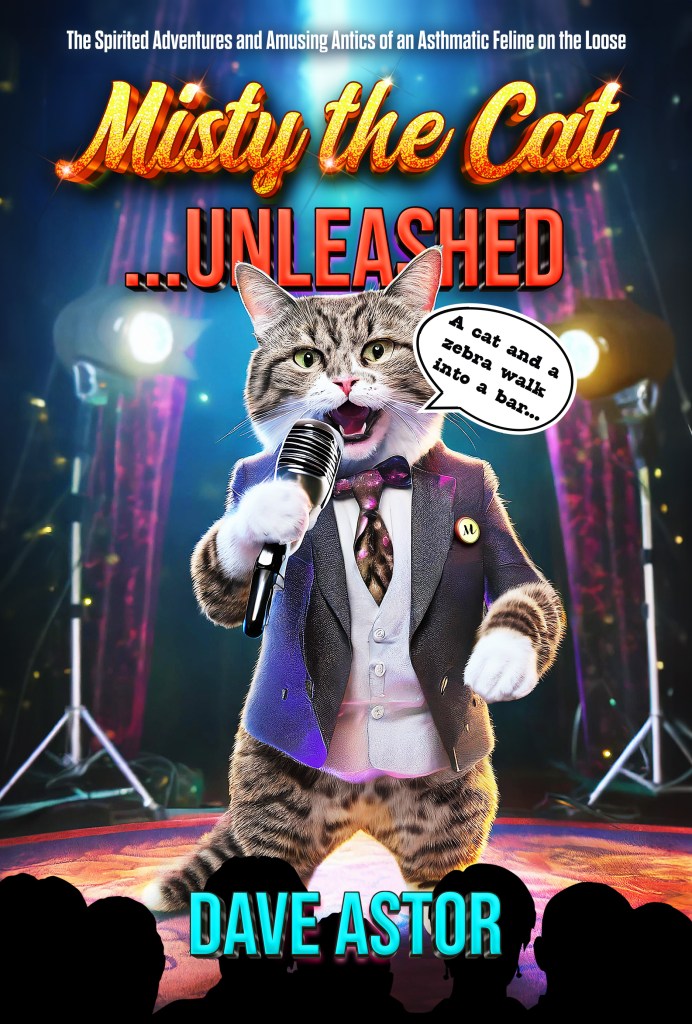
This 90-second promo video for my book features a talking cat: 🙂
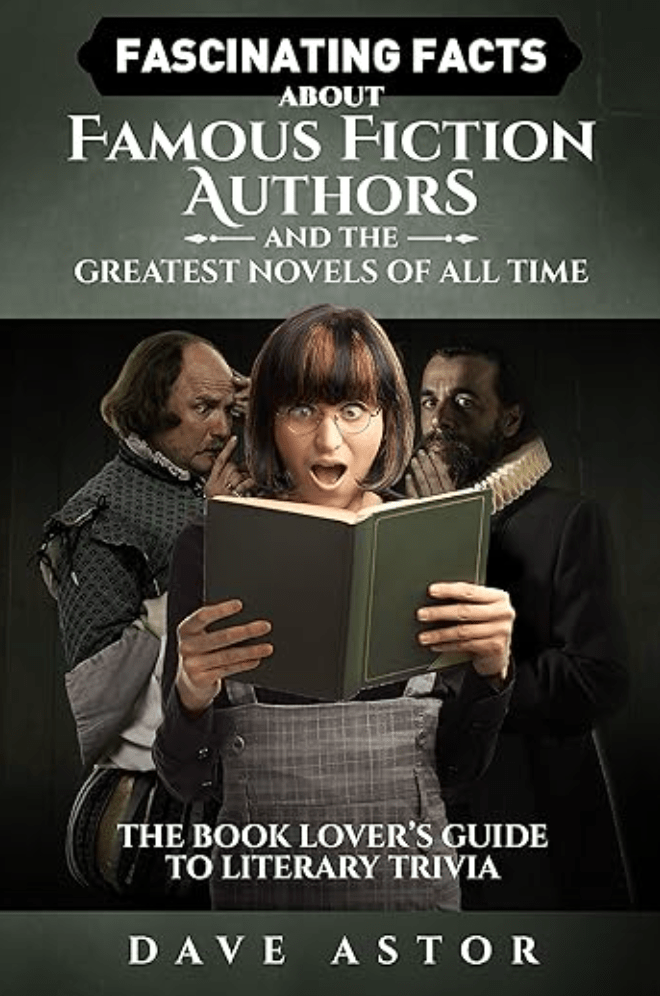
I’m also the author of a 2017 literary-trivia book…
…and a 2012 memoir that focuses on cartooning and more.

In addition to this weekly blog, I write the 2003-started/award-winning “Montclairvoyant” topical-humor column every Thursday for Montclair Local. The latest piece — about past-due school district bills, a township manager payout, diminished mass transit, and more — is here.
 Dave Astor on Literature
Appreciated
LikeLiked by 2 people
Thank you, swamigalkodi!
LikeLiked by 1 person
Great discussion, Dave!
I love the example of Slaughterhouse-Five, where Vonnegut seamlessly blends autobiography with fiction, making himself both an observer and participant. Stephen King takes it to another level in The Dark Tower series by making himself a literal character whose writing shapes the narrative’s reality.
I’m learning, as you pointed out, authors inevitably leave traces of themselves in their work.😃
LikeLiked by 2 people
Thank you, Carolyn! Excellent description of what Kurt Vonnegut did in “Slaughterhouse-Five”! Quite an innovative novel, really, and of course devastating to read. I have not gotten to Stephen King’s “The Dark Tower” series; maybe someday. 🙂
“…authors inevitably leave traces of themselves in their work” — yes! Hard to avoid, even if a writer tried.
LikeLiked by 1 person
Thanks, Dave. My late husband and I read this book together for a discussion group made up of many who had experienced the trauma of war.
Honestly, I don’t think I would have picked it up on my own, but I’m so grateful I did. Hearing how deeply others in the group connected with it—and even found a strange sense of comfort in it—was an eye-opening experience. It really showed me the power of storytelling in making sense of difficult realities. 💕
LikeLiked by 3 people
I can imagine how veterans — and civilians who also experienced the trauma of war — would react to “Slaughterhouse-Five,” Carolyn. Vonnegut being a veteran himself certainly helped him make the novel so powerful. And others lucky enough not to experience war could experience it, and be appalled by it, vicariously through the book.
LikeLiked by 2 people
HI Dave, Roald Dahl also did this. The BFG (Big Friendly Giant) is mentioned in his book, Danny the Campion of the World. He also mentions Willy Wonka’s chocolate factory in another book, I think it was James and the Giant Peach.
LikeLiked by 2 people
Thank you, Robbie! I appreciate the Roald Dahl mention! Nice to be reminded that authorial self-referencing happens in children’s lit, too. 🙂
LikeLike
Yes, I can’t think of another example though
LikeLiked by 1 person
I can’t either, Robbie, but it must exist. 🙂
LikeLike
💚
LikeLiked by 1 person
Oh absolutely Stephen King! First of all, he often uses the same characters in completely unrelated books which is a bit of a reminder that the master of horror is behind all of the different creations. Secondly, he sometimes has his characters talk about other Stephen King books and movies. In one novel, there’s a discussion about the “Cujo” adaptation and some pretty big spoilers about the different endings! But the biggest example of Stephen King inserting himself into his own books is when there’s a character called Stephen King. In “The Dark Tower” there’s a fictional author who smokes and drinks too much, and is too lazy to give a crap about the world ending. I’d like to think he’s a bit different from the real Stephen King, but I feel that he must have got some sort of benefit from writing about some things he struggled with when he was younger. Whatever the reasons, I found it very entertaining reading.
LikeLiked by 3 people
Thank you, Sue! Excellent Stephen King mention(s)! I’ve read a good deal of King’s work (about 15 novels, but not “The Dark Tower” series) yet somehow didn’t notice or remember that he inserts himself into some of his fiction. Either I wasn’t observant enough or read the wrong 15 or so books. 🙂
LikeLiked by 1 person
IT, for example, Dave, included a young Dick Halloran from The Shining. He was one of the few people who escaped the burning of the Black Spot nightclub in that book.
LikeLiked by 2 people
Robbie, one of these days I need to read “It”!
LikeLiked by 1 person
You haven’t read IT 🫨. One of my top three King books.
LikeLiked by 2 people
You must, Dave! – but it’s scary, very much so.
LikeLiked by 2 people
My “It”-less situation must be rectified! Now prominently on my to-read list for my next library trip. Hope it’s there.
I suppose seeing Cousin Itt on the old “Addams Family” TV show doesn’t count… 🙂
LikeLiked by 1 person
Hi Dave,
Random question time. Do you have access to articles on The Atlantic website and if so, can they be shared? I don’t do online subscriptions, and have no clue how they work, but I’m a big fan of Jeffrey Goldberg and would love to read his article about the accidental text messages. Just not enough to pay $79.99 for it.
Sue
LikeLiked by 1 person
I hear you, Sue. I don’t subscribe to The Atlantic, either. Will see what I can find and get back to you one way or another.
LikeLike
Sue, I found a link to the whole Atlantic article. Hopefully you can also access it and that it’s still a working link by the time you see this comment. Let me know!
https://www.theatlantic.com/politics/archive/2025/03/trump-administration-accidentally-texted-me-its-war-plans/682151/
LikeLike
That’s the same article I can find here but needs a subscription. I am tempted to sign up for a free trial however am reluctant to put credit card details anywhere. I also doubt that he says anything here I haven’t already heard.
Thanks for trying though ❤
LikeLiked by 1 person
Strange. It let me read all the way through without a subscription. Maybe it has something to do with accessing the article in the U.S. vs. internationally? Anyway, sorry — and you’re welcome! (I can understand the reluctance to give out credit card details.)
LikeLike
Hi Susan, Stephen King is the first author who came into my mind in this particular context. You have summed up his book and self-insertions into other works perfectly.
LikeLiked by 2 people
Thanks Robbie, your comment has made my day. It’s not often that anything I do is described as perfect ❤
Dave – I don’t think you can read a ‘wrong’ Stephen King, but the only time I know of Stephen King writing himself as a character was in “The Dark Tower” so you didn’t miss anything. Except for some really fun books!
LikeLiked by 1 person
😀🩷
LikeLiked by 1 person
Sue, of all the Stephen King books I’ve read, the only one I thought was so-so rather than very good or great was “Cell.”
LikeLike
I can understand why writers choose to embed themselves or their identities within their stories, creating a personal connection between their experiences and the narrative. This is not only the purview of writers. I have come across this in my exploration of art. These painters also positioned themselves in their artwork. Vincent van Gogh, Rembrandt van Rijn, Pablo Picasso, Frida Kahlo, Gustav Klimt, Diego Rivera, Henri Matisse and Edward Munch.
I think that creatives like artists, painters, and poets often immerse themselves in their work as a means of expressing their innermost thoughts and emotions. This deep engagement allows them to explore their identities and connect with others on a profound level. Perhaps it is a way to achieve immortality; by leaving behind a body of work, which they hope will resonate with future generations.
Your post and follow-up discussion, Dave, has prompted me to consider whether we, as bloggers, are doing much the same. We create and, in so doing, I believe that we build a bridge to others, past, present and into the future. I believe that we are writing the history of our generation. It is an exciting thought, is it not?
As Pericles wrote many centuries ago, “What you leave behind is not what is engraved in stone monuments, but what is woven into the lives of others.”
LikeLiked by 4 people
Thank you, Rebecca! A great comment on various levels!
Yes, writing something is a very personal thing that can reveal a lot about the writer. So, not a huge step to actually include a self-cameo — and a seeking of immortality is one of the draws.
From draws to drawing — you’re right that some artists also go the “self-insertion” route in their work. I remember reading about how the brilliant caricaturist Abe Hirschfeld would always hide his daughter’s name is his creations.
Us bloggers certainly leave some kind of mark — even as many book authors, painters, etc., leave more of a mark.
The quoted wisdom in your final paragraph is rated PG: Pericles Gold. 🙂
LikeLiked by 4 people
I like this comment, Rebecca. It is a way to achieve immortality of a more direct sort if you paint yourself or include yourself in a famous book. Some people asked me if my character, Michelle, in A Ghost and His Gold was based on me. She is but she is a better and more forgiving me. Margaret’s grandfather in my novel, Through the Nethergate, is based on my own father.
LikeLiked by 4 people
Robbie, wonderful that your books include some self-referencing/family-referencing!
LikeLiked by 3 people
I don’t think it is avoidable really. Characters must have characteristics that are familiar to the writer.
LikeLiked by 3 people
You’re absolutely right, Robbie, though of course the personal authorial stuff can be very indirect.
LikeLiked by 1 person
It can, that is true
LikeLiked by 2 people
Your comment or bridge thought, Rebecca, really made me feel well and I am thankful to everybody for having me!
LikeLiked by 2 people
Misty is of course all over a certain book…..
LikeLiked by 6 people
Ha, Shehanne! 😂 Misty the cat thanks you for that mention! 🙂 If he writes a second book, he should include a scene in which he uses his first book to prop up a wobbly table. 🙂
LikeLiked by 5 people
But of course. I expect no less.
LikeLiked by 3 people
LOL, Shehanne! 😂
LikeLiked by 2 people
Well said, Shey!! Misty is the best!
LikeLiked by 5 people
Many thanks, Rebecca! 🙂
LikeLiked by 2 people
🐈
LikeLiked by 1 person
😸
LikeLiked by 1 person
Haha, a good observation, Shey
LikeLiked by 1 person
🙂
LikeLike
And ditto, Shey! – Misty is the real star, eh?
LikeLiked by 1 person
Thank you, Chris! 🙂 All this praise is helping Misty recover from the trauma of being born in the Chinese year of the goat (2015). He likes goats, but they’re not cats…
LikeLiked by 1 person
Ha! What a great topic Dave! I’ve never even really thought about it! But then when you mentioned all the examples here, I was like “oh yeah they sure did do that! How sneaky!” LOL. As most of my own books take place in the distant past, I don’t foresee popping up in my own novels, but maybe someday haha! 🙂 So glad you’re enjoying Elin Hilderbrand! 🙂
LikeLiked by 2 people
Thank you, M.B.! Ha — 😂 — well, there’s always time travel to get yourself into one of your novels. 🙂 Or perhaps one of your ancestors could appear. 🙂
And, yes, I’m enjoying Elin Hilderbrand very much as I run through a good chunk of her “canon” (I’ve read 20 or her 30 novels so far 🙂 ). I’m so glad you recommended her work!
LikeLiked by 2 people
I wasn’t aware of (or hadn’t thought of) most of these Dave. It’s interesting. When you mentioned Kurt Vonnegut, I also thought that he references his other characters in his novels, but not in a serial recurring kind of way. Kilgore Trout and Mr. Rosewater come to mind. He also reminds us that’s he’s writing Breakfast of Champions.
LikeLiked by 2 people
Thank you, Dan! Definitely true that Kurt Vonnegut not only did the self-reference thing in multiple novels but also mentioned some of the same characters in more than one otherwise pretty much stand-alone novels. Something Balzac and Emile Zola did, too, quite a bit in the 19th century.
LikeLiked by 1 person
I have never noticed an author referring directly to himself/herself (or to his/her work) in a novel. I find it an interesting thing to do but also disconcerting. I have had my detective Giuliana Linder read crime novels by Michael Connelly and Lee Child, but I would find it unbearably “cute” to portray her reading one of mine. Ridiculous, too, since she’s in them.
LikeLiked by 2 people
Thank you, Kim! Very true that quite a few authors mention other authors/other authors’ novels in their books (as you did) — much more so than mentioning their own work. But when they do mention themselves or their own work, I don’t mind, even if things get a bit cutesy — and unrealistic in terms of the actual world and the fictional world intersecting. 🙂
LikeLiked by 2 people
How close, I wonder, is the author’s idea of himself to what others would recognise as him.
LikeLiked by 2 people
Thank you, Michael! That’s a great question! I think almost anyone’s idea of herself or himself differs at least somewhat from what others see of that person.
LikeLiked by 1 person
That ‘at least somewhat’ is the key. How much/big that can be.
LikeLiked by 2 people
True!
LikeLike
What an interesting article! The only example that springs to mind is “The Dear Green Place” by Archie Hind. The novel is set in Glasgow, and the protagonist’s experience and struggles mirror the author’s life. I do like it, too, when writers play a minor part in a film adaptation of the book. That always gets my attention! 😊
LikeLiked by 3 people
Thank you, Ada! I appreciate the example of “The Dear Green Place”!
I also greatly enjoy it when authors make cameos in screen adaptions of their novels. 🙂 One example that comes to mind is Lee Child appearing briefly during the first season of the current TV version of his Jack Reacher books.
LikeLiked by 2 people
I’m really thankful of your question of this week, Dave, because since I have been reading “David Copperhead” I have been asking myself, whether the writer Barbara Kingsolver didn’t have put many of her own experiences into her book. It really seems that she had been snubbed for a long time because she, too, was from the country and therefore backward. This absolutely made her tackle the opioid crisis in Appalachia, the exploited region!
LikeLiked by 3 people
Thank you, Martina! I agree that Barbara Kingsolver at least indirectly put some of her own experiences into “Demon Copperhead.” That great novel was definitely set in a part of the U.S. that Kingsolver was and is VERY familiar with. I also agree that she was looked down upon by some for being an author not living in a major city. She certainly should have won the Pulitzer Prize for fiction long before she received it for “Demon Copperhead.”
LikeLiked by 3 people
Many thanks, Dave, for your kind answer!
LikeLiked by 3 people
You’re very welcome, Martina! 🙂
LikeLiked by 2 people
Hi Martina, this is a good observation. I have not as yet read this book but I have seen numerous great reviews of it. Let me know what you think of it when you are finished reading it. Have a lovely day.
LikeLiked by 2 people
Robbie, “Demon Copperhead” isn’t the easiest book to get through, but I think it’s depressingly terrific — both in of itself and the way it uses “David Copperfield” as a partial blueprint.
LikeLiked by 1 person
Yes, that’s what I’m doing with my Dante rewrite so I’m very interested
LikeLiked by 2 people
Continued best of luck with that, Robbie! 🙂
LikeLike
I’m into Canto II 🥰
LikeLiked by 2 people
Making progress! 🙂
LikeLike
Yes, I am a very obsessive person – grin
LikeLiked by 1 person
Well, obsessive and productive can go hand-in-hand. 🙂
LikeLike
I very much hope, Roberto that it is not to hot there!
LikeLiked by 1 person
Thank you very much, Roberta, for your interest and I will certainly tell you, but I do already know that for me it is an unbelievably sad story, which speaks to me about an unknown side of the USA. I wish you a peaceful evening.
LikeLiked by 1 person
Very, VERY sad indeed, Martina, but with a few somewhat upbeat moments.
LikeLiked by 1 person
Your observation, Dave, makes me think of some tricks Angus and Demon played together.
LikeLiked by 1 person
Yes, Martina! And one of the healthier relationships in the book.
(My late cat before Misty was named Angus — a male, unlike the female Angus in “Demon Copperhead.”)
LikeLiked by 1 person
Absolutely, Dave, and this shows also the fact that you called your cat Angus 🌷
LikeLiked by 1 person
🙂
Way before “Demon Copperfield.” 🙂 (Angus lived from 1999 to 2012.)
LikeLiked by 1 person
:):)and sorry!
LikeLiked by 1 person
Angus had a very good life, though we wish he lived a few years longer.
LikeLiked by 1 person
I can understand this very well! We had several cats and it was always sad to lose them.
LikeLiked by 1 person
Very sorry about your kitties, Martina. 😦 It IS so sad to lose them. 😦 I’ve had seven in my life (two at a time, then three at a time, then Angus, then the current Misty.)
LikeLiked by 1 person
Let‘s hope the best for Misty
LikeLiked by 1 person
Thank you, Martina! Misty is still very healthy at age 9. 🙂
LikeLiked by 1 person
Yes, that makes sense and I’m sure that was her goal in the writing of this book.
LikeLiked by 2 people
I’m thinking Capote in his book In Cold Blood, in which he inserts himself in the whole of it re the trial of the killers, visiting with them in jail, even attending one of their executions *yikes*. Then there’s Tom Wolfe’s The Electric Kool-aid Acid Test and Hunter Thompson’s Fear And Loathing In Las Vegas. Yet these are all examples of journalism, which most definitely includes the author’s perspective and is not fiction such as Maugham’s The Razor’s Edge or Vonnegut’s Slaughter House-Five. Nice theme Dave. Susi
LikeLiked by 5 people
Thank you, Susi! Great mentions! Though, as you say, the books you cited are not fiction per se, they almost have a fiction feel to them because of the creative way they’re written. Examples of the “New Journalism” style of writing, I guess. And those authors indeed don’t hesitate to put the “I” in their work.
LikeLiked by 1 person
I have just finished reading DeWitt Henry’s secon novel, Top Cop Kills. DeWitt pops up in one of the scenes toward the end “looking fit and harmless,” wearing running shorts. The character (Mike) then goes on to say that the author (DeWitt) got the facts of the story 80% right and the rest he just made up. I got such a kick out of it.
LikeLiked by 3 people
Thank you, Liz! I can see why you got a kick out of that — sounds like a great, delightful scene! Perhaps one of the highlights of the book?
LikeLiked by 2 people
You’re welcome, Dave! For me, it was a highlight of the book.
LikeLiked by 1 person
Nice! 🙂
LikeLiked by 1 person
I can’t think of any authors that make overt self-reference in the way that you mention, Dave, but give me time. Along with many other authors I insert my own life-experiences into my books, when they’re suitable to a situation, but I don’t think I’d ever go for the direct reference. Having said that, I had a character in one book win an award, and when asked how they felt about it they claimed it to be ‘A fairytale come true’ – an oblique reference to my debut novel and one that I couldn’t resist. That’s about as close as I’d ever get, however. 🙂
LikeLiked by 3 people
Thank you, Laura! That’s definitely a self-insertion you mentioned from your work, and I like it. 🙂 And, yes, many authors use their life experiences as book fodder, at least indirectly. Nothing wrong with that!
LikeLiked by 2 people
None indeed. As to their moggies managing to insert themselves within the pages of the authors’ works and take over the narrative, however … 🙂 🙂
LikeLiked by 2 people
Ha ha! 😂 Cats will do what they do. 🙂
LikeLiked by 2 people
Interesting observation, Dave, about “self-insertion” in novels. In the rare cases where I’ve noticed this, I found it jarring. For this reason, it’s not a writing device that I favor in storytelling. However, I think that the author has the right to determine what best serves the story being told.
LikeLiked by 3 people
Thank you, Rosaliene! I agree that “self-insertion” can be jarring, and can hurt the flow of a novel. But, despite that, I kind of enjoy it. 🙂 And, yes, author’s choice. 🙂
LikeLiked by 2 people
Dave and Misty 🐈⬛.
Have a lovely Sunday 🤗
LikeLiked by 4 people
Thank you, Maggie! Hope you’re having a great Sunday, too! (Misty the cat is napping, making his Sunday even better. 🙂 )
LikeLiked by 4 people
My pleasure Dave.
Ah 😉 cat’s love to nap don’t they
Best not disturb.
He may be having some pleasant dreams where he is Heathcliff🤗
LikeLiked by 4 people
Misty thanks you, Maggie, for respecting his frequent naps. 🙂
Ha — 😂 — as you might know, there was actually a cartoon cat Heathcliff named after the “Wuthering Heights” character.
LikeLiked by 4 people
Aww Misty is too cute 🐈⬛🤗
I did not know that Dave 😆 perhaps I did, and it is lodged somewhere in my subconcious 😉
I just keep playing the Kate Bush song in my head now 🎶🎶it is a great song and it was a good book too.
LikeLiked by 4 people
Kate Bush’s “Wuthering Heights” song was great indeed! Such an unbelievably high voice!
LikeLiked by 3 people
I know amazing !
LikeLiked by 3 people
Yes!
LikeLiked by 3 people
Dave…I loved your phrase: …”delightful authorial self-mocking”. And thank you for the reminder from Slaughterhouse Five, “That was I. That was me. That was the author of this book.”
You shared several examples that are new to me…thanks for this post! 😊
LikeLiked by 3 people
Thank you, Victoria! Glad you liked the post!
I enjoyed the way Elin Hilderbrand did that scene in “The Five-Star Weekend.” An ironic subtext in the scene (at least for me) is that while Hilderbrand’s fiction is considered by many to be “light,” she actually gets into plenty of serious personal and social issues in her novels; she just happens to do so in a very readable way.
LikeLiked by 3 people
Love your tips and insights! Thank you, Dave! 🥰
LikeLiked by 3 people
You’re welcome, Victoria, and thank you! 🙂
LikeLiked by 3 people
It’s clever of an author to put themselves in their fiction. Perhaps I could have Amanda enter a bookstore in a country far from Canada and purchase a book written by Darlene Foster. Probably not, I think that would be just too weird.
LikeLiked by 5 people
Thank you, Darlene! I think it would be more fun than weird if you did that in one of your Amanda books, but of course the author knows best what they’re comfortable with. 🙂
LikeLiked by 3 people
Something to think about!
LikeLiked by 3 people
We shall see… 🙂
LikeLiked by 2 people
Thanks a lot for this detailed discussion of authors referencing themselves and/or their books in their fiction.
I think every author puts a greater or lesser amount of themselves into their writing, and not just in autobiography. … but I can’t think of any other instances of the (shameless) self-referentiality you mentioned in your post.
Sending a caress to Misty ❤️
LikeLiked by 6 people
Thank you, Luisa!
“I think every author puts a greater or lesser amount of themselves into their writing, and not just in autobiography” — so true! My post focused on when novelists do this in a more direct (and, yes, sometimes shameless 🙂 ) way, but I should have been clearer about that being the theme. So I just added a paragraph near the end. 🙂
Misty appreciates you thinking of him, and returns your regards! 😸
LikeLiked by 5 people
Many thanks to you for your kind reply, dear Dave!
Much appreciated ❤️
LikeLiked by 3 people
You’re quite welcome, Luisa! 🙂
LikeLiked by 3 people
Good morning Misty, and Dave!😅 What are you after there, Misty, digging in the brush?
LikeLiked by 4 people
Thank you, Melissa! Not sure — perhaps Misty is searching for a biography of the Bronte sisters? 🤔
LikeLiked by 4 people
I think it’s hard NOT to put yourself in your book in some way. Stephen King references his childhood experiences in a lot of his books.
LikeLiked by 6 people
Thank you, Dawn! You’re absolutely right! Most of the time this is kind of indirect; my post described some direct examples (with a couple of indirect ones thrown in). 🙂
LikeLiked by 2 people