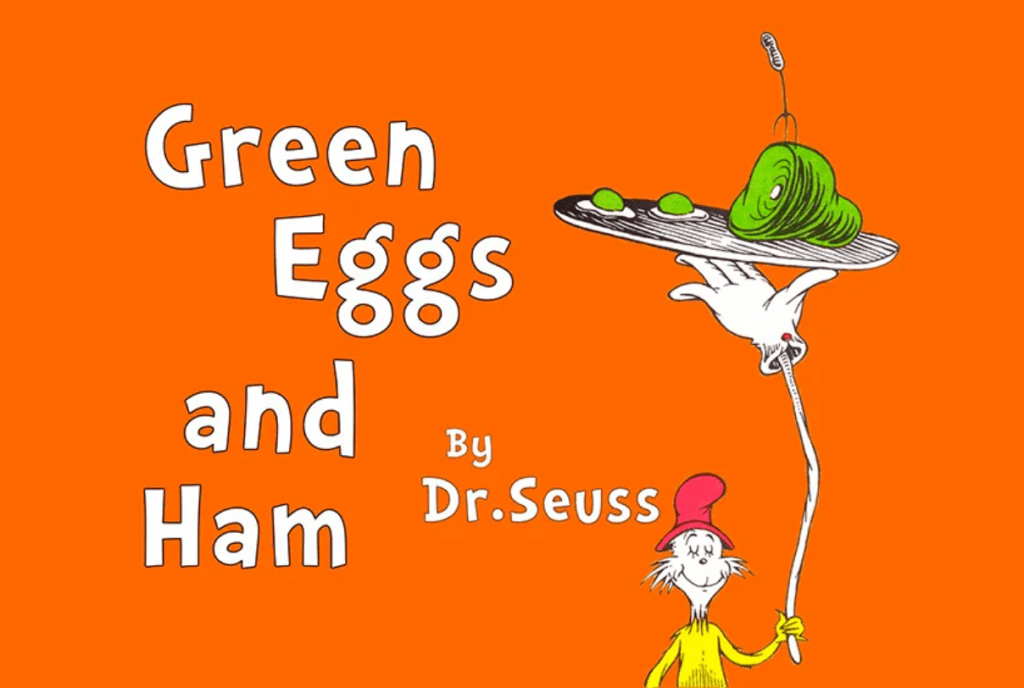
Credit: Random House
Authors dealing with restrictions can find their literary creativity stifled or stimulated. This post will discuss several examples of the latter.
Some fiction fans know the story behind the iconic Green Eggs and Ham. Dr. Seuss was challenged to do a children’s book containing a maximum of 50 different words (albeit all of which could be used more than once). The author struggled with that parameter, but eventually created what has been an enduring bestseller since 1960.
Moving to adult novels, Margaret Atwood was asked to write a book retelling a classic myth of her choosing — so the Canadian author obviously had a limitation on subject matter. She decided to do a feminist take on Homer’s Odyssey, focusing on Odysseus’ wife Penelope and other women. The result was 2005’s The Penelopiad. Not one of Atwood’s most compelling novels, but worth reading.
Another way of working within a framework is writing a novel in verse. Such was the case with Eugene Onegin (1833) by Russian author Alexander Pushkin, whose titular protagonist is a young, selfish, arrogant dandy. While one wouldn’t expect an all-poetry work to be as gripping as a more traditional prose novel, Eugene Onegin holds one’s interest and then some.
Russian-turned-American author Vladimir Nabokov also gave himself a challenge with Pale Fire (1962), which contains a lengthy poem along with prose. A brilliant novel, but not exactly a warm novel — despite having fire in its title. 🙂
Then there are novels written in countries ruled by dictatorial regimes, meaning that if the authors want to satirize said regimes they need to be indirect and allegorical to try avoid possible prison or death. One example is The Master and Margarita, a rollicking novel that Mikhail Bulgakov wrote between 1928 and 1940 in the Stalin-led Soviet Union.
There are also the creative restrictions involved with co-authoring a novel, because it’s not “the baby” of just the usual solo writer. Among such books is 1873’s The Gilded Age by Charles Dudley Warner and Mark Twain. Each man mostly wrote separate chapters, though they reportedly jointly penned a few. The result was an awkward fit; one could tell that the satirical chapters were Twain’s, although Warner’s serious/more-conventional sections weren’t bad.
Finally, I recently read Past Lying (2023), the seventh installment of Scottish author Val McDermid’s series starring cold-case detective Karen Pirie. McDermid imposed restrictions of a sort on herself by setting the novel during 2020’s Covid lockdown, which gave Pirie and her police colleagues quite a logistical challenge investigating a twisty case of murder committed by a crime author. But McDermid pulled it off; I think Past Lying is the best of the Pirie series.
Any comments about, and/or examples of, this topic?
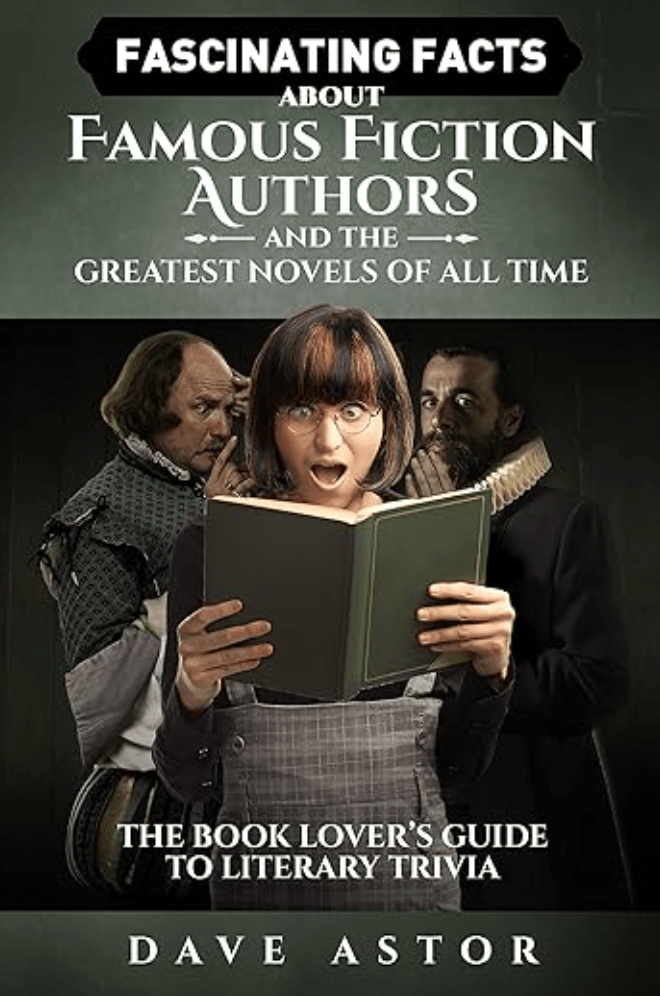
Many thanks to “The Introverted Bookworm” — talented blogger/author Ada Jenkins — for the wonderful review of my 2017 literary-trivia book she posted this past Tuesday, May 27. Very, very appreciated! 🙂
Misty the cat says: “Every cat needs a vacation home.”
My comedic 2024 book — the part-factual/part-fictional/not-a-children’s-work Misty the Cat…Unleashed — is described and can be purchased on Amazon in paperback or on Kindle. It’s feline-narrated! (And Misty says Amazon reviews are welcome. 🙂 )
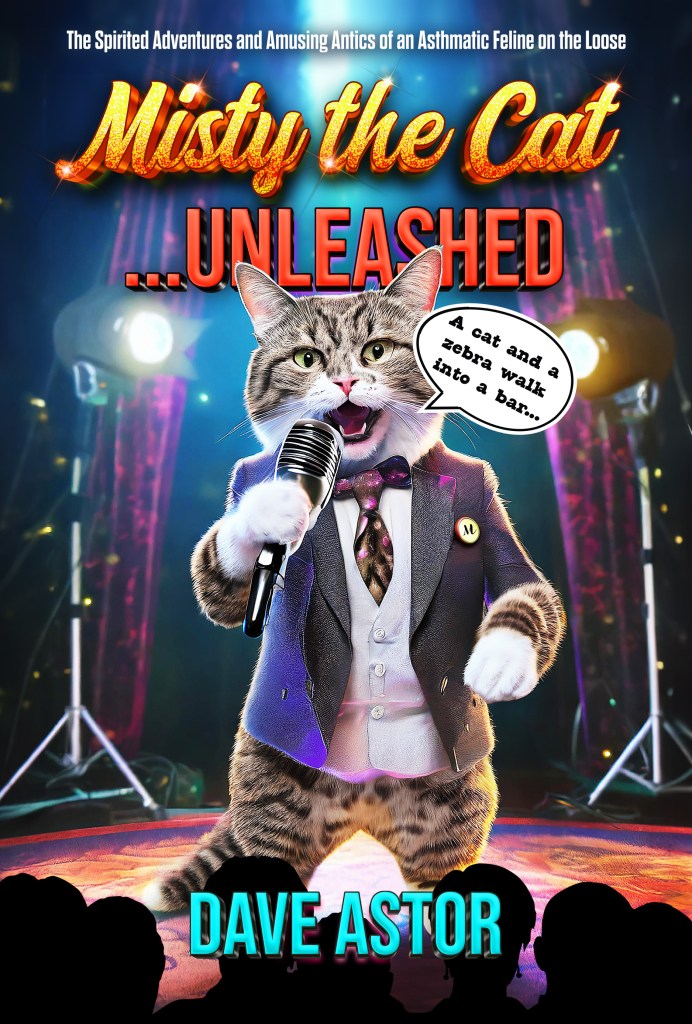
This 90-second promo video for my book features a talking cat: 🙂
I’m also the author of the aforementioned 2017 literary-trivia book…
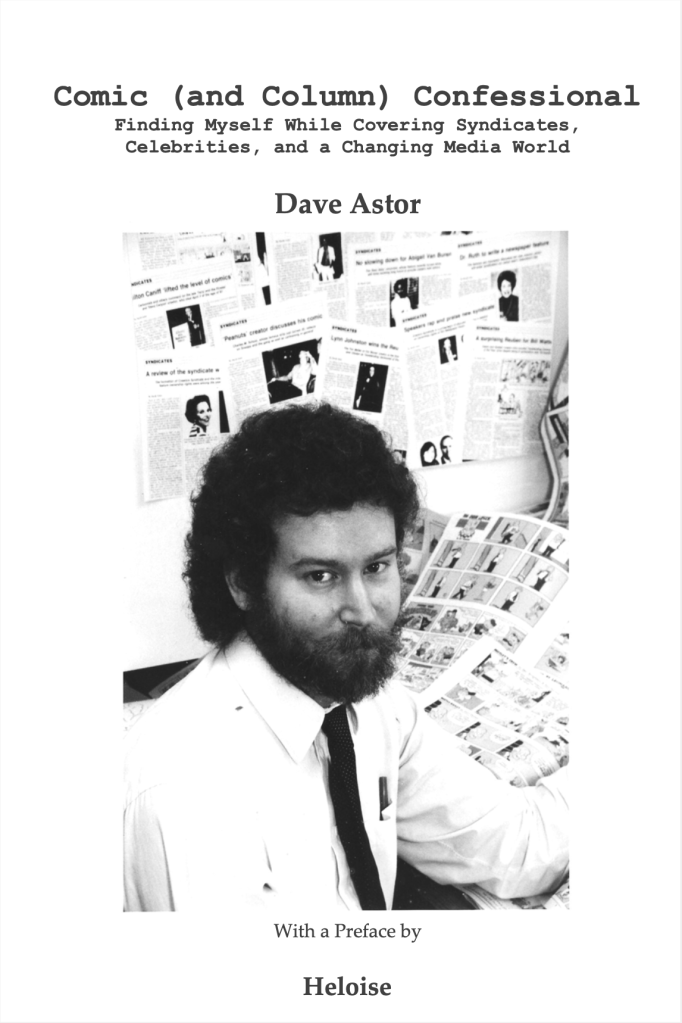
…and a 2012 memoir that focuses on cartooning and more.
In addition to this weekly blog, I write the 2003-started/award-winning “Montclairvoyant” topical-humor column every Thursday for Montclair Local. The latest piece — about Memorial Day, a local food pantry, and more — is here.
 Dave Astor on Literature
Hi Dave,
What about so called ‘woke’ restrictions? Tolkein created some of the earliest worlds of fantasy and it never crossed his mind that his whole Fellowship was male. I’m not sure that he’d get away with that now. So do you throw in random female characters to meet a quota? What about queer people or people of colour? Can you write about a character in a wheelchair if you’ve never been in a wheelchair? Admittedly research is easier for us than it would have been for Tolkein, but it’s also easier for people to share when things don’t ring true, or are blatantly incorrect in the books they read. Maybe a case of damned if you do and damned if you don’t?
Sue
LikeLiked by 2 people
Thank you, Sue! Well said and astutely said! The positive nature of including diversity in one’s writing can be a limitation, as well as an opportunity. Including diversity can of course feel organic, or feel forced; it can make sense or perhaps not make sense. What can bother me is when an author sets a novel in a very multicultural place yet the book doesn’t reflect that. In the film realm, I remember some Woody Allen movies set in the diverse-as-can-be New York City of decades ago that barely had any characters of color, even minor ones. Huh? (NYC, or at least Manhattan, is now whiter and more gentrified.)
LikeLike
Interesting post!
LikeLiked by 1 person
Thank you, Dawn! 🙂
LikeLike
Joyce set out to write a stream of consciousness novel (Finnegans Wake) that aimed to be only accessible for those who have an IQ of 130 or higher and speak 65 languages. It took him 17 years.
LikeLiked by 1 person
Thank you, Shaharee! A very interesting self-imposed restriction. I’ve never quite had the desire to tackle “Finnegans Wake”; I did like Joyce’s less-complex “Dubliners” collection. As for the IQ requirement, hopefully an IQ of 65 on two consecutive days would qualify. 🙂
LikeLike
Hello Dave,
I thought about this for 2 days. The only one I can think of is The Rime of the Ancient Mariner by Samuel Taylor Coleridge.
It is a story, morals and all, written in poem form.
Does this count?
LikeLiked by 1 person
Thank you, Resa! It counts! A story in poem form has certain parameters. 🙂 As Homer, Dante, Walter Scott, and others knew.
LikeLiked by 1 person
Yay!
Yes, “The Lady of Shalott” – Tennyson
The AGO owns a fabulous John William Waterhouse painting of her sitting at her loom, daydreaming by a window.
I can hardly wait to post that. I’m overwhelmed by the volume of pics of art I have in my files, yet I always think I need more.
It’s like the closet is full of gowns, some never worn, but I have nothing to wear to the ball. 🤭
LikeLiked by 1 person
Sounds like a great where-art-meets-literature painting at the Art Gallery of Ontario, Resa!
The size of your art file reminds me of the size of my to-read list. 🙂
LikeLiked by 1 person
Well, seems we both have piles! 😂
lolol…anyway, yes, I cannot control taking pics of art, but I can control my TBR pile. I’ve 7 books to read.
The only book that could possibly slip in now is – I promised to Beta read for someone. ANF Joy has a new book out in September.
I’m overwhelmed. 😳
LikeLiked by 1 person
Seven books to read in your current queue? I have maybe a thousand novels on my TBR list, with some high on the list and some not so high. Of course, I won’t get to MANY of them in my lifetime. 🙂
Another Joy Fielding novel coming soon? She’s such a prolific author!
LikeLiked by 1 person
Well, you can try!
Yes, “Jennie Cooper Has a Secret” -out August 25 – A riveting psychological thriller.
There’s already a waiting cue at the library.
It’s been awhile, I’d like to see her and that part of the family. (Not just for a free book – 🤭) I’ll send her a mail!
LikeLiked by 1 person
Hard to resist reading a novel with a title like that. 🙂
Hope you get a chance to get together with her and that part of the family in the not-too-distant future!
LikeLiked by 1 person
Yes, and me too! 43 holds, and not released yet. 0 copies in the library, but they say they have many copies on pre-order.
LikeLiked by 1 person
43 holds? A real tribute to Joy Fielding. Impressive! (And frustrating for those waiting.)
LikeLiked by 1 person
Yes, she’s popular in her genre. 43 holds…just waiting for the release, in 1 library system.
LikeLiked by 1 person
43 was my house number before we moved to our current apartment in 2014. 🙂
LikeLiked by 1 person
Sounds lucky…it adds up to 7!
LikeLiked by 1 person
I actually hadn’t thought of 4+3=7. Nice! 🙂 Actually, my current address number (160) also adds up to 7. Hmm…
LikeLiked by 1 person
Interesting!
Next move see if you can find a house with the address 26503! 🤭
LikeLiked by 1 person
Ha! 😂 Looking on Zillow now. 🙂
LikeLiked by 1 person
Oh.. well, no problem! Let is know when you move! 🤭😸
Misty is a 5. Dave is a 5. Very cool!
LikeLiked by 1 person
When Misty wakes up from his nap, I suppose he’ll move.
(To his food bowl. 🙂 )
LikeLiked by 1 person
Hmm, Misha will be doing the same. You know, they just might be related! 🤔
LikeLiked by 1 person
LOL, Resa! 😂
LikeLiked by 1 person
Two examples spring to mind – David Mitchell’s novel Cloud Atlas that he wrote concertina style with chapters stretching out from the past to present to future to very distant future and back again. Also all the stories are inter related and at no point does it feel contrived or gimmicky. Also most (all?) Mitchell’s novels exist in the same universe and he manages to make it all feel so cohesive and right. Another book that very much gave me conniptions was Tristram Shandy (oddly the very first thing I was given to read as an English Undergraduate) – where Sterne gives himself the contraint of moving as slowly as possible chronologically. I know Sterne was making a larger point or it was some kind of literary prank but nevertheless it got on my wick! Great topic Dave with lots of interesting responses.
LikeLiked by 1 person
Thank you, Joe! Great examples, and great summaries of them! I read “Tristram Shandy” way back in high school or college; it’s quite a classic in its quirky way. Some very interesting lit in the 18th century (also by Voltaire, Fanny Burney, Daniel Defoe, Henry Fielding, etc.).
Your description of the structure of the very ambitious “Cloud Atlas” (a novel I haven’t read) reminded me a bit of the structure of Eleanor Catton’s “The Luminaries,” which has an astrological-signs format that works well.
LikeLiked by 1 person
Hi Dave, I am very wary about writing anything that could come across as cultural appropriation as African people are sensitive about this. I don’t think a writer should think they can write about anything or anyone. Some circumstances are very sensitive like the apartheid era in South Africa and even I, a fellow South African, would never try to write about it from the point of view of a black South African because I just don’t know enough and would need to make assumptions. I do take umbrage when writers think that research is enough to put you into the shoes of those who have suffered greatly. I do think people should rather write what they know.
LikeLiked by 1 person
Thank you, Robbie! The worry about cultural appropriation can indeed be a restriction, and a fraught one. I totally hear what you’re saying; writing what one knows is ideal in a way and a white author can’t completely “inhabit” what a person of color experiences. Same for male authors creating female characters, etc., etc. Yet I do think that with good intentions, good research, personally knowing people who have different “demographics,” and so on, authors can try to write about almost anything. But perhaps best in the third person rather than the first person. 🙂
LikeLike
Hi Dave, that is reasonable, but I’ve had bad experiences with unreasonable and judgemental people. I’ve written about historical situations in a few different countries, but most of the time my characters are English or the history is ancient and not in living memory. I am very careful but this may not be as relevant in other countries.
LikeLiked by 1 person
Dealing with judgmental critics can indeed be difficult, Robbie. And, yes, “cultural appropriation” can be more fraught in some countries than others. I can see that South Africa could be one of those nations, and it can also be risky in the U.S.
LikeLike
I thought the US would also be risky as you nicely put it. The past burns.
LikeLiked by 1 person
Indeed it does, Robbie. And the present is no picnic, either. 😦
LikeLike
Haha, that is true. But you have to stop living in the past to even experience the present.
LikeLiked by 1 person
I agree, Robbie! 🙂
LikeLike
Smile
LikeLiked by 1 person
🙂
LikeLike
I’ve been very lucky as a writer so far in that I haven’t really bumped up against any major challenges or restrictions – other than keeping my wordcount down. I do tend to get very wordy haha! I was interested that you brought up co-authorships too. Sometimes I wouldn’t mind trying teaming up with someone, but as an OCD patient I think I’d struggle letting go of even part of the control of the project! 🙂
LikeLiked by 1 person
Thank you, M.B.! Keeping the word count of one’s book to a certain level is definitely a restriction of sorts. But it’s of course no problem to pour in many words in early drafts and then pare down from there. 🙂
I hear you about co-authoring; I don’t think I could do it, either.
LikeLiked by 1 person
When I first encounter restrictions on a project, I feel stifled. But I eventually loosen up while brainstorming — and the restrictions cause me to come up with ideas that I probably wouldn’t have without them. Years ago, I designed many 2-color books covers for a client. They wanted to keep printing cost lower, compared with full-color printing. Using just two colors pushed me to try to come up with ways of making them interesting.
Another example is Rod Serling. He changed settings of stories and added fantastical elements to stories so they wouldn’t get stopped by censors. Here’s an interesting article about that: https://www.smithsonianmag.com/arts-culture/early-run-censors-led-rod-serling-twilight-zone-180971837/
LikeLiked by 2 people
Thank you, Dave! So true that restrictions can feel stifling (at first or forever) but can also spark some strong creativity. Sounds like the latter happened with your two-tone book covers!
And that’s a fascinating piece about the great Rod Serling. He clearly was commenting on some very important issues in “The Twilight Zone,” but masked them in sci-fi, fantasy, and/or allegorical ways. Sort of like the various “Star Trek” series would go on to do. Serling must have been VERY frustrated with his pre-“Twilight Zone” TV experiences. Thankfully, that kind of censorship is not as strong these days, though of course Trump and his ilk would like it to be and have made efforts in that direction. 😦
LikeLiked by 2 people
What a great review of Fascinating Facts, Dave! Always a morale booster for an author.
I can’t think of any more good examples of books written under restrictions, but it does occur to me that when we choose to write from a specific point of view, such as first person, or a specific tense, that puts a restriction on how we can show certain things. Details not known to the pov character must be dealt with some other way.
Novels written in diary or letter form are another example. I’m sure you can come up with some titles faster than I can right now. 😉 Okay, there’s Les liaisons dangereuses by Choderlos de Laclos. I read it many years ago, and had to look up the spellings of both title and author.
LikeLiked by 2 people
Thank you, Audrey! Ada definitely did a great job — and, yes, a morale booster for an author. 🙂
You’re absolutely right that what you mention in your comment’s second paragraph are restrictions of a sort. Well stated!
Novels in diary or letter form definitely require an the author to write within certain parameters. Other examples I can think of offhand are Helen Fielding’s “Bridget Jones’s Diary” and (novels comprised of letters) Fanny Burney’s “Evelina” and Wilkie Collins’ “Armadale.”
LikeLiked by 2 people
Great examples, Dave and, as usual, wonderful comments. One point I would make is the rapid rate of change in technology. If an author changes the setting from 1960 to 1970, there are a handful of changes to make. Things like B&W TV to color. On the other hand, change the setting from 2010 to 2015, and the number of changes requires a good deal of research.
LikeLiked by 2 people
Thank you, Dan! A very interesting point! Definitely puts some pressure on an author to get the tech things right when setting a book within a recent or relatively recent timeframe.
LikeLiked by 2 people
I enjoy watching old movies, and the times that a scene benefits from making a phone call or someone having/sharing a cigarette always make me wonder, what would they do today?
LikeLiked by 2 people
Definitely food for thought, Dan. Hard to imagine Cary Grant pulling out a smartphone. 🙂
Plus recent mystery/detective/crime/thriller novels have to be different with all the new tech; for instance, harder to have a character be truly missing if they have a working phone on them.
LikeLiked by 2 people
I thought of the time-setting restriction when I read Sue Grafton’s alphabet novels and how they were set/stuck in a time of manual typewriters.
LikeLiked by 2 people
Thank you, Madeline! Excellent example! I guess authors have the option of time not advancing, or not advancing that much, in a series — even if the series has MANY books. (I read the first four of those alphabet novels and enjoyed them, but not quite enough to keep going.)
LikeLike
I haven’t read it, but I remember Georges Perec wrote a book without using the letter “e” inspired by Ernest Vincent Wright’s book “Gadsby” which I also haven’t read. But I’ve read about them…(K)
LikeLiked by 2 people
Thank you, Kerfe! Amazing to write a book without using such a common letter! Talk about a restriction… 🙂
LikeLiked by 1 person
Yes, I can’t imagine how he accomplished it.
LikeLiked by 2 people
Seems almost impossible! (Sms almost impossibl. 🙂 )
LikeLiked by 1 person
😊
LikeLiked by 1 person
🙂
LikeLike
Mary Shelley and others, while on vacation with Lord Byron were challenged by him to write a “scary” book (see link below). And so we have Frankenstein. Stephen King and Peter Straub collaborated on the book The Talisman. And there’s another book I can’t recall concerning a challenge, a competition or a collaboration, but it will probably come to me at 2am. Maybe Misty will write a book while on vacation. Thanks for another head-scratcher theme Dave. Susi
https://historyfacts.com/arts-culture/fact/mary-shelley-wrote-frankenstein-after-being-challenged-by-lord-byron/
LikeLiked by 1 person
Thank you, Susi! Excellent examples! Mary Shelley magnificently rose to that challenge, didn’t she. 🙂 And, yes, some other memorable co-authorships — including King and Straub, as you mentioned. Also, “The Guernsey Literary and Potato Peel Pie Society” by Mary Ann Shaffer and Annie Barrows, to name another.
“Maybe Misty will write a book while on vacation” — ha ha! 😂 His feline restriction is no opposable thumbs. 🙂
LikeLike
I have been watching videos of cats using buttons to communicate. Idk, I tend to think it has some validity. Then all Misty would need is a transcriber with opposable thumbs, perhaps a monkey. I hear they’ll work for bananas, ha
LikeLiked by 1 person
LOL, Susi! 😂 It seems a trip to Bananas R Us is called for. 🙂
LikeLike
The current political climate places restrictions on the subjects writers can address in fiction and the language they can use.
LikeLiked by 2 people
Thank you, Liz! That’s a GREAT point. The Trump administration’s racist efforts against DEI, its virulent anti-immigrant actions, its use of police-state tactics, its refusal to condemn what Israel is doing in Gaza, etc., etc., can be intimidating for writers (and of course many other people).
LikeLiked by 2 people
You’re welcome, Dave. There is also “cultural appropriation” accusations to contend with from the other end of the political spectrum.
LikeLiked by 2 people
Very true, Liz. While the left has very little influence in 2025’s United States, there are still some pressures from that side of the political divide.
LikeLiked by 2 people
Thanks, Dave. We writers (among other people) are walking a razor’s edge these days.
LikeLiked by 2 people
Absolutely, Liz. 😦
LikeLiked by 2 people
Thanks for raising this issue, Dave. Mikhail Bugakov’s novel The Master and Margarita is an excellent example. Unfortunately, I found it a difficult read and didn’t make it to the end. In my view, George Orwell’s satirical allegorical novella Animal Farm remains relevant in its critique of oppressive regimes over the years.
LikeLiked by 3 people
Thank you, Rosaliene! I agree that “The Master and Margarita” is not the easiest of reads, but it certainly has many compelling and eye-opening moments. And, yes, “Animal Farm” (like Orwell’s final novel “1984”) is a masterful critique of oppressive regimes. Unfortunately, it will never feel dated. 😦
LikeLiked by 2 people
Unfortunately 😦
LikeLiked by 1 person
😦
LikeLiked by 1 person
What a great story about Green Eggs and Ham, a book I loved as a child and still think is wonderful. It makes me think about the fact that writing for children of a certain age group–pre-school, primary school, high school–must have built-in restrictions. You have to be aware of the level of vocabulary children at those ages can understand and enjoy, the themes that are appropriate, the limitations of parents’ and teachers’ expectations–and more!
LikeLiked by 3 people
Thank you, Kim! A terrific point that virtually all books aimed at various younger-reader levels have restrictions of a sort — for all the reasons you mentioned. And I agree that the story behind “Green Eggs and Ham” is great. 🙂
LikeLiked by 1 person
Dave, – this is a wonderful post that stimulated a great deal of thought on how writers respond to challenges. My greatest takeaway was how limitations, far from being stifling, often ignite profound creativity. The examples you cited, from Dr. Seuss crafting classics within word counts to Mikhail Bulgakov navigating Stalinist censorship with allegory in The Master and Margarita, perfectly illustrate this point. I read somewhere that Alice Munro was restricted to writing during her children’s nap times, fitting her creative work into family responsibilities. Just as these writers found unique ways to express their visions despite external or self-imposed boundaries, we too encounter “restrictions” in our daily lives—whether they are time constraints, financial limitations, societal expectations, or even personal challenges. Much like a poet constrained by a sonnet’s form or a novelist under political duress, we are often forced to innovate, prioritize, and discover new strengths when faced with adversity, revealing that true ingenuity and resilience often flourish not in boundless freedom, but within the confines of our realities. I think that Maya Angelou, who encountered many challenges, says it the best:
“We delight in the beauty of the butterfly, but rarely admit the changes it has gone through to achieve that beauty.”
LikeLiked by 4 people
Thank you, Rebecca! Glad you liked the post! I’m also glad you widened the discussion to include time crunches and various other restrictions faced by authors with parental responsibilities, day jobs, health issues, etc., etc. (Perhaps her parental responsibilities were one reason Alice Munro wrote short stories rather than novels?) Anyway, excellent observations by you, and that’s a gem of a quote from Maya Angelou.
LikeLiked by 2 people
Well said, Rebecca!
LikeLiked by 3 people
Thank you, Liz!! I love stopping by Dave’s place. Always a vibrant discussion that prompts much reflection.
LikeLiked by 3 people
I agree, Liz! And thank you for the kind words, Rebecca! I love the discussions, too. 🙂
LikeLiked by 1 person
You’re welcome, Rebecca! I always enjoy Dave’s weekly posts, too.
LikeLiked by 2 people
Thank you, Liz! 🙂
LikeLiked by 1 person
You’re welcome, Dave!
LikeLike
Thank you, Dave! I’d never heard the backstory about Green Eggs and Ham. He surely took that restriction and turned it into an advantage. 😉
LikeLiked by 3 people
Thank you, Victoria! That IS quite an interesting backstory. 🙂 I guess many children like repetition in their books, and a word limitation forced Dr. Seuss to do a lot of that — cleverly, of course. 🙂
LikeLiked by 2 people
Love learning from you! Thanks, Dave! 🥰
LikeLiked by 2 people
Much appreciated, Victoria! 🙂
LikeLiked by 2 people
How lovely of you, Dave, to put a link to the review. It was an honor to read and review your book–I thoroughly enjoyed it. Thanks for your kind words! 😊🦋
I had no idea of the story behind Green Eggs and Ham! It’s really interesting. I think sometimes restriction can be a good thing, as it forces authors to come up with new ways to be creative within those limitations–a sort of challenge to their skills! I’d love to read The Penelopiad at some point; it sounds like a book I’d enjoy.
LikeLiked by 2 people
Thank you, Ada! Happy to link to your terrific review, and I’m very grateful that you wrote it. Glad you enjoyed the book!
I agree that restrictions can be a welcome challenge — sort of like what comic strip creators face when coming up with something for a limited space. And I also didn’t know the story behind “Green Eggs and Ham” until I read a biography of Dr. Seuss a number of years ago. As for “The Penelopiad,” it’s not Atwood’s best work (as I said in the post) but written in an interesting way. Plus it’s short. 🙂
LikeLiked by 2 people
A new subject for me, Dave, and once again I’ll have to go away and have a think. I have ‘The Master and Margarita’ on my TBR, so methinks I’ll have to bump that one further up the queue. Thanks for the exercise of my little grey cells! 🙂
LikeLiked by 4 people
Thank you, Laura! “The Master and Margarita” is quite a novel — complete with the devil as a major character as well as a flying human. 🙂 I look forward to a possible follow-up comment on this topic from you!
LikeLiked by 2 people
I’ll do my best! 😊
LikeLiked by 1 person
🙂
No pressure, Laura; a follow-up comment is not mandatory. 🙂
LikeLiked by 1 person
But if I think of anything I’ll be there with it! 🙂
LikeLiked by 1 person
🙂
LikeLiked by 1 person