
It feels like a dystopian time as we witness the dictatorial Trump regime’s multiple vile actions, Israel’s unprovoked attack on Iran (probably with U.S. approval and U.S. weapons), Israel’s 20-month genocidal war (again with U.S. backing) on innocent Gazan civilians after the horrors of October 7, Russia’s continuing war on Ukraine, yesterday’s assassination of a liberal Minnesota politician by a right-winger, the existential threat of climate change, and more.
Trump this month of course sent over-the-top military force into Los Angeles against the wishes of California’s governor (despite Republicans often blathering about “states’ rights”) to crack down on a small, mostly peaceful resistance to his administration’s brutal roundup of people of color — whether they’re undocumented immigrants, documented immigrants, or longtime American citizens. Which has broken up families, and served as another test for Trump to see how far he can install his Republican brand of fascism. U.S. Sen. Alex Padilla, a California Democrat who’s the son of Mexican immigrants, was even thrown to the ground and handcuffed by agents for trying to ask a question of Homeland Security secretary Kristi Noem, the Trump cabinet member best known for heartlessly shooting her 14-month-old dog. Then came yesterday’s grotesque (and grossly expensive) military parade in Washington, DC, that was held partly to “celebrate” the cruel Trump’s birthday. A parade, by the way, that drew many fewer spectators than Trump wanted — though his constantly lying administration is already inflating the numbers.
All quite convenient for distracting Americans from things like Trump’s support of a Republican congressional tax bill that would mostly benefit the already wealthy and tech billionaire Elon Musk’s recent post on X (formerly Twitter) saying Trump is in the Epstein files for repugnant past pedophile behavior with underage girls.
Anyway, my thoughts in our ultra-depressing era naturally turned to dystopian fiction and a desire to do a post about that genre — which can also include apocalyptic novels. But there was the nagging recollection that I had focused on dystopian literature before, and, sure enough, a search turned up a piece by me for The Huffington Post book section way back in 2012 — two years before starting this WordPress blog. So, I decided to post a revised/updated version of that 13-year-old piece today. Here goes:
War. Death. Despair. Oppression. Environmental ruin. Yup, when it comes to demoralizing literature, dystopian literature is a downer of downers. Yet some of us find that genre soberly appealing. Why?
For one thing, we read about rather than live through dystopian lit’s fictional bad stuff — though real life is plenty negative now (as this post has noted) and fictional bad stuff is often an extrapolation of a troubled actual world. Still, many 2025 readers are not as much “in the arena” as the beleaguered characters in Suzanne Collins’ dystopian The Hunger Games.
And there’s a certain “rightness” in reading about a harrowing society. Why? Because we know that politicians, military leaders, and corporate moguls are capable of doing awful things — meaning dystopian novels feel kind of honest.
In addition to The Hunger Games, excellent dystopian/semi-dystopian novels filled with carnage, inhumanity, hopelessness, and more include (among others) Aldous Huxley’s Brave New World, George Orwell’s 1984, H.G. Wells’ The Time Machine, Mary Shelley’s The Last Man, Stephen King’s The Stand, Octavia E. Butler’s Parable of the Sower, (Ms.) Lionel Shriver’s The Mandibles, Lois Lowry’s The Giver, Cormac McCarthy’s The Road, Ray Bradbury’s Fahrenheit 451, Anthony Burgess’ A Clockwork Orange, William Golding’s Lord of the Flies, Sinclair Lewis’ It Can’t Happen Here, Kazuo Ishiguro’s Never Let Me Go, Albert Camus’ The Plague, Franz Kafka’s The Trial, Nevil Shute’s On the Beach, Kurt Vonnegut’s Slaughterhouse-Five, Jack London’s The Iron Heel, and Margaret Atwood’s The Handmaid’s Tale, The Testaments, Oryx and Crake, The Year of the Flood, and MaddAddam.
The above books of course take different approaches — some very dramatic, others understated, some set in the near future, others in the distant future, etc., etc.
Sometimes, authors of dystopian literature temporarily ease the tension a bit with humor, as Atwood does with the clever genetic-engineering terms she coined for Oryx and Crake. And dystopian books can have seemingly utopian elements — with things appearing not too bad even though they ARE bad; Brave New World is a perfect example. There are even novels, such as H.G. Wells’ The Shape of Things to Come, that mix dystopian and utopian elements.
We admire the best dystopian novels because they’re written well and depict people with whom we can relate. We can be fascinated by the terrible things those characters face, and by how some react bravely and some react cowardly or with resignation. We, as readers, have a hard time averting our eyes from the misery even as we’re enraged by what despots and other vicious officials are doing to citizens. And we’re compelled to turn the pages as we wonder if rebels and other members of the populace can somehow remake a wretched society into something more positive. We also wonder who will survive and who won’t.
Last but not least, some of us might admire dystopian fiction because, by giving us worst-case scenarios of the future, we have a smidgen of (in vain?) hope that our current society can be jolted enough to avoid those scenarios starting or continuing in real life. Like some of the characters in dystopian novels, we might feel a little halting, against-all-odds optimism — such as that inspired by yesterday’s 2,000 or so anti-Trump-regime “No Kings” protests attended by millions of Americans in all 50 states, the resistance of politicians such as Bernie Sanders and Alexandria Ocasio-Cortez, the resistance of institutions such as Harvard University, the holding to a belief in the rule of law by some judges (including a percentage of those appointed by Trump), and so on. But it’s a difficult fight against very powerful forces.
All that said, I don’t blame anyone for preferring escapist fiction during a time like this. I’ve upped my quota of those kinds of books myself, while making sure to still read some weightier literature.
Any favorite dystopian novels? Why do you like or not like that genre? Thoughts about the current situation in the world?
Misty the U.S. cat: “I nap in the morning near an Australian novel because it’s night in Australia.”
My comedic 2024 book — the part-factual/part-fictional/not-a-children’s-work Misty the Cat…Unleashed — is described and can be purchased on Amazon in paperback or on Kindle. It’s feline-narrated! (And Misty says Amazon reviews are welcome. 🙂 )
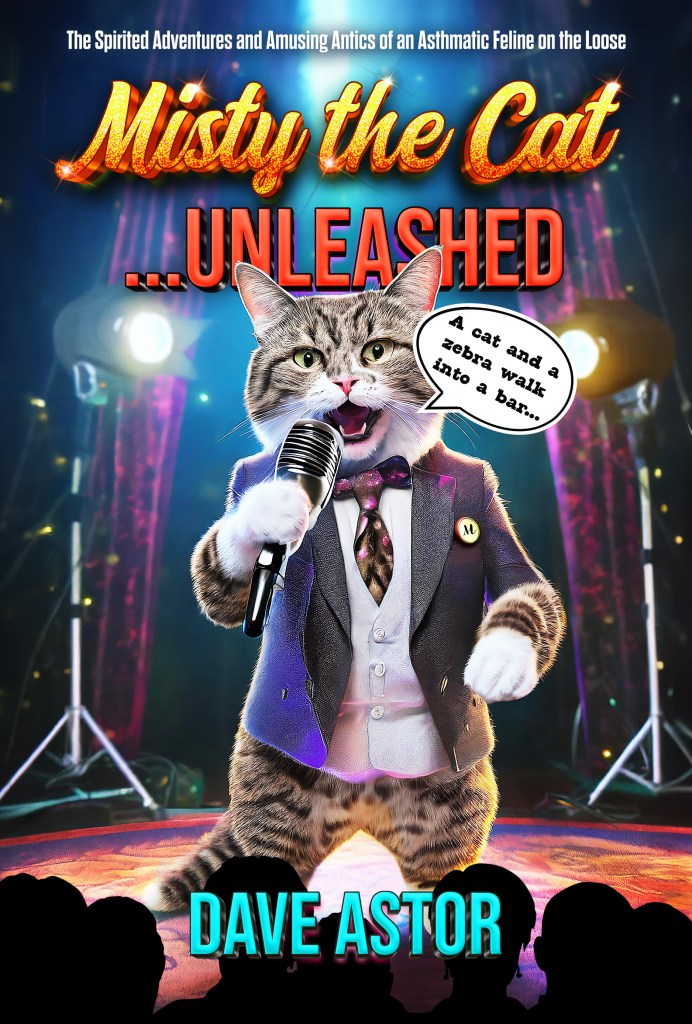
This 90-second promo video for my book features a talking cat: 🙂
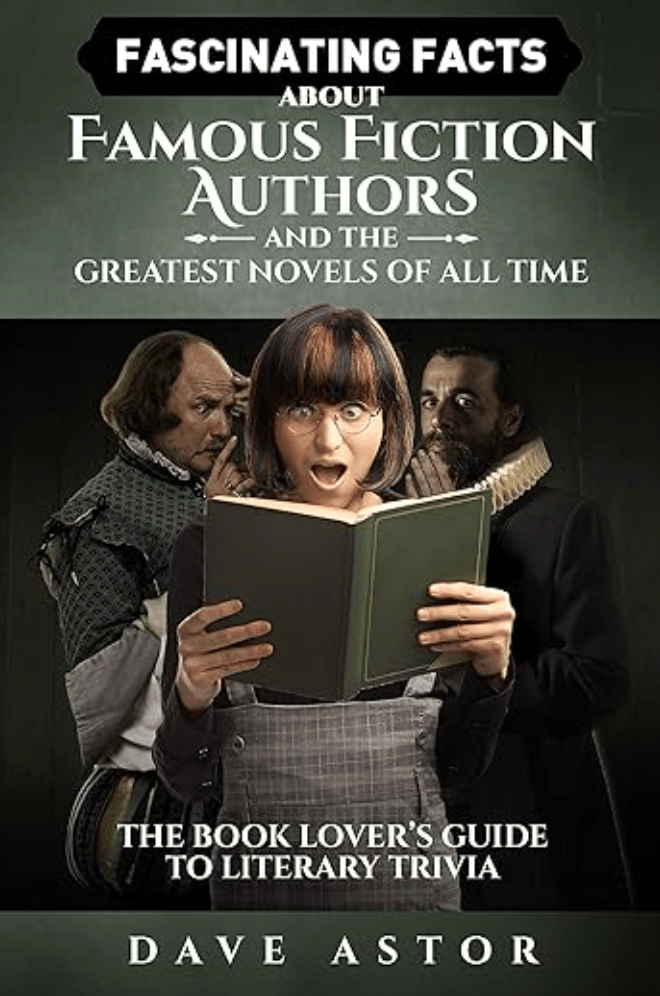
I’m also the author of a 2017 literary-trivia book…
…and a 2012 memoir that focuses on cartooning and more.
In addition to this weekly blog, I write the 2003-started/award-winning “Montclairvoyant” topical-humor column every Thursday for Montclair Local. The latest piece — containing election results, news about smartphones in classrooms, and more — is here.
 Dave Astor on Literature
Dave,
This is in response to your last response.
The thread was so thin, it was a word per line, working its way to a letter per line.
Anyway, yes the bombing last night.
In the ether of Iran being rendered less nuclear capable, many are missing a quintessential issue, that pertains to America’s democracy.
The felon did it without consent of Congress. It’s one more chip off the power of that body’s co-equality and a chip added to the felon’s authoritarian power.
Am I thinking correctly here?
LikeLiked by 2 people
Those thin, thinner, “thinneriest” threads! 🙂 😦
You’re absolutely correct, Resa; Trump should have consulted with Congress. Chances are that Congress — with its majority composed of spineless Trump Republican sycophants, plus the many Democrats “bought” but the Israel lobby — would have went along, but still…
LikeLiked by 1 person
Agree, he would have got his way.
Still, without resect for the rules, the king rules.
LikeLiked by 1 person
You’re right that rules are better than no rules. And when it comes to monarchs, I prefer butterflies over Trump.
LikeLiked by 1 person
Me Too!!!!! x
LikeLiked by 1 person
🙂
LikeLiked by 1 person
I don’t feel inclined to go along with this “bleeding hart” story when it goes about eliminating Hamas or the Ayatollahs. They had it coming. It’s just that they’re using their population as a human shield to play their power games. Add to that an Israeli prime minister who’s willing to do whatever to remain in power (in order to duck some corruption prosecution), a US president with dictatorial tendencies, a Russian War-mongerer who wants to restore the Soviet Union, and you get a poisonous international environment. In this context, the Chinese seem to be the most reasonable and predictable international players on the field, albeit they also have an imperialist agenda.
In the end, I’ve decided that I don’t want to have nothing to do with it anymore. It’s up to the population of each country to deal with their leadership. Either they go along with the rhetoric and war games of their leaders, or they remove them. I’ve been a soldier for too long time and ended up too many times fighting other people’s wars. Not anymore.
LikeLiked by 2 people
Thank you for the comment, Shaharee. I agree that there can feel like there’s no one to root for on this planet. Hamas and the theocratic Iranian regime are hardly admirable. But the U.S. and Israel have a lot more military firepower, Israel’s response to the grisly October 7 attack has been wildly disproportionate in terms of Palestinian civilian deaths, and Israel’s attack on Iran was unprovoked and is incredibly destabilizing to the region and the world. Re your mention of China, that country is obviously under authoritarian rule, but its leaders have had the sense the past few decades to spend a lot more than other powerful nations on development vs. the military/getting involved in war.
LikeLiked by 2 people
How do you think that your president would have reacted when some cartel of Mexican tugs would cross the border, wipe out a town with 1000 inhabitants (women and children alike) and carry off 200 hostages?
LikeLiked by 1 person
Or when Cuba would work on a nuclear bomb or install some Russian missiles?
LikeLiked by 1 person
Thank you for the follow-up comments, Shaharee. I hear you; Israel had every right to respond after October 7. But it has now killed maybe 50,000 (?) Palestinians (mostly civilians), so the response is grossly disproportionate. Plus there’s the issue of Palestinians being treated brutally by Israel since the country’s founding, so things don’t happen in a vacuum.
Re Iran, Trump’s own Director of National Intelligence Tulsi Gabbard said in March that Iran was not close to using its nuclear capability for nuclear bombs. Given that Israel has an estimated 90 nuclear warheads, one could just as easily say that Iran had the right to preemptively bomb Israel in “self-defense.”
LikeLiked by 1 person
So Cuba has also the right to develop nuclear warheads and install launch systems for them and you would stand as firm in your believe that since the US has a zillion warheads they can also have some, the US would not have any right to interfere like Kennedy did into the sixties?
LikeLike
I’d prefer that no country have nuclear arms. But if some countries are going to have them, who’s to say others can’t? Historically, the U.S. and Israel are among the nations much more dangerous to other nations than countries like Cuba and Mexico have been.
JFK did take action re Cuba and the Soviet Union during the “missile crisis” of his presidency, but that matter was resolved peacefully. He didn’t bomb Cuba. (Of course JFK did acquiesce to the Bay of Pigs invasion, but would regret it.)
LikeLike
And I agree, things don’t happen in a historical vacuum. First thought should be “Why did all those Jewish people massively flock to Israel in the post WW 2 period?”. In the interbellum the US has sent THOUSANDS of Jewish refugees back to the SS dead camps. So, just maybe, they were thinking “We need our own country”? Not to mention that during the interbellum the Jewish people living in what was then called Palestine, were also brutally treated and even murdered (for the same reasons as always: what one has, another one begets). Maybe they thought “An Eye for an Eye”? Of course, Americans, being good Christians, would just have turned the other cheek and would blissfully forget that their own nation is founded upon a genocide, slavery, and unlawful territorial encroachment. It’s easy to be sanctimonious when it doesn’t happen next door. For my part, they can bomb each other to dead with nuclear warheads. It would turn the Middle East into a dystopian Wasteland that could serve as an educational lesson for others (in case that they forgot already about Hiroshima and Nagasaki, the only time nuclear weapons have been used in a conventional conflict). And maybe it would get us a little faster off from our petroleum addiction. Just cross my fingers they don’t cause a new (nuclear) Ice Age. For the rest, it’s mainly just desert around there. Could still serve as a garbage dump.
LikeLike
Yes, about 6 million Jews were murdered by the Nazis in the unspeakable Holocaust (including members of my extended family; I’m Jewish). If anything, surviving Jews should have gotten a piece of Germany as a country as direct restorative justice. Instead, they got their biblical homeland and forced out or made second-class citizens out of Palestinians who had nothing to do with the Holocaust. As a Jewish person (albeit with no interest in religious Judaism and little interest in cultural Judaism) I’m appalled to see Jews such as the far-right Netanyahu, Smotrich, and Ben-Gvir become the oppressors when their ancestors were the oppressed.
LikeLiked by 1 person
Want to have a clean street? Start with sweeping the sidewalk in front of your own house. It’s going to be a messy job.
LikeLiked by 2 people
That’s a good metaphor!
LikeLiked by 2 people
Thank you, Dave for this most excellent post, which prompted a great deal of thought for me over the past few days. I believe that dystopian stories have become such a powerful mirror for our times. They often emerge when people are wrestling with uncertainty or seeking to make sense of complex, changing realities. It seems to me that dystopian novels and films don’t just predict disaster—they ask urgent questions about who we are, what we value, and how we respond under pressure.
Maybe that’s why so many of us are drawn to this genre right now—it offers both a warning and a window into resilience, reminding us that even in imagined darkness, there’s a human thread worth holding on to.
As George Orwell once wrote, “In a time of deceit, telling the truth is a revolutionary act.” Perhaps dystopian fiction helps us do just that—face difficult truths and imagine new ways forward.
By the way, I went back in time to consider whether dystopian writing was present in the 1700 – 1800’s. Consider Jonathan Swift’s Gulliver’s Travels (1726) which might not look dystopian at first glance, but parts of his journey—like the land of the Houyhnhnms—paint a deeply unsettling picture of a “perfect” society that’s anything but human. And then there’s Voltaire’s Candide (1759), which uses biting humor to expose the cruelty and absurdity of the world, and Mary Shelley’s Frankenstein (1818), which explores the dangers of unchecked ambition and what happens when we lose touch with empathy.
Sorry for the late response. I’ve been attending to family matters!!! What I like most about blogs is that the words/stories/posts are there waiting for our arrival.
LikeLiked by 2 people
Thank you, Rebecca! Great take on the importance, relevance, and appeal of dystopian literature — and the sobering nature of that genre.
I totally agree that “Gulliver’s Travels” has dystopian elements as well as more positive ones. “Frankenstein” is definitely dark. I haven’t read Dante’s “Divine Comedy,” but wonder if could be considered another example of a partly dystopian work in long-ago literature.
I appreciate you citing one of the great Orwell’s great quotes!
Wishing you the very best with your family matters. And, yes, blog posts are patiently waiting for when we get a chance to read them. 🙂
LikeLiked by 2 people
An interesting and weighty topic, Dave.
I have been enjoying a much needed escape from all what you speak of, by focusing on doing my Emmy nominating. Now that’s over and I’m back to reality.
Coincidentally, I have been thinking about Fahrenheit 451 a lot , because of the stain’s attack on universities and the general book banning going on. I was waiting for this weeks post to ask you –
What book would you memorize?
So, to add to your book list of dystopian novels, how about Brazil by John Updike?
In closing I’d like to say, Misty is one smart cat! The video is absolute proof.
LikeLiked by 2 people
Thank you, Resa!
Nice to be busy with something (Emmy nominating) that might take your mind off current events. Congratulations on being one of the nominators!
“Fahrenheit 451,” published in 1953, is VERY relevant to today.
What book would I memorize? I don’t think I have the brain capacity to memorize anything over a page or so. 🙂 Reminds me of a joke cartoonist Milton Caniff once told me; he said the Bible could be condensed to two words: “Be good.” (Of course, some Bible readers are far from good.)
I hadn’t been familiar with John Updike’s “Brazil”; just read about it on Wikipedia. Definitely an unusual novel.
LikeLiked by 2 people
Thanks Dave!
Showtime gifted me a membership to the Academy when I was designing for them.
I have kept up my membership, and I love being part of the process.
The actual nominations come out on July 15. Then the real work of voting begins.
I take my responsibility seriously, and watch every minute of every show before voting.
Anyway, when I read “Fahrenheit 451,” I thought I’d memorize “Gone with the Wind”. LOL!
The descriptions of Brazil’s plot line don’t do its dystopian elements justice. That element lies within the deferential between extreme poverty and wealth.
Anyway, just want to say…. Be Good! 😈
LikeLiked by 1 person
Ha ha, Resa! 😂 Combining “be good” with a devil emoji is Satanic perfection. 🙂
I’m not a big fan of John Updike, but “Brazil” does sound kind of fascinating. He definitely tried some different genres during his career.
A great gift from Showtime! I am not surprised that you are very diligent with your responsibility.
Ha ha, again! 😂 If I tried to memorize “Gone With the Wind,” from my memory each paragraph would be…gone with the wind. 🙂
LikeLiked by 1 person
😂 I guess that goes for song lyrics too?
You know I’m thinking of the old Dylan song “Blowin’ in the Wind”.
I’m wondering if “The Bean Trees” by Barbara Kingsolver is the cause of your wind problems.
Okay, I haven’t read “The Bean Trees’ so I read about it. OMG! Talk about a currently relevant story line about refugee immigrants. It sounds like a fab book.
The book sounds full of heart, so no doubt it will be banned shortly.
It seems the wind scatters not only seeds, but thoughts & ideas. 🤔 🙂
LikeLiked by 1 person
Thanks, Resa, for the seriocomic response!
“The Bean Trees” is an excellent early Barbara Kingsolver novel. Yes, the U.S. far right would love to ban that humanistic, socially conscious author. 😦
LikeLiked by 1 person
Where are we?
What are we becoming?
😨
LikeLiked by 1 person
Well, there are many a “we” not like that, but with less power at the moment.
LikeLike
I understand.
The sad part is the “we” who are not like that are being “forced” to live under the punishing hood of those that are.
That is as opposed to disagreeing in a civil manner, agreeing to disagree or another form of dealing with divergent ideas respectfully and legally through established government bodies.
From up here it looks like the positive lies in the courts, Gavin Newsom taking on the stain, and the people continuing peaceful protest, and growing that.
Dave, it’s scary, honestly.
LikeLiked by 1 person
Yes, Resa, good people are under the boot of nasty people. I agree that protests, some brave politicians, etc., provide some hope, but it is indeed a very dark time. The fact that a person as cruel as Trump is admired by maybe 30% of the country feels like a mass psychosis.
LikeLiked by 1 person
Yes, a psychosis. It turns that 30% into a cult.
Since day 1, I’ve always said he was building a cult following.
That is why none of his lies and crimes matter. Cult leaders take the followers’ money, screw their women and children, deny any education or thought that is not from/of the leader.
It’s quite the racket, and oh, god is always on their side. It is a testament to how lost and afraid some of humanity is.
It’s been a Dr. Strangelove night, in a way!
LikeLiked by 1 person
Yes, yes, and yes — and now the U.S. as of last night is officially in an unprovoked war against Iran with Trump’s disgusting bombing. 😡
LikeLiked by 1 person
Thanks Dave for your reflections.
I think in the US the border between fiction and reality gets more and more blurred. Umberto Eco coined the phrase ‘faith in fakes’ after he travelled through the US in the 70s. Everything is fake or fake is real, I would say from my experience living in the US.
In the US everything degenerates into a performance, and as a performance, anything goes. It’s like dystopian literature being played out in real life. Or should we say that dystopian literature prepared Americans for this reality?
But just like the buyers of dystopian novels, voters chose this reality of their own free will; it didn’t come out of the blue.
And how will it continue? We know from history that when someone wants to make their country great, they always lead it into ruin.
Anyway, thank you for this article, and we find it very commendable that you are taking a political stance here in a medium that deludes itself into thinking it can be apolitical.
All the best
Klausbernd 🙂
The Fab Fab Four of Cley
🙂 🙂 🙂 🙂
LikeLiked by 1 person
Oh dear, sorry, something went wrong here. Unfortunately, the last two sections appear twice. Could you, please, so kind to correct this. Thank you.
LikeLiked by 1 person
Klausbernd, I took out the repeat paragraphs and hopefully didn’t mess up your comment in any way. If I did, let me know! Thanks!
LikeLiked by 1 person
Thank you very much, dear Dave. Everything is fine now.
LikeLiked by 1 person
Great! Thank you for letting me know, Klausbernd. 🙂
LikeLiked by 1 person
Thank you, Klausbernd! All well said!
Yes, the line between fact and fiction does seem blurred in the words and actions of many U.S. “leaders,” especially the more conservative ones. Most of the time this is deliberately done to try to help turn their worst, most-unpopular policies into reality.
Many voters indeed choose this reality of their own free will — though if they were given honest news rather than propaganda, some might choose differently.
I share your belief that there is ruin coming in the future. 😦
Re what you said at the end of your comment, it’s hard to not be political sometimes given how dystopian things are these days.
LikeLiked by 1 person
Hi Dave, I clearly have a bit of an obsession with dystopian fiction as I’ve read the majority of the books you’ve mentioned. The time machine’s depiction of the Eloi, a demonstration of Wells’ ideas as to what would happen to man if we had no struggles, horrified me as a girl. It and War of the Worlds are still firm favourites of mine. Wells was a genius. I have never thought of Lord of the Flies as dystopian fiction.i think it’s very realistic. Look at what’s happening right now in the world and you can see it. A great post. You need to write about war books 😉
LikeLiked by 2 people
BTW, The Stand is another favourite book of mine. Have two copies, including the uncut version, and have read it three times since I was 11.
LikeLiked by 1 person
“The Stand” IS terrific, Robbie; great that you’ve read it three times! I think I’ve only read the abridged version, a long time ago.
LikeLike
I have reread a few of King’s books namely, The Stand, The Shining, IT, and Salem’s Lot. Those are my firm favourites and his best in my opinion.
LikeLiked by 1 person
All excellent! (I haven’t read “It” yet; I want to.) The Stephen King novels I found most compelling also include “Misery” and “From a Buick 8,” among others.
LikeLike
I really did enjoy IT. Certainly one of my top 3 King books. I didn’t like Misery as much. That was when King started crossing lines for me and it got to mindlessly violent.
LikeLiked by 1 person
“Misery” is indeed very violent. Sickening, but a real page-turner. And that dynamic of writer/(psychotic) fan of the writer.
LikeLike
It was a page turner. King is a great writer.
LikeLiked by 1 person
Yes, even when one is repulsed by some of his writing, one keeps reading.
LikeLike
👍
LikeLiked by 1 person
Oh, and Carrie
LikeLiked by 1 person
Quite a debut novel!
LikeLike
Yes, I think it was rejected by publishers 33 times though
LikeLiked by 1 person
I’ve heard about the many rejections for “Carrie”! Publishing companies sometimes are clueless, or prefer novels that are conventional/not that disturbing/not that different.
LikeLike
Yes, exactly, and it’s gotten worse. I don’t think a lot of famous novels would even get published now.
LikeLiked by 1 person
I think you’re right, Robbie. At least independent publishing is a major alternative these days.
LikeLike
Yes, but they are hard to market
LikeLiked by 1 person
Sadly, so true, Robbie. 😦 (My three books have not exactly been bestsellers. 😦 )
LikeLike
Thank you, Robbie! You have read an impressive amount of dystopian fiction! I agree that H.G. Wells is brilliant, whether he goes the dystopian route or does more general sci-fi — such as “The First Men in the Moon.”
Re “Lord of the Flies,” I guess the definition of dystopian fiction can be kind of flexible and wide-ranging. 🙂
I’ve written about war novels in the past, but it’s been a while. 🙂
https://daveastoronliterature.com/2017/05/28/the-wars-in-the-world-of-literature/
https://daveastoronliterature.com/2014/08/17/war-in-literature-a-no-peace-piece/
LikeLike
I appreciated the list of dystopian novels you presented, reflecting that unfortunately the current scenario seems to have come out of one of those
LikeLiked by 1 person
Thank you, Luisa! Trump indeed has seemingly used one or more dystopian novels as a blueprint for his regime, but of course he doesn’t read books. So I guess it was instead malicious instinct. 😦
LikeLiked by 1 person
I fear it too… and I’m terribly worried 😟
LikeLiked by 1 person
A lot to legitimately worry about, Luisa. 😦
LikeLiked by 1 person
Hi Dave,
I can’t add much this week as my current read is historical fiction. It’s a book club read, mostly a romance, and I’m not really enjoying it. But it’s set in France at the beginning of World War II which I guess is a bit interesting. One of the characters has a Jewish parent and she’s worried she’s going to be kicked out of her own country. But she’s assured that only the bad people are being targeted. It has nothing to do with their religion, it’s about the crimes they’ve committed. Until it’s about the foreigners and only people who were born here belong here. Still, she worries about being half Jewish and spoiler – she’s probably got good reason to be worried. So, sorry, no dystopia from me that can be compared to current events. Sigh
LikeLiked by 1 person
Thank you, Sue! Sorry you’re not enjoying that book. It does sound like it has quite a bit of relevance to today, including Trump’s blatant lie that only “bad” immigrants are being targeted. From your description, the book you’re reading also reminds me a bit of Elsa Morante’s great World War II novel “History,” which stars a half-Jewish woman in Italy.
LikeLike
Dystopian fiction was never my genre choice, Dave, but now I couldn’t read one if you paid me – not in our current political state. I can barely watch the news. And we’re told to lessen stress if we can. Yeah, right. 🙂 Between world events and what’s happening in our country, life is stressful and uncertain. I suppose every decade brings something unpleasant or tragic. But I feel with our current pres., things have really gotten out of hand. And I don’t recall feeling this way in the past. I’ve never read 1984 or A Brave New World, but I’d like to. I just don’t know when I’ll feel brave enough. LOL It’s hard enough falling asleep some nights. Sigh. I’m sticking with poetry, a good mystery, romance, drama, but nothing too dark or heavy.
LikeLiked by 1 person
Thank you, Lauren! Dystopian fiction is also not one of my favorite genres, and I hear you when you say it becomes even less of a favorite during dark times such as the present. I agree that there have always been dark times — including worse ones than the present — but the present is getting up there in the dystopian rankings “thanks” to a spectacularly mean, atrocious, unqualified U.S. president. “…sticking with poetry, a good mystery, romance, drama” is not a bad thing at all. 🙂
LikeLiked by 1 person
Speaking of mean and possibly crazy American presidents, have you read The Dead Zone by Stephen King. I could swear that man can see into the future. Now we just need Johnny to save us 💕
LikeLiked by 1 person
I have read “The Dead Zone,” Robbie, and it is indeed prescient — though the reality of nonfiction President Trump feels even scarier. I hope his supporters wake up from their moral coma.
LikeLike
I am surprised he still has supporters. Why?
LikeLiked by 1 person
That’s the million-dollar question, Robbie. Part of it is that he normalizes their racism, they like that he’s always trying to “own the libs” (liberals), he sounds candid even though he’s constantly lying, he sounds decisive even though his actions can be all over the map, many of his male supporters relate to his deep hatred of women, etc.
LikeLike
All rather terrible in a first world society. America certainly isn’t what I always thought it was. I must say the book, Pachinko, is really eye opening when it comes to the impact of racism on people. Really heartbreaking.
LikeLiked by 1 person
So true, Robbie; one would think a country like the U.S. would be more “evolved” in the 21st century. Many Americans are, but not enough of them. 😦 “Pachinko” sounds like an exceptional book!
LikeLike
I have found it very compelling as a read.
LikeLiked by 1 person
It’s on my (enormous) to-read list. 🙂
LikeLike
😂💕
LikeLiked by 1 person
🙂
LikeLike
I’ve read many of the books that you list. Somehow, right now, they’re not appealing to me because they are a bit too close to reality.
LikeLiked by 1 person
Thank you, Marie! I totally understand; reading or even thinking about depressing novels these days can feel like kicking ourselves when we’re already down. Still, I’m reading some here and there while definitely enjoying more escapist fiction than I used to.
LikeLiked by 1 person
Ugh. You make great points about states’ rights and the distraction away from Musk’s claim about Trump and the Epstein files in regard to the National Guard troops being sent into California. And about the impact of dystopian fiction. I remember during Covid shutdown, how pandemic movies were popular on Netflix, etc. Back then, a news commentator described that popularity as maybe people want to see how bad things could get. I think that’s why I’ve read those books.
You’ve listed powerful examples of novels. McCarthy’s “The Road” has one of my favorite pieces of writing — the last paragraph of that book sent me reeling.
Another example is “Station Eleven” by Emily St. John Mandel. I read it during the Covid shutdown, and it was a gripping book. The series on HBO Max for the book did a great job of expanding/deepening the story — and it had some really emotional moments.
Thanks for covering another great topic!
LikeLiked by 1 person
Thank you, Dave! Yes, Trump is the master of distraction — generating so much infuriating news that people think less about the previous infuriating news he generated. And such blatant Republican hypocrisy about states’ rights.
As you note, Covid (during the tragic height of it, anyway) definitely made many people think about dystopian fiction — whether movies or books. When Covid hit the U.S. in earnest in March 2020, I felt the urge to reread great dystopian novels like Albert Camus’s “The Plague” and Mary Shelley’s “The Last Man”…but resisted that urge. 🙂
I appreciate the “Station Eleven” recommendation!
LikeLiked by 1 person
Hi Dave, have you read The Stand by Stephen King. During Covid people said King was writing 2020 but he already had years before 🙃. I consider your book Bugbies to be a brilliant dystopian novel. What you wrote is quite possible due to mankind’s continuing and unrelenting abuse of the natural environment. I consider Bugbies to be a brilliant book.
LikeLiked by 2 people
Robbie, thank you very much for your kind words about Bugbies. I deeply appreciate that. Also, yep, I have read The Stand. I think I was a teenager when I read it. I remember being impressed by the huge scope of the story, and by the variety of characters. King has a great imagination, and the skill to write a story that you can’t wait to see what happens next!
LikeLiked by 1 person
Brilliant! So true. I had to smuggle books into Africa. Nothing online in those days?
Sent from my iPhone
LikeLiked by 1 person
Thank you, ghampadams! Sorry you had to smuggle in books, but glad you did.
LikeLike
Ah yes, dystopian fiction, one of my favourite genres. I’ve read all of Atwood’s and many of King’s, and lots of others as well. Also, I am mentioning ‘The Bone Wall’ by the wonderful D. Wallace Peach. What a brilliant book it was!
LikeLiked by 1 person
Thank you, Chris! You are a fan of a very interesting genre, and great that you’ve read so much of Stephen King and Margaret Atwood! I’ve also read (and loved) most of Atwood’s work — whether it’s dystopian speculative fiction, more general current fiction, or historical fiction (“Alias Grace”). And I appreciate the mention of Diana — an excellent writer!
LikeLiked by 1 person
Hi Dave,
A very thought-provoking post! It’s no fun when real life mimics a dystopian novel!!! The whole world seems to be experiencing troubled times at the moment!! The UK where I am is no exception!! I’m looking forward to some sort of improvement. Wishing you a great week and happy reading. Sharon
LikeLiked by 1 person
Thank you, Sharon! Yes, enough of the real world mimicking dystopian fiction! From what I’ve read, there are indeed some things going on in the UK that one wishes were not going on.
Wishing you a great week, too! (Despite the negatives in the world.)
LikeLiked by 1 person
That’s right, Dave! There’s lots going on here, that is not ideal! However, wishing better times for everyone. Thank you for your kind wishes. Sharon
LikeLiked by 1 person
You’re welcome, Sharon! Better times ahead…definitely hope so! 🙂
LikeLiked by 1 person
I’ve read many of the novels you mentioned, Dave and I’ve always had that nagging feeling that it wouldn’t take much time/effort for situations like that to develop. I had a dystopian short story planned for the TDWC that recently ended, but I have to rework it because the premise happened (in a different country, but…) It’s going to be harder to write fiction in that genre.
LikeLiked by 1 person
Thank you, Dan! Yes, things can scarily “go south” pretty quickly in a country. And that’s a very interesting observation of yours; with so much dystopian stuff going on in real life, some of the fictional ideas get taken in a way.
LikeLiked by 1 person
I’ve read a lot of the books you mentioned–but they never seemed as real as they do now somehow. I’m currently reading Celest Ng’s “Our Missing Hearts” and it could be taken right out of Project 2025’s text. Truth and fiction are too close for comfort these days. (K)
LikeLiked by 2 people
Thank you, Kerfe! I totally agree that, sadly, dystopian novels can feel more real these days. And it would be hard to imagine any fiction in that genre being scarier than Project 2025 — 900 or so pages of horror. 😦
LikeLiked by 1 person
I just grabbed a few new goodies to read because of this post. For my Kindle, which I know Misty isn’t a fan of, because this old dog can still manage a new trick every now and then.
LikeLiked by 1 person
Wonderful to read, whatever “medium” the book is on. 🙂 Glad you found some of the mentioned books of interest! Misty the cat thinks “The Giver” is about anyone who feeds him. 🙂
LikeLike
I find it difficult and disturbing that the ‘land of the free’ could deteriorate into a fascist state with a mentally-disturbed narcissist elected to head it – yet here we are. I feel so bad for my many friends in the USA, Dave, as well as the many who didn’t vote for this – and as for those who did, words fail me. My friend and fellow indie A.E.Dean published ‘Not My Country’ towards the end of 2024, imaging the UK about ten years from now and being run by a far-right regime. Less than a year later it’s looking more and more likely that we could end up there – which gives the author no pleasure. I’m one of those who likes to read dystopian fiction maybe because forewarned is forearmed? I’ve read many on the list you give, and would add -The Hundred’ by Kass Morgan. It’s a YA series of 4 books which imagines the earth of the future rendered uninhabitable by a nuclear, and the human survivors living on an ‘ark’ in space. One hundred young people are sent down to see if it’s possible to begin life down there again. I’ll confess that I haven’t read it myself yet, but have been watching the TV series made from it. There are seven series in total, and we’ve watched five so far. I have a free sample on my Kindle, however, and will be reading soon. Back in reality, please be assured that many of us over here are thinking of you over there and hoping that you can find an early way out of this bad situation. Very best wishes. Xx 😐🙂
LikeLiked by 1 person
Thank you, Laura, for the comment and the sympathy!
Yes, very disturbing what’s going on in the U.S. Of course, Trump won with a plurality, not a majority, and he is absolutely loathed by many Americans, but he somehow is in power despite that, his extensive criminal record, and his absolute lack of morals and empathy. 😦
I appreciate the mention of “The Hundred,” which I had not been familiar with but which sounds absolutely riveting.
LikeLiked by 1 person
You’re welcome, Dave, and please excuse the typos in my previous reply. I’m typing this on my phone in bed, and keep dozing! 😂
LikeLiked by 1 person
Your comment looked flawless to me, Laura! (My 2017 phone is so old I can’t even use it to comment on blogs anymore; new one to be purchased within a few months, I think.)
LikeLiked by 1 person
I would include Gulliver’s Travels by Jonathan Swift as both a dystopian and a utopian novel mixed together. Phillip K. Dick’s Do Androids Dream Of Electric Sheep, Brave New World by Aldous Huxley. Idk I feel like I’ve lived in a dystopian world for a long time yet it was never out in the open until Trump. The racism, the hatred, the disrepect for the rule of law, the lack of empathy, etc.
In the 70s, I was on my way from Texas to Cali via Greyhound and the border patrol was checking all buses outside of El Paso. They boarded the bus I was on and stopped and asked me what country I was from. It was a real shocker and for a moment I was speechless. Ha! My father had a similar experience when he was a young man, having been asked to leave a restaurant because they didn’t serve Mexicans. A guy I would often see at a coffee shop I frequented joined the Jim Jones cult. And last but not least, I was born January 27, 1951, the day they air dropped a nuke in the Nevada desert code name “Able”. My granddaughter suggested I read The Tolerance Theory which was an eye opener. But here I am, I couldn’t help watching a few clips of Trump’s parade and I thinking of this quote by Vonnegut: “Be aware of this truth that the people on this earth could be joyous, if only they would live rationally, and if they would contribute mutually to each others’ welfare.” I guess the key word “live rationally” confounds a whole lot of our fellow creatures. W
LikeLiked by 4 people
Thank you! I appreciate the book mentions — “Gulliver’s Travels” is indeed a mix of dystopian and utopian — and I agree that the world has been at least semi-dystopian for, well, basically forever but things are more obvious at certain times, including the present one.
Very sorry about the bias you faced and your father faced. 😦
And, yes, the world could be a much better place if people helped each other rather than all this “othering” going on. Heck, non-affluent people of various colors, ethnicities, etc., have a lot more in common with each other than do non-affluent white people with rich white people.
LikeLiked by 1 person
Quite often, when we face those biases, we learn valuable lessons. I think the oligarchs are completely disconnected from the real world and what real people experience. In turn, we learn that money can’t bring you happiness. They all look miserable most of the time. Like I said, they’ll never know the thrill of making that last car payment. Btw Happy Dad’s Day. Susi
LikeLiked by 1 person
True, Susi — negative stuff, while not welcome, can be a learning experience. And oligarchs are indeed disconnected from reality. One would think that the self-made ones (vs. the ones who inherited their fortunes) would have some memories of not being rich and thus be more empathetic about what others experience, but it’s rare. Making the last car payment, the last student-loan payment, etc., is definitely satisfying!
Thank you for the Father’s Day wishes! 🙂
LikeLike
Many thanks, Dave, for your stirring words concerning your country and the whole world! I remember quite well “The Handmaid’s Tale” by Margarit Atwood, which you mentioned, and the women who are domesticized as well as subordinated to men and forced to bear children for important men!
LikeLiked by 2 people
Thank you, Martina! “The Handmaid’s Tale” is a very powerful novel, and it certainly reflects, in an unfortunately not-THAT-exaggerated way, the kind of thing sexism/patriarchy/male chauvinism/male “supremacy” can lead to.
LikeLiked by 3 people
Very true, Dave! All the best:)
LikeLiked by 1 person
The best to you, too, Martina! 🙂
LikeLiked by 1 person
Hi Martina, it’s nice to see you here.i read a lot of dystopian fiction but I haven’t read this book of Margaret Atwood. I think it is just to scary an idea for me as a fairly modern woman. I hope the summer is treating you well.
LikeLiked by 2 people
It’s good to read your words, Roberta, and I thank you very much, proposing you to also read books that give you pleasure:) The temperature here is already over 30 degrees but we have a lovely forest not far away!
LikeLiked by 1 person
I don’t think I could stay sane without books to read. I read every day. How nice to have warm temperatures. We are in the depths of winter here but it is the solstice this week and we are heading back towards spring. Enjoy the forest.
LikeLiked by 1 person
Nor could I! So, be positive and look forward, Roberta!
LikeLiked by 1 person
Very apt theme for these times, Dave. I agree with all your points regarding why we read dystopian literature and have read several of the books mentioned. For my part, I see them as cautionary tales of where humankind is headed if we continue on whatever path we’re on. Tragically, we failed to heed all of the warnings of our great futuristic storytellers, past and present. As you mention in your opening sentence, it does now feel like we’ve entered a dystopian time. The time has come to change the narratives and rewrite our stories. Who are the real villains? Who will be our heroes? Whose side will we be on? The questions are many.
LikeLiked by 1 person
Thank you, Rosaliene! Excellent comment and on-point questions! You’re right that dystopian novels are cautionary tales that can be heeded or not (usually not 😦 ). In the U.S. today, I think a positive narrative would be that the villains are people such as billionaire oligarchs rather than people such as immigrants and the trans community.
LikeLiked by 1 person
Dave, the villains you mention would like us to believe otherwise.
LikeLiked by 1 person
Yes, Rosaliene! And those oligarchs have the money and influence to make a lot of people believe otherwise. 😦
LikeLike
I’d say Orwell’s Animal Farm is a dystopian gem. The Apes of God by the vorticist painter and author Percy Wyndham Lewis is hard-core dystopian. The Futurological Congress by Stanislaw Lem is highly enjoyable dystopian absurdism. Lord of the Flies by William Golding deserves to be mentioned in this context. As does London Fields by Martin Amis.
LikeLiked by 1 person
Thank you, Dingenom! “Animal Farm” is a classic dystopian novel! And I appreciate the mentions of several novels I wasn’t familiar with. “…dystopian absurdism” — that is an intriguing combination of words. 🙂
LikeLiked by 1 person
Lem teaches us that dystopia can be fun. I think Trump, with his stunted speech, is great fun, too. What he does, or causes to be done, not so much. But, ah well, humanity has had to deal with worse, and often for periods of time extending well beyond a US President’s term of office. And, for measure: “Let it be said that Democrats bore responsibility here, too, for the rise of the militarised police was a direct outcome of a bipartisan forever war that saw a surplus of American military weaponry returned to US police departments. Democratic presidents also oversaw vast programmes of deportation, with Obama dispatching more than 3mn and Biden more than 4mn. They both outpaced Trump, who deported slightly fewer than Obama in his first term and significantly fewer than Biden in his second term to far.” Dixit the Pullitzer laureate Viet Thanh Nguyen in this week’s FT weekend essay, which is otherwise extremely damning for the Trump administration. (Not a coincidence that he, also, mentions Orwell’s 1984).
LikeLiked by 1 person
I agree that Trump can be quite entertaining and charismatic. Also, given that he’s always talking to the press, he gives the illusion of being open even though he probably lies more than every other previous U.S. president combined.
You’re also right that centrist/center-right Democrats share a lot of the blame; some of them are just as “bought” by corporations and the military-industrial complex as Republicans are. Obama was basically a centrist president who gave the illusion of being left-of-center, and some of Biden’s foreign policy (including his support of Israel’s brutal war on Gaza) was as right-wing as Trump’s.
Viet Thanh Nguyen is a wise man and excellent novelist! (“The Sympathizer,” “The Committed”…)
LikeLiked by 1 person
I can’t read most dystopian novels as they are just too depressing for me and give me nightmares. I really could not get through The Road, ended up leaving it on a bus and then felt guilty that someone would pick it up and get nightmares too. 😨
LikeLiked by 2 people
Thank you for the comment, Darlene! I hear you — dystopian novels can be emotionally draining. While I’ve read a number of them, I do so sparingly. The ones I mentioned in my post’s 8th paragraph were read over a period of many years.
As for “The Road,” I thought it was kind of overrated in addition to being depressing. There are a number of Cormac McCarthy novels I prefer (including “Suttree,” “All the Pretty Horses,” and the VERY violent but excellent “Blood Meridian”).
LikeLiked by 1 person
I did however like The Giver by Lois Lowrey. Nowadays watching the news is enough dystopian for me.
LikeLiked by 1 person
I agree, Darlene — “The Giver” is a really good novel!
LikeLiked by 1 person
I thought The Road was brilliantly insightful into human nature 😉
LikeLiked by 2 people
The writing was good, I just couldn’t handle the subject matter and it gave me terrible nightmares. (which is why I can’t read horror).
LikeLiked by 1 person
I can understand why it gave you nightmares.
LikeLiked by 2 people
I haven’t read any dystopian novels in a number of years. Living in a dystopia is bad enough as it is without rubbing my nose in it. As for the current state of the world, I’m still waiting for a deus ex machina to come and save us.
LikeLiked by 5 people
Thank you, Liz! I can totally understand an aversion to dystopian literature when the real world is so dystopian. As for your quip about “deus ex machina” — 😂 — I’m looking out my window right now, hoping to spot its arrival. 🙂
LikeLiked by 3 people
You’re welcome, Dave! Let me know if you see it! Perhaps Misty can keep an eye out when you’re busy.
LikeLiked by 2 people
Ha, Liz! 😂 Misty does see everything. 🙂 (Except world peace. 😦 )
LikeLiked by 1 person
🙂
LikeLiked by 1 person
I agree – the real life dystopia is too much. I have my dystopian reading quota filled when opening the morning newspaper. That said, I admire the dystopian literature authors’ ability to predict the future!
LikeLiked by 2 people
Thank you, Thérèse! Great points about how readers can get their fill of dystopia by reading the news every day and about how some authors of dystopian novels have been VERY prescient. One example is that a lot of the society depicted in “Brave New World” consists of people too busy being entertained and pursuing personal pleasure to try to deal with how oppressive things are.
LikeLiked by 3 people
That is truly a very good case in point 😔
LikeLiked by 1 person
Thank you, Thérèse!
LikeLiked by 1 person
If only what is happening in the US was fiction Dave 🙄
I am not a political animal so can only shake my head in disbelief.
Take care and give Misty some kitty scratches from me 🤗
LikeLiked by 3 people
Thank you, Maggie! Yes, it would be great if what is happening in the U.S. were fiction. Fortunately, Misty the cat is literally not a political animal — 🙂 — though I occasionally put political words in his mouth for his daily video quips.
LikeLiked by 1 person
I am sure there will be many books written about this in years to 🙄
Aww Misty is too cute.
Hugs Dave 🙏
LikeLiked by 1 person
Yes, Maggie, Trump’s reign has and will continue to be the subject of MANY books. He’s like a cartoonish fictional villain, only his awful impact is much too real. 😦 And thank you for the compliment about Misty! 🙂
LikeLiked by 2 people
The election of populists with dictatorial tendencies is a worldwide issue and just illustrates that the current democratic model of representation has degenerated into a couple of self serving clans. The problem is that the only ones that actually can repair this system are the ones that benefit from it. So it will not happen unless there comes a massive uprise or revolution. That will probably a painful and bloody process. Especially in the USA, a country where there are so many guns in circulation. I have always pleaded for a democratic model where the legislative body is composed in a similar way as a jury selection process. A citizen that is deemed to have enough judgement to interprete the law, is perfectly able to sit in a congress that has the task to control the executive branch. It’s also the best way to get rid of this insane amount of lawyers that make up the legislative body and to have a more diverse composition of representatives. Just don’t see said lawyers depart from congress out of their free will.
LikeLiked by 1 person
Thank you, Shaharee! You’re so right that a number of other countries also have right-wing “populists” and outright dictators in charge. But the U.S. is supposed to be allegedly different, though of course it has rarely been as democratic as the myth suggests. And, yes, way too many guns in the U.S. and way too many lawyers in Congress (not public-interest lawyers). 😦
LikeLike
An extreme concentration and abuse of power by the current federal administration lead already in California to secessionist tendencies. While the current administration came to power with an agenda to reduce the Federal meddling with state affairs, they just do the oposite once they were elected. The increasing polarisation creates red and blue states with opposing visions on about every issue. Just like the soviet union, the USA is heading for an implosion.
LikeLiked by 1 person
I appreciate the follow-up comment, Shaharee. Yes, Republicans in the U.S. say they oppose a “meddlesome” federal government but meddle all the time in state and local matters when it suits their agenda. Total hypocrites.
LikeLike
As an outsider looking in, it’s difficult to fathom how the US did indeed become a dystopian society. Maggie
LikeLiked by 1 person
Thank you for the comment, Maggie! Current U.S. “leadership” definitely looks pathetic to much of the rest of the world. U.S. history of course is filled with awful elements (slavery, genocide of Native-Americans, women not being allowed to vote until 1920, etc.) but there has also been plenty of progress — much of which the Trump regime is trying to eliminate. 😦
LikeLiked by 2 people
What an interesting post! My personal favorite dystopian novel is George Orwell’s “1984”. I would like to read “The Stand” by Stephen King now that you’ve mentioned it. I think dystopian novels show us that fighting against powerful forces is oftentimes demoralizing, uphill battle. 🌸
LikeLiked by 3 people
Thank you, Ada! “1984” is a REALLY powerful novel. “The Stand” is definitely worth reading. And you’re absolutely right about what dystopian literature shows us.
LikeLiked by 3 people