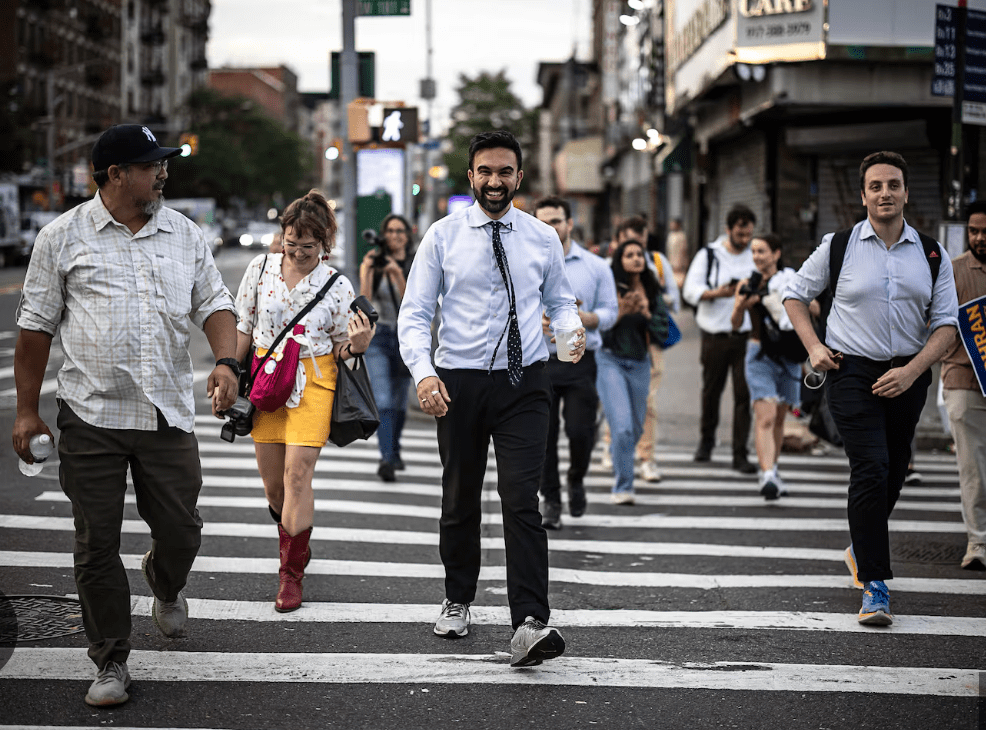
Zohran Mamdani walking New York City’s streets during his mayoral campaign.
I’ve written about activist authors (in 2014) and courageous characters (last year), but as far as I can recall I’ve never written specifically about activist characters in novels. So, today I will. 🙂
My inspiration for this topic was 33-year-old democratic socialist Zohran Mamdani winning last month’s Democratic primary for New York City mayor — and, thrillingly, the results weren’t even close. If Mamdani also wins the general election this fall he’ll become the youngest NYC mayor in more than a century, the city’s first Muslim mayor, and clearly the most progressive mayor the biggest U.S. city has ever had. Among Mamdani’s November opponents will be current NYC mayor Eric Adams, a cartoonishly corrupt politician who escaped multiple criminal charges by making a sell-out deal with Trump’s ghoulish Republican regime.
At a time of ever-growing economic inequality in NYC and the rest of the country, the charismatic Mamdani ran an energetic grassroots campaign that focused on freezing rents, making buses free, offering universal childcare, raising the inadequate minimum wage, and other pocketbook proposals — all to be paid for by raising the too-low taxes on the very rich.
Much of the very rich, of course, went bananas, and many of them during the primary backed Mamdani’s mayoral opponent Andrew Cuomo — the conservative-leaning former New York governor who resigned in disgrace four years ago after causing thousands of deaths by sending COVID patients into nursing homes and after being credibly accused of sexual harassment by 13 women who worked for the state. Plus, plenty of corruption in his administration. Many of those wealthy Cuomo supporters are now backing the aforementioned Adams, a right-wing Democrat who sat out the June primary and is now running as an “independent.”
Mamdani, who has an activist history, is also the rare American politician who supports equal rights for Palestinians and has publicly decried Israel’s genocide of innocent civilians in Gaza — drawing bogus accusations of anti-Semitism from people who wrongly equate being against Netanyahu’s far-right Israeli government with being anti-Semitic. In fact, Mamdani received many Jewish votes amid many votes from young people, Asian-American residents, etc. Also, Mamdani and Jewish mayoral candidate Brad Lander cross-endorsed each other — something they were able to do under the election’s ranked-choice system.
I should mention that I feel a connection to New York City because I lived in its Bronx, Manhattan, Brooklyn, and Queens boroughs for a total of 16 years and worked in Manhattan for 30 years. My current town of Montclair is 12 miles west of NYC in New Jersey.
Anyway, on to some inspiring activist characters in literature!
There’s lapsed preacher Jim Casy, one of the memorable supporting players in John Steinbeck’s The Grapes of Wrath (1939). Casy tries to organize migrant workers after he tags along with the Joad family to California, where conditions for financially struggling newcomers are appalling.
Kristin Hannah’s The Four Winds was clearly inspired by The Grapes of Wrath, though that 2021 novel is original in many ways. It tracks the radicalization of Elsa Wolcott, who’s part of a cast that also includes union organizer Jack Valen.
Kate Quinn’s The Rose Code (also 2021) focuses on a memorable trio of female British code breakers during World War II.
Another compelling historical novel is Leon Uris’ Mila 18 (1961), about the desperate Warsaw Ghetto uprising against the Nazis.
And Julia Alvarez’s In the Time of the Butterflies (1994) features the part-fictionalized sisters who opposed the regime of brutal Dominican Republic dictator Trujillo.
Richard Wright’s Native Son (1940) has a supporting cast that includes radical lawyer Boris Max, who represents protagonist Bigger Thomas.
Margaret Atwood’s The Testaments — the 2019 sequel to The Handmaid’s Tale (1985) — includes the Daisy character (birth name: Nicole) who infiltrates the repressive, patriarchal society of Gilead.
In Barbara Kingsolver’s Flight Behavior (2012), Dellarobbia Turnbow is an initially apolitical young farmer’s wife who joins the fight against climate change.
Then there’s the against-the-odds activism in these two classics: Upton Sinclair’s The Jungle (1906) and George Orwell’s Nineteen Eighty-Four (1949).
While activism occasionally succeeds, many other times it doesn’t — given the formidable/well-funded forces on the other side: powerful politicians, heavily armed military and police, giant corporations trying to increase their already-huge profits, bend-the-knee mainstream media outlets, etc. In fact, some of the fictional characters I mentioned in this post ended up being killed, making for riveting reading but very depressing reading.
Examples of activist characters in novels? Thoughts on this topic?
Misty the cat says: “When I groom myself near a window, it’s ‘A Groom with a View.'”
My comedic 2024 book — the part-factual/part-fictional/not-a-children’s-work Misty the Cat…Unleashed — is described and can be purchased on Amazon in paperback or on Kindle. It’s feline-narrated! (And Misty says Amazon reviews are welcome. 🙂 )

This 90-second promo video for my book features a talking cat: 🙂
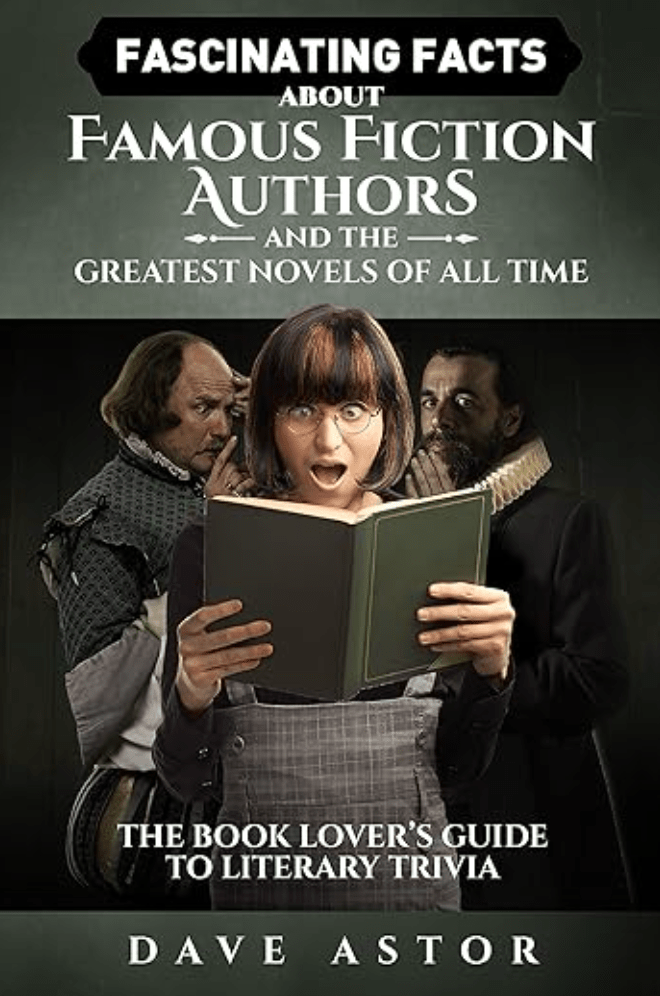
I’m also the author of a 2017 literary-trivia book…
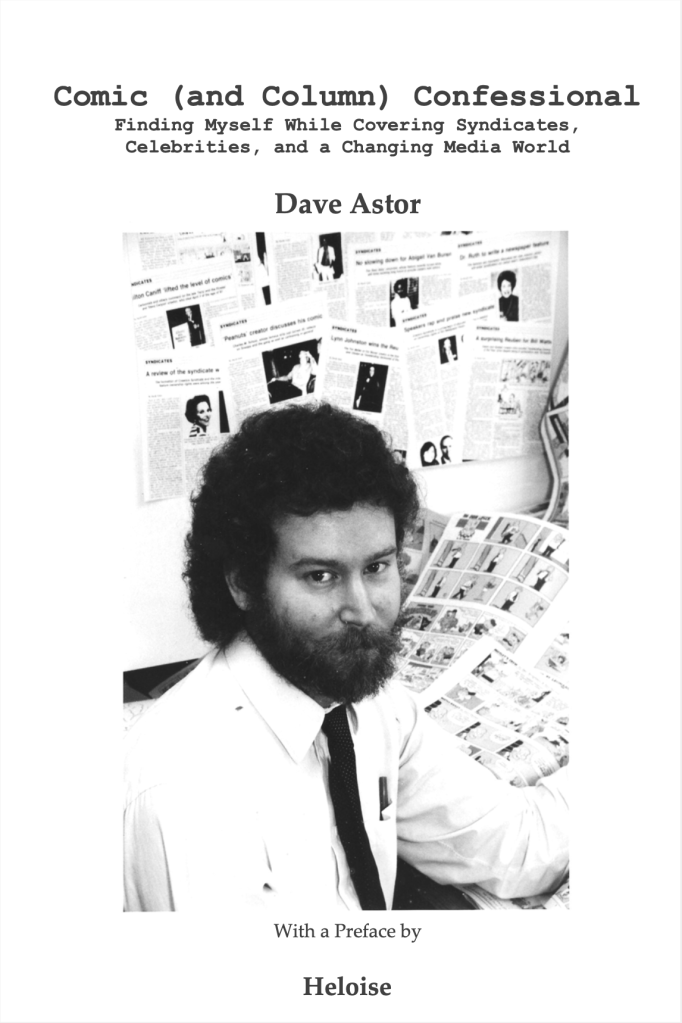
…and a 2012 memoir that focuses on cartooning and more.
In addition to this weekly blog, I write the 2003-started/award-winning “Montclairvoyant” topical-humor column every Thursday for Montclair Local. The latest piece — about my younger daughter’s June 26 high school graduation (again), a Township Council meeting, and more — is here.
 Dave Astor on Literature
Karmically tuned
LikeLiked by 1 person
Thank you, Swamigalkodi Astrology!
LikeLike
Wonderful Post Thanks
LikeLiked by 3 people
Thank you, Rehoboth!
LikeLike
What an amazing compilation Dave. 👏🏼👏🏼👏🏼 And oh my goodness, love that last photo Mr. Media Veteran! Thank you for continuing to press the recall voices from the past that continue to resonate with still relevant influences regarding social change! 🤗💖🥰
LikeLiked by 1 person
Thank you, Kym!
That cover photo was from around 1988, I think. 😲
I agree that activists of the past — whether real or fictional — have a lot to teach us today.
LikeLiked by 1 person
Oh my friend, you got that one right. You’re so very welcome.
We have to keep our eyes, ears, and minds as alert and tuned in as possible, because there are many messages that teach us some very valuable lessons, including some of the crazy rhetoric we sadly see a lot of nowadays. 😣😣😣
1988 eh? And you still have all of that hair! 😁 YES!
LikeLiked by 1 person
I agree, Kym — staying alert is a must as we parse what’s dismaying and what’s hopeful.
Still a lot of hair, but not quite the same color. 🙂
LikeLiked by 1 person
Yep staying alert is the key Dave. 👍🏼 Look, if you want to take the plunge on the “wild side,” there are many shades of color you can dye your hair should you choose to.
Who said men can’t be as daring as women with their hair color choices if they want to eh? 😜💖😎
LikeLiked by 1 person
Ha, Kym! 😂 I suppose I could go un-gray, especially after having read Faulkner’s “As I Lay Dye-ing.” 🙂 But…no. 🙂
LikeLiked by 1 person
😂😝🤣 Love that Dave!
LikeLiked by 1 person
🙂
LikeLiked by 1 person
Harriet Beecher Stowe, Frederick Douglass, and James Baldwin are often cited as powerful literary activists who significantly influenced social change. Their works, including Uncle Tom’s Cabin, Narrative of the Life of Frederick Douglass, and essays like Notes of a Native Son, sparked important conversations and movements around slavery, racial equality, and social justice.
LikeLiked by 1 person
Thank you, Shaharee! You’re absolutely right that those three writers were very powerful/influential/eloquent activist voices in the 19th and 20th centuries. I think Harriet Beecher Stowe’s “Uncle Tom’s Cabin” is an excellent novel in addition to being an excellent anti-slavery work, and James Baldwin was a giant in both fiction and nonfiction writing.
LikeLiked by 1 person
But the greatest activist in modern history was, beyond any doubt, Mahatma Gandhi. His ways were simple, non-violent, and went to the core of what sustained the British Imperialist hegemony. He also opposed the split up of India between muslims and hindus (hence you got Pakistan), with all this has entailed. In the end, it were not the British who killed him, but a hindu nazi.
LikeLiked by 1 person
Mahatma Gandhi was indeed an all-time activist, for all the reasons you mentioned. Also in the picture is the Rev. Dr. Martin Luther King Jr., who of course was influenced by Gandhi. And then there was Nelson Mandela, and Rosa Parks, and Harriet Tubman, and…
LikeLiked by 1 person
We tend to make things too complicated. Take the salt monopoly. The British levied a heavy tax on it (the US tea revolution comes to mind). But his solution was not “let’s fight the Brits!”, but “make your own salt!”. His attitude towards the industrial hegemony was similar: don’t buy your textiles from them, make your own. Rosa Parks grasped this on an atavistic level. Don’t use their services if you feel exploited. The bus company gave in. We just have to learn to translate those simple principles into ways that fit a third wave society without unnecessary complicating things. Simplicity and non-violence lays at the core of any meaningful activism.
LikeLiked by 1 person
Wise words, Shaharee. Thank you.
LikeLiked by 1 person
My husband and I voted for the “party” back then. After Bush, we changed to the other party. ☺️
LikeLiked by 1 person
Sounds like a move you and your husband were happy with, and I can totally understand why. 🙂
LikeLiked by 1 person
I’m interested and concerned about the earth and nature, Dave.
Former Vice President Al Gore’s “An Inconvenient Truth” addresses about global warming. The biologist, natural historian and writer, Sir David Attenborough’s book, “A Life on Our Planet: My Witness Statement and a Vision for the Future” directly advocates for climate change.
Sir. David addressed to the UN that if climate change is unaddressed, it will lead to the collapse of essential systems: food production, access of fresh water, habitable temperature, and ocean chains. Among other disasters, it will have increased extreme weather events.
In the US alone, the annual average of billion-dollar extreme weather and climate disasters was 9 events per year between 1980 to 2024, but the annual average was 23 events between 2020 to 2024 according to the National Oceanic and Atmospheric Administration (NOAA). It was scary to watch the frequency of natural disasters happening to many states in the US in the last five years. According to the Climate Change Performance Index, the US is among the very low performing countries.
LikeLiked by 1 person
Thank you, Miriam, for the comment and the sobering statistics. Climate change is indeed SUCH a major issue — as you say, it worsens weather tragedies…and ultimately jeopardizes the Earth’s existence. Plus things are of course getting even worse under the climate change-denying/ignoring Trump administration. 😦
LikeLiked by 1 person
You’re welcome, Dave! Al Gore had been advocating Climate Change for 30 years. Sir. Dave projected the earth will be to late to save by 2030? Turmp has never listened to anyone. Weather in many states became opposite. Dr. Fauci was careful not to get fired because he wanted to save people’s lives. Help us, heaven, in the next 3 1/2 years. 😦
LikeLiked by 1 person
Yes, Miriam, Al Gore was way ahead of his time among mainstream politicians in warning about climate change. Such a shame the presidency was taken from him by that politically biased Supreme Court decision in 2000; he would have been MUCH better than George W. Bush. And I agree that the next three-and-a-half years under Trump are going to be terrifying. 😦
LikeLiked by 1 person
Hi Dave, an interesting topic today. I’ve read some of the books you mentioned here. I’ll add Animal Farm, Brave New World, Lord of the Flies, Catch 22, and at Kill a Mockingbird.
LikeLiked by 1 person
Thank you, Robbie! Great additions! Definitely some activism, of different kinds, within the titles you mentioned.
LikeLiked by 1 person
Yes, some are a bit different but all involve staying true to your personal truth.
LikeLiked by 1 person
I agree!
LikeLiked by 1 person
Hi Dave,
As I went through your post I was wondering if Orwell’s “Nineteen Eighty-Four” might fit and then I saw it mentioned at the bottom there. I’m on my third read and it’s somehow even better than I remember. And it feels so very modern. I think even at the time of publishing, it probably felt more 2025 than it would have 1950s. I can often laugh at books set in the future as the author is bound to get some things wrong, but so far, the only thing that feels unbelievable is everybody smoking inside. And I know even that is still very true in some places. Obviously written while the memory of World War II was still very fresh, I remember this dystopian work being all about fear of World War III, but it’s much more than just being scared of the bombs. The control of the people, the lack of rations, the random shortages of a specific item, and of course, the fake news all feel much closer than any war dystopia should. But still early days for me. I haven’t really gotten to any activism yet.
Sue
LikeLiked by 2 people
Thank you, Sue! I totally agree that the great “Nineteen Eighty-Four” was prescient, ahead of its time, and sadly feels very present-day. Orwell was wise to expect dystopian governments/societies/conditions to continue and even worsen.
LikeLike
I salute you for reading Nineteen eighty-four three times. I appreciated it but could not read the ‘rat’ scene again.
LikeLiked by 1 person
That rat scene — terrifying indeed, Robbie. Authoritarian regimes will do anything to stay in power. 😦 Reading “1984” three times, as Sue has/is, IS impressive. I read it twice — once as a teen student and again maybe 15 (?) years ago.
LikeLiked by 1 person
I’ve re-read a lot of books I read between the ages of 10 and 18. I must say that none of my re-reads have disappointed. I liked the books even more the second time around 😉. I can’t remember if I told you I am reading mutiny on the Bounty.
LikeLiked by 1 person
It’s a great idea to reread some books, Robbie, especially if we read them the first time while a pre-teen or teen. And it’s heartening when those books don’t disappoint the second time around. I think you did mention “Mutiny on the Bounty”; I hope you’re liking it. Have yet to read it myself.
LikeLiked by 1 person
I was enjoying it. I have done much reading while travelling. It’s been to busy 😊
LikeLiked by 1 person
Understandable! 🙂
LikeLiked by 1 person
Hi Robbie,
There’s been at least ten years in between each of those reads so they don’t really feel like re-reads. And Orwell is so engaging that I always look forward to picking his books up. I think the first time I read “Nineteen Eighty Four” I was already aware of the rats; and then when the scene happened, it was almost disappointing. I was thinking really? All that fear, and all that build up and it’s actually not that bad. The second time was probably a tad more unsettling. However I’m much more horrified of the idea of Big Brother than I am the rats.
I hope you’re enjoying your time in Europe ❤
Sue
LikeLiked by 2 people
Hi Susan, Big Brother is very unsettling, even more so as if you have a cellular phone, as you know you can be watched/traced/spied on. The idea of a rat near my face is very horrible for me even though I am an animal lover. I didn’t know about it when I read the book a few years ago. Thank you for your reply 💓. PS this book was banned in South Africa when I was growing up (by the apartheid government).
LikeLiked by 1 person
Hello Dave!
I’m seeing many character attacks on Mamdani.
I’d love to know how it all plays out, but unfortunately my crystal ball is in the repair shop.
I asked it if Newsom would be arrested for the crime of being a blue governor, and it split into 2 equal parts.
Okay matters at hand:
How about Montag in Fahrenheit 451? His belief that the power of books hold answers pits him against family and the world. He’s forced to become a rebel, and activist.
OR
In Anthem: Prometheus (Equality 7-2521) rejecting a collectivist society, discovers his individual’s intellect via books. Although, his activism seems to only free one other person, Liberty 5-3000
Another valid, yet hypocritical write from Ayn Rand who led a group called “The Collective”. Interesting that Alan Greenspan was a devoted member of that group.
That’s what I came up with.
LikeLiked by 3 people
Thank you, Resa! Yes, both “mainstream” and left Democrats are getting viciously pilloried by Trump, other Republican politicians, conservative media, etc.
Ha! 😂 (Your crystal ball mention.) I suppose you now have two crystal balls of a sort… 🙂
A great, appropriate mention of “Fahrenheit 451”!
I haven’t brought myself to read Ayn Rand yet, but I’ve heard some of her characters were activists of a sort.
LikeLiked by 2 people
Hmm yes, 2 of a sort. I thought what is a word for 1/2 of a ball? 🤔
Guess what? I stumped AI. I didn’t use AI, but groggle always has some smart alec AI answer at the very top. I ignore it, but this time had to notice – it had no answer.
NO ANSWER!
Ha! ✊ Take that, you stupid idiot.
So, I have 2 crystal semi-spheres! 🤭
Yay about “Fahrenheit 451”!
You have enough books to read. I ended up reading some of Rand’s books because of the movie I did. It’s not just the clothes that need to be researched, there’s a feel to the
characters, especially ones that are not fiction that I try to capture.
Still, if ever, she is not w/o validity.
LikeLiked by 2 people
An AI fail! 😂 Love it! And “semi-spheres” is the perfect term. And I can see why you read Ayn Rand. I have read some novels by conservative authors (and it only took a couple decades to recover from the post-traumatic stress 🙂 ).
LikeLiked by 1 person
Hi Resa, great additions to this conversation. I’ve read and appreciated both of the books you mentioned.
LikeLiked by 1 person
“Long Island Purgatory” by Bradley Lewis doesn’t have a character engaged in activism but it’s a powerful, account the blockbusting and white flight in Laurelton, Long Island in the 1960s. It’s a well researched personal but fictional account, but it covers the subject.
I had an activist character in “Secrets Held Against Evil” but she was largely dismissed in the narrative. That book would probably be banned in some places today.
LikeLiked by 2 people
Thank you, Dan, for those two examples of books by Bradley Lewis and yourself! Blockbusting and white flight have happened far too often in the U.S. — as has book banning. None of those things are positive.
LikeLiked by 2 people
Many thanks, Dave, for your highly interesting post concerning Zohran Mamdani and activists in general! I have read some of the books, which you mentioned and especially appreciated 1984 by George Orwell.
LikeLiked by 3 people
Thank you, Martina!
“1984” is such a powerful and haunting novel. It sticks in a reader’s mind for years and years.
LikeLiked by 1 person
Absolutely, Dave!👍
LikeLiked by 1 person
Yes!
LikeLike
Hi Martina, greetings from Brussels. We are lucky and have had a cool week. A heat wave isn’t nice when touring. 1984 is a fantastic mention 🤗💗
LikeLiked by 2 people
Quite a trip for you, Robbie! Interesting to follow it on Facebook. 🙂
LikeLiked by 1 person
I’m pleased you are enjoying the photographs. I always try to squash in as much as possible. It is a long way from SA to Europe so I make the most of it.
LikeLiked by 1 person
Excellent photos, Robbie! And I can see why you would want to cram in as much as possible when you have to travel that far.
LikeLiked by 1 person
🧡
LikeLiked by 1 person
How nice to hear from you in my surrounding, Roberta! It has been soo hot here for weeks that I didn’t have much energy to read, but I remember how terrible it is to be under continuous control!🤗💝
LikeLiked by 2 people
I think Belgium has a lot of continuous reminders about the horror of war and lack of freedom. We missed the heatwave and I’m very glad about it. We have had some nice rain this week which I always enjoy. Rain is such a positive thing. Without it there is no life.
LikeLiked by 2 people
Oh yes, there were horrible fights in the first and second world war! I am happy for you as far as the weather is concerned. Have a good continuation of your trip!
LikeLiked by 2 people
🤗🌈🌹
LikeLiked by 1 person
I saw Zohran Mamdani on the TV a couple of days ago. Seeing him walking around in New York – very impressed I thought!
LikeLiked by 2 people
Thank you, Chris! He is indeed impressive — including him walking the 12-mile length of Manhattan a few days before the election. 🙂
LikeLiked by 2 people
Thanks a lot for the lovely introduction to your literary post
I was really impressed and delighted by the victory of Zohran Mamdani in the Democratic primary for mayor of New York!
LikeLiked by 3 people
Thank you, Luisa! So nice to hear that Zohran Mamdani’s victory has resonated even far from New York City. 🙂 His views definitely feel more like those of some European politicians than most American politicians.
LikeLiked by 2 people
I totally agree with you, dear Dave!👌
LikeLiked by 2 people
🙂
LikeLiked by 2 people
Abbie Hoffman’s provocative guide to counterculture activism
LikeLiked by 2 people
Thank you, K. Ravindre! Abbie Hoffman was quite an activist, personality, and writer. He was rarely boring. 🙂
LikeLiked by 1 person
Why you say Abby was is Abby gone?
LikeLiked by 1 person
Unfortunately, he died back in 1989, superbbravelydaacd9bcc0; not that old, unfortunately.
LikeLike
Are there thomas pyncheon novels about activists
LikeLiked by 2 people
Not that I’ve ready any (I keep on meaning to get round to it). Its a really good topic because it’s hard to find examples that have broken through into the canon of English and American Literature (or even popular fiction) – Its easy to find non fiction examples of activist writers (Noam Chomsky, Michael Parenti, Barbara Ehrenreich, Naomi Klein, Bell Hooks etc) but harder to come up with fictional characters.
LikeLiked by 2 people
Thank you, Joe! I’m not much of a Thomas Pynchon reader; the only book of his I tried was “Inherent Vice,” and I gave up on it halfway through.
LikeLiked by 2 people
So true, Joe, that there are MANY excellent nonfiction books about activist-related subjects and/or by activists. I’m a big fan of most of the nonfiction writers you mentioned — via their books, their shorter pieces, their podcast appearances, etc. Also, Michael Moore is great.
LikeLiked by 2 people
I’ve heard he’s hard work 🙂
LikeLiked by 2 people
I find his writing quite entertaining along with it being very progressive. 🙂
LikeLiked by 1 person
This post of yours makes me think I don’t read enough books about activists, Dave! But I have two book characters to add to your list. A favorite novel of mine that isn’t well known is NOT IN THE CALENDAR (1964) by Margaret Kennedy, and the activist in it is Caroline Knevett, who becomes a passionate advocate for the deaf in the late 1800s. Another activist is Gerald Durrell, the British naturalist, who wrote MY FAMILY AND OTHER ANIMALS about his childhood in Corfu and went on to write I-don’t-know-how-many books about his life protecting animals and setting up a zoo.
LikeLiked by 2 people
Thank you, Kim! I read “My Family and Other Animals” a few years ago, and found it really compelling.
Animal-rights activists are among the most admirable people on Earth!
“Not in the Calendar” also sounds excellent.
LikeLiked by 2 people
Here’s another, Dave. Mandras, from ‘ Captain Corelli’s Mandolin’. Returning from WWII to find that his fiancee no longer loves him, he goes to the mainland and joins ELAS, a communist activist organisation. He’s not well-educated, so doesn’t question the information he’s indoctrinated with, and he’s turned into a very unpleasant person. Ultimately he kills himself – a Greek tragic figure. 😪
LikeLiked by 3 people
Thanks, Laura, for the additional activist mention! “Captain Corelli’s Mandolin” is an excellent novel, despite its problematic ending. And activists can be very complicated people; not always admirable.
LikeLiked by 2 people
Agreed, Dave, and speaking of which, how about Fergus Mac-Ivor, the Jacobite rebel of Sir Walter Scott’s ‘Waverley’? 🙂
LikeLiked by 2 people
Sir Walter Scott definitely had some rebel characters — Rob Roy, too, among others.
LikeLiked by 2 people
True. I think Rob Roy managed a better ending than the unfortunate Fergus. 😦
LikeLiked by 2 people
True, that, Laura!
LikeLiked by 2 people
How about Etienne and the miners’ strike in ‘Germinal’, Dave – with more than a little help from Souvarine, the Russian emigre activist? I’ll need a think about some more, but this I think is one of the best. 🙂 Thanks for your usual engaging post. 😊
LikeLiked by 2 people
Thank you, Laura! Etienne, Souvarine, and other “Germinal” characters — definitely! My favorite novel by Zola, an author with a strong social conscience.
LikeLiked by 2 people
Steal This Book by Abbie Hoffmann, Sometimes A Great Notion by Ken Kesey, The Milagro Beanfield War by John Nichols, Catch 22 by Joseph Heller, Cats Cradle by Vonnegut, and lastly Parable Of The Sower by Octavia Butler to name a few. Nice theme Dave. Thanks, Susi
“Choose your leaders with wisdom and forethought. To be led by a coward is to be controlled by all that the coward fears.” Octavia E. Butler
LikeLiked by 2 people
Thank you, Susi! Great mentions! I’ve read all the novels you listed other than the Vonnegut one. Excellent Octavia E. Butler quote; she was quite a wordsmith, with a deep social conscience. Her “Kindred” novel tackling the issue of slavery is also extraordinary.
LikeLiked by 1 person
Dave, thank you for this compelling post and for the inspiring list of literary activists. This is a brilliant post and follow-up discussion. I’ve always believed that books are powerful catalysts for change. Each time we open a book — whether it’s The Grapes of Wrath, Mila 18, or countless others — we’re invited to walk beside those who speak truth, endure injustice, and imagine a better world. In reading their stories, we take a quiet step toward activism ourselves — one page, one heart-opening moment at a time. You brought to mind a few books that have inspired me.
Uncle Tom’s Cabin by Harriet Beecher Stowe — awakening abolitionist sentiment. Les Misérables by Victor Hugo — dignity and resistance amidst injustice. To Kill a Mockingbird by Harper Lee — courage in the face of systemic racism. A Room of One’s Own by Virginia Woolf — a rallying cry for women’s creative freedom.
Books may not march in the streets, but they do something just as vital: they teach us to care. Thank you for continuing to champion thoughtful reading, Dave. Your reflections always open the door to deeper contemplation.
As Uris wrote in Mila 18: “The answer is not in whether or not we fight. The answer is in the meaning of our fight.”
LikeLiked by 3 people
Thank you, Rebecca! Excellent/eloquent thoughts, and very relevant mentions of “Uncle Tom’s Cabin,” “Les Misérables,” “To Kill a Mockingbird,” and “A Room of One’s Own.” All classics with activism elements amid everything else in their pages.
Books can indeed be “powerful catalysts for change,” though I wonder if they unfortunately now have somewhat less societal impact than in the 19th- and 20th-century days of “Uncle Tom’s Cabin,” “The Jungle,” “The Grapes of Wrath,” etc. But novels can still have a big impact on an individual reader’s psyche.
LikeLiked by 1 person
Dave, I think you’ve articulated something very true—there may indeed be fewer novels today that catalyze widespread societal change in the way that Uncle Tom’s Cabin or The Jungle once did. But I also believe, as you say so well, that their ability to profoundly shape an individual reader’s psyche remains as strong as ever. I also believe (and in my experience) that is where change often begins. Quietly, internally, one person at a time. The fact that these books still stir reflection, empathy, and even resolve in readers today means their legacy is not just historical—it’s ongoing. I very much enjoy our conversations.
LikeLiked by 1 person
You’re so right, Rebecca — when enough individuals feel some internal change after reading literature, that can have a cumulative impact on society.
LikeLiked by 1 person
Hi Dave, I have to add my two Pennie’s worth to your comment. There are far fewer books about societal ills published by traditional publishers. The ones that do get published are often singing from a well known song sheet and are ground breaking. I believe this is because traditional publishers won’t take any chances about commercial success and stick with same old. You can find more controversial books in the Indie publishing world but you have to look for good writers and writing as the quality is uneven.
LikeLiked by 1 person
A terrific point, Robbie, that there are many independent books that are more controversial, bolder, quirkier, etc., than major-publisher-released books. Unfortunately, many independent books don’t have wide enough readership to have the societal impact they deserve.
LikeLiked by 1 person
Yes, I know. It is a reason why I haven’t completed my WIP novel. It’s so much effort and I will not reach enough people to make it worthwhile. I’d rather write poetry and short stories and fit in my painting currently.
LikeLiked by 1 person
I hear you, Robbie. 😦 A shame that major publishers are so cautious, among other things. 😦
LikeLiked by 1 person
Yes ❤️🔥
LikeLiked by 1 person
Hi Rebecca, a very good quote from MILA 18 which I also appreciated. I hope you are enjoying your break.
LikeLiked by 2 people
Thank you Robbie. It has been a wonderful couple of days. It was a great time to reflect on how much the blogging landscape has changed over the years. Every couple of years, I like to take a wide-angle look at where we are—what’s shifting, what remains constant—and consider how best to move forward in a way that stays true to both meaningful connection and my own creative rhythm. It’s an ongoing journey, and I’m so grateful to be walking it alongside thoughtful voices like yours. 💛
LikeLiked by 2 people
Hi Rebecca, that is a good idea. I do not consciously do this but my blogs evolve as I change. I am a very enthusiastic person who becomes completely absorbed by creative undertakings. They change every five or six years as I discover new things that challenge me. I am grateful for this inspiration provided by individual bloggers like you and Dave and also for groups like d’Verse and Tanka Tuesday which inspire and encourage me.
LikeLiked by 2 people
We belong to an amazing blogging community!!!!
LikeLiked by 2 people
💓
LikeLiked by 2 people
Love this post – I live in Brooklyn and was door-knocking and canvassing for Zohran – the response was great btw – apparently there were 30,000+ people volunteering. Jewish Voice for Peace got me involved.
It showed that you can win elections being pro-Palestinian even in the most Jewish City in America.
Joy unconfined when Cuomo conceded so early.
So I would offer a few Nonfiction reads for this topic – is that allowed?
Dude, Where’s My Country? by Michael Moore crossed my path around 2004. William Dalrymple’s work exposing the dark realities of the British and other Empires are truly ground-breaking work, and his podcast is fantastic. White Mughals was a good read.
But my top book about activism is Nelson Mandela’s Long Walk To Freedom. Totally inspiring, totally essential read.
Between The World & Me by Ta-Nehisi Coates is a good read too, and so is 33 Revolutions a Minute about activism in music, by Dorian Lynskey.
And then the great activist and inspiration himself Harry Belafonte who died recently aged 100 wrote a wonderful book entitled My Song. Read this and then carry on with your life.
Ralph Brown
LikeLiked by 2 people
Thank you, Ralph! Congratulations on being one of the wonderful, hard-working volunteers who helped Zohran Mamdani win the primary! Jewish Voice for Peace is a fantastic group.
Few politicians deserved to lose more than the repugnant Andrew Cuomo.
Yes, views are thankfully changing enough where an American office-seeker can be pro-Palestinian rights and still win an election despite the far-right AIPAC pouring money into races and most mainstream politicians and mainstream media still being pro-Zionist despite the Gaza genocide.
Mentions of nonfiction books definitely allowed, and you named some by very, VERY admirable people, past and present. I saw Harry Belafonte speak in person in NYC a number of years ago at an event remembering American volunteers in the Spanish Civil War (my wife’s father was one of them).
LikeLiked by 1 person
Am I ever late today! There’s a writer named Pam Lazos who has published a work of fiction called Oil and Water that is based around environmental concerns. She has a website called Green Life, Blue Water. I haven’t read her book yet but I intend to. And, my husband is working on an action/adventure/activist book based on the fracking industry in our area of the country.
LikeLiked by 2 people
Thank you, Leah! In a certain way, environmental activists (whether real or fictional) are the most important activists of all given that if the Earth is ruined, there is nothing else. I appreciate the mention of “Oil and Water,” and the best of luck to your husband with his book!
LikeLiked by 2 people
Democratic party needs young leaders like Mamdami,he will not be bullied by DJ Rump ,Mamdami is not a communist, is a US citizen ,may very well be next Mayor of NYC,could help with Cuomo who maybe on ticket as I think Independent,Eric Adams is corrupt under vile DJT who will try to buy Adam’s 2nd term. He bought judges to exonerate Adams. We are living in horrible times,erosion of checks and balances Supreme Court contributing to erosion of our justice system. On 4th of July holiday,every day this disgusting man is president, we all need to be wide awake, our democracy is eroding our founding father’s turning over in their graves.
Michele
E & P way back
LikeLiked by 2 people
Thank you, Michele! It IS a very dark time with Trump in power and conservative/corrupt politicians like Eric Adams cutting deals with the Oval Office ogre and/or spinelessly supporting him. A young progressive leader like Zorhan Mamdani is a small silver lining, at least. I hope he — and others like him — get elected this year and in years after that.
LikeLiked by 1 person
The main character in Redlined, a novel set in 1970s Boston, is a community activist.
LikeLiked by 2 people
Thank you, Liz! Sounds like an excellent example! Unfortunately, so many cities and other communities have been redlined.
LikeLiked by 2 people
You’re welcome, Dave!
LikeLiked by 2 people
🙂
LikeLiked by 2 people
Hi again Dave! A fascinating angle for a discussion on political activism in fiction. None of the books you mention I am familiar with, although they do sound interesting. It sounds like there is a lot of political change/economic proposals going on in your country. It is a similar story over here in the UK!! All such rich material for fiction writers! Kindest regards, Sharon
LikeLiked by 2 people
Thank you, Sharon! Yes, the UK definitely has its issues, too — even as the current U.S. government is worse than most. 😦 Definitely plenty of material for writers, even as most of us — including many writers — would prefer to have governments we admire over having awful stuff to write about.
LikeLiked by 2 people
I hear that, Dave! Here’s wishing for better times for everyone! Have a great week. With best wishes, Sharon
LikeLiked by 2 people
Yes, Sharon, hopefully better times ahead even as things feel grim now. Have a great week, too!
LikeLiked by 2 people
Thanks Dave!!
LikeLiked by 2 people
You’re welcome, Sharon! 🙂
LikeLiked by 2 people
Dave, your theme this week is spot on. Change is in the wind! Not surprisingly, I haven’t read most of the books you’ve mentioned. I found the environmental activists very compelling in Richard Powers’ award-winning novel The Overstory (2018).
LikeLiked by 2 people
Thank you, Rosaliene! I hope some widespread change is in the wind; if not, it was nice to get at least one victory.
The environmental activists in “The Overstory” are indeed compelling, and that novel in general is stunningly good.
LikeLiked by 2 people
Every victory counts. Glad that you also enjoyed reading “The Overstory.”
LikeLiked by 2 people
True, Rosaliene! One victory is better than no victory. 🙂
LikeLiked by 2 people
Another interesting post, Dave! Inspiring to hear about Zohran Mamdani winning last month’s Democratic primary for New York City mayor. Although I can’t think of any activist-related books off the top of my head, Kate Quinn’s The Rose Code is now on my tbr list! 🌸
LikeLiked by 2 people
Thank you, Ada! Yes, Zohran Mamdani’s win was very inspiring. 🙂
“The Rose Code” is excellent, and the three women protagonists in it are all well drawn and very different from each other.
LikeLiked by 2 people