
Our 2014 Toyota Prius leaving its apartment-complex garage. (Driven by my wife Laurel/photographed by me.)
My wife Laurel and I drove from New Jersey to Michigan and back this weekend for a memorial service in Ann Arbor for a cherished family member. It was a crazily compressed November 14-16 car journey of more than 1,200 miles round trip — a travel method we chose to avoid possible flight problems in the aftermath of the U.S. government shutdown.
Anyway, all that automotive time means I have driving on my mind, so I’m resurrecting a piece about cars in literature that I wrote for The Huffington Post in 2013, a year before starting this WordPress blog. Here it is, slightly edited and slightly rewritten:
In literature, sometimes a car is just a car. But sometimes it’s a “vehicle” for authors to write about independence, loneliness, progress, sex, death, wealth, poverty, and more.
Whether or not book-based cars are weighted with symbolism, most readers relate to driving. So I’d like to steer you to some novels in which cars are important “characters,” and then hear about your favorite fictional works that feature those on-the-road contraptions.
Which reminds me of Jack Kerouac’s On the Road novel and the way some cars in literature are used to search (futilely or otherwise) for freedom and/or pleasure, and can speak to characters’ restlessness, aimlessness, and/or discontent.
That’s the case in Paul Auster’s The Music of Chance. Protagonist Jim Nashe spends the first part of the novel endlessly crisscrossing the U.S. in a car after his wife leaves him. The ex-firefighter, who finances his marathon road trip with an unexpected inheritance, eventually ends up involved in a high-stakes poker game at the mansion of two eccentric/heartless rich guys. Then things get really weird before the novel concludes with (wait for it!) one more car ride.
There’s another fateful auto scene — though not at the end of the book — in Jeffrey Eugenides’ Middlesex. It’s a car chase that features Calliope’s dad Milton driving too fast on the Ambassador Bridge between Detroit and Canada.
Motor vehicles also figure prominently in Booth Tarkington’s The Magnificent Ambersons, with successful automaker Eugene Morgan representing turn-of-the-20th-century progress while Major Amberson and his dwindling fortune represent the vanishing horse-and-buggy age. New money vs. old money and all that.
Tarkington contemporary L.M. Montgomery offers a scene in The Blue Castle of Valancy Stirling sharing an exuberant car ride with “misfit” Barney Snaith. Many people in their straitlaced town are suspicious of Barney, but Valancy finds him very interesting — so the car ride is a symbol of Valancy’s break from the conventions of her place, time, and family.
Novels of the Montgomery-Tarkington era were usually subtle about sex, but that’s not the case with many books of recent decades. For instance, there’s a scene in Ken Grimwood’s time-travel novel Replay that shows how cars can potentially be bedrooms on wheels.
Speaking of time travel, there’s a great section of Jack Finney’s Time and Again in which Simon accompanies Julia from her present (1880s) to his present (around 1970), and Julia is of course stunned by the experience of riding in a modern motor vehicle.
Readers are the ones who might be stunned as they peruse Charles Dickinson’s The Widows’ Adventures, a novel starring two women on a long road trip. The one doing the driving is…blind!
Then there are supernatural thrills in car-oriented Stephen King novels such as Christine and From a Buick 8. The latter book includes a spooky gas station scene before various law-enforcement people enter the story.
Two memorable moments in Cormac McCathy’s Suttree involve what the title character does to a police car (to avenge racist cop behavior) and what Suttree’s girlfriend does to the couple’s own car. And in Fay Weldon’s The Bulgari Connection, the spurned older wife is jailed after using an auto to do a certain something to the trophy wife who “replaced” her.
Or how about that tense yet hilarious Harry Potter and the Chamber of Secrets scene in which J.K. Rowling has Harry and Ron travel to Hogwarts in a flying car? An auto can definitely be a “vehicle” for humor.
On a much more serious note, a car converted into a truck of sorts is how the Joad family travels from drought-stricken/agribusiness-devastated Oklahoma to a hoped-for better life in California. But the reality out west for the non-rich is as dismal as the Joads’ aged jalopy in John Steinbeck’s The Grapes of Wrath.
People take long car trips for various reasons. In John Grisham’s The Client, attorney Reggie Love and her beleaguered 11-year-old client Mark drive from Memphis to New Orleans to try to locate the body of a murdered U.S. senator.
What are your favorite fictional works with motor vehicle motifs?
Misty the cat says: “The Lincoln Tunnel has been renovated!”
My comedic 2024 book — the part-factual/part-fictional/not-a-children’s-work Misty the Cat…Unleashed — is described and can be purchased on Amazon in paperback or on Kindle. It’s feline-narrated! (And Amazon reviews are welcome. 🙂 )
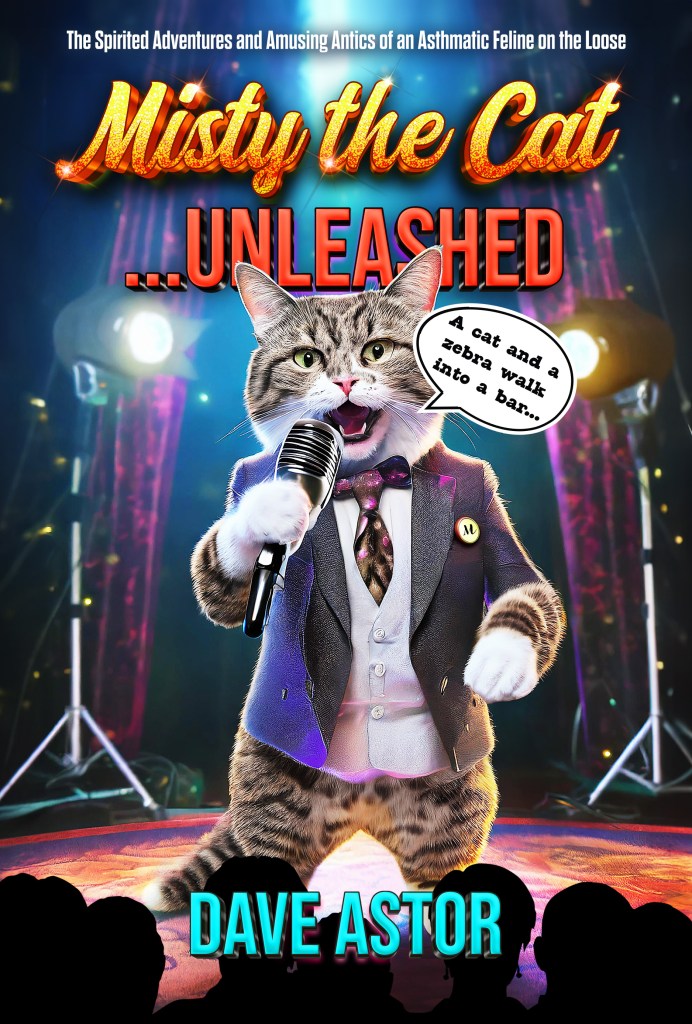
This 90-second promo video for the book features a talking cat: 🙂
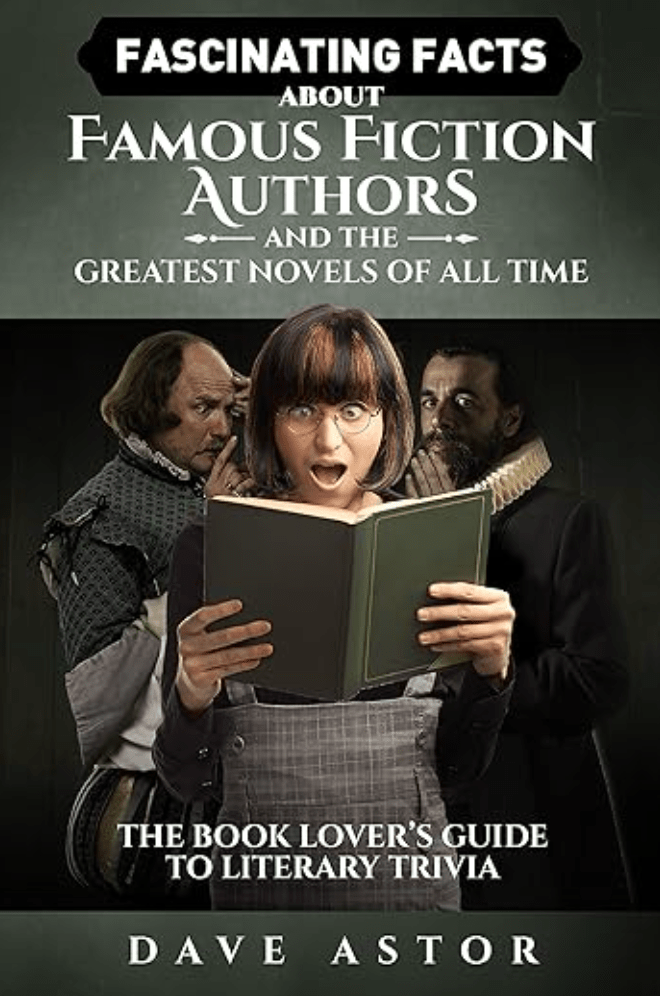
I’m also the author of a 2017 literary-trivia book…
…and a 2012 memoir that focuses on cartooning and more, including many encounters with celebrities.

In addition to this weekly blog, I write the 2003-started/award-winning “Montclairvoyant” topical-humor column every Thursday for Montclair Local. The latest piece — about two flawed local ballot questions relating to a massive school budget deficit — is here.
 Dave Astor on Literature
Your words ignite endless highways of thought, weaving literature and life into a single flowing journey;
every car becomes a vessel of memory, carrying freedom, rebellion, humor, and grief across time and imagination;
and every journey transforms into literature’s living heartbeat, reminding us that motion itself is meaning. 🚗
LikeLiked by 2 people
Thank you very much, harythegr8! Metaphorical excellence with a car motif. 🙂
LikeLiked by 1 person
Thank you for always uplifting my mood.
LikeLiked by 1 person
🙂
LikeLiked by 1 person
Thank you for spreading such positive energy.
LikeLiked by 1 person
The same to you! 🙂
LikeLiked by 1 person
Your words felt like a beautiful hug.
LikeLiked by 1 person
Hi Dave,
“Christine” was the first book that I thought of. And as well as the car accidents that Robbie mentioned, there’s a pretty big one in “The Dark Tower” written after King himself suffered some nasty injuries after being hit by a car. I feel like I also recall a King short story where someone is buried alive while in their car. I probably should Google that to see if it’s a real book, or I just made it up, but I hate when Google tells me my memory is incorrect.
Speaking of, I’m currently re-reading “The Long Walk” which I guess has cars because the officials follow along as the young men walk. And walk and walk and walk. I’ve always loved this story, but it’s even better than I remember. I keep expecting to fall out of love with Stephen King as I read more and more ‘real’ literature and more and more of the classics, but each time I pick up one of his books, especially the older ones, I’m more impressed than I was the last time. His quite left leaning politics make it easy for me to like him as a person too. And make me hope that he’d be a bit embarrassed about the casual sexism that publishers didn’t seem to have a problem with back in the olden days.
Sue
LikeLiked by 1 person
Thank you, Sue! Excellent mentions! Stephen King has definitely peppered a number of his fictional works with significant car elements.
I remember when King got hit, and seriously injured, by a motor vehicle while walking. 😦
Glad you’re still a major King fan. I’m more of a semi-major King fan, but I do like many of his novels…and, like you, admire his progressive politics.
“I hate when Google tells me my memory is incorrect” — ha! 😂
LikeLike
I think you are right! Cars and those who drive what reveal so many things about a person. Very true. Now, I need to develop those cars more in my next novel!
LikeLiked by 1 person
Thank you, cupcakecache! Yes, the cars fictional or real-life people drive can say something about them. Good luck with your next novel, and with whatever car elements it might have. 🙂
LikeLiked by 1 person
I’m a thinking. Thank you!
LikeLiked by 1 person
🙂
You’re welcome!
LikeLiked by 1 person
I haven’t read any car ride books recently but I did enjoy the 2021 film, Drive My Car, which is based on a short story of the same name by Haruki Murakami.
LikeLiked by 1 person
Thank you, Gallivanta! Great mention! I haven’t read that particular short story by Haruki Murakami, but have liked a couple of his novels. 🙂
LikeLiked by 1 person
I’m so sorry for your loss! Be careful driving.
LikeLiked by 1 person
Thank you very much, Dawn.
And long drives indeed have added dangers. 😦
LikeLike
So sorry for your loss, Dave. I think The Music of Chance sounds like a really intriguing and fun story. I’ll add it to my reading list and hopefully be able to treat myself to settling down to it over the Christmas holidays!💙
LikeLiked by 1 person
Thank you very much, Ada.
“The Music of Chance” IS quite interesting, though I liked it more than loved it. The only Paul Auster novel I’ve read.
The holidays can be a nice time for enjoying books. 🙂
LikeLiked by 1 person
Dave….
Get ready!
The first Joy Fielding book I ever read, has an exhilarating car chase at the end.
Kiss Mommy Good-bye, 1981, was her 4th book. About parental kidnapping, it is a grinding heartbreak, with thrilling ending.
Not only was it my first Fielding novel, it was the first time I read a car chase.
Nice to see Misty using the Lincoln tunnel instead of the Holland!
LikeLiked by 1 person
Thank you, Resa! Car chases in novels can indeed be exciting, and I’m glad (as well as not surprised) that Joy Fielding skillfully depicted a great one!
Ha! 😂 Misty does prefer the Lincoln Tunnel over the Holland Tunnel because he’s still trying to figure out how the latter connects New Jersey with the Netherlands.
LikeLiked by 1 person
It was a good car chase, and although not one of her best novels, still pretty good; excellent when you consider it was one of her early ones. I read it in the 90’s, and the next one I read was “See Jane Run”. That sold n=me 100% on her.
I understand Misty’s confusion. 🤔 I’ve wondered the same thing for years!
LikeLiked by 1 person
😂
I still have “See Jane Run” on my to-read list!
LikeLiked by 1 person
The library texted! Joy’s new book is in!
LikeLiked by 1 person
Yay!
LikeLiked by 1 person
IKR!
I’m picking it up tomorrow!
LikeLiked by 1 person
Great! Enjoy!
LikeLiked by 1 person
Dear Dave! So sorry for your loss! I have a copy of Stephen King’s ‘Christine ‘ here, but it’s so long I’m frightened to start it!! Perhaps I will dust it off in light of your interesting and unusual subject matter for a post.
With best wishes, Sharon
LikeLiked by 1 person
Thank you very much, Sharon.
Yes, “Christine” is compelling-car-character King, who has indeed written some really long novels. Fortunately, he usually holds readers’ interest. 🙂
LikeLiked by 1 person
Hi Dave! Thank you for your reply! I will get around to reading ‘Christine’ eventually, if only to see how Stephen King uses a car as character. Thanks once again.
With best wishes, Sharon ☺
LikeLiked by 1 person
So many books to read. 🙂 Hard to get to all of them. Best wishes to you, too, Sharon!
LikeLiked by 1 person
I agree, Dave! So many books out there demanding our attention! Thank you. 🤗
LikeLiked by 1 person
Kind of overwhelming, but kind of nice to have (too) many books to choose from. 🙂
LikeLiked by 1 person
That’s exactly right! So many books, overwhelming but in a nice way!
Happy reading, Dave! ☺
LikeLiked by 1 person
Happy reading to you, too, Sharon! 🙂
LikeLiked by 1 person
☺️😁
LikeLiked by 1 person
🙂
LikeLiked by 1 person
The book that immediately comes to mind is by fellow Vermonter Phillip R. Jordan: In Bootleggers, Bullets and Brothers in The Kingdom. Very big, very powerful cars driven at breakneck speed on dirt roads to and from Quebec during Prohibition. Very exciting!
LikeLiked by 2 people
Thank you, Liz! Sounds like a colorful book, colorfully described by you!
LikeLiked by 1 person
You’re welcome, Dave! There is even a murder mystery involved.
LikeLiked by 1 person
A multifaceted book!
LikeLiked by 1 person
😊
LikeLiked by 1 person
I have friends who do marathon road trips like that all the time. Not my cup of tea. I’m sorry the halfway point of the journey was a sad one. But I’m glad you made it there and back safely.
“The Remains of the Day” features a road trip. Not my favorite Ishiguro novel, but I liked it. And Graham Swift’s “Last Orders” is also worth reading. (K)
LikeLiked by 1 person
Thank you very much, Kerfe.
A long road trip is not something I like, either, but sometimes there’s no avoiding it…
I read “The Remains of the Day” long enough ago to have forgotten the road trip in it. Great mention!
LikeLiked by 1 person
Great list in your post and in the comments, Dave. I’m sorry for your loss. That was a heck of a road trip. I’m glad it went well.
LikeLiked by 1 person
Thank you very much, Dan.
It was indeed an overload of driving. 🙂 We did see road signs for Pittsburgh as we drove down Route 80 in Pennsylvania. 🙂
LikeLiked by 1 person
I-80 is one long ride through Pennsylvania. I don’t envy you that.
LikeLiked by 1 person
Yes, about 300 miles, Dan. 😦 But scenically kind of nice in that there isn’t that much commercial stuff visible from that stretch of 80.
LikeLiked by 1 person
We come across 84 and scoot down through Scranton. Outside of Scranton and Wilkes-Barre, there isn’t much to see after crossing the Hudson.
LikeLiked by 1 person
Sounds like a good route, Dan! Seeing trees and not-that-high mountains in Pa. can be nice, though. 🙂
I’ve driven 84 a number of times, including when my wife and I visit our daughter in college in Boston.
LikeLiked by 1 person
Love this sentence, observation, Dave:
“In literature, sometimes a car is just a car. But sometimes it’s a “vehicle” for authors to write about independence, loneliness, progress, sex, death, wealth, poverty, and more.”
So very true…like an additional character with four wheels. Thank you for this. My wheels are now turning! 😊😎😊
LikeLiked by 1 person
Thank you, Vicki! Glad you liked that paragraph! And a car in a novel can indeed be a character of sorts.
“My wheels are now turning!” — love that line. 🙂
LikeLiked by 1 person
Appreciate you, Dave! 😎😊😎
LikeLiked by 1 person
The feeling is mutual, Vicki! 🙂
LikeLiked by 1 person
❤️😉❤️
LikeLiked by 1 person
🙂
LikeLiked by 1 person
Sorry for your loss Dave. And that a along drive. Obviously a fav when it comes to flying cars is Ian Fleming’s Chitty Chitty Bang Bang, but other non flyers include the cross country jaunt that is anything but in High Sierra by Burnett
LikeLiked by 1 person
Thank you very much, Shehanne.
I appreciate those two mentions. I hadn’t realized Ian Fleming wrote “Chitty Chitty Bang Bang” until you and another person commented here. 🙂 Not just James Bond for that author.
LikeLiked by 1 person
Indeed no. Mind you Bond had a fancy car didn’t he. I don’t know if it still is but the Chitty car from the film was in the Transport Museum here.
LikeLiked by 1 person
Ah, yes, there IS some car connectivity between those two very different Ian Fleming projects. 🙂
That’s quite a (past and/or present) museum object!
LikeLiked by 1 person
Well, I think the great thing is them having it because it was one of the piecemeal projects that set up from scratch and has done well. They’ve also got an old Triang scooter that was mine. hey were appealing fro all kinds of transport so…
LikeLiked by 1 person
Was it literally your scooter, or the same/similar model you had?
LikeLike
Dave, sorry to hear of your loss ❤ That was quite a road trip! So glad you and your wife made it safely back home. As explored in many novels, so much could go wrong on a long road trip in a car. Of the novels you've mentioned, I've only read The Grapes of Wrath.
LikeLiked by 1 person
Thank you very much, Rosaliene.
Yes, one of the longest car trips in a finite amount of time I’ve ever done. And I’m not a big fan of driving. 🙂
A lot can indeed go wrong during a fictional road trip, which can make for a very dramatic novel. But I suppose there have also been some mostly happy novels featuring road trips. Can’t think of one at the moment, but some of the novels I mentioned in the post are at least partly happy, including “Time and Again” and “The Blue Castle.”
If one could read only one novel with a major motor vehicle element, “The Grapes of Wrath” would be a fantastic choice!
LikeLiked by 1 person
Sincere condolences Dave.
I am so sorry for your loss .
LikeLiked by 1 person
Thank you very much, Maggie. This was a brother-in-law of my wife’s, so not immediate family for me. But he was an exceptionally nice, smart, funny man who I always enjoyed seeing, and he died too young. 😦
LikeLiked by 1 person
Hi Dave, immediate family or not, loss is loss my friend 😥 hugs 🫂 and take care..
LikeLiked by 1 person
An excellent point, Maggie. Thank you again!
LikeLiked by 1 person
And, of course, we can’t forget Chitty Chitty Bang Bang!
LikeLiked by 1 person
Thank you, Marie! I have somehow never read the Ian Fleming children’s book or seen the movie, but it does seem to be a classic story. 🙂
LikeLiked by 1 person
My heartfelt condolences on your loss, Dave. I am so glad that you were able to attend the memorial. These are very important moments!!!
Another exciting post,Dave !! I LOVE travel books! I’ve been to so many places that I have never been!!! Your post immediately brought Jules Verne to mind, especially Around the World in Eighty Days. Travel in literature is about something more ancient in us. The need to move, to wander, to test the edges of our world and ourselves. Phileas Fogg’s journey wasn’t simply a race against time. It was a movement toward possibility, and a movement away from the confines of a predictable life.
So many travel stories carry that dual longing. Curiosity on one side, survival or renewal on the other. Whether the vehicle is a ship, a train, a balloon, a jalopy, or simply our own two feet, the journey becomes a mirror for our restlessness and our hope for new beginnings. I think that’s why “on the road” stories endure. They remind us that we are always leaving something behind and moving toward something unseen, even when we don’t know what awaits us.
The other book that came to mind was “Night Train to Lisbon: by Pascal Mercier. This quote has stayed with me in my travels.
“We leave something of ourselves behind when we leave a place, we stay there, even though we go away. And there are things in us that we can find again only by going back there.”
LikeLiked by 2 people
Thank you very much, Rebecca.
Yes, travel books can be wonderful, whether they involve cars or (obviously in novels written before automobiles were invented) other forms of transportation. I think my favorite nonfiction travel book might be Mark Twain’s hilarious “The Innocents Abroad.” But some of Jules Verne’s sci-fi novels, such as the “Around the World in Eighty Days” classic you mentioned, are also terrific.
The Pascal Mercier quote you included is exceptional, as is your “I’ve been to so many places that I have never been” line about reading. 🙂
LikeLiked by 1 person
Funny you should mention The Grapes of Wrath as I am reading it (for the first time) right now. The vehicle certainly does play a big role in the story.
LikeLiked by 2 people
Thank you, Darlene! Reading “The Grapes of Wrath” for the first time is amazing! Wish I could experience that again. 🙂 That overpacked (with humans and belongings) vehicle IS a prominent “character” in the early part of the novel.
LikeLiked by 2 people
I can’t believe I hadn’t read this amazing book before.
LikeLiked by 1 person
Well, I think all readers have missed some classics earlier in their lives. 🙂
LikeLiked by 1 person
I added two books to my “to read” list from this post (I love books about Detroit, where I grew up and currently live nearby) so Middlesex, and I have not read Suttree (but am in favor of police reform). Being from Detroit (where many people have relationships with their cars and we have car cruises throughout the summer), I tend to notice cars in books. I am currently reading The Late Show by Michael Connelly, featuring a cop who lives in her van as well as a van used by a criminal and a car salesman as a suspect.
LikeLiked by 2 people
Thank you, Madeline! Nice that you live in Michigan/the Detroit area! During our just-completed trip, my wife and I were at the Detroit airport to drop off our younger daughter flying back to college. (I realize the airport is not in Detroit per se, but I’ve visited the city several other times to see family and to attend conferences.) As you note, the Detroit area definitely has a strong history/affiliation with cars, and the late father of the person the memorial service was for was an autoworker.
I found “Middlesex” to be very compelling, and “Suttree” is actually my favorite Cormac McCarthy novel even though a number of his other books are better-known (“The Road,” “No Country for Old Men,” “All the Pretty Horses,” “Blood Meridian,” etc.).
“The Late Show” is now on my to-read list. Sounds fascinating!
LikeLiked by 2 people
My dad was a Detroit cop, and I think that influenced my connection to cop novels, plus the 8.5 years I worked at the FBI during the 1970’s. One thing about the Late Show that saddens me is that it was written in 2017, and it highlights issues women still face in a male-dominated profession.
LikeLiked by 1 person
You definitely have law enforcement in your family! Working at the FBI back then must have been a really interesting experience, for better or for worse. As you note, I’m sure being a woman in law enforcement, then and now, could at times be fraught — including the behavior of some fellow (male) officers.
LikeLike
Hi Dave, sorry for your loss but glad you made it there and back in safety; not the road trip anybody wants to make, I fear. As to the books, you’ve named my favourite ‘The Grapes of Wrath’ above, but there are others. There’s the abhorrent ‘road trip’ on which Humbert takes Dolores in ‘Lolita’, for a start, and ‘Fear and Loathing in Las Vegas’ to continue, and Faulkner’s ‘As I Lay Dying’ to make a trilogy. For a futuristic twist, ‘The Passengers’ by John Marrs tackles fears over self-driving cars (my review is on my website. And – please forgive me, but I like to help friends – ‘Not My Country’ by A.E. Dean deals with an English widow in the mid-2030s who ends up driving an illegal migrant through France to help him get home – while attempting to make her own trip for personal reasons.
That I think will do it for now, but if I think of any more I’ll be back. Thanks as always for the brain-food. Hope you and your wife are resting up now. 🙂 🙂
LikeLiked by 2 people
Thank you, Laura, for the kind words and the various great book mentions! (Including mentions of books by friends and indie authors is always welcome. 🙂 )
For all of Vladimir Nabokov’s brilliance, “Lolita” is not a novel I would want to read again. The book’s central “relationship” is off-putting, to say the least. Humbert Humbert and Jeffrey Epstein might have been sicko pals if inter-fictional/real-life relationships were a thing.
Re your reference to fear of self-driving cars, I share that. I don’t think technology will ever be foolproof enough for those cars to be 100% safe when amid other cars (with drivers), pedestrians, and cyclists.
LikeLiked by 2 people
Thanks, Dave, and I agree about ‘Lolita’. I don’t know what motivated Nabokov to write it, but it’s an uncomfortable read at best, and not to be repeated. There are so many ‘road’ books I need to read, and you’ve motivated me with some that you’ve mentioned. If I find any more I’ll be back! Have a good week. 🙂
LikeLiked by 1 person
From what I’ve read about Nabokov’s life, Laura, I don’t think he was the nicest of guys. That kind of personality can indirectly show up in one’s writing. I like his tour de force “Pale Fire” more than “Lolita,” but “Pale Fire” is also hardly a warm-and-fuzzy read.
Have a good week, too!
LikeLiked by 1 person
Hi Dave, Christine by Stephen King was the first book that came to mind. King also used a car accident to land his MC in the care of Annie Wilkes in misery. If I remember correctly, Johnnie also ends up in a coma following a car accident in Dead Zone. Mr de Winter also takes the unnamed narrator on drives in the beginning of Rebecca. It also describes the de Winter’s arriving at Manderley and driving up a long driveway lined with Rhododendrons.
LikeLiked by 2 people
Thank you, Robbie! Glad you mentioned additional Stephen King novels featuring cars that play a big role. Definitely “Misery” and “The Dead Zone”! And very evocative “Rebecca” references!
LikeLiked by 2 people
There is also The Stand where Charles Champion escapes the biological weapons military base in a car and crashes it into the pumps in Stuart’s small town. That leads to the spread of the disease. Later scenes where Larry escapes New York through tunnels packed with cars and dead bodies was very atmospheric and creepy. There was also an iconic scene where Trashcan man meets The Kid among a bunch of body filled cars in Las Vegas.
LikeLiked by 1 person
I appreciate hearing about those dramatic car references in “The Stand,” Robbie! It has been a LONG time since I read that novel.
LikeLiked by 1 person
I bought the unabridged version when it came out and re-read it in about 2017. I remember it well.
LikeLiked by 1 person
I of course read the abridged version many years ago, and that was pretty long in itself. 🙂
LikeLiked by 1 person
😂 Time to reread 😉
LikeLiked by 1 person
Might be a good idea. 🙂
LikeLiked by 1 person
This is such a cool topic, please do wagons some time 😛
LikeLiked by 1 person
If WordPress changes its name to WagonPress, I might. 🙂
LikeLiked by 1 person
😂🤣
LikeLiked by 1 person
🙂
LikeLiked by 1 person
I am glad your road trip was a safe and successful one. It sounds like the best option was the car ride – because I heard some airports were a mess. It also led to a fun post here and you know, in the 80’s, I thought we would all have flying cars by 2020 – but only see it in Harry’s flying car.
Speaking of the 80s, I had to read Lolita for a class (in ’89) and your post reminded me of how a huge part of that story is when Humbert and Lolita travel the U.S. and stay in motels and motor courts. I still recall my instructor noting the Venetian blinds – funny because in hindsight I see how neural that professor was as he explored this book without talking about how indecent and mentally ill Humbert was – and he noted things like lighting and blinds: “The bathroom door is slightly open, and there’s a “skeleton glow” coming through a Venetian blind from outside arclights”
—
LikeLiked by 2 people
Thank you, Prior…! The shutdown started to wind down a couple of days after we canceled our plane flight, but we decided to stick with the car. Even in the best of times, American air travel is often a painful experience.
Yes, having flying cars by our current time did seem possible decades ago! “The Jetsons” animated TV show from the 1960s also envisioned that.
It has been a long time since I read “Lolita,” but, yes, all the car travel in that queasy novel. Interesting description by you of that professor focusing on something (the Venetian blinds) that isn’t anywhere near the most important thing in the book. Perhaps those blinds symbolized how shady Humbert Humbert was. 🙂
LikeLiked by 2 people
Yes, – and I remember the prof talking about the alliteration – “Lolita, light of my life, fire of my loins” – and he was so into details like that – while overlooking the child abuse – hahaha
LikeLiked by 2 people
Sounds like that professor was a little too detail-oriented while not focusing enough on the big picture. Yes, child abuse!
LikeLiked by 2 people
He laughed a lot and and was not boring – and so maybe the fact that I even remember him says something about a lasting impact – some profs (or people) are very forgettable (ha)
LikeLiked by 1 person
Okay, he’s sounding better. 🙂
LikeLiked by 1 person
💙
LikeLiked by 1 person
🙂
LikeLiked by 1 person
Also, that same class included Ralph Ellison’s “Invisible Man” where the dad had inappropriate relations with his daughter – and then sang on the front porch – and once again, that professor overlooked some of the trauma – and noted how the dad ultimately sings on the porch – and expounded on what that meant – etc – and Dave, now I am wondering about that teacher – hahah – just kidding –
because he might have been more comprehensive and in. my limited and flawed recalling – I only have tidbits.
__
By the way, after your Rush post – when I saw the title of this post, I was expecting a Cars song….
Drive perhaps?
LikeLiked by 2 people
It’s a gift (not!) to avoid focusing enough on major points in more than one novel. But, as you say, a person could forget things a professor did right when doing some things wrong can be more memorable. 🙂 Overall, I thought “Invisible Man” was a great novel.
If I had included song mentions and/or song videos in my post, The Cars’ “Drive” would’ve been very appropriate! Also, “Red Barchetta” by Rush. 🙂
LikeLiked by 2 people
yes – and little red corvette – not!
hahahha
LikeLiked by 1 person
Ha! 😂
Prince and your screen name share the same first three letters. 🙂
LikeLiked by 1 person
dude – you are so astute
LikeLiked by 1 person
😂 🙂
LikeLiked by 1 person
;0)
LikeLiked by 1 person