Rowing One’s Way into New England Fiction

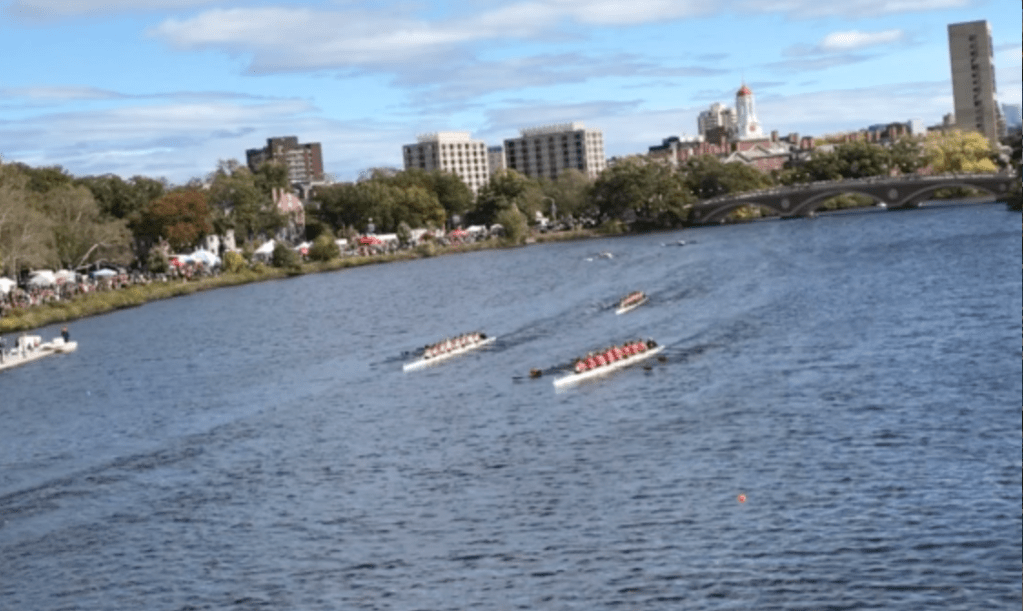
My daughter’s boat, left, racing on the Charles River earlier today. (Photo by me.)

This week’s blog post is late because my wife Laurel and I took a car trip from New Jersey to the Boston area to see our teen daughter Maria compete with her Montclair High School crew team in the huge “Head of the Charles” regatta on October 22.

So, naturally I thought about fiction I’ve read set in New England — a beautiful area of the United States with a long history as well as interesting cities and towns.

The work of Nathaniel Hawthorne immediately came to mind. Until his Italy-placed final novel The Marble Faun, most of that author’s books and short stories featured New England milieus. The best-known, of course, being The Scarlet Letter — the classic that unfolds in 17th-century Massachusetts. His novels The House of the Seven Gables and The Blithedale Romance are also set in The Bay State.

Hawthorne’s friend Herman Melville had the Pequod ship in Moby-Dick sail from Nantucket, Mass., after some pre-sea chapters on land. Melville wrote his masterpiece in Pittsfield, Mass., where a mountain (Mount Greylock) seen from his desk has sort of a whale shape. I looked out that window myself during a visit to Melville’s house nearly 20 years ago.

Another renowned 19th-century author, Louisa May Alcott, made the March family in Little Women residents of Concord, Mass.

Before going any further, I have to mention that Stephen King places a LOT of his page-turning fiction in Maine. Too many novels to list. 🙂

One of King’s influences, Shirley Jackson, put her chilling short story “The Lottery” in Vermont, where her novel We Have Always Lived in the Castle is also set. And the dwelling that dominates her most famous novel, The Haunting of Hill House, might be in New England — though that’s not specified.

John Irving’s canon also often has a New England flair — with, for instance, The Cider House Rules set in Maine, A Prayer for Owen Meany set in New Hampshire, and The Hotel New Hampshire set in…well, I’ll let you figure that out. 🙂

Edith Wharton placed several of her best-known novels in high-society locales in and near New York City, but a notable exception was Ethan Frome, which has a Massachusetts milieu.

Then there’s Mark Twain’s A Connecticut Yankee in King Arthur’s Court, though most of that novel goes way back in the past to England. (Twain lived much of his adult life in Connecticut.) Another late-19th-century-written time-travel classic, Edward Bellamy’s Looking Backward, is set in Boston in both the 1800s and the year 2000.

Boston is also the city for Esther Forbes’ young-adult novel Johnny Tremain, starring a 1770s teen in American Revolution times.

And…ahem…The Bostonians by Henry James.

Other works set or partly set in New England? Margaret Atwood’s The Handmaid’s Tale, Richard Russo’s Empire Falls, Jhumpa Lahiri’s The Namesake, Donna Tartt’s The Secret History, Elizabeth Strout’s Olive Kitteridge, Sylvia Plath’s The Bell Jar, Anita Shreve’s The Weight of Water, Jodi Picoult’s My Sister’s Keeper, Erich Segal’s Love Story, and Dennis Lehane’s Mystic River, to name a few.

Any fiction with New England settings you’d like to mention?

My literary-trivia book is described and can be purchased here: Fascinating Facts About Famous Fiction Authors and the Greatest Novels of All Time.

In addition to this weekly blog, I write the 2003-started/award-winning “Montclairvoyant” topical-humor column every Thursday for Baristanet.com, which has merged with Montclair Local. The latest piece — about a high-profile councilor who resigned and the contentious vote for his replacement — is here.

Reading Can Be a Disaster

As the cycle of tragedy in the Mideast continues — decades of vicious oppression of Palestinians by Israel, vicious attacks on Israel by Hamas, all the deaths, etc. — among the words that describe the ghastly situation is: disaster. And since this is a book blog, I’m going to write about disaster in literature.

There are of course novels about devastating wars, novels about the unimaginable horror of the Holocaust, and so on, but I’ve covered those topics before. This post will be mostly about one-off disasters happening within a relatively small window of time.

As we read about these situations — fictional but reminiscent of, and sometimes based on, real disasters — there is of course much drama amid the dread. Instances of courage, instances of cowardice, wondering if the characters will survive, etc.

Before I knew last week that I would write this post, I happened to be reading Chitra Banerjee Divakaruni’s compelling novel One Amazing Thing — about nine people in an unnamed American city trapped in a passport/visa office when a major earthquake hits. The interpersonal dynamics among this multiracial group are fascinating as they try to control their fear while thinking of ways to escape or at least survive until possible rescue. Meanwhile, they pass some of the agonizing hours telling at-times-enthralling tales to each other about their lives — making the novel almost a short-story collection of sorts.

I also thought of Ann Patchett’s Bel Canto, about attendees at a posh party in a South American country who are taken hostage. In this novel, the interaction is not only between the party guests but also between the guests and the attackers during what turns out to be a four-month standoff. Good vs. evil? It’s more complicated than that.

Paul Gallico’s The Poseidon Adventure? A tidal wave turns a cruise ship upside down. Not ideal. But quite riveting as the surviving passengers try to save themselves.

In Donna Tartt’s The Goldfinch, a museum bombing is the focus only of the first part of the novel, but that bombing sets off a series of consequences, actions, and events that drive the rest of the Pulitzer Prize-winning work.

What will happen at the end of the book hangs over Nevil Shute’s On the Beach. Nuclear war has devastated much of the Earth, a massive radioactive cloud is heading toward Australia, and the novel’s characters in and near Melbourne know it’s coming.

Your thoughts about, and examples of, this topic?

My literary-trivia book is described and can be purchased here: Fascinating Facts About Famous Fiction Authors and the Greatest Novels of All Time.

In addition to this weekly blog, I write the 2003-started/award-winning “Montclairvoyant” topical-humor column every Thursday for Baristanet.com, which has merged with Montclair Local. The latest piece — about the split-vote approval of a controversial redevelopment in my town — is here.

When the End Game Is Far From Lame

This is the beginning of a blog post about the endings of books.

We’ve all read excellent novels in which the latter parts/conclusions were at least somewhat unsatisfying. Among those that come to mind for me are Louisa May Alcott’s Little Women, Louis de Bernieres’ Captain Corelli’s Mandolin, Charles Frazier’s Cold Mountain, Nathaniel Hawthorne’s The House of the Seven Gables, Ian McEwan’s Atonement, Jodi Picoult’s My Sister’s Keeper, Mark Twain’s Adventures of Huckleberry Finn, and Edith Wharton’s The Age of Innocence.

But I’m going to flip that and discuss novels with endings every bit as good as what came before. In some cases, the conclusion is the highlight.

There are of course a small number of works with iconic final lines or passages; F. Scott Fitzgerald’s The Great Gatsby and Charles Dickens’ A Tale of Two Cities are prime examples. There are also books that, while not having boffo last words, end with great plot developments, incredibly poignant situations, etc.

That was the case with a novel I read last week — Kristin Hannah’s Winter Garden (2010), about two very different adult daughters and their cold, unloving mother who had escaped besieged Leningrad under tragic circumstances during World War II. For much of the 2000/2001-set book, I thought what I was reading was good not great — interesting and intense at times, but repetitive and forced at other times. Then came the ending, which, while requiring a major suspension of belief, was extremely moving and powerful.

Another 2010 novel, (Ms.) Lionel Shriver’s So Much for That, is terrific throughout as it takes a scalpel to America’s very problematic health-care system via the experiences of its main characters. Then the book goes into an even higher gear with a conclusion that combines some sobering stuff with wonderful wish fulfillment.

There’s also John Steinbeck’s The Grapes of Wrath, which ends with a scene that mixes despair, desperation, hope, and human decency. I’ve read that Steinbeck came up with that seldom-duplicated conclusion before starting the novel, and wrote toward that pre-planned finale.

The conclusion of Gabriel Garcia Marquez’s One Hundred Years of Solitude is quite melancholy, but beautifully written and the perfect capstone to what was an instant classic.

I’ve loved every George Eliot novel I’ve read, but the one with the most satisfying ending for me was Daniel Deronda, with its fulfillment of destiny for several characters and the sadness/bravery of another character facing unrequited love.

Other excellent novels whose latter parts/conclusions — whether upbeat or downbeat, surprising or not, annoying or not, etc. — I thought were knocked out of the park include James Baldwin’s Go Tell It On the Mountain, Charlotte Bronte’s Jane Eyre, Lee Child’s Jack Reacher thriller 61 Hours, Agatha Christie’s And Then There Were None, Fyodor Dostoevsky’s The Brothers Karamazov, Lisa Genova’s Still Alice, John Grisham’s The Racketeer, Barbara Kingsolver’s Unsheltered, Giuseppe Tomasi di Lampedusa’s The Leopard, Stieg Larsson’s Millennium Trilogy (third book: The Girl Who Kicked the Hornet’s Nest), Jack London’s Martin Eden, Cormac McCarthy’s Suttree, Herman Melville’s Moby-Dick, Liane Moriarty’s Big Little Lies, Richard Russo’s Empire Falls, Irving Stone’s The Agony and the Ecstasy, Donna Tartt’s The Goldfinch, and Amor Towles’ A Gentleman in Moscow, to name a few.

Any novels with especially memorable endings you’d like to mention?

My literary-trivia book is described and can be purchased here: Fascinating Facts About Famous Fiction Authors and the Greatest Novels of All Time.

In addition to this weekly blog, I write the 2003-started/award-winning “Montclairvoyant” topical-humor column every Thursday for Baristanet.com, which has merged with Montclair Local. The latest piece — which comments on the resignation of an unregistered financial consultant and more — is here.

When Friends or Siblings Grow Apart in Lit

iStock.com/LIVINUS

Among the poignant and dramatic story lines in literature is seeing friends or siblings who were close as children diverge in their life paths and feelings toward each other as they grow older. Sometimes things get better after that rupture, but in many cases they don’t.

Containing a strong example of divergence is John Grisham’s The Boys from Biloxi, which I finished this past week. In it, Keith Rudy and Hugh Malco are close friends and fellow baseball stars as Mississippi kids, but things take a different trajectory by the time they become adults. Keith follows his father in becoming a prominent attorney, while Hugh follows his father into mob-world territory. No surprise to say the two young men will eventually meet on different sides of the court system in this riveting novel.

As the above paragraph indicates, parental influence can be a big factor in determining the future turns children take. Look at siblings Maggie and Tom Tulliver in George Eliot’s masterful The Mill on the Floss. As was often the case in the 19th century, Tom is treated better by his parents (and society) as a male, which helps drive a wedge between him and his sister Maggie — a much nicer and smarter person. Not that the two were ever super-close in the first place, but things definitely got worse for many years until a shocking turn at book’s end.

In Toni Morrison’s absorbing early novel Sula, the protagonists Sula Peace and Nel Wright are close childhood friends. But a tragedy, different personalities (Nel is much more conventional), and a betrayal yank them apart as they grow older.

The conventional/less-conventional divide is also a factor in Kristin Hannah’s page-turning Firefly Lane, in which Tully Hart and Kate Mularkey are extraordinarily close pals in childhood and into adulthood. But the ambitious, driven Tully becomes a famous TV host who remains single while Kate marries and becomes a stay-at-home mother — so they obviously live much different lives. Plus there’s a betrayal here, too, as well as the tension of Kate wondering if her husband Johnny loves Tully more than her.

The siblings in Fyodor Dostoevsky’s The Brothers Karamazov, John Steinbeck’s East of Eden, Jane Smiley’s A Thousand Acres, and Ken Kesey’s Sometimes a Great Notion? Too complicated to summarize the machinations and drama here, but all four of those novels are very compelling reads.

There are of course many marriages in literature that start off wonderfully before later disintegrating, but that’s a somewhat different theme that I blogged about in 2014.

Your thoughts about, and examples of, today’s topic?

My literary-trivia book is described and can be purchased here: Fascinating Facts About Famous Fiction Authors and the Greatest Novels of All Time.

In addition to this weekly blog, I write the 2003-started/award-winning “Montclairvoyant” topical-humor column every Thursday for Baristanet.com, which has merged with Montclair Local. The latest piece — about the reappointment of my town’s poorly performing municipal clerk — is here.

This Post Was Written By a Cat Not a Kitten

Misty the cat says: “I’m perched today next to ‘The Boys from Biloxi.’ I am NOT a boy from Biloxi.” (Photo by me.)

My cat Misty hasn’t hijacked this blog since early 2021, but he’s back on the computer today discussing some of the novels his human (me) has read during the past two-plus years. Has Misty read those books, too? Perhaps, although his Goodreads account lists him as only reading the labels on cat-food cans. Is that great literature?

Anyway, here’s Misty:

“‘Is that great literature?,’ my male human asked. Depends. How do we know that, say, Dostoevsky and George Eliot didn’t write the words on cat-food-can labels? All authors have to start somewhere.

“Anyway, I was thrilled that one of the novels Dave read since early 2021 was Kristin Hannah’s The Nightingale! I could practically taste that avian protagonist until I pawed through the book and learned that ‘The Nightingale’ was a nickname for a female HUMAN who did heroic things during World War II. Now I’m itching to start World War III by swiping my food bowl off the table.

“Despite the persona I just put forth, I’m a very nice kitty most of the time. For instance, when Dave read Barbara Kingsolver’s Unsheltered, I cried tears of empathy for the homeless animals that novel undoubtedly depicted. But the book turned out to be people-focused. Still, I will always have a soft spot in my feline heart for Kingsolver’s The Poisonwood Bible, in which a missionary converts dogs into cats. Religious zeal? You gotta love it.

“Actually, the missionary did NOT convert dogs into cats, so those canines howling in the Pink Floyd song ‘Dogs’ can just shush.

“The barkers in that prog-rock tune have no names, which reminds me of Wilkie Collins’ novel No Name. The title actually make sense once you read the book, as does the title of that author’s The Moonstone — about a member of The Rolling Stones visiting the moon in the 19th century. Yes, Keith Richards looks, and is, that old.

“Now that I’m name-dropping, I read Paulo Coelho’s The Alchemist assuming it was a fictional work about my friend Al the chemist. It was not. I also thought Morgan’s Run by Colleen McCullough was about 18th-century character Richard Morgan competing in the Boston Marathon. It was not. Maybe he was actually an 18th-century pickleball player?

“As for Bel Kaufman’s Up the Down Staircase, the first-floor apartment my humans and I share doesn’t have stairs, so I don’t know how Dave can relate to that book. Still, there are hallway stairs that lead to the second and third floors of our basic, plain-looking rental building. Shirley Jackson authored We Have Always Lived in the Castle, but she needs to speak for herself. There isn’t even a moat around here.

“But there’s an inhaler in my apartment, because I’m an asthmatic cat. Thus I thought Breathing Lessons would be a very valuable instructional read for me and other felines in my situation. Alas, that Anne Tyler novel — like the aforementioned Unsheltered — focused on people. No wonder I can’t get a library card.

“As some of you know, I’m given a leashed walk every morning around my apartment complex. The other day, I saw a puddle of rain from the night before, and was awestruck to realize I was witnessing the very body of water that’s the titular setting for Agatha Christie’s Death on the Nile. Cue the soundtrack for The Bangles’ ‘Walk Like an Egyptian.’

“The title of Song of Solomon also evokes the Mideast, although Toni Morrison’s novel is set in the United States. Did King Solomon rule the U.S. sometime between the presidential terms of FDR and Jimmy Carter? Morrison ignores that question in her book, but everyone knows the Electoral College works in strange ways.

“It’s also strange that Irving Stone’s The Agony and the Ecstasy isn’t about me being fed five seconds late one day. Instead, it’s about some guy named Michelangelo. Wasn’t he a Teenage Mutant Ninja Turtle?

“More questions: Was Lorna Doone a novel first or a cookie first? R.D. Blackmore wrote the book, but who wrote the list of ingredients on Lorna Doone cookie boxes? Not Dostoevsky or George Eliot, because they were busy writing for cat-food cans.”

Misty the cat will reply to comments between naps.

My literary-trivia book is described and can be purchased here: Fascinating Facts About Famous Fiction Authors and the Greatest Novels of All Time.

In addition to this weekly blog, I write the 2003-started/award-winning “Montclairvoyant” topical-humor column every Thursday for Baristanet.com, which has merged with Montclair Local. The latest piece — which comments on a negative report about my town, among various other topics — is here.

An Array of Asian and Asian Ancestry Authors

This month, the G20 Summit was held in India, with the U.S. president subsequently visiting Vietnam. Also this month, the leader of North Korea met with the leader of Russia — a country partly in Asia. Next month, my New Jersey town’s “AAPI Montclair” organization representing Asian Americans and Pacific Islanders will hold several events. Countries such as China and Japan are often in the news, too.

All that is my excuse for writing this week about novels I’ve read by living authors who reside in Asian nations or reside elsewhere but are of Asian or part-Asian descent. I’ll also mention a few Asia-set books by non-Asian writers.

Among the titles that immediately came to mind is The God of Small Things, the 1997 debut novel by author/activist Arundhati Roy of India. It’s a depressingly riveting story featuring fraternal twins and other memorable characters.

I’ve only gotten to one novel so far by Japan’s Haruki Murakami — his intriguing After Dark (2004) that unfolds during a single night. (I’ve also read The Tale of Genji, the 11th-century work by Japan’s Murasaki Shikibu, but she’s not a living author as far as I know. 🙂 )

I recently read (and discussed in last week’s blog post) Nadia Hashimi’s Afghanistan-set The Pearl That Broke Its Shell, an absorbing 2014 debut novel about two women separated by a century. Hashimi’s parents emigrated from Afghanistan a few years before their daughter’s 1977 birth in New York.

Afghanistan-born American author Khaled Hosseini is known for works such as The Kite Runner (2003), also an excellent debut novel — this one set in Afghanistan and California.

Another now-American writer, Viet Thanh Nguyen, was born in Vietnam — the partial setting for his intense/tragic/cleverly crafted novels The Sympathizer (2015) and The Committed (2021).

Jhumpa Lahiri was born in London to Indian immigrants parents who soon moved to the U.S. I enjoyed her novels The Namesake (2003) and The Lowland (2013) as well as her 1999 short-story collection Interpreter of Maladies.

Kazuo Ishiguro is a Japanese-born British novelist known for works such as 1989’s The Remains of the Day (which I liked a lot) and 2005’s Never Let Me Go (which I found slow going).

Amy Tan? I’ve read and been impressed with three novels — The Joy Luck Club (1989), The Kitchen God’s Wife (1991), and The Bonesetter’s Daughter (2001) — by that American author of Chinese descent.

Among the novels that have stuck with me by non-Asian living writers using Asian settings are Adam Johnson’s 2012 The Orphan Master’s Son (set in North Korea) and Lawrence Osborne’s 2020 The Glass Kingdom (set in Thailand). I also loved James Clavell’s 1975 Shogun (set in Japan), but that author is no longer with us.

Your thoughts about, and examples of, this week’s theme?

My literary-trivia book is described and can be purchased here: Fascinating Facts About Famous Fiction Authors and the Greatest Novels of All Time.

In addition to this weekly blog, I write the 2003-started/award-winning “Montclairvoyant” topical-humor column every Thursday for Baristanet.com, which has merged with Montclair Local. The latest piece — about a cyber attack and more — is here.

In Some Books, Female to Male Is Not Beyond the Pale

Nadia Hashimi

There are several obvious reasons why some of literature’s female characters dress as males.

Males tend to get more respect and “perks” in our sexist, misogynist, patriarchal world. Also, they’re often considered physically stronger, so females might feel safer — from general attack and/or sexual assault — being in male garb. Etc.

Nadia Hashimi’s compelling Afghanistan-set novel The Pearl That Broke Its Shell, which I just finished, gives readers a double dose of cross-dressing. In the 21st century, the girl Rahima becomes known as the boy Rahim. And, in the book’s parallel story unfolding 100 years earlier, her beleaguered great-great-grandmother Shekiba passes as a male, too. Both also appear as the females that they are in parts of the novel, so we get quite a contrast with how differently they’re treated when seen as a person of each gender — especially in a women-oppressing, double-standard-rife country such as Afghanistan with many brutal male leaders. As Shekiba thinks to herself late in the book: “Only a daughter could know what it was to cross that line, to feel the freedom of living as the opposite sex.”

J.R.R. Tolkien’s otherwise superb The Lord of the Rings unfortunately mostly focuses on men, so it’s perhaps no surprise that one of the few women getting some authorial attention is the Eowyn character who eagerly heads off to battle disguised as a man by the name of Dernhelm. But she is a secondary player in Tolkien’s trilogy.

Moving from fantasy fiction to dystopian lit, Lauren Olamina poses as a male to try to be safer in a dangerous post-apocalyptic world. Plus she feels her masculine disguise gives her more gravitas as the leader that she is. All in Octavia E. Butler’s Parable of the Sower.

Another brave cross-dressing young woman is Eliza Sommers, who travels from Chile to Gold Rush-era California in Isabel Allende’s Daughter of Fortune.

Set much further back in time, we have the legendary 15th-century teen warrior who dresses as a male in Mark Twain’s historical-fiction novel Personal Recollections of Joan of Arc.

I know there are various other works of fiction that include females passing as males; in this post, I’ve just mentioned the ones I’ve read. Your thoughts about, and examples of, this theme?

My literary-trivia book is described and can be purchased here: Fascinating Facts About Famous Fiction Authors and the Greatest Novels of All Time.

In addition to this weekly blog, I write the 2003-started/award-winning “Montclairvoyant” topical-humor column every Thursday for Baristanet.com, which has merged with Montclair Local. The latest piece — about a problematic municipal clerk, the first day of school, a large local jazz festival, and more — is here.

Your Next Stop: Leaving ‘The Comfort Zone’?

Terry Pratchett (photo by Rob Wilkins/Doubleday)

Many avid readers occasionally stray out of their literary comfort zone. I’m one of them. 🙂

Doing that can be interesting, educational, mind-expanding, challenging, rut-avoiding, tolerance-enhancing, and…fun.

The majority of novels I’ve gotten to in recent years are 21st- or 20th-century works of general fiction by authors from the United States or England. (I used to focus a lot on 19th-century literature from those two countries, but after a while one reads most of what one wants to read from that era and the authors are, um, not around anymore to produce new books.)

Also in recent years, I’ve enjoyed quite a few 21st- and 20th-century Canadian novels (Margaret Atwood, L.M. Montgomery, etc.); 20th- and 19th-century French novels (Camus, Colette, Balzac, Dumas, Hugo, Zola, etc.); and 19th-century Russian novels (Tolstoy, Dostoevsky, etc.). So, not really far out of any comfort zone.

A little less often on my list have been novels by authors from Australia (Liane Moriarty and Colleen McCullough!), Brazil (Jorge Amado and Paulo Coelho!), Chile (Isabel Allende!), Colombia (Gabriel Garcia Marquez!), the Czech Republic (Jaroslav Hasek!), Germany (Erich Maria Remarque and Hermann Hesse!), India (Arundhati Roy!), Italy (Elsa Morante and Giuseppe Tomasi di Lampedusa!), Japan (Haruki Murakami!), New Zealand (Janet Frame!), Nigeria (Chimamanda Ngozi Adichie and Wole Soyinka!), Scotland (Sir Walter Scott!), South Africa (Nadine Gordimer and Alan Paton!), Sweden (Stieg Larsson and Fredrik Backman!), and Switzerland (Johanna Spyri!), among other places. An incomplete list by me, and some of those authors ended up moving to other countries.

But getting out of one’s comfort zone is not just a geographical thing. For instance, I just read Terry Pratchett’s fantasy novel Small Gods despite — with a few exceptions such as J.R.R. Tolkien’s The Lord of the Rings — my not being much of a fantasy buff. The weird, satiric, religion-questioning, often-dark, often-funny Small Gods — part of Pratchett’s Discworld series — was quite good, actually, after a slow-ish start.

Also somewhat off the beaten track for me have been long-long-ago novels (such as Miguel de Cervantes’ 17th-century Don Quixote and Murasaki Shikibu’s 11th-century The Tale of Genji), experimental/modernist fiction (as in Virginia Woolf’s Mrs. Dalloway), novels in poetic form or with a good chunk of verse (Alexander Pushkin’s Eugene Onegin and Vladimir Nabokov’s Pale Fire), very lengthy novels (James Clavell’s Shogun, Anne Rice’s The Witching Hour, a number of Diana Gabaldon’s Outlander books), sci-fi (the great Octavia E. Butler, anyone?), young-adult literature (I must revisit the aforementioned L.M. Montgomery’s Anne of Green Gables in the not-too-distant future), mysteries, etc.

What do you read to vary your fiction focus?

My literary-trivia book is described and can be purchased here: Fascinating Facts About Famous Fiction Authors and the Greatest Novels of All Time.

In addition to this weekly blog, I write the 2003-started/award-winning “Montclairvoyant” topical-humor column for Baristanet.com every Thursday. The latest piece — with more on a developer’s bait-and-switch project — is here.

When Authors Pour It On

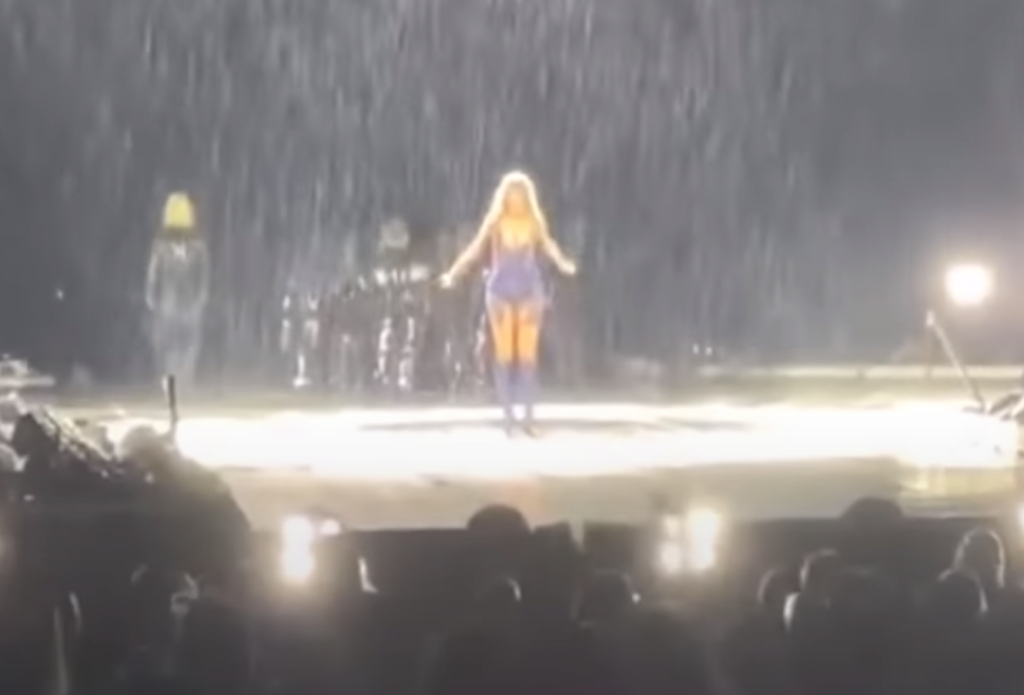
Oh, what the heck, a screen shot I grabbed off YouTube of Taylor Swift singin’ in the rain.

Sometimes, bloggers have no idea what to write for their next post. Such was the case with me this past Friday, trying to think of a topic as the rain poured down.

I looked out the window and decided to write about…rain. In literature. Fiction’s precipitation can be quite atmospheric, set a mood, reflect a character’s state of mind, be a plot element, portend nature’s growth, and more.

There’s an evocative scene or two of rain in A Gentleman in Moscow author Amor Towles’ debut novel Rules of Civility, which I had finished the previous night. Set mostly in 1938 New York City, the 2011 book stars a young, plucky, literature-loving ( 🙂 ) career woman named Katey Kontent (!) and is full of elegant writing such as these damp-weather words: “Come September, despite the waning hours, despite the leaves succumbing to the weight of autumnal rains, there is a certain relief to having the long days of summer behind us; and there’s a paradoxical sense of rejuvenation in the air.” Not a bad passage to read when it’s almost September.

Published in 1939 — a year after Rules of Civility is set — The Grapes of Wrath features days of torrential rain near book’s end. Sometimes a downpour is just a downpour, as the 1939-deceased Sigmund Freud might have said, but the rain in John Steinbeck’s classic novel also symbolizes the gloom and despair of the ever-more-impoverished Joad family as they struggle to survive after economic conditions forced them to migrate to California.

Rain and other bad weather is of course potentially even more catastrophic for homeless characters, as the Joads became.

Another example of relentless, dramatic rain near the end of a masterful novel is in the unforgettable scene that concludes George Eliot’s The Mill on the Floss.

There’s also the symbolic four-plus years of rain after the brutal massacre in still another classic novel — Gabriel Garcia Marquez’s One Hundred Years of Solitude. It’s as if the sky is mourning the many murdered workers.

On a more personal scale, Jane Eyre‘s memorable storm and lightning-split tree at a moment of great happiness for Ms. Eyre and Edward Rochester foreshadows that the star and co-star of Charlotte Bronte’s novel will soon be experiencing rough times.

In Toni Morrison’s Song of Solomon, the exhausted Hagar character being soaked by rain when returning home from a shopping trip is among the novel’s pivotal scenes.

Some novels of course literally have a certain weather event in the title, with Garth Stein’s The Art of Racing in the Rain one example.

There’s also significant rain in Charles Dickens’ Bleak House, Herman Melville’s Moby-Dick, Mark Twain’s Adventures of Huckleberry Finn, J.D. Salinger’s The Catcher in the Rye, Yann Martel’s Life of Pi, and many other fiction books.

Including this passage from William Faulkner’s novel As I Lay Dying: “It begins to rain. The first harsh, sparse, swift drops rush through the leaves and across the ground in a long sigh, as though of relief from intolerable suspense. They are as big as buckshot, warm as though fired from a gun; they sweep across the lantern in a vicious hissing…”

Examples of, and thoughts about, today’s topic?

My literary-trivia book is described and can be purchased here: Fascinating Facts About Famous Fiction Authors and the Greatest Novels of All Time.

In addition to this weekly blog, I write the 2003-started/award-winning “Montclairvoyant” topical-humor column for Baristanet.com every Thursday. The latest piece — about a mayoral withdrawal, a developer’s bait-and-switch, quarterback Aaron Rodgers moving close to my town, and more — is here.

Bookstores I Have Known

My town’s Montclair Book Center, August 19, 2023. (Photo by me.)

Last week, I discussed some libraries in my life. This week, I’m following that up by focusing on some bookstores in said life.

I’ll start with my New Jersey town of Montclair, which has two independent bookstores — unusual for a suburb of about 40,000 people.

One of those retailers is Montclair Book Center, which opened in 1984 (thanks, George Orwell 🙂 ) but appealingly feels much older. Rather scruffy-looking, but filled with a ton of new and used titles in its crowded aisles. I can’t count the number of book (and calendar) gifts I’ve purchased there over the years.

The second Montclair literary haven is the less quirky but quite nice Watchung Booksellers, a mere five-minute walk from my apartment.

In nearby New York City, where I lived and worked for many years, perhaps the most memorable bookstore is the renowned Strand — which has 2.5 million new, used, rare, and out-of-print books. Formerly also very convenient, given that the Manhattan-based magazine for which I used to write was only two blocks down Broadway in the East Village.

Among my memories of shopping at the Strand, from when I was in my mid-20s, was surprising a woman I was dating at the time with a present of a very hard-to-find book she said she’d been seeking for years. The Strand had it in stock during those pre-Amazon days. But the woman was rather blasĂ© about the gift, and we didn’t date much longer. 🙂

Further afield in the United States, I have fond memories of visiting famous bookstores such as City Lights in San Francisco and Powell’s in Portland, Oregon. And a not-so-famous one in Tennessee whose name I can’t remember — but I recall several other things about that 1991 experience.

I was in Memphis to cover the Association of American Editorial Cartoonists convention for a magazine when a free afternoon allowed me to walk around the city with Jerry Robinson, whose many accomplishments in cartooning included creating the iconic character of The Joker (and naming sidekick Robin) while working on the Batman comic books as a pre-World War II teen. Anyway, we found a great shop with comic books and other cartoon items — and Jerry, who was 69 at the time, was like a kid in a candy store. Needless to say, he made several purchases.

While I prefer independent bookstores to chain ones (especially indies with cats 🙂 ), I’ve certainly frequented some nice Barnes & Noble outlets. The now-defunct Borders, too; I even visited its flagship store in Ann Arbor with my wife Laurel — who spent the majority of her childhood in that Michigan city.

Airport bookstores? Usually pretty basic, but they’ve come in handy at times.

After flying to Paris, one has to at least browse the many outdoor book kiosks near the Seine — as I’ve done several times. And I found a bookstore in Moscow many years ago that featured some English-language offerings among its Russian-language titles. I still have Nikolai Ostrovsky’s novel How the Steel Was Tempered from that visit.

Bookstores you have known?

My literary-trivia book is described and can be purchased here: Fascinating Facts About Famous Fiction Authors and the Greatest Novels of All Time.

In addition to this weekly blog, I write the 2003-started/award-winning “Montclairvoyant” topical-humor column for Baristanet.com every Thursday. The latest piece — about an “emergency” meeting that wasn’t an emergency, and more — is here.