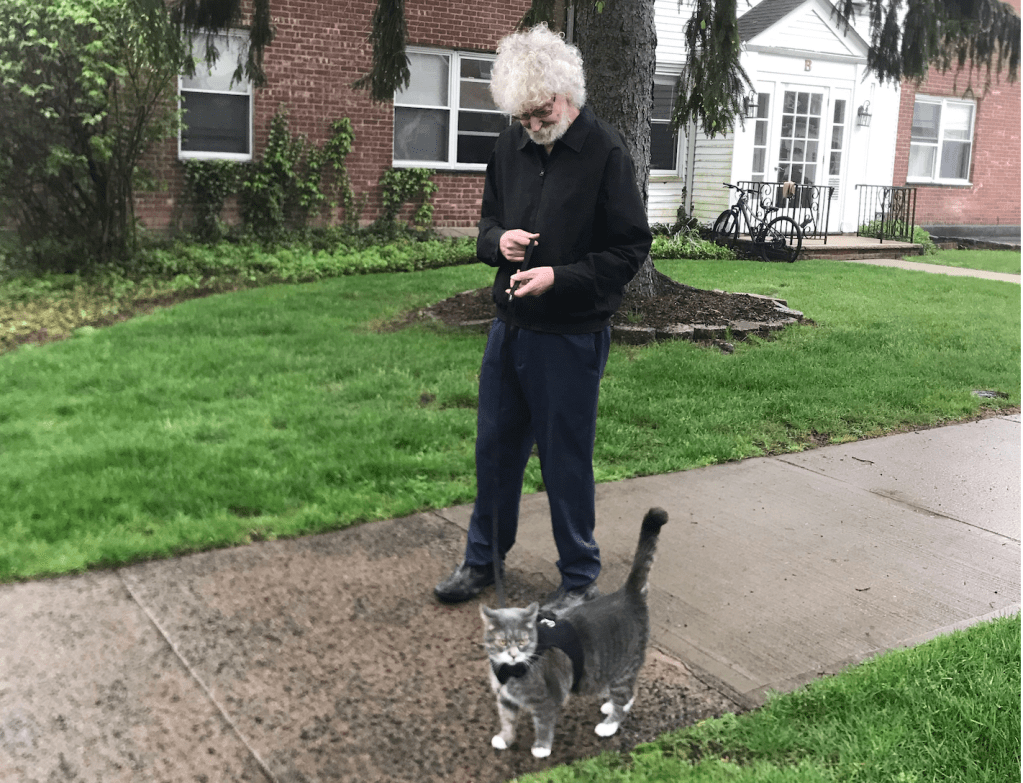
Misty and me. (Photo by my wife, Laurel Cummins.)
My third book — Misty the Cat…Unleashed — has just been published! It’s partly factual and partly fictional, so I guess it’s partly a novel. Along with being partly a memoir, told in Misty’s comedic voice. (A voice you’ve occasionally experienced here when that commendable kitty has guest-blogged about literature.)
In the 242-page book, asthmatic feline Misty slips his harness during one of his daily leashed walks and gets lost in Montclair, New Jersey. To pass the time and try to control his fear, Misty cracks MANY jokes, reminisces about his life, imparts information about his species and human family (mine!), discusses his favorite novels and music, gets philosophical, fantasizes about things, and more.
This NOT-a-children’s book includes 11 cartoons of Misty amid the text, and has paperback and Kindle editions. (Links in the boldface paragraph near the end of this post.) If you end up buying and reading the book, an Amazon review would of course be very welcome. 🙂
I came up with the idea for a memoir “by” Misty several years ago, but couldn’t quite figure out a good plot to hang the story on. Then, in 2022, Misty slipped his harness one morning in real life and was lost for about 16 hours. We were frantic and devastated before finally finding him after much searching and much leaving of our contact information with neighborhood residents. A few months later, it belatedly occurred to me that I had a plot for my (Misty’s) book.
Then came the writing and rewriting, from March to September 2023. After that, I figured I’d make a long-shot attempt to find a literary agent — researching agency web sites and sending out 88 individually crafted queries whenever I had some free time in late 2023 and early 2024. I received some nice responses, but not an offer of representation.
So, I decided to again enter the wonderful world of independent publishing, as I had done with my 2017 Fascinating Facts literary-trivia book after going the small press route with my 2012 memoir Comic (and Column) Confessional. After all, Misty and cats in general are all about independence. 🙂 (But they are of course very loving creatures, too.)
“Misty the Cat…Unleashed” can be purchased on Amazon in a paperback or a Kindle edition.
In addition to this weekly blog, Dave writes the 2003-started/award-winning “Montclairvoyant” topical-humor column every Thursday for Montclair Local. The latest piece — about a final Council meeting, a beloved independent stationery store closing, and more — is here.