Marrying Marriage Ceremonies to Literature

The wedding in A Walk to Remember‘s movie version. (Screen shot by me.)

I’ll be attending a family wedding this coming weekend, so naturally I’ll write today about…weddings in literature.

As in real life, fictional weddings can be wonderful and/or weird and/or lavish and/or bare bones and/or dramatic and/or problematic and/or heartwarming and/or…whatever.

One of the most famous fictional wedding ceremonies is that of the title character and Edward Rochester in Charlotte Bronte’s 1847 classic Jane Eyre. They are a couple very much in love, but, as many of you know, Rochester has quite a secret. Will it be revealed before the duo says “I do”?

Also memorable is the union of Gervaise and Coupeau in Emile Zola’s 1877 novel The Drinking Den. The couple spend more money on the nuptials than they can afford, the priest who marries them is surly, and the guests get lost in The Louvre museum while killing time between the ceremony and reception. Gervaise had been reluctant to marry Coupeau, or any man, and the imperfect wedding is a harbinger of the disasters that will follow after a few years of happiness.

Their daughter would meet with her own disasters in a subsequent Zola novel, 1880’s Nana.

In Diana Gabaldon’s Outlander, the wedding of Claire and Jamie takes place not long after Claire involuntarily time-travels from the 1900s to the 1700s. The two barely know each other, and the union is basically forced — making for a tension-filled yet partly humorous situation. But, lo and behold, the 20th-century-born Claire and the 18th-century-born Jamie by chance end up being very compatible even as they face many daunting challenges in the rest of the novel and its sequels.

Claire and Jamie tied the knot in the first Outlander book, but sometimes it pays to build things up more gradually. For instance, Anne Shirley and Gilbert Blythe have like-dislike interactions in L.M. Montgomery’s Anne of Green Gables and beyond. It’s not until the fourth sequel — Anne’s House of Dreams — that they marry. The wedding scene, and Montgomery’s writing of it, are worth the wait. As with Claire and Jamie, Anne and Gilbert are ultimately compatible.

Nicholas Sparks’ tear-jerker A Walk to Remember features the unexpected high-school-student relationship between the popular Landon and the ostracized Jamie, who’s immensely good-hearted but considered “uncool” for dressing poorly and being religious. We learn she is terminally ill, but the two teens marry anyway in a beautiful ceremony. The novel, whose story is told 40 years later by Landon, leaves things ambiguous as to whether Jamie died or not.

Then there’s the wedding element in Charles Dickens’ 1861 novel Great Expectations. Miss Havisham was jilted at the altar by a scoundrel, and becomes a bitter/depressed recluse who never gets over the traumatic nuptials experience she had as a young woman.

On a more upbeat note, Jane Austen novels are known for a number of “happy ending” weddings after complications and obstacles are overcome. The marriage ceremonies tend to be mentioned more than actually depicted.

Your thoughts about, and examples of, today’s theme?

My next blog post will run on Monday, May 8, rather than the usual Sunday.

My literary-trivia book is described and can be purchased here: Fascinating Facts About Famous Fiction Authors and the Greatest Novels of All Time.

In addition to this weekly blog, I write the 2003-started/award-winning “Montclairvoyant” topical-humor column for Baristanet.com every Thursday. The latest piece — about two Black firefighters suing over blatant racism in my town’s “leadership” — is here.

A Range of Role Reversal Reads

Roll reversals! When you eat a roll from the bottom up. Actually, my topic this week is ROLE reversals…in literature.

There’s plenty of potential drama in those reversals — including how the protagonists act in the unexpected/unfamiliar situations they find themselves in, and how other people react to those characters. 

Perhaps the best known example of a role reversal in fiction is Mark Twain’s The Prince and the Pauper, whose two main characters dizzyingly switch stations in life. But role reversals can be more realistic and recognizable.

In a novel I recently read — Kristin Hannah’s heart-wrenching, masterful Home Front — Jolene is deployed as a helicopter pilot in the Iraq War while her attorney husband Michael remains on the…home front…to take care of their two daughters. A somewhat unusual gender reversal. Of course, many women are now in the military, but the novel is set nearly 20 years ago and there are still many more cases where the man is the member of the couple overseas.

Jolene and Michael’s marriage is already on shaky ground before the deployment, partly because Michael opposed the Bush administration’s unnecessary, disastrous invasion of Iraq, even as Jolene was a pilot in the National Guard. Then, something happens to Jolene in the war zone that makes things REALLY challenging. Ms. Hannah certainly doesn’t sugar-coat the situation. 

Another recently read novel — Mary Robinette Kowal’s absorbing The Fated Sky, sequel to The Calculating Stars — continues the alternate-history story of female American astronaut Dr. Elma York into the early 1960s, a time when all real-life American astronauts were men. All white men, too, while Kowal’s fictional crew to Mars includes several women and men of color. They experience plenty of bias from one racist crew member, but they’re there.

Herman Melville’s gripping 1855 novella Benito Cereno is set on a slave ship where a very clever and intricate role reversal has taken place. Another example of how Melville was one of the few 19th-century authors to give characters of color significant roles and some three-dimensionality — as he did with Queequeg four years earlier in Moby-Dick.

A time-travel novel with quite a generational reversal is Marlys Millhiser’s The Mirror, in which a granddaughter and grandmother involuntarily switch bodies and the years they live in (1978 and 1900). Major culture shock for both.

Also a role reversal of sorts is when novels make animals the main characters and humans the secondary ones. Various examples of this, with the two I read last year being Tad Williams’ Tailchaser’s Song (featuring cats) and Jane Smiley’s Perestroika in Paris (starring a horse and other critters).

Your thoughts about, and examples of, this topic?

My literary-trivia book is described and can be purchased here: Fascinating Facts About Famous Fiction Authors and the Greatest Novels of All Time.

In addition to this weekly blog, I write the 2003-started/award-winning “Montclairvoyant” topical-humor column for Baristanet.com every Thursday. The latest piece — about a local legal expenses controversy and more — is here.

Not-Terrific Novels Can Still Be Quite Good

Margaret Atwood (photo by Chris Boland/Flickr www.chrisboland.com/cambridge).

If you really like a writer, even their “lesser” novels can be appealing.

I recently experienced that with The Heart Goes Last by Margaret Atwood — a 2015 novel, by one of my favorite living authors, that I had somehow failed to read before. Far from her best book, but it’s still a fairly engrossing, socially conscious, and at times funny work of speculative fiction about people escaping a U.S. turned dystopian for a closed U.S. community where they all alternate between a house and a prison. A community that, not surprisingly, turns out to be rather dystopian, too. The weirdly humorous parts? Well, for one thing, prepare to meet multiple Elvis Presleys and Marilyn Monroes.

Willa Cather, whose authorial career ended a year after Atwood was born, is best known for My Antonia and Death Comes for the Archbishop. But she also wrote a number of other novels ranging from good to very good — including The Song of the Lark (about an opera singer), One of Ours (a World War I novel), and Shadows on the Rock (historical fiction set in Quebec City).

James Hilton is also best known for two novels — the moving Goodbye, Mr. Chips and the eye-opening Lost Horizon — but some of his not-as-scintillating works, including So Well Remembered, are rather nice, too.

Maugham is most famous for Of Human Bondage, and also pretty famous for The Painted Veil, The Razor’s Edge, and The Moon and Sixpence. But there’s a pretty good sleeper amid the Maugham canon: Cakes and Ale, which is more compelling than its title might indicate.

Aldous Huxley? The iconic Brave New World is practically synonymous with his name, but he wrote several not-iconic novels that are quite readable — including the not-dystopian Point Counter Point.

Getting back to favorite living authors, I give many of Liane Moriarty’s novels an A or A+. But even the one I liked least — Truly Madly Guilty, focusing on a fateful barbecue — more than held my interest.

Good but not terrific Jane Austen? Northanger Abbey. Charles Dickens? Hard Times. Herman Melville? Omoo. Anne Bronte? Agnes Grey. Mark Twain? Pudd’nhead Wilson. John Steinbeck? The Wayward Bus. Isabel Allende? The Japanese Lover. Donna Tartt? The Little Friend. Etc.

Anything you’d like to say related to this week’s theme?

My literary-trivia book is described and can be purchased here: Fascinating Facts About Famous Fiction Authors and the Greatest Novels of All Time.

In addition to this weekly blog, I write the 2003-started/award-winning “Montclairvoyant” topical-humor column for Baristanet.com every Thursday. The latest piece — about a time machine, a bridge, and a $1,000 (!) dessert — is here.

Late in Life in Literature

The movie version of Kent Haruf’s Our Souls at Night novel starred Jane Fonda and Robert Redford. 

A person’s later years comprise a life’s p.m. — which also might stand for poignant and moving. There can be declining health, death of loved ones, loneliness, regrets, and other negatives — as well as positives such as the gaining of wisdom and the experiencing of memorable “last hurrahs.”

Such is the case with various fictional characters — including the older protagonists in Kent Haruf’s bittersweet novel Our Souls at Night, which I read “late” last month. It stars a widowed woman (Addie) and a widowed man (Louis) who barely knew each other as neighbors when their spouses were alive but develop an interestingly offbeat relationship soon after the compelling book begins. They find a good measure of happiness but also face challenges — such as dealing with judgmental residents of their small town, a son who tries to break up their relationship, and the responsibilities of taking care of a previously neglected grandchild. Making Our Souls at Night even more elegiac is that it was Haruf’s final novel, published about six months after his 2014 death.

There are few novels with as much of a “last hurrah” as Jonas Jonasson’s The 100-Year-Old Man Who Climbed Out the Window and Disappeared, whose protagonist experiences more adventures after reaching the century mark than most people a quarter or half his age.

Or how about Ernest J. Gaines’ The Autobiography of Miss Jane Pittman? That book uses the main character’s extremely advanced age (110) to recount Jane’s often-difficult life as well as take a general look at the U.S. sociopolitical climate from the time of slavery to the modern civil rights movement.

Gabriel Garcia Marquez’s Love in the Time of Cholera, about a very delayed late-life romance, also fits this theme. The male co-protagonist can be annoyingly sexist at times, but the novel is beautifully written.

Among the many other lead or supporting characters who are memorable in old age are the brilliant wizard Dumbledore of J.K. Rowling’s Harry Potter books, the long-suffering Iris Chase of Margaret Atwood’s The Blind Assassin, Miss Marple the amateur detective in various Agatha Christie mysteries, Emily Pollifax the amateur spy in Dorothy Gilman’s novels, the loner grandfather in Johanna Spyri’s Heidi, the problematic family patriarch Larry Cook in Jane Smiley’s A Thousand Acres, the woodsman Natty Bumppo at end of life in James Fenimore Cooper’s The Prairie, the dying George Washington Crosby in Paul Harding’s Tinkers, the “Chowder Society” men in Peter Straub’s Ghost Story, and of course the title character in Honore de Balzac’s Old Goriot as well as Santiago the fisherman in Ernest Hemingway’s The Old Man and the Sea.

Any thoughts on this week’s theme and novels you’ve read that fit it?

My literary-trivia book is described and can be purchased here: Fascinating Facts About Famous Fiction Authors and the Greatest Novels of All Time.

In addition to this weekly blog, I write the 2003-started/award-winning “Montclairvoyant” topical-humor column for Baristanet.com every Thursday. The latest piece — about an outrageous monetary demand from a misogynist township manager and some alternatives to the ending of a long-time local bus service — is here.

‘Fish Out of Water’ Are ‘C’ (Character) Creatures

Ten years ago, before I started this blog, I wrote a piece about characters who are “fish out of water.” Time to revisit that “fishional”…um…fictional topic by discussing some novels I’ve read since 2013 that are relevant to this theme.

As I noted back then, there’s often lots of drama and/or comedy when authors transport protagonists to a much different place. Those characters may initially “flounder” and have embarrassing moments — which is not good for them but interesting to read about. Then they might eventually get their bearings, experience new things, meet new people, and gain more confidence — which is good for them and also interesting to read about. Even if characters don’t adapt to new locales, there’s drama in that, too.

And readers — many of whom have been “fish out of water” themselves during vacations or after moving to new places — can compare their own real-life memories with the made-up situations depicted by authors.

Last week, I read John Grisham’s Gray Mountain, which tells the story of a young attorney at a big Manhattan law firm who unexpectedly ends up working at a legal-aid clinic in a small Virginia town. Samantha Kofer experiences culture shock far from her beloved New York City, but satisfaction as well practicing meaningful law for low-income clients. Samantha also finds herself in danger when she gets on the radar of Big Coal, which always plays hardball to keep the profits rolling in — whatever the cost to workers, to residents living near strip mines, and to the environment.

Another novel with a leaving-a-larger-population dynamic is Joyce Carol Oates’ Solstice, in which newly divorced Monica Jensen takes a job teaching in rural Pennsylvania — where she gets to know a rather interesting, problematic woman.

The opposite dynamic — small town to big city — probably happens more often in literature. One memorable example is when Denise Baudu moves to Paris in Emile Zola’s The Ladies’ Delight to work in a large department store. Another is when Molly Bolt, in Rita Mae Brown’s Rubyfruit Jungle, leaves an anti-LGBTQIA+ environment in Florida (sound familiar? 😦 ) to move to New York City.

Immigrants/long-time visitors to other countries are very much “fish out of water” at first. So many novels with that motif: Viet Thanh Nguyen’s The Sympathizer, Khaled Hosseini’s The Kite Runner, Chimamanda Ngozi Adichie’s Americanah, Isabel Allende’s Daughter of Fortune, Colleen McCullough’s The Thorn Birds, Jeffrey Eugenides’ Middlesex, James Clavell’s Shogun, Colm Toibin’s Brooklyn, Charles Dickens’ Martin Chuzzlewit, Wilkie Collins’ A Rogue’s Life, etc.

Being a “fish out of water” can of course be mostly positive. Such is the case with Anne Shirley of L.M. Montgomery’s Anne of Green Gables, who leaves an orphanage to live with adult siblings Marilla and Matthew Cuthbert in a house and rural area she finds bucolic — though obviously life isn’t perfect.

Science fiction certainly makes characters “fish out of water” as they might exit the Earth for other worlds or visit Earth from other worlds. So many examples, including the human colonizers of The Red Planet in Ray Bradbury’s The Martian Chronicles.

Not surprisingly, time travel novels also offer major “fish out of water” experiences for characters visiting the past or future. Some books, including Jack Finney’s Time and Again, even give us both of that. Much of Finney’s novel is devoted to Simon Morley’s trips to 1880s New York City from the second half of the 20th century. Later, the woman Simon falls in love with — Julia Charbonneau — accompanies him back to HIS time in Manhattan. She is certainly shocked by all the cars, the less-modest clothing, TVs, and more.

Last but not least, animals can be “fish out of water,” too — without being sea creatures. 🙂 Jack London’s The Call of the Wild tells the story of Buck the canine being yanked from “civilization” to become a sled dog in…the wild, while London’s novel White Fang features the opposite scenario: from the wild to “civilization” for its title character. That part-dog/part-wolf is as shocked as Julia Charbonneau when seeing a big city, in this case San Francisco.

Any examples of, or thoughts about, this week’s topic?

My literary-trivia book is described and can be purchased here: Fascinating Facts About Famous Fiction Authors and the Greatest Novels of All Time.

In addition to this weekly blog, I write the 2003-started/award-winning “Montclairvoyant” topical-humor column for Baristanet.com every Thursday. The latest piece — about a municipal budget and a misogynist township manager who seemingly can’t be gotten rid of — is here.

Two Eras in One Fictional Work

Many readers have an affinity for PT. Physical therapy? In some cases. But what I’m talking about is parallel timelines.

Those timelines can be very appealing in novels. We get two stories for the price of one, in two disparate eras. We see that people from distinct historical periods are different (in the way they speak, in what they wear, in the “devices” they use, in cultural norms, etc.) yet emotionally not so different (most people from any era want love, good health, security, and enough money to be comfortable; feel anger and jealousy; etc.).

Parallel timelines are not easy for an author. A lot of research is involved, and characters from centuries or many decades apart have to be depicted in different ways. Then, for the icing on the cake, the expected connections between characters from different eras should be revealed slowly and convincingly.

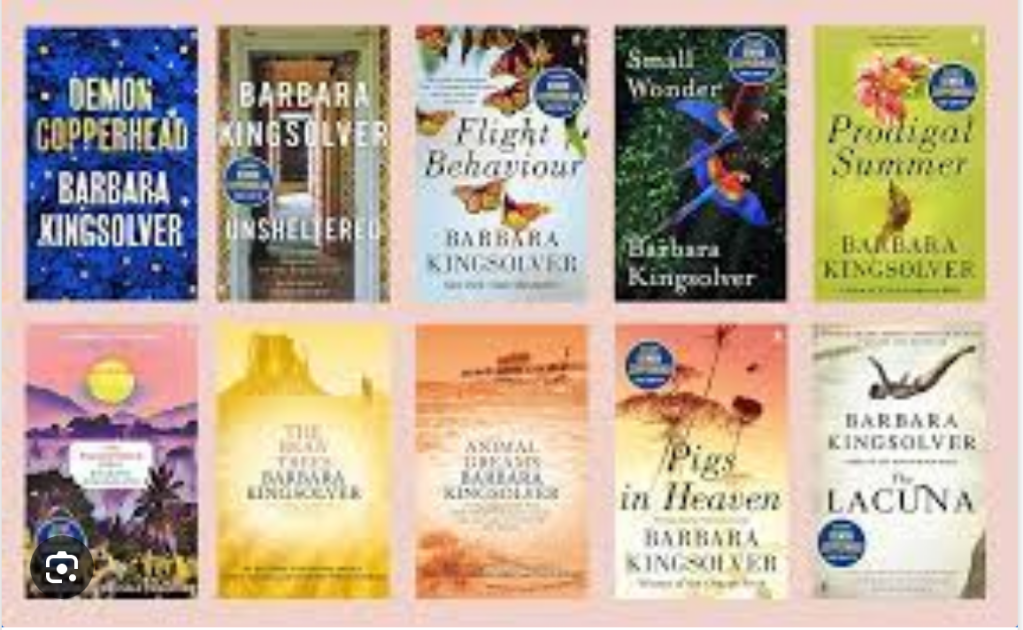
Barbara Kingsolver does all this expertly and compellingly in her wonderful novel Unsheltered, which I read last week. The book chronicles an interesting extended family from the mid-2010s and, in alternating chapters, equally interesting characters from the mid-1870s — including several partly fictionalized real people such as Mary Treat, known for her groundbreaking work as a naturalist and for her copious correspondence with Charles Darwin.

Connections across the 140 years in the 2018 book? The 21st-century family and a 19th-century science teacher live/lived on the same site in Vineland, New Jersey. There are teachers in each era, and journalists, too; unconventional women in both time periods; a compatible marriage in one century and an incompatible one in the other; authoritarian villains in the background in each period; and the main characters in both story lines face serious challenges, economic and otherwise. Unsheltered has drama, poignancy, humor, topical commentary, and other trademarks of a Kingsolver novel.

Another fabulous novel with dual timelines is A.S. (Antonia Susan) Byatt’s Possession, about two 20th-century academics researching a previously undiscovered romance between two 19th-century poets. A riveting 1990 book.

Then there are the flashback scenes in J.K. Rowling’s Harry Potter series that show Tom Riddle as a Hogwarts student. (We see a much younger Dumbledore, too.) Tom grew up to become the evil Lord Voldemort, who of course is featured a lot more in the Potter books than his younger Riddle self.

Not surprisingly, parallel eras are also depicted in time-travel novels.

For instance, Daphne du Maurier’s The House on the Strand features a 20th-century man who uses a drug to make multiple visits to the 14th-century version of the same English town, where we witness the lives and schemes of various long-ago people.

There’s also Diana Gabaldon’s Outlander series, in which the 1900s-born Claire spends time in both that century and the 1700s. Same for her daughter Brianna and son-in-law Roger.

Anything you’d like to say about this theme, including other novels that fit it?

My literary-trivia book is described and can be purchased here: Fascinating Facts About Famous Fiction Authors and the Greatest Novels of All Time.

In addition to this weekly blog, I write the 2003-started/award-winning “Montclairvoyant” topical-humor column for Baristanet.com every Thursday. The latest piece — about a discontinuation of bus service, a local Hillary Clinton appearance, and a principal conundrum — is here.

A Year of Good Reads Long Before Goodreads

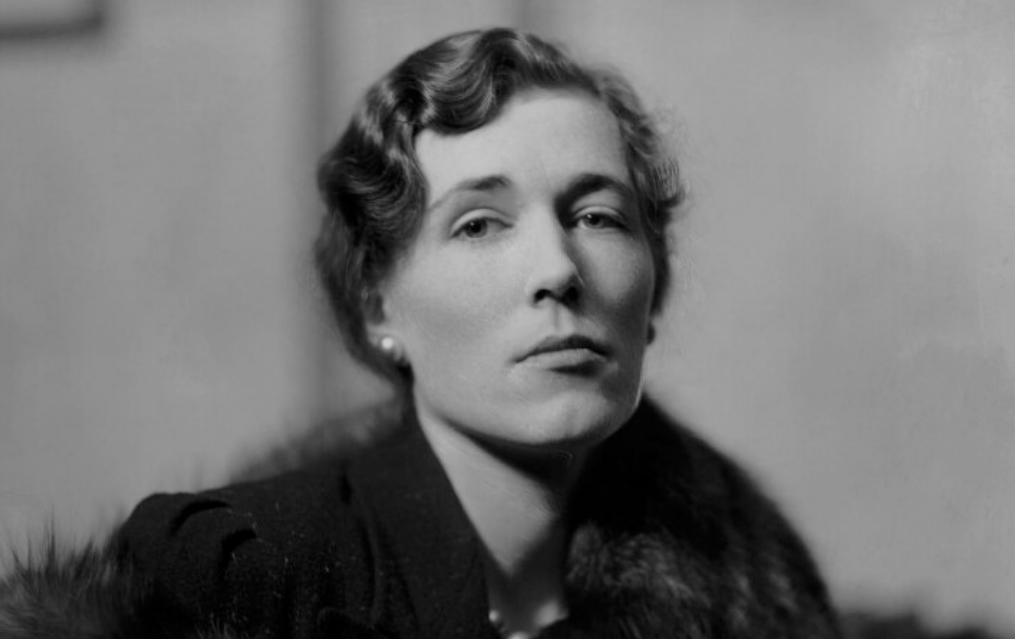
Agatha Christie

Many a specific year featured a variety of interesting fiction, but 1937 was an especially eclectic 12 months for literature.

Their Eyes Were Watching God, Of Mice and Men, The Hobbit, the first Dr. Seuss book, and more.

That “more” includes Death on the Nile, which I finished last week. I’ve only read a handful of Agatha Christie’s mysteries, but this was a good one — considered among her best. An ingenious plot, many suspects with lots of personality, the ever-observant detective Hercule Poirot seeing what no one else sees. A novel with some flaws — the depiction of people of color (when they’re depicted at all) is cringe-worthy, though I suppose the book being “of its time” is a partial excuse. Also, the book’s leftist character is laughably caricatured. Fortunately, and not surprisingly, Christie does much better in vividly portraying a number of memorable women in Death on the Nile.

Zora Neale Hurston’s Their Eyes Were Watching God is the 20th-century classic about the experiences of African-American woman Janie Crawford. John Steinbeck’s Of Mice and Men is the compelling novella featuring two migrant workers in Depression-era California. J.R.R. Tolkien’s The Hobbit, which of course would become the prequel to the 1950s-published trilogy The Lord of the Rings, is a delightful fantasy adventure story for “children of all ages.” And to Think That I Saw It on Mulberry Street started Dr. Seuss on a kid-book career that would make him perhaps the genre’s most famous author.

The year 1937 also saw the publication of Ernest Hemingway’s To Have and Have Not, which I “Have Not” read (yet). In the memoir realm, there was Karen Blixen’s Out of Africa, which I have read — and enjoyed.

I’ll end by noting that some famous writers unfortunately died in 1937 — most notably Edith Wharton, H.P Lovecraft, and Peter Pan creator J.M. Barrie.

Any thoughts on 1937 fiction I mentioned and didn’t mention?

My literary-trivia book is described and can be purchased here: Fascinating Facts About Famous Fiction Authors and the Greatest Novels of All Time.

In addition to this weekly blog, I write the 2003-started/award-winning “Montclairvoyant” topical-humor column for Baristanet.com every Thursday. The latest piece — with a Pink Floyd-meets-local-news theme — is here.

Authors, Like Gymnasts, Don’t Always ‘Stick the Landing’

Nick Youngson/Alpha Stock Images

Many excellent novels have excellent endings — conclusions that might be upbeat or downbeat but are done well, feel satisfying, and make sense in the context of the books as a whole. Among the many famous novels with fine finishes are The Great Gatsby, A Tale of Two Cities, The Grapes of Wrath, The Brothers Karamazov, and Silas Marner.

Then there are excellent novels that don’t quite “stick the landing.” Their endings are either too positive or too negative for the story lines, or too rushed, or too drawn out, or have other flaws. I will discuss some disappointing finales, while not revealing too much in the way of specific spoilers.

Why are some conclusions less than top-notch? No author is perfect, of course; sometimes, it’s just hard to end a novel well. Or perhaps the author has a deadline, or is tired of the book, or wants to get on to her/his next book, or…

This topic occurred to me last week while reading John Grisham’s Sooley — a very good novel about an admirable African teen named Samuel Sooleymon who comes to the U.S. to play college basketball. The book had compelling feel-good elements and wrenching tragic elements, but the ending just felt wrong and out-of-character for the protagonist. A problematic conclusion can obviously affect one’s feelings about an entire book; in the case of Sooley, that single jarring late scene in a 368-page novel bumped it from an A- to a B- for me.

A similar thing happened a few years ago when I was reading My Sister’s Keeper. I found that Jodi Picoult novel to be absorbing and heartbreaking as we saw a child conceived specifically to be a medical donor to her ill sister — and watched that younger sibling grow to understandably resent her “purpose.” Then, as in Sooley, a late plot development came out of left field and had me going “Whaaat?” The result was another B-, this time dropping from a full A.

Not that the unexpected is always bad. For instance, the twist in (Ms.) Lionel Shriver’s Big Brother — to name another sibling-themed novel — was ingenious and more realistic than where I thought the story was going. And of course mystery fiction can often have great concluding twists, aided by red herrings along the way.

Do thwarted couples in various novels get together at the end, or not? Either finish can make sense, depending on the book, but I thought Edith Wharton made the wrong choice in her otherwise terrific The Age of Innocence.

When Margaret Atwood decided to write a sequel more than 30 years after The Handmaid’s Tale, I wondered how close it would be in quality to the initial novel. As it turned out, pretty close — The Testaments was really good. But the concluding pages seemed rushed after the previous parts of the novel unfolded just right.

There was an opposite issue with J.R.R. Tolkien’s The Lord of the Rings. After the breathtaking drama in most of the trilogy, the last few dozen pages felt like an extended epilogue. Poignant, with some insight into what we would today call post-traumatic stress syndrome, but things seemed too drawn out.

The Harry Potter series? I had no problem with the exciting and cathartic ending of the seventh book, even as some earlier parts of that final book in J.K. Rowling’s series dragged at times. But then the author tacked on an epilogue showing the teen characters as adults a number of years later. Interesting to see, but it felt kind of clunky and “summarized.”

I’ll conclude by discussing a couple of 19th-century novels.

The House of the Seven Gables ending came off as too positive for the earlier parts of Nathaniel Hawthorne’s mostly melancholy book. Very glad I read the novel, though.

And Mark Twain’s Adventures of Huckleberry Finn was going along amazingly — with the pitch-perfect depictions of Huck and Jim, their relationship, and the memorable supporting characters they met while traveling on the Mississippi — until Tom Sawyer entered the picture in the latter section of the novel. He was annoying, things got too “slapsticky,” and the book went from an A++ to an A. It almost made one wish that Tom didn’t escape the cave in the earlier novel in which he starred. 🙂

Any examples you’d like to mention of great novels that could have ended in a more satisfying way? 

My literary-trivia book is described and can be purchased here: Fascinating Facts About Famous Fiction Authors and the Greatest Novels of All Time.

In addition to this weekly blog, I write the 2003-started/award-winning “Montclairvoyant” topical-humor column for Baristanet.com every Thursday. The latest piece — about some weirdly fantastical fake upgrades to my town’s school buildings — is here.

When Claustrophobia Isn’t Fear of Santa

Claustrophobic fiction! Books of that sort are usually quite intense as we sympathize with physically or mentally “confined” characters, wonder if things will improve for them, and think of what we might do if we found ourselves in a similar situation.

I just read Belgian author Georges Simenon’s Across the Street, and it sure was claustrophobic. The poignant novel features a lonely, depressed woman named Dominique who — because of low self-esteem, a problematic upbringing, a years-ago romance that ended tragically, and current economic difficulty — withdraws into an existence where she mostly stays in her Paris apartment and eavesdrops not only on the couple who rent a room from her but on a dysfunctional family living across the street.

Another recently read book — No Plan B, the latest Jack Reacher thriller by Lee and Andrew Child — is partly set in a jail. Prisons and prison cells are of course claustrophobic places, as we also see in such novels as Alexandre Dumas’ The Count of Monte Cristo, Victor Hugo’s Les Miserables, Fyodor Dostoevsky’s The House of the Dead, Charles Dickens’ Little Dorrit, Margaret Atwood’s Alias Grace, Colleen McCullough’s Morgan’s Run, Viet Thanh Nguyen’s The Sympathizer, and Henri Charriere’s Papillon. It’s certainly cathartic when, in some cases, protagonists escape or reach the end of their prison terms.

Obviously, ships can be claustrophobic, too. A half-dozen Herman Melville novels come to mind, including lesser-known ones such as Redburn and White-Jacket. Plus Jack London’s The Sea-Wolf, Herman Wouk’s The Caine Mutiny, Martin Cruz Smith’s Polar Star, Paul Gallico’s The Poseidon Adventure, and Patrick O’Brian’s Master and Commander, among many others. Most horribly claustrophobic is the hold of a slave ship, as in the early section of Alex Haley’s Roots.

There are also novels in which small casts of characters are isolated near bodies of water. Some of them include Daniel Defoe’s Robinson Crusoe, Agatha Christie’s And Then There Were None, W. Somerset Maugham’s The Moon and Sixpence, and M.L. Stedman’s The Light Between Oceans.

Getting back to Jack Reacher novels, one of the most claustrophobic scenes in the 27-book series is when the huge Reacher (6’5″/250 pounds) has little room to maneuver while battling a bad guy in a cramped South Dakota underground bunker. That climactic moment is in 61 Hours.

Speaking of limited hours, a novel can feel claustrophobic when it covers a small amount of time — as with Virginia Woolf’s Mrs. Dalloway focusing on a single day.

And if a disability or catastrophic injury limit how much a person can move, things get pretty claustrophobic for that person. Think of Dalton Trumbo’s Johnny Got His Gun.

In the short story realm, it doesn’t get much more “enclosed” than the settings of such Edgar Allan Poe tales as “The Premature Burial” and “The Cask of Amontillado.”

Fiction you’ve read that fits this theme?

My literary-trivia book is described and can be purchased here: Fascinating Facts About Famous Fiction Authors and the Greatest Novels of All Time.

In addition to this weekly blog, I write the 2003-started/award-winning “Montclairvoyant” topical-humor column for Baristanet.com every Thursday. The latest piece — about my town’s leaders not always practicing what they preach — is here.

When I View Reviews

Inside my local library in Montclair, New Jersey. (Photo by me.)

Book reviews! Whether capsule or full-length, I rarely read them before I read the book. Used to, but I’ve mostly stopped.

Why? I don’t want to know very much about the plot until it slowly (or not so slowly) unfolds in a novel’s pages.

I don’t want to see “spoilers,” which can sometimes slip into reviews.

I don’t want to be influenced by what reviewers think. (But if you enthusiastically recommend a novel in my blog’s comments section, there’s a very good chance it will go on my to-read list. 🙂 )

Some reviewers may of course not be fans of a book, so, if I take those sentiments to heart, I might avoid a book I would end up liking.

For instance, I didn’t look at reviews of J.K. Rowling’s sixth novel starring private investigators Cormoran Strike and Robin Ellacott before enjoying the book this month. After finishing The Ink Black Heart (written under Rowling’s “Robert Galbraith” alias), I as usual THEN read various reviews. Turns out many people felt the 1,024-page novel was way too long for its premise and genre, but in my opinion Rowling is such an engaging writer she pulled it off. Glad I didn’t peruse the reviews beforehand and risk not reading The Ink Black Heart

I should say that, out of curiosity, I sometimes look at the aggregate average of “stars” a novel gets from reviewers before I read it.

I should also say that some reviews obviously approach the perfection of whetting one’s appetite for a book while giving virtually nothing away — and thus can be safe to read beforehand. 🙂

All that said, AFTER I finish a book I do read reviews — at least 10 or 20 of them — to see what others thought.

So how DO I decide which books to read? As mentioned, I often rely on recommendations from commenters here — as well as suggestions from family and friends. Also, if I like a novel by an author, I’ll quickly or eventually read other titles by that author. (My previous sentence referred to standalone works; if I enjoy the first book in a series, I’ll of course continue with that series for anywhere from a few installments to indefinitely.) There’s also the occasional serendipity of looking for specific books in my local library and another novel not on my to-read list catches my eye. Perhaps I had heard something about that book or author and my memory got nudged.

Oh, another thing I usually avoid before starting a novel is reading any foreword or introduction written by someone other than the author. Too much risk there’ll be plot “giveaways.” (I double back to the foreword or intro after finishing the book.) I also sometimes hesitate to look at book jacket copy for the same reason, though I might give that copy a quick glance when deciding on which novels to grab in the library.

Anything you’d like to say relating to this week’s theme?

My literary-trivia book is described and can be purchased here: Fascinating Facts About Famous Fiction Authors and the Greatest Novels of All Time.

In addition to this weekly blog, I write the 2003-started/award-winning “Montclairvoyant” topical-humor column for Baristanet.com every Thursday. The latest piece — containing “cameos” from Bruce Springsteen and The Eagles — is here.