A Kitty with Nine Lives and Ten Favorite Novels

“Dave, this is not the direction to the library,” says Misty the cat. (Photo by Laurel Cummins.)

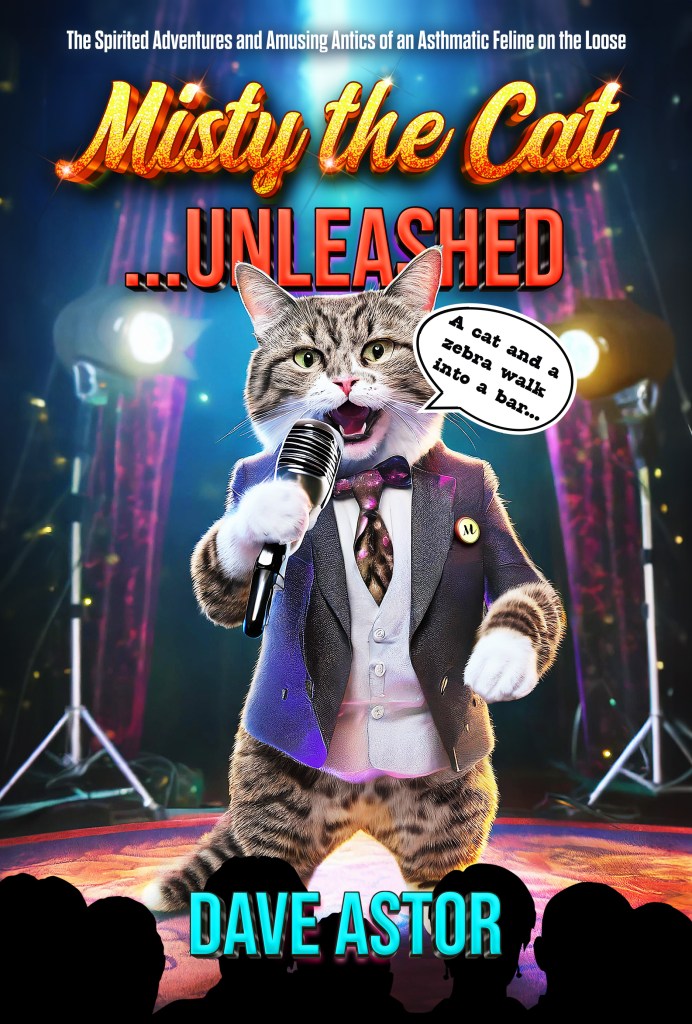
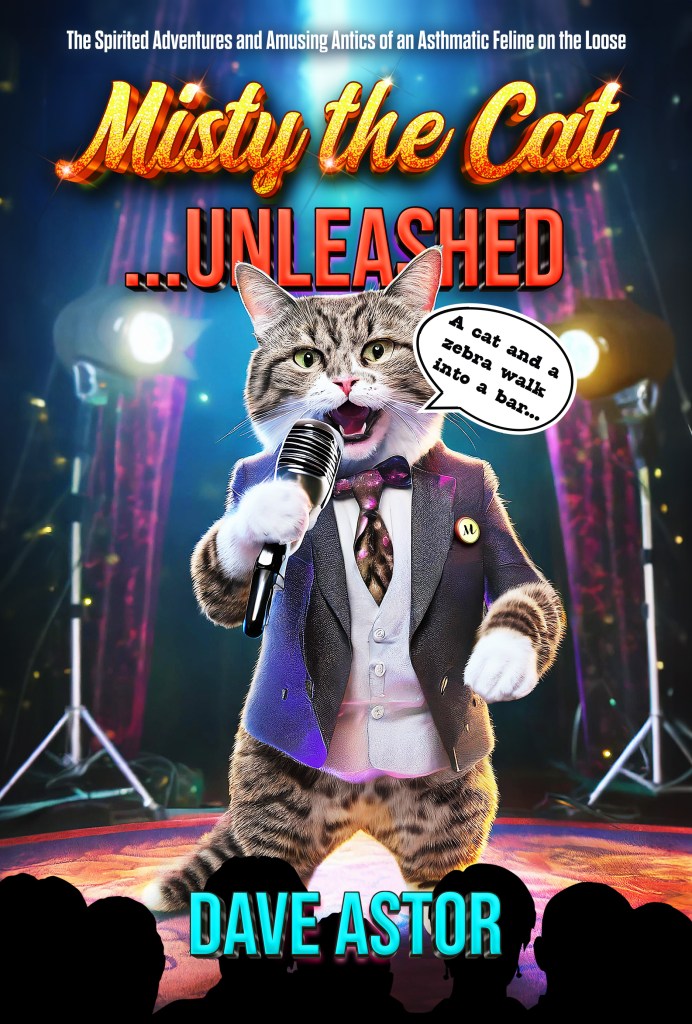
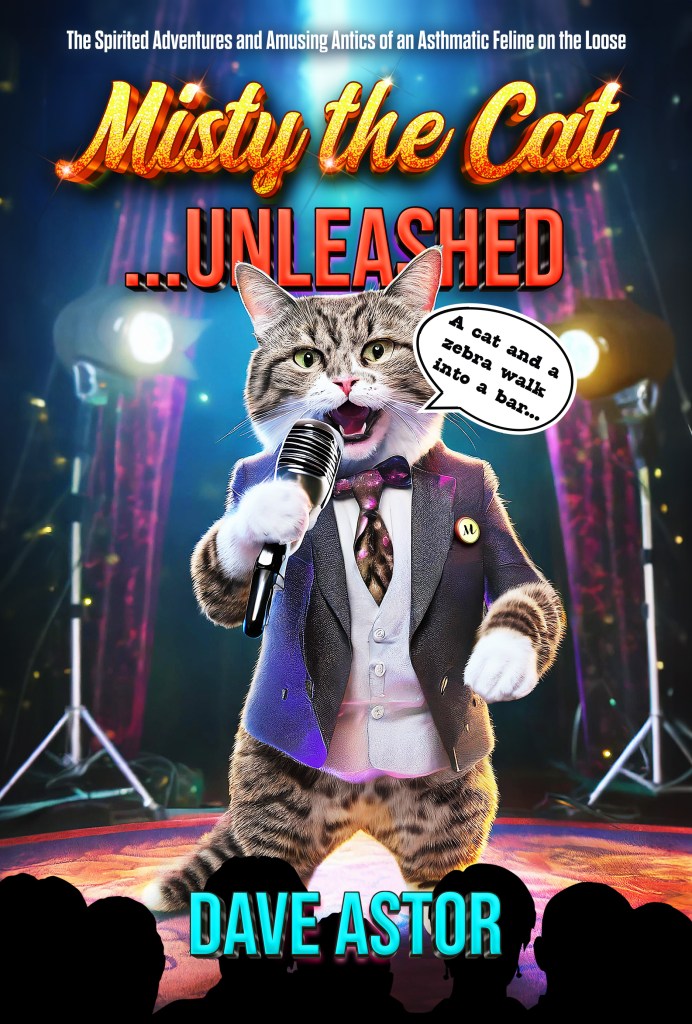
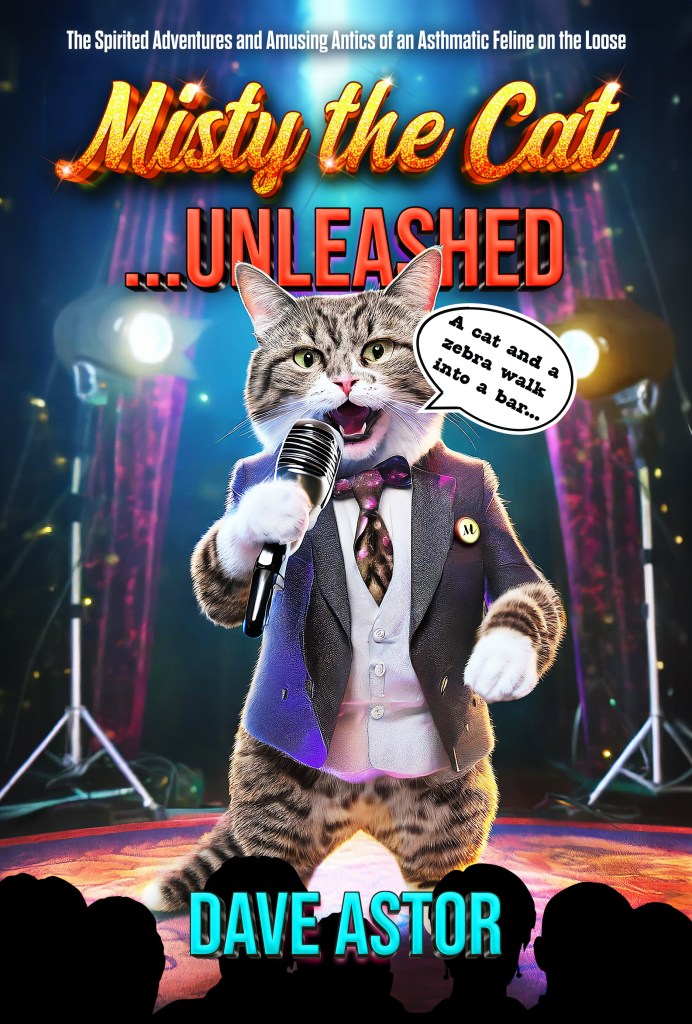
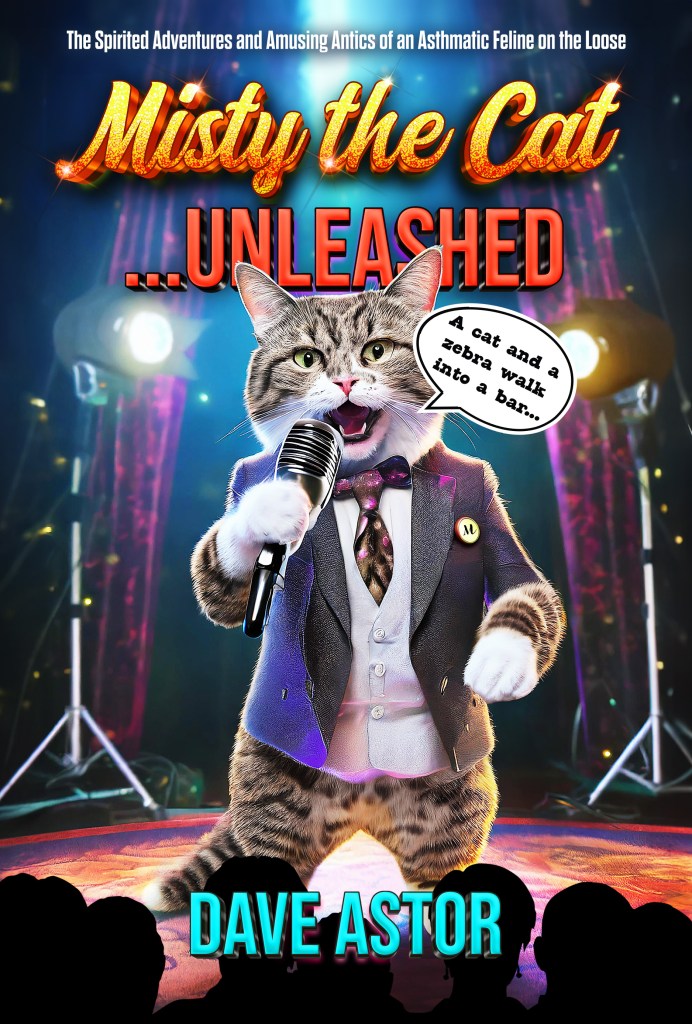
Hi! Misty the cat here. My bloomin’ hogger…um…human blogger invited me to guest-post again. Seems like a good time to do so after this month’s publication of Misty the Cat…Unleashed, a book co-authored by me, Dave, and Jane Austen, minus Jane Austen. The same formula used to write the Jack Reacher novel No Plan B by Lee Child, Andrew Child, and Jane Austen, minus Jane Austen.

A brief interlude: The highly accomplished author/poet/blogger Colleen Chesebro posted a wonderful written interview with Dave about Misty the Cat…Unleashed on her blog last Thursday. Click on this link to see it. The blogosphere can be a great place, even though I, as a feline, didn’t see the blogosphere at the 1964 New York World’s Fair. I saw the Unisphere.

Anyway, in Misty the Cat…Unleashed I say a lot after I slip my harness in Montclair, New Jersey, and become lost (yes, I get a daily leashed walk that would’ve been sponsored by Coca-Cola — “Taste the Feeling!” — if “carbonation” weren’t too long a word for me to spell). One of the many things I discuss in the book is a list of my 10 favorite novels, which surprisingly is also a list of Dave’s 10 favorite novels but not a list of Jane Austen’s 10 favorite novels because all the books mentioned were written after her 1817 death. She had eight fewer lives than me.

To write the rest of this blog post, I’m referring to the 10-favorite-novels list in Chapter 52 of Misty the Cat…Unleashed, though my thoughts here will often be different from those in the book. After all, blog posts and books are different mediums, as Sherlock Holmes creator Arthur Conan Doyle learned at the seances he spent way too much time attending.

Here’s the fave list, with a warning that the descriptions will contain lots of fiction about these 10 works of fiction.

10. History by Elsa Morante. They say Rome (where this World War II novel is set) “wasn’t built in a day.” That usually means it takes many more than 24 hours to create great things, but maybe Rome was actually built in, say, one minute. If Dave gifted me a Rolex watch, I’d know for sure.

9. Possession by A.S. Byatt. This novel should’ve been about a cat possessing a Rolex watch, but, as noted above, Dave didn’t gift me one. So, Byatt’s book became about two 20th-century academics investigating two 19th-century poets. Omitted from the story line was a 21st-century cat investigating whether the original cover of Murasaki Shikibu’s 11th-century novel The Tale of Genji was edible.

8. The Blue Castle by L.M. Montgomery. I’m a cat who lives in an apartment complex, so every year I stand on my building’s front porch to give a “State of the Apartment Complex Address.” If I lived in a blue castle, it would be a “State of the Blue Castle Address.” But the L.M. in L.M. Montgomery doesn’t stand for Lotsa Meows.

7. The Count of Monte Cristo by Alexandre Dumas. The oldest novel on this list, yet it still post-dates Jane Austen’s life. She was born in 1775, meaning she saw the Broadway show 1776 at the age of 1. Edmond Dantes paid for Austen’s booster seat at that matinee performance after becoming the wealthy Count of Monte Cristo.

6. The Hobbit and The Lord of the Rings by J.R.R. Tolkien. Bilbo and Frodo were not members of the Marx Brothers like Groucho, Harpo, Chico, and sometimes Zeppo, but they could’ve been. Same for Aragorno, Gandalfo, and Gollumo. Which reminds me that cat treats are preciousssss.

5. The Harry Potter series by J.K. Rowling. Should’ve been titled the Mrs. Norris series, after Argus Filch’s pet cat. And those half-blood paw prints scared the hell out of me. Um…you say the sixth Potter book was called Harry Potter and the Half-Blood Prince? Not as thirst-quenchingly satisfying as Harry Potter and the Goblet of Milk.

4. Daniel Deronda by George Eliot. She authored better-known novels (Middlemarch, The Mill on the Floss, etc.), but DD is a gripping saga featuring two of these three themes: religion, unrequited love, and periodic claw trimmings.

3. Crime and Punishment by Fyodor Dostoevsky. Set in St. Petersburg (St. Pet for short), protagonist Raskolnikov develops two killer apps. Or maybe he kills two people. But whichever of those two things happened, Dostoevsky “kills it” in this riveting novel.

2. The Grapes of Wrath by John Steinbeck. Re the initials JC: Jim Casy is a Jesus Christ figure in Steinbeck’s masterpiece, while I’m a Jersey Cat figure in my new book.

1. Jane Eyre by Charlotte Bronte. In which the title character becomes governess to a kitty. And there’s someone in the Thornfield Hall attic, but it’s not Atticus Finch.

Your favorite novels? If one of them is the just-referenced To Kill a Mockingbird, I, Misty the cat, didn’t murder the winged creature named in the book’s title.

PS: Dave tells me that, starting next week, he’ll mostly return to writing “normal” literature posts that don’t reference Misty the Cat…Unleashed to this degree. As long as Dave doesn’t switch his focus to Misty the Cat…Unleased, because I want to stay in our apartment.

Dave’s comedic new 2024 book — the part-factual/part-fictional Misty the Cat…Unleashed — is described and can be purchased on Amazon in a paperback or a Kindle edition. It’s feline-narrated! (And Amazon reviews are welcome. 🙂 )

In addition to this weekly blog, Dave writes the 2003-started/award-winning “Montclairvoyant” topical-humor column every Thursday for Montclair Local. The latest piece — about my town’s mayor announcing a run for New Jersey governor despite his VERY unpopular and problematic 2020-2024 term — is here.

‘Misty the Cat…Unleashed’ Is Unleashed into the Book World

Misty and me. (Photo by my wife, Laurel Cummins.)

My third book — Misty the Cat…Unleashed — has just been published! It’s partly factual and partly fictional, so I guess it’s partly a novel. Along with being partly a memoir, told in Misty’s comedic voice. (A voice you’ve occasionally experienced here when that commendable kitty has guest-blogged about literature.)

In the 242-page book, asthmatic feline Misty slips his harness during one of his daily leashed walks and gets lost in Montclair, New Jersey. To pass the time and try to control his fear, Misty cracks MANY jokes, reminisces about his life, imparts information about his species and human family (mine!), discusses his favorite novels and music, gets philosophical, fantasizes about things, and more.

This NOT-a-children’s book includes 11 cartoons of Misty amid the text, and has paperback and Kindle editions. (Links in the boldface paragraph near the end of this post.) If you end up buying and reading the book, an Amazon review would of course be very welcome. 🙂

I came up with the idea for a memoir “by” Misty several years ago, but couldn’t quite figure out a good plot to hang the story on. Then, in 2022, Misty slipped his harness one morning in real life and was lost for about 16 hours. We were frantic and devastated before finally finding him after much searching and much leaving of our contact information with neighborhood residents. A few months later, it belatedly occurred to me that I had a plot for my (Misty’s) book.

Then came the writing and rewriting, from March to September 2023. After that, I figured I’d make a long-shot attempt to find a literary agent — researching agency web sites and sending out 88 individually crafted queries whenever I had some free time in late 2023 and early 2024. I received some nice responses, but not an offer of representation.

So, I decided to again enter the wonderful world of independent publishing, as I had done with my 2017 Fascinating Facts literary-trivia book after going the small press route with my 2012 memoir Comic (and Column) Confessional. After all, Misty and cats in general are all about independence. 🙂 (But they are of course very loving creatures, too.)

“Misty the Cat…Unleashed” can be purchased on Amazon in a paperback or a Kindle edition.

In addition to this weekly blog, Dave writes the 2003-started/award-winning “Montclairvoyant” topical-humor column every Thursday for Montclair Local. The latest piece — about a final Council meeting, a beloved independent stationery store closing, and more — is here.
Stack to the Future: Prolific Living Authors

Photo from Getty Images.

Nearly nine years ago, I wrote a post focusing on some of the most prolific dead and living authors. Today I’m going to do a similar piece, this time focusing only on living authors. Most obviously now have more novels to their name than they did in 2015, and I’ll include a number of living authors I didn’t mention back then because they had yet to be on my reading radar.

As noted in the earlier post, prolific can be defined in a way that not only involves churning out many novels; authors can also be prolific in the sense of writing less-frequent-but-long novels. But for this post I’m sticking with those authors who have high numbers of separate titles.

Of course, there are novelists who produce lots of books by co-authoring some of them, running a “writing factory” of sorts, putting out short-story collections, writing nonfiction in addition to fiction, etc.

It’s also worth noting that authors whose output is at least partly comprised of series rather than stand-alone novels have an advantage in not having to dream up a new protagonist each time.

Below is an incomplete list that only includes prolific living authors I have read one or (in some cases many) more novels by…

James Patterson has written, co-written, or otherwise had his name on more than 200 (!) novels in the 48 years since 1976.

Dean Koontz has produced a whopping 144 novels since 1968.

Janet Evanovich has, since 1987, written or co-written more than 70 novels — including the series with numbered titles starring bounty hunter Stephanie Plum.

Stephen King has gone the route of 66 novels — quite a Carrie-over since 1974.

Joyce Carol Oates has also penned more than 60 novels, dating back to 1964.

Walter Mosley has authored about 55 novels since 1990, including one — Every Man a King — I’m currently reading and enjoying.

David Balducci: more than 50 novels since 1996.

John Grisham: nearly 50 novels since 1989.

Michael Connelly: 39 novels since 1992.

Harlan Coben: 37 novels since 1990.

Lisa Scottoline: 35 novels since 1993.

Joy Fielding: 31 novels since 1972.

Lee Child: 28 Jack Reacher thrillers since 1997; the last few co-written with his brother Andrew.

Kristin Hannah: 25 novels since 1991.

Isabel Allende: 22 novels since debuting with The House of the Spirits in 1982.

Nicholas Sparks: also 22 novels, since 1996.

Diana Gabaldon: 19 novels since 1991, including nine lengthy Outlander books.

Margaret Atwood: 17 novels since 1969, along with lots of poetry, nonfiction books, and other works.

J.K. Rowling: 15 novels (some quite long) since 1997, along with other works. As is occasionally the case with authors, some of Rowling’s books appear under a different name — Robert Galbraith for her Cormoran Strike/Robin Ellacott crime fiction.

Liane Moriarty: nine novels since 2004, not including several children’s books (as some other adult authors also write on the side).

Any prolific living authors you’d like to discuss?

Dave’s literary-trivia book is described and can be purchased here: Fascinating Facts About Famous Fiction Authors and the Greatest Novels of All Time.

In addition to this weekly blog, Dave writes the 2003-started/award-winning “Montclairvoyant” topical-humor column every Thursday for Montclair Local. The latest piece — about another election and a new municipal budget — is here.

Book Titles Get a New Look Thanks to Trump the Crook

Friday’s edition of The New York Times. (Photo by me.)

With the corrupt Donald Trump deservedly convicted this past Thursday on 34 counts of falsifying records to cover up a sex scandal that threatened his ultimately successful 2016 presidential campaign, it’s time to change some book titles!

The presumptive 2024 Republican presidential nominee — history’s first former Oval Office occupant to ever be convicted — also faces three future trials for taking home classified documents and fomenting the January 6, 2021, assault on the U.S. Capitol building after falsely claiming he won the 2020 election he clearly lost.

Anyway, on to the revised titles…

Portnoy’s Complaint becomes Stormy’s Complaint. (As in Stormy Daniels, the woman with whom the married Trump had sex and then paid off to keep silent.)

Death Comes for the Archbishop becomes Seth Comes for the Archvillain. (If Seth was one of the jurors’ names.)

Their Eyes Were Watching God becomes Jury’s Ayes Were Splotching Don. (From Hurston to hurts him.)

The Age of Innocence becomes The Age of Guiltiness. (Hmm…we have Edith Wharton, even as Trump is a Wharton School alum.)

Gone with the Wind becomes Don Who Has Sinned.

The Secret Life of Bees becomes His Overt Life of Sleaze.

The Shipping News becomes The Stripping News.

Dona Flor and Her Two Husbands becomes Donald Flawed and His Three Wives. (Plus many paramours.)

Don Quixote becomes Don’s Felonies.

The Count of Monte Cristo becomes The 34 Counts of Don T.: Bozo.

Fahrenheit 451 becomes Fahrenheit 34.

Catch-22 becomes Catch-34.

The Catcher in the Rye becomes He Was Caught in the Lies.

A Portrait of the Artist as a Young Man becomes A Portrait of the Adulterer as a Con Man.

The Book Thief becomes The Crook Chief.

A Painted House becomes A Tainted Louse.

Devil in a Blue Dress becomes Devil in a Blue Suit.

A Clockwork Orange becomes A Clocked Jerk, Orange. (Referring to Trump’s makeup color.)

The Mill on the Floss becomes A Chill on the Boss.

Winesburg, Ohio becomes Whines Big, Anywhere.

The Old Man and the Sea becomes The Old Man and the Glee. (Yes, many are happy with the verdict against the 77-year-old Trump.)

Crime and Punishment becomes Crime and Hopefully Major Punishment.

A Passage to India becomes A Passage to Incarceration. (If only…)

A Gentleman in Moscow becomes A Charlatan in Hoosegow. (Slang for jail. If only…)

One Hundred Years of Solitude becomes A Few Years of Solitary. (If only…)

From Here to Eternity becomes From Here to Uncertainty. (Trump’s 2024 presidential prospects.)

Any other revised titles you’d like to suggest?

Dave’s literary-trivia book is described and can be purchased here: Fascinating Facts About Famous Fiction Authors and the Greatest Novels of All Time.

In addition to this weekly blog, Dave writes the 2003-started/award-winning “Montclairvoyant” topical-humor column every Thursday for Montclair Local. The latest piece — about topics such as a too-big project approved again — is here.

Ten Years That Shook the Book World

It’s irrelevant to this post, but Neil Young had an album called “Decade.”

Some decades have nicknames: “The Roaring Twenties” (1920s), “The Swinging Sixties” (1960s), etc. When it comes to authors, there are those who’ve had such an impressive run of novels in a particular 10-year period (starting with a year ending in zero) that one could almost name a decade after THEM.

Let’s start with Jane Austen, whose six major novels all came out in the 1810s — the last two books posthumously. Sense and Sensibility (1811), Pride and Prejudice (1813), Mansfield Park (1814), Emma (1816), and Persuasion and Northanger Abbey (both 1818). Quite a run!

In the 1830s, among Honore de Balzac’s outpouring of great novels were The Magic Skin (1831), Eugenie Grandet (1833), Old Goriot (1835), and Cesar Birotteau (1837).

Alexandre Dumas powered through the 1840s with the impressive Georges (1843), The Three Musketeers (1844), The Count of Monte Cristo (1844-1846), Twenty Years After (1845), and more.

Charles Dickens had several decades of creating iconic works, but the 1850s was probably the most notable. David Copperfield (1850), Bleak House (1853), Hard Times (1854), Little Dorrit (1857), and A Tale of Two Cities (1859).

The 1880s was the peak authorial decade for Mark Twain, with a mix of fiction and nonfiction books. A Tramp Abroad (1880), The Prince and the Pauper (1881), Life on the Mississippi (1883), Adventures of Huckleberry Finn (1884), and A Connecticut Yankee in King Arthur’s Court (1889).

That same decade was also consequential for Henry James — with such works as Washington Square (1880), The Portrait of a Lady (1881), The Bostonians (1886), and The Aspern Papers (1888).

And for Emile Zola, too, whose best novels from that time span were Nana (1880), The Ladies’ Paradise (1883), Germinal (1885), The Masterpiece (1886), and The Earth (1887).

In the 1920s, Sinclair Lewis churned out five classics: Main Street (1920), Babbitt (1922), Arrowsmith (1925), Elmer Gantry (1927), and Dodsworth (1929).

The 1930s weren’t too shabby for Agatha Christie; her 20 mysteries that decade included the iconic trio of Murder on the Orient Express (1934), Death on the Nile (1937), and And Then There Were None (1939).

Stephen King has produced a huge amount of writing for a half century, with his first published decade among his most acclaimed: Carrie (1974), ‘Salem’s Lot (1975), The Shining (1977), The Stand (1978), and The Dead Zone (1979).

The also-prolific John Grisham has had several excellent decades, including the 1990s that saw him produce such novels as The Firm (1991), The Pelican Brief (1992), The Client (1993), and The Chamber (1994) — the last of which I’m currently reading.

The 2000s were an awesome decade for J.K. Rowling, as the fourth through seventh books of her Harry Potter series came out — all longer and more complex than the first three installments from the 1990s. The four were Harry Potter and the Goblet of Fire (2000), Harry Potter and the Order of the Phoenix (2003), Harry Potter and the Half-Blood Prince (2005), and Harry Potter and the Deathly Hallows (2007).

Kristin Hannah had quite a 2000 to 2020, with the latter decade including excellent novels such as Winter Garden (2010), Night Road (2011), Home Front (2012), The Nightingale (2015), and The Great Alone (2018).

Liane Moriarty also thrived in the 2010s with The Hypnotist’s Love Story (2011), The Husband’s Secret (2013), Big Little Lies (2014), Truly Madly Guilty (2016), and Nine Perfect Strangers (2018).

Yes, some writers build LOTS of momentum in a certain decade.

Any thoughts on, or other examples of, this topic?

Dave’s literary-trivia book is described and can be purchased here: Fascinating Facts About Famous Fiction Authors and the Greatest Novels of All Time.

In addition to this weekly blog, Dave writes the 2003-started/award-winning “Montclairvoyant” topical-humor column every Thursday for Montclair Local. The latest piece — about a diverse new Township Council and an extension for the local schools superintendent — is here.

A Cat Talks Books and Hairballs, But Not Hairballs

My feline self being walked by Dave. The upraised tail that looks like a number 1 means this blog post will get 1 visitor. Well, maybe more. (Photo by Laurel Cummins.)

I’m Misty the Cat, and I’m here to guest-blog again for my human Dave. It’s a good time for me to do so because I recently read George Eliot’s Middlemay. Um…Dave just nudged me to say that the title of Eliot’s iconic novel is actually Middlemarch, but I try not to dwell on the past (two months ago).

Also, I and Dave recently read Walter Mosley’s The Last Days of Ptolemy Grey, and we agree that it’s a great example of how some novels contain many elements in addition to the plot and characters. In this case, Mosley explores themes such as racism, poverty, old age, dementia, and Moby-Dick buying Starbucks coffee from the Starbuck character in Herman Melville’s famous sea saga. But how does a whale hold a coffee container? And do aquatic mammals prefer decaffeinated?

To tell you the truth, Mosley did not mention Moby-Dick. But I have rarely seen a better depiction of memory loss than the one that author crafted for his nonagenarian protagonist Ptolemy. The character’s many foggy moments, coupled with a dramatic period of clarity, were compelling and poignant for a cat to experience. And…um…I forgot what I was going to write next. Oh…Lisa Genova also skillfully depicted a fading mind when spotlighting early-onset Alzheimer’s disease in her novel Still Alice. Which reminds me that when Ralph Kramden of the 1950s sitcom The Honeymooners chauvinistically joked (not funny) about giving his wife Alice a smack that would send her “to the moon,” he invented science fiction.

Wait, you say the real sci-fi pioneers were authors like Mary Shelley, Jules Verne, and H.G. Wells? All I can say is Verne also wrote adventure novels, including Around the Food Bowl in Eighty Days. Cats prefer their food bowls to have large circumferences.

An unusual and heartwarming element of Mosley’s book was the cross-gender and cross-generational but not cross-species friendship of 91-year-old Ptolemy and 17-year-old Robyn. That age gap was the largest since 969-year-old Methuselah (born in 3074 BC) hung out with 21-year-old singer Olivia Rodrigo (born in 2003 AD) to discuss Spotify and other music streaming services. Leading me, Misty the Cat, to wonder why Miguel de Cervantes’ 17th-century classic Don Quixote didn’t feature rock musicians when Tom Perrotta’s The Wishbones (1997) and Jonathan Franzen’s Freedom (2010) did. Any theories?

Three years after Freedom was published, acclaimed short-story writer Alice Munro won the Nobel Prize in Literature. Sadly, she died this past week at age 92. I’ve read only one of her story collections — Friend of My Youth — which I enjoyed except for the tale “Oranges and Apples” because felines are not fans of fruit. Which explains why The Grapes of Wrath author John Steinbeck drove around the United States with a dog rather than a cat in Travels with Charley.

Acclaimed novelist Paul Auster also recently passed away, late last month. As with Munro, I’ve read only one of his works: The Music of Chance. After doing that, I used my paw to swipe at a Chance card on my humans’ Monopoly board, expecting to hear music — like when you open those greeting cards that have sound. But, alas, all I heard was the usual clanking of machinery at the nearby factory that manufactures literature blogs.

I’ll conclude by mentioning that I have my own book (sort of co-written with Dave 🙂 ) coming out in a couple months. That seriocomic work, told in my own feline voice, is partly fact and partly fiction — so I guess it can be described as a memoir or a novel. It’s called Misty the Cat…Unleashed, and the ellipsis in the title was purchased from Ellipses R Us just before that retail chain went out of business.

The question of the week, which occurred to me during one of the daily cat walks my peeps take me on: Are all bloggers billionaires or just millionaires? 🤔

Dave’s literary-trivia book is described and can be purchased here: Fascinating Facts About Famous Fiction Authors and the Greatest Novels of All Time.

In addition to this weekly blog, Dave writes the 2003-started/award-winning “Montclairvoyant” topical-humor column every Thursday for Montclair Local. The latest piece — about the results of my town’s May 14 election and the settlement of a major lawsuit — is here.

The Art of Depicting Large Families in Novels

Vermeer’s iconic painting “Girl with a Pearl Earring,” which inspired Tracy Chevalier’s 1999 novel of the same name. The 17th-century artist was the father of 15 children. (Photo by Lex van Lieshout/ANP via Getty Images.)

Novels featuring families with plenty of children offer plenty of content fodder. The various kids will obviously have personality differences, fight with each other, be nice to each other, get sick at times, etc. — with the older ones perhaps acting as sort of assistant moms or dads. Large households of course also make for frazzled parents (not to mention multiple never-easy pregnancies), economic challenges, and more. And what kind of work will the children do when they become adults? Much potential to keep novel readers absorbed.

For the purposes of this post, I’m defining a big family as including four or more children.

The main point of Tracy Chevalier’s excellent novel Girl with a Pearl Earring, which I just read, is the author’s imagining the life of the teen maid (Griet) who posed for the legendary painting of the book’s title created by masterful 17th-century Dutch artist Johannes Vermeer. But one can’t help noticing along the way that Vermeer and his wife Catharina had a LOT of children: 15, with 11 surviving past infancy, of whom more than half had been born during the mid-1660s time in which Chevalier’s historical novel is primarily set. The variations between those kids, and in how they treat Griet, make for interesting reading — with one Vermeer child, Cornelia, particularly mean.

Anne Shirley eventually had seven children with Gilbert Blythe as L.M. Montgomery’s many Anne of Green Gables sequels spooled out. The beloved character was a great mother, and her kids had appealingly distinct personalities, but one couldn’t help but lament that the brilliant/spirited Anne didn’t live up to her early promise and be more than mostly a parent — important as that is. This was of course partly due to her living in a more patriarchal time with many fewer women in out-of-home workplaces, but still disappointing.

Arthur and Molly Weasley of J.K. Rowling’s Harry Potter series also had seven children. That couple certainly struggled economically but retained personalities with some strong non-parental facets. And the kids (Bill, Charlie, Percy, Fred, George, Ron, and Ginny) were quite memorable in their ways — including the bravery or humor displayed by some of them.

Other large fictional households with diverse, hard-to-forget siblings include — among many others — those in Jane Austen’s Pride and Prejudice (five sisters), Louisa May Alcott’s Little Women (four sisters), Barbara Kingsolver’s The Poisonwood Bible (four sisters), Liane Moriarty’s Apples Never Fall (four sisters and brothers), Lisa Genova’s Inside the O’Briens (four sisters and brothers), and Fyodor Dostoevsky’s The Brothers Karamazov (four brothers, including one “illegitimate” one who’s treated as a family servant).

There is also Cheaper by the Dozen by Ernestine Gilbreth Carey and Frank Gilbreth — with that author duo being two of the 12 children referenced in their book’s title. Not exactly a novel; it’s a memoir/fiction mix about the 14-person Gilbreth family who lived in my town of Montclair, New Jersey.

Any thoughts about this topic and/or specific books that fit this topic?

My literary-trivia book is described and can be purchased here: Fascinating Facts About Famous Fiction Authors and the Greatest Novels of All Time.

In addition to this weekly blog, I write the 2003-started/award-winning “Montclairvoyant” topical-humor column every Thursday for Montclair Local. The latest piece — about my town’s upcoming May 14 election and more — is here.

Gaslighting, Gaza, and Genocide

New York City police in riot gear march into Columbia University to break up peaceful protests against Israel’s war on Gaza. (Kena Betancur/AFL via Getty Images.)

The manipulation of truth to mislead people is known as gaslighting. We’ve been seeing a lot of that lately, and I’m going to discuss a real-life example before talking about gaslighting in novels.

As most of you undoubtedly know, there has been an outpouring of protest on numerous college campuses against the Israeli assault on Gaza that has left at least 34,000 Palestinians dead (the vast majority women and children), hundreds of thousands of other Palestinian civilians homeless and starving, many hospitals blown up, many schools destroyed, and more. This of course happened after the horrific Hamas attack on Israel last October 7 that killed more than 1,100 people. Which happened after years of Israel’s harsh authoritarian control over Gaza. Which happened after the Holocaust at the hands of the Nazis (not the Palestinians) — an unspeakable trauma that has influenced Israel’s actions ever since its founding. But it’s a shame when the oppressed become the oppressors.

The college protests have been overwhelmingly peaceful, but that hasn’t stopped various university administrators and elected officials from sharply escalating the situation by sending in aggressive/militarized police to attack and arrest the admirable students, many of whom were subsequently suspended and kicked out of campus housing — even as rich right-wing alumni donors threatened to derail the students’ future career prospects.

What kind of gaslighting is coming from those rich right-wing alumni donors, university administrators, mainstream-media outlets, and politicians — including not only most Republican pols and many Democratic pols (among them President Biden) in the U.S. but also Israel’s far-right prime minister Benjamin Netanyahu? It involves falsely describing the protesters as violent and (despite many of the demonstrating students being Jewish) also falsely describing them as anti-Semitic. Criticizing Israel’s government and the worst tendencies of Zionism is not being anti-Semitic. Sure, a tiny sliver of the protesters and/or protest hangers-on have said problematic things, but almost every righteous movement has bad apples who attach themselves to a cause but don’t represent the essence of it.

In fact, the only recent, major, not-by-police violence was perpetrated by a pro-Israeli mob that attacked pro-Palestinian protesters on California’s UCLA campus — with a feeble law-enforcement response to that quite different from the police crackdowns on students peacefully opposing Israel’s siege of Gaza.

Why the gaslighting of pro-Palestinian protesters? Many reasons, of course, with a key one an effort to distract from Israel’s unrelentingly disproportionate response to the vicious October 7 attack. A response that the vast majority of the world’s citizens, and a majority of Americans, feel is over-the-top.

There have been a few notable university exceptions involving schools willing to negotiate with students on such matters as considering the divestment of funds that help the powerful Israeli military. Among those schools are Brown, Rutgers, and Northwestern (the latter two my undergraduate and graduate alma maters) — and their willingness to bargain kept things calmer on those campuses. Did those universities negotiate with their students in good faith? Maybe, maybe not, but it was something.

Novels with gaslighting? In a political/governmental sense, few feature more examples of the “g” word than George Orwell’s Nineteen Eighty-Four, in which the dictatorial leaders churn out slogans like “war is peace,” “freedom is slavery,” and “ignorance is strength.”

In another dystopian novel, The Handmaid’s Tale by Margaret Atwood, gaslighting is one of the tools the sicko male rulers of Gilead use to subjugate women.

On a more one-to-one level, we have the “second Mrs. de Winter” gaslit by creepy housekeeper Mrs. Danvers in Daphne du Maurier’s Rebecca. Mr. de Winter is no angel, either.

Edward Rochester also did some gaslighting when trying to keep a major secret from the title character in Charlotte Bronte’s iconic Jane Eyre.

Another memorable 19th-century English novel, Wilkie Collins’ The Woman in White, has a gaslighting scenario too complicated to briefly summarize here…but it’s quite riveting.

Moving to more recent literature, J.K. Rowling’s The Ink Black Heart crime thriller features a nasty misogynist gaslighter who goes by the online alias “Anomie.”

In On Mystic Lake, the emotionally wrenching Kristin Hannah novel I just read, protagonist Annie is basically gaslit by two men (her old-fashioned widowed father and her sexist corporate lawyer husband who leaves her for a younger woman) into feeling she is less capable than she actually is. That’s something perpetuated by many men on many women in real life and fiction, as is also the case with the way Dorothea is treated by her husband, the Rev. Casaubon, in George Eliot’s superb Middlemarch. And gaslighting is sometimes perpetuated by women on women, with one example being the behavior of Valancy Stirling’s disapproving mother in L.M. Montgomery’s classic The Blue Castle — until Valancy finally leaves her childhood household at age 29.

One final note: When American students and others in decades past strongly/publicly protested such abominations as racism, sexism, homophobia, the Vietnam War, South African apartheid (via the divestment movement), and the U.S. invasion of Iraq, they were vilified by an “establishment” that rarely hesitated to send in the cops. Then, many years later, it became “safe” among at least part of the “establishment” to do the revisionist-history thing and acknowledge that the demonstrators had been morally correct. I suspect the students rightly protesting Israel’s collective punishment on Gaza might eventually be viewed the same way. It’s a shame that morally correct students can’t be respected in real time by “the powers that be,” but I guess those students are considered too threatening to imperial and corporate narratives.

Your thoughts about, and examples of, this topic?

My literary-trivia book is described and can be purchased here: Fascinating Facts About Famous Fiction Authors and the Greatest Novels of All Time.

In addition to this weekly blog, I write the 2003-started/award-winning “Montclairvoyant” topical-humor column every Thursday for Montclair Local. The latest piece — about a senior center and a data breach — is here.

When There’s Dramatization of Economic Stratification

Literature often contains gender dynamics and racial dynamics, but there can also be class dynamics. Given how depressingly present class divisions are in real life, it’s good to see some fiction wrestle with that, too.

In Night Road (2011), another emotionally wrenching novel from Kristin Hannah that I read last week, among the major characters are best friends Mia (daughter of a doctor) and Lexi (daughter of an impoverished mother). The respective “stations” in life of those two and others are major drivers of Hannah’s plot.

Another friendship fraught with class differences is the one between well-to-do Amir and servant’s son Hassan in Khaled Hosseini’s The Kite Runner (2003).

Chimamanda Ngozi Adichie’s Half of a Yellow Sun (2006) has a diverse cast that includes a “houseboy” (Ugwu), a professor (Odenigo), and two women (Olanna and Kainene) from an affluent family during the Nigerian Civil War.

Liane Moriarty’s 2014 novel Big Little Lies features a single mother (Jane) who is less affluent than most of the other parents at the Australian school her son attends.

Just before Night Road, I read John Grisham’s A Painted House (2001) — which features a struggling farm family in 1950s Arkansas. But even though the Chandlers barely get by, they’re in better financial shape than the “hill people” and Mexican migrant workers they hire to help pick the cotton crop. In turn, the Chandlers are worse off economically than a relative who’s a unionized auto-factory worker visiting from Detroit.

A book of course doesn’t have to be from the 21st century to have class consciousness. In the 20th century, Edith Wharton’s The Custom of the Country (1913) looks at new money vs. old money as it chronicles the saga of upward striver Undine Spragg. (The main characters are all affluent but there’s still a class divide.) And the guests in Vicki Baum’s Grand Hotel (1929) include a businessman (Preysing) and an underling (Kringelein) who the businessman initially doesn’t know is also staying at the hotel.

In the 19th century, Emile Zola’s Germinal (1885) focuses on mineworkers and mine owners heading for a showdown. The characters in George Eliot’s Silas Marner (1861) include a landowner secretly married to a working-class woman and the child of that union who ends up being raised by someone else. Also published in 1861 was one of Charles Dickens’ most class-conscious novels, Great Expectations, in which impoverished orphan Pip comes into some money.

Your thoughts about, and examples of, this theme?

My literary-trivia book is described and can be purchased here: Fascinating Facts About Famous Fiction Authors and the Greatest Novels of All Time.

In addition to this weekly blog, I write the 2003-started/award-winning “Montclairvoyant” topical-humor column every Thursday for Montclair Local. The latest piece — about one suggested voting-age change, two traffic lights, and more — is here.

An Anniversary for an American Classic

My much-read copy of The Grapes of Wrath that I’ve had since high school. (Photo by me.)

This month is the 85th anniversary of The Grapes of Wrath, certainly in the conversation for The Great American Novel.

As many readers know, John Steinbeck’s April 1939-published classic is about the Joad family fleeing Dust Bowl/Great Depression-stricken rural Oklahoma for the “paradise” of California, which turns out to be more hellish than heavenly for the impoverished people moving there.

The Grapes of Wrath became a beloved bestseller, won the Pulitzer Prize for fiction, and inspired an also-beloved 1940 movie somewhat more upbeat than the mostly downbeat novel — which chronicles the experiences of ultra-memorable characters such as main protagonist Tom Joad, family matriarch Ma Joad, and lapsed preacher Jim Casy (who appropriately shares the same initials as Jesus Christ).

Not surprisingly, the wealthy elite of “The Golden State” hated the populist book and its class-conscious author for depicting them, and things, as they were. The novel has also, to this day, been periodically banned by right-wingers who don’t like its expose-injustice bent. Yes, The Grapes of Wrath still feels relevant in 2024 — 85 years after its publication and more than six decades after Steinbeck won the 1962 Nobel Prize for Literature.

The well-researched/very readable Grapes of Wrath (title suggested by Steinbeck’s first wife Carol Henning) is the author’s best novel, but he of course wrote various other excellent books that linger in the American consciousness. They include East of Eden, Steinbeck’s longest and most complex work; The Winter of Our Discontent, with its themes of materialism and moral decline; and the emotionally wrenching Of Mice and Men.

Steinbeck (1902-1968) was also skilled at seriocomic writing, as can be seen in Tortilla Flat as well as Cannery Row and its sequel Sweet Thursday. All three are quite enjoyable and compelling.

Among the author’s many other worthwhile works is the lesser-known The Moon Is Down, set in an unnamed Nazi-occupied country during World War II.

Any thoughts on The Grapes of Wrath, Steinbeck’s other writing, and the author himself?

My literary-trivia book is described and can be purchased here: Fascinating Facts About Famous Fiction Authors and the Greatest Novels of All Time.

In addition to this weekly blog, I write the 2003-started/award-winning “Montclairvoyant” topical-humor column every Thursday for Montclair Local. The latest piece — about a senior center finally coming to my town and the “political hit job” of two councilors on another councilor — is here.