Novels with a Sunshine State of Mind

A Delray Beach retirement community in 2018. (Photo by me.)

Florida! Beaches. Palm trees. Retired senior citizens. Disney World. Miami Vice. Kennedy Space Center/Cape Canaveral. Many nationally known pro and college teams in football and other sports. A once-blue but now-red state led by far-right/mean-spirited Governor Ron DeSantis. The home state of far-right/mean-spirited President Donald Trump, a New York native.

“The Sunshine State” has personal elements for me, too. After she retired, my New York-born/later-New Jersey-based mother lived in Delray Beach from the early 1990s to her death in 2018. My wife has extended family in Florida, where I also have friends. I covered conferences in Orlando, Sarasota, and Boca Raton when I was a magazine writer.

As you might expect, I’m also going to discuss Florida’s various literary connections. It’s one of the places where Ernest Hemingway lived — in Key West. The state is associated as well with novelists Zora Neale Hurston and Marjorie Kinnan Rawlings, columnists/authors Dave Barry and Carl Hiaasen, and other wordsmiths. And it’s the state where “The Wizarding World of Harry Potter” is located — a theme park inspired, of course, by the blockbuster J.K. Rowling series.

I didn’t plan this, but the last two novels I read were set a little or mostly in Florida. First there was James Leo Herlihy’s Midnight Cowboy (known more for the iconic movie), a riveting book about a down-and-out Texas hustler in New York City who ends up taking a fraught bus ride to Miami. Then I proceeded to James Michener’s Recessional, which takes a poignant and very absorbing look at a senior facility near Tampa. It was Michener’s final novel — published when he was 87 — so the author really “lived” the subject matter.

Other novels with partial or mainly Florida settings? Referencing authors already mentioned in this post, there was Zora Neale Hurston’s compelling classic Their Eyes Were Watching God starring a memorable independent woman, Marjorie Kinnan Rawling’s Pulitzer Prize-winning The Yearling featuring a boy and his fawn, and Ernest Hemingway’s fishing-boat saga To Have and Have Not.

I’ve read the columns of Dave Barry and Carl Hiaasen, and met and written about both men, but have not tried any of their books.

But I have read Rita Mae Brown’s Rubyfruit Jungle, in which the lesbian protagonist leaves Florida for more-tolerant New York City; Colson Whitehead’s The Nickel Boys, much of which is set at a problematic reform school in Florida; Joy Fielding’s Cul-de-sac, a page-turner about the families living on one suburban Florida street; John Grisham’s thriller Camino Island, in which manuscripts of F. Scott Fitzgerald play a prominent role; and Peter Straub’s Ghost Story, which — not surprisingly for a novel partly set in Florida — prominently features senior citizens in its cast.

Thoughts about and/or examples of this theme?

Misty the cat says: 🎵 “There’s something happening here/what it is ain’t exactly clear.” 🎵

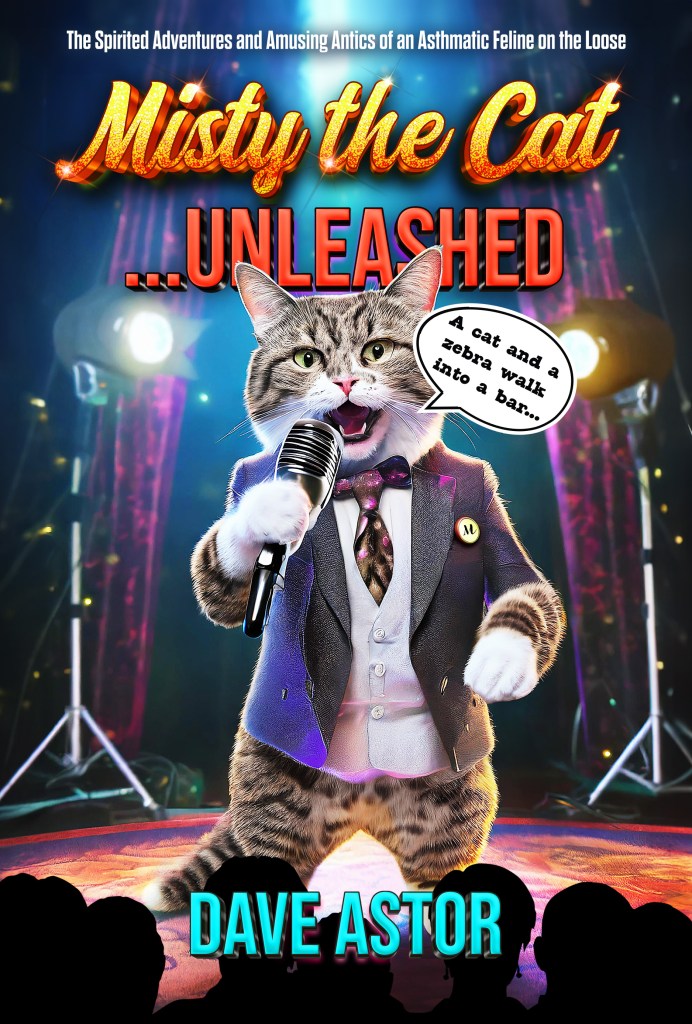
My comedic 2024 book — the part-factual/part-fictional/not-a-children’s-work Misty the Cat…Unleashed — is described and can be purchased on Amazon in paperback or on Kindle. It’s feline-narrated! (And Amazon reviews are welcome. 🙂 )
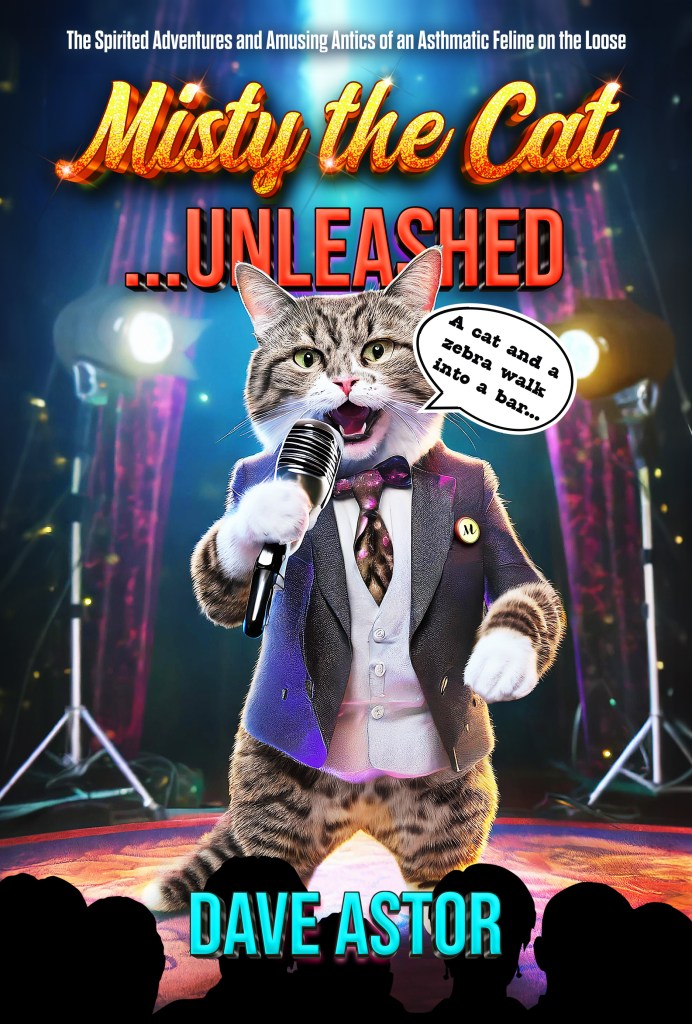
This 90-second promo video for the book features a talking cat: 🙂

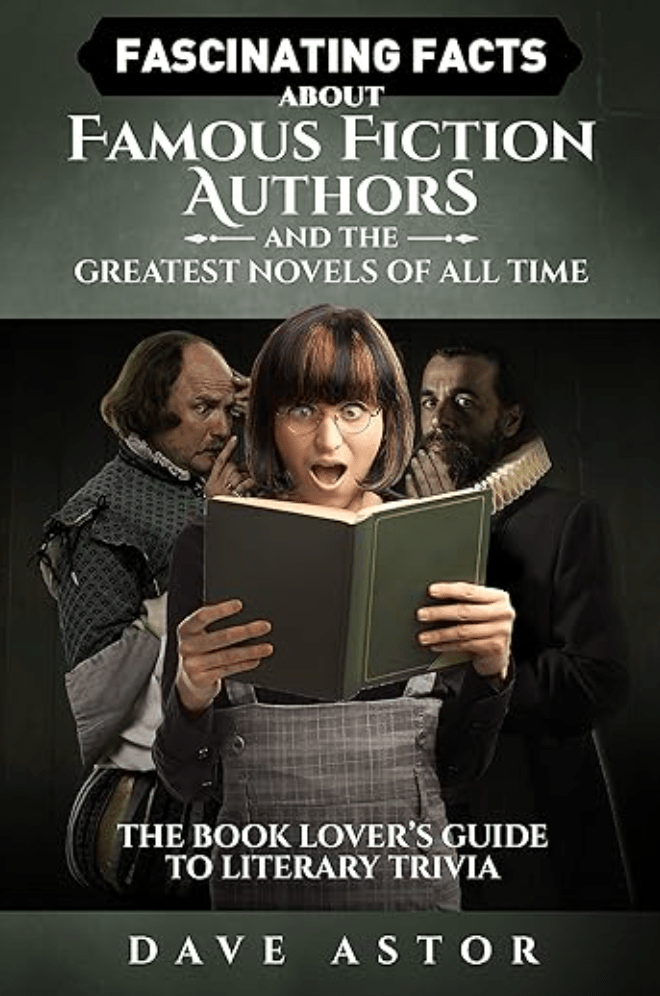
I’m also the author of a 2017 literary-trivia book

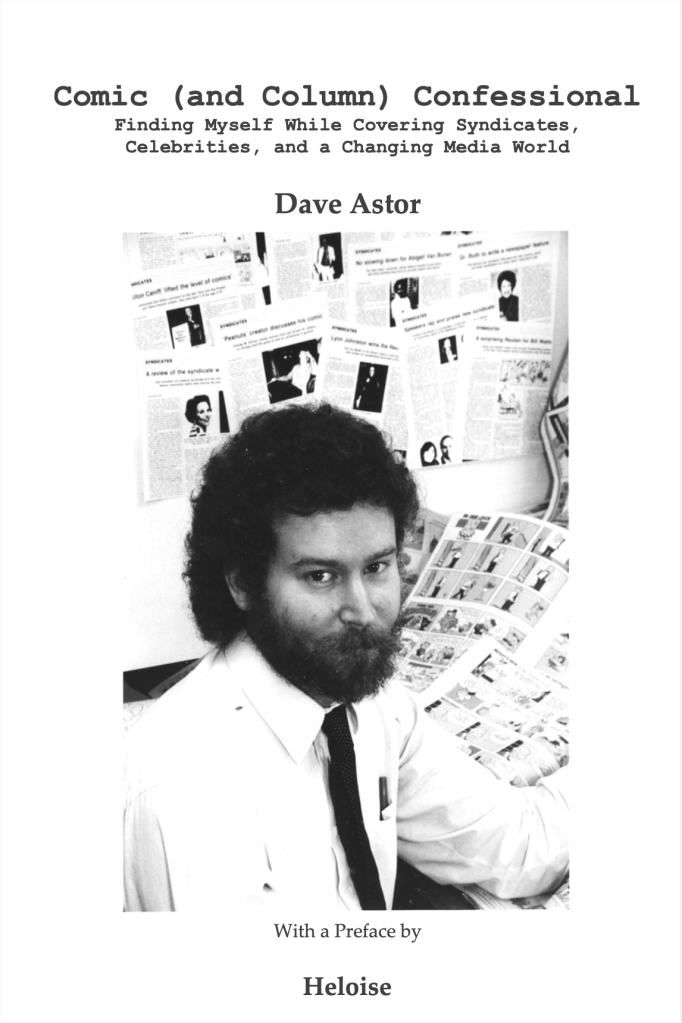
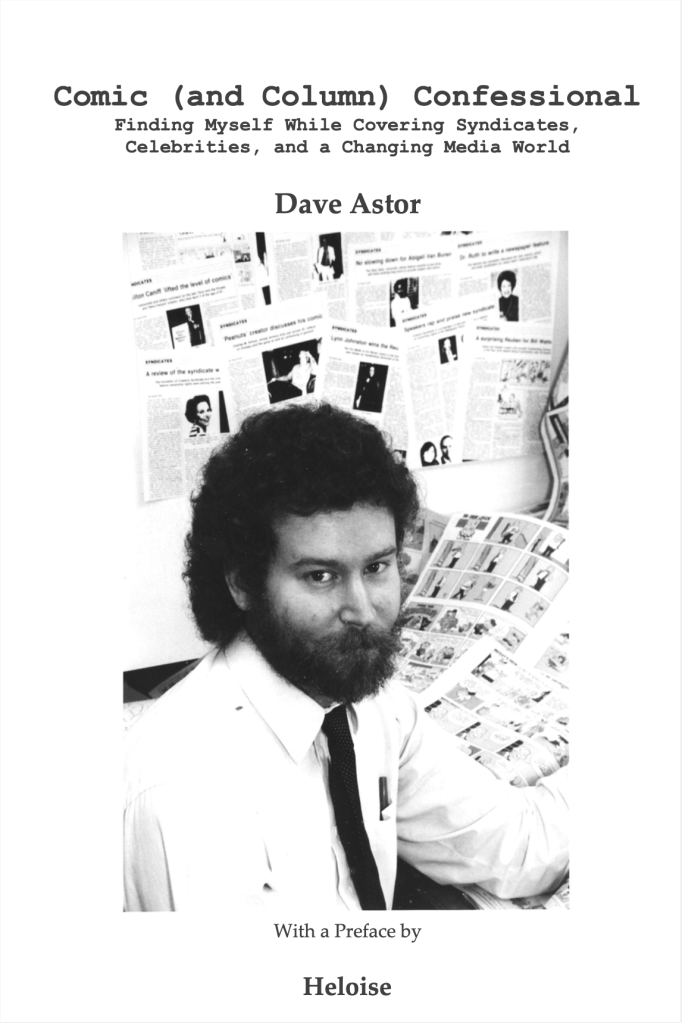
…and a 2012 memoir that focuses on cartooning and more, with many encounters with celebrities.
In addition to this weekly blog, I write the 2003-started/award-winning “Montclairvoyant” topical-humor column every Thursday for Montclair Local. The latest piece — about awful massive layoffs in my school district, upcoming elections, and more — is here.
Ten Years After: a Video Interlude

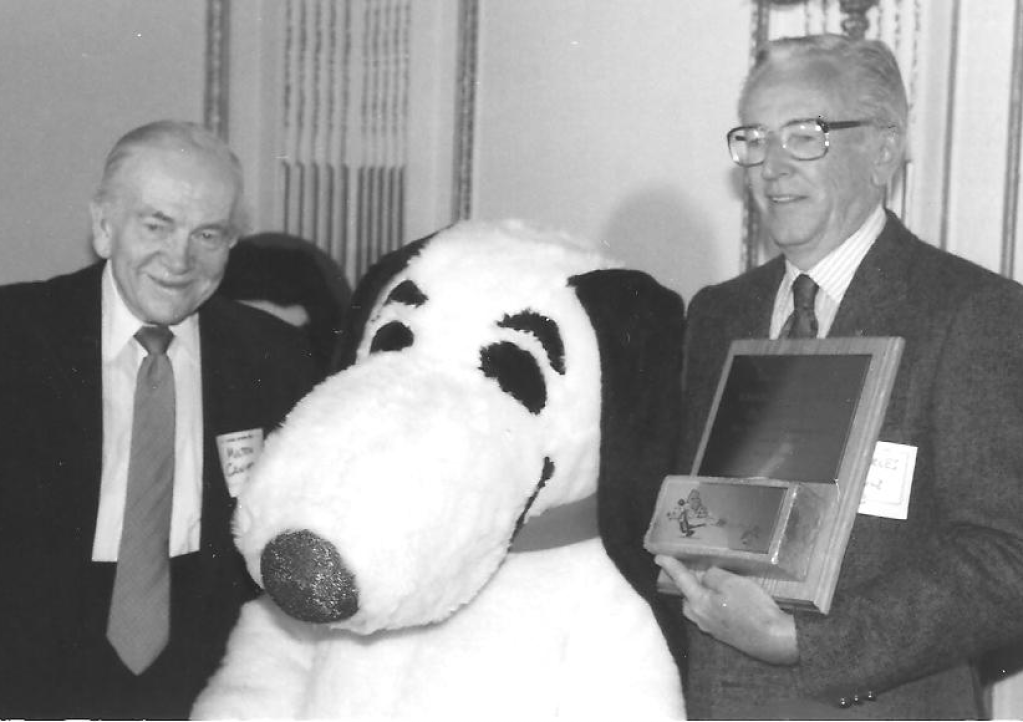
A 1987 photo I took of ‘Peanuts’ cartoonist Charles M. Schulz (1922-2000) on the right, ‘Terry and the Pirates’/’Steve Canyon’ cartoonist Milton Caniff (1907-1988) on the left, and Snoopy.

Today, I’m doing something different in this usually literature-focused blog of mine. 🙂 I was surprised and pleased to see on the Bluesky social-media platform three days ago that my Canadian writer friend Dan St.Yves had re-posted a filmed interview he did with me almost exactly ten years ago, so I decided to re-post it again here instead of going with a more typical lit post.

In that summer of 2015 conversation, we talked about various syndicated cartoonists and columnists I had met and covered while working for Editor & Publisher magazine from 1983 to 2008 — before I started blogging on literature. Among the creators discussed: Charles M. Schulz (“Peanuts”), Jim Davis (“Garfield”), Lynn Johnston (“For Better or for Worse”), Bill Watterson (“Calvin and Hobbes”), Stan Lee (“Spider-Man”), humor columnist Dave Barry, and twin-sister advice columnists Abigail Van Buren (“Dear Abby”) and Ann Landers.

When Dan and I had our conversation, we were in Indianapolis attending the 2015 conference of the National Society of Newspaper Columnists — for which I was a board member from 2009 to 2023.

Again, this is not a typical book post for me, although all the cartoonists and columnists mentioned above have seen MANY sales of paperback (and in some cases hardcover) collections featuring their work, and some have written some non-collection books as well. (For instance, Dave Barry has authored and co-authored a number of novels.) Also, the 2012 Comic (and Column) Confessional memoir I wrote about my time at Editor & Publisher comes up during the interview. I could add that Alexandre Dumas wrote an 1845 sequel to his famous 1844 novel The Three Musketeers titled Twenty Years After — twice the length of time since this post’s 2015 video of ten years ago. So, if one read half of Twenty Years After

Anyway, below is a link to the video, which lasts a bit over 20 minutes. Whether you watch it or not (no obligation!), I’ll be back with a more normal literature post next week. Actually, Misty the cat is soon due for another guest blog effort here to discuss books from his feline perspective, but he’s not sure yet if that will be on August 3 or sometime later in the month. In the meantime, Misty is reading Marcel Proust’s In Search of Lost Treats and hoping for a happy ending.

Misty the cat asks: “Why is there smoke in July when the new Pope was chosen in May?”

My comedic 2024 book — the part-factual/part-fictional/not-a-children’s-work Misty the Cat…Unleashed — is described and can be purchased on Amazon in paperback or on Kindle. It’s feline-narrated! (And Misty says Amazon reviews are welcome. 🙂 )

This 90-second promo video for my book features a talking cat: 🙂

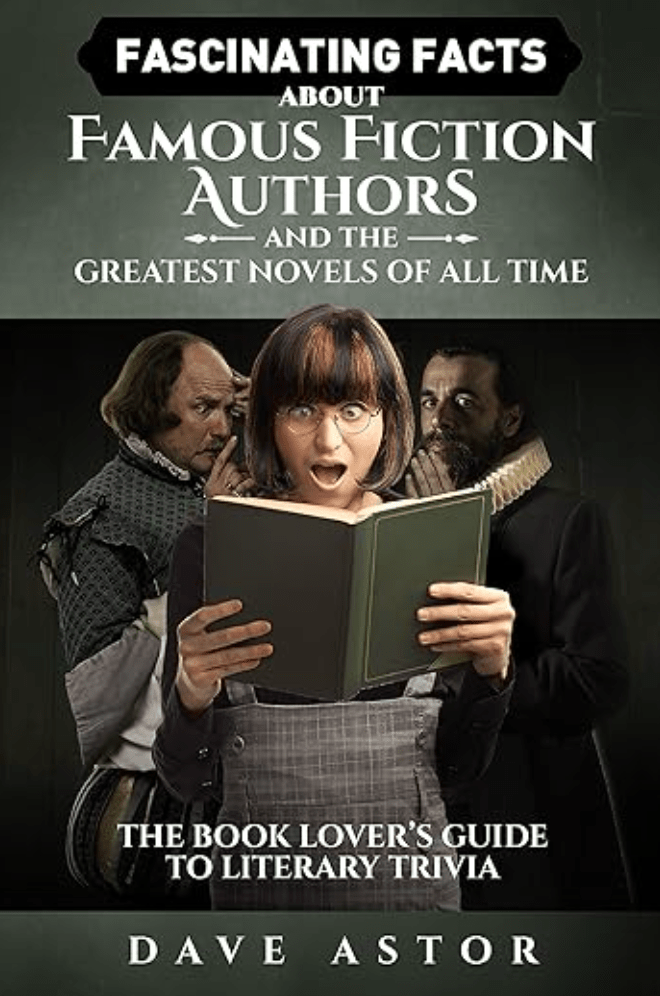
I’m also the author of a 2017 literary-trivia book

…and the aforementioned 2012 memoir that focuses on cartooning and more.

In addition to this weekly blog, I write the 2003-started/award-winning “Montclairvoyant” topical-humor column every Thursday for Montclair Local. The latest piece — about the cancellation of “The Late Show,” whose host Stephen Colbert is a resident of my town — is here.

Media People in the Medium of Literature

It’s not news that some fictional characters work in the media. The casts of more than a few literary works contain reporters, columnists, bloggers, TV hosts, and other information/entertainment purveyors.

Those media people can be major protagonists, secondary characters who objectively or not so objectively observe what the main characters do, or just bit players. They’re smart, curious, driven, idealistic, investigative, crusading, accurate, sloppy, biased, cynical, pompous, abrasive, or egotistic — or several of those things, and more.

And they don’t just appear in post-19th-century novels. I recently read Henry James’ The Portrait of a Lady, and among the most interesting characters is journalist Henrietta Stackpole. She’s friends with the novel’s American-in-Europe protagonist Isabel Archer, and provides a valuable perspective as a “modern woman” watching Isabel struggle with the constraints placed on most females back then. And unlike the wealthier characters who just talk and visit in that stellar James novel, Henrietta actually works for a living!

Moving to the 20th century and another gender, we have cynical journalist Will Farnaby checking out a utopian society in Aldous Huxley’s last novel: Island. Are the words “cynical” and “journalist” almost redundant? In many cases, but there are also many nice media people — including the very talented writers in the National Society of Newspaper Columnists organization of which I’m a member.

Columnists appear in novels such as Nathanael West’s Miss Lonelyhearts and Robert Penn Warren’s All the King’s Men — with the latter book’s Jack Burden becoming an aide to Huey Long-like politician Willie Stark and playing a crucial role as the book’s narrator. He’s also an example of the way many media people cycle in and out of politics.

“Miss Lonelyhearts” is the alias of a male advice-giver who gets depressed from the painful letters he has to read. The late twins Ann Landers and Abigail Van Buren handled that burden a lot better in real life, and didn’t get into the trouble West’s character did! Landers was even the subject of a play a few years ago — David Rambo’s The Lady With All the Answers.

The most famous play about journalism might be Ben Hecht’s and Charles MacArthur’s The Front Page, which of course was also adapted for the screen.

Perhaps the most famous reporter in recent fiction is none other than the nasty, at times weirdly charming Rita Skeeter of J.K. Rowling’s Harry Potter novels. A biased tabloid reporter who would do just about anything for a scoop.

Speaking of that last word and sensationalistic reporting, there’s Evelyn Waugh’s satirical novel Scoop.

Among the other literary works featuring journalists is Robertson Davies’ Murther & Walking Spirits, whose newspaper threesome includes a still-existing-in-a-way murdered man, the murdered man’s widow, and the murderer who had been sleeping with the murdered man’s wife. National Enquirer material!

Fay Weldon’s The Bulgari Connection contains another trio: a man, the woman he divorces, and the younger woman he takes up with. The last is a glamorous, obnoxious TV host.

Fictional TV reporters also frequently make cameo appearances in novels, with one example being the smug, faux-sweet Tina Ultner in Barbara Kingsolver’s Flight Behavior.

Print-media people can have small roles, too — as is the case with Alabama newspaperman Braxton Underwood, a racist who nonetheless was prepared to prevent a lynching in Harper Lee’s To Kill a Mockingbird.

Can comic book cartoonists be considered media people? If so, there are two memorable ones in Michael Chabon’s The Amazing Adventures of Kavalier & Clay who are loosely based on Jerry Siegel and Joe Shuster, the real-life “Superman” creators so monetarily exploited by corporate men in suits.

An honorable mention in this post is the real-life Nellie Bly, the famous journalist with a literary connection: She tried to circle the globe faster than the fictional Phileas Fogg did in Jules Verne’s Around the World in Eighty Days, and finished her 1889-90 trip in just over 72 days.

What are some of your favorite literary works featuring media people in big or small roles? And given that there aren’t a huge number of such characters in fiction, you’re also welcome to discuss nonfiction books by or about media people, or discuss real-life media people you like best or least!

(The box for submitting comments is below already-posted comments, but your new comment will appear at the top of the comments area — unless you’re replying to someone else. Also, please feel free to read through comments and reply to anyone you want; I love not only being in conversations, but also reading conversations in which I’m not involved!)

For three years of my Huffington Post literature blog, click here.

I’m also in the middle of writing a literature-related book, but still selling Comic (and Column) Confessional — my often-funny memoir that recalls 25 years of covering and meeting cartoonists such as Charles Schulz (“Peanuts”) and Bill Watterson (“Calvin and Hobbes”), columnists such as Ann Landers and “Dear Abby,” and other notables such as Hillary Clinton, Coretta Scott King, and various authors. The book also talks about the malpractice death of my first daughter, my remarriage, and life in New York City and Montclair, N.J. — where I write the award-winning weekly “Montclairvoyant” humor column for The Montclair Times. You can email me at dastor@earthlink.net to buy a discounted, inscribed copy of the book, which contains a preface by “Hints” columnist Heloise and back-cover blurbs by people such as “The Far Side” cartoonist Gary Larson.