One of the ways novelists can be inventive is with…inventions.
Yes, some of their books weave stories around some of the greatest inventions in the history of humankind. That can certainly add drama and historic resonance to partly fact-based fiction.
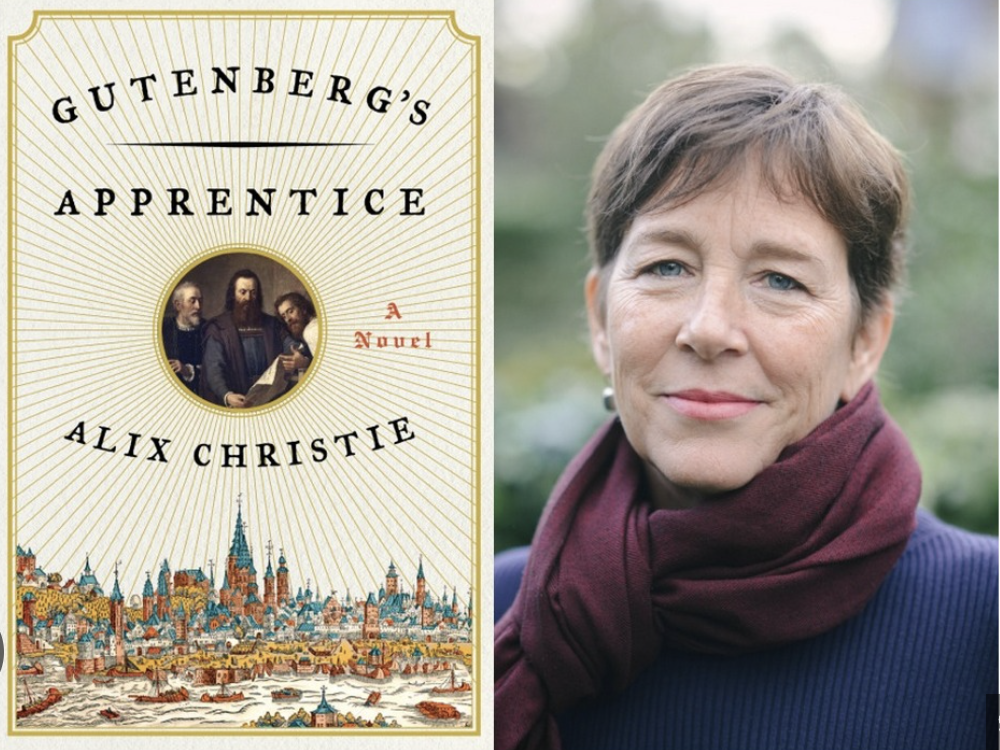
A prime example is Gutenberg’s Apprentice by Alix Christie, who tells the 15th-century story of a man who (at first reluctantly) helps the prickly, driven Johann Gutenberg develop the printing press — surely one of the most consequential inventions of all time. I’m currently in the middle of reading this absorbing 2014 novel.
Part of The Magnificent Ambersons (1918) revolves around the invention and early days of the automobile — which figures in Booth Tarkington’s absorbing exploration of progress vs. stasis, and new money vs. old money.
Stephen King’s novel Cell takes a horror-laden (and satirical?) approach to cell phones as that technology was becoming widely popular. The book — perhaps my least-favorite King effort — features a mysterious broadcast over a cell-phone network that turns a bunch of people into zombie-like beings. 🙂 Published in 2006, a year before the iPhone was introduced.
The main focus of Mark Twain’s Pudd’nhead Wilson (1894) is the switching in infancy of two boys — one born into slavery and the other born to the master of the house. But a fascinating subplot features a court case in which the new technology of fingerprinting figures prominently. Interestingly, that new technology was anachronistically more current to when Twain wrote the novel than to the time period in which the novel was set.
Also anachronistic was Ayla’s much-too-early invention of the travois (a type of sled or platform, pulled by a horse, on which could be placed heavy loads) in Jean M. Auel’s circa-18,000 BC-set series that began with The Clan of the Cave Bear. The incredibly resourceful Ayla’s method of starting a fire was more contemporary to her prehistoric time.
Novels with time travel can certainly make inventions fascinating. For instance, the 20th-century physician Claire of Diana Gabaldon’s Outlander novels creates some homemade penicillin after she ends up living in the 18th century. Claire knew about that antibiotic because penicillin was discovered in 1928.
Another time travel book, Edward Bellamy’s Looking Backward (1888), was prescient in inventing an early version of a debit card — the modern version of which didn’t arrive until 1966.
Science fiction can of course also predict and depict inventions before they’re actually invented. One of countless examples is the spaceship from Earth in H.G. Wells’ 1901 novel The First Men in the Moon.
For younger readers, Danny Dunn and the Homework Machine by Raymond Abrashkin and Jay Williams took an early look at computers — which tended to be huge at the time of that novel’s 1958 publication.
Your thoughts on this topic? Other novels with a strong invention element?
My literary-trivia book is described and can be purchased here: Fascinating Facts About Famous Fiction Authors and the Greatest Novels of All Time.
In addition to this weekly blog, I write the 2003-started/award-winning “Montclairvoyant” topical-humor column every Thursday for Montclair Local. The latest piece — about a controversial project being voted on again, some overpaid municipal hires, and more — is here.
 Dave Astor on Literature
The connotation ‘Gentleman’ was an invention of the British. Read the travelogue ‘England’ penned by Nikos Kazantzakis to know more.
LikeLiked by 1 person
That’s an interesting angle on inventions — the invention of a word. 🙂 Thank you, vijayravivarma!
LikeLike
I thought about this, and outside of several novels you have already mentioned… I couldn’t think of another story based around an invention.
Perhaps you could count “A Tale of Two Cities”, based around the guillotine?
On “mentions” of inventions, more than a book around such- In “100 Years of Solitude”
“Melquíades brings inventions to Macondo, such as magnets & a magnifying glass the size of a drum. Later, other gypsies will bring “sewing machines that reduce fevers,” and, finally, they will bring the world’s largest, most glittering, “hot” diamond: ice.”
There’s a fab movie “Phone Booth”. The entire story takes place in a phone. I checked, but it’s not from a book. Maybe I’ll watch it again!
LikeLiked by 1 person
Thank you, Resa! The guillotine was a terrible invention, but an invention nonetheless. And I love your “One Hundred Years of Solitude” mention! I remember “Phone Booth,” though I’ve never seen that film. Scary premise!
LikeLiked by 1 person
Sigh.. true that not all inventions are good, or good for mankind.
It seems there’s something of everything in that book, “100 Years Of Solitude”.
It’s a good film, worth watching.
LikeLiked by 1 person
So true about “One Hundred Years of Solitude” containing just about everything a novel can contain!
LikeLiked by 1 person
Yes, a masterpiece.
LikeLiked by 1 person
Absolutely!
LikeLiked by 1 person
William Gibson, in his 1984 novel “Neuromancer”, invented something big, though but a word: ‘cyberspace’. Or was it something more?
“In his afterword to the 2000 re-issue of Neuromancer, fellow author Jack Womack goes as far as to suggest that Gibson’s vision of cyberspace may have inspired the way in which the Internet developed (particularly the World Wide Web), after the publication of Neuromancer in 1984. He asks “[w]hat if the act of writing it down, in fact, brought it about?“
https://en.wikipedia.org/wiki/Neuromancer
LikeLiked by 1 person
Thank you, jhNY! A major inspiration for a major invention! I remember “cyberspace” being a much-used word in the 1990s.
LikeLike
The Naive and Sentimental Lover”– John Le Carre’s only non-espionage novel, and not well-loved. Its chief protagonist invents a revolutionary brake for baby carriages, the large and imposing dreadnoughts favored by the mid-century British upper middle class, which allows him to dominate the pram market. The invention seemed more far-fetched than any international intrigue the author had concocted previously or since.
“The Assistant” by Robert Walser– a strange and engaging book told by Robert Marti, a man “drowning in obedience” who helps, such as he is able, Karl Tobler, a baselessly egotistical inventor who has squandered his inheritance on his self-image as visionary inventor. He invents a few items that attract no interest and no buyers— the Advertising Clock, the Marksman’s Vending Machine and the Deep Drilling Machine.
“Chitty-Chitty Bang Bang” by Ian Fleming– received the book one Christmas, but was told old to take to it. I do seem to remember that the fellow with the magic automobile/flying machine invented something I think he termed ‘whistling sweets’– hard candy with a hole in the center. As Lauren Bacall once told a fellow–“you just put your lips together and blow.”
LikeLiked by 1 person
Thank you, jhNY! Interesting that John Le Carre authored a non-espionage novel! Good for him, even if the book was not widely loved. From the premise, it does sound readable, and of course he was an excellent writer.
I remember reading Robert Walser’s “The Assistant” several years ago on your recommendation, and found it engrossing. (I also liked Bernard Malamud’s totally unrelated novel of the same name, which I read way back in high school.)
LikeLike
Your blog post reminds me of a book I’ve been planning to read; however, I keep setting it aside: https://krieger.jhu.edu/modern-languages-literatures/faculty-books/the-man-who-invented-fiction/ There’s also what I consider a very brilliant short story by Vonnegut re: Edison inventing the electric light. It’s from Welcome To The Monkey House and aptly titled Tom Edison’s Shaggy Dog. Hope you and yours had a nice Easter. Now that my kids are grown, there were no eggs to decorate and hide or baskets to make, but alas no chocolate bunnies either. Susi
LikeLiked by 1 person
Thank you, Susi! Loved the link! Miguel de Cervantes did “invent” fiction in a way. There were of course earlier novels of a sort — such as “The Tale of Genji” — but “Don Quixote” is so good: readable and enjoyable.
Also, I appreciate the mention of “Tom Edison’s Shaggy Dog.”
Hope you had a nice Easter, too! Even without the chocolate bunnies. 🙂
LikeLike
Wow, a topic that’s making the wheels turn this week Dave! 🙂 The best I could come up with was a long time ago, I read a book called “the Wright Sister” – written from the POV of Wilbur and Orville Wright’s sister who helped them along while they invented and tested out the various Flyer models. It was okay, an interesting perspective but not the best book I’ve ever read. I’ve also read a few of your mentions – including Outlander, and while I haven’ read the First Men in the Moon, I have read the Time Machine by H.G. Wells – an excellent book.
LikeLiked by 1 person
Thank you, M.B.! I like the premise of “The Wright Sister”; women are often not given enough credit for inventions and other things. Sorry it wasn’t a better book. As for “The First Men in the Moon” — very good, but “The Time Machine” is a more compelling read.
LikeLiked by 1 person
HI Dave, a most interesting topic this week. The Clan of the Cavebear is a great mention. Ayla goes on to invent other things like soap. HG Wells also wrote The Time Machine which was far ahead of its time. John Wyndham featured a young female biochemist who discovered that a chemical extracted from an unusual strain of lichen could be used to slow down the ageing process, enabling people to live to around 200–300 years. That was his book Trouble with Lichen. He also featured a post-apocalyptic world after a nuclear explosion in The Chrysalids. Teagan Riordain Geneviene from our blogging community also features lots of inventors and inventions in her fabulous novels, especially the steampunk ones.
LikeLiked by 2 people
Thank you, Robbie! Ayla was quite an inventor, wasn’t she? That brilliant, clever character could do almost anything.
I appreciate the other excellent mentions, too — including the work of the very inventive Teagan!
LikeLike
It is my pleasure, Dave. I read all the Earth Children series but I didn’t finish the last one. I thought the author really went off track and it turned into another relationship squabble which I’d already gone through in The Mammoth Hunters.
LikeLiked by 1 person
I finished all six books, but agree that the series faltered at times as it advanced — for one thing, Jondalar too often was quite annoying. Still, the series was an amazing accomplishment.
LikeLike
Yip, I also found Jondalar annoying. Oversensitive.
LikeLiked by 1 person
Oversensitive is the word! Of course, that oversensitiveness drove some of the plot here and there, but it was still annoying. 🙂
LikeLike
Oh yes, John Wyndham – excellent! How could I forget?
LikeLiked by 1 person
He was one of the front runners with sci fi. I am very admiring.
LikeLiked by 2 people
For all that science fiction is dismissed as otherworldly dreaming, it’s interesting to see how practitioners’ predictions sometimes fall short of what actually happens.
To give one example, and probably from one of my favorite books even though it hasn’t aged well:
Arthur C. Clarke’s “Imperial Earth,” is among other things is a travelogue of Westernized Earth in the year 2276 from the point of view of a visitor from the human colony on Saturn’s moon Titan.
Pretty much everyone on Earth owns something called a “Minisec,” described (in 1976) as something looking very much like a graphing calculator of the 1990s-2000s. In every residence is a “comsole” with a keyboard and screen, with a description that can’t help but call to mind a desktop computer.
Both are tied in to “Aristotle,” a name given to a computer bank with global connections. It’s a communication system and an encyclopedia, basically. You want to talk to someone, you look them up; you want information, you ask “Ari.”
Compare that to the smartphones, laptops and decentralized, interactive, and pervasive internet and social media that exists in 2024 — wildly more so than Clarke’s information ecology of 2276.
A little bit more of a reach, but Clarke’s “The City and the Stars,” set millions of years in the future, depicts humans living in Earth’s last city. The billions of residents of Diaspar are “stored” in memory banks except for brief periods of time when an individual may be downloaded into a human body created for them, then live for a hundred years or so among a few thousand other embodied humans in Diaspar before returning to the memory banks. While “alive,” the Diaspar residents amuse themselves in immersive, virtual-reality games called “sagas.”
Writing in 1956, Clarke JUST misses describing the wholly-simulated society of 1999’s fictional (we hope) “The Matrix.”
LikeLiked by 1 person
Thank you, Don, for those two Arthur C. Clarke mentions and the great descriptions of each fascinating book! You got me interested in reading more from that author; like many people, I’ve only read his “2001: A Space Odyssey.” Science fiction obviously can’t predict the future exactly, but many sci-fi novels have been impressively in the ballpark with their speculation.
LikeLike
How about ‘Do Androids Dream of Electric Sheep?’ by Philip K. Dick. I quite enjoyed that, some time ago. That’s kind of in the right direction?
LikeLiked by 1 person
I don’t know that book, Chris. I shall look it up. Thank you.
LikeLiked by 2 people
Thank you, Chris! I know of that book — it inspired the movie “Blade Runner,” didn’t it? — but haven’t read it. Sounds like a great mention!
LikeLiked by 1 person
What a wonderful list of books, Dave🙏
I am non familiar with some of them so I’ll take the titles provided both by you and in the comments as an excellent suggestion for my next reads
LikeLiked by 1 person
Thank you, Luisa! 🙂 Glad you liked the post, and I hope you enjoy the books you might read that were mentioned in it and in the excellent comments!
LikeLiked by 1 person
As always you are very kind and I thank you warmly🙏📚
LikeLike
Hello, Dave. So far I’ve only come up with one example. In a favorite novel of mine by Margaret Kennedy, NOT IN THE CALENDAR, a little girl makes friends with a neighborhood child who is considered completely unreachable because they invent a sign language for communicating with each other. This is in mid-1800s when not many people understand that being deaf has nothing to do with being stupid. The deaf girl is finally educated and becomes a painter as an adult while her friend makes a career of working with the deaf. Excellent book. I have read that twins also sometimes invent private languages for talking to each other.
LikeLiked by 1 person
Sorry, I forgot to say that this is Kim Hays; I’m in Kyoto!
LikeLiked by 1 person
Thank you, Kim! “Not in the Calendar” sounds REALLY good. Now on my to-read list. Amazing how inventive humans can be when there’s a strong incentive to be inventive, in this case the incentive being friendship.
Hope you’re enjoying your stay in Kyoto! Exciting!
LikeLike
That’s an interesting list of books. I have not read “Gutenberg’s Apprentice” but I remember my 3rd grade teacher reading a Swedish book with a similar theme to us students.
LikeLiked by 2 people
Thank you, Thomas! That’s a nice third-grade memory. 🙂 Gutenberg and his invention are amazing subjects; I can see why he and the printing press have inspired a number of books from various parts of the world.
LikeLike
I need to add these to my TBR list!
LikeLiked by 1 person
Thank you for the comment, Leslie! There are definitely some good novels with invention elements. 🙂
LikeLiked by 1 person
Many thanks for yet another post to exercise the little grey cells, Dave. It’s late and I’ve just got in, so I’ll sleep on the idea and see what I can come up with. 🙂
LikeLiked by 1 person
Thank you, Laura! I’ll look forward to another comment, if you think of something. I realize this was a tough topic this week; there are probably not an enormous number of novels with invention elements.
LikeLiked by 1 person
But I l’ll give it my best shot. ‘Frankenstein’ is up there, of course, and HG Wells with his time machine, etc, although they’re the usual suspects and the inventions haven’t come to pass. Talking of Frankenstein though, there’s a story by Nathaniel Hawthorne called ‘Rappacini’s Daughter’, in which Dr Rappacini grows a garden of poisonous plants, creating a ‘poison ivy’ figure in his daughter. Both he and Frankenstein play God, interfering with the laws of nature, and both were referred to with the advent of GM crops (aka ‘Frankenstein foods’) at the beginning of this century. A tenuous link, but maybe I can squeeze it in under the wire? 😊
LikeLiked by 1 person
Frankenstein is a great mention. I really loved The Scarlet Letter but have not read Rappacini’s Daughter. It sounds most intriguing. Thanks for the mention.
LikeLiked by 2 people
Some of Hawthorne’s short stories are definitely worth a look, Robbie!
LikeLiked by 1 person
Thanks for confirming, Dave.
LikeLiked by 1 person
🙂
LikeLike
There’s Ira Levin’s ‘The Stepford Wives’ too, and George Langelaan’s ‘The Fly’ – both tales of horror that have been made into films. Later this week I’m going to publish my review of a book I only discovered recently and which fits, but I won’t name it here, I’ll keep that until I post it. 🙂
LikeLiked by 2 people
I appreciate the follow-up comments, Laura! “Rappaccini’s Daughter” is a great, haunting short story. Hawthorne was really excellent in that genre before mostly turning to novels. And interesting to think of inventions (time travel, the creation of beings) that haven’t come to pass. Looking forward to your book review!
LikeLiked by 1 person
Thank you! It’s incredible how much literature is out there that we often don’t know about and only discover by chance. I’ll have to have a re-read of some of these now. Have a good week. 🙂
LikeLiked by 1 person
“It’s incredible how much literature is out there that we often don’t know about and only discover by chance” — so true!
Thanks! Have a good week, too!
LikeLiked by 1 person
A footnote from Greek mythology – and who knows who came up with those stories – is Daedalus inventing wings for himself and his son Icarus. And now I’m really going! 🙂🙂🙂
LikeLiked by 1 person
Wings are quite an invention! From patent pending to patent ascending. 🙂
LikeLiked by 1 person
😂😂😂
LikeLiked by 1 person
And patent descending, unfortunately for Icarus.
LikeLiked by 1 person
🙂
LikeLiked by 1 person
LOL, Laura! 😂 Brilliant. 🙂
LikeLiked by 1 person
The novel that immediately jumps to mind is Beautiful Invention by Margaret Porter, based on the life of Heddy Lamarr, who invented something that helped the war effect in WWII. I don’t remember what the invention actually was. (Too technical for me!)
LikeLiked by 2 people
Thank you, Liz! I’ve heard about that Hedy Lamarr invention, which apparently was some kind of precursor to Wi-Fi. She was brilliant! I didn’t know her life inspired a novel.
LikeLiked by 1 person
You’re welcome, Dave. I know of at least one other novel based on her life.
LikeLiked by 1 person
Certainly a compelling subject!
LikeLiked by 1 person
Yes, I learned a lot!
LikeLiked by 1 person
🙂
LikeLiked by 1 person
A novel that comes to mind is the sci-fi adventure novel Twenty Thousand Leagues Under the Seas by Jules Verne. Verne’s 1872 classic novel was inspired by a French submarine, the first of its kind, launched in 1863. I believe that such stories about inventions, fictitious or real, open the minds of our youth to possibilities for future inventions. To dream big. To make the impossible possible.
LikeLiked by 2 people
Thank you, Rosaliene! That Jules Verne book is a great example of a relatively new (at the time) invention being the focus of a novel! And your comment’s last three lines are quite eloquent. 🙂 Yes, stories like that can be very inspiring to young readers. Heck, to readers of all ages.
LikeLiked by 1 person
🙂
LikeLiked by 1 person
🙂
LikeLike
This is a fantastic mention. This was one of my son’s favourite books as a teen.
LikeLiked by 2 people
Made me look it up! The “Plongeur”, was probably the first and last submarine designed to use compressed air for propulsion. But its need for large areas of compressed air storage made the “Plongeur” one big undersea boat– impressive for scale in itself. This early submarine never quite advanced past the testing stage, and proved unstable, its bow tending to sink faster than its stern. It could not submerge at depths lower than 10 meters.
But a model of it was displayed in 1867 at the Exposition Universelle and Verne saw it, and was inspired
I’d bet he was also inspired by the early submarine CSS Hunley,which sank a Union ship with its ‘spar torpedo’ off the coast of South Carolina near Charleston in 1864. And most likely was sunk itself by the compression wave of the torpedo’s explosion which sank the USS “Housatonic”.
In gambling slang, a ‘plunger’ is a high stakes gambler willing to take large risks. I’d say any sailor in either of those early submarines qualifies.
LikeLiked by 2 people
VERY interesting. Thank you, jhNY!
LikeLike
Another interesting post, Dave. I think I’d enjoy Gutenberg’s Apprentice. I think about a lot of science fiction books and short stories that seem prescient in their ability to predict what authors may have considered a safe distance into the future.
I’m going to go with 2001 A Space Odyssey, credited to Arthur C. Clarke but (as I checked) co-written with Stanley Kubrick. Apparently the book and the movie were developed in tandem. The reason I focus on this book is its reliance on Artificial Intelligence. Imagine a computer we address by name (Hal). Clarke and Kubrick were a little early. The book is set in 1999, but they weren’t far off. I only hope we can control AI better than they did.
LikeLiked by 2 people
Thank you, Dan! I appreciate the interesting comment. I didn’t know the “2001” novel and movie were basically created in tandem! And I agree that both were ahead of their time and had a lot to say about AI and more. Also, it’s fascinating when the future depicted in a decades-ago book or film is now in our 2024 past. Orwell’s “Nineteen Eighty-Four” would be another example of that.
LikeLiked by 1 person
Yes, as we are surrounded by flat screens and our privacy is under attack.
LikeLiked by 1 person
Very true! I’ve even heard that newer cars track a lot of stuff that drivers and others are doing in those cars. 😦
LikeLiked by 1 person
We will bring this on ourselves 🙁
LikeLiked by 1 person
Yes, that’s part of it. Also caused by corporate greed, the desire by governments to be controlling and intrusive, etc. 😦
LikeLiked by 1 person
Hi Dan, I think AI will become more and more popular for novels. Interestingly, my oldest son who is triple majoring in mathematics and computer science at university this year, has said he doesn’t want to pursue AI as a career option. He thinks AI is bad for humanity. I also think this, but I was surprised that a young person had given the implications of AI so much deep thought.
LikeLiked by 2 people
I also think AI is and will be problematic, though obviously it has some positives and potential positives. If only AI weren’t yoked to the maximize-profit motives of corporations, whether they’re tech companies or not.
Kudos to your son, Robbie!
LikeLike
Thank you, Dave. You have nailed the problem. I think the negatives to society currently outweigh the positives.
LikeLiked by 1 person
Yes!
LikeLike
That is surprising, Robbie. I say, good for him. I look forward to the contributions he makes that can only be made by humans.
LikeLiked by 1 person
Gregory is a great empath.
LikeLiked by 2 people
Thank you to Rebecca Budd for recommending “Gutenberg’s Apprentice”!
LikeLiked by 2 people
I am delighted that you are enjoying Gutenberg’s Apprentice, Dave. I have found that most “invention stories” are in non-fiction. For example,”The Wright Brothers” by David McCullough and “The Innovators” by Walter Isaacson
I enjoyed Gutenberg’s Apprentice’s blend of fiction with real-life events to create a compelling narrative. I gained a deeper understanding of the historical context in which this invention emerged. I was especially excited about exploring the impact of the printing press on society, which prompted me to reflect upon the technological innovations influencing our current reality.
“What needs has any man, besides those needs we share with beasts? And then I knew: he has to read.” Alix Christie, Gutenberg’s Apprentice
LikeLiked by 4 people
Thank you, Rebecca! So true that there are many nonfiction books about inventors. I remember reading biographies of Thomas Edison, Alexander Graham Bell, etc.
Yes, Alix Christie mixes fact and fiction very skillfully, and gives the reader a strong sense of what it was like to live in the 1400s. Plus she shows (as others have shown before) that “great men” are not always great people.
Excellent comment-finishing quote you cited, as always. 🙂
LikeLiked by 3 people
That was a profound takeaway! Great men are not always great people!!
LikeLiked by 1 person
Thank you! 🙂 I think there used to be more “mythologizing” of leaders and other famous people of the past. Healthier, as well as more interesting, to have “warts and all” depictions.
LikeLiked by 1 person
A great quote, Rebecca. I’m clapping my hands in delight.
LikeLiked by 2 people
🤗🤗🤗
LikeLiked by 1 person