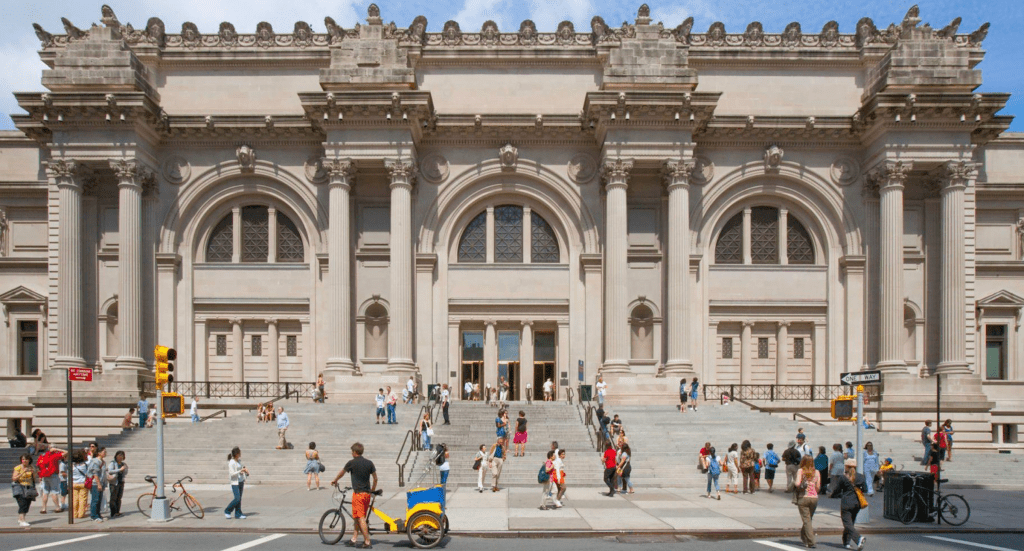
The Metropolitan Museum of Art in New York City. (Photo: Google Arts & Culture.)
Museums are interesting places, educational places, entertaining places, sometimes mysterious places, and sometimes intimidating places, so why not include them in some fiction?
I just read Metropolitan Stories, a group-of-short-tales-as-novel set in New York City’s renowned Metropolitan Museum of Art. Among the intriguing wrinkles in Christine Coulson’s 2019 book are the presence of some ghosts and the fact that paintings and sculpture in the Met’s massive collection can experience emotions, have memories, etc. There’s even a chapter that would have worked as a Twilight Zone episode. But Coulson also focuses on various flesh-and-blood museum staffers — some rather eccentric.
Also set at the Met is The Goldfinch, at least in the first part of Donna Tartt’s novel — when a tragic gallery bombing gets the sprawling, dynamic plot rolling. The 2013 book won the Pulitzer Prize for fiction.
The American Museum of Natural History in NYC is the setting for The Night at the Museum. While I haven’t read Milan Trenc’s 1993 children’s book, I did see the popular 2006 movie version in which we got to visualize the museum’s exhibits come to life after sunset. I think some of us have fantasized about that. 🙂
Getting out of NYC, among the Chicago locations where the two protagonists in Audrey Niffenegger’s 2003 novel The Time Traveler’s Wife find themselves are the Art Institute and the Field Museum. Being in places like that can telegraph things like a character’s education level and cultural awareness.
But not always. The working-class members of the wedding party in Emile Zola’s 1877 novel The Drinking Den feel out of place when they roam The Louvre in Paris, though of course there are plenty of working-class people who are avid museum-goers.
The Louvre is more prominent in Dan Brown’s 2003 novel The Da Vinci Code; for instance, that museum is where a certain curator (who’s also a leader of a secret society) meets his fate.
I know there are various other novels with at least partial museum settings. Any you’d like to name? Any thoughts on this topic?
My comedic 2024 book — the part-factual/part-fictional/not-a-children’s-work Misty the Cat…Unleashed — is described and can be purchased on Amazon in paperback or on Kindle. It’s feline-narrated! (And Misty says Amazon reviews are welcome. 🙂 )

This 90-second promo video for my book features a talking cat: 🙂
In addition to this weekly blog, I write the 2003-started/award-winning “Montclairvoyant” topical-humor column every Thursday for Montclair Local. The latest piece — about restaurants and other places no longer in my town, and the sad demise of a 250-year-old tree after a recent storm — is here.
 Dave Astor on Literature
The only book that came to mind was The Da Vinci Code. I haven’t really given museum settings in novels much thought before!
LikeLiked by 1 person
Thank you, Liz! “The Da Vinci Code” was definitely museum-infused. 🙂
LikeLiked by 1 person
You’re welcome, Dave!
LikeLiked by 1 person
🙂
LikeLiked by 1 person
Oh wow! That’s a great post. I only knew about AMNH, not the other museums.
LikeLiked by 1 person
Thank you very much, alazyreader! 🙂
LikeLiked by 1 person
Just finished Equal Danger (1971), a novel of crime/suspense by the Italian political philosopher Leonardo Sciascia. An excellent piece of pithy pointings to a few likely destinations of murderous responsibility to be found in the malevolent political scene of a fictional country like–yet not– 1960’s Italy. At the novel’s denouement, its detective protagonist and the head of a revolutionary party meet in The National Gallery, “because each of them… enjoyed looking at certain paintings again and again.” The encounter did nothing good for either.
Two of My Favorites Meet:
The post-Louis XVI Louvre, as a repository of art removed from its original locations and owners by a victorious Napoleon, was, shortly before his Empire’s end, the responsibility of one Stendhal, who was charged with cataloguing the spoils. It was while tending to this duty that he had occasion to meet the tourist, art lover and essayist William Hazlitt, who was also, inconvenient to his reputation in England, an outspoken admirer of Napoleon.
No small part of his admiration centered on that dubiously assembled collection of art, for the first time made available to the gaze of ordinary people, but previously hidden away in noble and royal houses throughout those parts of Europe that came, for a time, under the Emperor’s control.
LikeLiked by 1 person
Thank you, jhNY, for the mention of “Equal Danger”! The title alone piques one’s interest, and that climactic scene sounds memorable.
I didn’t know Stendhal had that Louvre job. Fascinating what some authors did in their lives besides authoring! And, yes, museums are democratizing to some extent, allowing people to experience certain paintings, objects, and other things without having to be very rich.
LikeLike
Howdy, Dave!
— I know there are various other novels with at least partial museum settings. Any you’d like to name? —
If one accepts the (Ezra) Poundian proposition that all ages are contemporaneous in the mind, then I would like to name E.L. (Elmore Leonard?) Doctorow’s Ragtime, which famously features the initial incarnation of the super structure known as the Morgan Library & Museum on Mad Ave in The Town So Nice They Named It Twice. As any local culture vulture worth his or her carrion could tell you, the mostly white-marbled building in Murray Hill is marking its first century as a public institution in 2024. In its years as a private institution, however, it was a place for some of the moneyed John Pierpont Morgan’s stuff, such as historical, illuminated and literary manuscripts; early printed books; and drawings and prints by a few of the Old Masters. It was in this guise that Doctorow employed the edifice as the setting for the climactic moment in what I consider his best novel, but I have not read all of them yet, so facts could force me to change my opinion.
Back in the late 1980s, I frequently passed by the Morgan Library at lunchtime while walking between my nearby office and good old Baby Bo’s Burritos. And, every time, I imagined I could hear the bullets whizzing by, evidence of the memorability of Doctorow’s denouement in most cases and a beef between crack dealers in only a couple. (Did I mention this was in the late 1980s?)
J.P., I Mean, J.J. McGrath (Alias MugRuith1)
LikeLiked by 2 people
Thank you, J.J., for that interesting and delightful comment! I’ve read three E.L. Doctorow novels, and the excellent “Ragtime” is definitely my favorite. (Read it so long ago that I forgot that I could have included it in this week’s blog post. 🙂 )
“As any local culture vulture worth his or her carrion could tell you…” — great line! And nice 100th-anniversary reference.
Re your last paragraph: One indeed knows a novel is memorable when something we walk past makes a person think about it.
LikeLike
Hi Dave, a fabulous post as always. I have not read A Night at the Museum, but I have seen the movie (s – I think there was more than one). I can add The Museum of Ordinary People by Mike Gayle which I enjoyed very much. The Midnight Library by Matt Haig could also fit in here in a way and that was also a great book.
LikeLiked by 2 people
Thank you, Robbie! Yes, more than one “Night at the Museum” movie. (I only saw the first.) And I just put “The Museum of Ordinary People” on my list. 🙂 I’ve read and enjoyed the very compelling “The Midnight Library.”
LikeLiked by 1 person
Hi Dave, I am glad to know you also enjoyed The Midnight Library. I liked The Museum of Ordinary People very much.
LikeLiked by 1 person
“The Midnight Library” was a very interesting book with an unusual premise!
LikeLike
I agree, I will probably read it again.
LikeLiked by 1 person
I can see how it would be worth rereading!
LikeLike
Here’s a good one – a debut novel back from 1995 (and then many more after). It’s called Behind the Scenes at the Museum by Kate Atkinson. It is about the young girl who goes to school and who looks around the York Castle Museum – that being York in the UK. Kate Atkinson came from York, as I did for several years too. We both went to the same school and almost the same time. We wore the school clothes including the skirt –gored, flared or pleats but NOT STRAIGHT – and this was totally lifted from her book – I will always remember that bit.
LikeLiked by 3 people
Thank you, Chris, for that Kate Atkinson mention! Great setting/topic for a debut novel. 🙂 And it can be very fun and interesting to see things in a book with which one has direct experience!
LikeLiked by 2 people
Wow. This is brilliant Chris. It is a wonderful book. I think I actually bought it in York. I do love York
LikeLiked by 1 person
Hi Shehanne, yes, York is a great place, although I didn’t really think about it until I left it and I moved to Liverpool. I then went to Univ. and then stayed there. Daft really.
LikeLiked by 2 people
xxx CHrist. Yeah we have had many wonderful tiems in Yorkshire. We first came down and and stayed in Easingwold, in 1983. We stayed there many times but then the couple who ran the place we stayed were selling to a private buyer so we we moved on re holidays. Then we learned that that sale had fallen through and it was still a B & B so we made a lot of hay then in terms of going back. It is a lovely area and York itself is the cake icing. A great city.
LikeLiked by 2 people
That should of course have read CHRIS. Predictive text is doing my nut in.
LikeLiked by 2 people
Gee, I can’t think of 1 book.
I have however, seen the movie The Night at the Museum. I had no idea it was based on a book.
Did you know there’s an Anne of Green Gables Museum?
It’s the home of LMM’s aunt and uncle where she spent a lot of time. https://www.annemuseum.com/index.php
For some reason Joy’s book Still life popped into my mind.
In an avant-garde way of thinking, the heroine’s body is the museum/gallery where-in the story takes place.
Just trying to participate! 🙄
LikeLiked by 3 people
Thank you, Resa! I didn’t know “The Night in the Museum” movie was based on a book until I read a Wikipedia entry about the film as I was writing the post. 🙂
I’ve heard about The Anne of Green Gables Museum on Prince Edward Island. Would LOVE to visit it someday.
Ha — 😂 — I like your metaphysical-museum take on Joy Fielding’s novel “Still Life”! BTW, I just finished Ms. Fielding’s “The Housekeeper” a couple of hours ago — and LOVED it. Very suspenseful, with viscerally drawn characters. I hope to include the book in my next blog post.
LikeLiked by 2 people
HI Resa, I didn’t know there was an Anne of Green Gables Museum. That sounds wonderful.
LikeLiked by 3 people
Yes!
Prince Edward Island is one of the 2 provinces I have never been to. I’d love to go.
Everyone talks about its charm.
LikeLiked by 2 people
I have read about its charm and Darlene Foster has visited and written about the Anne of Green Gables Museum.
LikeLiked by 2 people
It’s on my list!
LikeLiked by 1 person
Nice
LikeLiked by 2 people
OOh, just getting round to catching up Dave. Great post but then I just love museums. and one I am very fond of is York Castle Museum, cos the first I saw it I thought was utterly amazing in terms of how to recreate the past. Growing up I had a huge fondness for our own now called the McManus Galleries, cos they had and still do have a wee ‘room’ that was like my Nannie’s house. So obvi I am going to name Kate Atkinson’s book Behind the Scenes at the Museum because in addition to thporoughly enjoying that book, the musues is the Castle museum. .
LikeLiked by 5 people
Thank you, Shehanne! The title of Kate Atkinson’s novel (and I assume its content) couldn’t be more appropriate for this theme. 🙂 Great, also, when the setting of a book is a place (in your case the York Castle Museum) one is personally familiar with. And the McManus Galleries sound wonderful!
LikeLiked by 3 people
Thank you Dave. And yes, it was great to read a book set in aplace I was familiar with. The Mc Manus Galleries are nice, quite beloved of Dundonians. I’ve memories of going there often with my dad on a Sat morning. Big old Gothic building. with some beauitful Victorian gallieries. I still love going there.
LikeLiked by 1 person
A bonus, Shehanne, when a museum has a great building with lots of character in addition to having a great collection!
LikeLiked by 1 person
Oh yeah. It is quite beautiful inside. In addition to the old ‘kitchen’ my fav is a fabulous old model of Dundee in the 1800 in a big glass case, you look down on. When it reopened after a big overhaul and updating, I got permission for the photographer of a local mag I editted at the time, to go in and get a camera in to take pics for a centre spread. I still have these, in fact until recently I had huge blowups on our kitchen wall.
LikeLiked by 2 people
What a wonderful idea for the museum to have and display a model of Dundee in the 19th century!!!
LikeLiked by 2 people
it is quite amazing. There’s little figures, carts street stalls..
LikeLiked by 1 person
Wonderful that it has all those details!
LikeLiked by 1 person
The details are incredible.
LikeLiked by 1 person
👍👍👍 🙂
LikeLiked by 1 person
Thank you, Shey for the recommendation. I just found “Behind the Scenes at the Museum “ by Kate Atkinson at the Vancouver Public Library. There is a 7 week hold so I know this will be a page turner when I finally have the book in hand. I even found an article on The Guardian from 12 years ago!! Another debut novel!! . https://www.theguardian.com/childrens-books-site/2012/jan/22/review-behind-scenes-museum-kate-atkinson
LikeLiked by 2 people
I certainly found it apage turner. I’ve read a few of her books and loved them and for me they are keepers. I still my copy on the shelves here that was bought all these years ago. Amazing article.
LikeLiked by 2 people
I just finished a novel by Jonathan Santlofer entitled, “The Last Mona Lisa,” As you know I have been researching the history of the Mona Lisa, so when this book popped up, seemingly our of nowhere, it was serendipitous. It was a delightful mystery and involved going to the Louvre. Jonathan Santlofer weaves a tale that blends art, mystery, and history. Set against the backdrop of the Mona Lisa, the story unfolds as an art historian uncovers secrets that could change the world of art forever. As you know, I am mostly a nonfiction reader so I am not familiar with many of the fiction writers. I did a little research into Jonathan Santlofer. This is what I found out: Jonathan Santlofer, a prolific author, has penned five notable novels: The Death Artist, Color Blind, The Killing Art, The Murder Notebook, and Anatomy of Fear. His literary prowess was recognized with the prestigious Nero Wolfe Award for best crime novel in 2009 for Anatomy of Fear. The Death Artist, his debut novel, not only became an international bestseller but also gained widespread acclaim, being translated into 22 languages, showcasing his ability to resonate with a global audience. What I notice is the common theme in all of his books is art.
“We lose the things we do not cherish enough, his one thought, his only thought, as he slips into his workman’s tunic, buttons it over his street clothes, and opens the closet door.” Jonathan Santlofer, The Last Mona Lisa
LikeLiked by 5 people
Thank you, Rebecca! “The Last Mona Lisa” does sound excellent, and a museum setting — specifically the amazing Louvre — is definitely a draw. (I’ve been to the Louvre twice myself. 🙂 ) Impressive when a debut novel becomes a bestseller! Will add Jonathan Santlofer to my to-read list.
LikeLiked by 2 people
The Mona Lisa and Leonard de Vinci are both fascinating subjects to read up about, Rebecca.
LikeLiked by 2 people
House of Wax, Vincent Price film,a wax museum doesn’t count, does it Dave? 😀
Scary film!
Michele, E&P way back
LikeLiked by 3 people
Thank you, Michele! A wax museum works for me. 🙂 I imagine such a museum has appeared in a novel or novels in addition to being in that Vincent Price film, which I saw a long time ago. Scary indeed!
LikeLiked by 1 person
Maybe better, but at least as good, given the superior direction and cast, and the weird color film stock used, which looks more than a bit like tinted photos of the period–Lionel Atwill and Fay Wray, starring in Mystery of the Wax Museum, made in 1933, directed by Michael Curtiz.
Fay Wray was very busy that year: she also made King Kong. In the previous year, she made The Most Dangerous Game “filmed at night on the same sets used later in King Kong (1933) and with four of the same actors, Fay Wray, Robert Armstrong, James Flavin and Noble Johnson.”
https://en.wikipedia.org/wiki/The_Most_Dangerous_Game_(1932_film)
LikeLiked by 1 person
Thank you, jhNY! Wow — Fay Way was indeed VERY busy during that part of the 1930s. And the film stock used in “Mystery of the Wax Museum” sounds quite intriguing!
LikeLike
I can’t think of any I’ve read, but there’s one I’d really love to read “All The Light We Cannot See” by Anthony Doerr in which a little girl lives next door to the Museum Of Natural History in Paris where her father is a locksmith. She’s been blind since the age of 6. Set during WWII. I think there is a movie about it yet I’m holding off watching it until then. Any reviews or opinions are most welcome. Susi
LikeLiked by 3 people
Thank you, Susi! When I was researching this post, I saw that “All The Light We Cannot See” has a museum element. But I haven’t read it, so I didn’t want to mention it. Glad you did! 🙂 It certainly is a very well-regarded book. I’m putting it on my list, too!
LikeLiked by 1 person
Dave, the only novel that comes to mind is “The Da Vinci Code.” Based on the film version version of three of the novels you’ve mentioned, I would say that the museum offers an excellent setting for all types of intriguing stories. Your fascinating topic also brings to mind a documentary I watched about Boston’s Greatest Unsolved Mystery: The Gardner Museum Art Heist on March 18, 1990.
LikeLiked by 3 people
Thank you, Rosaliene! “The Da Vinci Code” definitely had quite a museum motif (among other things). And I appreciate you mentioning The Gardner Museum Art Heist; I had vaguely remembered it, but just looked it up to get more info. A very major crime.
LikeLiked by 2 people
An interesting subject, Dave. The only instance I can think of at present is in George Gissing’s ‘The Nether World,’ in which Bob Hewett–a working-class man enbarking on a life of crime as a forger–runs into Clem Peckover, with whom he was intimate some years ago, outside the British Museum. Both are now married to other people, but they’re looking to resurrect their old relationship. Bob takes Clem into the museum to prolong their meeting, and proves surprisingly knowledgeable about the exhibits, we’re told. It’s all wasted on Clem, who’s intellectually-challenged. Gissing makes a point of suggesting that, had the museum been open outside of working hours, both Bob and others of his class might have benefitted thereby. 🙂
LikeLiked by 3 people
Thank you, Laura! Sounds like a VERY interesting use of a museum in “The Nether World”! Museums should definitely be open during non-working hours. 🙂
LikeLiked by 2 people
He was writing during the late 19th century, and for sure was commenting on the need to give opportunities to the oppressed working classes. I think many museums and galleries stay open late on certain days of the week nowadays, so Gissing would be pleased about that. 🙂
LikeLiked by 2 people
True about museum hours these days — plus they’re also open on weekends, of course. 🙂
LikeLiked by 2 people
Great post, Dave. I think a museum is a great setting for a book. There is so much content in most museums that a story could go almost anywhere. One book which almost does go almost everywhere is The Smithsonian Institution by Gore Vidal.
LikeLiked by 4 people
Thank you, Dan! Great mention of Gore Vidal’s “The Smithsonian Institution”! (Which I hadn’t heard of.) And I agree that a museum setting offers various plot possibilities.
LikeLiked by 2 people
The was an airport purchase for me, but I did enjoy it.
LikeLiked by 2 people
Airport purchases can work! 🙂
I’ll see if my local library has that Gore Vidal novel during a future visit.
LikeLiked by 2 people
A great mentioned, DAn.
LikeLiked by 2 people
Thanks Robbie.
LikeLiked by 1 person
Love Misty the cat. 😀
LikeLiked by 2 people
Many thanks, KC! 🙂
LikeLiked by 2 people
Thank you so much for this article, which, as always, is interesting and so well documented. I liked it a lot
LikeLiked by 3 people
Thank you, Luisa! 🙂 Very much appreciated! 🙂
LikeLiked by 2 people
You’re more than welcome, dear Dave 🌹🌹🌹
LikeLiked by 2 people
🙂
LikeLiked by 2 people
Thank you to Rebecca Budd for recommending “Metropolitan Stories”!
LikeLiked by 2 people
I am so pleased that you reading Metropolitan Stories, Dave. I understand that Christine Coulson has another book out “One Women Show” which has been noted by NPR as a “modern masterwork”. I have too many books on my TBR shelf as it is – YIKES!!! But it looks compelling!
LikeLiked by 3 people
Thank you, Rebecca! “Metropolitan Stories” is quite different from the “usual” novel. And glad to hear that Christine Coulson wrote another book!
LikeLiked by 1 person
Hi Rebecca, I am delighted to see that Dave also enjoyed this book. And its a reminder to me to get it.
LikeLiked by 2 people
You will enjoy the short story format, Robbie. I was surprised by the diversity of narratives.
LikeLiked by 1 person
VERY diverse narratives indeed! Some chapters/stories were better than others, but the best ones carried quite an emotional punch.
LikeLiked by 1 person
YEs, it sounds fabulous.
LikeLiked by 2 people
Good prompt. Meet me at the Museum by Anne Youngson comes to mind. The Paris Library by Janet Skeslien Charles is set at the American Library which is museum-esque. Horse by Geraldine Brooks.
LikeLiked by 3 people
Thank you, Madeline! And I appreciate those three examples! I agree that a library can have museum aspects. 🙂
LikeLiked by 2 people