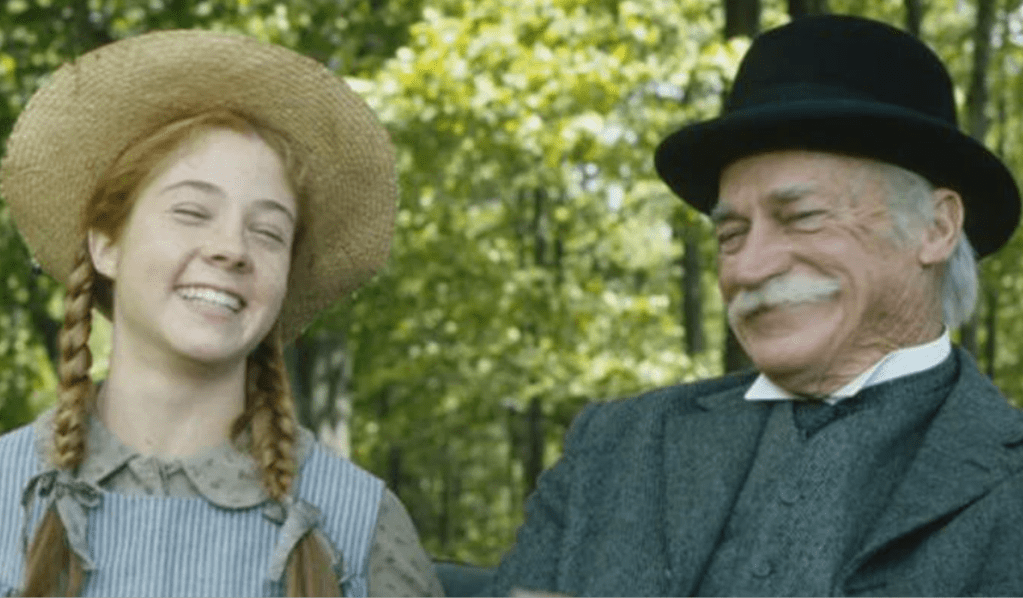
Megan Follows as Anne Shirley and Richard Farnsworth as Matthew Cuthbert in 1985’s beloved Anne of Green Gables screen adaptation.
With all the scary real-world stuff happening (that has nothing to do with Halloween), it’s good to think positive…about nice characters in literature.
Those characters can be admirably nice or cloyingly nice, but they’re…nice. (Even as they, like most people, usually have some flaws.) They can also be boring or interesting, with some of them interesting enough to carry a novel and others needing “villains” to play off of — possibly to be victimized by or possibly to triumph over. The latter scenario is of course heartening wish fulfillment when it occurs.
Nice characters come from all walks of life. For instance, Sonya — a beacon of goodness and decency in Fyodor Dostoevsky’s oft-disturbing classic Crime and Punishment — is a drunkard’s daughter forced into prostitution to help her family.
There are also moral religious characters such as Helen Burns, the very kind classmate of the young Jane Eyre in Charlotte Bronte’s equally classic novel. (It should be noted that it’s hardly a given a religious person will be moral.)
Another 19th-century-literature character in the kind category is Fanny Price of Mansfield Park. Super-nice but rather on the boring side, unlike Jane Austen’s usually fascinating female protagonists.
A more interesting 1800s character with a kind nature is Denise Baudu, the young countrywoman who moves to Paris to work in a pre-Walmart-like department store in Emile Zola’s The Ladies’ Delight.
And young Eva of Uncle Tom’s Cabin is positively angelic. Sort of one-dimensional but a potent contrast to another of Harriet Beecher Stowe’s white characters — vicious slaveowner Simon Legree — in a rare 19th-century novel with a multiracial cast giving African-Americans (such as Tom, Eliza, and George) prominent roles.
Going back further in time, the titular Joseph Andrews of Henry Fielding’s satirical 18th-century novel is comically pure of heart.
Very nice characters in 20th- and 21st-century fiction? Among the many are shy Matthew Cuthbert, who becomes Anne Shirley’s beloved adoptive father in L.M. Montgomery’s Anne of Green Gables; masochistic-until-he’s-not Philip Carey, who eventually becomes a physician in W. Somerset Maugham’s Of Human Bondage; caring, disease-stricken Jamie Sullivan in Nicholas Sparks’ A Walk to Remember; and altruistic Subhash in Jhumpa Lahiri’s The Lowland.
There are also admirably good characters who become full or sort-of social/political activists — including lapsed reverend Jim Casy in John Steinbeck’s The Grapes of Wrath, attorney Atticus Finch in Harper Lee’s To Kill a Mockingbird, reproductive-rights advocate Dr. Wilbur Larch in John Irving’s The Cider House Rules, the anti-dictatorship Mirabel sisters in Julia Alvarez’s In the Time of the Butterflies, and the anti-police-brutality teen girl Starr Carter in Angie Thomas’ The Hate U Give.
Thoughts about, and examples of, this topic?
Misty the cat says: “I’m editing a manuscript.”
My comedic 2024 book — the part-factual/part-fictional/not-a-children’s-work Misty the Cat…Unleashed — is described and can be purchased on Amazon in paperback or on Kindle. It’s feline-narrated! (And Misty says Amazon reviews are welcome. 🙂 )

This 90-second promo video for my book features a talking cat: 🙂
In addition to this weekly blog, I write the 2003-started/award-winning “Montclairvoyant” topical-humor column every Thursday for Montclair Local. The latest piece — featuring a pre-Halloween theme — is here.
 Dave Astor on Literature
Nice post Dave, I loved Matthew Cuthbert’s character, there is so much warmth in him. His subdued character contrasted against Anne’s bubbly and vivacious personality. I can think of Melanie Hamilton in Gone with the Wind, although at times her character was boring and too good to be true but it brought out Scarlett’s grey shades very well. I read Jane Eyre long back so only vaguely remember Helen Burns…
LikeLiked by 1 person
Thank you, Tanya! I totally agree about Matthew Cuthbert’s warmth, and you make a great point about his low-key personality offering such a compelling contrast to Anne’s “bubbly and vivacious” one. And, yes, nice characters can sometimes be on the boring side (as you note with Melanie Hamilton), but fortunately not always. 🙂
LikeLike
Great post Dave! After someone mentioned Lucy Mannette in the comments, I couldn’t help thinking about Charles Darnay from A Tale of Two Cities as a “nice” character. It’s interesting though how readers really root for the cynical hard-drinking Sydney Carton even before he makes his sacrifice at the end of the novel.
LikeLiked by 3 people
Thank you, Ponder Hub! Very interesting, well-stated point about those two “A Tale of Two Cities” characters! Often, a “complex” character appeals to readers more than a “nice” character.
LikeLiked by 1 person
“Nice characters” is a very pleasant topic right now! I’ve been enjoying the Thursday Murder Club series, and I’m on book 4, the final one (for now, at least). The character named Bogdan is woven throughout all the books, playing a minor or sometimes more major role. His kindness is mainly portrayed when he is always on hand to help Elizabeth with her husband, who is slipping into dementia. I love how he will play chess with him, treating him as either a worthy opponent (during his more lucid times) or as someone who knows/remembers nothing about the game.
LikeLiked by 3 people
Thank you, Becky! Bogdan sounds like a wonderful character! I loved your description of him treating the husband with dementia so kindly and respectfully.
LikeLiked by 1 person
It’s a great series, with such interesting characters!
LikeLiked by 1 person
That’s very good to hear!
LikeLiked by 1 person
I’m not sure that many people would object to a morale boost at any time 🙃 And there are various ways to get it. Kind characters or kind acts can serve as a morale boost. Which is why I’m curious: What made you opt for nice characters specifically?
LikeLiked by 3 people
Thank you, Endless Weekend! Yes, we’ll take morale boosts any way we can get them. 🙂
Over the years I’ve done blog posts on all kinds of characters — villainous ones, female ones, Black ones, Hispanic ones, Native-American ones, LGBTQ+ ones, young ones, old ones, artist ones, athletic ones, etc., etc. Nice characters were a group I hadn’t written about yet, so… 🙂 Plus that morale-boost thing just before America’s fraught election.
LikeLike
I enjoyed this a lot; pious Helen from Jane Eyre is definitely one of the “nice” characters. I found her calm acceptance of the awful treatment she and Jane received to be a bit frustrating. I guess I prefer characters with more passion, like Jane, but I can see that the nice characters have a place in literature as well that’s just as important! Thanks for sharing this interesting post! 💙
LikeLiked by 3 people
Thank you, Ada! A great point about Helen — nice, almost saintly, but passive rather than passionate. Jane is indeed a much more interesting character in Charlotte Bronte’s novel.
LikeLiked by 1 person
Some of Dickens’ young female characters were very nice, they included Agnes Wickfield in “David Copperfield” and Lucie Manette in “A Tale of Two Cities”. However those characters tended to be overly idealized and one dimensional and do not appeal to most modern readers.
LikeLiked by 3 people
Thank you, Tony! Agree with your observation about many of Dickens’ characters, perhaps especially the females, being one-dimensional. Fortunately, I think Dickens’ plots, sweep, social commentary, prose style, humor, etc., still make his novels appealing to modern readers.
LikeLike
Hello Dave,
Wow, Misty sure can edit without taking too many pawses.(Beautiful cat… I just love Misty!)
So, I read this the other day, and could not shake 2 thoughts. They are like a music ear bug.
One, Nancy Drew. In my early teens , I lived for Nancy Drew books. I’m hoping this counts.
Two, an aside, my early years in film when I worked as a seamstress, on LM Montgomery stories made into movies and tv series.
I was trained by the award winning Martha Mann (rip), who designed the original Anne of Green Gables and Anne of Avonlea and Road to Avonlea series and Jane of Lantern Hill and more.
I lived almost exclusively in the creation of LM Montgomery’s worlds for several years.
Although I made costumes for Megan Follows, Sarah Polley and others, I never got to meet them. I was buried in the sewing room.
Although once, Michael York, class act, came in for a fitting and wanted to meet the peasants in the sewing room to personally thank us.
I fell over every body part I own racing to him, and called him Tybalt. 😅 (love Zeffirreli’s Romeo and Juliette).
LikeLiked by 3 people
Thank you, Resa! 🙂 Misty appreciates the kind words, and he and I appreciate the Nancy Drew and “Anne of Green Gables” mentions! Fascinating and impressive to hear about your history of costume-making for screen adaptations of L.M. Montgomery’s creations. Sorry you didn’t get to meet Megan Follows and others, but Michael York is some compensation. 🙂 Enjoyed your comment, and its humor!
LikeLiked by 1 person
Hi Dave, you left out Pollyanna. I always remember the film with Hayley Mills. I’ll also add Paddington, who’s heart was always in the right place, Piglet (from Winnie the Pooh), Clara (from Heidi), Aunt Helen (from What Katy Did), Mary (from Little House on the Prairie), Belladonna (from Which Witch?), Captain Hastings (from Hercule Poirot’s series), Rupert (from Rupert the Bear), Anne from the Famous Five series. I think that is enough for now – smile). PS I am nearly finished ready Flatland – what a great book. Have you read it?
LikeLiked by 5 people
Thank you, Robbie! Many fabulous mentions! Obviously, I was just scratching the surface with my post, and I mostly left out nice characters from children’s books and YA fiction — so I’m very glad to see many more examples from you and other commenters. 🙂
“Flatland” by Edwin Abbott? I have not read it. Just looked at a description of it online and, wow, intriguing!
LikeLiked by 1 person
Hi Dave, yes, Flatland is a fascinating book. I will be reviewing it. I’m glad you enjoyed my character contributions. Of course, Pollyanna was the first book I thought of.
LikeLiked by 2 people
I look forward to seeing that review, Robbie! And, yes, Pollyanna was made for this blog theme. 🙂
LikeLike
Indeed 💕
LikeLiked by 1 person
🙂
LikeLike
Ohh, I forgot about Pollyanna. Loved that story! & Heidi… love!
LikeLiked by 1 person
Two wonderful books 💗🤗
LikeLiked by 2 people
Yes! 💗🤗
LikeLiked by 1 person
oh dear
For I thought about ‘Little Women’ with poor Beth, then ‘Matilda’ by Roald Dahl – (loves books, like all of us), and finally ‘The Book Thief’ by Markuz Zusaz.
But then it’s all about Misty and his editing (perfect) – sorry, Luna just walked around our laptop, and something went wrong!🐈⬛
LikeLiked by 3 people
These are good mentions, Chris. Miss Honey from Matilda was really lovely too.
LikeLiked by 2 people
Thank you, Chris! Several excellent examples! Poor Beth indeed. 😦 A very sad part of Louisa May Alcott’s novel. 😦
Ha! 😂 Misty learned his editing technique from watching pro wrestling. 🙂 And it’s seemingly no coincidence that “Luna” and “laptop” start with the same letter. 🙂
LikeLiked by 1 person
😂😂
LikeLiked by 1 person
🙂
LikeLiked by 1 person
For I thought about ‘Little Women’ with poor Beth, then ‘Matilda’ by Roald Dahl – (loves books, like all of us), and finally ‘The Book Thief’ by Markuz Zusaz.
But then it’s all about Misty and there he edited (pe
LikeLiked by 2 people
Hi Dave,
I’m pretty sure if you look this topic up on Wikipedia it will have a picture of Melanie Hamilton. The first time I read “Gone With the Wind” I did so through Scarlett’s eyes and Melly bored me to tears. But in subsequent reads she is sometimes the hero of the whole book, while still being one of the nicest characters you could ever hope to meet.
I feel much the same about Jane Bennet. Obviously “Pride and Prejudice” is all about Elizabeth and Darcy, but Jane’s niceness is always such a comfort to me, especially when it seems the heroine may not get a happy ending.
Sue
LikeLiked by 4 people
Thank you, Sue! Great opening line to your comment, and two great examples! Yes, skillfully depicted nice characters might initially seem boring but some can really grow on a reader — and give us a bit of faith in humanity when less-nice characters might not. 🙂 As is the case with your two examples, many well-known nice people in novels are supporting characters.
LikeLike
🤣🌻
LikeLiked by 2 people
🙂
LikeLike
How many nice characters you have mentioned Dave, which make me feel good! I also remember East of Eden and especially Lee, the Chinese servant and moral compass in this great novel by Steinbeck.
LikeLiked by 3 people
Thank you, Martina! Lee of “East of Eden” is a wonderful character, and I appreciate you mentioning him! He’s my favorite person in that novel, and one of my favorite characters in all of John Steinbeck’s writing.
LikeLiked by 1 person
Hi Martina, I hope you are well. Lee is a wonderful mention.
LikeLiked by 1 person
Thank you very much, Roberta🌹
LikeLiked by 1 person
My pleasure
LikeLiked by 2 people
I wish you a sunny day, together with some kind people!
LikeLiked by 1 person
🌞
LikeLiked by 1 person
A great topic, Dave. The timing feels very welcome to think about nice people, with the nastiness thrown around in the U.S. election. After reading your examples of nice people in literature, I thought of Haruki Murakami’s novels. The main characters might not be consistently nice (a good portion of Murakami’s plots are not black and white, but more ambiguous). But as the characters continue in their journeys, usually seeking clarity, they are often helpful to other people around them.
Also, I like Misty’s editing style. I should try that sometime, and the results might be better! 🙂
LikeLiked by 5 people
Thank you, Dave! Yes, the U.S. election is as nasty as can be — and I feel a huge portion of that nastiness is coming from the Trump/Vance side. 😦
I should read more of Haruki Murakami; the one novel of his I did get to (“After Dark”) I liked. From your great description, his characters sound very human.
Ha! 😂 (Your comment about Misty and editing. 🙂 ) Misty should patent his editing style, but he unfortunately shredded the patent form. 🙂
LikeLiked by 2 people
Hi Dave, I’ve not heard of this writer’s novels. Thanks, I’ll look the books up.
LikeLiked by 2 people
Mr Ruggles, dustman and father of seven in the 1937 Carnegie winner, The Family from One end street. Won’t even stop for a drink when his 12 year old daughter hasn’t come home, and prisoners are on the loose. . Fixes his family’s shoes when he can, grows veggies, and – on at most, £5 a week, hands in every penny when he finds £38 (13, 360 now) – and shares the reward with his workmate. Saves his twin sons from becoming Roland and Nigel too. They wouldn’t have lived
LikeLiked by 2 people
Mr Ruggles, father of seven, in the Carnegie winning children’s book of 1937. Dustman, does as much overtime as he can, might get less than £5 a week, but when he finds £38 = to £13, 360 now, hands it all in to the police and insists his workmate shares the reward.
Fixes his family’s shoes when he can, grows veggies, and saves his twin sons from becoming Roland and Nigel. Won’t even stop for a drink when his 12 year old girl’s out late, escaped prisoners on the loose.
LikeLiked by 4 people
Thank you, Esther! Terrific example of a nice character, very well described by you! Mr. Ruggles sounds almost saintly. 🙂
LikeLike
I think Abra Bacon in East Of Eden is a very nice person albeit a bit conflicted since she’s young and in love. And because she wants to be in love, I’d have to add Dolly Levi of Hello Dolly, the musical, based on the book The Matchmaker by Thorton Wilder. Gordie and Chris in Stephen King’s The Body, even though they are somewhat rowdy boys since both have been left to their own devices due to parental neglect.
I guess what makes someone a nice person doesn’t really depend on their being nice rather the way they handle their propensity to go off the rails whenever life’s struggle overwhelm them. As Jung observed: The diference between a good life and a bad life is how well you walk through the fire.
Nice theme about nice characters. Thanks Dave. And Misty has it right re editing. At times, perfection requires a little shredding here and there. Ha. Happy Halloween. Susi
LikeLiked by 3 people
Thank you, Susi! I appreciate the excellent examples of this theme! “East of Eden” certainly has a potent mix of nice and not-nice characters — with Cathy Ames being one of the latter. And, yes, one “proof” of being nice is how one acts during the challenging times as well as the easier times.
Ha! 😂 When it comes to shredding, at least Misty doesn’t do that to his bedding. 🙂
Happy Halloween to you, too!
LikeLike
My favourite nice character would be Robin in Robert Galbraith’s Cormoran Strike series.
LikeLiked by 3 people
Thank you, Kirsten! That’s a terrific mention! Robin IS a kind person, and a very talented private investigator. I love that J.K. Rowling series; I’ve read the first six books, and greatly look forward to belatedly getting to the seventh.
LikeLiked by 1 person
Me too, can’t wait!
LikeLiked by 1 person
🙂
LikeLike
Interesting post, Dave. I think nice guys are necessary. I like the ones you mention. I’ll add my favorite nice guy, Bob Cratchit, Ebenezer Scrooge’s clerk in A Christmas Carole.
And, for the record, I could use Misty’s editing prowess at the moment.
LikeLiked by 5 people
Thank you, Dan! Great mention of Bob Cratchit! Dickens’ vast gallery of characters definitely included many good souls. The young Florence in “Dombey and Son” is another that comes to mind.
Ha! 😂 Your comment about Misty’s editing prowess. 🙂 That cat puts more physicality into his work on a manuscript than the average editor. 🙂
LikeLiked by 2 people
Sometimes, that’s what’s required.
LikeLiked by 1 person
LOL! Especially if it’s the manuscript of “The Exercist.” 🙂
LikeLiked by 1 person
When we had our cats, MuMu used to sit on the shelf above my desk. She would look at my laptop on her way up and down, and never seemed to be impressed.
LikeLiked by 1 person
Interesting! Every cat is so different. 🙂 Perhaps MuMu preferred smartphones or desktop computers over laptops? 🤔
LikeLiked by 1 person
I used to have to keep a pad on my keyboard if I left the desk because she would jump on it on her way down.
LikeLiked by 1 person
I hear you, Dan. Cats can do some damage to keyboards. I have to close my laptop every time I get up to take a break from writing. I closed my previous laptop so often that it would no longer close all the way after several years.
LikeLiked by 1 person
HI DAn, Bob Cratchit is a great mention.
LikeLiked by 2 people
Thanks Robbie. One of the nicest characters I know.
LikeLiked by 1 person
Yes 💓
LikeLiked by 2 people
I read some time ago that the Christian author C.S. Lewis thought it was harder to write a virtuous character than an evil character. He found that it was easy to imagine the thoughts of an evil character but very hard to understand the inner life of a truly good character so he can only write about this character from the outside.
LikeLiked by 3 people
Fascinating take by C.S. Lewis, Tony, and I can see his points. Plus evil characters can be so much more…dramatic, for lack of a better word. And fiction of course usually needs drama.
LikeLike
Gabriel Oak from Hardy’s “Far from the Madding Crowd” was steady, generous, hard working, and not afraid to criticize his employer when she acted foolishly.
LikeLiked by 1 person
Thank you, Tony! That’s an excellent mention and a great description! Thomas Hardy had quite a few characters who were memorably good or memorably not-so-good.
LikeLike
Margaret Hale, the heroine from Elizabeth Gaskell’s “North and South” could be considered a “good” rather than a nice character, She was somewhat snobbish and not always likeable but she was courageous, compassionate, and had a strong sense of justice. I thought that she was better written than the novel she appeared in.
LikeLiked by 2 people
Thanks for the Margaret Hale mention! She does sound like a complex character with various good aspects amid the flaws. The only Gaskell novel I’ve read is “Cranford,” which I liked a lot but didn’t love.
LikeLike
I sometimes find that I like a certain character or characters whether good, evil, or somewhere in between than I like the novel as a whole. “North and South” was written in an old fashioned and ponderous style and had a forced happy ending that I’m not crazy about but it has some well written characters (more rounded and realistic than most of Dickens’ characters).
LikeLiked by 2 people
Interesting observations, Tony! I agree that some characters are more appealing than the novel they’re in, and that many of Dickens’ characters were not especially three-dimensional. As for Gaskell’s not-scintillating writing, I guess that helps explain why she’s considered a good but not great 19th-century author.
LikeLike
Dave, apart from the few you mention, I’m finding it difficult to recall nice major characters in literature. Perhaps, it’s because “nice characters” can be boring, unless they are involved in some struggle greater than themselves, as is the case of the attorney Atticus Finch in Harper Lee’s To Kill a Mockingbird.
LikeLiked by 4 people
Thank you, Rosaliene! You’re right that nice characters can often be on the boring side, but fortunately not all the time. And you’re also right that being involved in a cause greater than one’s self can give a “boring” character some “un-boringness.” 🙂 Your example of Atticus Finch is an excellent one; he certainly displayed courage as a white attorney representing a Black man in the mostly racist U.S. south of the 1930s.
LikeLiked by 1 person
An interesting subject, Dave, and a more-than-usually difficult one. Finding people who are more nice than anything else! Let me see … how about Miss Bates from Emma? She’s not too bright, and rather too talkative, but her heart’s in the right place. Emma is famously rude to her on the picnic, and although obviously embarrassed Miss Bates doesn’t openly wish Emma any ill by return. This next one’s a heartbreker – Giles Winterbourne of Hardy’s The Woodlanders. He loves Grace Melbury, although she prefers a man of far less worth–and Giles ends up dying because of her. Marty South, who nurses her own unrequited love for Giles is also a rather good person. She’s the only one to mourn him at the end, and her talking to him in his grave right at the end of the book always has me blubbing. Off to get tissues, and if I think of any more I’ll be back. Thanks for the post. 🙂
LikeLiked by 3 people
Thank you, Laura! Excellent mention of Miss Bates from “Emma”! Reminds me that Harriet Smith — another character in that Jane Austen novel — is also quite kind, while being treated rather shabbily by Emma for a good part of the book. Emma is certainly not the most sympathetic of Austen’s “heroines.”
And I appreciate all the interesting information about “The Woodlanders,” a Thomas Hardy novel I haven’t read.
LikeLiked by 1 person
Harriet’s sweet, if not very intelligent. And what are we like? How about Mr Knightley, the best of the best? Loves his brother, is the perfect knight who rescues Harriet when she’s snubbed by Mr Elton and gives Emma tough love when she needs it. What a guy! 🙂
LikeLiked by 1 person
Yes, that sums up Harriet in a nutshell. But we root for her, even as many readers (including myself) find the more intelligent Emma rather annoying for her meddling and such. Mr. Knightley is indeed a great guy!
LikeLiked by 1 person
And Austen anticipated this, lol. “I’m going to take a heroine whom no one but myself will much like.” 🙂
LikeLiked by 1 person
Ah, Jane Austen knew exactly what she was doing. 🙂 Readers certainly are more fond of Austen “heroines” such as Anne Elliot of “Persuasion.”
LikeLiked by 1 person
Yes, I’ve got a lot of time for Anne. 🙂
LikeLiked by 1 person
Me, too! As we might have discussed before, she’s the star of my favorite Austen novel.
LikeLiked by 1 person
A put-upon lady who manages to win through. 🙂
LikeLiked by 1 person
Yes! Delayed happiness, but happiness.
LikeLiked by 1 person
And I hope I haven’t spoiled The Woodlanders for you, if you ever read it. 😦
LikeLiked by 1 person
Not a problem! 🙂
LikeLiked by 1 person
Oh yes, Jane Eyre for me for sure! I haven’t read A Walk to Remember, but perhaps I should. 😊
LikeLiked by 3 people
Yes! I’ve reread “Jane Eyre” at least three times (though not recently).
“A Walk to Remember” is definitely “mass audience” fiction, but quite good — as was the movie version.
LikeLiked by 1 person
Your post makes me want to go back and reread some of these wonderful novels. Such memorable characters named here, Dave!
LikeLiked by 3 people
Thank you very much, Jennifer! I agree that there are some very “re-readable” novels there, and the characters in them are of course a huge part of the attraction. 🙂 Of the books I mentioned, I’ve reread “Jane Eyre” and “Anne of Green Gables” the most times.
LikeLiked by 1 person
I am a huge fan of nice people in books. In fact, if a book doesn’t have at least one likable character, I rarely finish it. Luckily, most books do. One character I like a lot is Ellie in ABOUT A BOY (Nick Hornby), a teenage girl who befriends (and defends) 12-year-old Marcus, who is being bullied. I greatly enjoy Margaret Kennedy, a British author who wrote from the 1920s to the 1960s and used to be much more well-known than she is now. She has several characters I’d almost consider friends. One is Lucy Carmichael (in Kennedy’s 1951 book of the same name), and the other is Caroline Knevett, an “unorthodox saint” (although not of the religious variety) in Kennedy’s NOT IN THE CALENDAR.
LikeLiked by 3 people
Thank you, Kim! Yes, it’s a rare novel one can easily get through without it having at least one likable character — even if she or he is a secondary one.
I appreciate the excellent examples you offered! Re Ellie, a character who defends a bullied/”unpopular” character is definitely a person to like and admire. And I’m intrigued by your mention of Margaret Kennedy, who I had not heard of.
LikeLiked by 1 person
Don’t feel bad–I think very few people today have heard of Margaret Kennedy. She wrote a number of novels, and I haven’t liked all of them, but in my opinion, the two I’ve mentioned are very good.
LikeLiked by 1 person
Two very good novels can be plenty! 🙂
LikeLike
I can’t think of any good characters who had no flaws. That’s what makes them human. I’d expect that I’ve read about purely good characters, but I don’t remember them. Misty puts the old blue pencil method to shame.
LikeLiked by 3 people
Thank you, Liz! I didn’t mean to imply in my post that nice characters have no flaws; it’s more that those characters are mostly good overall. (I’ll do a needed minor edit of the post after I send this reply. 🙂 )
Ha! 😂 Misty’s editing method is indeed rather innovative. 🙂
LikeLiked by 1 person
You’re welcome, Dave!
“Innovative” is one way to look at it!
LikeLiked by 2 people
Ha ha! 😂
LikeLiked by 1 person
Haha, Liz, you can’t remember truly good characters because they are so boring. We remember the interesting characters like Scarlett O’Hara and Rabbit (Winnie the Pooh).
LikeLiked by 2 people
Exactly, although I’ll always remember Winnie the Pooh. Scarlett O’Hara came off better in the movie than in the book.
LikeLiked by 1 person
I haven’t seen the movie so that is interesting to know.
LikeLiked by 3 people
I think that totally good characters need to be treated with extreme care to avoid them seeming a bit flat, not as well-rounded as we are in real life, unless we are saints😇
LikeLiked by 5 people
Thank you, Luisa! Great point! There is indeed a danger that very nice characters might not be depicted three-dimensionally enough. Even the nicest people have some flaws. Except saints, of course, as you note. 🙂 (Doesn’t apply to America’s New Orleans Saints football team. 🙂 )
LikeLiked by 1 person
Thanks a lot for the nice reply! 🙏🙏🙏 You are always very kind, dear Dave! I appreciate both this and your precious friendship
LikeLiked by 1 person
You’re very welcome, Luisa, and the feeling is mutual. 🙂
LikeLiked by 1 person
🙏💙🙏
LikeLike
🙂
LikeLiked by 1 person
Good job, Misty.👏🏻
LikeLiked by 4 people
Ha, Melissa! 😂 Misty thanks you, and says he’ll even edit manuscripts from the “slush pile.” 🙂
LikeLiked by 2 people