
Some authors are good at two or more things: novels and short stories, fiction and nonfiction, literary fiction and mass-audience fiction, etc. For this post, I’ll add to that by focusing on authors who are good at series as well as standalone novels. It certainly requires some different writing muscles to wrap up things in one book vs. extending things across multiple books.
This topic occurred to me last week as I read Val McDermid’s A Place of Execution, a superb standalone novel with a concluding twist that will knock your socks off. My previous experience with McDermid was with her series fiction, including the books starring “cold case” detective Karen Pirie.
I followed A Place of Execution with Martin Cruz Smith’s Independence Square — his 10th in the series starring Russian investigator Arkady Renko that began with Gorky Park. (Independence Square was okay; not as good as the earlier Renko books.) Smith has also written standalone novels such as Rose.
Sometimes, authors toggle throughout their careers between standalone books and series — as has been the case with Smith and McDermid as well as authors such as Walter Mosley with his Easy Rawlins books and much more. Other times, authors start with standalone novels before hitting on a hit series and focusing on that — as did Sue Grafton, who wrote two standalones before launching her popular Alphabet Mysteries (25 in all; she reached the letter “Y” before she died).
J.K. Rowling has also written many more series novels than standalone ones: seven Harry Potter books, then The Casual Vacancy one-off, then seven Cormoran Strike/Robin Ellacott crime novels (so far).
L.M. Montgomery followed her classic Anne of Green Gables with seven sequels over the years, during which time she also penned the Emily trilogy and standalones such as The Blue Castle.
Stephen King is known mostly for standalone novels, with a sprinkling of sequels and trilogies, but has also written many books in The Dark Tower series.
Some long-ago authors also toggled. For instance, James Fenimore Cooper wrote the five “Leatherstocking” novels (including The Last of the Mohicans) as well as various standalone books. Alexandre Dumas did both as well — many standalones (most famously The Count of Monte Cristo) as well as The Three Musketeers and its five sequels (sometimes published as fewer sequels when certain books were combined into one edition).
Your thoughts about and examples of this topic?
Misty the cat says: “My fitness tracker better record backward steps.”
My comedic 2024 book — the part-factual/part-fictional/not-a-children’s-work Misty the Cat…Unleashed — is described and can be purchased on Amazon in paperback or on Kindle. It’s feline-narrated! (And Misty says Amazon reviews are welcome. 🙂 )

This 90-second promo video for my book features a talking cat: 🙂
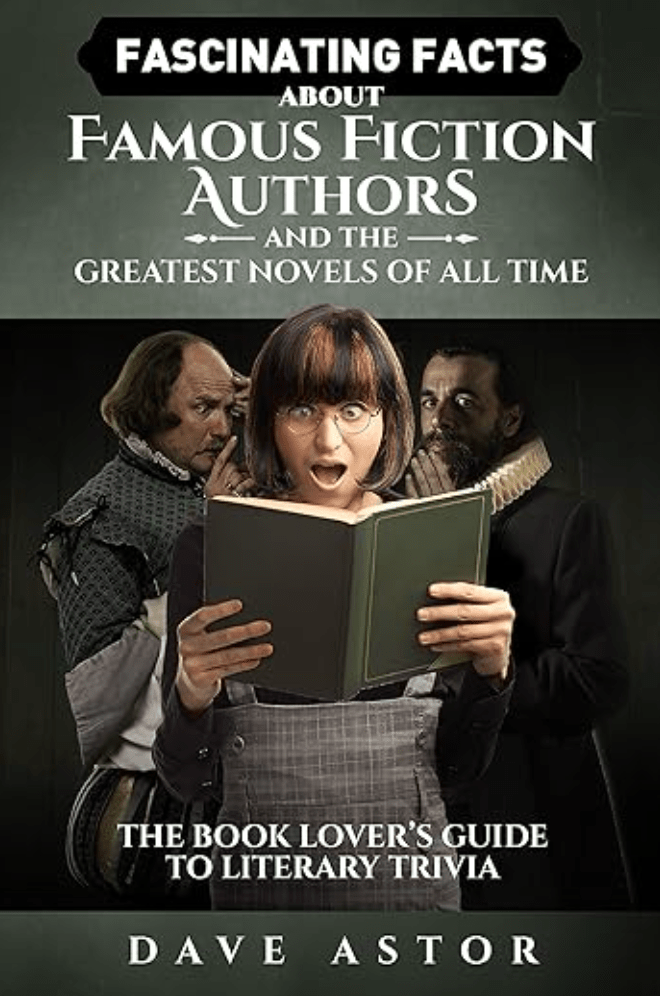
I’m also the author of a 2017 literary-trivia book…
…and a 2012 memoir that focuses on cartooning and more.

In addition to this weekly blog, I write the 2003-started/award-winning “Montclairvoyant” topical-humor column every Thursday for Montclair Local. The latest piece — about a lot of school news during a non-school time — is here.
 Dave Astor on Literature
Engaging read
LikeLiked by 3 people
Thank you, Swamigalkodi Astrology!
LikeLike
Hi Dave,
Like so many people I got completely swept up in the “Twilight” craze. The night that I finished the first book I went well out of my way to the only bookseller I could find still open to buy all the sequels because I wanted to be able to read them one after the other (which I rarely do). I’ve read them another time or two since then and while they still have nostalgic value, I have to admit that Stephenie Meyer isn’t the most talented writer going around. Then a few years ago I stumbled on her stand alone, non supernatural “The Chemist” which I finally started reading this week. Again, her writing won’t win any literary awards, but I’m having a surprisingly good time with the characters that she’s created that have nothing in common with vampires and werewolves. She has much more diversity than I would have given her credit for.
Sue
LikeLiked by 3 people
Thank you, Sue! I’ve never tried Stephenie Meyer’s books; maybe I should. Glad you found that lone open bookstore. 🙂 There are indeed writers who tell a good story while not being top wordsmiths; I thought that was also the case with Dan Brown’s clunky but compelling “The Da Vinci Code.”
LikeLike
Hi Dave, I tend to avoid series although I did read 6 1/2 of the Harry Potter books and 21/2 of the Lord of the Rings trilogy. The half being the last books in both series which became so drawn out and boring for me, I skipped to the end. I do like Aggie Christie’s series but have not read a standalone book of hers ( not sure if she wrote any). I started the Regeneration series by Pat Barker. The first was brilliant but the second had to much sex for me. I was interested in the history. The same thing happened with Bernard Cornwall’s Sharpe series – it became to sex and relationships focused for me. Nice post.
LikeLiked by 1 person
Thank you, Robbie! I loved the “Harry Potter” series and “The Lord of the Rings” trilogy; glad you read most of each. There were indeed tedious spots in both works, but most of the rest was quite compelling, I thought. And, yes, some series or trilogies can lose a degree of appeal after the first book, but of course not all. For instance, I thought Stieg Larsson’s Millennium Trilogy started great and just got more and riveting.
LikeLike
Because I read mainly mysteries, I read lots of series, and over the years there must have been 50 or more mystery writers whose next books I was looking forward to (some of them have died, like P D James, Dick Frances, or Margaret Maron) and I’m still adding new people (new to me, at least) like Mick Herron. But I also read novels that stand alone, with or without a mystery involved. The great thing about mystery series is how much you look forward to meeting your old friend(s), the detective(s), again. But I don’t NEED to meet characters again–a good novel should give you a great feeling of satisfaction when it ends, assuming enough of the threads you’ve been following are tied up.
I’ve written a quartet of mystery novels, the Linder and Donatelli books, and I think each one stands on its own. The quartet also provides a feeling of conclusion with the fourth book. I may write a fifth, but right now I’m starting to work on a standalone novel. It’s a new challenge!
So, this is a topical post for me, Dave.
LikeLiked by 1 person
Thank you, Kim! Glad you can relate to this post, partly because of your own book writing. 🙂 Great observation that mystery/detective fiction often lends itself to the series format — with the same sleuth returning for additional cases. 🙂 And I agree that the way authors wrap up things is very important, whether they’re concluding a series or a standalone novel.
LikeLike
Many thanks Dave for all your book proposals and above all for Val McDermid’s A Place of Execution, of which I have never heard about and you made me curious!
LikeLiked by 1 person
Thank you, Martina! “A Place of Execution” was one of the cleverer/more original mysteries I’ve read. Not exactly an upbeat novel, but very atmospheric.
LikeLike
:):)
LikeLiked by 1 person
🙂
LikeLike
Gosh, where to start? All those books I have read, and so many different genres. So, I will just say… that was very interesting. Oh, and yes, I have seen ‘The Mousetrap’ more than twice – say nothing!
LikeLiked by 1 person
Thank you, Chris! It is definitely a pleasure to read all kinds of books — standalones, novels in series, different genres…
I need to do some catching up in seeing “The Mousetrap”! 🙂
LikeLiked by 1 person
I haven’t read ‘A Place of Execution’ by Val McDermid, but am intrigued after your recommendation! The most recent standalone book I’ve read is “Thinner” by Stephen King. It’s my first book by this author, and I’m flabbergasted to say the least (it was awesome!). 😊📚
LikeLiked by 1 person
Thank you, Ada! I hope you enjoy “A Place of Execution,” if you get to it. It would be great even without the surprise ending, but the surprise ending was a bonus. 🙂
Wow! You have a LOT of Stephen King reading ahead of you, if you want that. 🙂
LikeLiked by 1 person
Impressive writeup
LikeLiked by 1 person
Thank you, Swamigalkodi Astrology!
LikeLike
Interestingly Dave, I don’t tend to read sequels of novels, I prefer standalone novels! ‘A Place of Execution’ by Val McDermid has certainly caught my eye especially as you have mentioned the twist ending!!! Sounds good!! Dave, I’m trying to fathom where Stephen King is getting the material to write sequels!! His standalone books are already on the long side!!! Have a lovely week and thank you. Sharon
LikeLiked by 3 people
Thank you, Sharon! Sequels to novels can disappoint or be very satisfying, but if I really like a novel that has a sequel, it’s hard for me to resist reading it. 🙂
I did not see the ending of “A Place of Execution” coming; I could recall some clues in retrospect, but not at the time.
As for Stephen King, he’s insanely productive in every which way.
Have a great week too!
LikeLiked by 1 person
Hi Dave! Thank you for your comment! However, please ignore me…!!! Your post was about authors who write in a series as opposed to sequels!! I think a series can be interesting especially if the main character is strong such as Inspector Morse by Colin Dexter. Oh, I love a good twist ending and Val McDermid is just the writer to do that well!! As for Stephen King, he will continue to amaze me!! Thank you once again Dave, your posts are always refreshing to read. With best wishes, Sharon
LikeLiked by 1 person
I appreciate the follow-up, Sharon! Yes, a good series needs a strong main character (and strong supporting characters don’t hurt 🙂 ).
The impressive Val McDermid definitely keeps her readers guessing.
As for the prolific Stephen King, I assume he also writes in his sleep. 🙂
LikeLiked by 1 person
Dave, you are so welcome! Nothing gives me more pleasure than discussing books!! I agree with your points about what makes a good series!! Val McDermid is indeed a great writer!! As for Mr King!! I came to the same conclusion as you, he must write those long books in his sleep!!! 😄. Thanks again.
LikeLiked by 1 person
I agree, Sharon — discussing books is wonderful! (Including Stephen King writing in his sleep. 🙂 )
LikeLiked by 1 person
😂
LikeLiked by 1 person
🙂
LikeLiked by 1 person
Great post, Dave. Interesting comments as well. I especially liked the consideration of whether it’s a series or just familiar characters in standalone stories.
LikeLiked by 2 people
Thank you, Dan! Standalone books that might have some characters from previous books definitely blur the line between novels that are totally standalone and a series. 🙂
LikeLiked by 1 person
Dave, as always your posts open a door to thinking about books in new ways. The comparison between authors who write both standalone and series fiction is especially rich—each format calls forth a different kind of storytelling rhythm, doesn’t it? I love both the standalone and the series. Of course my most favourite series, as you know is Lord of the Rings!!! And what would we do without Sherlock Holmes. But there are others that I have taken the step to read the next one….
One of my favourite series is by Tarquin Hall, who created the wonderfully astute and delightfully human detective Vish Puri, “India’s most private investigator.” I discovered the series through another favourite “series” author of mine, Alexander McCall Smith, who recommended Hall’s work
I especially appreciate how Tarquin Hall’s books combine mystery with warmth, humour, and cultural texture. The Vish Puri series may be detective fiction, but it also captures the atmosphere and contradictions of modern India. There’s something beautiful about a series that not only entertains but also allows us to travel and reflect—to enter into another rhythm of life.
What I find interesting is that in many cases, a good series can also function like a collection of standalones. Take Vish Puri or even Agatha Christie’s Poirot—the story is complete in each book, but we return to spend more time with the character, not necessarily because we’re following an unresolved arc. It’s a relationship, not a cliffhanger.
That’s quite different from something like The Lord of the Rings, where the trilogy is a single story told in three acts. Both approaches have their magic—one invites us to return for companionship, the other to journey toward a conclusion.
Thank you again for a most excellent discussion. I look forward to Sundays to meet up with you and this amazing collection of book-lovers.
LikeLiked by 5 people
Thank you, Rebecca! Yes, definitely a different storytelling rhythm between standalone novels and series.
“The Lord of the Rings” and the Sherlock Holmes novels and short stories — classics!
I appreciate the mention of Tarquin Hall and his Vish Puri series! Will have to give that a try. The first book was “The Case of the Missing Servant,” from what Wikipedia tells me. Good detective fiction can indeed almost be literary fiction in some cases.
Yes, a series can contain books that totally work as standalones. I remember the first Jack Reacher novel I read by Lee Child was the 14th in the series (“61 Hours”) and I found it very compelling even without knowing the character’s backstory and previous adventures.
“It’s a relationship, not a cliffhanger” — great line!
LikeLiked by 3 people
Interesting theme, Dave. I imagine that, for authors, the mixture of stand-alone and series may offer a challenge they crave and/or alternative ways of telling the stories that drive them. Agatha Christie’s murder mystery series, featuring Poirot and Miss Marple, fascinated me as a young adult reader. These days, I prefer standalone novels, including those by my favorite authors.
LikeLiked by 3 people
Thank you, Rosaliene! I agree that for some authors, doing things differently from project to project is a real draw — and one way to vary creativity is to write standalone books as well as series.
The majority of the few Agatha Christie books I’ve read I also read when I was younger. 🙂
I have a preference for standalone books, too, but do enjoy some series a lot — including Lee Child’s Jack Reacher novels.
LikeLiked by 1 person
Yet another great topic, Dave. I’d like to add Honore de Balzac’s ‘La Comedie Humaine’, which is vast, having some standalone novels, with others connected and recurring characters appearing in more than one book. ‘La Pere Goriot’ and ‘La Cousine Bette’ are two of the better known, and which I’ve read. There’s also the late, great naturalist and author Gerald Durrell, who wrote The Corfu Trilogy as well as many standalone books such as ‘The Whispering Land’. Yet another is another late and great author, the Egyptian Naguib Mahfouz, author of The Cairo Trilogy as well as standalones such as ‘Children of the Alley’, which got him attacked for similar reasons to Salman Rushdie (long before Rushdie’s attack). I read and reviewed this latter novel not long ago, and reviewed it on my website. On the lighter, Jean Plaidy (long gone) wrote historical books, often as a set of three about such personages as Mary, Queen of Scots, Charles II of England and Scotland, Catherine de Medici and Lucrezia Borgia. On a personal level, my debut meant-to-be-standalone novel ‘Fairytales Don’t Come True’ turned into a six-volume family series, while my ‘You Know What You Did’ suggested a sequel, which I eventually wrote, as ‘What Else Did You Do?’. My latest publication, ‘An Honourable Institution’ is a standalone, however – for the time being. Thanks for the usual mind-exercising post, Dave, and have a good week. 🙂 🙂
LikeLiked by 3 people
Thank you, Laura! Yes, the books in Balzac’s La Comedie Humaine definitely have interconnections, and would of course influence Zola’s later Rougon-Macquart novels. “Old Goriot” is excellent, and one of these days I have to read “Cousin Bette.”
I appreciate the mention of various trilogies and such, and how you yourself have mixed series and standalone efforts! And, yes, a standalone will not necessarily stay a standalone. (In some cases, the sequel can arrive years later, as with Margaret Atwood’s “The Testaments” follow-up to “The Handmaid’s Tale.”)
LikeLiked by 3 people
🙂 🙂 🙂
LikeLiked by 2 people
🙂
LikeLiked by 2 people
I enjoyed Steig Larsson’s Millenium series and Ray Bradbury’s Green Town Trilogy beginning with Dandelion Wine. Yet I don’t really care for series book since they can become problematic. For instance, if you lose your place, say in book 2, you almost have to reread book 1 or a significant part of it. It’s sort of like deja vu– been there, read that or have I? Yikes! Nor do I like streaming movies although with movies one can fast-forward and rewind. Post-it notes and book markers can help, but often not. When you lose your place, you may also lose the initial experience.
Nice theme Dave. Susi
LikeLiked by 3 people
Thank you, Susi! Excellent observation! And if one doesn’t read the next book in a series fairly soon after finishing the previous one, a person might forget some things and lose the flow.
I loved the Millennium trilogy and liked “Dandelion Wine”; didn’t know the latter was part of a trilogy!
LikeLiked by 1 person
Fab topic Dave, thank you!
I’m citing Agatha whose favourite series character is Poirot, and then Miss Marrple.
However, she has many stand alone books, of which I have read one, And Then There Were None.
🤭 Bonus: I’ve seen her play “The Mousetrap” several times, and it’s terrific!
LikeLiked by 5 people
Thank you, Resa! I appreciate the mention of Agatha Christie! I haven’t read enough of her to know: Are the books starring Poirot and Miss Marple considered series per se, or standalone mysteries with those sleuths as recurring characters?
Of the six (?) so Christie novels I’ve read, “And Then There Were None” is definitely my favorite. 🙂
I unfortunately have never seen “The Mousetrap.” Great that you have!
LikeLiked by 3 people
I always thought they were both series.
In searching it, just now, answers refer to them as series.
I also think they could be “standalone mysteries with those sleuths as recurring characters” as you don’t necessarily need to read them in any order.
It seems a fine line here.
Mousetrap is perhaps the best play I have seen where I can say – If you want to take someone to the theatre who is not interested in theatre/never been exposed – This is the play you should take them to.
They will like the theatre!
LikeLiked by 4 people
A fine line indeed. 🙂 The definition of a series can be kind of fluid. 🙂
If one of the local or regional theaters in my area ever put on “The Mousetrap”…
LikeLiked by 4 people
You’ll go?
LikeLiked by 1 person
I would! There’s a community playhouse in my town that I’ve been to maybe 25 (?) times over the years and a larger theater of near-Broadway quality about 10 miles south of me.
LikeLiked by 1 person
Nice!!!
We have lots of huge theatres where big Broadway productions come, but I prefer the smaller playhouses. Here one gets local theatre companies doing cool smaller $$ productions like “Mousetrap” and plays by new unknowns, etc.
I hope this form of entertainment survives modernity.
LikeLiked by 1 person
Not surprised that Toronto has all those options, Resa. A great city! I really enjoy smaller playhouses, too. At the one in my town, the performers often come to the lobby after the plays to meet attendees. And, yes, I hope live theater never goes away.
LikeLiked by 1 person
I believe the arts will survive, even if they have to go underground.
LikeLiked by 1 person
I imagine they will, in some form.
LikeLiked by 1 person
Sigh!
LikeLiked by 1 person
Dave, you’re so well-read! I’m no match and can’t do proper justice to the topic. The only example I can readily come up with is Émile Zola, who wrote many great stand-alone novels, including the famous Les Rougon-Macquart cycle, which is effectively an ecosystem of 20 novels that very well bear to be read outside of the Rougon-Macquart context. Great post!
LikeLiked by 3 people
Thank you, Dingenom! Great that you mention that Emile Zola cycle! I’ve read maybe 10 of the 20, and found most of them very compelling. “Germinal,” “The Drinking Den,” “The Masterpiece,” “The Beast in Man,” etc. Interestingly, as you know and allude to, that Zola cycle is kind of a hybrid of standalone and series fiction; each Rougon-Macquart novel can stand alone, yet members of the same extended/multigenerational families appear and some individual characters make multiple appearances — starring in one book and being a secondary player in another.
LikeLiked by 3 people
Exactly. I’ve always found it quite modern.
LikeLiked by 2 people
Yes! Zola was ahead of his time for a 19th-century novelist.
LikeLiked by 1 person
I don’t generally read series novels; I prefer standalone novels. I feel like I have more freedom. 🙏💙🙏
LikeLiked by 3 people
Thank you, Luisa! I hear you — reading a series can get a reader locked in for a while, leaving less time for other authors’ books. But I do like mixing series and standalone books, while reading more of the latter than the former. 🙂
LikeLiked by 2 people
Thanks a lot, dear Dave, for your kind reply❣️
LikeLiked by 2 people
You’re welcome, Luisa! 🙂
LikeLiked by 2 people
🙏🌹🙏
LikeLiked by 2 people
🙂
LikeLiked by 2 people
Interesting food for thought. I actually considered writing my book, ‘Reunions And Secrets’ as a stand alone – and then I reached the end. Yes, there’s a second book and a third, fourth… up to eight so far.
LikeLiked by 2 people
Thank you, rsangel! As your situation illustrates, sometimes a story just has to be a series rather than a standalone; one book doesn’t offer enough space. 🙂 Congratulations on the eight books!
LikeLiked by 2 people
I used to read series when I was younger but not any more. I don’t need the added pressure to read another book to find out what happened.
LikeLiked by 3 people
Thank you, Liz! You’re right that there are disadvantages to reading a series — including the need to keep reading additional books to get the full picture. And of course some series go downhill, even as others improve as they go along. Still, I’m a fan of certain series and often enjoy the familiarity of reading the next book. 🙂
LikeLiked by 4 people
The other factor for me is that I’m trying to read a wide range of books and authors.
LikeLiked by 2 people
Reading series definitely means reading fewer authors and a smaller variety of books!
LikeLiked by 3 people