
Yesterday, a massive total of nearly seven million people attended the 2,700-plus “No Kings” rallies in the United States and abroad to protest Trump’s fascist/authoritarian regime as that Republican administration ignores Congress, enriches itself, cracks down on peaceful dissent, arrests innocent people of color, invades American cities for no good reason, meddles in other countries’ affairs, starts or supports wrongful military actions around the world, etc. Which, as a literature blogger, reminded me of kings and other royalty in fiction — including historical fiction.
Of course, some royalty can be partly benevolent, but in many cases all that power heightens a ruler’s nasty instincts, makes a corrupt person even more corrupt, and increases the entitlement of the already entitled. Also, being a member of royalty doesn’t exactly involve the merit system.
I’ve never deliberately sought out novels containing royal characters, much preferring to read about the lives of “everyday” people. But privileged aristocrats have popped up here and there in my reading.
For instance, when long ago working through many a great book by Mark Twain, I polished off The Prince and the Pauper (two boys changing places) and A Connecticut Yankee in King Arthur’s Court (in which a certain king appears).
Another 19th-century novel, Alexandre Dumas’ 17th-century-set The Three Musketeers, includes King Louis XIII and Queen Anne as secondary characters.
In Charles Dickens’ A Tale of Two Cities, King Louis XVI and King George III are referenced.
Some novels written in the 20th and 21st centuries also include royal characters. Hilary Mantel’s Wolf Hall has Henry VIII and other monarchical personages, Josephine Tey’s The Daughter of Time harkens back to King Richard III, Robert Graves’ I, Claudius features the Roman emperor of the book’s title, J.R.R. Tolkien’s The Lord of the Rings has the would-be king Aragorn, and Philippa Gregory’s Earthly Joys has the Duke of Buckingham.
There’s also William Goldman’s The Princess Bride, Meg Cabot’s The Princess Diaries, Antoine de Saint-Exupery’s The Little Prince, Lewis Carroll’s Alice’s Adventures in Wonderland and its Queen of Hearts, C.S. Lewis’ The Chronicles of Narnia and its King Tirian, Diana Gabaldon’s Outlander and its King Louis XV appearance, Margaret Landon’s Anna and the King of Siam that inspired The King and I musical, and so on.
Of course there’s royalty, too, in various Shakespeare plays and in other stage creations such as Eugene O’Neill’s The Emperor Jones, Lin-Manuel Miranda’s Hamilton (King George III), etc.
I’m sure I’ve only touched the surface here. Any additional examples of, or thoughts about, this topic?
Misty the cat asks: “What’s the new White House ballroom doing here?”
My comedic 2024 book — the part-factual/part-fictional/not-a-children’s-work Misty the Cat…Unleashed — is described and can be purchased on Amazon in paperback or on Kindle. It’s feline-narrated! (And Amazon reviews are welcome. 🙂 )
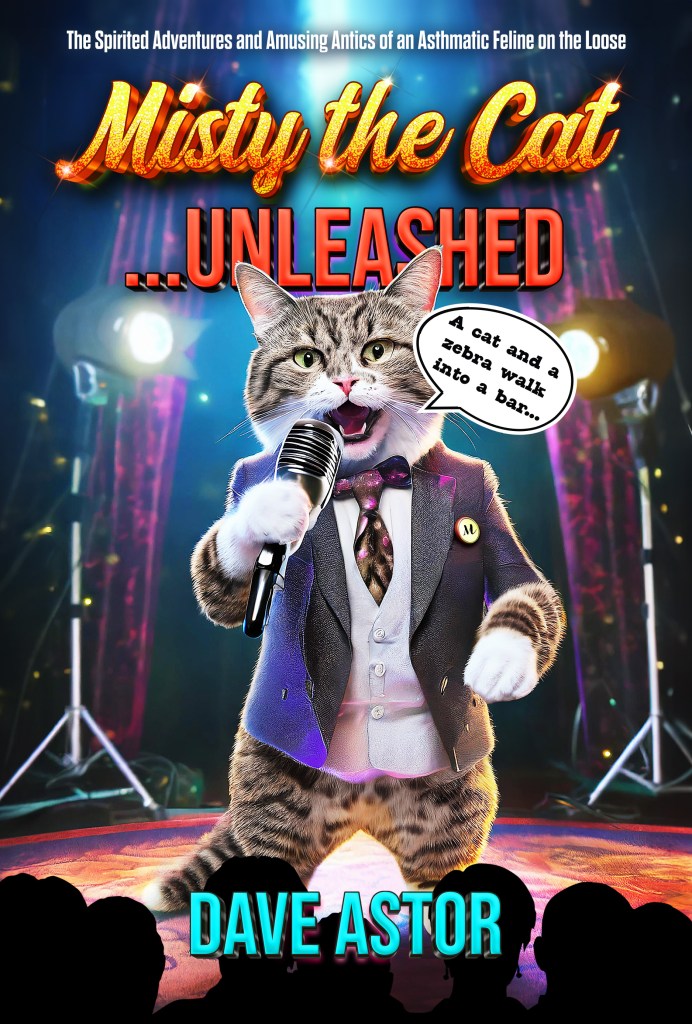
This 90-second promo video for the book features a talking cat: 🙂
I’m also the author of a 2017 literary-trivia book…

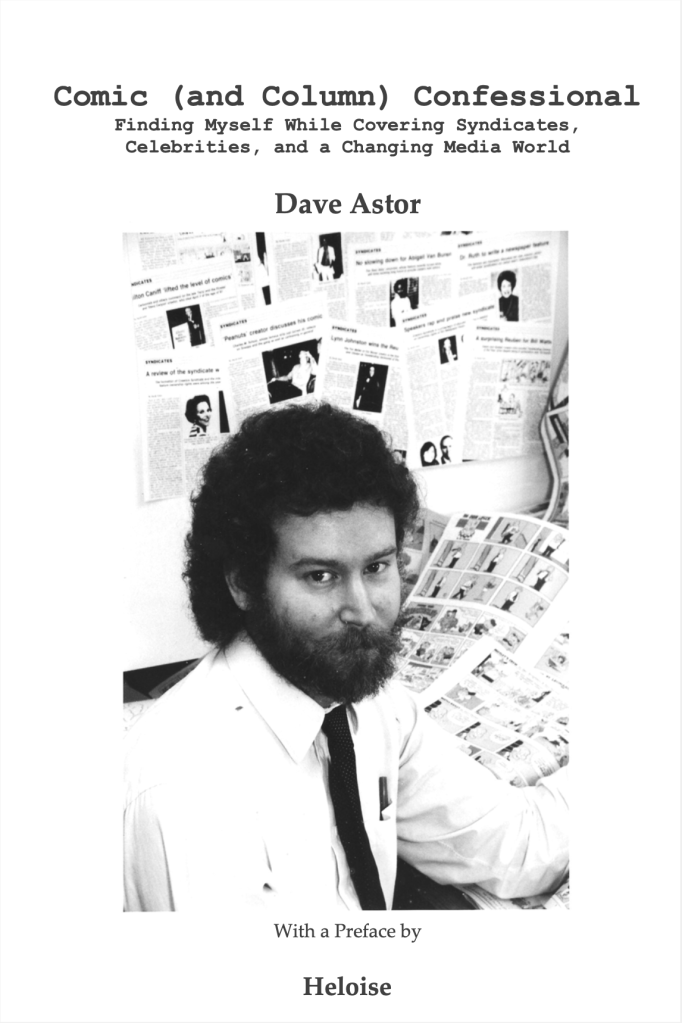
…and a 2012 memoir that focuses on cartooning and more, and includes many encounters with celebrities.
In addition to this weekly blog, I write the 2003-started/award-winning “Montclairvoyant” topical-humor column every Thursday for Montclair Local. The latest piece — about wondering how to vote in a controversial local tax referendum that will be held this December because of a huge school district deficit — is here.
 Dave Astor on Literature
I have no issues with monarchies. I know that hereditary rulers stand against all democratic principles, but most of the ones that survived the second world war have a rather ceremonial function and take as head of state a rather apolitical stance that functions as nexus of conciliation. Most modern monarchs have a long time view and have no incentive for fast enrichment or drive fast a certain agenda through, while presidents have a prescribed four or five year term to fill their pockets and realise their agendas (often by disdaining a big chunk of their population: the so called dictature of the 50% +1). Take a look at the British, Danish, Dutch, Belgian, Norwegian, Spanish, Luxembourg, Japanese, and compare those heads of states with most presidential regimes.
LikeLiked by 1 person
Thank you, Shaharee! I hear you about how a lot of royalty these days is essentially ceremonial and not particularly harmful, but they still suck up a lot of money for their palaces/lifestyle that could be used for better purposes. You’re right that elected officials are often worse.
LikeLike
Wow, Dave — what a fascinating roundup! You’ve covered such an incredible range, from the classics to contemporary works. I love how you highlighted that even when we gravitate toward stories of “everyday” people, royalty still manages to slip into the narrative — often reflecting power, privilege, or the human condition in striking ways.
I’d add The Other Boleyn Girl by Philippa Gregory, which gives such a gripping, personal angle to the Tudor court. And perhaps Hamnet by Maggie O’Farrell, which, while not about royalty per se, beautifully contrasts ordinary life with the looming world of kings and queens that shaped Shakespeare’s time.
It’s interesting how royal figures, even in fiction, often serve as mirrors for the rest of us — showing that love, ambition, and loss don’t spare anyone, crown or not. 😃💕👑
LikeLiked by 2 people
Thank you, Carolyn! Happy you enjoyed the post! Yes, royal characters do seem to crop up in both older and newer fiction. And Philippa Gregory definitely seems to have a thing for a certain kind of historical fiction.
A great, well-stated point that while royal characters are certainly more privileged than most other people, they have the same emotions and can have some of the same problems as everyday folk. Nearly every human is of course going to have illnesses, and every human will die. (Well, the title character in H. Rider Haggard ‘s “She” was 2,000 years old, but I assume she had problems with Social Security after a while. 🙂 )
LikeLiked by 1 person
That’s such a great point, Dave—royalty or not, no one escapes the universal challenges of being human. And your one-liner about “She” made me laugh out loud. I imagine the Social Security office would have had quite a time processing that claim! 😂😂💕💕
LikeLiked by 1 person
I suppose things would even out if a Social Security recipient lived to minus-2,000 years old. 🙂
LikeLiked by 1 person
Haha! At that point, Dave, Social Security would probably owe them the entire national budget!
LikeLiked by 1 person
Ha! 😂
LikeLiked by 1 person
Well delivered my friend. Thank you for courageously sharing this! 😊🙏🏼🥰 I think we are beyond disgusted. Pure garbage with a foul odor! 😣😠😖
LikeLiked by 1 person
Thank you, Kym! Glad you liked the post! Beyond disgusted is exactly right. The current U.S. president is so vulgar, so corrupt, so hateful, etc., it boggles the mind. 😦
LikeLiked by 1 person
Dave, there are not enough adjectives in the dictionary to define the level of disgust we’re feeling…and the enablers are even worse! UGH! 😣😝😖
LikeLiked by 1 person
Yes, Kym! On some level, Trump is who he is. But some of his enablers know better, and several of them — such as J.D. Vance and Marco Rubio — harshly criticized Trump in the past before opportunistically selling their souls to him.
LikeLiked by 1 person
Selling their souls is spot on Dave! But oh the consequences they have to bear – sooner or later – and it seems like it may be sooner than later! In the words of Mr. T…I pity the fool. 😝🤦🏻♀️😱
LikeLiked by 1 person
Love the Mr. T reference, Kym! 🙂 I remember “The A-Team” TV series. 🙂
I hope you’re right that there will be some comeuppance for the Trump soul-sellers — preferably soon, but later would be better than nothing.
LikeLiked by 1 person
Yep Dave, the way karma works, consequences are inevitable. We will continue to fight however, with what we have…BRAIN POWER! 👍🏼 We will not be denied democracy! Not today and tomorrow ain’t lookin’ too good either! 😜
Enjoy the rest of your amazing weekend my friend! 🥂🍷🍺
LikeLiked by 1 person
Well said, Kym! Yes, the right approach is to keep fighting — while crossing our fingers that karma eventually kicks in.
Hope you’ve had a good weekend, too!
LikeLiked by 1 person
Somehow Dave, I think in spite of it all, we’re going to be okay. It’s the others that need to worry! LOL 😜
LikeLiked by 1 person
There are certainly plenty of people in Washington, DC, now who merit future jail sentences.
LikeLiked by 1 person
Dave, that is a truth that I dare not argue with. Both of us would have been jailed by now on much lesser crimes! UGH! 😜😡😝
LikeLiked by 1 person
Absolutely, Kym! Such an unequal “justice” system. 😦
LikeLiked by 1 person
Don’t you know it my friend? A monumental injustice on so many levels! 😡 Unreal! ⚖
LikeLiked by 1 person
Yes! Definitely a two-tier system — with most rich white males able to get away with almost anything. 😡
LikeLiked by 1 person
😖🤦🏻♀️😱
LikeLiked by 1 person
😦
LikeLiked by 1 person
Hi Dave, and sorry I’m running late with my comments. As someone who has always read fantasy and science fiction, I’ve run into a lot of royalty, good and bad. One example from science fiction is John Scalzi’s Interdependency series (2017-2020), which starts with THE COLLAPSING EMPIRE. In this series, the Empress is a positive character. As a reader and writer of mysteries, I’m familiar with a fun series by S J Bennett, in which Queen Elizabeth II is a behind-the-scenes solver of crimes, with the help of her staff.
LikeLiked by 1 person
Thank you, Kim! Not late at all. 🙂 Nice mention of some fantasy and sci-fi novels including royalty, often on fictional worlds and on worlds beyond Earth. Another character who comes to mind is the Grand Lunar in H.G. Wells’ “The First Men in the Moon.”
Queen Elizabeth II as a detective? Hmm. 🙂 I guess plenty of time to do different things during her very long reign. 🙂
LikeLike
Hi Dave, an interesting topic this week. Your assessment of people in power resonates with me. Many have become mass murderers as they aspire for more control, power, money and land. On the books front, there are upper classes in Jane Eyre, Tess of the D’Urbervilles, Agatha Christie’s many novels, some of Enid Blyton’s children’s books and War and Peace. Naturally, the many books about the Tudors feature King Henry VIII. Even All Quiet on the Western Front features German aristocracy.
LikeLiked by 1 person
Thank you, Robbie! Yes, some people in power have been mass-murderers and/or abetted mass murder, and Trump has been one of them. (He has been bombing people in boats near Venezuela, continued to send military aid to Israel as it was committing genocide against Palestinians in Gaza, etc.) And definitely some upper-class villains, such as Brocklehurst in “Jane Eyre.”
LikeLike
Yes, exactly
LikeLiked by 1 person
Hi Dave,
I don’t know if I’m missing something but I’m not sure I see why the word King is evil? We have a King here (well, we share him with Great Britain) and it’s fine. I do have a bit of a problem with so much wealth and power coming from an accident of birth rather than any kind of democracy, but that doesn’t make him evil. And I’m curious if Queen would be used the same way against a female president? Anyway, something that I definitely did miss until I saw it here was all that rallying. Sometimes I watch the news and think am I the only one still appalled by this? Has everyone else just accepted it as the new normal? So thank you for the reminder that there are still at least 7 million people who want to see an end to all the badness.
On a fictional note I’m surprised to not see “A Song of Ice and Fire” mentioned. Adapted into the wildly popular “Game of Thrones” TV series it’s all about getting to be King (or Queen) when you win. Of course when you lose you don’t miss a turn or fall down the snake or get sent to directly to jail without $200; you’re more likely to be beheaded or set on fire, but I guess that’s a reasonable risk when you want to rule the Seven Kingdoms.
Sue
LikeLiked by 2 people
Thank you, Sue! I enjoyed your really interesting comment. 🙂
I hear you — some royalty is rather benevolent. But, even so, there often seems to be a problem with even the “better” royalty. King Charles III recently welcomed Trump to England. Why? Hell, Charles was once an environmentalist, and Trump is the total opposite — among his countless other vile policies. Charles’ late mother Queen Elizabeth II was basically beloved, but she was quite racist about her daughter-in-law Meghan Markle. Plus royalty, through the accident of birth you mention, sucks up so much money for their lifestyles that could be used for more important things.
Great mention of George R.R. Martin’s opus! I only read the first book, so I’m not super-versed in the story. 🙂
LikeLiked by 1 person
I kinda gravitate toward kings, queens, etc in fairy tales. Although I’ve been fascinated with queen never to be, Wallis Simpson, and felt a closeness to Princess Di, it’s an odd set of circumstances re the problematic hubbies. I think I’d much rather concentrate on The Frog Prince by Bros. Grimm. He was funny as a frog, yet as they say, when it comes to love, it’s warts and all. The idea of kings and queens or prince and princesses is rather antiquated so I can say our founding fathers were very progressive in that regard. Yet they never anticipated some evil pusillanimous little worm like Trump would hold us hostage. *sigh* As Vonnegut would say, “Here we are, trapped in the amber of the moment. There is no why.” Nice theme Dave. Susi
LikeLiked by 1 person
Thank you, Susi! Greatly enjoyed your comment! Yes, kings and queens are best featured in fairy tales rather than in real life — though, as you note, there’s some real-life royalty, like Princess Di, that had positive attributes.
Your Frog Prince riff — ha ha! 😂
Trump as an “evil pusillanimous little worm”…that describes him, even as most of us prefer worms over the Oval Office occupant.
LikeLike
Thank you so much, it’s always wonderful reading you.
LikeLiked by 1 person
Thank you very much for the kind words! 🙂
LikeLike
Dear Dave Astor, You’re most welcome. And I’ve signed into your Monclair Newsletter which I will hopefully enjoy, too. Just as you offer resources of sports in literature, I would also eagerly love to have ‘Teachers/Teaching in Literature; Human Resources Management/Academic Managers in Literature ‘. Las but not least, I would very much enjoy having details of your personal and professional lives, including photos of you. Best regards, Ahmadou.
LikeLiked by 1 person
Thank you again, Ahmadou!
I don’t think I’ve ever done a post related to “Human Resources Management/Academic Managers in Literature.”
Re educators in literature:
https://daveastoronliterature.com/2015/05/10/as-some-reformers-disrespect-public-school-teachers-its-nice-seeing-top-notch-teachers-in-fiction/
https://daveastoronliterature.com/2021/09/12/educators-give-fiction-lots-of-class/
This is my WordPress blog bio:
I’m an avid reader who started the weekly “Dave Astor On Literature” blog in 2014. Since then, I’ve written thematic pieces on all kinds of fiction-related topics.
Also, I’m the author of the 2024 book “Misty the Cat…Unleashed,” the 2017 book “Fascinating Facts About Famous Fiction Authors and the Greatest Novels of All Time: The Book Lover’s Guide to Literary Trivia,” and the 2012 memoir “Comic (and Column) Confessional.”
In addition, I write the award-winning weekly “Montclairvoyant” topical-humor column for Montclair Local in New Jersey, and am the copy editor for the email newsletter published by the National Society of Newspaper Columnists, for which I was a board member from 2009 to 2023.
I’m not related to the rich Astors! 🙂
LikeLike
Thank you ever so much for everything and I get more closely drawn to your posts and writings. Best regards, Ahmadou
LikeLiked by 1 person
You’re very welcome, Ahmadou!
LikeLike
OOPS!
This is the link that exposes the contents. https://www.bbc.com/news/articles/c5ylepx85nxo
LikeLiked by 1 person
Thank you!
LikeLiked by 1 person
Hello Dave!
Let’s not forget The Emperor’s New Clothes by Hans Christian Anderson! Seems to be an oft pointed to tale these days.
On another note
I’d like to take a moment to mention a non fiction coming out in a few days. Nobody’s Girl by Virginia Roberts Giuffre, in which Prince (the scum) Andrew appears.
I read a BBC article. SHOCKING OMG! Way way way X thousands than I ever imagined. No wonder she committed suicide!!!
My stomach is churning, but my heart’s in my throat blocking the vomit. To think your pathetic leader, ANY MAN, was this sex slave & pedophile’s friend is beyond words. Put them all in jail!
https://www.bbc.com/news/articles/c4gzp6xgdx4o
LikeLiked by 1 person
Thank you, Resa! “The Emperor’s New Clothes” is VERY relevant to Trump.
And, yes, Virginia Giuffre was treated awfully by the criminal, immoral Epstein, Trump, Prince Andrew, etc. At least the disgusting Andrew has had some (relatively light) punishment in the UK by losing some of his royal privileges. Trump, of course, has had no punishment for his association with Epstein and his (Trump’s) own low-life pedophile behavior. Instead, Republicans in the Trump administration and U.S. Congress are covering up those particular Trump crimes. Like you, it makes me sick that these victimized/exploited girls (now women) are being thrown under the bus to protect Trump.
LikeLiked by 1 person
Something’s got to give.
Virginia is speaking from the grave, nay, she is shouting.
People will hear, are hearing.
There is a hope that this will be the Achilles Heel of the orange heel.
The biggest shock is that the liar/felon/rapist/possible pedophile/law breaker on every possible level is worshipped by so many.
LikeLiked by 1 person
Yes, Resa, the late Virginia is bravely doing that.
I also hope Trump’s huge part in the Epstein scandal will bring down his whole fascist house of cards, but Trump and his toadies are unfortunately doing an effective job so far of keeping that under the rug. 😦
It IS demoralizing that about one-third of U.S. voters worship Trump. I guess doing that gives them permission to be their own worst/racist/misogynist/homophobic/hateful selves. 😦
LikeLike
This post put me in mind of the American Royals series – a story that imagines if Washington would’ve become King instead of President. It’s kind of more YA romance than anything, but I still really enjoyed the first book in the series. The second one I didn’t like as much. I think maybe there was a third??? Can’t remember haha!
LikeLiked by 1 person
Thank you, M.B.! Sounds like the premise of that series is exactly what Trump wishes would happen to him in an alternate timeline. King Trump! Aka, King Worst Person on the Planet.
LikeLiked by 1 person
Can’t think of any other titles in books about kings and queens and stuff, but how about ‘The Aristocats’ in Paris? Well, actually they are from America (1970) with a wonderful musical comedy film produced by Walt Disney. Fab and fab – ‘cos they’re cats!
LikeLiked by 2 people
Thank you, Chris! Nice mention of “The Aristocats”! I suppose Walt Disney was the King of animation, though I have mixed feelings about the empire he created. 🙂
LikeLiked by 1 person
Let’s not go there then.
LikeLiked by 1 person
Yes! Literally, I’ve never gone to the overpriced/over-hyped Disney World or Disneyland, even when my daughters were kids. We did local amusement parks and other things. But I’ve enjoyed some Disney movies.
LikeLiked by 1 person
I read this post yesterday, Dave, but I got distracted and never came back to it. Misty can explain how that happens. Anyway, showing up late means I get to read the comments (which I always enjoy).
I was going to mention The Lion, the Witch and the Wardrobe. Maybe royalty…
I hope you have a great week.
LikeLiked by 1 person
Thank you, Dan! Ha! 😂 Cats indeed get distracted — by squirrels, etc. 🙂
Yes, C.S. Lewis had at least one royal character. I wonder if he and his friend J.R.R. Tolkien ever discussed King Tirian and would-be-king Aragorn. 🙂
Have a great week, too!
LikeLiked by 1 person
What a fascinating post, Dave. One of my all-time favourite books is Antoine de Saint-Exupery’s The Little Prince. I have a treasured copy tucked away in my bookshelf! I’d also like to read Anna and the King of Siam; it sounds like something I’d enjoy!
LikeLiked by 1 person
Thank you, Ada! Happy you enjoyed the post! “The Little Prince” is indeed a lovely book; glad you have a treasured copy. 🙂
I didn’t even know “The King and I” was inspired by a novel until I researched this post. 🙂
LikeLiked by 1 person
Yet another fascinating post, Dave! I can’t really claim to have read any books about nobility! For no particular reason, however anything by Mark Twain, I would like to read. As for the political climate in your country right now, the UK is proving to be equally as dicey! The economy is in a startling place, with the cost of living rising quicker than I can blink!! Shocking!! I’m sure I have moaned about this to you before!
Have a wonderful week! Thanks Dave. Sharon
LikeLiked by 1 person
Thank you, Sharon! While the U.S. “leadership” is now one of the most repulsive in the world, it’s definitely true that the governments of the UK and various other places also leave a lot to be desired. Including not caring about the rising cost of living you mention; all these “leaders” are interested in is the rich getting richer.
The expert satirist Twain would have a depressing field day describing today’s world. 😦
Have a great week, too!
LikeLiked by 1 person
Sadly, your message is all so very true! I heard Dave in the summer, on the radio, that companies over here have recorded mega profits!!! True!!! What the bulletin didn’t say was, who these companies were!! A very, very sad state of affairs. Isn’t *greed* one of the seven deadly sins?!!! Or something like that!!
From what I have heard, Mark Twain would have a thing or two to say about today’s world!!
I must admit Dave, when heard Donald Trump was running for presidency again, I had to pinch myself, because I thought I was having a nightmare!!!
With all best wishes to you and thank you. Sharon
LikeLiked by 1 person
Yes, Sharon, mega-profits for many conscience-less companies — who charge their customers too much, underpay their employees, overpay their execs, etc. Sick. 😦 Greed is definitely one of the deadly sins.
Trump, his two presidencies, and the fact that he has the never-ending support of about a third of American voters — all nightmarish. 😦
LikeLiked by 1 person
It is sick, Dave! Too greedy!! Very unpleasant times for the rest of us! Terrible!! Brings me my second point: who on earth voted for Trump?!!! A third of American voters!!! It would make a good Shakespearean tragedy!!! Oh Dave!! 😐😑
LikeLiked by 1 person
I hear you, Sharon. 😦 Definitely a sad state of affairs. 😦
LikeLiked by 1 person
😐
LikeLiked by 1 person
“Power tends to corrupt, and absolute power corrupts absolutely,” was written in a letter by Lord Acton in 1887
https://wordsmusicandstories.wordpress.com/2021/01/10/lord-acton-1/
LikeLiked by 2 people
Thank you, Luisa! That famous quote is VERY appropriate for a repugnant wannabe dictator like Trump, and other authoritarians.
LikeLiked by 1 person
i know…😔
LikeLiked by 1 person
😦
LikeLiked by 1 person
Fairy tales and “Wolf Hall” are what come to mind for me, although I think there may have been some royalty in John Crowley’s AEgypt books, (of which I’ve only read two).
“Increasing the entitlement of the already entitled”–that’s perfect. Great turnout in NYC yesterday. (K)
LikeLiked by 1 person
Thank you, Kerfe! Yes to “Wolf Hall” and fairy tales! Many fairy tales date back to when royalty was more widespread, though there is of course still some royalty now. I saw photos of the huge “No Kings” rally turnout in NYC — fantastic!
LikeLiked by 1 person
It was. The photos from everywhere are so empowering.
LikeLiked by 1 person
The “No Kings” turnout was a morale booster in a very dark time.
LikeLiked by 1 person
Indeed
LikeLiked by 1 person
🙂
LikeLiked by 1 person
Orange is the color of lies.
Emotional to see the collective coming together on both sides of the aisle. If only we could overthrow this vile,corrupt despot.
Michele
E @ P way back
LikeLiked by 1 person
Thank you, Michele! “Orange is the color of lies” — great line! And, yes, the turnout yesterday was very heartening, and the repugnant Trump leaving the White House would be VERY welcome.
LikeLike
The book about a monarch that I really enjoyed was a biography of Queen Victoria. I don’t usually gravitate toward novels with monarchs, except I, Claudius and fairy tales.
LikeLiked by 2 people
Thank you, Liz! I also read a Queen Victoria biography many years ago (probably a different one than you read). She did have a fascinating life, and an incredibly long reign. And, yes, some fairy tales include royalty — “Cinderella,” “Sleeping Beauty,” and “The Princess and the Pea” are among those that come to mind.
LikeLiked by 2 people
You’re welcome, Dave!
LikeLiked by 1 person
🙂
LikeLiked by 1 person
A very apt theme for our times, Dave. I’ve read or seen the movie adaptations of several of the books you’ve mentioned. No other novel comes to mind.
LikeLiked by 1 person
Thank you, Rosaliene! Yes, some very good movies and other screen adaptations made out of some of those novels: “The Princess Bride,” “The Princess Diaries,” “The Three Musketeers,” “The Lord of the Rings,” “Outlander,” “I, Claudius,” etc.!
LikeLiked by 2 people
You arraigned quite some nobility already, the dubious kind included. The grotesque Queen of Hearts in one of Alice in Wonderland’s adventures was one of the first that came to my mind. “Off with their heads” must be among the headlines in the incumbent US President’s playbook.
LikeLiked by 3 people
Thank you, Dingenom! The Queen of Hearts IS quite a memorable antagonist, and, yes, a role model of sorts for the current U.S. president. And that white supremacist likes the color of Lewis Carroll’s White Rabbit. 🙂 😦
LikeLiked by 1 person
With your today’s post you really hit the nail on the head, Dave! From the precious books you mentioned I very much liked “A tale of two cities” by Charles Dickens!
As the lady before me mentioned a book concerning China, “The good Earth” by Pearl Buck came to my mind, as well as the poor farmer Wang Lung and his family. Due to luck Wang was able to buy good earth, but due to a famine, which had its origin in a drought, the family had to emigrate. O-lan had even to kill one of her children, because there was not enough food to feed it! Later he worked as a Ritschka driver and got informed about rich Chinese as well as white people.Due to the revolutionary caos Wang and O-lan succeeded in making a lot of money. He became a big landowner, but despite of this he was of the opinion that the land was the foundation of his wealth.
LikeLiked by 1 person
Thank you, Martina! Yes, “A Tale of Two Cities” is quite a book — as is “The Good Earth.” Great description/summary of Pearl S. Buck’s novel! Your mention of her book reminds me that China had imperial rule for more than 2,000 years — until 1912. And not exactly a democracy since then.
LikeLike
🤣👏
LikeLiked by 1 person
🙂
LikeLike
Thank you, Dave — you have the best posts that give me much to consider. I believe that long-ago “kingly/queenly” history truly is our shared story. The more I read, the more I realise that understanding their world helps me understand ours a little better. I’ve particularly enjoyed reading the biography of Élisabeth Vigée Le Brun, whose remarkable life offered a window into the royal courts of France, Italy, and Russia. Through her eyes, those distant figures of power become surprisingly human — bound by art, friendship, and the shifting tides of history, much as we can appreciate in today’s world. Perhaps Élisabeth says it best with these words:
“I painted many queens and princesses, but I preferred to paint those whose hearts were noble.” Élisabeth Vigée Le Brun
LikeLiked by 3 people
Thank you, Rebecca! I enjoyed the way you brought the great painter Élisabeth Vigée Le Brun into the discussion. 🙂 Her quote is VERY astute: if I’m understanding it correctly, there is nobility and there are noble hearts, but the two don’t necessarily end up in the same person.
History has definitely been shaped by royalty — some humane, some not — but also shaped by “ordinary” people. Those “ordinary” people often didn’t get included in the history books.
LikeLiked by 2 people
Yes!!! Nobility and noble hearts don’t always reside together. That’s what makes Élisabeth Vigée Le Brun’s perspective so compelling; she saw beyond crowns and ceremony to the humanity within her sitters. She was also remarkably candid — sometimes very honest (YIKES) — in her opinions, which gives her memoirs such vitality and truth. I agree wholeheartedly that history has been shaped just as powerfully by those “ordinary” lives that rarely made it into the record. I think that is why I love fiction, because fiction writers are able to bring out “ordinary” people, who might have lived.
LikeLiked by 2 people
Great point about “ordinary” people in fiction/historical fiction, Rebecca! Even if there’s not much historical material about such people, novelists can conjure up many elements of them from their imagination.
Élisabeth Vigée Le Brun sounds quite astute, courageous, and charismatic!
LikeLiked by 2 people
She spoke her truth, as they would say today!!!😃
LikeLiked by 1 person
It does seem like she did! 🙂
LikeLiked by 1 person
Hi Dave, another week gone by and here you are again with another brain-teasing topic. I need to give this some thought – as usual – but off the top of my head I’ve come up with a favourite of mine, ‘The Black Tulip’ by Alexandre Dumas. If you know it you’ll remember that the beginning is factual, the appalling lynching of John and Cornelius de Witt by a mob. Dumas – doubtless motivated by the historic enmity between his native France and the Netherlands, makes the non-ruling William of Orange (later King of England) the villain of the piece, hiding the key to a city gate through which the brothers might have escaped. William returns at the end of the book as a sort of deus ex machina to help sort matters out to the readers’ satisfaction. A great read, one of my favourites. There’s also ‘Anna Karenina’ and ‘War and Peace’, in which many major characters of the Russian aristocracy are Princes and Princesses, although they don’t rule the country. Okay, I have to go now, but I’m sure I’ll think of something else and be back. Good to see you! 🙂
LikeLiked by 3 people
Thank you, Laura! Glad you mentioned “The Black Tulip”! An underrated Dumas work that I liked a lot; there has never been a more exciting flower contest. 🙂 And the William of Orange character was indeed memorable. You summarized parts of the novel well!
(I live near four separate New Jersey towns named after “Bill”: Orange, East Orange, West Orange, and South Orange. The non-existent “North Orange” is in effect my town of Montclair.)
And, yes, the aristocratic characters in those Tolstoy books! Reminds me of the Count protagonist in Amor Towles’ fantastic “A Gentleman in Moscow” novel.
LikeLiked by 1 person
Thank you, Dave. I shall have to find the Amor Towles book. ‘The Black Tulip’ has been a favourite with me since the BBC dramatised it when I was quite young. I got the book soon after and still have that original text. I wrote a post around it for International Literacy Day last year, but it didn’t arouse much response, which surprised me, given the amount of people concerned with reading and writing on here. It’s such an original story, in terms of the flower, but also that wonderful twist at the end, which would never have happened if … but no spoilers in case anyone else reading this hasn’t read that. In which case, what are you waiting for? Go read! Interesting too that William of Orange was popular enough to have so many places named for him on your side of the pond. I’m afraid we weren’t too keen over here. 😦
LikeLiked by 2 people
Thanks for the follow-up comment, Laura! The problematic William of Orange didn’t deserve all that town-naming, but somehow it happened…
I suppose “The Black Tulip” is kind of obscured by Dumas’ ultra-famous “The Three Musketeers” and “The Count of Monte Cristo,” but he also wrote quite a few other excellent novels — “The Black Tulip” and “Georges” among them.
LikeLiked by 1 person
Another relatable topic! I enjoy reading about “ordinary” people too, but I’ve noticed that kings, queens, princes, princesses, and emperors never stop fascinating both authors and readers. With my interest in Chinese history, I dived into Jung Chang’s biography Empress Dowager Cixi a few years ago. It’s not fiction, but it reads like a novel, and it portrays China’s last empress in a very different light from what we’re used to. She is depicted as less of a tyrant and more of a feminist figure in this book.
As Cixi played a major role in how foreigners were accepted – or not accepted – in China during her reign, she also influenced my relatives’ lives there to a great extent. She was the empress in power during the Boxer Rebellion, which claimed the lives of many missionaries. I also find it interesting to read this book, as all Jung Chang’s oevres are banned in China.
LikeLiked by 5 people
Thank you, Thérèse! Yes, royal people (whether fictional or real) can be fascinating — what they choose to do with their power, whether they retain some humanity, etc., etc. And it can indeed be especially interesting when the royal person is a woman in a patriarchal world. From your excellent description, “Empress Dowager Cixi” sounds like a very compelling nonfiction book.
LikeLiked by 3 people