
Election Day on November 4 brought some good news during a very dark year for American politics. Various progressive and centrist candidates decisively won state and local races that were in part votes against the cruel, far-right Trump regime — providing some hope for people who want kinder and gentler government.
The highlight for me was the resounding victory of Zohran Mamdani over Andrew Cuomo for mayor of New York City, where I used to live and work — and just 12 miles east of my current apartment in New Jersey. Mamdani ran a masterful campaign focusing on affordability, enabling the 34-year-old Democrat/democratic socialist to become NYC’s youngest mayor in over a century and its first Muslim mayor when he’s sworn in on January 1. Cuomo — who ran as an independent after losing the Democratic primary to Mamdani in June — is a mean-spirited, Trump-like figure (even endorsed by the Republican president!) who resigned in disgrace as New York governor in 2021 after being credibly accused of sexual misconduct by 13 women, after causing many deaths by allowing nursing homes to readmit hospital patients with Covid, etc.
Being in a good mood, I thought I’d write a post about novels that are utopian — or at least contain a lot of hope, feature extraordinarily nice characters, etc. I’ve written before about dystopian novels, so it’s a pleasure to go the opposite route today. 🙂
One utopian novel I thought of is Edward Bellamy’s Looking Backward (1888), in which Boston-based protagonist Julian West travels forward in time from 1887 to 2000 and finds that society is doing pretty well in a democratic socialist sort of way. (Reminded me a bit of the Star Trek franchise’s often sunny view of the future.) We get the added bonus in Looking Backward of the debit card being invented by the author — who, incidentally, was a cousin of “Pledge of Allegiance” writer Francis Bellamy.
I also thought of Island (1962), Aldous Huxley’s final novel. As utopian as the author’s Brave New World was dystopian, Island features a cynical journalist who lands on an…island…and finds himself observing a very appealing society. Not one of Huxley’s best novels, but it was interesting to get a feel-good story from him.
There’s also Lost Horizon, James Hilton’s 1933 novel about a visit to an idyllic place called Shangri-La. The part-utopian tale is mesmerizing.
Both utopian and cautionary is Nathaniel Hawthorne’s A Blithedale Romance (1852), set in a commune that’s not as wonderful as it ideally could be. In fact, the semi-autobiographical novel kind of satirizes would-be utopian life.
Not-utopian novels that are mostly upbeat and/or heartwarming are semi-utopian in a way, as can be books that offer happy endings after the protagonist faces challenges. I’m looking at you, L.M. Montgomery; her novel The Blue Castle (1926) and its Valancy Stirling star are real mood-lifters. There are of course many other nice, kind characters — such as Tiny Tim of Charles Dickens’ A Christmas Carol (1843) — with positive outlooks on life even if life, in some cases, has dealt them a bad hand.
The novel I read most recently, The Chemist (2016) by Stephenie Meyer of Twilight fame, is a page-turning thriller that focuses on the tough, brainy, loner, brave-but-often-insecure female title character who goes by different names. As this small-in-physical-stature former government agent tries to fend off multiple murder attempts, she meets a teacher (Daniel) who is about as sweet and amiable as it gets.
Thoughts about and/or examples of this theme?
My next post will appear either later than usual on Sunday, November 16, or on Monday the 17th.
Misty the cat says: “As leaves turn brown, it’s either autumn or Snickers bars have a new look.”
My comedic 2024 book — the part-factual/part-fictional/not-a-children’s-work Misty the Cat…Unleashed — is described and can be purchased on Amazon in paperback or on Kindle. It’s feline-narrated! (And Amazon reviews are welcome. 🙂 )

This 90-second promo video for the book features a talking cat: 🙂
I’m also the author of a 2017 literary-trivia book…

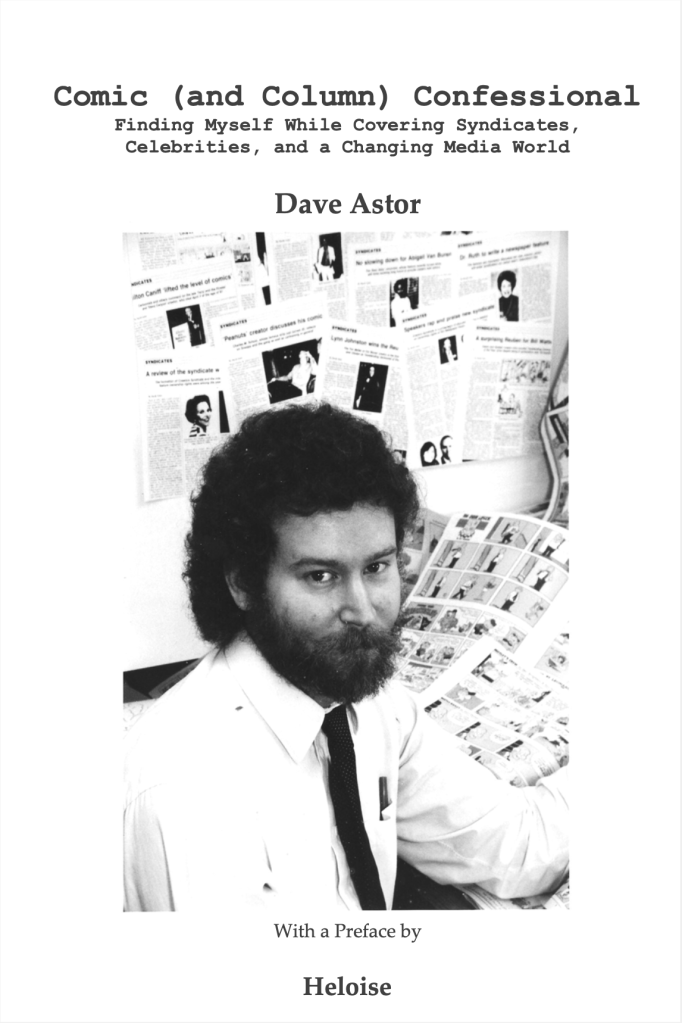
…and a 2012 memoir that focuses on cartooning and more, including many encounters with celebrities.
In addition to this weekly blog, I write the 2003-started/award-winning “Montclairvoyant” topical-humor column every Thursday for Montclair Local. The latest piece — commenting on election results in my town, New Jersey, and New York City — is here.
 Dave Astor on Literature
You make some great points about positive signs in the political landscape, Dave! And we can use all the optimistic fiction we can get:) A charming book that I read years ago is A Redbird Christmas by Fannie Flagg. I’ve forgotten the details but remember it being a lovely, small town, feel-good book that is perfect for reading in the season (or any other time!).
LikeLiked by 2 people
Thank you, Becky! I’m a big fan of Fannie Flagg’s novels, and agree that “A Redbird Christmas” is a great, charming, feel-good book! 🙂
LikeLiked by 1 person
I could probably read it again (or listen…I love her accent) this season!
LikeLiked by 1 person
Definitely a prime candidate for a reread, Becky, and it’s not a very long novel. 🙂
LikeLiked by 1 person
Exactly!
LikeLiked by 1 person
🙂
LikeLiked by 1 person
I’m afraid that this newborn New York Mair has been chosen because he’s an outsider. Now comes the reality check. Even Trump, who had already 4 years of high level politics behind him, ran finally into the limits of his mandate. I still stick to my point that what the US needs the most is a third party that breaks the hegemony of the actual bi-partisan hegemony of the 50% + 1 vote dictature.
LikeLiked by 1 person
Thank you, Shaharee! You’re right that part of Mamdani’s appeal is being seen as an “outsider” from the usual corporate, centrist, corrupt politics. He’ll indeed have a challenging time as mayor because some major status-quo interests will be arrayed against him. But he’s very talented, hard-working, and seemingly principled, so maybe he has a chance.
I agree that the U.S. could use a very strong third party competing against Republicans and Democrats (in too many cases “Republican lite”). As a democratic socialist, Mamdani is sort of/kind of third party, even though he of course ran and won as a Democrat.
LikeLiked by 1 person
Wow! The positivity and hope in this blog are truly inspiring. The story of Zohran Mamdani’s victory and the context behind it was both exciting and enlightening. I really enjoyed your selection of utopian and heartwarming novels—from Bellamy and Huxley to Hilton and L.M. Montgomery—each example brought a sense of calm and optimism. Your writing not only informs but uplifts, encouraging readers to reflect on kindness, hope, and courage in both fiction and reality. Truly inspiring, and I’m looking forward to your next post!
LikeLiked by 1 person
Thank you very much for the kind words, harythegr8! Greatly appreciated!
LikeLiked by 1 person
Dave,
I can think of happy endings, Utopian endings, Utopia somehow in the book for a minute, the up parts of “ups and downs”, feel good books, stories that take your breath away, picturesque writing that delivers a clear visage of a lovely place….
But I cannot think of a book that I would call 100% Utopian.
Odd, because dystopian stories are piling up.
A most intriguing post, leaving questions.
LikeLiked by 1 person
Thank you, Resa! Excellent observation! I agree that a 100% utopian novel has probably never been written, and that there is more of a chance that a 100% dystopian book HAS been written. That says something about humankind, or at least humankind’s “leaders.”
LikeLiked by 1 person
Thanks Dave!
I thought about this for a few days before leaving a comment.
I really wanted to think of, or find out about a Utopian novel.
Yes, it does say a lot about both mankind and our leaders.
SIGH!
LikeLiked by 1 person
I appreciate that several-day effort, Resa! 🙂
LikeLiked by 1 person
🌟😺
LikeLiked by 1 person
🙂
LikeLiked by 1 person
There’s something irresistible about stories where danger meets decency, where someone who’s seen too much finds light in an ordinary, kind soul. Daniel sounds like the quiet axis around which hope turns. Can’t wait to see how optimism holds its ground against the shadows. And your book sounds like a fun read!
LikeLiked by 1 person
Thank you, Patricia! Very eloquently said! I liked the way Stephenie Meyer reversed thriller-genre gender tropes via her characters of The Chemist and Daniel — with The Chemist being a hard-boiled/unsentimental/adventurous woman and Daniel being a gentle/empathetic/supportive male.
And Misty the Cat thanks you for the kind words about “his” book. 🙂
LikeLiked by 1 person
Howdy, Dave!
— Thoughts about and/or examples of this theme? —
Since my salad days as a college student in the 1970s, I have been a big consumer of dystopian/utopian depictions in multiple media — Munch, Munch, Munch — which means I have been psychologically well-prepared for the advent of the all-crime, all-the-time agenda of Pomarańczowa Panda. To quote the Barenaked Ladies, “It’s all been done before.”*
Meanwhile, B.F. Skinner’s Walden Two may be a unique novel in this genre of literature in that the number of readers who consider it dystopian might be comparable to the number of readers who consider it utopian. And I do not believe the former readers are all political left-wingers and the latter readers are all political right-wingers. Messy!
Personally, I liked the concepts explored in Walden Two, but I have to acknowledge Skinner’s storytelling ability does not approximate that of the likes of George Orwell: Sitting here at my Dream Machine today, I cannot remember the name of the protagonist in Walden Two, and I cannot forget the names of Snowball in Animal Farm and Winston Smith in Nineteen Eighty-Four . . .
J.J. McGrath (Alias MugRuith1)
*https://youtu.be/Zs3xXlXSOKk?si=j3sz12l2nOVQzxb1
LikeLiked by 1 person
Thank you, J.J.! Great mention of “Walden Two”! I read that novel many years ago (in college?) and should have included it in my post. I also can’t remember much of anything about the book — perhaps because, as you allude to, it’s not as memorable as (dystopian) novels such as “1984” and “Animal Farm.”
Also, it’s fascinating when a certain novel codes either utopian or dystopian depending on the reader, the era it’s read in, etc.
LikeLike
Hi Dave,
The first novel that I thought of was “The Grapes of Wrath”. It was my first Steinbeck and it’s set in a time and place that I know very little about. I don’t read the backs of books and stay away from reviews until after I’m done, so on the first few pages when Mr Steinbeck told me this was a book about California and oranges and hope and prosperity I believed him. And I kept believing him until about two thirds through it I realised it wasn’t ever going to be about any of those things.
I’m so excited to see that you’ve just read “The Chemist”. I was going to tell you what fun I had with it a few months ago but it looks like I already did when I recommended it (which I don’t at all remember doing!). I thought the love interest was very sweet, but I must admit, I was more taken with the brother. But a wonderful dynamic between all three characters no matter who your favourite may be.
Glad to see that things in your part of the world are a little more blue than they were. Given the current political climate, I didn’t think a 34 year old Muslim stood a chance. I’m glad to be wrong.
Sue
LikeLiked by 1 person
Thank you, Sue! I did enjoy “The Chemist” a LOT. Actually, one of my favorite reads of 2025. I agree that the three major characters and the dynamic between them were great! Thanks again for recommending that Stephenie Meyer novel. 🙂
“The Grapes of Wrath” does include some optimism (real and in a misdirection sort of way) but of course mostly bad stuff happens in that superb novel.
Yes, the November 4 elections did bring some rare good political news in the U.S., but the stupid corporate wing of the Democratic Party soon ruined some of that by caving to Trump and the Republicans on the government shutdown. 😦 Defeat snatched from the jaws of victory. 😦
LikeLike
I guess one man’s caving to is another man’s make sure people can still eat. I haven’t followed all the ramifications of shutdown very closely, but it seems that one person with some authority would say you can’t deprive people of food assistance, and an hour later another instruction was coming out that Trump could do whatever he liked. Or maybe he was just skipping the instruction bit. Either way, the Democrats must have felt that their hands were tied when pushing back on the Republicans meant that people were going hungry. Anyway, that’s more than enough politics from me on a site that’s supposed to be about books! Unfortunately, aside from Steinbeck’s false hope about the Joad family, I’m drawing a blank on any other books that have made me feel optimistic. If next week’s topic is What’s even the point of it all? I might have more to offer…
LikeLiked by 1 person
You’re right, Sue — Trump was trying to use the U.S. government shutdown to (among other things) block lower-income people from getting food stamps. But he was already trying to do disgustingly cruel stuff like that before the shutdown, and will continue now that the shutdown is ending. He and other Republican “leaders” are willing to do anything, while at least some Democrats have a conscience, so that does explain part of the reason the Dems gave up.
It’s okay to discuss politics. 🙂 As a way to vent, and for other reasons.
Your “What’s even the point of it all?” line — dark humor, and very appropriate humor.
LikeLike
I just thought that Paradiso, part 3 of the Divine Comedy is possibly Utopian.
LikeLiked by 1 person
Interesting, Robbie! I’ve never read Dante, and didn’t know that “The Divine Comedy” has a possibly utopian section, But, then again, that can be a powerful contrast to negative sections.
LikeLike
Hi Dave, I don’t seem to lean to much towards utopian books although I’ve read many dystopian books. A few books with happy endings are Little Women, The Secret Garden, I am David and The Coral Island. These are all books for youngsters 🩷
LikeLiked by 1 person
Thank you, Robbie! An excellent point that a number of books aimed at younger readers can be at least somewhat more upbeat than books aimed at older readers, though the former still often deal with some weighty issues (such as the death in “Little Women”).
LikeLike
I feel like Vicki does, Dave. Aside from A Christmas Carol, I haven’t read the other books you highlighted. But I always enjoy reading your thoughts and suggestions. And I leave with a more towering TBR. 🙂
LikeLiked by 1 person
Thank you for the kind words, Lauren! 🙂 I hear you about having a towering TBR list, including in my case many books suggested in comments under my posts. 🙂 Sometimes I feel TBR means Twenty Billion Reads. 🙂
LikeLiked by 1 person
Haha! That sounds about right, Dave!
LikeLiked by 1 person
🙂
LikeLike
I’ve read Thomas More’s UTOPIA, but it isn’t really a sunshine-filled book. The sunniest novel I’ve read during the past two years is Anne Patchett’s TOM LAKE. In the words of one review, it’s “a luminous reminder about the endurance of love and happiness in a broken world.” I agree.
LikeLiked by 1 person
Thank you, Kim! Apparently a rather ironic title for Thomas More’s “Utopia,” which I’ve never read.
Nice that Ann Patchett wrote such a sunny book in “Tom Lake”! The only novel of hers I’ve read is “Bel Canto” — very compelling but not exactly happy…it depicts a mass-hostage situation.
LikeLike
Hi Dave! Another fascinating post! The only dystopian novel I have read is George Orwell’s ‘1984’, many years ago at college. I can’t recall enjoying it that much! Novels with a utopian theme would be more to my tastes.
Good luck with the election of Zohran Mamdani, he is certainly a step in the right direction.
With kindest regards, Sharon
LikeLiked by 1 person
Thank you, Sharon! “1984” is indeed painful and depressing to read, but I thought really well done.
I’m looking forward to seeing what Zohran Mamdani does as mayor. He will of course be opposed by the Trump regime, New York billionaires and multi-millionaires (Mamdani wants to raise taxes slightly on the undertaxed rich), corporate media, and others, but he does have a lot of residents who will root for him and support his plans.
LikeLiked by 1 person
I agree with there Dave, ‘1984’ was well-written but very depressing.
Zohran Mamdani can expect fierce opposition to any idea of raised taxes on the super rich!!
Thanks Dave.
LikeLiked by 1 person
*I meant I agree with you*
LikeLiked by 1 person
Thanks for your reply, Sharon! If I were super-rich, I’d be happy to pay another 2% in taxes (what Mamdani is proposing) so that people could have things like free buses and free childcare (among Mamdani’s proposals). I’d still be super-rich, wouldn’t miss the money, and would be living in a slightly less-unequal city.
LikeLiked by 1 person
That’s the salient point, Dave! To create a less unequal city!!! That would be good and fair. With a small increase in taxes aimed at the super-rich then perhaps that could be achieved. Sadly, the concept and workings of ‘capitalism’ doesn’t seem to want that! Sad state of affairs, I hope the small tax increase can be pushed through. Thank you, Dave.
LikeLiked by 1 person
Well said, Sharon! Capitalism can sort of work in social-democratic countries where the rich are taxed more and there’s a decent social-safety net. The U.S. is not one of those countries. 😦
LikeLiked by 1 person
Thank you for your comments Dave! It’s such a shame we are agreeing again on the topic of ‘capitalism’. It’s the same here in the UK! There is a huge difference between the wealthy and the much less wealthy! And the gap is getting bigger!! I really hope that the political/socioeconomic environment in the US can improve in time Dave, but you might have to wait for a further three years!!
With kindest regards for a great week, hard I know at times!! 😔
LikeLiked by 1 person
Ps: If I were wealthy I certainly wouldn’t mind paying more in taxes to help society’s safety net! I wouldn’t mind at all.
LikeLiked by 1 person
Definitely true, Sharon, that the UK and many other countries in addition to the U.S. have too much economic inequality — and that it’s getting worse. 😦 It certainly doesn’t help that the ultra-wealthy directly or indirectly “buy” politicians with their donations and access. 😦
Things might be better in the U.S. in 2026 or 2028, if the Republican Party and their ultra-wealthy backers allow relatively unrigged elections. Of course, the ultra-wealthy have control over many Democratic politicians, too.
Have a great week, too, despite the news!
LikeLiked by 1 person
Hi Dave! Crooked politicans are everywhere!! Rigging votes!! Oh dear!! You know Dave, there was a time when you were either to the left or to the right politically, now I can barely tell the difference (over here). It comes down to, if you have money you are fine, if not then well…!!
Thank you, Dave.
LikeLiked by 1 person
Astute points, Sharon. Yes, in the U.S. as well, there aren’t enormous differences on some issues between Republicans and “corporate” Democrats. Both are conservative in many ways. And the big divide is indeed often between the rich and the non-rich rather than between the right and the left.
LikeLiked by 1 person
All very accurate, Dave! I think our countries have a similar outlook!! Over here it’s the Labour Party and the Conservative Party. To tell you the truth, their policies are so similar in reality, that I wonder which is which!! We can only hope for the best!
LikeLiked by 1 person
A shame, Sharon, when two parties that are supposed to be very different are not that different. I guess part of the problem is when there’s a right-wing party and a party that’s sort of center-left rather than truly left.
LikeLiked by 1 person
You have got it again, Dave! The current Labour administration is most certainly centre-left! The personal affluence/wealth of Labour politicians today, tells me they are far removed from being true left wing! 😕
LikeLiked by 1 person
The more affluent the politician, the less in-touch with their constituents in many cases. 😦
LikeLiked by 1 person
Very good point! Thanks Dave! As much as I dislike the unfolding of contemporary politics, I really enjoy our discussions! With best wishes! 🤗
LikeLiked by 1 person
I share your dislike of today’s politics and also greatly enjoy our conversations. 🙂
LikeLiked by 1 person
Thanks Dave!
LikeLiked by 1 person
🙂
LikeLike
For me your advice to read something positive comes really at the right moment Dave and I thank you very much for your always excellent reading proposals:) Unfortunately I can’t read very much at the moment because of vision problems after my eye-operation, but I can tell you that a love the book you recommended me or “A woman of Substance” by Barbara Taylor Bradford, which inspires me with hope! I will go on with it as soon as possible
LikeLiked by 2 people
Thank you, Martina! Very sorry about your vision issues after the eye operation. 😦 I hope you’ll be seeing better soon.
Glad you were enjoying “A Woman of Substance”! Coincidentally, I just started my fourth Barbara Taylor Bradford novel — “The Triumph of Katie Byrne.” So far so good, but I’m only on the second chapter. 🙂
LikeLike
:):)
LikeLiked by 1 person
🙂
LikeLike
Hi Martina, I hope your eyes recover quickly
LikeLiked by 2 people
Me too, Roberta and many thanks for your kind words:)
LikeLiked by 1 person
Oh, what an interesting post! I’ve never read Aldous Huxley’s The Island, but have always wanted to. The fact it’s his final novel makes it very intriguing for me. I think utopian novels are important, as they keep our imaginations focused on a brighter future. Sadly, I can’t think of any of my own examples, as my reading generally tends to veer on the darker side of life!!
LikeLiked by 1 person
Thank you, Ada! Yes, an author’s last novel can be intriguing; it’s interesting to see what kind of final statement a writer wants to make. (Of course, when writing their final novel, an author might not necessarily know it will be their final novel.)
Utopian and otherwise optimistic novels are definitely morale-boosters, but I understand about reading darker books. Probably more of those kinds of books out there, plus they can be pretty darn compelling.
LikeLiked by 1 person
How about Alice in Wonderland and the second one by Lewis Carroll? Pretty good I would say. Also LC’s poems, like Jabberwocky – I had to learn it when I was at school. Our drama teacher got us to dance like strange mythical creatures – I was an odd tree!
LikeLiked by 1 person
Thank you, Chris! Lewis Carroll’s work is a great mention! It includes some unsettling things, of course, but overall such fun reads. Nice memory of your drama teacher getting you and other students to dance. 🙂
LikeLiked by 1 person
Thank you for putting together this post! A great idea to celebrate positivity. I don’t have suggestions for utopian novels. But I recently heard an interview with Charlie Mackesy who wrote “The Boy, the Mole, the Fox, and the Horse.” Such kindness and openness in the book and author. I’d recommend that book as a beacon of positivity. Same with “Everyone’s a Aliebn When Ur a Aliebn Too” by Jomny Sun. Those are the kind of books that have helped me.
LikeLiked by 2 people
Thank you, Dave! I appreciate those book recommendations, and love your phrase “a beacon of positivity”! We certainly need as many such beacons as we can get these days. And your mention of Charlie Mackesy’s kindness and openness makes me wonder how many authors of upbeat books are upbeat themselves or are downbeat personalities able to write upbeat books. Authors, of course, can do that switch, and vice versa. 🙂
LikeLiked by 1 person
Brave New World and Clockwork Orange are the only utopia/dystopia novels I’ve read. They either go south or improve to a degree where the utopianism lives a short tragic life. Can’t say I care for them. Nice theme Dave. Susi
LikeLiked by 1 person
Thank you, Susi! “Brave New World” definitely cloaks dystopia in utopia. I haven’t read “A Clockwork Orange” in so long that I can’t remember its utopian elements amid the awful stuff.
As far as dystopian novels go, there are some that pack a more powerful punch than “Brave New World” — “1984” and “The Handmaid’s Tale,” to name two.
LikeLike
You write like you breathe poetry — naturally and free (^_^)
Each line flows like calm water across the heart (ღ✪v✪)ღ
Please stop by my page and share a comment if it resonates (^ω~)
LikeLiked by 1 person
Thank you very much for the kind words, harythegr8! 🙂
LikeLiked by 1 person
I suspect there are more dystopian novels written than optimistic ones. One indie author who comes to mind is C Litka. His books are often lighthearted, but with a good mix of adventure, family “situations,” and a bit of romance. They are set in a post-apocalyptic world that seems to have figured out how to avoid the worst of human tendencies. I recommend Chateau Clare and Glencrow Summer as “nice, pleasant reads,” to quote the author’s descriptions.
LikeLiked by 2 people
Thank you, Audrey! I think you’re right about there being more dystopian novels than optimistic ones. A greater opportunity for drama, and closer to being realistic.
I appreciate the mention of C Litka, and good to hear there’s some post-apocalypse hope. 🙂
LikeLiked by 1 person
I’m hard put to think of a Utopian book I’ve read. I’ve heard Ursula Le Guin’s “The Dispossessed” is good, but I haven’t read it. I feel like her books have an optimistic undertone, even when there is trouble. (K)
LikeLiked by 2 people
Thank you, Kerfe! I’ve only read one Ursula Le Guin book, but good to hear about the optimistic undertone. Some authors have that knack, even when depicting some depressing stuff.
LikeLiked by 2 people
Worth reading ‘The Dispossessed‘ – I enjoyed that! Not too depressing with this one.
LikeLiked by 1 person
“The Dispossessed” is now on my to-read list, Kerfe and Chris. 🙂
LikeLiked by 1 person
I’m ashamed to say that I haven’t read any of the utopian texts you mention above, Dave, apart from ‘A Christmas Carol’. I think that by nature I’m drawn to dystopian literature, which doesn’t help. Both types are at opposite poles, obviously, and of course ‘real’ literature resembles ‘real’ life in that it’s a mixture of both, meeting somewhere in the middle. Rebecca’s comment below, with her reference to that ‘small seed of darkness’ is I think the truth. I remember a university lecture I attended where the lecturer pointed out that Shakespeare’s comedies, while ending happily, had a tendency to begin in darkness; Hermia eloping with Lysander because she’s under threat of death if she refuses to marry Demetrius, her father’s choice for her, leading to the antics of ‘A Midsummer Night’s Dream’, for example. It’s part of the Bard’s greatness, of course, that his plays contained both light and darkness, the outcome conferring the ultimate label of ‘comedy’ or ‘tragedy’. I like his ‘problem comedies’, where the ‘comic’ outcome is problematic, with audience brows furrowed, the words ‘yeah, but … ‘ on their puzzled lips. Sorry, I’ve gone off in a different direction, even if an associated one; and even as I write this I have a nagging idea in my head of having read a story of someone who finds an ‘ideal’ society, only to find dark things underlying it. Will I remember what it was? If I do I’ll let you know. Off now to resume my dystopian existence; thanks for another thought-provoking post! 🙂
LikeLiked by 1 person
Thank you, Laura! Dystopian lit is in many cases probably more interesting than utopian lit, but I’m glad the latter fiction is out there. And, yes, some fiction has elements of both — including Shakespeare’s plays, as you note!
There is definitely a strand of fiction where things seem utopian but bad things are going on. Actually, the basically dystopian novel “Brave New World” fits that bill in a way.
“Off now to resume my dystopian existence” — a droll line! 😂
LikeLiked by 1 person
Perhaps a bit exaggerated! 😊
LikeLiked by 1 person
😂
I’m sure it was. 🙂
LikeLiked by 1 person
Great theme, Dave. This dystopian time we now live in does call for an escape into the world of utopian novels. It’s been years since I’ve read Hilton’s Lost Horizon; I don’t recall the story-line. At this time of year, our Christmas short stories/novels/movies depict the best in humankind.
LikeLiked by 2 people
Thank you, Rosaliene! Yes, it’s hard these days to be in the mood for dystopian novels when we’re getting dystopia every day in real life. And a great observation that holiday-themed books, movies, etc., can be upbeat and heartwarming. One novel that comes to mind is Fannie Flagg’s “A Redbird Christmas,” which I loved.
LikeLiked by 1 person
I haven’t read “A Redbird Christmas.” The Hallmark movie channel does a great job in bringing these stories to us at Christmas.
LikeLiked by 1 person
True about the Hallmark movie channel, Rosaliene! Those films can be kind of formulaic, but comforting. 🙂
LikeLiked by 1 person
They are, indeed, formulaic 🙂
LikeLiked by 1 person
Which can be good once in a while. 🙂
LikeLiked by 1 person
Ah yes, lovely ‘A Redbird Christmas‘ by Fannie Flagg. I really enjoyed that!
LikeLiked by 1 person
Nice to hear you enjoyed that book, too, Chris! Fannie Flagg is an underrated author; I’ve read all her novels, and they’re quite good.
LikeLiked by 1 person
Thank you Dave for a great topic and the uplifting energy that came with it. I am looking forward to the follow-up dialogue! The first thing that came to mind was how the idea of a utopia, whether in literature or in life, always carries within it a small seed of potential darkness. Even the most harmonious societies in fiction seem to hold that tension between perfection and fragility.
You reminded me of the myth of Pandora’s box. Curiosity, hope, and temptation are always intertwined. Even in our most ideal visions, there’s that moment of choice. Should we open the lid, should we question, should we act? Perhaps that’s what keeps utopian stories so compelling and singular. They remind us that hope isn’t the absence of struggle, but gives us the courage to understand our humanity even in the most perfect of circumstances. I just found “Hesiod, The Homeric Hymns, and Homerica on Gutenberg project. I am not putting in on my TBR pile of books just yet, but I was delighted to find the text available. Anyway, this is a quote about hope that I found in it:
Only Hope remained there in an unbreakable home within the rim of the great jar, and did not fly out at the door.” (Hesiod, Works and Days, translated by H.G. Evelyn-White). https://www.gutenberg.org/files/348/348-h/348-h.htm#chap20
LikeLiked by 2 people
Thank you, Rebecca! So true that anything approaching an idyllic utopia can hang on a thin thread. Many humans are just too flawed, selfish, greedy, etc. 😦 But it’s certainly always worth striving for.
As an aside, I’ve driven on Utopia Parkway in Queens, New York (yes, that street exists) and the experience is not utopian. 🙂
An interesting quote about hope! May that jar remain unbroken!
LikeLiked by 3 people
Although I suppose it’s considered dystopian, I’m going to go with The Time Machine by H.G. Wells. I think it has a hopeful ending.
LikeLiked by 3 people
Thank you, Dan! I suppose the end of “The Time Machine” could be looked at as being either depressing or offering the Earth a chance for some kind of renewal. Or both.
I noticed when researching this post that H.G. Wells also wrote a lesser-known novel titled “A Modern Utopia,” but I’ve never read it.
LikeLiked by 2 people
I’ve never heard of that, Dave. In the original movie that was based on the book, the time traveler takes three books back with him into the future. I wonder which three books we would choose.
LikeLiked by 1 person
I’ve never seen “The Time Machine” movie, Dan. I wonder if it has a more hopeful ending than the novel has?
Three books to time-travel with? Well, my two favorite novels are “Jane Eyre” and “The Grapes of Wrath.” Then maybe I’d bring Arthur Frommer’s “Traveling into the Future on 5 Dollars a Day,” if that travel guide existed. 🙂
LikeLiked by 1 person
I really enjoyed The Time Machine. And yes, it has, in my humble opinion, a hopeful ending. Not exactly what I was expecting!
LikeLiked by 2 people
H.G. Wells was indeed often not predictable, Rebecca. 🙂
LikeLiked by 1 person
Hi Rebecca, I think it depends how you interpret utopian when it comes to The Time Machine. I think the Eloi with their child like behaviour due to living a Utopian life was very sad and the end when the sun is dying was even worse.
LikeLiked by 2 people
That’s such an excellent point, Robbie!! I can see exactly why you’d find it sad. The Eloi’s innocence feels almost empty, as if too much comfort has erased curiosity and courage. Yet somehow, I still sensed hope at the end. The dying sun, to me, seemed less a final extinguishing and more a quiet renewal. Almost like a phoenix moment, where something must end for new life to emerge. Perhaps that’s Wells reminding us that even in decline, there’s the possibility of transformation. I LOVE our conversations.
LikeLiked by 1 person
I don’t know how you do this, Dave. Give me gentle nudges about books I’ve missed out on – like Montgomery’s “The Blue Castle”. I’m gonna need to subdivide my “TBR” to have a separate column for your terrific tips and reminders. Thank you! 😉😉😉
LikeLiked by 2 people
You’re welcome, Vicki, and thank you for the kind comment! 🙂 I had read the great “Anne of Green Gables” and its many sequels, but “The Blue Castle” was not on my L.M. Montgomery radar until my wife told me about it maybe 20 years ago. Turned out to be in a close race with “AoGG” for my favorite Montgomery novel, and it’s more an adult than YA book. Funny and moving, with a really clever plot premise.
LikeLiked by 2 people
Love it! Thank you, Dave! 🥰
LikeLiked by 2 people
🙂
LikeLike
Thanks for these reminders of hope!
LikeLiked by 2 people
You’re welcome, Marie, and thank you for the comment! Hope is welcome at a time when there isn’t a big supply of it. 🙂
LikeLiked by 2 people
This is going to sound silly, but the utopian book that immediately comes to mind is Winnie the Pooh. I’ve read Lost Horizon, but I don’t remember a thing about it.
LikeLiked by 4 people
Thank you, Liz! Not silly at all. 🙂 I enjoyed A.A. Milne’s positive “Winnie the Pooh,” even though it at times was a bit sappy and sentimental for my tastes. But it is a children’s book (though also enjoyable for adults).
I read “Lost Horizon” many years ago, and all I remember is a plane ride to Shangri-La, some really old guru type there, and a couple other details. I did find the whole thing pretty compelling.
LikeLiked by 3 people
You’re welcome, Dave!
LikeLiked by 1 person
🙂
LikeLiked by 1 person
I don’t remember it either, Liz, but I do remember the movie, which had great actors!!!
LikeLiked by 2 people
Thank you to Susan for recommending “The Chemist”!
LikeLiked by 1 person