
Sometimes, authors dazzle with their debut novels. Mary Shelley and Frankenstein. Emily Bronte and Wuthering Heights. Carson McCullers and The Heart Is a Lonely Hunter. Ralph Ellison and Invisible Man. Arundhati Roy and The God of Small Things. Zadie Smith and White Teeth. Etc.
But more frequently there’s somewhat of a learning curve for authors, which is totally natural — and totally the topic of this post.
I came to this topic via the work of Stephenie Meyer, three of whose novels I recently read in reverse order: first The Chemist (2016), then The Host (2008), and then Twilight (2005). Twilight was of course Meyer’s mega-bestselling debut featuring a teen human and teen vampire who fall in love. An interesting take on the vampire genre that held my interest even as it was too often written in a pedestrian way. Published three years later, The Host turned out to be a fascinating sci-fi story — and more skillfully crafted. Finally, The Chemist thriller about a hunted female ex-government agent was full of superb prose and dialogue. Meyer’s wordsmithing arc was impressive.
It all reminded me a bit of J.K. Rowling’s progression. The first Harry Potter novel was compelling and tons of fun as the author did her world-building, even as the writing itself was not super-scintillating. But Rowling’s prose and dialogue got better and better as her next six wizard-realm books emerged, and continued in that direction with the skillfully written The Casual Vacancy and the riveting crime series starring private investigators Cormoran Strike and Robin Ellacott.
Both Rowling and Meyer can be rather long and wordy in their more recent offerings, but I’m here for it.
Going much further back in time, I liked the feminist idea of Jack London’s early novel A Daughter of the Snows, but the dialogue was laughable and the prose clunky. One year later, London’s pitch-perfect The Call of the Wild was released. I don’t know what writing elixir the author imbibed during those 12 months, but I want it. 🙂
F. Scott Fitzgerald’s college-set debut novel This Side of Paradise is quite uneven, only hinting at the greatness of The Great Gatsby published just five years later.
John Steinbeck’s debut novel Cup of Gold was an okay, rather conventional pirate novel before much of his later fiction became light years better — including, of course, his masterpiece The Grapes of Wrath.
Willa Cather’s first two novels — Alexander’s Bridge and O Pioneers! — exhibited some authorial growing pains before they were followed by her absorbing The Song of the Lark and then the masterful My Antonia.
Dan Brown’s early-career novel The Da Vinci Code was VERY popular and quite ingenious in its way but even more awkwardly written than Stephenie Meyer’s Twilight. I never read Brown again, but I assume his writing improved?
Any comments about, or examples of, this theme?
Misty the cat asks: “How am I supposed to shovel this stuff without opposable thumbs?”
My comedic 2024 book — the part-factual/part-fictional/not-a-children’s-work Misty the Cat…Unleashed — is described and can be purchased on Amazon in paperback or on Kindle. It’s feline-narrated! (And Amazon reviews are welcome. 🙂 )
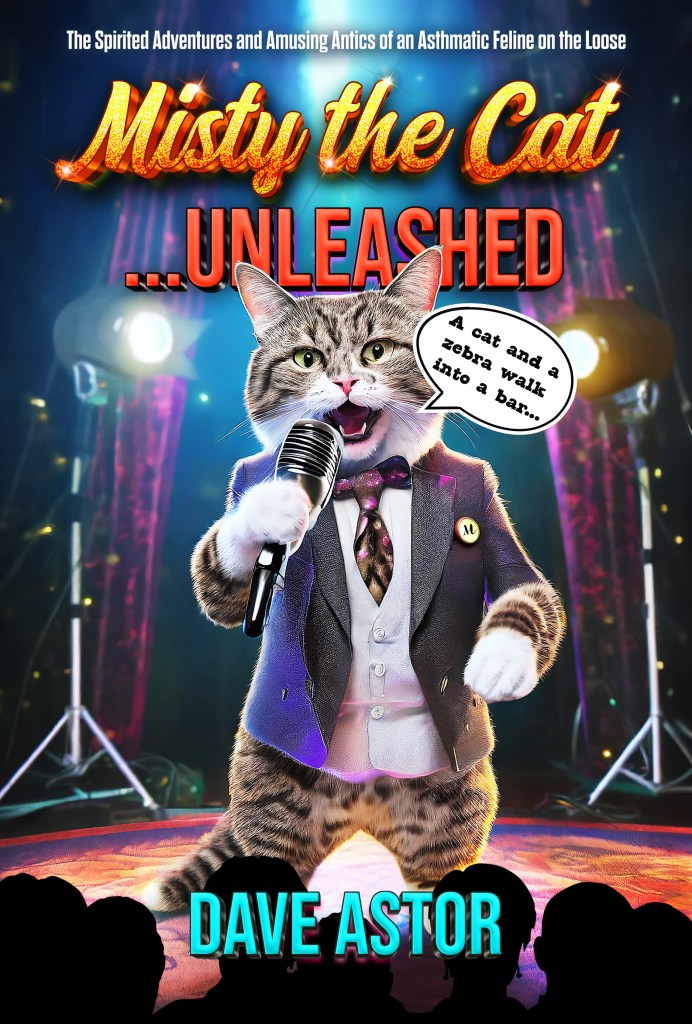
This 90-second promo video for the book features a talking cat: 🙂
I’m also the author of a 2017 literary-trivia book…

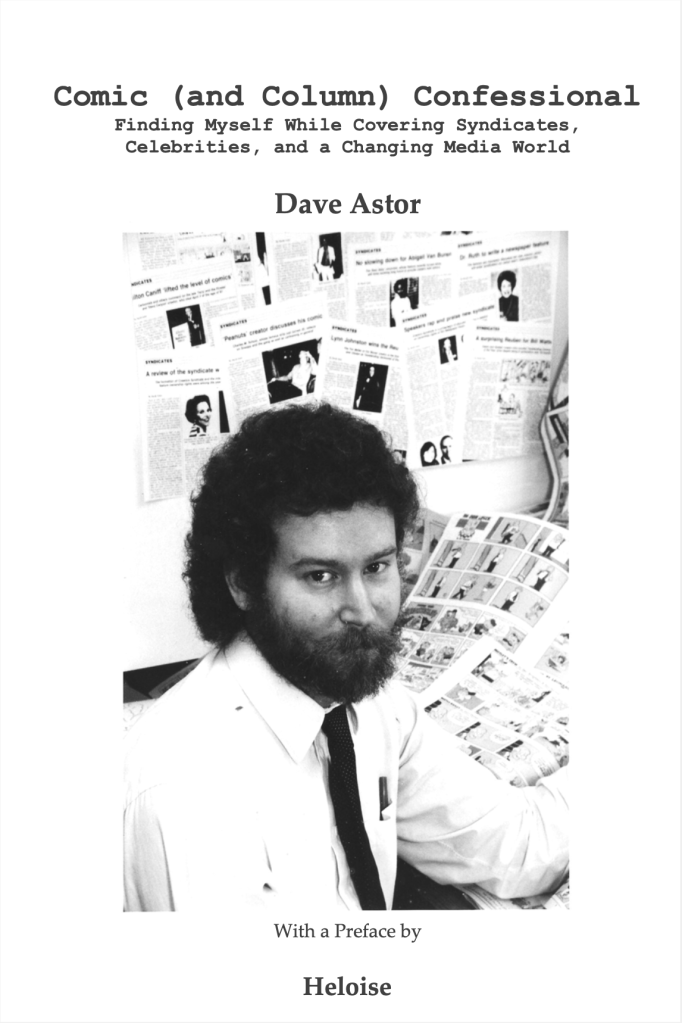
…and a 2012 memoir that focuses on cartooning and more, including many encounters with celebrities.
In addition to this weekly blog, I write the 2003-started/award-winning “Montclairvoyant” topical-humor column every Thursday for Montclair Local. The latest piece — which has “no appeal” appeal — is here.
 Dave Astor on Literature
“Twilight” was so poorly written, I couldn’t finish it. I understand why it was published, but it wasn’t for the writing. I enjoyed the movie franchise, however. When I read the first Harry Potter book, I was unimpressed. But Chris Columbus did a fabulous job with the movie. Again, “Fifty Shades of Gray” was another badly written book. Yet, the movie franchise was hugely popular. Sometimes, Hollywood does a better job of interpreting a story than the original author.
LikeLiked by 1 person
Thank you, Dawn! I hear you about “Twilight” and the first “Harry Potter” book; fortunately they had interesting plots and characters amid the mediocre writing, the authors got better, and, as you say, movie versions of books can be great and even compete in quality with the original book versions. (I’ve never seen any of the “Twilight” films but did see and love all eight “Harry Potter” movies.)
LikeLike
Gee, other than Joy Fielding, I can’t think of other authors who I’ve read enough books by to make this judgement.
Still, from her first novel to a stride she hit by See Jane Run, and more obviously Grand Avenue there was huge improvement.
Thanks Dave!
LikeLiked by 2 people
Thank you, Resa! Sounds like Joy Fielding evolved as an author in a pretty typical way. 🙂 I don’t think I’ve read any of her very early novels, but I’ve read about a half-dozen of her mid-career and recent ones and — as I’ve said before — found them excellent.
LikeLiked by 1 person
🎉 𝓗𝓪𝓹𝓹𝔂 𝓗𝓸𝓵𝓲𝓭𝓪𝔂𝓼! 🎉
LikeLiked by 1 person
Thank you, Resa! Happy Holidays to you as well! 🎄 🎅🏻
(I’m impressed with that typeface. 🙂 )
LikeLiked by 1 person
Ah… the typeface is in emojis. There is lovely lettering in both Latin & Math…bols
IE: 𝔁𝔉ℍ𝕎𝔚𝓒𝓜ƤⱿɐ
LikeLiked by 1 person
Love it! Thanks for the “origin story.” 🙂
LikeLiked by 1 person
Your analysis of the author’s learning curve is incredibly reassuring for anyone in the middle of their process. It is fascinating to see how Stephenie Meyer or J.K. Rowling evolved; it reminds us that talent is just the starting point, while dedication is the engine. Thank you for highlighting this growth so elegantly, Dave.
LikeLiked by 1 person
Thank you, Livora! 🙂 Well said! It IS reassuring (and inspiring) to see writers get better as their careers go along. 🙂
LikeLiked by 1 person
Hi Dave,
Nice to see you having fun with Stephenie Meyer. I’ve already commented that I was surprised at how much I enjoyed “The Chemist” so I’ll just say that even though the “Twilight” series wasn’t very well writen I gobbled them up as quickly as I could.
I was a fan of Dan Brown’s during all the hype of “The Da Vinci Code” and bought a copy of all (then 5) of his books. I also bought a parady book called “The Va Dinci Cod” but that’s a story for another day. I read the last one in the past year or two, and I gotta admit his writing doesn’t get any better. Given my extra exposure to good writing since then, I might even say Dan’s gotten a bit worse.
Earlier this year I ticked off the last (of 130) random books that I had on my shelves at home. That means that I’m now officially allowed to put some re-reads in the mix. I was incredibly hesitant about picking up Rowling’s “The Casual Vacancy”. Partly because I didn’t know if it would be as good as I remembered, but mostly because of all the controversy around Rowling’s politics. I wasn’t sure if I could (or should) separate the work from the person. Well I’ve been reading it for a week or so and am nearly finished all 500+ pages of it and it’s even more fun than I remember and while I’m caught up in all the drama coming out of this little English town I keep thinking Rowling who? Oh yeah; not caring as much as I thought I would.
Sue
LikeLiked by 2 people
Many thanks again, Sue, for recommending “The Chemist” a couple months ago, which put me on a mini Stephenie Meyer reading binge. 🙂 I agree that “Twilight” wasn’t written that well, but I never considered stopping.
Interesting to hear that Dan Brown never became that good at prose or dialogue. I don’t think I’ll be reading him again in the future, but am open to trying other novelists whose last name is a color. 🙂
“The Casual Vacancy” IS excellent. J.K. Rowling really captures small-town relationships, small-town politics, and more. Like you, I’m bothered by Rowling’s dismaying anti-trans views, but, also like you, I usually (not always) ignore an author’s personal politics and personal life when choosing to read a book by them.
Congratulations on reaching your reread-some-of-the-time phase!
LikeLiked by 1 person
Hi Dave, I think this progression in writing is quite natural. I see it in my own prose and poetry and note the changes. Charlotte Bronte’s writing improved between The Professor and Jane Eyre. I preferred Hemingway’s later novels to The Sun Also Rises.
LikeLiked by 1 person
Thank you, Robbie! I agree with your general point and your specific examples! “Jane Eyre” is clearly better written than “The Professor,” and I also think “The Sun Also Rises” is not as good as, say, the later “For Whom the Bell Tolls.”
In Charlotte Bronte’s case, her later “Villette” was not anywhere near as compelling as “Jane Eyre,” but that wasn’t a problem of the actual writing in “Villette.” Rather, the plot wasn’t as good and the characters weren’t as interesting.
LikeLike
Hi Dave, I must admit to DNFing Villette after finding a copy in New Zealand of all places and being all delighted about it.
LikeLiked by 1 person
Yes, Robbie, “Villette” is far from a page-turner. I can see not finishing it. After “Jane Eyre,” one starts reading “Villette” with…great expectations…but it’s not super-compelling.
LikeLike
Invisible Man by Elisson is one of the books I read when I was very young and I remember that it touched me so much, because I understood that to be accepted by society one has to give a contribution that is seen and not just hide in cellar and steal electricity from the others! Thank you very much Dave for having made me think about this point:)
LikeLiked by 1 person
Thank you, Martina! Very well said! I also read “Invisible Man” when I was very young, and it has stuck with me, too.
LikeLiked by 1 person
Good to here this Dave and thanks for your words!:)
LikeLiked by 1 person
You’re very welcome, Martina! 🙂
LikeLiked by 1 person
I enjoy your words, Dave!
LikeLiked by 1 person
Thank you again, Martina! 🙂
LikeLiked by 1 person
A couple of Dan Brown’s, not too bad. JKR – fine for Potter and the rest. Never read Stephie, actually not true, I did try one of those, but I dropped it down after a couple of paragraphs – not for me. End of… 😉
LikeLiked by 1 person
Thank you, Chris, for that concisely interesting look at three authors! Stephenie Meyer hasn’t published a lot in the last few years; I wonder what she’s doing these days?
LikeLiked by 1 person
I only read one novel by Dan Brown and that was enough, not my cup of tea.😘
LikeLiked by 1 person
Thank you, Arlene! He doesn’t seem to have a big fandom in this comments section (at least so far). 🙂
LikeLike
Great post, Dave! You have outlined some very interesting points. And if I were a cat, my ears would prick up around about now!!😺. The debut novels you have mentioned is one point (all good books) but I really appreciated your salient point about author’s writing skills improving with each subsequent novel!
I have found that some authors do improve and some do not. The latter, simply stick to the style that launched them and made them famous.
I am curious about JK Rowling and her later crime novels. Like you, I found ‘Harry Potter’, fine but the writing didn’t blaze a trail for me, so to speak!
I thought, ‘The Da Vinci Code’ was awkward in its writing style, but then, it was a difficult plot! It didn’t do him any harm!! 😊 I’ve read nothing more by him either.
Absorbing post Dave, it will certainly give me lots to ponder on over the holidays.
With best wishes for a good week!
Sharon
LikeLiked by 2 people
Thank you very much, Sharon! 🙂 So true that some authors find a formula and stick to it while others continue to experiment. (Of course, a writer can experiment somewhat within a formula. 🙂 )
Yes, the “Harry Potter” books were more about the plot, the characters, and the wizard world than about the writing, though, as I mentioned in the post, I thought the writing did get better as the series advanced. J.K. Rowling’s crime novels (eight since 2013) combine better-than-“Harry Potter” writing with great plots, and I love the interactions between partner private investigators Cormoran Strike and Robin Ellacott.
“The Da Vinci Code” plot was definitely interesting enough to (somewhat) overcome the clunky writing.
Hope you have a good week, too!
LikeLiked by 2 people
Please excuse my late response, Dave! Yes, I agree with all the points you have made. I have only read the first ‘Harry Potter’ book, so I cannot comment on her later novels in the series. However, if JK Rowling has gone on to switch genres, then I can imagine her writing would be better, so to speak. And I trust your judgement!
Try this for size though, Dave. How about when an author’s debut novel is so good, they cannot match it with subsequent work.
I found this with ‘The Horse Whisperer ‘ by late writer, Nicholas Evans. His other books, like ‘The Smoke Jumper’ although beautiful and well-written could not match the impact of his debut book. This could merely just be me, however.
Thank you so much for your kind regards for a good week.
Sharon ☺
LikeLiked by 1 person
Thanks for your follow-up comment, Sharon! J.K. Rowling’s “Harry Potter” series and her later/current crime series (written under the pen name Robert Galbraith) are definitely quite different. I’m impressed with how well Rowling switched to a very different genre.
You’re right that there have been some debut novels that were the highlight of those authors’ career. I haven’t read Nicholas Evans, but it sounds like he is a good example of that.
LikeLiked by 1 person
Thank you so much, Dave. And I haven’t read anything by J K Rowling, writing as Robert Galbraith! I was a bit wary as crime fiction is my favourite genre and I wondered how well she would handle it. From what you have said, J K Rowling writes equally as well in the genre. So many thanks again, I may try one in the future!
Yes, Nicholas Evans’ first novel was incredible and I think was definitely the highlight of his career.
I really enjoyed your post.
All the best,
Sharon ☺
LikeLiked by 1 person
Thanks again, Sharon!
I think J.K. Rowling holds her own against most contemporary crime writers (Lee Child, Michael Connelly, Val McDermid, etc.).
LikeLiked by 1 person
Really?!! If she holds her own against that calibre of crime writers, then I’d better read something, and quickly! That’s very helpful, thanks Dave.
It’s always a pleasure discussing books with you, although the downside is – yet more books added to the TBR pile!! 😂
Thank you once again, Dave.
LikeLiked by 1 person
I hear you about TBR piles, Sharon. 🙂 😦 At least the first book in Rowling’s series — “The Cuckoo’s Calling” — is not super long. 🙂
LikeLiked by 1 person
The ‘Cookoo’s Calling’ not too long, that’s a tremendous relief! I’ll probably start with it.
Thanks Dave, I really appreciate the information. ☺
Have a great day!
LikeLiked by 1 person
Have a great day, too, Sharon!
LikeLiked by 1 person
☺
LikeLiked by 1 person
🙂
LikeLiked by 1 person
Yet another great thought-provoking post, Dave, and I’m here for it. I’ve found with quite a few great authors that I end up reading their first novels last, I guess because they aren’t promoted as much as their later, more practised, works. Thomas Hardy’s ‘A Pair of Blue Eyes’ (I think it’s called) was his first (or one of his first) and noticeably less well-written than the books he went on to write. Other examples from my own reading include Fay Weldon and Salman Rushdie, which will do for now. In my own writing I know that my debut novel isn’t as well-written as subsequent works, although I have edited and tweaked to improve it. Writing is a learning curve, a craft that we learn as we go along. I’ll stop now, as it’s late and I have an early start, but thanks for a good post. I’ll be back, I’m sure. Have a good week. )
LikeLiked by 2 people
Thank you, Laura! Reading a great author’s first novel or other early-career novels last is not a bad idea! Also, interesting to think of tweaking early books to make them better, as you’ve done with your debut novel.
I’ve read several of Thomas Hardy’s novels, but must admit I hadn’t heard of “A Pair of Blue Eyes” until seeing your comment. 🙂
Have a good week, too!
LikeLiked by 2 people
https://amzn.eu/d/hNUpfpn
LikeLiked by 1 person
I’ve posted a link to a free ecopy on Amazon, if you’re interested, Dave. You’d need to change the ending to .com though. 🙂
LikeLiked by 1 person
I appreciate the link, Laura! Given what you said about the book, I might pass on this. 🙂 So many other things to read… 🙂
LikeLiked by 1 person
So true Dave. Interesting to reflect – as your post suggests – that even the greats of literature had to start somewhere and more often than not they didn’t ace it first time. 🙂
LikeLiked by 1 person
Yes!
LikeLiked by 1 person
Dave, another wonderful topic for discussion which has led me to revisit how I choose books. I enjoyed the way you trace creative growth with excellent examples. What strikes me most is how reassuring this arc is. We tend to mythologize the dazzling debut, but your examples remind us that mastery is so often the result of staying with the work. Perseverance, risk, and time are usually the real teachers. Both for writers and for readers alike.
You also reminded me how each of us chose our reading journey. I don’t read novels the way you do. My sister Sarah, however, reads the same way as you, moving voraciously through a single author or category. She has your wonderful sense of comparative momentum across a body of work. My reading life has always been more meandering, shaped by a deep love of nonfiction. Often, I read simply because I’m drawn to a particular voice and because I want to spend time with a mind I trust, as I did with The Weight of Ink.
Still, what your post reminds me of is something we share: writers grow into their voices much as we grow into ourselves. Later works feel wiser not because the talent suddenly appeared, but because life had been lived alongside the craft. There’s something quietly hopeful in that. It suggests that creative work is not a race, but a long conversation between intention, experience, and patience.
And yes — if you ever find that writing elixir Jack London took, please let the rest of us know. 😊
I think that I left this quote before, but it does remind me that life has a way of allowing us experience the full breadth of living. And I believe it is the wisdom from walking through life that comes through the writer’s pen:
“Our life is a walk in the night, we know not how great the distance to the dawn that awaits us. And the path is strewn with stumbling blocks and our bodies are grown tyrannous with weeping yet we lift our feet. We lift our feet. Rachel Kadish, The Weight of Ink
LikeLiked by 2 people
Thank you, Rebecca, for your multifaceted comment! Among the things that struck me was your mention of how life experience can shape an author’s work. So, as you’re saying, the work of many authors will improve over time not just because they’re getting in more writing “reps” as they do more books, but because they’re accumulating more life experiences as the years go by.
Yes, the dazzling debut novel can be the stuff of legend, but only a minority of authors come out with that kind of first book.
A great Rachel Kadish quote, worth repeating. Eloquent, as was your comment.
LikeLiked by 2 people
I love coming to your space, Dave! Great topics and excellent follow-up discussions!
LikeLiked by 2 people
Thank you again, Rebecca! 🙂 I always enjoy the discussions, too. 🙂
LikeLiked by 1 person
Well, I guess everyone has to start somewhere…..
LikeLiked by 1 person
Thank you, Shehanne! Very true! In Stephenie Meyer’s case, Arizona. 🙂
LikeLiked by 1 person
Hello, Dave, and thanks for a fun theme to think about. I’ve thought of four authors to mention. One is Judith Guest, whose first novel was ORDINARY PEOPLE, about parents with two teenage boys who are in a sailing accident. The older dies, and the younger survives and can barely live with his guilt at being the one who lives. I think it’s a brilliant book (and a great movie, too), and it’s Guest’s first novel. She has written a number since, but I’ve never read any others. So is it her best? No idea. Nick Hornby’s first novel was HIGH FIDELITY (I don’t count his first book, Fever Pitch, which is about his love of soccer, as a novel). I believe I’ve read all his novels, and, although I like them all, my favorites remain his first and second, HIGH FIDELITY and ABOUT A BOY. So those are examples of people writing what I think are excellent early books. In the case of Pat Conroy, on the other hand, whose first four books I read, THE PRINCE OF TIDES (#4), was the best. And although I love Barbara Kingsolver’s first three novels, the latest one, DEMON COPPERHEAD, is in a different category–it’s outstanding. So that gives you arguments for and against writers getting better as they write more (although I imagine that it’s generally true; who doesn’t get better with practice?)
Writing this has inspired me to try more novels by Judith Guest!
LikeLiked by 2 people
Thank you, Kim! Great examples of authors whose first or early books were their best and of other authors who hit creative peaks later on. I agree that “Demon Copperhead” is an exceptional novel for a writer several decades into a career.
“…who doesn’t get better with practice?” — too true! (But I guess not 100% of the time. 🙂 )
“Ordinary People” is on my to-read list, and the movie was indeed terrific.
LikeLiked by 1 person
Larsson’s The Girl With A Dragon Tattoo. Rice’s Interview With The Vamipire and Shelley’s Frankenstein. There’s always a learning curve but then sometimes one book is enough, one book is not more. Nice theme Dave. Susi
LikeLiked by 2 people
Thank you, Susi! Those three books you mentioned are definitely outstanding debut novels, and all three authors went on to write other excellent books. I loved the two page-turning novels that followed “The Girl with the Dragon Tattoo” in Stieg Larsson’s Millennium Trilogy, thought Mary Shelley’s apocalyptic “The Last Man” was excellent, and enjoyed Anne Rice’s “The Witching Hour” despite it being longer than it had to be.
LikeLiked by 1 person
I cannot comment on Stephenie Meyer’s evolving writing skills as I haven’t read any of her novels. Not surprisingly, as you noted, writers do get better at their craft with each new book.
LikeLiked by 2 people
Thank you, Rosaliene! Yes, it does seem almost inevitable that writers will get better over time — with perhaps some fall-off many years later if they start to run out of ideas, are in failing health, etc. As for Stephenie Meyer, the only novel of hers I’d recommend unreservedly is “The Chemist” — it’s quite a thriller, and a woman is in the lead role many other authors would give to a male character.
LikeLiked by 2 people
Thanks for the recommendation, Dave 🙂
LikeLiked by 1 person
You’re welcome, Rosaliene! Originally recommended to me by Susan, who often comments here from Australia. 🙂
LikeLiked by 1 person
As always, I found your post extremely rich and engaging, with your insights into the evolution of certain authors’ writing.
Thank you so much for covering so many writers and their works.
LikeLiked by 2 people
You’re welcome, Luisa, and thank you very much for your kind comment! It’s always a pleasure to write about — and converse about — literature. 🙂
LikeLiked by 2 people
I always appreciate your posts, dear Dave!
LikeLiked by 1 person
Thank you again, Luisa! 🙂
LikeLiked by 1 person
I love these examples and the potential you highlight for writers to grow – even those who achieve mega-watt success early on. Reminds me of the power of the craft…to keep writing, no matter. Thank you for another lovely Sunday morning treat, Dave. 💝
LikeLiked by 2 people
Thank you, Vicki! It is indeed inspiring to watch authors grow at their craft — either in real time or when reading their books in some kind of consecutive order years later. And, yes, impressive when those authors who find major success early on continue to evolve as writers. 🙂
LikeLiked by 2 people
Appreciate you, Dave! Sending holiday hugs! ❤️🥰❤️
LikeLiked by 2 people
Thank you again, Vicki! Wishing you Happy Holidays as well!
LikeLiked by 2 people
I’ve noticed the a different variation. An early novel brilliant, albeit with pedestrian prose. Then subsequent novels are better crafted with smoother prose but lack the emotional resonance of the debut. Larry McMurtry’s The Last Picture Show and Texasville would be an example.
LikeLiked by 3 people
Thank you, Liz! Interesting! I think there’s something to that with a number of authors. Perhaps some debut novels have more emotional heft partly because they might be more semi-autobiographical than later novels?
LikeLiked by 2 people
You’re welcome, Dave! I agree with you about the likelihood that the debut novel tends to have more emotional heft because it’s semi-autobiographical.
LikeLiked by 1 person
🙂
LikeLiked by 1 person
Excellent examples of how an author can improve over time. Sometimes it’s best not to read an early publication as it may put you off the writer. (like Dan Brown for instance). On the other hand, sometimes the authors first book is their best book. I loved Colleen McCullough’s The Thorn Birds but was never as fond of anything she wrote after that. I like to think my later books are better than my first one as I have learned a few things over time.
LikeLiked by 2 people
Thank you, Darlene! Great angle about some authors’ first (or early) books ending up being their best. I agree about Colleen McCullough never topping “The Thorn Birds,” although I did like her later “Morgan’s Run” a lot. I do think the vast majority of authors, including yourself, feel they grow as writers as they create more books.
LikeLiked by 2 people
I’m lucky to be the first commenter here, but sadly I can’t contribute any wise words. I never read any of Dan Brown’s books after Da Vinci Code, so don’t know if his prose improved.
Looking forward to better comments as the day progresses!
LikeLiked by 3 people
Thank you, Audrey! Sounds like “The Da Vinci Code” made you a just-one-Dan Brown-book person as well. 🙂
LikeLiked by 1 person
You’re welcome, Dave! Good to know I’m not the only one. 😉
LikeLiked by 1 person
“The Not a Huge Fan of Dan Brown Club” is growing, Audrey. 🙂
LikeLike
When I read The Da Vinci Code at the height of its popularity I was shocked at how bad the prose was, Like you, I never read another of Dan Brown’s books.
LikeLiked by 5 people
I totally hear you, Liz, about “The Da Vinci Code.” I’m definitely curious to hear from any possible multi-Dan Brown readers to see if he became a better writer over the years. 🙂
LikeLiked by 2 people
It wasn’t just the prose, as I recall. Some of the plot elements were awkward, to say the least!
LikeLiked by 2 people
Those, too!
LikeLiked by 2 people
I don’t know about all his other books, but Digital Fortress suffered from plot holes, a lack of basic research and some errors that basic editing should have caught. I didn’t read The Da Vinci Code, I assumed it was good, but the subject of Digital Fortress was intriguing and close to my interests.
On the subject of writers improving over time, I only hope that’s true in my case. I don’t know that I’d say the writing has improved with the authors who I’ve followed through multiple books, but there is a maturity in their craft that comes through in most case.
LikeLiked by 2 people
Thank you, Dan! “The Not a Fan of Dan Brown Club” is definitely growing here. The sense I’m getting is that his books have some intriguing premises but the writing (and other things) could be better.
As for authors’ improved writing over time, I guess many eventually reach a plateau of sorts, but that can be a very good plateau. 🙂
LikeLiked by 1 person
I’ve seen some improvement over time with poets I follow, not so much with fiction writers.
LikeLiked by 2 people
That’s a fascinating observation, Liz!
LikeLiked by 1 person
Thanks, Dave!
LikeLiked by 1 person
You’re welcome, Liz!
LikeLiked by 1 person